The first thing Denise sold was my mother’s silver hairbrush.
Chapter 1
The first thing Denise sold was my mother’s silver hairbrush.
I found the empty velvet box in the bottom drawer of the hall cabinet, the brush-shaped dent still pressed into the lining. The drawer smelled like old lavender sachets and furniture polish. Someone had closed it too quickly, catching one corner of the lace runner in the wood.
I stood there with the box in my hands while Denise moved through the dining room, talking into her phone about peonies.
“No, not pink,” she said. “Blush is different. Blush looks expensive.”
She did not see me in the hall. Or she did and decided I was furniture.
That was one of Denise’s talents.
She could walk around a person as if they were a chair she had not ordered but had to live with.
My mother had been gone almost seven years by then. Long enough for people to stop lowering their voices when they said her name. Long enough
for my father to remarry. Long enough for Denise to replace the blue curtains with cream linen, the chipped breakfast mugs with white porcelain, and the framed photo over the mantel with a mirror that made the room look bigger and colder.
Only the piano had survived.
It sat in the front room beside the west window, dark walnut, upright, heavier than anything else in the house. Sunlight touched it every afternoon. Dust gathered along the carved legs no matter how often I cleaned them. One ivory key near the middle had a thin crack across the corner. My mother used to press that key first every morning, not because it sounded right, but because it always sounded a little broken.
“That one tells the truth,” she once told me.
I was nine. I believed every object in the house had a secret voice.
Maybe I still did.
My father
used to keep a cream cloth over the piano after she died. Not because he wanted it hidden, but because he could not pass it without stopping. On winter nights, I would find him standing beside it with one hand flat on the closed lid. He never played. He had large hands, builder’s hands, not musician’s hands. But he knew what the piano meant.
Then his cough started.
Then the appointments.
Then the orange bottles lined up on the kitchen windowsill.
By the time I was twenty-four, my father spent most afternoons in a recliner near the back window with a blanket over his knees and a stack of unopened mail beside him. Some days he knew exactly what year it was. Other days he called me by my mother’s name, then stared at his own hands as if they had betrayed him.
Denise handled everything now.
That was what
she told people.
“I handle everything,” she said at church, at the pharmacy, at the door when delivery men arrived. “Clara helps when she can.”
When she said my name, she always made it sound like a small courtesy she regretted offering.
Her daughter, Brielle, had moved back into the house three months earlier after ending her engagement to a man with a sailboat and no patience. Brielle was twenty-two, glossy and restless, with a closet full of satin dresses and an Instagram account that turned breakfasts into productions. Denise had cleared my old sewing room for her “content studio” before asking me where the sewing machine should go.
I found it in the garage under a tarp.
The piano stayed in the front room.
For a while.
Brielle’s birthday was on Saturday. Denise had turned it into an event with a garden tent, white lanterns, gold-rimmed plates, and a dessert table she kept calling “European.” Every morning another vendor called. Every afternoon another box arrived. Denise stood in the foyer with a clipboard, speaking in the brisk voice she used when she wanted the house to remember she was in charge.
On Wednesday, I came home from the grocery store and saw a man measuring the front doorway.
He had a tape measure stretched across the frame and a pencil tucked behind one ear.
“What are you doing?” I asked.
Denise appeared behind him with a smile already prepared.
“Just checking clearance.”
“For what?”
She adjusted the gold bracelet on her wrist. “The piano.”
The grocery bag handles cut into my fingers.
The man looked from Denise to me and back again, then lowered the tape measure.
Denise gave him a bright little laugh. “Family things. You know.”
He did not know. He left his card on the entry table and stepped outside to make a phone call.
I stayed where I was.
Denise picked up the card before I could read it.
“Brielle needs space in the front room for the gift display,” she said. “And honestly, Clara, that piano has been sitting there rotting for years.”
“It belonged to my mother.”
“It belonged to this house.”
“No.”
The word came out flat.
Denise’s smile thinned. “Your father agreed.”
I looked toward the back room.
My father’s recliner faced the window. His blanket was folded on the armrest. He was asleep, his head tilted to one side, one hand resting open against his knee.
“He agreed?” I said.
Denise slid the card into her pocket. “Do not start.”
“That piano is not yours to sell.”
“It is an object. We are not building a shrine.”
I set the grocery bags on the floor one by one. A lemon rolled out and bumped against the baseboard.
Denise watched it as if it had done something rude.
“You should be grateful I found a buyer who will take it quickly,” she said.
Quickly.
That word stayed with me after she left the hall.
I did not follow her. I went to the piano instead.
The bench creaked when I sat. My mother’s old lesson books were gone from the inside. I had checked a hundred times over the years, though I knew Denise had boxed them up during one of her “decluttering weekends.” Still, I lifted the lid and looked again.
Empty.
Almost.
At the back left corner, tucked behind the wooden support, a thin curl of paper showed.
I reached for it with two fingers.
It tore before I could pull it free.
Only a small piece came away. Cream paper, brittle at the edge. A sliver of ink crossed it, the tail of a letter. Not enough to read. Not enough to prove anything.
I folded it into my palm.
From the kitchen, Denise called someone and laughed.
“It’s handled,” she said. “The old thing will be gone before anyone arrives.”
The next morning, there was a listing online.
Brielle posted it first by accident.
She had filmed a story in the front room, turning slowly in front of the mirror with her phone raised, showing the party samples spread across the coffee table. Behind her, Denise’s laptop sat open on the sideboard. The screen was reflected in the mirror.
Vintage upright piano. Must pick up today.
I paused the video so hard my thumb hurt.
Then I took a screenshot.
The listing had no mention of my mother. No mention of family history. No mention of the cracked key, the hidden latch, the old walnut, the years of my father standing beside it without touching the keys.
Price: $600.
Denise had ordered flower arches that cost more than that.
I found her in the dining room with Brielle and two women from the party company. Fabric swatches covered the table. Brielle held a champagne-colored napkin against a plate.
“This one makes the gold pop,” she said.
Denise did not look up when I entered.
“You listed the piano.”
One of the women from the party company stopped writing.
Brielle lowered the napkin.
Denise set down her pen with care. “We are in the middle of something.”
“You listed it for six hundred dollars.”
“That is a fair price for an old piano nobody plays.”
“My mother played it.”
The room did not move for a moment.
Then Brielle sighed through her nose. “Clara, it’s not like she’s using it.”
The party woman nearest me looked down at the table.
I walked to the sideboard and placed my phone on top of the fabric samples, screen facing up. The screenshot glowed between us.
Denise picked it up, glanced once, and placed it face down.
“You are making guests uncomfortable.”
“They are vendors.”
“They are people in my home.”
My home.
My father’s chair scraped faintly in the back room.
I turned.
He stood in the doorway, one hand on the frame, wearing his gray cardigan over pajama pants. His face looked thinner in the morning light. He looked at me first, then at Denise, then toward the front room where the piano sat under a strip of sun.
“What’s going on?” he asked.
Denise moved before I could answer.
“Nothing, Daniel. We’re clearing space for Saturday.”
His eyes stayed on the piano.
“Clearing space?”
“For Brielle’s party. You remember.”
He blinked once.
Brielle crossed to him and kissed his cheek. “It’s going to look beautiful.”
My father nodded, but his gaze had drifted.
I stepped toward him.
“Dad, did you agree to sell Mom’s piano?”
Denise’s chair made a small sound behind me.
My father looked at me. His mouth opened.
No answer came.
He pressed two fingers to his temple and turned toward the hall.
“I need to sit down.”
I went after him, but Denise caught my wrist.
Not hard enough for anyone else to call it force.
Hard enough for me.
“He is not well enough for your little trials,” she said.
I looked at her hand until she let go.
That afternoon, I called the number listed under the piano ad from my own phone.
It went straight to voicemail.
An older man’s voice said, “This is Whitaker. Leave your name and number.”
Whitaker.
The name landed somewhere deep and unpleasant.
I had seen it before.
Not recently. Not on a bill or a business card.
In my father’s old workshop, years ago, on the back of a photograph tucked behind a jar of screws. Three men standing in front of a half-built porch. My father in the middle, younger, laughing. Another man beside him with silver already at his temples. On the back, in my father’s handwriting: D. Whitaker, 1998.
I left no message.
Instead, I went to the garage.
The workshop had gathered dust since my father stopped using it. Tools still hung on the pegboard in careful rows. A coffee can of nails sat on the bench, and beside it, under a folded tarp, were three cardboard boxes Denise had labeled DANIEL — OLD PAPERS.
Old papers meant things she had not bothered to read.
I opened the first box.
Tax records.
Receipts.
Manuals for appliances we no longer owned.
The second box held my mother’s nursing certificates, a stack of birthday cards, and two envelopes with my name written in my father’s hand. Both were empty.
In the third box, beneath a cracked leather folder, I found the photograph.
D. Whitaker, 1998.
The man in the photo was younger, broader, but the shape of his face matched the voice on the phone. Beside the photograph was a folded piece of paper with only one line written across the top.
Piano moving invoice — paid in full.
My mother’s name was listed under customer.
Below it, in smaller print, was another name.
Elias Whitaker.
Not D. Whitaker.
Elias.
I folded the invoice and slid it into my back pocket.
Behind me, the garage door opened.
Brielle stood there in a white workout set, holding a bottle of iced coffee.
“What are you doing in here?”
“Looking for something.”
“In dusty boxes?”
I closed the folder.
She stepped inside, eyes moving over the papers. “Mom said you were acting weird.”
“She said that?”
“She said you were trying to ruin my birthday over a piano.”
A small laugh caught in her throat, but it did not become a full laugh. She looked younger in the garage, away from the ring light and the silk dresses.
“It was my mother’s,” I said.
Brielle took a sip of coffee. The straw clicked against the lid.
“Everything in this house is someone’s something.”
“That doesn’t make it yours.”
Her eyes sharpened. “I didn’t sell it.”
“No. You just let her.”
She looked toward the driveway, then back at me.
“You think I get a say when she wants something?” she said.
It was the first honest thing she had said to me in months.
Then she lifted her chin again.
“But maybe you should stop acting like grief gives you ownership of every room.”
She left before I answered.
I stood in the garage until the automatic light clicked off.
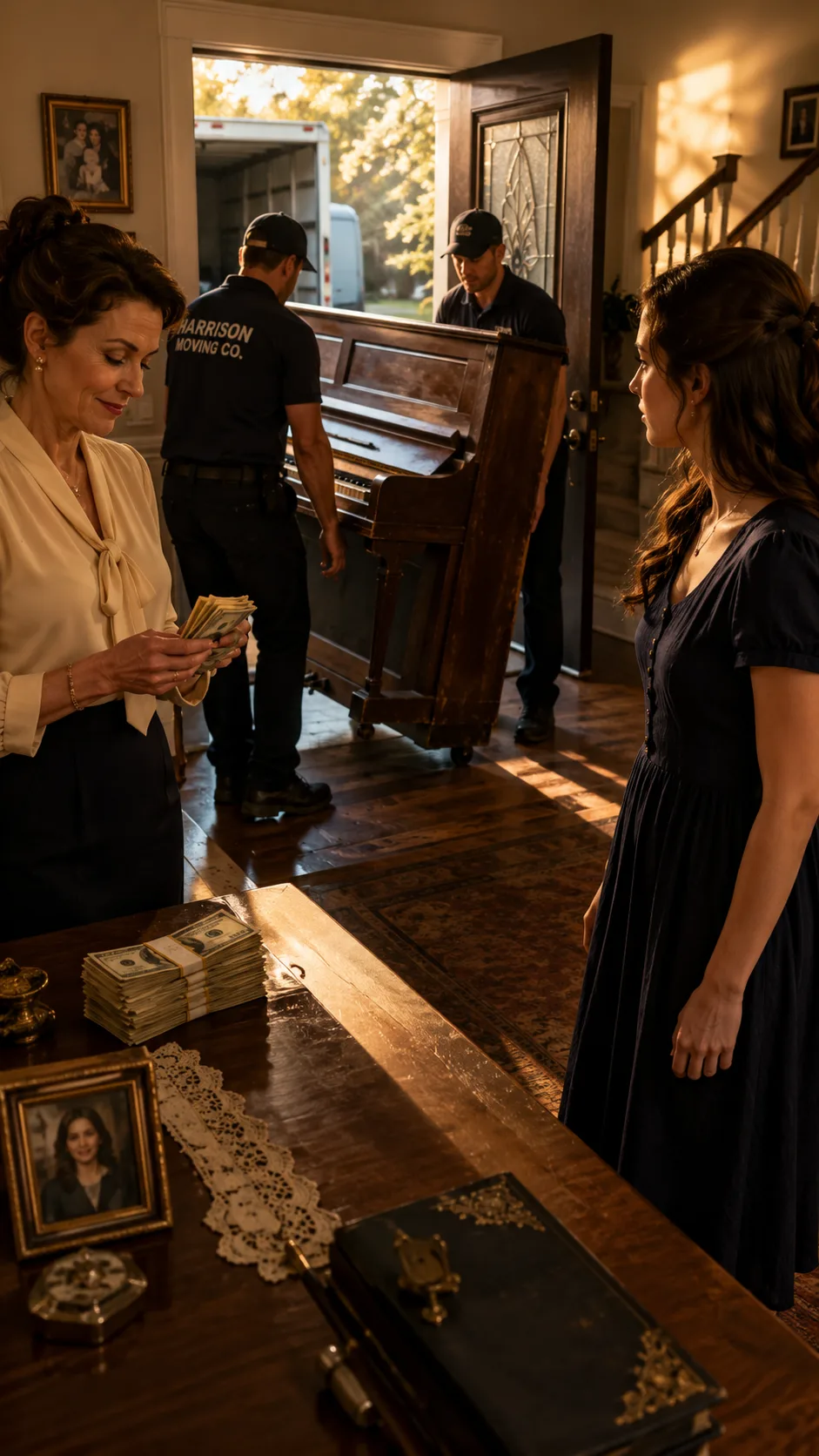
The movers came Friday at four-twenty.
Not Saturday morning. Not after breakfast. Not after one more chance to speak to my father.
Friday.
The front door stood open, letting in warm afternoon light and the smell of cut grass. A white moving truck waited in the driveway. Denise had dressed like she was hosting an appointment at a private bank: cream silk blouse, dark slacks, gold chain, lipstick the color of expensive berries.
She was counting cash on the entry table when I came down the stairs.
A stack of bills lay beside a black leather checkbook. The party florist’s invoice sat underneath it.
The piano bench had been pulled away from the piano and set crooked on the rug.
Two movers wrapped straps around the body.
The buyer stood near the door.
He wore a brown wool coat despite the warmth, and his silver hair was combed neatly back. His hands hung at his sides, but his fingers moved once when he saw the piano. Like they remembered a song.
Denise saw me and smiled without showing teeth.
“Clara. There you are.”
I looked at the buyer.
“Mr. Whitaker?”
His eyes came to mine.
“Yes.”
Denise’s smile slipped for half a second. “You know each other?”
“No,” I said.
Mr. Whitaker looked from me to the piano.
“Are you Daniel’s daughter?”
The room changed shape around that question.
One mover straightened.
Denise placed one palm over the cash.
“How do you know my husband?” she asked.
Mr. Whitaker did not answer her right away. He looked at me again, and something old crossed his face.
“I knew him before this house had shutters.”
Denise gave a brittle little laugh. “That must have been a long time ago.”
“It was.”
She picked up the cash and tapped the bills into a neat stack. “Well, he is resting. We won’t disturb him.”
“I would like to see him.”
“He is not receiving visitors.”
Mr. Whitaker’s gaze moved toward the hallway.
Denise stepped into his line of sight.
The movers waited.
One had his hand on the piano’s side. The other shifted his weight and glanced toward the truck.
I walked to the piano bench.
Denise’s eyes followed me.
“Clara,” she said, “do not make this ugly.”
That sentence again.
Always before she did something ugly herself.
I placed one hand on the piano’s side. The wood was warm where the sun had touched it.
Mr. Whitaker noticed my hand.
His eyes dropped to the front panel.
The hidden latch was almost invisible unless you knew where to look. My mother had shown it to me when I was six. She had pressed it with her thumb, opened the small inner panel above the knee board, and told me some things were not hidden to keep people out. Some things were hidden so they would survive.
“Move it carefully,” Denise told the movers.
The first mover tilted the piano away from the wall.
The old wood gave a low groan.
I stepped forward.
“Don’t touch that panel.”
Denise turned.
“What did you say?”
“Don’t touch that panel.”
The mover froze, one hand still gripping the strap.
Denise let out a small breath through her nose. “It’s sold. Take it out.”
The movers lifted.
Mr. Whitaker raised one hand.
“Stop moving it.”
No one spoke.
The command did not come loud. It came with the weight of someone used to being obeyed for reasons people did not always understand.
The movers stopped with the piano halfway between the living room and the open front door.
Denise stared at him.
“Excuse me?”
Mr. Whitaker stepped toward the piano. “Open the panel.”
Denise laughed once. “There is no panel.”
“There is.”
I looked at him.
He knew.
The word moved through my body without sound.
He knew.
Denise stepped closer. “Mr. Whitaker, with respect, you purchased a used piano. Not a family investigation.”
He did not look at her.
“Open it,” he said.
I reached for the latch.
Denise caught my arm.
This time the mover saw.
So did Mr. Whitaker.
His face went still.
“Let her go,” he said.
Denise released me like my skin had burned her.
I pressed the latch.
The small inner wooden panel opened with a soft click.
Dust rose from the seam and turned gold in the light.
Inside, the walnut was darker, protected from years of air and hands. At first I saw only wood grain. Then Mr. Whitaker leaned in, and his fingers stopped just above the inner wall.
There was a carving.
Not deep.
Not decorative.
A name.
Elena.
My mother’s name.
Below it, a date.
June 14, 1998.
Below that, three words scratched so lightly I had to bend closer to read them.
Keep the promise.
The room narrowed to those words.
Denise’s cash hand lowered an inch.
“That means nothing,” she said.
Mr. Whitaker touched the carved name with the tip of one finger.
“It means everything.”
His voice had changed.
Not broken. Not soft.
Stripped down.
He turned toward the piano bench. It sat crooked on the rug, the lid closed. He moved to it with care, as if sudden movement might scare something away.
Denise stepped in front of him.
“No,” she said.
Mr. Whitaker looked at her.
The movers looked at her too.
I noticed then that Brielle stood on the stairs, one hand on the railing, phone hanging forgotten at her side.
Denise saw all of us seeing her.
She straightened.
“This is ridiculous,” she said. “There is nothing in that bench.”
Mr. Whitaker held out his hand.
“Then let me open it.”
Denise did not move.
I did.
I walked around her and lifted the bench lid.
The inside looked empty at first. Just old felt lining, faded at the corners, one torn strip near the hinge.
Mr. Whitaker reached in and pressed against the left wall.
A hidden compartment slid loose.
Denise made a sound so small most people would have missed it.
I did not.
Mr. Whitaker pulled out a folded paper sealed flat with age.
The paper was cream, the edges browned. It had been folded twice. The outer side bore my father’s handwriting.
For Clara, when the piano leaves this house.
My name sat there in blue ink.
Not Clara Elizabeth.
Not the legal neatness of a document.
Just Clara.
The way my father wrote it on lunch bags when I was small.
Mr. Whitaker held the paper out to me, but his own fingers did not let go.
“May I?” he asked.
I nodded once.
He unfolded it.
The first page was a letter.
He read silently at first. His eyes moved down the page, stopped, went back up, then stopped again.
Denise stepped toward him.
“That is private.”
Mr. Whitaker turned the letter away from her.
“No,” he said. “It was hidden from her.”
That was the first time Denise looked at me instead of through me.
My father appeared in the hallway behind Brielle.
He had one hand on the wall and one on the banister. His gray cardigan hung open. His face looked pale under the warm light.
“What is happening?” he asked.
Nobody moved toward him.
For once, Denise did not get there first.
Mr. Whitaker looked at my father.
“Daniel.”
My father’s eyes fixed on him.
For a few seconds, age fell off both of them in uneven pieces.
“Elias,” my father said.
The name came out rough.
Mr. Whitaker lifted the letter.
“You left it where she said you would.”
My father closed his eyes.
Denise turned on him. “Daniel, what is he talking about?”
My father opened his eyes and looked at the piano.
Then at me.
Not at Denise.
“At your mother’s request,” he said.
His voice had little strength, but every word found the room. “If the piano ever left the house, Clara was to get the letter.”
Denise’s mouth tightened. “You never told me that.”
“No.”
“Why not?”
My father looked at the cash in her hand.
The answer sat between them.
Mr. Whitaker unfolded the second page.
“This is not just a letter,” he said.
He turned it so I could see.
It was a notarized document.
Old, but clear.
My mother had purchased the piano before she married my father. The receipt was attached. The maintenance records were attached. A handwritten addendum bore my mother’s signature and my father’s beneath it.
The piano was to remain in the family home for Clara until she reached adulthood.
If the piano was ever sold, transferred, or removed without Clara’s consent, all proceeds and contents connected to the instrument were to be delivered to Clara.
But there was more.
A line near the bottom made Mr. Whitaker pause.
He looked at my father.
My father gave a small nod.
Mr. Whitaker read aloud.
“Elias Whitaker holds the companion envelope until the condition is met.”
Denise’s eyes cut to him.
“What companion envelope?”
Mr. Whitaker reached inside his coat.
This time Denise moved fast.
She reached for the letter in his hand.
The first mover stepped forward and blocked her without touching her.
A plain movement.
One body between her and the paper.
The room saw it.
Denise stopped.
Mr. Whitaker pulled a second envelope from inside his coat. It was cream-colored, thick, sealed with a strip of old tape. My mother’s handwriting crossed the front.
To my daughter, if someone tries to take the music.
My fingers closed around nothing.
Mr. Whitaker placed both papers on the piano lid.
The cash sat on the entry table now, abandoned.
Denise looked from the envelope to my father, then to me.
“This is absurd,” she said. “A sentimental note does not change ownership.”
Mr. Whitaker opened the envelope.
Inside was a bank document, a letter from an attorney, and a small black-and-white photograph.
The photograph showed my mother sitting at the piano, young and laughing, with me as a baby on her lap. My father stood behind us, one hand on the piano. Mr. Whitaker stood beside him, holding a toolbox.
On the back, my mother had written: The day we finished paying for Clara’s piano.
Clara’s piano.
Not Elena’s.
Not Daniel’s.
Not the house’s.
Mine.
The words did not need volume.
They sat on the piano lid and changed the room.
Mr. Whitaker set the bank document beside the photograph.
“Your mother paid me to restore this piano after the fire at my shop,” he said. “She refused a discount. Said one day I might need to keep a promise for her.”
His hand rested beside the envelope.
“She saved my business that year.”
My father leaned against the wall.
“She knew I was weak where peace was concerned,” he said.
Denise turned toward him. “Daniel.”
He did not look at her.
“She knew I might stay quiet to keep the house calm.”
The second mover lowered his strap completely.
The piano settled back onto the rug with a wooden thud.
Brielle came down two steps, then stopped.
Mr. Whitaker looked at Denise.
“You sold something that was never yours.”
Denise’s lips parted.
No sound came out.
Then she tried again.
“That’s not—”
The rest failed.
Her hand still held one bill, folded between two fingers. She seemed to notice it at the same time everyone else did. She placed it on the entry table, but it missed the stack and slid to the floor.
No one picked it up.
My father took one slow step toward me.
“I should have told you sooner,” he said.
I looked at the envelope.
Then at the piano.
Then at him.
There were too many years standing in that room. Too many closed doors. Too many times I had swallowed words because he looked tired, because Denise looked ready, because peace had always been treated like something I owed.
I picked up the photograph.
My mother’s smile was turned toward me in the picture. Baby me had one fist pressed against the cracked ivory key.
The same key.
I set the photograph back down and closed the piano panel.
The click sounded final.
“Cancel the sale,” I said.
Denise looked at me as if she had never heard my voice at its full size.
Mr. Whitaker turned to the movers. “You heard her.”
The first mover nodded.
“Yes, ma’am.”
Ma’am.
Not kid.
Not sweetheart.
Not poor thing.
Ma’am.
The word did something Denise could not undo.
The movers removed the straps. One carried them out to the truck. The other rolled the piano bench back into place with careful hands.
Brielle came the rest of the way down the stairs.
Her phone stayed at her side.
“Mom,” she said.
Denise did not answer.
My father lowered himself into the armchair near the hall. His breathing sounded uneven. Mr. Whitaker crossed to him, not quickly, not dramatically. He placed one hand on the back of the chair and stood beside him like an old beam returning to a house.
Denise gathered the cash.
Her hands were neat again, but too fast.
“I will refund him,” she said.
Mr. Whitaker glanced at the bills.
“No need.”
She froze.
“I paid to find the piano,” he said. “I found it.”
Denise stared at him.
“That money was for the sale.”
“It was for my mistake.”
“What mistake?”
He looked at me.
“For staying away too long.”
Nobody spoke after that.
Outside, the truck engine started, then shut off. A bird hit the porch railing and flew away. Somewhere in the kitchen, the refrigerator clicked on with its dull little hum.
I put the envelope under my arm and touched the cracked key.
It gave the same crooked note.
My father closed his eyes.
Denise left the room first.
She did not storm. That would have given her too much shape. She walked into the dining room, placed the cash inside her handbag, then removed it again when she saw Mr. Whitaker watching from the hall.
She set it on the sideboard.
All of it.
Brielle stood beside the stairs, arms folded around herself. The party samples were still spread over the dining table. Blush napkins. Gold ribbons. A seating chart with names written in Denise’s careful script.
At the top, in the place meant for family, my name was missing.
I had seen it earlier and said nothing.
Brielle saw me looking.
She crossed into the dining room, picked up a pen, and wrote Clara at the top table.
Denise watched from the doorway.
Brielle capped the pen.
No one applauded.
No one thanked anyone.
That was better.
The florist called an hour later. Denise let it ring until it stopped.
That night, Mr. Whitaker stayed for dinner.
It was not planned. Nothing about the table looked ready for company. There were only four clean plates because the dishwasher had been run half-empty that morning. Brielle burned the rolls. My father ate very little. Denise did not sit down until everyone else had already served themselves.
Mr. Whitaker told me how my mother found him after his workshop fire. How she had brought him soup in a blue pot. How she had hired him to restore a piano that did not need much restoring, then insisted on paying twice what he asked.
“She said people accept help better when they think they earned it,” he said.
My father looked down at his plate.
“She was right about most things.”
Denise’s fork touched the rim of her plate once.
Sharp.
Nobody reacted.
After dinner, Mr. Whitaker handed me a small brass key.
“This opens the lower compartment,” he said. “Your mother asked me to keep the spare.”
I took it.
The key was warm from his palm.
Upstairs, I sat on the floor beside my bed and read my mother’s letter.
She had written it before the diagnosis became a word spoken in rooms with closed doors. The sentences were steady. Practical, even. She wrote about the piano’s tuning schedule. She wrote about the cracked key and how I should never replace it unless it stopped sounding altogether. She wrote that my father loved me, but he feared conflict more than loss.
That line stopped me for a long time.
Then I kept reading.
She wrote that love without courage could still leave bruises no one could see.
She wrote that the piano was mine not because wood and strings mattered more than people, but because memory needed a place to sit.
At the end, she wrote one sentence by itself.
When someone tries to sell what kept you alive, make them name the price out loud.
I folded the letter along its old lines.
The next morning, the party tent went up in the yard.
Denise tried to continue as if Friday had not happened. She gave instructions to the caterers. She corrected the angle of the welcome sign. She asked Brielle to steam the table runners.
But the house no longer moved around her.
The front room had changed.
The piano sat uncovered by the west window. I had polished the lid before breakfast. Not perfectly. One streak remained near the corner where the cloth had been too dry. I left it there.
Guests arrived at two.
By three, everyone knew something had happened.
They always do.
They noticed Denise was not speaking to me. They noticed Mr. Whitaker standing beside my father like family. They noticed the piano had not been moved out for the gift display. They noticed the gift display had been moved to a folding table near the back wall.
Brielle wore a pale gold dress and looked beautiful in the way she had practiced, but she kept glancing toward the front room.
At four, after cake, someone asked if anyone played.
It was one of Denise’s friends, a woman with pearl earrings and a voice that carried.
“What a gorgeous old piano,” she said. “Does it work?”
Denise’s hand tightened around her glass.
I stood before I could plan it.
The room parted with small movements. A chair shifted. Someone lowered a fork. Brielle looked at me once, then looked away, but not unkindly.
I sat at the piano bench.
The wood creaked under me.
My hands hovered above the keys.
For seven years, I had touched the piano only to dust it.
I pressed the cracked key first.
The note came out imperfect and clear.
Then I played the only piece my mother had taught me all the way through. Not well. Not cleanly. My left hand stumbled in the middle. My right hand missed one note and found the next.
Nobody spoke.
When I finished, my father had one hand over his mouth.
Mr. Whitaker stood behind him, eyes lowered.
Denise stared at the floor near the entry table, the place where one bill had fallen the day before.
Brielle was the first to clap.
One clap.
Then another.
Then the room followed.
I did not look at Denise.
Two weeks later, I moved the piano.
Not out of the family.
Out of that house.
Mr. Whitaker arranged the movers himself. Different men this time. They wore plain shirts and carried the piano with the kind of care people show when they have been told the story and understand enough not to ask for more.
My father signed the transfer papers at the kitchen table. His hand shook. The signature was uneven, but it was his.
Denise stood in the hallway and watched.
She did not object.
There had been conversations after the party. Quiet ones. Legal ones. Mr. Whitaker had known an attorney who still had copies of the old documents. The cash from the attempted sale went into an account in my name. Denise called it excessive. My father called it late.
Brielle moved out again at the end of the month.
Before she left, she brought me a small box.
Inside was my mother’s silver hairbrush.
“I found it in Mom’s closet,” she said.
I looked at the brush, then at her.
“She said it was hers now,” Brielle said. “It wasn’t.”
She stood in my doorway with no makeup, hair pulled back, looking tired and younger than her twenty-two years.
I took the box.
“Thank you.”
She nodded.
That was all.
Some apologies arrive without the word.
My father stayed in the house with Denise for another year. Their marriage did not end in one dramatic scene. It thinned. Room by room. Word by word. Denise stopped hosting large parties. My father hired a nurse who spoke to him directly and did not ask Denise for permission to open windows.
Mr. Whitaker visited every Thursday.
Sometimes he brought soup.
Sometimes he brought tools and fixed things that had been loose for years.
The piano came with me to a small apartment above a bookstore on Maple Street. It took four men and one removed door to get it inside. The landlord complained until Mr. Whitaker handed him a repair receipt for the stair rail and offered to reinforce it himself.
The piano sat against the brick wall near the window.
Every afternoon, sunlight crossed the walnut again.
I kept my mother’s letter in the lower compartment with the brass key on a ribbon. The photograph stayed on top in a simple wooden frame. In it, baby me pressed one fist against the cracked key while my mother laughed and my father stood behind us, still young enough to believe silence was harmless.
On the first morning after the move, I made coffee too strong and burned one slice of toast.
Then I sat at the piano.
I pressed the cracked key.
The note sounded exactly the same.
Not perfect.
Mine.
Chapter complete
You have reached the end of this chapter.
Continue reading
A few more worlds to get lost in after this chapter.