while speaking. People trusted her because she looked like the kind of woman who packed lunches and remembered birthdays.
But inside our house, she measured love like a competition.
Her daughter, Madison, was one year younger than me. We were not enemies at first. In the beginning, I tried to help her with homework, offered to drive her places, even shared my old sweaters when she said she liked them.
But Rachel hated comparison, and comparison followed us everywhere.
If I got an A, Madison had “an unfairly hard teacher.”
If I won a scholarship, Madison was “too creative for standardized boxes.”
If I worked late, I was “performing poverty.”
If I got praised, Rachel’s eyes went straight to Madison, checking for damage.
By senior year of college, Madison had dropped two majors, failed several classes, and moved back home after losing her campus housing. I never judged her for that. College breaks people in different ways.
But Rachel judged me for surviving it.
Graduation morning arrived with golden sunlight spilling over Westbridge University’s stone buildings. I stood in my cap and gown outside the auditorium, looking at the crowd of families taking photos under oak trees.
My best friend Ava adjusted the gold honor cord around my neck.
“Valedictorian,” she said, grinning. “Say it again.”
“No.”
“Say it.”
“Ava.”
“Say it like you didn’t almost pass out when they told you.”
I laughed, but my stomach was a knot.
Across the lawn, my father walked toward me holding a bouquet of white roses. Rachel followed beside him in a fitted cream dress, sunglasses covering her eyes. Madison trailed behind them, scrolling on her phone.
Dad looked older than he had four years ago. Softer. More tired. When he saw me, his face folded with pride.
“My girl,” he whispered, pulling me into his arms. “Your mother would have been so proud.”
For one second, the world stopped hurting.
Then Rachel stepped forward.
“Look at you,” she said. “All grown up.”
“Thank you for coming,” I said.
“Oh, of course.” Her smile tightened. “Family shows up.”
Madison gave me a quick hug without looking directly at me.
“Congrats,” she muttered.
“Thanks, Maddie.”
Rachel’s hand landed on Madison’s shoulder.
“Your sister has always enjoyed the spotlight,” she said lightly. “Today is certainly her day.”
Dad chuckled awkwardly, like he wanted to smooth the air with sound.
I looked at him.
He looked away.
Inside the auditorium, everything blurred into music, speeches, applause, and flashes of camera light. When the dean called my name and announced me as valedictorian, the applause rose so loudly my knees nearly gave out.
I walked across the stage and shook hands with the president of the university. The diploma cover felt unreal in my hands. So light, after being so heavy for so long.
I found my father in the crowd.
He was standing. Clapping. Crying.
Rachel was clapping too.
But her face was still.
That night, Dad hosted a graduation dinner at the Oak Room, a private restaurant with chandeliers, white tablecloths, and framed family photos he had brought from home. He wanted everything perfect. A slideshow played on a large screen near the small stage: pictures of me as a child, pictures of my mother holding me, pictures from school events, birthdays, and college move-in day.
I had not expected the photo of my mother.
When it appeared, my throat closed.
She was laughing in the picture, her dark hair blowing across her face, one arm around my shoulders. I was twelve, missing a front tooth, holding a science fair ribbon.
Dad squeezed my hand under the table.
Rachel saw it.
Her wineglass paused halfway to her mouth.
The room was filled with relatives, neighbors, two of my professors, and several of Dad’s friends. People kept approaching me, saying things that made me blush.
“You earned this.”
“Your mother would be bursting with pride.”
“You’re going to change the world, Olivia.”
Each compliment landed softly on me and sharply on Rachel.
I watched her smile harder every time.
Then Madison spilled her drink.
It wasn’t dramatic. Just a glass tipping over near her plate. But when people turned, her face went red.
Rachel snapped her napkin down.
“It’s fine,” she said too quickly. “Everyone stop staring.”
No one had been staring.
But Madison pushed back from the table and disappeared toward the restroom.
Rachel’s eyes followed her, then came back to me.
Something in her face changed.
The smile vanished.
And for the first time that night, I felt afraid.
PART 2 — THE VIDEO ON THE SCREEN
After dessert, my father stood and tapped a spoon against his glass.
“Everyone,” he said, voice thick with emotion. “I just want to say a few words.”
The room quieted.
He stepped onto the small stage beside the slideshow screen. His hands shook slightly around the microphone.
“I’m not good at speeches,” he began, and people laughed gently. “But tonight deserves one. Olivia, when your mother passed, I worried I wouldn’t be enough for you. I worried I wouldn’t know how to raise a daughter through all the pain that came after.”
My chest tightened.
Dad looked at me.
“But somehow, you raised yourself into someone extraordinary.”
For a moment, I couldn’t breathe.
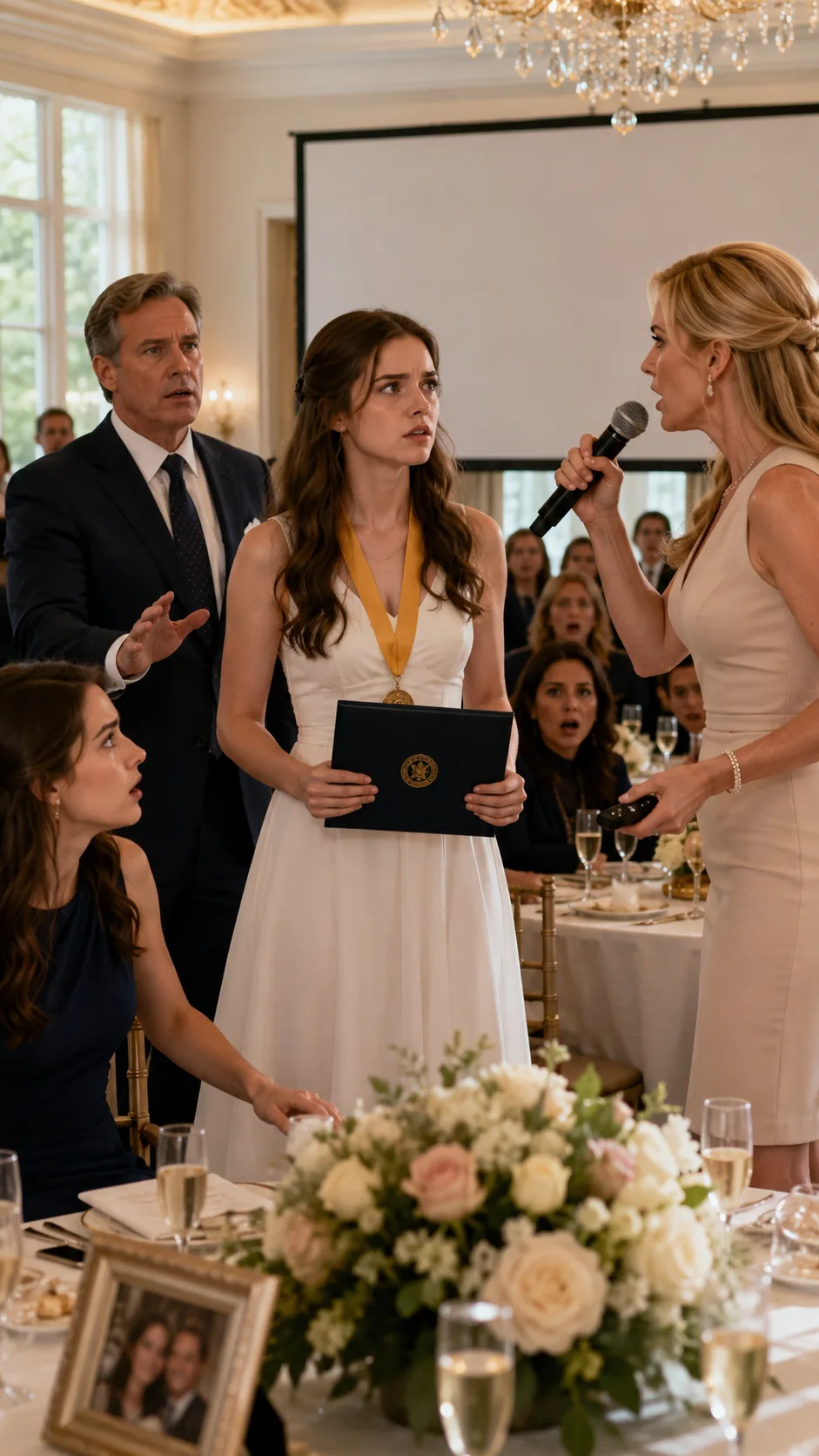
Then Rachel stood.
Not slowly. Not politely.
She rose like she had been waiting for a cue.
“Daniel,” she said, smiling at the guests, “before we turn Olivia into a saint, maybe we should show everyone the whole story.”
The room shifted.
Dad frowned. “Rachel, what are you doing?”
She walked toward the stage, heels clicking against the floor.
“Just adding honesty,” she said.
A cold wave moved through me.
Rachel took the microphone from my father’s hand before he could stop her. Then she picked up a small remote from the podium.
“I put together something special,” she announced. “A reminder that people are not always what they pretend to be.”
“Rachel,” Dad said, his voice sharper now. “Don’t.”
She pressed the button.
The screen went black.
Then a video appeared.
At first, I didn’t recognize it.
The camera was shaky. The lighting was dim. A kitchen cabinet filled the background. Then a girl stepped into frame.
Me.
Seventeen years old.
Hair tangled. Face swollen. Wearing my mother’s old sweatshirt.
My stomach dropped through the floor.
In the video, I was crying so hard I could barely stand. A shattered glass lay near my feet. My hands covered my face, and my voice came through the speakers broken and raw.
“I can’t do this without her. I can’t. I don’t want to wake up and remember she’s gone.”
The room went silent.
Not quiet.
Silent.
The kind of silence that makes every breath sound like an accusation.
I remembered that day.
It was two weeks after Mom’s funeral. Dad had gone back to work because bills didn’t pause for grief. Rachel had been living with us then, not yet married to him, but already arranging herself into our home. I had dropped a glass while trying to make tea, and the sound broke something inside me.
I thought I had been alone.
I hadn’t been.
Rachel had filmed me.
The video kept playing.
Seventeen-year-old me slid down the cabinet to the floor, sobbing into my knees.
People looked away. My aunt covered her mouth. One professor lowered his eyes. Madison stood frozen near the hallway, one hand still on the restroom door.
Rachel turned to the room with a soft, poisonous voice.
“Olivia has always been very good at performing strength,” she said. “But I think it’s only fair everyone knows the girl behind the perfect grades.”
My chair scraped back.
“Turn it off,” I whispered.
Rachel looked at me. “What was that?”
I stood, my legs shaking. “Turn it off.”
Instead, she raised the volume.
My own crying filled the restaurant.
Dad moved toward the podium. “Rachel, enough.”
She stepped away from him, still holding the remote.
“No, Daniel. Everyone praises her like she climbed a mountain alone. But she had this family, this house, this name. And still, she acts like some tragic little hero.”
The words hit harder because they were familiar.
They were every dinner comment, every fake compliment, every caption, every whisper dressed up as truth.
Ava stood behind me. “Olivia, we can leave.”
But I couldn’t move.
My eyes went to my father.
He was pale. Humiliated. Angry, maybe.
But silent.
Again.
Rachel saw me looking at him and smiled.
That smile told me she knew exactly where the deepest wound was.
“You want to know the truth?” she said into the microphone. “The truth is, Olivia built her whole identity on being pitied. The dead mother. The scholarship girl. The hardworking daughter. It’s exhausting.”
Someone gasped.
Madison whispered, “Mom…”
Rachel ignored her.
“Don’t perform the perfect daughter tonight, Olivia. Not when some of us know exactly how fragile you really are.”
My hands curled into fists.
For years, I had dreamed of proving Rachel wrong. I thought success would silence her. I thought a diploma, honors, applause, all of it would finally make her stop.
But standing there under the chandelier, with my grief projected behind me like entertainment, I understood something.
Rachel didn’t hate my weakness.
She hated that I survived it.
Before I could speak, a chair pushed back from the far end of the room.
Professor Thomas Whitaker stood slowly.
He was a tall man in his early sixties with silver hair, square glasses, and the calm presence of someone who had seen too many students almost break and still keep going. He had been my research advisor for two years.
“Mrs. Bennett,” he said, voice steady, “you should turn that video off.”
Rachel laughed once. “And who exactly are you to tell me what to do at my family dinner?”
“I’m the professor who read every page Olivia wrote when she was working twenty hours a week and sleeping four hours a night.”
The room turned toward him.
Rachel’s smile flickered.
Professor Whitaker stepped closer to the stage.
“I’m also the faculty advisor for the Hamilton Fellowship selection committee.”
My heart stopped.
The Hamilton Fellowship.
I had applied months earlier and heard nothing back. It was one of the most prestigious research programs in the country. Full funding. Housing. A paid position. A pathway to graduate study.
Rachel’s fingers tightened around the remote.
Professor Whitaker looked at me, and his face softened.
“Olivia, I had planned to tell you privately tomorrow. But I believe the room should hear this now.”
I couldn’t speak.
“You were selected,” he said. “Unanimously.”
A sound moved through the room. Surprise. Applause. Relief.
Ava grabbed my arm.
Dad’s mouth opened.
Rachel went still.
Professor Whitaker continued, louder now. “Her application was reviewed without family names, without financial background, and without personal influence. Olivia earned her place through research, academic excellence, and character.”
Rachel lifted her chin.
“Well,” she said tightly, “that is wonderful news. No one is denying she works hard.”
“You did more than deny it,” he said.
The room froze again.
Rachel blinked. “Excuse me?”
Professor Whitaker reached into his jacket pocket and removed his phone.
“Three months ago, the fellowship office received a series of anonymous emails accusing Olivia of dishonesty, favoritism, and using family money to secure academic awards.”
My skin went cold.
I heard Ava whisper, “What?”
Professor Whitaker did not look away from Rachel.
“The messages were dismissed because there was no evidence. But they were reviewed, especially after similar claims were sent to two department chairs.”
Dad turned slowly toward Rachel.
“Rachel?”
She gave a breathless laugh.
“This is absurd.”
Professor Whitaker tapped his phone.
“The sender made one mistake. One attached image contained device information. The original user profile was registered under the name Rachel Bennett.”
For a second, no one moved.
Then Madison stepped back like the floor had shifted beneath her.
Dad stared at his wife as if seeing a stranger wearing her face.
“Tell me that isn’t true,” he said.
Rachel looked at him, then at the guests, then at me.
Her expression cracked.
“I was protecting Madison,” she said.
The words were quiet, but they carried everywhere.
Madison’s face crumpled. “Protecting me from what?”
Rachel snapped toward her. “From being crushed under Olivia’s shadow!”
I flinched.
Madison whispered, “I never asked you to do that.”
Rachel’s eyes filled, but not with regret. With rage.
“Every room we enter, it’s Olivia this, Olivia that. Her grades. Her awards. Her poor dead mother. Do you know what that does to my daughter?”
I stepped forward.
My voice came out low.
“No, Rachel. Do you know what you did to yours?”
The room seemed to lean in.
Rachel looked confused for half a second.
I pointed toward Madison.
“You taught her that my success was an attack. You taught her that love is a scoreboard. You taught her that if she couldn’t win, someone else had to lose.”
Madison covered her mouth.
Rachel’s face twisted. “Don’t you dare talk to me about my child.”
“I’m not,” I said. “I’m talking to her.”
Madison looked at me then. Really looked.
For years, we had been placed on opposite sides of a war neither of us started.
Now, for the first time, I saw the tired girl behind her jealousy.
And she saw me too.
PART 3 — THE TRUTH MY FATHER COULDN’T HIDE FROM
The video was still paused behind us.
Seventeen-year-old me sat frozen on the screen, face buried in my hands, caught forever in the worst moment of my life.
Rachel had meant it to shrink me.
But now everyone was looking at the woman who had pressed record.
Dad walked to the podium and took the remote from Rachel’s hand.
She resisted for a moment.
Then he pulled it free.
The screen went black.
That small darkness felt like a door closing.
“Daniel,” Rachel said quickly, “you don’t understand what this has been like.”
Dad stared at her. “You filmed my daughter grieving.”
Rachel’s lips parted.
“You sent emails to her school,” he continued, voice breaking. “You tried to damage everything she worked for.”
“I was scared for Madison.”
“You were jealous of a child.”
Rachel recoiled as if he had slapped the air between them.
The room went painfully quiet.
For most of my life, I had wanted Dad to say something like that. I had imagined it in a hundred ways. At the dinner table. In the car. At home after Rachel made one of her little comments and walked away smiling.
But hearing it now did not heal me instantly.
It almost hurt more.
Because it proved he had always known what the truth looked like.
He had simply waited too long to name it.
Rachel turned to the guests, desperate now.
“You’re all acting like I’m some monster. I cooked for her. I drove her places. I welcomed her into my life.”
Ava muttered, “You recorded her crying.”
Rachel ignored her.
Madison stepped forward, her eyes wet.
“Mom, stop.”
Rachel’s face changed. “Madison, honey—”
“No,” Madison said, shaking her head. “You said you were protecting me. But you made me hate someone who never did anything to me.”
Rachel’s confidence shattered a little more.
“I did everything for you.”
“You did it because you couldn’t stand not being the mother of the impressive daughter.”
That sentence landed like glass hitting marble.
Rachel’s mouth opened, but nothing came out.
I looked at Madison, stunned.
She wiped her cheek quickly, embarrassed by her own tears.
“I’m sorry,” she said to me. “I believed her because it was easier than admitting I was lost.”
My throat tightened.
I had waited years for Rachel to apologize.
I never expected Madison to do it first.
Professor Whitaker stepped beside me and handed me a cream-colored envelope.
“The official fellowship packet,” he said gently. “You should have this tonight.”
I took it with both hands.
The paper felt heavier than my diploma.
Dad turned toward me.
“Olivia,” he said.
I knew that voice. It was the voice he used when he wanted forgiveness before earning it.
I stepped onto the small stage and took the microphone.
My hands were shaking, but this time I didn’t hide them.
“I want everyone to know something,” I said.
My voice echoed through the room.
“That video Rachel showed you is real. I was seventeen. My mother had just died. I was broken in a way I didn’t know people could be broken.”
I looked at the dark screen behind me.
“I’m not ashamed of that girl.”
Rachel lowered her eyes.
“She cried on the kitchen floor and still got up. She went to class with swollen eyes. She worked after school. She filled out forms alone because she didn’t want to owe anyone her future.”
My voice trembled, but I kept going.
“She became me.”
No one spoke.
I turned toward Rachel.
“You wanted that video to prove I was weak. But all it proves is that you watched a grieving child collapse and decided to save the footage for later.”
Rachel’s face crumpled, but I didn’t stop.
Then I looked at my father.
This was the part I feared most.
“Dad, I love you,” I said. “But I needed you.”
His eyes filled instantly.
“I needed you when Rachel called my scholarships luck. I needed you when she told people your money built my life. I needed you when she made me feel like my mother’s memory was a burden at your new table.”
He covered his mouth.
“And tonight, when she played that video, I looked at you first.”
A tear slipped down his cheek.
“You didn’t move.”
He whispered, “I’m sorry.”
“I know,” I said, and my voice cracked. “But sorry can’t be where this ends.”
The room blurred through my tears.
I lifted my diploma in one hand and the fellowship packet in the other.
“I don’t need my stepmother to be proud of me. I don’t need her permission to know what I earned.”
Then I looked straight at my father.
“I just needed my father not to stay silent while someone tried to destroy me.”
Daniel bent forward like the words had gone through him.
Rachel began crying quietly, but for once, the room did not move to comfort her.
Madison walked to my side.
Not dramatically. Not like a perfect ending.
Just one step. Then another.
She stood beside me and faced her mother.
“I’m going back to school,” she said.
Rachel looked up. “Madison—”
“And I’m doing it without using Olivia as my excuse anymore.”
For the first time all night, I saw Rachel truly lose control. Not by screaming. Not by making a scene. But by realizing the story she had built was collapsing without anyone touching it.
Dad removed his wedding ring slowly and placed it in his pocket. He didn’t announce anything. He didn’t need to. His face said enough.
The guests began to leave quietly after that. Some hugged me. Some apologized for witnessing something so private. Professor Whitaker told me he was proud, and Ava cried harder than I did.
Rachel stood alone near the stage, the microphone at her feet, the dark screen behind her.
The image she had tried to create was gone.
Only the truth remained.
Outside the restaurant, the night air was cool against my face. I stood under the awning with my diploma pressed to my chest, listening to the muffled sounds of chairs being moved inside.
Dad came out a few minutes later.
He looked smaller somehow.
“Olivia,” he said, “I don’t expect you to forgive me tonight.”
I nodded.
“I don’t.”
He accepted that with a painful breath.
“But I want to learn how to stand up,” he said. “Even if I’m late.”
I looked at him for a long moment.
Part of me wanted to run into his arms. Another part wanted to walk away and make him feel the silence I had lived with for years.
So I told him the truth.
“Then start with Madison,” I said. “She needs a parent too. Not a referee. Not someone hiding from conflict. A parent.”
He looked through the window at Madison, who was sitting alone at a table, wiping her eyes.
Dad nodded.
Then he turned back to me.
“And you?”
I smiled sadly.
“I’m leaving in August for the fellowship.”
His face tightened with pride and grief at the same time.
“That’s far.”
“It’s mine.”
He nodded again, tears returning.
“Yes,” he whispered. “It is.”
Madison came outside then, arms wrapped around herself.
She looked at me awkwardly.
“I don’t know how to fix us,” she said.
“Me neither.”
“Can we maybe start with coffee sometime?”
I studied her face. She looked younger than twenty-one in that moment. Not spoiled. Not cruel. Just tired of carrying someone else’s bitterness.
“Yeah,” I said. “Coffee is a start.”
Behind us, Rachel appeared in the doorway. Her makeup was streaked. Her perfect hair had loosened. She looked at the three of us standing together and seemed to understand she was no longer the center of the room.
For years, she had told everyone my success belonged to the Bennett family.
But that night, under the restaurant lights, with my diploma in one hand and my future in the other, I finally understood the truth.
My success had never belonged to them.
My grief had not ruined me.
My stepmother had not defined me.
My father’s silence had hurt me, but it would not hold me.
And the girl on that video — the one crying on the kitchen floor, convinced she could not survive losing her mother — had done more than survive.
She had walked across a stage.
She had faced the woman who tried to bury her.
She had spoken while the whole room listened.
And when the night ended, I did not leave as the perfect daughter Rachel tried to expose.
I left as the woman she failed to break.
THE END.




