The last thing my father ever gave me was a rusty coffee can full of screws.
Chapter 1
The last thing my father ever gave me was a rusty coffee can full of screws.
Not money.
Not advice.
Not some heartfelt goodbye.
Just a dented blue can he handed me from a shelf in his garage while asking if I could finally fix the loose gate behind his house.
I remember standing there with grease on my hands while he pointed toward the backyard.
“It's getting worse.”
That was all he said.
No thank you.
No smile.
Nothing that sounded like affection.
Just another task.
I carried the coffee can outside and spent the afternoon replacing hinges while my stepbrother Ryan sat inside drinking iced tea and watching a football game with Dad.
The television was loud enough to hear from the yard.
Every few minutes I could hear them laughing.
That sound followed me most of my life.
Ryan laughing with Dad.
Ryan being included.
Ryan being seen.
Growing up in Oregon, everyone knew Ryan was the favorite.
He was two years younger
than me and the son my stepmother brought into the marriage.
From the outside, people probably assumed we were close.
We weren't.
Not enemies.
Not friends.
Just two boys living under the same roof while orbiting the same man for completely different reasons.
Ryan always got the easier version of Dad.
The version who attended games.
The version who gave driving lessons.
The version who bragged to neighbors.
I got the version who expected things.
Work.
Responsibility.
Silence.
When I was twelve, Dad made me spend an entire summer helping him rebuild a deck.
Ryan spent that same summer fishing with friends.
When I complained, Dad handed me another board.
When Ryan complained, Dad handed him twenty dollars.
Nobody said it out loud.
Nobody had to.
The hierarchy was obvious.
Even relatives joked about it.
At Thanksgiving dinners my aunt would laugh and say, “Ryan's the prince.”
Everyone laughed.
Including
Dad.
I learned early that there was no point arguing.
People believe what they can see.
And what they saw was Ryan sitting beside Dad every holiday while I drifted further toward the edges of photographs.
By the time I reached adulthood, I had stopped expecting anything different.
I moved to Portland.
Started my own construction business.
Got married.
Had a daughter.
Built a life that had nothing to do with proving myself to my father.
Or at least I told myself that.
The truth was uglier.
Every time my phone rang and his name appeared, part of me still hoped.
Maybe this would be the call.
Maybe this would be the conversation.
Maybe today he would finally act like I mattered.
The calls never came.
Only requests.
Could I fix a fence?
Could I replace a water heater?
Could I drive him somewhere?
Could I check the roof?
I
always said yes.
I hated that I always said yes.
But I did.
Because some part of me remained twelve years old.
Still carrying lumber.
Still waiting.
Then Dad got sick.
Everything changed.
At first it was small things.
Missed appointments.
Forgotten names.
Medication mistakes.
Eventually doctors found the cancer.
Advanced.
Aggressive.
The kind that makes entire rooms fall silent.
Ryan immediately became the public face of caregiving.
He drove Dad to appointments.
Posted updates online.
Answered relatives' questions.
People praised him constantly.
“Ryan is incredible.”
“Your father is lucky.”
“What would he do without Ryan?”
I heard those comments everywhere.
Church.
Family dinners.
Hospital waiting rooms.
Ryan accepted every compliment like it belonged to him.
Meanwhile I continued doing what I'd always done.
Quiet work.
The roof still leaked.
The furnace still needed repairs.
The lawn still needed mowing.
Someone had to keep the house running.
That someone was usually me.
Dad never thanked me.
Not once.
At least not directly.
Sometimes I'd arrive early and find tools already laid out where he knew I'd need them.
Sometimes there'd be coffee waiting.
Sometimes he'd leave garage lights on before I arrived.
Tiny things.
Easy to ignore.
So I ignored them.
Until I couldn't anymore.
One rainy afternoon, six months before he died, I discovered something strange.
Dad was asleep in his recliner.
I had come over to replace a broken kitchen faucet.
While searching for a wrench in the garage, I opened an old cabinet.
Inside sat dozens of folders.
Most contained boring paperwork.
Insurance.
Taxes.
Receipts.
Then I found a small envelope.
Yellow.
Worn.
My name was written on the front.
Just my first name.
Daniel.
I stared at it for several seconds.
Then footsteps sounded behind me.
I shoved it back.
Closed the cabinet.
Dad stood in the doorway.
He looked at the cabinet.
Then at me.
For a moment neither of us spoke.
Then he walked forward and quietly closed the cabinet door himself.
“Need anything from inside there?”
“No.”
He nodded.
That was it.
No explanation.
No conversation.
But the image stayed with me.
My name.
On that envelope.
Months passed.
His health worsened.
Then came the final weeks.
Machines.
Hospice nurses.
Visitors speaking softly in hallways.
Ryan rarely left the house.
Relatives admired his devotion.
One afternoon I arrived carrying groceries.
Dad sat alone on the back porch.
The sky was gray.
A cold wind rattled leaves across the deck.
He held a coffee mug in both hands.
The coffee had long gone cold.
I set the groceries down.
We sat together.
Five minutes.
Ten.
No conversation.
Just silence.
Then I stood.
Ready to leave.
His hand caught my wrist.
Lightly.
Weakly.
But intentionally.
I looked down.
Then back at him.
He opened his mouth.
Stopped.
Tried again.
Nothing came out.
Finally he squeezed my wrist once.
And let go.
I never understood what he wanted to say.
Three weeks later he died.
The funeral filled an entire church.
Rows of flowers.
Relatives everywhere.
Stories.
Memories.
Laughter mixed with grief.
Ryan stood near the front greeting guests.
People hugged him constantly.
“Your father loved you.”
“You were his rock.”
“He was proud of you.”
Each sentence landed like another nail in a coffin that already existed long before Dad died.
Nobody said those things to me.
By the second day I had become invisible again.
Familiar territory.
Then came the meeting at the bank.
Dad's attorney had already handled most estate matters.
The house.
The vehicles.
The investments.
Nothing surprising.
Everything divided exactly as expected.
Then the bank called.
Apparently an old account had surfaced during a records review.
An account nobody knew existed.
Opened decades earlier.
The bank requested a family meeting because documentation needed verification.
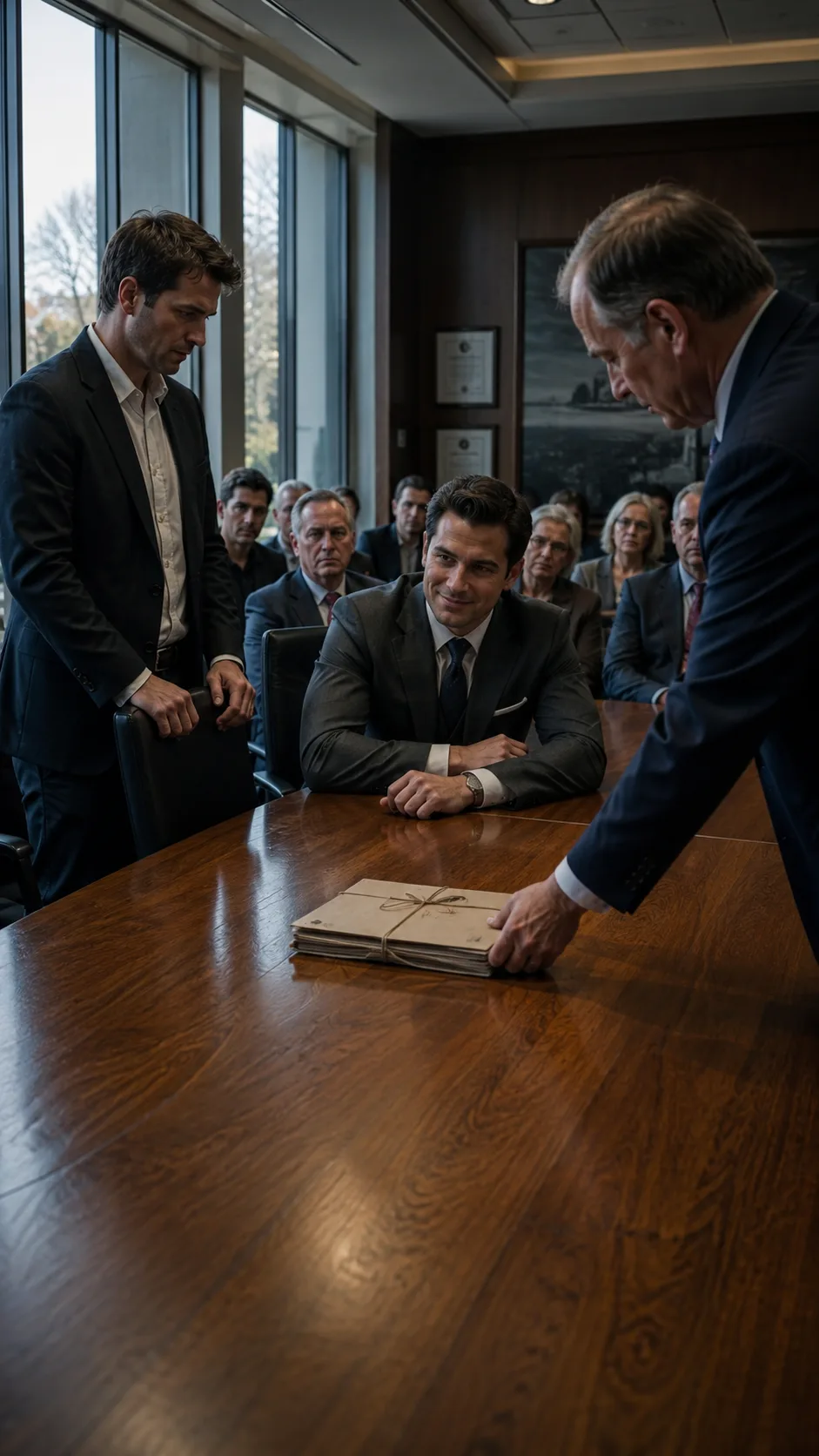
Ryan arrived looking pleased.
Very pleased.
He wore an expensive charcoal suit.
Sat near the center of the conference table.
Closest to the bank manager.
Closest to the file.
Relatives filled the remaining seats.
Twenty people.
Maybe more.
The room buzzed with quiet assumptions.
Everyone expected Ryan to receive one final gift.
One final confirmation.
One final proof that he had always been the chosen son.
I sat near the end of the table.
The bank manager entered carrying a thick folder.
Old.
Weathered.
Important.
He placed it in the center.
The room fell silent.
Ryan smiled.
The manager adjusted his glasses.
“We discovered a savings account opened in 1987.”
Several relatives nodded.
Ryan leaned back.
Comfortable.
Certain.
“The account remained active for decades.”
Ryan smiled wider.
“The account contains beneficiary instructions.”
A cousin laughed softly.
“Of course it does.”
Ryan glanced toward me.
That glance said everything.
The meeting was already over in his mind.
The manager opened the file.
Removed several documents.
Then stopped.
His expression changed.
Not dramatically.
Just enough.
He looked around the room.
“There's a complication.”
Ryan's smile faltered.
Only briefly.
“What complication?”
The manager slid one document free.
“The named beneficiary differs from family expectations.”
Nobody understood.
Not yet.
Ryan chuckled.
“Then let's hear it.”
The manager looked directly at me.
Not Ryan.
Me.
My stomach tightened.
The room shifted.
Tiny movements.
Chairs.
Eyes.
Breathing.
Everyone sensed something.
Nobody knew what.
The manager placed the document on the table.
Directly in front of me.
Ryan stood so quickly his chair scraped backward.
“Dad spent his whole life proving who mattered most.”
Several relatives nodded automatically.
Years of assumptions speaking through them.
The manager didn't respond.
I looked down.
The document stared back.
My hands froze.
Then I picked it up.
Read it once.
Read it twice.
Read it a third time because my brain refused to cooperate.
My name.
Only my name.
Daniel Harper.
Sole beneficiary.
Opened in 1987.
Four years before Ryan entered our family.
The room became strangely quiet.
Not dramatic quiet.
Confused quiet.
The kind that happens when reality and expectation collide.
Ryan stepped closer.
“What does it say?”
I couldn't answer.
The manager answered instead.
“The account was opened exclusively for Daniel Harper.”
Nobody moved.
Nobody breathed.
Ryan grabbed the edge of the table.
“That doesn't make sense.”
The manager continued.
“There were never any amendments.”
A cousin frowned.
My aunt blinked repeatedly.
Someone dropped a pen.
The sound echoed.
Ryan shook his head.
“No.”
The manager turned another page.
“Additional instructions were attached.”
Now every eye locked onto the file.
The manager unfolded a yellowed handwritten note.
My pulse hammered.
The handwriting was unmistakable.
Dad's.
The manager cleared his throat.
“This account belongs to my son Daniel. If anything happens to me, the money remains his. No changes are to be made regardless of future circumstances.”
Future circumstances.
The words hit harder than the money.
Future circumstances.
Meaning Ryan.
Meaning the remarriage.
Meaning everything that came later.
Dad had made the decision before any of it.
The room erupted.
Questions.
Voices.
Disbelief.
Ryan looked physically ill.
“What are you saying?”
The manager held up the note.
“I'm reading exactly what your father wrote.”
Ryan stared at me.
Then at the note.
Then back at me.
His mouth opened.
Closed.
Opened again.
Nothing emerged.
For the first time in my life, he had no speech prepared.
No answer.
No confidence.
Nothing.
Around the room, relatives slowly shifted their attention.
Not because of the money.
Because of what the money meant.
This wasn't inheritance.
It was evidence.
Evidence that everything they'd believed for thirty years might have been wrong.
Ryan sat down heavily.
My aunt wiped her eyes.
A cousin whispered, “He opened it before Ryan.”
Nobody corrected her.
Nobody could.
The facts sat on the table.
Impossible to argue with.
Impossible to explain away.
Then the manager unfolded one final page.
Another handwritten note.
Short.
Only one sentence.
He handed it directly to me.
I read it alone.
Dad's handwriting.
Crooked from age.
“Some things don't need to be said to be true.”
That was all.
One sentence.
One lifetime.
The meeting ended shortly afterward.
Nobody knew what to say.
Relatives left quietly.
Conversations became whispers.
Ryan disappeared before anyone noticed.
I found him outside in the parking lot.
Standing beside his car.
Looking smaller somehow.
Older.
He didn't turn around when I approached.
We stood there for a long time.
Finally he spoke.
“I thought he loved me more.”
I looked toward the mountains.
“I know.”
Neither of us moved.
Neither of us argued.
There was nothing left to argue about.
The account wasn't enormous.
It wouldn't change my life.
But the truth inside it already had.
In the weeks that followed, relatives called constantly.
Some apologized.
Others tried explaining.
A few insisted Dad had loved us both equally.
I stopped participating in those conversations.
People needed a cleaner ending than the one we received.
Life rarely provides that.
One afternoon I drove back to Dad's house.
The property was being prepared for sale.
Rooms sat empty.
Walls bare.
Echoes everywhere.
I walked into the garage.
The old cabinet remained.
So did the envelope.
The one with my name.
Inside was a photograph.
Nothing else.
Just a photograph.
Me at twelve years old.
Covered in sawdust.
Holding a hammer.
Standing beside the deck we'd built together.
On the back Dad had written six words.
“Never needed to worry about you.”
I sat there for a long time.
The garage smelled like old wood and machine oil.
A loose chain tapped softly against the wall whenever the wind entered.
The same sound I'd heard as a kid.
Eventually I put the photograph back inside the envelope.
Then I took the rusty coffee can from the shelf.
The one full of screws.
The last thing he ever handed me.
It sits in my workshop now.
Right above my workbench.
People assume it's junk.
I let them think that.
Sometimes my daughter asks why I keep it.
I tell her it reminds me of someone.
That's enough.
A few months later Ryan called.
Not about money.
Not about the account.
Not about Dad.
He asked if I wanted to get lunch.
Just lunch.
Nothing dramatic.
No speeches.
No apologies.
We met at a small diner halfway between our towns.
The coffee was terrible.
The waitress forgot our fries.
We talked for two hours.
Mostly about ordinary things.
For once, that was enough.
When we left, Ryan paused beside his truck.
“You know,” he said, “I think he expected you to be okay.”
I looked toward the parking lot.
Toward the road stretching home.
Maybe.
Maybe not.
Either way, the answer no longer mattered.
The gate behind Dad's old house still stands.
Straight.
Solid.
Exactly where I left it.
And every time I think about him, that's what I remember first.
Not the bank.
Not the account.
Not the money.
The gate.
Still holding.
Chapter complete
You have reached the end of this chapter.
Continue reading
A few more worlds to get lost in after this chapter.




