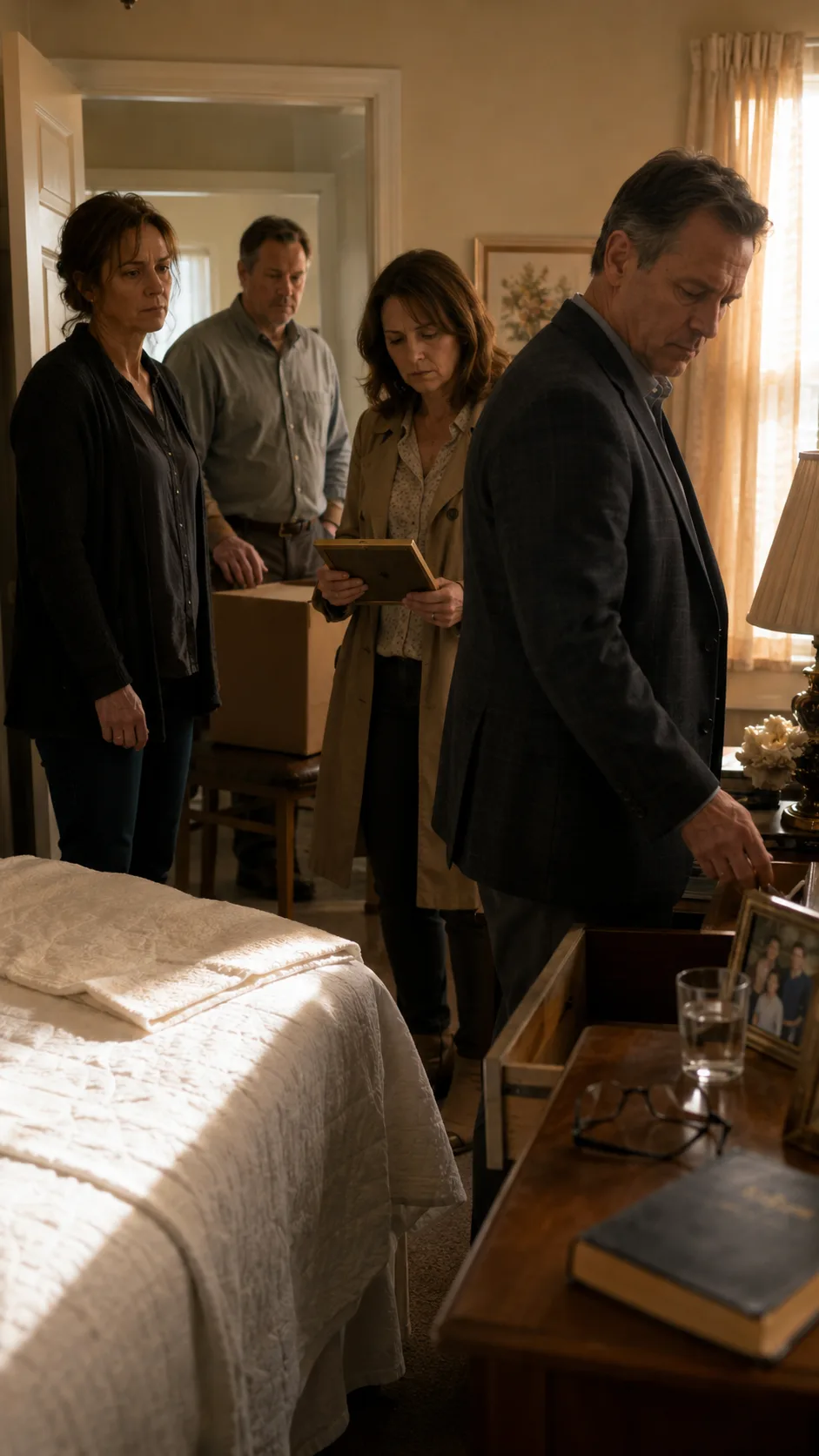
Ray had one hand inside our mother’s drawer before the nurse reached the bed.
Chapter 1
Ray had one hand inside our mother’s drawer before the nurse reached the bed.
Nobody had told him to open it.
The room still held the shape of her. The dent in the pillow. The white blanket folded at the foot of the bed. Her reading glasses on the small wooden table, one arm bent from the time she fell asleep with them on and rolled over in the dark.
Ray slid the drawer farther out.
It scraped.
Mark stood behind him with a cardboard box against his hip. Denise held her purse with both hands. I stayed near the doorway, where the hallway light fell across my shoes and stopped there.
“Let’s just get this done,” Ray said.
His jacket looked too nice for that room. Dark navy, pressed flat, the kind he wore when he wanted people to see he had a job with a title. He had not worn it when we moved Mom in. That day, he wore golf clothes
and checked his watch in the parking lot.
The nurse stepped in behind us.
Her name was Helen Brooks. She had a round face, gray at her temples, and a way of standing near the bed without crowding it. During Mom’s last week, Helen called me twice. Not Mark. Not Denise. Not Ray.
Me.
“She had a good night,” Helen had said once.
Another time, she said, “Your mother asked for peach tea.”
I had brought it the next morning in a travel cup from a gas station off Highway 31. Mom took three sips and said it tasted like summer.
That was all.
Helen looked at Ray’s hand in the drawer, then at the bed.
“We kept her things together,” she said.
Ray did not close the drawer.
“Appreciate that,” he said.
Mark cleared his throat. “We’ll be out of your way soon.”
Helen nodded once. “Take your time.”
Nobody did.
The first time my mother could not get out of her chair by herself, Mark called it a fall risk.
The second time, Denise called it unsafe.
The third time, Ray called a meeting at his house and ordered sandwich trays like we were discussing a church fundraiser instead of the woman who had patched our jeans, worked double shifts at the county courthouse, and stretched one pot roast into four meals because Ray had come to live with us when he was twelve and ate like the house owed him something.
Mom sat in a recliner at the corner of Ray’s living room during that meeting.
Her cane leaned against her knee. Her hands rested on top of each other, thin blue veins crossing like rivers on a map.
“I can manage,” she said.
“You can’t,” Ray said.
Mark looked at the carpet.
Denise twisted her wedding
ring.
I said, “Maybe we could try home care first.”
Ray leaned back, his mouth tight around a toothpick. “Who’s paying for that?”
The room answered for us.
Mom did not.
She lifted one hand and reached for the glass of iced tea on the side table. It was too far. I stood to get it, but Ray passed it first, with a quick, public kindness that made everyone else look unreasonable.
“There,” he said.
Mom thanked him.
Thanked him.
Three weeks later, we drove her to Magnolia Creek Senior Care in Alabama with two suitcases, her Bible, three framed pictures, and the quilt my grandmother had sewn from old flour sacks. Ray followed us in his truck but did not carry anything heavier than a folder of papers.
At the front desk, he signed where the admissions director pointed.
Mom watched the pen move.
“Do I sign anything?” she asked.
Ray looked up. “I’ve got it.”
The admissions director smiled at Mom. “We’ll get you settled, Mrs. Carter.”
Mom adjusted the collar of her lavender blouse. She always dressed up for doctors, banks, funerals, and bad news.
“All right,” she said.
Small words.
Her room was clean. Beige walls. One window. A metal bed with a wooden headboard polished to look less like metal. The bathroom smelled like lemon disinfectant. There was a calendar from a funeral home hanging beside the closet.
Mom touched the mattress, then the windowsill.
“There’s a crape myrtle,” she said.
Outside, a tree leaned near the parking lot. The flowers were gone, but Mom said it like it was blooming.
Mark carried in the quilt. Denise arranged the pictures. I put her reading glasses on the bedside table.
Ray opened the closet and looked inside.
“Not bad,” he said.
Mom sat on the edge of the bed.
Her feet did not touch the floor all the way.
I noticed.
Ray noticed the television bracket.
“Cable included?” he asked.
The first month, everyone visited.
Mark came on Sundays and brought store-bought banana bread still in the plastic. Denise came twice with hand lotion and told Mom about her daughter’s cheer schedule. Ray came once, talked to the administrator in the hallway, then stood at Mom’s door and said he had another stop.
Mom always said the same thing after they left.
“They’re busy.”
She said it while smoothing the blanket.
She said it while checking her pill cup.
She said it while looking out at the crape myrtle.
By the third month, Mark mailed cards instead of coming. Denise called from her car. Ray sent nothing, but he called Mom when he needed dates, account numbers, names of old insurance agents, and once, the location of a key to the cedar chest in her old house.
“Why does he need that?” I asked her.
Mom held the phone in both hands after the call ended.
“Maybe he wants your father’s military papers,” she said.
“Dad kept those in the file cabinet.”
“Oh.”
She placed the phone on the blanket.
Then she asked whether I had eaten.
That was Mom. A person could take the roof off her house and she would ask whether they wanted a plate wrapped for later.
I came when I could. That became the phrase I used.
When I could.
I had a job at the school office. I had a leaking water heater. I had a son in community college who needed books. I had a thousand small excuses, and none of them were lies.
None of them were enough.
Mom never accused me. That made it worse.
She would point to the chair by her bed and say, “Sit. Tell me something ordinary.”
So I told her about the copier jamming, about Mrs. Ellis bringing deviled eggs to the staff lounge, about the neighbor’s dog stealing a package from our porch and dragging it under the azaleas.
Mom liked the ordinary.
She kept it like medicine.
One afternoon in late August, I found Ray in the parking lot when I arrived. He stood beside his truck with his phone against his ear and his sunglasses hooked in his shirt collar.
“No, I’m handling it,” he said.
He saw me and turned away.
I waited beside my car until he finished.
“Everything okay?” I asked.
“Fine.”
“Were you here to see Mom?”
He looked toward the building. “Dropped off some paperwork.”
“What paperwork?”
He smiled without teeth. “Nothing for you to worry about.”
Then he climbed into his truck.
Mom was sitting in her chair when I got to her room. Her lunch tray was still there. A square of cornbread sat untouched beside a paper cup of applesauce.
“Ray came by?” I asked.
She folded a napkin over her lap.
“For a minute.”
“What did he bring?”
“Questions.”
She looked at the window.
The crape myrtle had started blooming late, one thin cluster of pink flowers near the top. Mom pointed it out like it had sent her a letter.
“He worries about things,” she said.
“Ray worries about Ray.”
Her mouth moved, but no sound came out.
Then she reached for her Bible and opened it to the place where she kept a pressed violet between two pages.
A week later, I saw Helen at the nurses’ station with an envelope in her hand. She tucked it under a clipboard when I approached.
“Your mother had a busy morning,” she said.
“Busy how?”
Helen smiled in a way that did not show too much. “She asked for stationery.”
“Mom writes letters?”
“Sometimes.”
“To who?”
Helen glanced toward Mom’s hallway. “She said she’d tell you when she was ready.”
I almost asked more.
I didn’t.
That was one of the last clean chances I had.
By October, Mom’s voice had grown thinner. She stopped asking for peach tea and started asking what day it was. Not because she forgot every day. Because some days mattered.
On the first Monday, she asked, “Did Mark come?”
I said, “He called.”
She nodded like calls had weight.
On a Thursday, she asked, “Did Denise bring the red sweater?”
“She said she’ll look for it.”
Mom touched the blanket. “It’s in the cedar chest.”
I did not tell her Ray had already been asking about that chest.
On a Saturday morning, Ray called while I was in her room.
Mom looked at his name on the screen for three rings before answering.
“Hello, honey.”
His voice came through sharp enough for me to hear pieces.
The house. The taxes. The estate. The safe deposit box.
Mom’s fingers tightened around the phone.
“No,” she said.
A pause.
“No, Ray. Not yet.”
Another pause.
Her eyes moved to me.
“I’m still living,” she said.
The room shrank.
I stood.
Mom ended the call before Ray did. She set the phone facedown on the blanket and smoothed the sheet near her knee.
“Would you hand me that pen?”
“What was that about?”
“The pen, Laura.”
I gave it to her.
Her hand shook as she wrote something on a yellow notepad. She folded the page once, then twice, then slid it into her Bible.
“Mom.”
She closed the Bible.
“I’m tired.”
That night, Ray texted me.
Did she say anything weird to you?
I stared at the message while my kitchen sink dripped every eight seconds.
No, I typed.
I deleted it.
Then I typed, Why?
He didn’t answer.
The following week, Helen called me at 6:12 in the morning.
“Your mother had a rough night,” she said.
I was standing in my kitchen in one sock, with coffee grounds spilled across the counter.
“Is she asking for me?”
“She asked for all of you.”
All of us came.
Mark arrived first, hair wet from the shower, shirt buttoned wrong at the collar. Denise came with mascara under one eye and the red sweater in a shopping bag. Ray came last, carrying his leather folder.
Mom lay against raised pillows.
The room smelled faintly of lotion and clean sheets.
She looked smaller than the pillow behind her.
Mark sat in the chair. Denise stood at the foot of the bed. Ray stayed near the dresser, folder under one arm.
Mom opened her eyes when I took her hand.
“You came,” she said.
“Yes.”
She looked at Mark. “You too.”
Mark rubbed his mouth.
She looked at Denise. “That sweater?”
Denise held up the bag. “I found it.”
Mom’s lips curved, barely. “Good.”
Then she looked at Ray.
He stepped closer.
“I brought those papers,” he said.
Mark looked up.
Denise turned her head.
Mom’s fingers moved under mine. One tap. Then another.
“What papers?” I asked.
Ray opened the folder. “Just housekeeping. There are things that need to be organized.”
Helen appeared in the doorway with a medication cup.
Mom’s eyes stayed on Ray.
“I don’t need to sign today,” she said.
Ray kept the folder open.
“It’s easier if we do it while everyone’s here.”
“No.”
The word was not loud.
It landed.
Ray’s face changed. Only around the mouth.
Helen stepped inside. “Mrs. Carter needs rest.”
Ray closed the folder.
“Fine,” he said.
Mom did not watch him leave.
She watched Helen place the medication cup on the table.
After everyone stepped into the hallway, Helen remained beside the bed. I saw Mom touch her sleeve and say something. Helen bent close. Mom nodded toward the folded blanket at the foot of the bed.
Helen listened.
Then she looked toward the hallway, where Ray was already on his phone.
I should have gone back in.
I didn’t.
Two days later, Mom died before sunrise.
Helen called me first.
The nursing home gave us until the afternoon to collect her belongings. I called Mark. Mark called Denise. Nobody called Ray, but he came anyway.
He arrived in the same jacket he wore to bank appointments.
That was how we returned to the room.
The bed had been made. The pillowcase was fresh. Someone had removed the oxygen tubing. Her slippers sat side by side beneath the chair, toes facing the door, like she might step into them after a nap.
A cardboard box waited on the chair.
Mark picked it up.
Denise touched the red sweater folded on the shelf. She pressed her thumb over one sleeve, then placed it in the box.
Ray went to the drawer.
That was where the story started to split open.
He pulled out a small pouch with cough drops, a comb, two receipts, and a folded tissue. He set those aside without looking at them. Then he reached deeper.
“What are you looking for?” I asked.
He did not turn.
“Important things.”
“Like what?”
“Documents.”
Mark stood still with the box.
Denise kept her head down.
I crossed the room.
“Ray.”
He pulled open the drawer farther.
The wood made that scraping sound again.
Helen stepped into the room.
“We kept her things together,” she said.
Ray’s hand paused, then kept moving.
“I appreciate it,” he said. “We’ll handle it.”
Helen walked to the bed instead of the drawer. She touched the folded blanket with both hands, smoothing the edge as if Mom might complain about wrinkles.
Her fingers reached the corner.
Stopped.
A cream-colored envelope slid out from beneath the fold.
The room took one breath.
Helen lifted it.
My mother’s handwriting crossed the front in blue ink, thin and slanted.
To the staff of Magnolia Creek.
Ray shut the drawer halfway.
“What’s that?”
Helen turned the envelope over. The flap was sealed.
“She left this for the staff.”
“For the staff?” Ray stepped away from the table. “We’re her family.”
Helen did not answer right away.
She held the envelope against her uniform.
Mark said, “Maybe we should read it.”
Ray reached out. “I’ll take it.”
Helen moved the envelope out of his reach.
It was not dramatic.
It was enough.
“This was addressed to us,” she said.
Ray’s hand remained in the air for a second before he lowered it.
Denise looked at me.
I looked at the bed.
Helen opened the envelope with her thumb, careful not to tear the paper. The sound was small. Paper against paper. It filled the room more than Ray’s voice ever had.
She unfolded one sheet.
Mom had written in uneven lines, the letters larger than they used to be. Her hand had always been neat when she paid bills at the kitchen table. This writing wandered downward, but every word stayed on the page.
Helen began to read.
“To the people who helped me sit up when my legs would not listen.”
Ray shifted.
Helen kept reading.
“To the people who brought warm blankets, peach tea, and patience.”
Mark lowered the cardboard box onto the chair.
The box made a dull sound.
“To the people who called me Mrs. Carter even when I could not button my own blouse.”
Denise pressed the sweater to her chest now.
Too late.
Helen paused.
Ray looked toward the hallway. “Is there a point?”
Nobody answered him.
Helen’s thumb moved over the page. She found the next line.
“I do not have much left to give.”
The room was still.
“I know this room is small, but it was shelter when I needed shelter.”
Ray’s jaw moved.
Helen read the final lines.
“If there is someone with nowhere to go, please give them my room. Let them have the window, the chair, and the quiet.”
No one touched the drawer.
No one touched the box.
Helen lowered the letter.
For a moment, the only sound came from the air conditioner under the window. It rattled, then caught, then rattled again.
Ray’s hand hung beside the half-open drawer.
His fingers curled once.
The expensive jacket looked different in that room now. Too sharp. Too clean. Too loud.
Helen placed the letter on the folded blanket.
The bed was empty, but it no longer looked available.
It looked claimed.
Ray stepped back.
One step.
His heel hit the leg of the bedside table. The glass of water trembled. A small ring spread across the surface.
Mark sat down without meaning to. The chair creaked under him.
Denise put the red sweater back on the bed beside the letter.
I moved toward the drawer.
Ray blocked me with his shoulder.
“Laura,” he said.
I did not stop.
I reached around him and pushed the drawer closed.
The click was quiet.
Helen looked at me.
I looked at the letter.
Outside the doorway, a nursing aide stood with an elderly woman I did not know. The woman held a paper grocery bag against her stomach. Her coat was too thin for November. One button was missing.
Helen saw her too.
Then Helen looked back at us.
“Your mother asked us to give this room to someone who needed it,” she said.
Ray’s mouth opened.
Nothing came.
The aide stepped away from the doorway with the woman, giving us privacy that we had not earned.
Mark rubbed both hands over his face.
Denise took the framed photo from the table and held it so tightly the stand on the back snapped with a dry little crack.
Ray picked up his folder from the dresser.
The folder.
He had brought it even that day.
I looked at it, and then at him.
“What were you going to do with that?”
He stared at the letter on the bed.
“Nothing.”
“Ray.”
He tucked the folder under his arm. “This isn’t the place.”
“No,” I said. “It wasn’t the place when she was alive either.”
Mark looked between us.
Denise made a sound but did not form a word.
Ray’s face hardened in pieces. First the mouth. Then the eyes. Then the whole practiced expression he used with bankers and service managers.
“She was my stepmother too,” he said.
“She was our mother,” I said.
He looked at the drawer.
Not at me.
Helen lifted the letter from the blanket and slipped it back into the envelope.
“I’ll make a copy for your family,” she said. “The original stays in our records.”
Ray turned to her. “That letter has no legal standing.”
Helen folded the flap closed.
“No one said it did.”
That stopped him.
Because there was nothing to fight.
No house. No check. No signature. No judge. No attorney.
Just a bed, a window, and a dead woman’s last request.
Ray left first.
He did not say goodbye to Mom’s room. He did not take the cough drops, the comb, or the folded tissue from the drawer. He took his leather folder and walked into the hall with his phone already in his hand.
Mark stayed seated.
Denise stayed by the bed.
I picked up Mom’s reading glasses from the bedside table. One arm still bent outward. I folded it carefully, but it would not sit straight.
Helen brought us a small paper bag for the personal things.
Not the box.
The box stayed empty on the chair.
We packed almost nothing. The Bible. The glasses. The family photo with the broken stand. The red sweater. Her slippers.
Denise asked to take the quilt, then stopped herself before Helen answered.
“Leave it,” she said.
Helen nodded.
The air conditioner rattled again.
Outside, in the hallway, someone rolled a cart past the door. A plastic cup bounced on the tray with each turn of the wheels.
Mark stood at last and looked at the bed.
“I thought she’d want to come home,” he said.
No one told him she had.
On the way out, I passed the elderly woman with the paper grocery bag. She was sitting near the nurses’ station, both hands folded over the bag, looking down at her shoes. They were white sneakers with one gray lace and one blue lace.
Helen walked toward her with a clipboard.
I kept walking.
Then I stopped.
The bag in my hand was light. Too light for a life.
I turned around and went back to the nurses’ station.
Helen looked up.
“Could you tell her something?” I asked.
The woman with the grocery bag lifted her head.
My mouth dried.
“Tell her the crape myrtle blooms late,” I said.
Helen’s face changed just a little.
She wrote something on the clipboard.
After Mom’s funeral, Ray did not come to the house.
He sent Mark a message asking whether anyone had located “the papers.” Mark forwarded it to me with no comment.
I did not answer Ray.
Three days later, an attorney called all four of us into a small office downtown. The carpet had a coffee stain near the door. The receptionist kept a jar of peppermint candies beside the sign-in sheet.
Ray arrived first.
Of course he did.
He sat closest to the attorney’s desk with one ankle over his knee, looking rested and polished. Mark sat beside him. Denise sat beside me, clutching tissues she never used.
The attorney opened Mom’s file.
There was no surprise inheritance. No hidden fortune. No secret account Ray could touch.
Mom’s house had already been placed in a small trust years earlier, with instructions that it be sold and divided after expenses. A portion went to each child. A portion went to Magnolia Creek’s resident assistance fund.
Ray leaned forward. “How much?”
The attorney gave the number.
Ray sat back.
It was not nothing.
It was not enough for the face he had brought with him.
Then the attorney added, “Mrs. Carter also left a personal note regarding Mr. Miller.”
Ray looked at me before he looked at the attorney.
The attorney opened another envelope.
Ray’s name was written across it.
The attorney handed it to him.
Ray did not open it right away.
“Is that private?” Denise asked.
Ray slid a finger under the flap.
The paper inside was only half a page.
His eyes moved once across it.
Then his face lost its arrangement.
He folded the letter and put it back in the envelope.
“What did it say?” Mark asked.
Ray stood.
“Nothing.”
He walked out before the meeting ended.
Later, Mark told me Ray had stopped answering his calls for a while. Denise heard from her husband that Ray tried to contest the donation to Magnolia Creek, but the attorney shut it down before it reached a courtroom.
There was no case.
Only his signature on admissions papers, Mom’s trust documents, and the letter she had written when her hand could barely hold a pen.
Months passed.
The crape myrtle outside Magnolia Creek dropped its leaves, then stood bare through January. I kept visiting, though Mom’s room was no longer Mom’s room.
The first time I returned, I brought peach tea.
Helen met me at the front desk.
“She’s settled in,” she said.
“Who?”
Helen tilted her head toward the hall.
The elderly woman with the grocery bag was sitting in the chair by the window in Mom’s old room. She had a knitted blanket over her knees and a paperback open facedown beside her. The room looked different. A small radio sat on the dresser. A church bulletin was pinned near the calendar.
But the chair was the same.
The window was the same.
The crape myrtle waited outside.
I did not go in.
Helen stood beside me, close enough that I could smell hand lotion and laundry soap.
“She likes the quiet,” Helen said.
I nodded.
Small words.
A week later, I brought another tea and left it at the nurses’ station. After that, I came every Thursday. Sometimes I sat with the woman, whose name was Ruth Ellen. Sometimes I just dropped off lotion, socks, a crossword book, a sweater Denise had bought and asked me to take.
Mark came once.
He stood in the hallway for a long time before entering. He brought banana bread, still in plastic. Ruth Ellen thanked him and asked whether he played cards.
He said he used to.
He stayed two hours.
Denise came in spring with a red cardigan that looked almost like Mom’s sweater but not quite. Ruth Ellen wore it to bingo that afternoon. Denise watched from the doorway, one hand over her mouth, then went to the restroom and came back with her face washed clean.
Ray never came.
Not once.
But one afternoon in May, an envelope arrived at Magnolia Creek with no return address. Inside was a cashier’s check made out to the resident assistance fund.
Helen showed it to me in her office.
The amount was large enough to notice.
The signature line was blank because the bank had issued it.
“Do you think it was him?” Helen asked.
I looked at the envelope.
The handwriting on the front was typed.
“I don’t know.”
That was true.
Mostly.
In June, the crape myrtle bloomed.
Not all at once. One cluster first, then another. Pink flowers gathered near the top branches, late and stubborn against the Alabama heat.
I brought Ruth Ellen a peach tea that day. She sat by the window in Mom’s old chair, shoes lined neatly beside the bed, the laces now both white.
“Your mother liked that tree?” she asked.
“Yes.”
Ruth Ellen took the cup from me with both hands.
“She picked a good room.”
I looked at the bed, the window, the chair.
The folded blanket was gone now. The letter was in a file somewhere. The drawer held someone else’s cough drops, someone else’s comb, someone else’s folded tissues.
Mom had left almost nothing behind.
Almost.
I sat beside the window until the tea sweated through the paper cup and left a ring on the table.
Then I wiped it clean.
Chapter complete
You have reached the end of this chapter.
Continue reading
A few more worlds to get lost in after this chapter.




