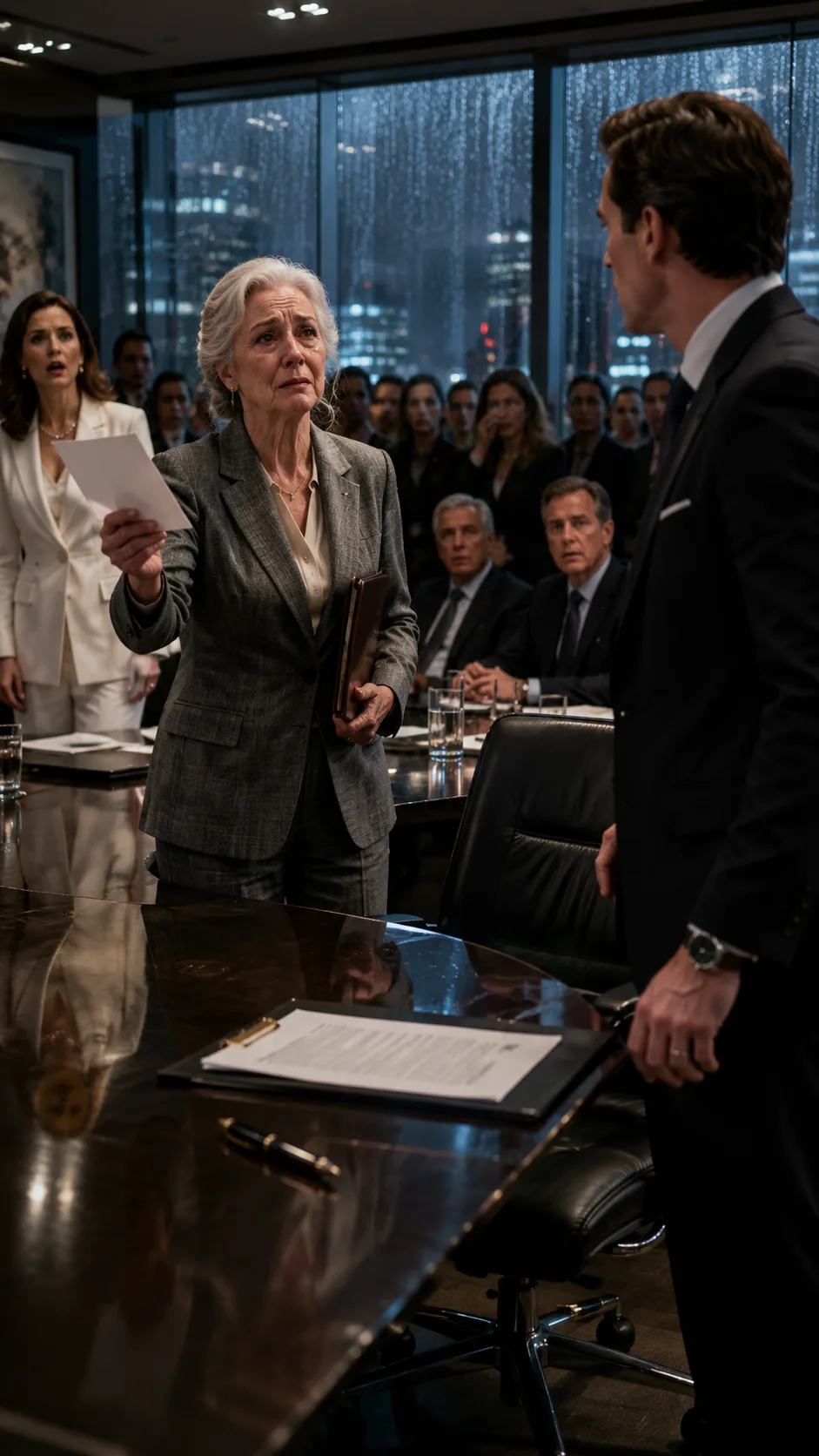
MY SON THREW ME OUT OF THE FAMILY COMPANY… THEN LEARNED I STILL OWNED IT
PART 1
For thirty-seven years, Eleanor Whitfield woke before sunrise.
Chapter 1
For thirty-seven years, Eleanor Whitfield woke before sunrise.
Even after she became wealthy enough to sleep until noon, even after magazines called her one of the most respected businesswomen in America, even after her company’s name appeared on storefronts across the country, her body still remembered the old days.
It remembered cold mornings in a rented garage behind a peeling blue house in Ohio.
It remembered numb fingers cutting fabric before dawn.
It remembered the smell of coffee gone bitter in a chipped mug, the hum of an old sewing machine, and a little boy asleep on a folded blanket in the corner because she could not afford a babysitter.
That boy was Daniel.
Her only child.
Her reason.
When Eleanor’s husband died in a highway accident, Daniel was only three years old. There was no insurance payout big enough to change their lives. No rich family member came to rescue them. No miracle arrived in an envelope.
There was just Eleanor, a grieving young widow with a toddler, a mortgage she could barely pay, and a stubborn belief that if she worked hard enough, she could build something no one could take away from her son.
So she began sewing.
At first, it was table runners, curtains, pillow covers, and kitchen linens. She sold them at church fairs, farmers’ markets, and small home decor shops that agreed to take a few pieces on consignment.
She called her tiny business Whitfield Home Goods because it sounded bigger than one tired woman and a secondhand sewing machine.
At night, after Daniel fell asleep, Eleanor packed orders on the kitchen floor. She wrapped each item in brown paper and tied it with string. She wrote thank-you notes by hand.
Thank you for supporting my small business.
Thank you for helping me build a future for my son.
She never wrote
that second line, but she thought it every time.
Daniel grew up beneath cutting tables and fabric shelves. He learned to count by stacking invoices. He learned colors by naming bolts of cloth. When he was five, he drew a crooked little logo with a house and a heart. Eleanor laughed until she cried, then used the idea for the company’s first printed tags.
As the years passed, Whitfield Home Goods grew.
The garage became a small workshop.
The workshop became a factory.
The factory became a headquarters with glass doors, polished floors, and a sign out front that made Eleanor stop the car the first time she saw it.
WHITFIELD HOME GOODS.
Her name.
Her work.
Her life.
But success did not make Eleanor cold.
She knew the names of the people on the factory floor. She knew whose child had asthma, whose mother needed surgery, whose husband had
been laid off. Every Thanksgiving, she gave every employee a bonus, even in lean years. When one of her oldest seamstresses, Ruth, lost her home in a fire, Eleanor quietly paid the deposit on a new apartment.
“Our company is not just products,” she used to say. “It is people. If we forget the people, we have no company at all.”
The employees believed her because she lived that way.
Daniel believed her too, once.
As a boy, he admired his mother more than anyone. He used to sit in her office after school and watch her handle phone calls, vendor meetings, and design approvals with the quiet authority of someone who had earned every inch of respect she received.
“You’re going to run this one day,” Eleanor told him often.
Daniel would grin and spin in her office chair.
“I’ll make it even bigger, Mom.”
“I hope you do,” Eleanor said. “But promise me one thing.”
“What?”
“Don’t make it bigger by making it crueler.”
Daniel always laughed, as if cruelty were something that belonged to villains in movies, not to real people in expensive suits.
“I promise.”
Eleanor believed him.
That was a mother’s first mistake.
She paid for Daniel to attend the best schools. Business camps in the summer. Private tutors when he struggled with math. College out of state because he wanted distance and opportunity.
Daniel was bright, charming, and ambitious. Professors loved him. Investors liked him. He had the polished confidence Eleanor had never possessed when she was young.
She was proud of that.
She wanted him to have doors open easily because she had spent her life forcing them open with bleeding hands.
When Daniel graduated from business school, Eleanor brought him into Whitfield Home Goods as director of expansion. He was twenty-six, full of energy, and eager to modernize everything.
At first, he did well.
He built an online store. He attracted younger customers. He negotiated better shipping contracts. He pushed the company into new markets Eleanor had hesitated to enter.
Eleanor did not resent his ideas. She welcomed them.
“You see things I don’t,” she told him. “That is why I need you.”
Daniel loved hearing that.
For a while, they were a good team.
Eleanor brought wisdom, patience, and loyalty.
Daniel brought speed, technology, and ambition.
Together, they helped Whitfield Home Goods become a nationally recognized brand.
Then Daniel met Melissa.
Melissa Hart was beautiful, intelligent, and sharp in a way that made every room feel slightly colder when she entered. She came from a world of private clubs, luxury apartments, and people who spoke of family businesses as assets to be optimized.
Daniel introduced her to Eleanor at a charity dinner.
“Mom, this is Melissa,” he said, smiling with the nervous pride of a man presenting something valuable.
Eleanor stood and offered both hands.
“It’s so lovely to finally meet you.”
Melissa smiled politely, but her eyes moved quickly over Eleanor’s simple navy dress, her modest pearls, the reading glasses hanging from a chain around her neck.
“I’ve heard so much about you,” Melissa said.
There was nothing rude in the sentence.
Still, Eleanor felt something hidden beneath it.
Not warmth.
Evaluation.
After dinner, Daniel asked Eleanor what she thought.
“She’s very impressive,” Eleanor said carefully.
Daniel frowned.
“That’s all?”
Eleanor smiled and touched his cheek.
“What matters is how she treats your heart when no one is watching.”
Daniel laughed it off.
“You’re old-fashioned, Mom.”
Maybe she was.
But old-fashioned women often know things before modern men do.
Daniel married Melissa the following spring in a ceremony at a vineyard outside Napa. Eleanor paid for half of it without complaint, even though Melissa’s family could have paid for all of it. She wanted Daniel’s wedding to be beautiful. She wanted him to remember joy.
At the reception, Daniel gave a toast.
“My mother built everything I have ever stood on,” he said, raising his glass toward Eleanor. “This company, this family, this life. If I become half the leader she is, I will be lucky.”
The guests applauded.
Eleanor cried softly into her napkin.
Melissa watched from beside Daniel, her smile perfect, her eyes unreadable.
Two years later, Eleanor turned sixty-five.
Her hands had begun to ache in the mornings. Her knees protested when she climbed stairs. She still loved the company, but she was tired in a place sleep could not reach.
Daniel had been asking for more control.
Not rudely at first. Not directly.
He would say things like, “Mom, you shouldn’t have to carry all this anymore.”
Or, “Investors want to see a younger face.”
Or, “You deserve to enjoy what you built.”
Eleanor resisted for months, not because she feared losing power, but because she knew leadership was not a chair. It was responsibility. It was memory. It was conscience.
Eventually, Daniel persuaded her.
“Let me take care of it now,” he told her one evening in her office.
Rain tapped gently against the windows. The headquarters was quiet. Most employees had gone home.
Daniel stood near her desk, tall and handsome in a charcoal suit. For a moment, Eleanor did not see the executive. She saw the little boy asleep in the garage, one sock missing, curls stuck to his forehead.
“You’re ready?” she asked.
Daniel smiled.
“I’ve been ready my whole life.”
Eleanor wanted to believe that meant he understood the weight.
She announced her retirement as CEO at the annual company gathering.
Hundreds of employees filled the atrium. Some had been with her for decades. Some were young workers who knew her only as a legend, the founder who still walked the factory floor and asked about their families.
Daniel stood beside her on the stage.
Eleanor wore a cream suit and the same pearls from Daniel’s wedding. Her voice trembled once, but she steadied it.
“Whitfield Home Goods began with a borrowed sewing machine and a promise to my son that we would survive,” she said. “But it became what it is because of all of you.”
Employees wiped their eyes.
“I am stepping down as CEO,” she continued. “And I am placing day-to-day leadership in the hands of my son, Daniel Whitfield.”
The applause was thunderous.
Daniel hugged her in front of everyone.
Then he took the microphone.
“My mother built this company with her hands,” he said. “I will protect her legacy with everything I have.”
Eleanor closed her eyes.
Those words entered her heart like a prayer.
But prayers, she would later learn, can become evidence.
At first, retirement felt strange.
Eleanor remained chair emeritus and kept a seat on the board. She attended monthly meetings, reviewed major decisions, and offered guidance when asked. She spent more time gardening. She volunteered at a women’s business center. She visited the factory twice a month with homemade cookies because old habits rarely retire.
Daniel made changes quickly.
Some were good.
He refreshed the website. He expanded distribution. He hired a new marketing team that gave the brand a cleaner, more modern look.
Eleanor supported him.
But then came the cuts.
First, Daniel ended the handmade premium line because it took too much labor.
“It’s not scalable,” he said during a board meeting.
Eleanor folded her hands.
“It is our signature line.”
“It’s sentimental,” Daniel replied. “Not profitable enough.”
Then he replaced long-time suppliers with cheaper overseas vendors.
“The quality is different,” Eleanor warned.
“The margin is better,” Daniel said.
Then he offered early retirement packages to senior employees.
“Some of them have been here since the beginning,” Eleanor said.
“That’s exactly the problem,” Daniel answered. “The company needs new blood.”
The first time he said that, Eleanor flinched.
New blood.
As if loyalty were a disease.
Melissa began attending company events more often. Though she held no official role, she sat in Daniel’s office, spoke with consultants, and advised him on “brand positioning.”
She disliked the old factory.
“It’s depressing,” Eleanor overheard her say once. “You can’t build a premium national lifestyle brand around people sewing curtains in Ohio.”
Eleanor stood outside Daniel’s office door, holding a folder, suddenly unable to knock.
Daniel laughed.
“Mom would kill me if she heard you say that.”
Melissa’s voice softened.
“Your mother needs to let go, Daniel. She had her time. Now she’s making you feel guilty for wanting yours.”
Eleanor walked away before she heard his response.
She told herself Melissa was not the problem.
Daniel was a grown man.
A wife could whisper into his ear, but she could not build a throne inside his heart unless he wanted to sit on it.
Months passed.
The boardroom grew colder.
Daniel stopped asking for Eleanor’s opinion and began treating it like an interruption. When she spoke, he checked his phone. When she raised concerns, he sighed before answering. When she mentioned employees by name, he looked embarrassed, as if compassion were an outdated business practice.
One morning, Eleanor questioned a proposal to close the original sewing department.
Daniel leaned back in his chair.
“Mother, with respect, you are thinking like someone from another era.”
The boardroom fell silent.
Eleanor looked at him.
Another era.
She had survived recessions, lawsuits, supply shortages, inflation, sleepless years, and rooms full of men who smiled at her while waiting for her to fail.
But nothing had prepared her for being dismissed by the child she had built everything for.
“I am thinking like someone who knows what this company is,” she said quietly.
Daniel’s jaw tightened.
“No. You are thinking like someone who can’t accept that this is not your company anymore.”
Several board members looked down.
Melissa, seated against the wall, crossed her legs and smiled faintly.
Eleanor felt the smile more than she saw it.
She did not cry.
Not there.
She had learned long ago that some rooms punish women for tears and punish them again for strength.
So she only nodded.
“I hope you never learn the difference between owning a company and deserving one,” she said.
Daniel’s face hardened.
That was the day something broke.
A week later, Eleanor received notice of a special board meeting.
The agenda was vague.
Governance restructuring.
She knew.
In her bones, she knew.
Still, she dressed carefully that morning. Gray suit. Silver hair pinned neatly. Wedding ring on her right hand because she still wore it when she needed courage.
When she arrived, Daniel was already seated at the head of the table.
Melissa was beside him.
That was unusual.
Eleanor paused at the door.
“Melissa is joining us?” she asked.
Daniel did not meet her eyes.
“She’s here as my advisor.”
Eleanor took her seat.
The meeting began with formal language. A consultant spoke about agility, generational transition, market confidence, and leadership alignment. He used many words to avoid saying the simple truth.
They wanted Eleanor gone.
Finally, Daniel stood.
“Mother,” he said, voice smooth and rehearsed, “this company owes you everything. No one denies that.”
Eleanor looked at his face and searched for her son.
She found a CEO performing sincerity.
“But as we move forward,” Daniel continued, “it has become clear that your continued presence on the board is creating confusion. Employees still look to you. Investors still view you as the real authority. That makes it difficult for me to lead.”
Eleanor’s hands remained folded.
“So your solution is to remove me.”
Daniel inhaled.
“To honor your legacy properly, we need to let the next chapter begin without interference.”
The word interference struck harder than she expected.
Not guidance.
Not caution.
Interference.
Eleanor looked around the table. The older members avoided her gaze. The newer ones stared at Daniel, waiting to see which direction power would move.
Then Melissa spoke.
Her tone was gentle enough to sound respectful and sharp enough to cut.
“Eleanor, sometimes the greatest gift a founder can give is stepping aside gracefully.”
Eleanor turned to her.
“Gracefully,” she repeated.
Melissa smiled.
“Yes.”
Eleanor looked back at Daniel.
“And what do you want, Daniel?”
For one second, only one, his face shifted.
The boy flickered.
Then he disappeared.
“I want you to resign from the board,” he said.
“And if I refuse?”
Daniel’s voice cooled.
“Then the board will vote.”
Eleanor sat very still.
She had expected it, but expectation did not make betrayal smaller.
“You would put your own mother through that?”
Daniel’s face flushed.
“You are making this personal.”
“It is personal,” Eleanor said. “You are not removing a stranger. You are removing the woman who slept on a factory floor so you could have a bed.”
The room went silent.
Daniel looked embarrassed now, and embarrassment made him cruel.
“That is exactly what I mean,” he snapped. “You always do this. You turn every business decision into a story about your sacrifices.”
Eleanor stared at him.
He continued, louder.
“Yes, you worked hard. Yes, you built the company. But that does not mean you get to control me forever. I am not a little boy in your garage anymore.”
“No,” Eleanor said softly. “You are not.”
Daniel’s mouth tightened.
“Then stop treating me like one.”
A vote was called.
It passed.
Not unanimously, but enough.
Eleanor Whitfield, founder of Whitfield Home Goods, was removed from the board of the company she had created from nothing.
Afterward, no one knew what to say.
Papers shuffled.
Chairs scraped.
Melissa whispered something to Daniel, and he nodded.
Eleanor rose slowly.
She gathered her purse, her reading glasses, and the worn leather folder she always carried to meetings.
At the door, she turned back.
“Daniel.”
He looked up.
“Do you truly want me to leave this company?”
He hesitated.
Then Melissa touched his arm.
Daniel looked at his mother and said the words that would follow him for the rest of his life.
“This is not your company anymore.”
Eleanor absorbed them without blinking.
Then she nodded once.
“All right.”
She walked out.
No dramatic speech. No slammed door. No public breakdown.
Just the quiet exit of a woman who had been mistaken for powerless because she had chosen not to use her power.
Outside the boardroom, behind the glass wall, several employees stood frozen. News had already spread. Ruth, now old and bent but still working part-time in quality control, covered her mouth.
Mr. Harris, the operations manager who had joined Whitfield Home Goods when it had only twelve employees, stepped forward.
“Mrs. Whitfield,” he said, voice trembling.
Eleanor touched his arm.
“Go back to work, Henry.”
“But—”
“Please,” she said. “Don’t let them see you grieve for me.”
Then she entered the elevator alone.
As the doors closed, she finally let one tear fall.
Only one.
The rest she saved.
Because Eleanor Whitfield had not survived thirty-seven years in business by confusing silence with surrender.
For three days after her removal, Eleanor did not go near the company.
That frightened people more than anger would have.
If she had stormed into the building, shouted at Daniel, or threatened legal action, everyone would have known what to expect. But Eleanor’s silence left a heavy fog over Whitfield Home Goods.
Employees whispered in break rooms.
Executives spoke carefully.
Daniel acted victorious.
He moved into the largest office on the top floor, the one Eleanor had refused to use because she preferred the smaller office that overlooked the factory entrance. He replaced the old framed photo of the first workshop with a sleek abstract painting Melissa had chosen. He ordered new furniture. He asked facilities to remove “outdated founder memorabilia” from common areas.
When a young assistant hesitated before taking down the photograph of Eleanor cutting ribbon at the first factory opening, Daniel frowned.
“Is there a problem?”
“No, sir,” she said quickly.
But her hands shook as she lifted the frame from the wall.
Melissa loved the changes.
“This is what leadership looks like,” she told Daniel one evening as they looked over the city from his office windows. “Clean. Modern. No ghosts.”
Daniel laughed, but the word ghosts stayed with him.
Because Eleanor was everywhere.
In the company logo.
In the employee handbook.
In the old factory bricks.
In the way older workers still lowered their voices when they passed her former office, as if respect had become a religion.
Daniel hated that.
He told himself he was not a villain. He was saving the business. The market had changed. Customers had changed. Margins mattered. Sentiment could not drive strategy.
His mother did not understand that.
Melissa did.
She understood him.
Or at least she understood the version of himself he wanted to become.
Within a week, Daniel announced the next phase of transformation.
A private sale.
Not of the entire company, not officially, but of a controlling operational partnership with Marwick Global, a massive international conglomerate known for acquiring family brands and turning them into mass-market giants.
Daniel called it strategic expansion.
The older employees called it the end.
The proposal included licensing the Whitfield name, outsourcing most manufacturing, closing the original Ohio factory, and relocating corporate decision-making to New York.
The numbers were dazzling.
The human cost was buried in appendix pages.
Three hundred and twelve employees would lose their jobs within six months.
The old factory would be sold.
The handmade product lines would be discontinued.
Whitfield Home Goods would still exist, but only as a logo on cheaper products made far away from the people who had given the logo meaning.
Daniel expected some resistance.
He did not expect the leak.
Someone in finance forwarded the confidential proposal to Mr. Harris, who read it three times at his kitchen table before his wife found him crying into his hands.
Henry Harris had given thirty-one years to Whitfield Home Goods. He had missed birthdays, worked weekends, trained generations of supervisors, and stayed loyal through every crisis because Eleanor had once visited him in the hospital when his son was born premature.
That kind of loyalty does not disappear when a CEO orders it to.
The next morning, Henry drove to Eleanor’s house.
She lived in a beautiful but modest home near a lake, far smaller than Daniel and Melissa’s estate. The garden was neat. The porch light was on even though it was daytime. A pot of lavender sat near the door.
Eleanor opened before he knocked twice.
“Henry,” she said.
He tried to speak, but his face crumpled.
Eleanor stepped aside.
“Come in.”
He sat at her kitchen table, the same table where she still reviewed charity budgets and wrote birthday cards to employees’ children. He placed the leaked proposal in front of her.
“I know I shouldn’t have this,” he said. “But you need to see it.”
Eleanor put on her glasses.
At first, her face showed nothing.
Henry watched her read.
Page after page.
Factory closure.
Workforce reduction.
Brand licensing.
Executive retention bonuses.
That last phrase made her stop.
Daniel and the executive team would receive enormous bonuses upon completion of the Marwick deal.
Eleanor removed her glasses slowly.
“He is paying himself to bury us,” Henry whispered.
Eleanor looked toward the window.
Outside, the lake was calm under a pale sky.
When she finally spoke, her voice was quiet.
“Does Daniel know you came here?”
“No.”
“You could lose your job.”
Henry gave a sad laugh.
“From what I just read, I’m losing it anyway.”
Eleanor closed her eyes briefly.
“I am sorry.”
“No,” Henry said, surprising himself with the force of it. “Don’t apologize. You built a place where people could raise families with dignity. You gave us good wages. Health insurance. Christmas bonuses when the company barely broke even. My daughter became a nurse because of the scholarship fund you created. Don’t apologize for what he’s doing.”
Eleanor’s mouth trembled.
Henry leaned forward.
“Mrs. Whitfield, if you can stop this, please stop it.”
She did not answer.
He placed both hands flat on the table.
“I know he’s your son. I know that makes it hard. But he is about to destroy the company you built, and he is using your name to do it.”
Your name.
That was what finally pierced through the mother and reached the founder.
Eleanor stood and walked to the hallway.
On the wall hung old photographs: Daniel missing his front tooth beside a stack of fabric rolls; Daniel in a graduation gown; Daniel at his wedding; Daniel hugging her the day he became CEO.
Beneath them was a framed black-and-white photo of Eleanor in the garage at twenty-nine. Her hair was tied back. Her sleeves were rolled up. Dark circles shadowed her eyes. A sleeping child lay on a blanket behind her sewing chair.
She remembered that night.
Daniel had a fever. She had orders due by morning. She had checked his temperature every fifteen minutes while hemming curtains for a boutique that paid late and complained often.
She had whispered to him, “One day, sweetheart, none of this will be so hard.”
And now that same child was preparing to sell the shelter she had built around him.
Eleanor returned to the kitchen.
“Henry,” she said, “call Ruth. Call Linda from accounting. Call anyone who still has documents, emails, or records connected to this deal. Quietly.”
Henry stared.
“Are you going to fight him?”
Eleanor picked up the proposal.
“No,” she said. “I am going to stop him.”
The difference mattered.
Over the next forty-eight hours, Eleanor did what Daniel had forgotten she knew how to do.
She worked.
She called her attorney, Samuel Price, the same careful man who had helped her structure the Whitfield Family Trust fifteen years earlier.
Samuel was seventy-two and still terrifying in court.
When Eleanor sent him the Marwick proposal, he called her within ten minutes.
“Does Daniel understand the voting structure?” he asked.
“No.”
“Did he ever read the trust documents?”
“I doubt it.”
Samuel sighed.
“Then he is about to have a very bad week.”
Eleanor did not smile.
“I do not want to humiliate him.”
“Eleanor,” Samuel said gently, “he humiliated you.”
“That is different. I am his mother.”
“You are also the majority shareholder of a company he is trying to dismantle.”
She said nothing.
Samuel softened.
“Your love for him does not require you to let him harm hundreds of families.”
That sentence stayed with her.
For years, Eleanor had believed motherhood meant absorbing pain. When Daniel was rude, she forgave. When he forgot her birthday dinner because of a client meeting, she understood. When Melissa excluded her from holidays, she made excuses.
He was busy.
He was under pressure.
He was building his own life.
But at some point, understanding becomes permission.
And Eleanor had given too much permission.
Meanwhile, Daniel prepared for the signing ceremony.
Marwick Global sent three executives and a legal team. Daniel arranged a formal boardroom meeting for Friday evening. The contract would be signed at six o’clock, followed by a private dinner at the city club.
Melissa chose his suit.
“Navy makes you look trustworthy,” she said, holding it against him.
Daniel smirked.
“I am trustworthy.”
Melissa raised an eyebrow.
“To investors, yes.”
He laughed and kissed her forehead.
But later that night, Daniel stood alone in his closet, staring at the suit.
He thought of his mother’s face when he told her the company was no longer hers.
For a brief second, shame moved through him.
Then he pushed it away.
She had forced his hand.
She had made people doubt him.
She had clung to power.
He was doing what needed to be done.
The morning of the signing, Eleanor woke before sunrise.
The old habit again.
She dressed slowly.
Gray suit. White blouse. Low heels. Silver hair pinned. Minimal jewelry. Wedding ring on her right hand.
On her desk lay the worn leather folder she had carried for decades.
Inside were the original incorporation documents, old photographs, handwritten notes from early employees, and copies of the trust paperwork proving what Daniel had never bothered to understand.
She also placed one more item inside.
A drawing.
A crooked house with a heart.
Daniel’s childhood logo.
She almost left it behind.
Then she slid it into the folder.
Not as a weapon.
As a reminder.
At 5:42 p.m., Daniel entered the boardroom on the fortieth floor of Whitfield headquarters.
Rain streaked the floor-to-ceiling windows. City lights blurred in the distance. The long polished table reflected everything: glasses of water, leather binders, silver pens, nervous hands.
The Marwick executives sat on one side.
Whitfield board members sat on the other.
Melissa sat near Daniel, dressed in a white suit that looked like victory.
At the far end of the table lay the unsigned sale agreement.
Daniel took his seat at the head.
For a moment, he allowed himself to enjoy it.
This was what power felt like.
Not asking permission.
Not being corrected.
Not being someone’s son.
Being the man in charge.
At 5:58, the lead Marwick attorney cleared his throat.
“We are ready when you are, Mr. Whitfield.”
Daniel picked up the pen.
Then the boardroom doors opened.
Every head turned.
Eleanor Whitfield stepped inside.
Behind her came Samuel Price, carrying a briefcase. Behind him stood Henry Harris and Ruth, who remained outside the glass wall with several other long-time employees.
Daniel rose so fast his chair rolled backward.
“What is this?”
Melissa’s face hardened.
“Daniel, handle this.”
Daniel pointed toward the door.
“Security! Who let her in?”
His voice cracked across the room.
Eleanor did not flinch.
She stepped forward, holding the worn leather folder against her chest.
“I don’t need permission to enter the company I built with my life.”
The room went still.
Daniel’s cheeks flushed.
“You were removed from the board, Mother. You have no authority in this room.”
Eleanor looked at the contract on the table.
“Is that what you told them?”
The Marwick executives exchanged glances.
Daniel’s jaw tightened.
“This is a private meeting.”
“It concerns the company,” Eleanor said. “That makes it my concern.”
Melissa stood.
“Eleanor, this is embarrassing. For you.”
Eleanor finally looked at her.
“No, Melissa. Not for me.”
Samuel Price walked to the table and opened his briefcase.
Daniel’s eyes narrowed.
“What is he doing here?”
Samuel placed a stack of documents in front of the board.
“My name is Samuel Price. I represent Mrs. Eleanor Whitfield in her capacity as majority shareholder of Whitfield Home Goods.”
The phrase landed like thunder.
Majority shareholder.
Daniel laughed once, sharply.
“That’s ridiculous.”
Samuel removed his glasses.
“It is not.”
Daniel looked at the board, then at Melissa.
“My mother gave me control of the company.”
Eleanor’s voice was soft.
“I gave you the CEO chair.”
Samuel slid the trust documents across the table.
“Mrs. Whitfield retains fifty-two percent ownership through the Whitfield Family Trust. Mr. Whitfield was appointed chief executive officer and granted operational authority, but he was never transferred controlling ownership.”
The silence that followed was unlike any silence Daniel had ever heard.
It was not empty.
It was full.
Full of realization.
Full of judgment.
Full of the sound of power changing hands.
Melissa’s mouth parted.
“Daniel,” she whispered. “You said the company was yours.”
Daniel did not look at her.
His eyes were fixed on his mother.
“You planned this?”
Eleanor’s brows lifted slightly.
“I planned to protect the company long before you planned to sell it.”
“You lied to me.”
“No,” Eleanor said. “You never asked. You never read. You assumed that because I loved you, I had made myself powerless.”
Daniel stepped toward her.
“You can’t do this.”
“I can.”
“I’m your son.”
For the first time, Eleanor’s expression broke.
Pain moved across her face so clearly that even Melissa looked away.
“I know exactly who you are,” Eleanor said. “That is why this hurts.”
Daniel’s voice dropped.
“You want to destroy me in front of everyone?”
Eleanor held his gaze.
“No, Daniel. You did that when you threw your mother out of the company she built and called it leadership.”
The words struck him like a slap, though she never raised her voice.
Outside the glass wall, employees watched with tears in their eyes.
Ruth held Henry’s hand.
The Marwick attorney cleared his throat.
“Mr. Whitfield, we may need to pause the signing pending clarification of authority.”
Samuel turned to the board.
“There will be no signing today.”
Daniel snapped, “You don’t get to decide that.”
“No,” Samuel said. “Mrs. Whitfield does.”
Eleanor walked to the head of the table.
Daniel stood there, blocking the chair.
For a moment, mother and son faced each other across the narrow space between blood and power.
Then Eleanor said, “Move, Daniel.”
He stared at her.
When he did not move, she added, “Please do not make me ask again.”
Something in her voice made the room colder.
Slowly, Daniel stepped aside.
Eleanor did not sit.
She placed the worn leather folder on the table.
“I am calling for an immediate shareholder vote to cancel the Marwick transaction,” she said. “I am also calling for an emergency review of Daniel Whitfield’s position as CEO.”
Daniel’s face drained of color.
Melissa gripped the back of her chair.
“You can’t remove him,” she said.
Eleanor looked at her.
“I can remove any executive who endangers this company.”
Daniel slammed his palm on the table.
“This company was dying under your old ways!”
Eleanor turned back to him.
“No. It was slower under my ways. There is a difference.”
“You were afraid of growth.”
“I was afraid of greed.”
He laughed bitterly.
“There it is. The moral lecture.”
“Yes,” Eleanor said. “Because someone in this room still remembers morality.”
The board members shifted.
Daniel looked around, suddenly realizing the room was no longer his audience.
It was his jury.
Eleanor opened the folder and removed an old photograph. She placed it on the table.
It showed the first twelve employees outside the original workshop. Henry was there, thirty years younger. Ruth too. Eleanor stood in the center, holding Daniel in her arms.
“This company was built by people,” she said. “Not spreadsheets. Not bonuses. Not consultants who learned our name last month. People.”
Her voice trembled now, but did not weaken.
“Daniel, when you were a child, these people stayed late so I could take you to the doctor. They covered shifts when I had parent-teacher meetings. They bought your school fundraiser candy. They applauded when you graduated. They believed you would protect what we built because I raised you among them.”
Daniel looked at the photo.
His throat moved.
Eleanor removed another document.
“This is the Marwick proposal. Three hundred and twelve layoffs. Factory closure. Brand licensing. Executive bonuses.”
She looked at him.
“You were going to pay yourself for abandoning them.”
Daniel whispered, “That is not fair.”
“Neither is losing your job because the boy you helped raise wants a larger bonus.”
The words finally broke something in the room.
One of the older board members, Margaret Ellis, removed her glasses and wiped her eyes.
“I cannot support the Marwick deal,” she said.
Daniel turned on her.
“Margaret.”
She shook her head.
“I should have said something sooner. Eleanor is right.”
Another board member nodded.
Then another.
Melissa leaned close to Daniel.
“Stop this,” she hissed.
But Daniel had no move left.
Samuel distributed ballots.
The first vote was to cancel the Marwick transaction.
Eleanor cast her vote.
With her fifty-two percent, the decision was immediate.
Canceled.
The second vote was to restore the previous board oversight structure.
Passed.
The third vote was to remove Daniel Whitfield as CEO, effective immediately, pending formal transition.
Daniel stared at the ballot as if it were a death sentence.
“You would really do this to me?” he asked.
Eleanor held the paper in her hand.
Tears shone in her eyes.
For one terrible second, she was only his mother.
She saw him at three, crying for his father.
She saw him at seven, bringing her dandelions from the yard.
She saw him at twelve, saying he would buy her a mansion one day.
She saw him at twenty-two, hugging her at graduation.
She saw him at forty-two, throwing her out of the company and calling it his.
Love begged her to stop.
Conscience told her she could not.
Eleanor signed the ballot.
“I am not removing my son,” she said. “I am removing a CEO who forgot who sacrificed everything for him.”
She placed the ballot on the table.
Daniel’s pen slipped from his fingers and hit the floor.
The sound echoed through the boardroom.
Small.
Final.
Outside the glass wall, someone began to clap.
It was Henry.
Then Ruth.
Then another employee.
Then another.
Soft applause spread through the hallway like rain becoming a storm.
Daniel stood frozen beside the empty CEO chair.
Melissa picked up her purse.
“Melissa,” he said.
She looked at him with disgust.
“You told me you owned all of this.”
Then she walked out.
For the first time in his adult life, Daniel Whitfield stood in a room full of people and had no one to impress.
No title to hide behind.
No wife whispering certainty into his ear.
No mother absorbing the consequences.
Only the truth.
And the truth was unbearable.
The next morning, news of Daniel’s removal spread through the company before nine o’clock.
No official announcement could move faster than grief, relief, and gossip.
Employees gathered in hallways, by coffee machines, near loading docks, in the sewing department that had nearly been erased from existence. Some cried openly. Some laughed from shock. Some simply sat down because the fear they had been carrying for weeks had finally loosened its grip.
Eleanor arrived at 9:30.
Not as CEO.
Not as chairwoman reclaiming a throne.
Just Eleanor.
She entered through the factory entrance, the same entrance she had used for decades, carrying a box of pastries from the bakery across town.
The security guard, a young man who had only been with the company for six months, stood quickly.
“Good morning, Mrs. Whitfield.”
Eleanor smiled.
“Good morning, Marcus.”
He blinked.
She knew his name.
Of course she knew his name.
That was why people loved her.
Word spread that she was in the building.
By the time she reached the factory floor, work had slowed. Machines quieted. Workers stood from their stations. Supervisors stepped out of offices.
Eleanor stopped near the center aisle.
For a moment, she seemed overwhelmed.
Then Ruth walked toward her.
The old woman’s hands shook as she took Eleanor’s face between them.
“You came back,” Ruth said.
Eleanor covered Ruth’s hands with her own.
“I never left you in my heart.”
Ruth began to cry.
Then Henry started clapping.
This time, the applause was not soft.
It rose from the factory floor, from the cutting tables, from the packaging line, from the loading dock, from people who had feared they were about to become numbers on a termination sheet.
Eleanor stood in the middle of it all, tears running freely now.
She did not try to hide them.
There are rooms where tears are weakness.
This was not one of them.
When the applause faded, she raised a hand.
“I owe you all an apology,” she said.
Several people shook their heads.
She continued anyway.
“I trusted that love would make someone wise. That was my mistake. Love can inspire wisdom, but it cannot replace character.”
The factory was silent.
“I should have paid closer attention. I should have listened sooner. But I am listening now.”
Henry stepped forward.
“What happens to the factory?”
Eleanor looked around.
“It stays open.”
A sound moved through the crowd, half sob, half cheer.
“What about the Marwick deal?” someone asked.
“Canceled.”
More applause.
“What about Daniel?” another voice called.
Eleanor lowered her eyes briefly.
“Daniel is no longer CEO.”
No one cheered then.
Not because they disagreed.
Because they loved Eleanor enough to understand that victory had cost her something.
Later that day, Eleanor held a meeting with senior staff.
She announced that Grace Miller would become interim CEO.
Grace had worked at Whitfield Home Goods for twenty-two years, beginning as a logistics coordinator and rising through operations because she was calm in crisis, honest in disagreement, and respected by both factory workers and executives.
When Eleanor offered her the role, Grace looked stunned.
“Me?”
“Yes,” Eleanor said.
“I don’t have Daniel’s profile.”
“No,” Eleanor said. “You have something better.”
“What?”
Eleanor smiled faintly.
“The trust of the people who actually keep this company alive.”
Grace accepted with tears in her eyes.
The transition was not easy.
Nothing real ever is.
The Marwick deal had left damage. Suppliers were nervous. Investors wanted explanations. Several executives loyal to Daniel resigned within days, though not before acting offended that consequences existed.
Melissa disappeared from the office immediately.
At home, she was less quiet.
Daniel returned to their estate the night of the vote and found her in their bedroom, placing jewelry into a travel case.
“What are you doing?” he asked.
She did not look at him.
“Going to my sister’s.”
“For how long?”
“I don’t know.”
Daniel stood in the doorway, exhausted, humiliated, still wearing the navy suit she had chosen for his triumph.
“You’re leaving because I lost the CEO position?”
Melissa snapped the jewelry case shut.
“I am leaving because you lied.”
“I didn’t lie. I thought—”
“You thought?” She turned to him. “You built our entire life around power you did not even own.”
Daniel flinched.
“That company should have been mine.”
“Should have been?” she said. “That is not a legal strategy, Daniel.”
He stared at her.
For the first time, he heard how cold she sounded.
Not angry for him.
Angry at the failed investment he had become.
“My mother betrayed me,” he said.
Melissa laughed.
“No. Your mother outplayed you. There is a difference.”
The words cut because they were true.
She left that night.
Daniel did not stop her.
He walked through the silent house afterward, past rooms decorated for people who rarely felt at home in them. Everything was expensive. Everything was perfect. Nothing comforted him.
On the mantel sat a framed photo from his wedding.
His mother was in it, smiling through tears.
He remembered her toast that night.
“Marriage is not about finding someone who applauds your pride,” Eleanor had said. “It is about finding someone who protects your goodness.”
Daniel had laughed then.
Now he sank into a chair and covered his face.
Goodness.
When had he stopped protecting his?
In the days that followed, Daniel became a ghost in his own life.
The board had offered him a temporary advisory position with no decision-making authority, largely because Eleanor insisted he not be thrown away entirely.
“He is still my son,” she told Samuel.
Samuel sighed.
“Yes. But do not confuse mercy with access.”
“I won’t.”
Daniel did not come to the office for a week.
When he finally did, he entered through the front lobby and felt every eye turn toward him.
No one was rude.
That made it worse.
Rudeness would have given him something to fight. Polite silence forced him to stand inside what he had done.
The founder’s photographs had been restored to the walls.
His mother’s old office remained empty.
Grace Miller occupied the CEO office temporarily, but she had refused Daniel’s top-floor suite and moved into Eleanor’s former modest office overlooking the factory entrance.
When Daniel saw that, shame burned through him.
He had thought the large office proved he had surpassed his mother.
Grace understood what he had not.
Leadership did not need height.
It needed roots.
For several weeks, Daniel worked quietly on transition documents. No one asked his opinion unless necessary. No one laughed at his jokes. No one lingered in his doorway.
He had power once, and people had gathered around him.
Now he had none, and he learned the difference between loyalty and proximity.
At night, he called Melissa.
She rarely answered.
When she did, the conversations were short.
“Are you coming home?” he asked once.
“I don’t know,” she said.
“Do you love me?”
There was a pause.
“I loved who you were becoming.”
That answer told him everything.
One afternoon, Daniel found himself driving without planning the destination.
He ended up outside his mother’s house.
The lake shimmered under a gray sky. Lavender still sat by the porch. Wind moved through the trees.
He sat in the car for twenty minutes.
Then he got out.
When Eleanor opened the door, she did not look surprised.
Mothers often know when their children are approaching long before they knock.
Daniel stood on the porch in a wrinkled shirt and no tie. He looked younger without armor.
“Mom,” he said.
Eleanor held the door.
“Come in.”
He stepped inside.
The house smelled like tea and lemon polish. It was the same house where he had spent holidays, birthdays, and Sunday dinners he had too often canceled. Nothing about it accused him.
That made it harder.
Eleanor led him to the kitchen.
“Tea?” she asked.
He almost laughed. He almost cried.
“You’re offering me tea?”
“You look like you need it.”
He sat at the table.
She poured two cups.
For a while, neither spoke.
Daniel looked at her hands. Older now. Veined. Slightly bent at the knuckles.
Those hands had sewn until midnight.
Signed payroll checks.
Packed school lunches.
Held his feverish forehead.
Built a company.
Cast a vote that removed him from it.
He swallowed.
“I hated you that night,” he said.
Eleanor looked into her cup.
“I know.”
“I thought you wanted to humiliate me.”
“No mother wants to watch her child fall in public.”
“But you let it happen.”
She lifted her eyes.
“You were standing on the backs of hundreds of people, Daniel. If I softened the fall for you, they would have been crushed beneath you.”
He closed his eyes.
The truth entered slowly.
Like cold water.
“I don’t know when I became that man,” he whispered.
Eleanor said nothing.
That was her gift now.
Not rescuing him from silence.
Daniel opened his eyes.
“I kept telling myself I was doing what had to be done. That you were too sentimental. That the company needed to change. But that wasn’t all of it.”
“What was it?”
He looked toward the window.
“I wanted to prove I didn’t need you.”
Eleanor’s face softened with pain.
“You never had to prove that.”
“Yes, I did,” he said, voice breaking. “At least I thought I did. Everywhere I went, I was your son. Eleanor Whitfield’s boy. The founder’s child. Even when people praised me, I heard your name behind it. I thought if I made the company bigger, colder, more impressive, people would finally see me.”
“And did they?”
He laughed once, bitterly.
“They saw someone I don’t even recognize.”
Eleanor’s eyes filled.
Daniel leaned forward.
“I am sorry.”
She closed her eyes.
He continued, words spilling now.
“I am sorry for removing you from the board. I am sorry for letting Melissa speak to you the way she did. I am sorry for calling your life’s work outdated. I am sorry for the Marwick deal. I am sorry for every employee who thought they were going to lose their job because I wanted to feel powerful.”
His voice cracked.
“And I am sorry for saying it wasn’t your company anymore.”
Eleanor breathed in sharply.
That was the wound.
Not the vote.
Not the office.
That sentence.
Daniel covered his face.
“You built it for me, and I used it against you.”
For a long time, Eleanor did not move.
Then she reached across the table and touched his wrist.
He broke.
Not neatly. Not beautifully.
He cried the way grown men cry when pride finally collapses and leaves them with the child beneath it.
Eleanor did not rush to forgive him.
Instant forgiveness would have comforted him, but it would not have changed him.
So she let him cry.
When he quieted, she said, “I love you, Daniel.”
He looked up, eyes red.
“But I do not trust you.”
He nodded as if he had expected the blow.
“I know.”
“Trust is not inherited. It is earned.”
“I know.”
“And you cannot earn it by apologizing once in my kitchen.”
“I know.”
She studied him.
“Do you?”
He nodded again.
“What do I do?”
Eleanor leaned back.
“You start by going to the factory floor.”
He looked afraid.
“And say what?”
“The truth.”
The next morning, Daniel arrived at Whitfield Home Goods through the factory entrance.
People noticed immediately.
He wore no suit jacket. No expensive watch. No polished CEO smile.
Grace Miller met him near the entrance.
“Are you sure?” she asked.
Daniel shook his head.
“No.”
“Good,” Grace said. “That means you understand something.”
She led him to the factory floor, where employees gathered with cautious faces.
Daniel stood before them.
He had given speeches to investors, press, and executives. He had spoken in ballrooms and conference halls. He had never been more terrified than he was in front of the people who knew exactly what his ambition had almost cost them.
He took a breath.
“My mother once told me this company was people,” he began. “I repeated those words for years without living them.”
No one moved.
“I treated many of you like expenses instead of human beings. I supported a deal that would have ended jobs, histories, and families. I told myself it was business. It was not. It was cowardice dressed up as strategy.”
Ruth stood near the front, arms crossed.
Daniel looked at her.
“Many of you helped raise me. I forgot that. Worse, I used the company you helped build as if it existed only for my success.”
His voice trembled.
“I am sorry.”
Silence.
He deserved silence.
So he accepted it.
“I know apologies do not restore trust. I am not asking for forgiveness today. I am asking for the chance to do the work I should have respected from the beginning. If that means starting at the bottom, I will.”
Henry Harris stepped forward.
“The bottom?”
Daniel nodded.
Henry studied him.
Then he pointed toward a stack of inventory crates.
“Receiving department is short two people.”
A few workers exchanged looks.
Daniel removed his watch and put it in his pocket.
“Tell me where to start.”
That was how Daniel Whitfield, former CEO of Whitfield Home Goods, spent his first real day of work in the company his mother built.
Not in the boardroom.
Not at the head of a table.
In receiving.
Lifting crates.
Checking labels.
Learning names.
Getting corrected by employees who had once feared him.
At noon, his shirt was damp with sweat. His back hurt. His hands were scratched from cardboard.
Henry handed him a bottle of water.
“Harder than signing papers?” he asked.
Daniel gave a tired smile.
“Much.”
Henry nodded.
“Good.”
Over the next six months, Daniel remained in the company under Grace’s supervision. He rotated through departments. Customer service. Quality control. Inventory. Factory scheduling. Vendor relations.
Some employees softened.
Others did not.
Daniel learned not to resent either response.
Forgiveness was not a policy he could implement.
It was a gift no one owed him.
Melissa filed for separation by autumn.
Daniel signed the papers quietly.
He no longer mistook abandonment for injustice. Their marriage had been built on the version of him that valued status more than soul. When that version collapsed, there was little left for Melissa to love.
Eleanor did not celebrate the separation.
She simply told him, “Losing what flatters you can make room for what forms you.”
He wrote that down.
A year after the boardroom confrontation, Whitfield Home Goods held its annual gathering in the atrium.
This time, Grace Miller stood on stage as CEO.
The company had stabilized. The factory remained open. A new product line combined Daniel’s digital expansion ideas with Eleanor’s commitment to craftsmanship. Profit had not exploded the way Marwick promised, but it had grown steadily and honestly.
Employees filled the room.
Eleanor sat in the front row.
Daniel sat beside her, not as CEO, not as heir apparent, but as director of operations training, a role Grace had created only after months of watching him work without complaint.
Grace spoke about the future.
Then she looked toward Eleanor.
“But before we move forward, we need to honor the woman who made sure there was still a company to move forward with.”
The crowd rose before Grace finished the sentence.
A standing ovation filled the atrium.
Eleanor pressed a hand to her heart.
Daniel stood beside her, clapping.
This time, he did not feel overshadowed.
He felt grateful to stand in the light of someone who had earned it.
Grace invited Eleanor to speak.
Eleanor walked slowly to the stage.
The applause softened.
She looked out at the employees, then at Daniel.
“When I started this company, I thought I was building security,” she said. “A roof over my son’s head. Food on the table. A future that could not be taken away.”
She smiled sadly.
“But life has taught me that nothing built with love is safe from pride. Not companies. Not families. Not legacies.”
Daniel lowered his eyes.
Eleanor continued.
“A legacy is not what you leave in someone’s hands. It is what you leave in their conscience. And conscience must be chosen again and again.”
The room was silent.
“I have made mistakes. I trusted too easily where I should have watched carefully. I stayed silent when I should have spoken sooner. But I also learned this: love does not mean allowing destruction. Sometimes love means standing in the doorway and saying, ‘No farther.’”
Her voice trembled.
Then she looked at Daniel.
“And sometimes, if grace is real, the person you stopped may one day thank you for stopping them.”
Daniel’s eyes filled.
He stood.
In front of everyone, he said, “Thank you, Mom.”
Two words.
Simple.
But this time, they carried weight.
The crowd did not erupt. It did not need to.
Some moments are too sacred for noise.
After the gathering, Daniel found Eleanor near the restored founder’s wall. The old garage photo hung in the center, newly framed. Beside it was the crooked house-and-heart logo Daniel had drawn as a child.
He stared at it.
“You kept that?”
Eleanor smiled.
“Of course.”
“I don’t remember drawing it.”
“You were five. You said every house needed a heart.”
Daniel swallowed.
“I forgot that too.”
Eleanor took his hand.
“You remembered eventually.”
He looked at her.
“Do you trust me now?”
She considered the question carefully.
“A little more than yesterday.”
He laughed softly.
It was not the answer a proud man would want.
It was the answer a changed man could accept.
Outside, evening light poured through the atrium windows.
Employees moved around them, laughing, talking, carrying boxes, checking schedules, living their ordinary lives inside the extraordinary thing Eleanor had built.
Daniel watched them.
For the first time, he did not see labor costs.
He saw Henry’s tired knees.
Ruth’s sharp eyes.
Marcus at security remembering everyone’s badge.
Grace carrying responsibility without needing worship.
His mother standing beside him, older now, smaller than she once seemed, and somehow greater.
“I thought owning the company would make me powerful,” Daniel said.
Eleanor looked at the founder’s wall.
“It was never ownership that made this place powerful.”
“What was it?”
She touched the frame of the old photograph.
“People who stayed when staying was hard.”
Daniel nodded.
Years earlier, he would have turned that sentence into branding.
Now he let it become a lesson.
That evening, Eleanor left the headquarters through the factory entrance.
Daniel walked with her to her car.
At the curb, she paused.
“Are you coming Sunday?”
“For dinner?”
“Yes.”
He smiled.
“I’d like that.”
“Good. Bring pie.”
“What kind?”
She opened her car door.
“The kind you buy yourself. I’m retired.”
He laughed.
It was the first easy laugh between them in years.
As she drove away, Daniel stood beneath the Whitfield Home Goods sign and watched her taillights disappear into the evening.
He had once thought his mother’s love made her weak.
He had been wrong.
Her love had made her patient.
Her courage had made her dangerous.
And her wisdom had saved him from becoming the kind of man who could inherit everything and still be empty.
Inside the building, the lights of the factory glowed warm against the darkening sky.
The company was still there.
So was the family.
Not healed completely.
Not restored magically.
But alive.
And sometimes, after betrayal, alive is the first miracle.
Eleanor Whitfield never returned as CEO.
She did not need to.
Her name was on the wall, yes.
Her signature remained in old documents.
Her shares still gave her power when power was necessary.
But her true legacy was not ownership.
It was the lesson no one in that company ever forgot again:
A mother may step aside.
She may grow quiet.
She may let her child sit in the chair she built.
But do not mistake her silence for surrender.
And never tell the woman who built the house that she no longer has the key.
THE END.
Chapter complete
You have reached the end of this chapter.
Continue reading
A few more worlds to get lost in after this chapter.




