MY SON PUT ME IN A NURSING HOME TO SELL MY HOUSE… BUT HE DIDN’T KNOW THE HOUSE WAS NEVER HIS TO SELL
PART 1
The day my son told me I needed “professional care,” he held my hand like he was saving me.
Chapter 1
The day my son told me I needed “professional care,” he held my hand like he was saving me.
Andrew sat across from me at my kitchen table, the same table where I had packed his school lunches, helped him with spelling tests, and once stayed awake until two in the morning making cupcakes for his fourth-grade class because he forgot to tell me it was his turn to bring snacks.
He was forty-two now.
A grown man.
A husband.
A father.
A real estate consultant with polished shoes, perfect hair, and a way of speaking that made every sentence sound like a decision already made.
“Mom,” he said gently, “you can’t keep living alone in this house.”
I looked around my kitchen.
The sunlight came through the lace curtains I had sewn myself in 1987. The copper kettle sat on the stove. The little crack in the yellow tile near the sink was still there from the day Andrew dropped a baseball trophy and cried because he thought
his father would be angry.
Charles hadn’t been angry.
My husband had just laughed, kissed Andrew’s forehead, and said, “A house without scratches isn’t a home.”
That was Charles.
Everything in that house still carried his voice.
I wrapped both hands around my teacup.
“Andrew, I’m not helpless.”
“I know you’re not,” he said quickly. Too quickly. “Nobody said that.”
“You just said I can’t live alone.”
“I said I’m worried.”
He leaned forward and reached for my hand.
His fingers were warm, but his grip felt practiced. Like he had rehearsed this conversation with someone else before coming here.
“Mom, you fell last month.”
“I slipped on water near the sink.”
“You were on the floor for almost twenty minutes.”
“I got up.”
“What if next time you don’t?”
I looked away.
That was the part that made me quiet.
Because no matter how much pride an old woman
has, fear still finds the softest place to press.
I was sixty-nine. My knees hurt in the morning. My left hand sometimes shook when I buttoned my coat. At night, the house creaked in the silence, and sometimes I woke thinking Charles had called my name from the hallway.
But he was gone.
Five years gone.
And some nights, the truth was simple.
I was lonely.
Andrew saw my face change, and he moved in with the tenderness of someone who knew exactly which door had opened.
“There’s a place called Willow Creek Residence,” he said. “It’s not like those depressing homes you see on TV. It’s beautiful. Private rooms. Nurses. A garden. Activities. You’d have people around.”
“I have people around.”
“Mom.” His smile faded. “You have the mailman. Mrs. Carter from next door. And me when I can make it.”
That hurt, though I tried not to show
it.
Andrew used to come every Sunday.
After he married Melissa, Sundays became every other Sunday. Then once a month. Then holidays, if they weren’t traveling. When my grandson Lucas was born, Andrew brought him over often for a while, mostly when they needed babysitting.
I never complained.
Mothers learn to be grateful for scraps if they come from their children.
“What about the house?” I asked.
Andrew squeezed my hand.
“The house will stay right here.”
“You promise?”
His eyes met mine.
“Of course. It’s your home.”
I nodded slowly.
A promise is a dangerous thing when it comes from the person you want most to believe.
Three days later, Andrew drove me to Willow Creek.
It was beautiful, just as he said.
White brick building. Wide windows. Trimmed hedges. A fountain in the front courtyard. Inside, it smelled like lemon cleaner and fresh flowers. A young nurse named Kelly showed me a room with a view of a small garden.
Andrew kept smiling.
“See, Mom? Isn’t this nice?”
I looked at the bed.
It had a pale blue quilt. Not mine.
The walls were cream. Not mine.
The chair by the window was stiff. Not Charles’s old brown recliner.
I touched the curtain.
It was clean and expensive and meant nothing to me.
“It’s nice,” I said.
Andrew wrapped an arm around my shoulders.
“This is going to be good for you.”
I wanted to believe him so badly that I did.
That was my first mistake.
My second was not asking why Melissa had been measuring my living room windows the week before.
My third was not noticing how quickly Andrew packed my things.
He told me not to worry about the house.
He said he would check on it.
He said he would water my roses.
He said he would bring my photo albums once I settled in.
That first evening at Willow Creek, after Andrew left, I sat on the edge of my new bed and stared at a single suitcase.
A few sweaters.
Two nightgowns.
My Bible.
A framed photo of Charles.
And one pair of slippers.
That was what Andrew thought I needed from forty-two years of life.
I placed Charles’s photo on the nightstand.
He was smiling in the picture, wearing his old navy sweater, standing in front of our rose bushes.
“I’m trying,” I whispered to him. “I’m trying to trust our boy.”
The next morning, I met Evelyn Price in the dining room.
She was eighty-one, with sharp eyes and lipstick always slightly too bright.
“You’re new,” she said, sitting across from me without asking.
“I’m Rose Bennett.”
“Widow?”
“Yes.”
“Children?”
“One son.”
She stirred her oatmeal.
“Does he visit?”
I smiled.
“He brought me here yesterday.”
“That wasn’t what I asked.”
I didn’t know what to say.
Evelyn looked at me for a long moment, then nodded toward the window.
“My daughter brought me here two years ago. Said it was temporary. Then she sold my condo.”
My spoon stopped halfway to my mouth.
“She sold it?”
“With everything in it.”
“I’m sorry.”
“Don’t be sorry,” Evelyn said. “Be careful.”
I forced a laugh.
“Andrew would never do something like that.”
Evelyn didn’t laugh with me.
People who have already been hurt recognize innocence as a kind of danger.
Over the next week, I tried to settle into my new life.
I joined morning chair exercises. I learned the name of the woman who played piano in the lounge. I met Frank Miller, a retired mechanic whose children lived less than twenty minutes away but sent cards instead of visiting. I met Nora Whitcomb, who kept a small calendar by her bed and crossed off every Sunday her son failed to call.
At night, I called Andrew.
Sometimes he answered.
Sometimes he sent me to voicemail.
When he did answer, he sounded busy.
“How’s the house?” I asked every time.
“Fine, Mom.”
“Did you water the roses?”
“Of course.”
“Could you bring my blue album next time? The one from the hallway cabinet?”
“Sure. I’ll look for it.”
But he never brought it.
One Thursday afternoon, I called Mrs. Carter, my neighbor of thirty years.
She answered on the second ring.
“Rose?”
“Hi, Margaret. I just wanted to check in.”
There was a pause.
A strange one.
“Are you all right?” I asked.
“Yes. I just… I wasn’t sure if I should call you.”
My chest tightened.
“Why?”
Another pause.
“Rose, there are strangers going in and out of your house.”
I stood slowly from my chair.
“What do you mean?”
“I saw Andrew there yesterday with a woman holding a camera. Today there were two men carrying boxes out.”
My fingers went cold.
“What boxes?”
“I couldn’t see exactly. But one looked like it had picture frames.”
I gripped the phone harder.
“Was there a sign?”
Margaret didn’t answer fast enough.
“Margaret.”
“Yes,” she said quietly. “There’s a real estate sign in the front yard.”
For a moment, I heard nothing.
Not the television in the Willow Creek lounge.
Not the nurses walking past.
Not even my own breathing.
Just silence.
The kind that comes right before your heart understands what your mind is still refusing to accept.
Andrew had promised me.
The house would stay right there.
It’s your home.
I sat back down before my legs gave out.
“Rose?” Margaret said.
“I’m here.”
“Didn’t you know?”
I closed my eyes.
“No,” I whispered. “I didn’t know.”
That night, Andrew finally answered after I called three times.
“Mom, I’m in the middle of something.”
“Are you selling my house?”
Silence.
Then a sigh.
Not guilt.
I recognized it immediately.
Irritation.
“Mom—”
“Answer me.”
“It’s not that simple.”
“It is very simple. Are you selling my house?”
He lowered his voice.
“We were going to talk about it when the time was right.”
“We?”
“Melissa and I.”
I stared at Charles’s photo on my nightstand.
“You told me the house would stay mine.”
“It is yours.”
“Then why is there a sign on my lawn?”
“Because the house is sitting empty.”
“It has been empty for one week.”
“Mom, please don’t be dramatic.”
The word hit me harder than I expected.
Dramatic.
I had given that boy my body, my sleep, my youth, my savings, my patience, my prayers.
And now my pain was inconvenient.
“I want to come home,” I said.
Another silence.
Then Andrew said, “That’s not a good idea.”
“Why?”
“Because you’re settled now.”
“I am not settled. I am placed.”
“Mom, Willow Creek is good for you.”
“My home is good for me.”
He exhaled sharply.
“You don’t understand how much work that house needs. The taxes, the maintenance, the insurance—”
“I paid those bills before you were old enough to spell insurance.”
“That’s exactly my point,” he snapped. “You shouldn’t have to worry about it anymore.”
“Then why didn’t you talk to me?”
His voice hardened.
“Because every time we talk about that house, you act like Dad is still alive inside it.”
My throat closed.
Andrew must have realized he had gone too far, because he softened immediately.
“Mom, I didn’t mean—”
“Yes,” I said. “You did.”
I hung up.
Then I cried for the first time since Charles’s funeral.
Not because of the house.
Because my son had learned how to speak to me like a problem.
The next morning, I asked Kelly, the nurse, to arrange transportation to my house.
She looked uncertain.
“Mrs. Bennett, should I call your son first?”
“No.”
“Are you sure?”
I looked at her until she stopped asking.
An hour later, a Willow Creek van pulled up in front of the home I had entered as a young bride.
For a second, I didn’t move.
The house looked brighter than I remembered, almost too perfect.
The shutters had been repainted. The porch chairs were gone. The ceramic birdbath Charles had bought at a flea market had disappeared from the yard. My rose bushes had been cut down to short, neat stumps.
A glossy sign stood near the sidewalk.
FOR SALE.
My name was nowhere.
A young couple stepped out of the front door laughing softly, followed by a real estate agent in a navy blazer.
Then Andrew came out behind them.
My son.
Standing on my porch.
Smiling like a host.
He didn’t see me at first.
I heard him say, “The previous owner was elderly, so we’re clearing out some outdated things. Once it’s staged properly, it’ll feel brand-new.”
The previous owner.
Not my mother.
Not Rose.
The previous owner.
I opened the van door myself.
The real estate agent noticed me first.
Then Andrew turned.
His face changed so quickly it would have been funny if my heart hadn’t been breaking.
“Mom,” he said, walking fast toward me. “What are you doing here?”
I stepped past him.
“Visiting my house.”
He lowered his voice.
“You should have called.”
“You should have told me you were selling it.”
The young couple looked embarrassed. The agent glanced at his tablet like he wanted to vanish into it.
I walked into the living room.
Everything was wrong.
The walls were stripped of family photos. The old grandfather clock was gone. Charles’s recliner had been moved to the garage or thrown away. My quilt basket was missing. The room smelled like paint, lemon polish, and betrayal.
Then I saw the boxes near the fireplace.
Black marker on the side.
DONATE.
Inside were my photo albums.
My Christmas ornaments.
The quilt my mother made.
Charles’s old cardigan.
I knelt down slowly and lifted the cardigan with both hands.
It still smelled faintly like cedar.
Andrew came in behind me.
“Mom, those are just old things.”
I stood.
My knees hurt, but I stood straight.
“These are not old things. These are my life.”
He rubbed his forehead.
“This is exactly why I didn’t tell you. You get too attached.”
I looked at him.
Too attached.
To my husband’s sweater.
To my child’s drawings.
To the house where I had buried every dream I gave up so Andrew could have his.
Melissa appeared near the staircase.
She wore cream trousers and a silk blouse, her arms folded tight.
“Rose,” she said carefully, “nobody is trying to hurt you.”
“Then why does it hurt?”
She looked away.
Andrew stepped between us, not physically stopping me, but placing himself where he thought authority should stand.
“Mom, listen to me. We found a buyer who may make a very strong offer. This could solve a lot of problems.”
“What problems?”
His jaw shifted.
“Financial ones.”
“Your financial problems?”
“Our family’s financial problems.”
“I am your family.”
He said nothing.
That silence told me everything.
The agent cleared his throat.
“Mr. Bennett, perhaps we should reschedule—”
“No,” Andrew said sharply. Then to me, softer but colder, “Mom, we can talk outside.”
I looked around the room.
A stranger’s tablet rested on my coffee table.
A staging brochure sat where my Bible used to be.
A woman I didn’t know had placed white lilies in a glass vase, as if flowers could cover the smell of someone being pushed out of her own life.
“I want my blue album,” I said.
Andrew frowned.
“What?”
“The album from the hallway cabinet.”
He hesitated.
Melissa looked down.
That tiny movement told me where to go.
I walked to the hallway closet and opened it.
Empty.
Not messy.
Not half-packed.
Empty.
“Where is it?”
Andrew said, “Mom…”
“Where is my album?”
Melissa spoke quietly.
“Some boxes went to storage.”
“Which storage?”
Andrew’s face tightened.
“We don’t need to do this right now.”
“Yes,” I said. “We do.”
His polite mask slipped.
“Fine. Some things were taken away because we had to make the house presentable.”
My voice came out very soft.
“Taken away where?”
He didn’t answer.
I turned to Melissa.
She swallowed.
“Andrew said most of it wasn’t important.”
There it was.
Not lost.
Not misplaced.
Discarded.
I walked past both of them and went upstairs.
Andrew followed, whispering my name like I was embarrassing him.
I entered my bedroom.
Or what had been my bedroom.
The bedspread was gone.
The curtains were gone.
Charles’s photograph was gone from the dresser.
In its place sat a white ceramic bowl with fake green apples.
I laughed once.
I couldn’t help it.
Fake apples.
That was what remained of a marriage.
I opened the top dresser drawer.
Empty.
Second drawer.
Empty.
Then I opened the small jewelry drawer.
My wedding pearls were gone.
My breath stopped.
“Andrew.”
He stood in the doorway.
“Where are my pearls?”
His eyes flickered.
“They’re safe.”
“Where?”
“Melissa took them to be appraised.”
My hands curled around the edge of the dresser.
“You appraised my wedding pearls?”
“We needed to know their value.”
“They were a gift from your father.”
“I know.”
“No,” I said, turning toward him. “You don’t.”
For the first time, something like shame crossed his face.
But it didn’t stay.
“Mom, you have to stop acting like everything is sacred.”
I walked toward him.
He stepped back.
Not because I was strong.
Because truth can make even a selfish man move.
“Your father worked overtime for six months to buy those pearls. He gave them to me after you were born because he said I had given him the best gift of his life.”
Andrew’s mouth opened, then closed.
I continued.
“And you treated them like inventory.”
“Mom, I was going to put everything back.”
“No, you weren’t.”
His face hardened again.
“You don’t know that.”
“I know you.”
That hurt him.
Good.
It should have.
I left the room and went downstairs. The buyers had already gone. The agent stood stiffly by the front door. Melissa was whispering into her phone.
Andrew followed me.
“Mom, please. You’re making this bigger than it is.”
I turned in the middle of the living room.
“This house is not yours to sell.”
His expression changed.
Just a little.
But I saw it.
Not fear exactly.
Confidence.
He believed he knew something I didn’t.
“Mom,” he said carefully, “Dad left everything to you. You’re not thinking clearly right now. I’m trying to help manage things before they become too much.”
Before they become too much.
That phrase sounded familiar.
I had heard it from doctors when they spoke over elderly patients.
From bank clerks when they addressed adult children instead of parents.
From young people who thought gray hair meant empty judgment.
I picked up my purse.
“I’m calling Martha Ellis.”
Andrew went still.
Melissa looked up fast.
The agent wisely stared at the floor.
“Martha?” Andrew said. “Why?”
“Because she was your father’s lawyer.”
His voice sharpened.
“Mom, that’s unnecessary.”
“Then you won’t mind.”
He came closer.
“Please don’t make this complicated.”
I looked at my son, really looked at him.
His expensive watch.
His tense mouth.
His eyes that were not pleading with me as a mother, but calculating me as an obstacle.
And suddenly, I saw the little boy inside him.
Not the sweet one who wrote I love you, Mom in crayon.
The frightened one who hated being told no.
“You’re scared,” I said.
He blinked.
“What?”
“You’re not worried about me. You’re scared of something.”
Melissa whispered, “Andrew…”
He snapped, “Not now.”
I stared between them.
“What did you do?”
Nobody answered.
That was the moment I knew the house was not the beginning of the story.
It was the cover.
Back at Willow Creek, I called Martha Ellis.
She was seventy-four now, retired except for old clients she still cared about. She answered my call like she had been waiting years for it.
“Rose,” she said. “Is it the house?”
I closed my eyes.
“You knew this might happen.”
A quiet sigh.
“Charles feared it might.”
My fingers tightened around the phone.
“What did he do, Martha?”
“I’ll come tomorrow.”
“No,” I said. “Come today.”
She arrived before sunset, carrying the same worn leather briefcase I remembered from Charles’s office.
We sat in the small visiting room at Willow Creek. Evelyn sat nearby pretending to read a magazine. Frank played cards alone at a table. Nora knitted by the window.
Martha placed a folder in front of me, but she did not open it yet.
“Rose, before Charles died, he changed the structure of the house.”
My heart began to pound.
“What does that mean?”
“The house was placed into a family trust.”
I stared at her.
“I don’t understand.”
“It means Andrew cannot sell it. Melissa cannot sell it. No agent, no buyer, no bank can touch it without your permission.”
I covered my mouth.
Charles.
Even gone, he had placed one more hand between me and harm.
Martha opened the folder and slid a letter toward me.
“This is from Charles. He asked me to give it to you only if anyone tried to remove you from the house or sell it without your clear consent.”
My hands shook as I unfolded the letter.
Rose,
If you are reading this, then I was right to be afraid.
Not afraid of our son exactly. I love Andrew. But I have seen what money does to people who feel entitled to the sacrifices of others.
This house is yours.
Not because your name is attached to it.
Because your life is inside it.
If the day comes when Andrew forgets that, do not fight to keep walls that no longer bring you peace. Use them to build something better.
A house is not sacred because we lived in it.
It is sacred when it shelters love.
Choose love, Rosie.
Always.
By the time I finished, I couldn’t see the page.
Martha waited.
Evelyn had stopped pretending to read.
Frank’s cards were still in his hand.
Nora’s knitting needles were frozen mid-stitch.
I whispered, “He knew.”
Martha nodded.
“He hoped he was wrong.”
I pressed the letter against my chest.
For years after Charles died, I thought grief was the worst kind of emptiness.
I was wrong.
The worst emptiness is discovering someone you love looked at your life and saw an opportunity.
Martha leaned forward.
“What do you want to do?”
The old Rose would have said, “I want my house back.”
The old Rose would have called Andrew and begged him to remember who I was.
The old Rose would have tried to make him love me correctly.
But that afternoon, I looked through the glass wall of the visiting room and saw Evelyn alone with her untouched tea. Frank staring at a deck of cards because no one came to play. Nora watching the driveway for a car that never arrived.
I thought of my empty bedroom.
My missing pearls.
The word DONATE written on my memories.
Then I thought of Charles’s final sentence.
Choose love, Rosie.
I looked at Martha.
“I want to sell the house.”
She raised her eyebrows.
“Are you sure?”
“Yes.”
Evelyn gasped softly.
Martha studied me.
“And the proceeds?”
I wiped my face.
“I want to buy another house.”
“For yourself?”
I looked at the lonely people around me.
“No,” I said. “For us.”
Andrew scheduled the final showing for the following Saturday.
He didn’t know Martha had already sent notice to the agent that no sale could proceed without my approval. He didn’t know she had contacted the trust manager. He didn’t know I had spent three days touring properties with her and a nonprofit advisor named Grace Holloway, a woman who specialized in small community homes for seniors without family support.
Most importantly, he didn’t know I was coming.
When the Willow Creek van stopped in front of my old house, I didn’t sit frozen this time.
I stepped out wearing my cream coat, the one Charles bought me for our thirtieth anniversary. Around my neck were my wedding pearls, recovered by Martha after one very direct phone call to the appraiser.
Evelyn came with me.
So did Frank.
So did Nora.
Martha walked beside us carrying her leather briefcase.
I had spent forty-two years entering that house as a wife, mother, cook, nurse, comforter, cleaner, keeper of birthdays, keeper of secrets, keeper of peace.
That day, I entered as the owner of my own life.
The front door was open.
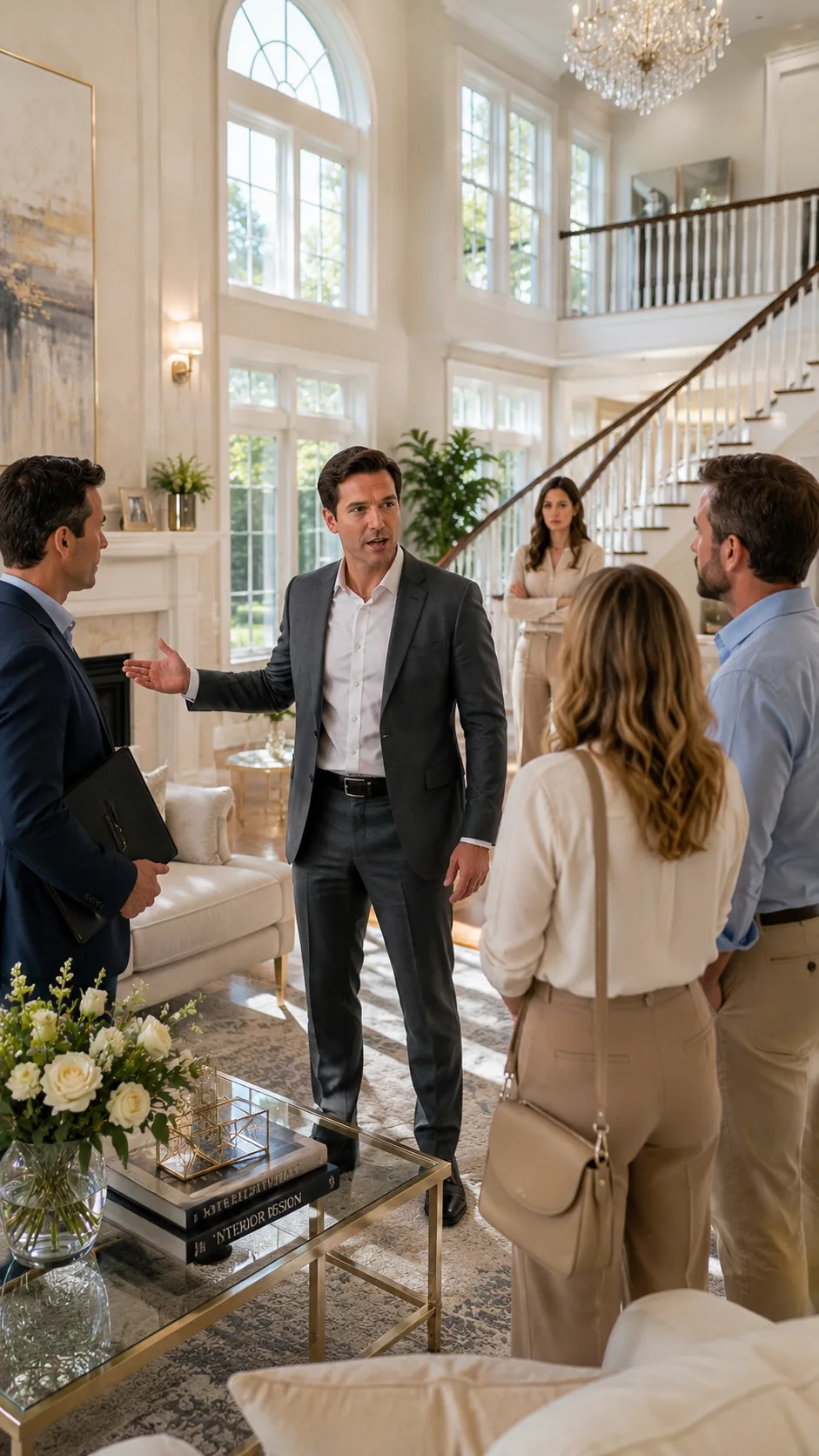
Andrew stood in the living room with Melissa, the agent, and two potential buyers. He looked polished, confident, almost cheerful.
He was pointing toward the fireplace wall.
“My mother doesn’t need this place anymore,” he said. “She’s being cared for now.”
My voice crossed the room before my feet did.
“No, Andrew. You moved me out so you could sell my memories.”
Everyone turned.
Andrew went pale.
“Mom.”
Melissa’s hand flew to her throat.
The agent closed his tablet.
I walked into the room slowly.
The house was bright and beautiful, staged with white flowers, pale rugs, and expensive pillows. Sunlight poured through the tall windows, making the whole space look innocent.
That almost made me angrier.
Some betrayals don’t happen in dark rooms.
Some happen in perfect daylight.
Andrew came toward me.
“Mom, this isn’t the time.”
I looked at the buyers.
“I’m sorry you were brought into a family matter without the truth.”
The woman buyer shifted uncomfortably.
Andrew’s voice dropped.
“Please don’t do this.”
I turned to him.
“Do what? Speak in my own home?”
His jaw tightened.
“You agreed to move.”
“I agreed to be cared for. I did not agree to be erased.”
Nobody moved.
Evelyn stood near the door with her cane. Frank held his cap in both hands. Nora clutched a tissue.
Melissa whispered, “Rose, we can talk privately.”
“We had privacy,” I said. “That was when Andrew chose not to tell me.”
Andrew’s face flushed.
“I was trying to make a hard decision easier.”
“For whom?”
“For everyone.”
I stepped closer.
“No. For you.”
His mouth tightened.
“Fine. Yes. For me. Are you happy? I’m drowning, Mom.”
There it was.
The truth finally cracked through the performance.
Melissa closed her eyes.
Andrew spread his hands.
“The business slowed down. We took out loans. Lucas’s school costs more than we expected. The mortgage on our place is behind. I didn’t want to scare you.”
“So you scared me by taking my home?”
“I thought once it sold, I could fix everything.”
I looked at him sadly.
“You did not want to fix everything. You wanted me quiet until the money arrived.”
His face twisted.
“That’s not fair.”
“No,” I said. “What you did was not fair.”
He pointed toward the stairs.
“This house is too much for you. You know it is. Dad would understand.”
A silence fell so hard even the agent looked up.
I felt Charles’s letter inside my purse.
My husband’s final protection.
My son had just made the mistake of bringing his father into the room.
I nodded to Martha.
She stepped forward.
“Mr. Bennett,” she said, “your father understood more than you think.”
Andrew looked at her.
“Who are you?”
“Martha Ellis. I represented Charles Bennett.”
Andrew’s face shifted.
“You’re retired.”
“Not from this.”
Martha placed her briefcase on the coffee table and opened it.
Andrew snapped, “I don’t want legal drama in front of strangers.”
I held up one hand.
“She doesn’t need to read anything.”
Then I reached into my purse and took out Charles’s letter.
Not the trust paperwork.
Not formal pages.
A letter.
The last voice of the man Andrew had tried to use against me.
I unfolded it.
Andrew stared.
“What is that?”
“Your father’s answer.”
He swallowed.
I read only one line.
“If the day comes when Andrew forgets your life is inside that house, use it to build something better.”
Andrew’s face drained of color.
Melissa whispered his name, but he did not answer.
I folded the letter carefully.
“Your father placed this house in a trust. You cannot sell it. You cannot promise it. You cannot trade it for your debts.”
The room went silent.
The buyers looked at Andrew with shock.
The agent muttered, “I was told authority had been cleared.”
“It has now,” Martha said.
Andrew stared at me like I had betrayed him.
That almost made me laugh.
People who steal your peace are often offended when you find the key.
“Mom,” he said, voice shaking, “you would really stop this?”
“No.”
His eyes flickered.
“What?”
“I’m not stopping the sale.”
Relief crossed his face so quickly it exposed everything.
He actually thought he had still won.
I let him have that relief for one breath.
Then I said, “I’m approving it.”
He exhaled.
“Thank God.”
“But you won’t receive a dollar.”
His relief collapsed.
Melissa’s mouth opened.
Andrew blinked.
“What did you say?”
“I’m selling the house. The proceeds will purchase a new home for seniors who have been left behind by their families.”
Evelyn began to cry quietly.
Frank looked down.
Nora covered her mouth.
Andrew stared at them, then back at me.
“You’re giving our family home to strangers?”
I stepped closer until I could see the boy he had once been hiding behind the man he had become.
“No. I’m giving it to people who still understand what a home is.”
He shook his head.
“This is insane.”
“No, Andrew. Insane is moving your mother into a facility and telling buyers she doesn’t need her memories anymore.”
“I was desperate.”
“You were trusted.”
That stopped him.
I reached into my purse and pulled out a small folded paper.
His old card.
The one I had found in a DONATE box.
The one he had written when he was eight.
I held it out.
His eyes dropped to the crayon letters.
I LOVE YOU MOM. YOU ARE MY HOME.
His face changed.
Not enough to fix anything.
But enough to show me the memory had landed.
“I kept this for thirty-four years,” I said. “You threw it into a box marked donate.”
His lips parted.
“I didn’t see that.”
“That is the problem, Andrew. You stopped seeing anything that didn’t look like money.”
Melissa began crying then.
Not loudly.
Just one hand over her mouth, eyes red.
“I told him to slow down,” she whispered.
Andrew turned on her.
“Melissa—”
“No,” she said, stepping back. “I did. But I also let it happen.”
I looked at her.
She lowered her eyes.
“I’m sorry, Rose.”
I believed she was sorry.
But sorry after discovery is not the same as love before harm.
The buyers left quietly.
The agent followed, murmuring that he would wait outside.
Now it was just family.
Or what was left of it.
Andrew sat down on the sofa as if his legs had failed.
For the first time, he looked small in that room.
“I’m going to lose everything,” he whispered.
I looked at the staircase where he had once slid down in pajamas on Christmas morning.
“No,” I said. “You are going to lose what was never yours.”
He looked up.
“And me?”
The question was soft.
Almost childlike.
I felt my heart pull toward him, because that is the curse of motherhood. Even when your child wounds you, some part of you still remembers the weight of them asleep against your chest.
But love without boundaries becomes a place where selfish people store their excuses.
“I am not gone,” I said. “But I am no longer available to be used.”
His chin trembled.
“Mom…”
I took one step back.
“Don’t call me because you need money. Don’t call me because you need a babysitter. Don’t call me because you need me to pretend this didn’t happen.”
He covered his face with one hand.
“What do I do?”
I looked at him for a long moment.
“You become the kind of man who would never do this again.”
Then I walked out.
This time, no one led me.
No one placed me.
No one decided for me.
I left my house by choice.
Three months later, the sale closed.
The buyer was a family who loved the house the moment they saw it. A young mother cried when she walked into the kitchen because it reminded her of her grandmother’s home. Her husband promised to keep the rose garden.
I asked only one thing.
“Let them grow wild sometimes,” I told him. “Charles hated when things looked too perfect.”
He smiled.
“We will.”
With the proceeds, Martha and Grace helped me purchase a large old farmhouse outside town. It had eight bedrooms, a wraparound porch, wide doorways, and enough land for a garden.
We named it Bennett House.
A Home for Those Who Were Forgotten.
Evelyn chose the curtains for the sitting room.
Frank fixed the porch swing.
Nora planted lavender by the front steps.
I took the room facing east, where the morning light came in soft and gold. Charles’s photo went on my nightstand again. My pearls stayed in a small dish beside it. His letter stayed in the top drawer.
Willow Creek was clean.
Bennett House was alive.
Every morning, someone made coffee. Every afternoon, someone complained about the television volume. Every Sunday, we cooked a real dinner.
Not fancy.
Real.
Roast chicken.
Mashed potatoes.
Green beans.
Pie if Nora was in a good mood.
Some evenings, I would stand on the porch and watch the others talk in the garden. Evelyn laughing too loudly. Frank pretending he didn’t like attention. Nora waiting less and living more.
That was when I understood Charles’s final gift.
He had not saved the house for me.
He had saved me from believing I had to remain inside anything that no longer loved me back.
Andrew came to Bennett House for the first time in late October.
I saw his car pull into the gravel driveway.
For a moment, I nearly went inside.
Then I stayed.
He got out slowly.
No suit.
No polished performance.
Just jeans, a dark jacket, tired eyes, and a paper bag in one hand.
He walked up the porch steps like a boy approaching a closed bedroom door after doing something wrong.
“Hi, Mom.”
“Hello, Andrew.”
He looked past me into the house.
“I brought your blue album.”
My breath caught.
He held out the bag.
“I found it in a storage unit. Along with some of Dad’s things. I should have brought them sooner.”
I took the bag.
“Thank you.”
He swallowed.
“I also brought the cardigan.”
My fingers tightened.
“And the ornaments. The quilt. Everything I could find.”
“That matters,” I said.
His eyes filled.
“I’m sorry.”
The words were simple.
No performance.
No explanation first.
No request attached.
Just sorry.
That made them heavier.
“I know,” I said.
He wiped his face quickly, embarrassed by his own tears.
“I sold my watch.”
I raised an eyebrow.
He gave a broken little laugh.
“Not for sympathy. I just… I started paying things down. Melissa and I are selling our house. Moving somewhere smaller.”
I nodded.
“That sounds wise.”
He looked at the porch floor.
“I told Lucas what I did.”
That surprised me.
“You did?”
“He asked why you don’t come to our house anymore. I didn’t want to lie.”
“What did you say?”
“I told him I hurt you because I cared more about fixing my problems than protecting my mother.”
My throat tightened.
“And what did he say?”
Andrew smiled sadly.
“He said I should apologize and bring cookies.”
For the first time in months, I laughed.
Andrew lifted the paper bag slightly.
“Oatmeal raisin. He said old people like those.”
I laughed harder then, and Andrew did too, though tears ran down his face.
For a few seconds, I saw my little boy again.
Not innocent.
Not absolved.
But still there.
Trying to find his way back.
“Would you like to come in?” I asked.
He looked up fast.
“Really?”
“You may come in,” I said. “But understand something, Andrew.”
He straightened.
“This house is not a place where guilt buys forgiveness. It’s a place where people learn how to show up.”
He nodded.
“I can do that.”
“I hope so.”
He stepped inside.
Evelyn watched him from the sitting room like a judge.
Frank gave him a firm nod.
Nora took the cookies, opened the bag, and said, “Oatmeal raisin? That child thinks we have no joy.”
Andrew laughed softly.
It was awkward at first.
Of course it was.
Trust does not return like a light switched on.
It returns like winter ending.
Slowly.
Unevenly.
With cold mornings even after the first warm day.
Andrew began visiting every Sunday.
At first, he stayed one hour.
Then two.
He fixed a loose cabinet. Drove Frank to a doctor’s appointment. Helped Nora set up video calls with her son, though the son still rarely answered. He sat with Evelyn while she told the same story three times and never corrected her.
One afternoon, I found him in the garden, kneeling beside the rose bushes.
He was pruning them badly.
Charles would have groaned.
I stood behind him.
“You’re cutting too much.”
He looked up.
“I know. I never learned right.”
“No,” I said. “You never listened when your father tried to teach you.”
He smiled with wet eyes.
“Will you teach me?”
I looked down at my son.
The man who had betrayed me.
The boy who had come back with cookies.
The child I loved.
The adult I no longer protected from consequences.
“Yes,” I said. “But if you ruin my roses, Evelyn will throw you out.”
He laughed.
Then he handed me the clippers.
Years ago, I thought losing my old house would destroy me.
It didn’t.
Because Andrew had been wrong about one thing from the beginning.
I did need care.
But not the kind he used as an excuse to remove me.
I needed the care of honest people.
The care of community.
The care of boundaries.
The care of a life that still belonged to me.
My old house became someone else’s beginning.
My son lost the inheritance he thought he could take.
But in time, if he kept showing up, he might earn something better.
Not my house.
Not my money.
Not my blind trust.
Maybe, one day, my peace when he entered a room.
And that would be worth far more than any key he ever tried to hold.
THE END.
Chapter complete
You have reached the end of this chapter.
Continue reading
A few more worlds to get lost in after this chapter.




