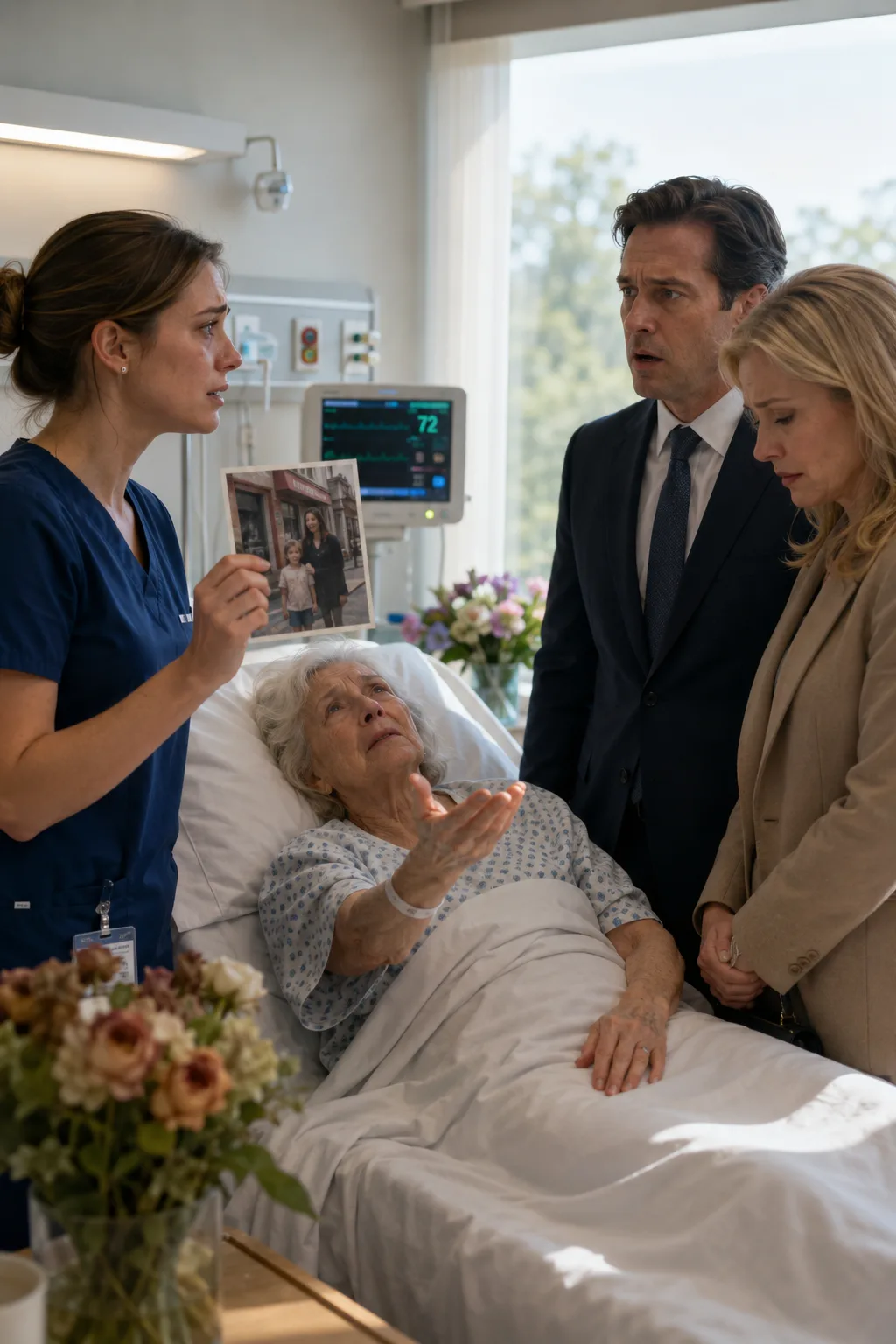
MY SON LEFT ME ALONE IN THE HOSPITAL… BUT THE ONLY NURSE WHO CAME TO SEE ME REMEMBERED WHAT I DID FOR HER YEARS AGO
PART 1
The morning my heart nearly stopped, my son sent me to voicemail.
Chapter 1
MY SON LEFT ME ALONE IN THE HOSPITAL… BUT THE ONLY NURSE WHO CAME TO SEE ME REMEMBERED WHAT I DID FOR HER YEARS AGO
PART 1
The morning my heart nearly stopped, my son sent me to voicemail.
I remember that detail more clearly than the pain.
Not the sound of the mug shattering on the kitchen tile. Not the sharp pressure spreading across my chest like someone had set a stone inside my ribs. Not even the terrifying moment when my knees gave out and I slid down against the cabinet, one hand clawing at the counter, trying to keep myself upright.
I remember the ringing.
One ring.
Two.
Three.
Then David’s calm recorded voice filled my kitchen.
“You’ve reached David Whitmore. Leave a message.”
I tried to speak, but all that came out was a broken breath.
My phone slipped from my hand and landed face-up beside the pieces of the blue mug my husband, Henry, had bought me on our twenty-fifth anniversary. The screen showed David’s smiling contact photo. He was standing in front of his lake house in a navy sweater, one arm around
his wife, Lauren, the other around their daughter, Emily.
My family.
My only family.
I pressed the call button again with a trembling finger.
This time it rang twice before the call was declined.
Declined.
I stared at the word until it blurred.
The pain tightened. I could not breathe deeply. My left arm had gone strange and heavy. Somewhere in the back of my mind, I heard Henry’s voice from years ago, the way he used to warn me whenever I lifted boxes at our bakery.
“Ellie, don’t be stubborn. Ask for help before your body asks for you.”
I almost laughed. Even dying, I was still thinking of him.
I called again.
On the third try, Lauren answered.
“Eleanor?” she said, her voice clipped, distracted. “David’s driving. What is it?”
I swallowed hard.
“Lauren… something’s wrong. My chest…”
There was a pause. In the background, I could hear
the faint hum of car speakers, some man on a business podcast talking about wealth strategy.
“Are you having anxiety again?” Lauren asked.
“No,” I whispered. “I think… I think it’s my heart.”
Another pause.
“Okay,” she said, and I heard irritation tucked beneath the word. “Then call 911.”
“I’m scared.”
“Eleanor, we’re on the way to an important lunch. I really can’t handle this right now. Just call 911, okay?”
My eyes filled with tears, but the pain was so strong I could not even cry properly.
“Can you tell David?”
“He knows you called. He’ll call you later.”
Then the line went dead.
I lay on the kitchen floor for several seconds staring at the ceiling fan. It turned slowly above me, one blade wobbling slightly. Henry had promised to fix that wobble fifteen years ago. He died before he ever got around to it. I never had
the heart to let anyone else touch it.
Somehow, I called emergency services.
I do not remember everything after that. I remember a woman’s voice on the phone telling me to stay with her. I remember the front door being forced open. I remember a young paramedic kneeling beside me and saying, “Ma’am, can you hear me?”
And I remember thinking, absurdly, that I had not cleaned the kitchen that morning.
When I woke up, I was in a hospital room.
The ceiling was white. The sheets were white. The walls were a pale gray that made everything feel colder than it probably was. A monitor beeped steadily beside me, reminding the room that I was still alive.
My throat felt dry.
A doctor stood near the foot of my bed with a tablet in his hand. He had kind eyes and a tired face.
“Mrs. Whitmore,” he said, “you had a cardiac event. A mild heart attack, but serious enough that we need to monitor you closely.”
My first thought was not about my heart.
It was about David.
“Did my son come?” I asked.
The doctor glanced toward the nurse beside him.
The nurse looked at the chart.
“No visitors yet,” she said gently.
Yet.
That small word gave me something to hold on to.
Of course David would come. He had been busy. He had an important lunch. He had a company to run. He had a wife who kept their life polished and organized. He had Emily, who was eighteen and preparing for college.
He would come when things calmed down.
That was what I told myself the first hour.
Then the second.
Then the third.
By evening, the sun had lowered behind the hospital windows, turning the room golden for a few minutes before fading into blue shadow. I watched the doorway every time footsteps passed. Nurses came and went. A man delivered meal trays. Someone laughed down the hall. A child cried in another room. An old man coughed so hard I wanted to call someone for him.
But David did not appear.
My phone sat on the bedside table. I kept looking at it like it might suddenly become kind.
At 7:12 p.m., a message came through.
David: Heard you’re stable. We’ll visit when things calm down.
I read it once.
Then again.
Then a third time.
Not “Mom, I’m on my way.”
Not “I’m sorry I missed your call.”
Not “Are you scared?”
Just: Heard you’re stable.
I turned my face toward the window because I did not want the nurse to see me crying.
But she saw.
Her name was Natalie Reed.
She came in quietly around eight, carrying a cup of water and a folded blanket. She was young, maybe late twenties, with light brown hair tied in a low bun and soft eyes that seemed to notice too much. Most nurses were kind, but busy. Natalie was different. She moved like she had made a private promise to every patient in her care.
“Mrs. Whitmore,” she said, “your hands are cold.”
I tried to smile.
“They’re always cold. My husband used to say I had winter in my bones.”
“Then we’ll bring spring back.” She spread the warm blanket over me and tucked it gently around my arms.
It was such a simple thing.
A blanket.
A cup of water.
A voice that did not sound annoyed by my need.
And somehow that broke me more than the pain had.
I covered my mouth with one hand, but a sob slipped through.
Natalie froze beside the bed.
“I’m sorry,” I whispered. “I don’t usually…”
“You don’t have to apologize.”
I looked away.
“My son will come tomorrow.”
She did not say anything.
Maybe that was why I trusted her. She did not insult me with false comfort.
The next morning, I woke to sunlight across my feet and a small vase on the table.
Inside it were three yellow daisies.
I blinked at them.
When Natalie came in to check my vitals, I looked at the flowers.
“Did someone come?”
She hesitated.
“No,” she said. “I brought those from the nurses’ station. They looked like they needed a room.”
I touched one petal with my fingertip.
“They were my husband’s favorite.”
Natalie’s expression changed, just slightly.
“Yellow daisies?”
“Yes. He said roses tried too hard.”
She smiled, but her eyes shone.
For a moment, I had the strangest feeling that she knew something about me that I did not remember telling her.
“You’re from Columbus?” she asked.
“Most of my life.”
“What did you do before you retired?”
I closed my eyes, letting the memory warm me.
“My husband and I owned a bakery. Whitmore’s Corner. Small place on Fairview Avenue. Cinnamon rolls, pies, wedding cakes when people trusted us enough.”
Natalie’s hand paused on the blood pressure cuff.
“Whitmore’s Corner,” she repeated.
“Yes. It’s gone now. Sold the building after Henry passed.”
She nodded slowly.
“My mom used to talk about that place.”
“Really?”
“She cleaned there for a while, I think.”
I turned my head toward her.
“What was her name?”
Natalie adjusted the cuff a little too carefully.
“Maria Reed.”
The name stirred something in me, but I was tired, and memory at seventy-two is like a drawer full of old ribbons. You know what is inside, but sometimes it takes a while to untangle.
“Maria,” I said softly. “Yes. She had a little girl.”
Natalie looked down.
“She did.”
Before I could ask more, another nurse called her from the hall. Natalie gave me a quick smile and said she would be back.
That afternoon, I called David.
He did not answer.
I called Emily.
She sent a text.
Grandma, Dad said you’re okay. I have college prep stuff today. I’ll come soon. Love you.
I stared at “Love you” until I almost believed it.
On the second day, no one came.
On the third day, no one came.
By then, I knew the rhythm of the hospital. Breakfast at seven-thirty. Medication at eight. Doctor rounds around ten. Lunch at noon. A volunteer with magazines around two. The cleaning woman with kind brown eyes at three. Natalie whenever she could find a reason to step into my room.
She brought me tea once, even though the hospital only had terrible tea.
“I found honey,” she said like she had stolen treasure.
“You’re spoiling me.”
“No,” she said. “I’m doing what someone should be doing.”
I looked at her then.
Really looked.
“You sound angry.”
Her mouth tightened.
“I’m not angry at you.”
“No,” I said. “I don’t suppose you are.”
She checked the monitor, but her hands were not as steady as before.
“Natalie,” I said, “do you know me?”
She stood very still.
Before she could answer, my room door opened.
David walked in wearing a dark suit and polished shoes. Lauren followed in a beige coat, carrying a bouquet wrapped in plastic from the hospital gift shop.
My heart lifted before my pride could stop it.
“David,” I whispered.
He crossed the room and kissed my forehead, too quickly.
“Hey, Mom. You gave us a scare.”
I almost said, Did I?
Instead I reached for his hand.
He let me hold it for two seconds before pulling away to move a chair.
Lauren placed the flowers on the table beside Natalie’s daisies. The plastic crinkled loudly.
“You look better than I expected,” Lauren said.
I smiled weakly.
“I’ll try not to disappoint.”
David frowned.
“Mom, don’t start.”
The warmth I had felt when he walked in began to fade.
Natalie stood near the door, watching quietly.
David glanced at her.
“Could we have a minute?”
Natalie looked at me.
I nodded, though I suddenly did not want her to leave.
She stepped out.
David sat at the foot of my bed, not close enough to touch me.
Lauren remained standing.
“We talked to the doctor,” David said.
“Did you?”
“Briefly. He says you’ll need rest and support after discharge.”
“I know.”
He leaned forward, elbows on knees, using the tone he used with clients. Reasonable. Controlled. Final.
“Mom, I think this is a wake-up call.”
I almost smiled.
My heart had nearly stopped, and my son had decided the lesson belonged to me.
Lauren opened her purse and pulled out a glossy brochure.
“We found a very nice senior living community,” she said. “Not one of those depressing places. It has gardens, activities, nurses on staff.”
I looked at the brochure as if it were written in another language.
“Senior living?”
David held up one hand.
“Just listen.”
My chest tightened, but not from the heart attack this time.
“David, I want to go home.”
“You can’t keep living alone in that house.”
“I have lived alone for seven years.”
“And look what happened.”
The words landed hard.
Lauren stepped closer.
“No one is blaming you, Eleanor. But we need to be practical. David can’t drop everything every time you have an episode.”
I stared at her.
“Every time?”
She blinked.
“I mean, as you get older.”
David looked at the floor.
“Mom, the house is too much. The stairs, the yard, the maintenance. You don’t need all that space.”
“That house is where your father died,” I said. “It’s where you took your first steps.”
His jaw tightened.
“That doesn’t make it safe.”
Lauren placed the brochure on my blanket.
“There’s also the financial side. Selling the house now would give you options.”
There it was.
Not concern.
Not love.
A plan.
I looked at my son.
“Is that why you came?”
His face colored.
“Mom.”
“Three days,” I said. “I lay here for three days waiting for you. And when you finally came, you brought a brochure.”
Lauren’s eyes narrowed.
“That is not fair.”
“No,” I said softly. “It isn’t.”
PART 2
David stood and rubbed his forehead like I was exhausting him.
“Mom, you’re emotional. That’s understandable.”
I laughed once, quietly.
“I had a heart attack, David. I’m allowed.”
Lauren crossed her arms.
“We are trying to help you.”
“No,” I said. “You are trying to arrange me.”
David looked wounded by that, which surprised me. He had hurt me so many times without noticing, but the moment I named it, he became the injured one.
“That’s not fair,” he said.
I turned my head toward him.
“Tell me what is fair. Is it fair that I called you from my kitchen floor and you declined the call?”
His mouth opened.
Lauren answered for him.
“He was driving.”
“He could have pulled over.”
“We didn’t know it was serious.”
“I said my chest hurt.”
Lauren’s face hardened.
“Eleanor, you have called before saying you felt dizzy, or lonely, or worried. Sometimes it feels like you want attention.”
The room went silent.
Even the monitor seemed louder.
I looked at David.
I waited.
I waited for him to say, Lauren, don’t talk to my mother like that.
I waited for him to remember the nights I sat beside his bed when fever made him shake. The years I packed his lunches before dawn. The money Henry and I took from our retirement to pay for his graduate school. The mornings I opened the bakery at four and still drove three hours to watch his college debates.
David said nothing.
His silence walked across the room and sat on my chest.
“So that’s what I am?” I whispered. “Attention?”
He closed his eyes.
“Mom, please don’t twist this.”
Something inside me went very still.
For most of my life, I had been a soft woman. Not weak, exactly. Just soft. I believed people had reasons. I believed love meant patience. I believed children grew away from you but came back when it mattered.
But lying in that bed, with tape on my arm and bruises from IV lines, I finally understood something Henry had tried to tell me before he died.
“Ellie,” he had said one night, his body thin beneath the quilt, “don’t let loneliness make excuses for people who know better.”
I had cried then and told him David was a good son.
Henry had only squeezed my hand.
“He is. But good people can become careless when someone loves them too easily.”
Now David stood in front of me, careless in an expensive suit.
“I want to go home,” I said.
Lauren sighed sharply.
“You are not thinking clearly.”
The door opened before I could respond.
Natalie stepped in carrying a medication tray.
She must have heard enough from the hallway, because her face was different. The softness was gone. Her eyes were wet, but her hands were steady.
Lauren turned toward her.
“We asked for privacy.”
Natalie set the tray down on the bedside table. The metal hit the surface with a sharp sound that made all three of us flinch.
“If this is family,” Natalie said, “where were you for three days?”
David stared at her.
“Excuse me?”
Natalie stepped closer to my bed.
“I was here when she woke up asking for you. I was here when she stared at that door every time shoes passed in the hallway. I was here when she tried not to cry over a text message that sounded like it came from a stranger.”
Lauren’s mouth tightened.
“You have no right to judge us.”
“I have every right to know when a patient is being pushed while she is recovering.”
David’s face went red.
“Nurse Reed, this is inappropriate.”
“So was leaving your mother alone after a heart attack.”
“Natalie,” I whispered.
She looked down at me, and the anger in her face broke into something painful.
“I’m sorry, Mrs. Whitmore. But I can’t stand here and listen to them talk about you like you’re an inconvenience.”
Lauren scoffed.
“You don’t know anything about our family.”
Natalie reached into the pocket of her scrubs.
“Yes,” she said. “I do.”
She pulled out an old laminated photograph.
The edges were worn. The plastic had scratches across it. She held it carefully, almost reverently, then placed it on my blanket.
I looked down.
For a second, I did not understand what I was seeing.
A younger version of me stood outside Whitmore’s Corner Bakery, wearing a flour-dusted apron over a blue dress. My hair was brown then, pulled back with a scarf. Beside me stood a little girl with thin arms, dark eyes, and a shy smile. I had one hand on her shoulder. Behind us, the bakery window displayed a crooked hand-painted sign Henry had made: FRESH PIES BEFORE NOON.
My breath caught.
“Maria’s daughter,” I whispered.
Natalie’s chin trembled.
“Yes.”
David looked between us.
“What is this?”
Natalie lifted the photo.
“That little girl is me.”
Lauren’s expression shifted, but she tried to hide it.
“Okay. And?”
Natalie turned toward her.
“My mother cleaned their bakery at night. She worked two jobs. Sometimes three. When I was eleven, she brought me with her because she couldn’t afford childcare.”
The memory returned so suddenly I could smell sugar and yeast.
Maria Reed had been quiet, proud, exhausted. She cleaned floors after closing, her hands cracked from chemicals. Her daughter, Natalie, used to sit at the back table doing homework under the warm bakery lights. A serious little girl with a purple backpack, always trying to stay out of the way.
“You were good at math,” I said.
Natalie laughed through tears.
“I hated math.”
“But you were good at it.”
“You gave me cookies when I finished my worksheets.”
“Only the broken ones.”
She smiled.
“You always said broken cookies tasted better because they had survived something.”
David sank slowly into the chair.
Natalie wiped her cheek with the back of her hand.
“When I was seventeen, I got accepted into a nursing program,” she said. “My mother cried for two days because she was proud and terrified. We didn’t have the money. I was going to turn it down.”
I closed my eyes.
I remembered that too.
Maria standing in the bakery office, twisting a paper napkin until it tore. Her voice shaking as she said, “Mrs. Whitmore, Natalie is smart. Smarter than me. But smart doesn’t pay tuition.”
Henry had looked at me across the desk. We did not even need to discuss it.
We paid.
Not because we were rich. We were not. We had a bakery, a mortgage, a son in college, and a roof that leaked every spring. But Henry had said, “If we can help a kid climb out of fear, we help.”
So we did.
Quietly.
Through the school.
No announcement. No gratitude required.
Natalie looked at David.
“Your mother paid my tuition for four years. Books too. Uniforms. Application fees. When my mom got sick one winter, your mother left groceries on our porch and pretended she didn’t know who did it.”
David stared at me like he had never seen my face before.
“Mom?”
I could not answer.
Natalie’s voice grew stronger.
“She told the school not to tell me who was helping. But my mother found out before she passed. She gave me this photo and said, ‘If you ever become the kind of woman people trust when they are scared, remember Eleanor Whitmore helped you get there.’”
The room blurred through my tears.
Lauren shifted uncomfortably.
“That’s very touching,” she said, though her voice had lost its sharpness. “But it doesn’t change the fact that Eleanor needs care.”
Natalie turned on her.
“You’re right. She does need care. She needed it three days ago.”
David stood.
“Lauren, stop.”
It was the first time he had corrected her.
Too late, but still, the words changed the air.
Lauren looked at him.
“David.”
“No,” he said quietly. “Stop.”
She looked shocked.
I looked at him too, but I did not feel victory. I felt tired.
David stepped closer to my bed.
“Mom, why didn’t you tell me?”
I looked at my son, my beautiful boy who had become a stranger slowly enough that I had not noticed the day it became complete.
“Because kindness isn’t a receipt,” I said.
He flinched.
“I didn’t mean—”
“I know what you meant.” I touched the photograph. “You thought I was just sitting in that house, getting older, waiting to become your problem.”
His eyes filled.
“No.”
“Yes.” My voice shook, but I kept going. “You forgot I had a life before you were busy. You forgot I had hands that built things. You forgot I had a heart that loved people who could give me nothing back.”
David covered his mouth.
Lauren looked toward the window.
Natalie stood beside me, one hand resting near mine but not touching until I reached for her.
When I did, she took my hand immediately.
That was when David broke.
Not loudly. Not dramatically. He simply folded into the chair and lowered his head, shoulders shaking.
“I’m sorry,” he said.
For years, I had imagined those words.
I had imagined David saying them after missing Christmas dinner. After forgetting my birthday until Lauren reminded him. After arriving late to Henry’s memorial dinner because a client call ran long. After leaving my porch light on for hours while I waited with soup getting cold on the stove.
I had imagined that if he ever said “I’m sorry,” something inside me would heal.
But lying there, I learned apology is not medicine when the wound is too old.
“I believe you,” I said.
He lifted his face, hopeful.
“But I don’t know what to do with it yet.”
The hope faded.
Lauren whispered, “Eleanor…”
I turned to her.
“No. You don’t get to soften your voice now.”
Her eyes widened.
I had never spoken to her that way.
Maybe I had never spoken to anyone that way.
“You called my fear attention,” I said. “You stood beside my son while he forgot me and made it easier for him. You looked at my home and saw convenience. You looked at my illness and saw an arrangement to be made.”
Lauren’s face flushed.
“I was trying to protect my family.”
“So was I,” I said. “For forty-five years.”
Emily arrived an hour later.
David must have called her, because she rushed in wearing leggings, a college sweatshirt, and mascara smudged beneath her eyes.
“Grandma!”
She ran to the bed and grabbed my hand.
For a moment, I saw the little girl who used to sleep over at my house and ask for pancakes shaped like hearts. The girl who used to call me her best friend. The girl who once cried because she thought I would be lonely after Grandpa died.
Then she grew older.
Lauren got busier managing her schedule.
David got busier making money.
And Emily learned, without anyone saying it directly, that Grandma could wait.
“I’m sorry,” she sobbed. “Dad told me you were okay. I thought—”
“You thought you had time,” I said.
She cried harder.
I squeezed her hand.
“So did I.”
Her face crumpled.
Natalie quietly stepped out to give us privacy, but before she left, Emily noticed the photograph on my blanket.
“Who’s that?”
I looked at Natalie.
Natalie paused in the doorway.
“That’s me,” she said.
Emily frowned.
“With Grandma?”
Natalie nodded.
“Your grandmother changed my life.”
Emily looked at me, stunned.
“Why didn’t I know?”
I touched her cheek.
“Because no one asked.”
PART 3
I went home six days later.
Not to David’s lake house.
Not to the senior living community with the glossy brochure and gardens Lauren had described like a resort brochure for inconvenient mothers.
I went home to my little house with the uneven porch step, the yellow kitchen, the ceiling fan that still wobbled, and the framed picture of Henry beside the fireplace.
Natalie helped me arrange a home care aide for the mornings. Emily came twice a week after her classes. David offered to stay with me the first night, but I said no.
He looked hurt.
I let him.
That was new for me.
All my life, I had treated other people’s discomfort like a fire I needed to put out. If David felt guilty, I comforted him. If Lauren felt criticized, I softened my words. If Emily forgot to call, I told her I understood. I had confused peace with love for so long that I did not recognize the difference until peace nearly killed me.
The first evening home, Natalie stopped by after her shift.
She came carrying soup in a paper bag and a small bundle of yellow daisies.
“You don’t have to keep doing this,” I told her.
“I know.”
“Then why do you?”
She placed the flowers in my old blue vase.
“Because when I was a kid, I used to sit in your bakery and pretend I wasn’t scared. You noticed anyway.”
I looked down at my hands.
“They were just small things.”
“No,” Natalie said. “They were not small to me.”
We ate soup at my kitchen table. The same table where David had done homework, where Henry rolled pie crust, where Emily once spilled grape juice and cried until I told her the stain looked like a flower.
Natalie looked around the kitchen with a soft smile.
“I remember this color.”
“The yellow?”
“You used it in the bakery office.”
“Henry hated white walls. Said they made people feel like they were waiting for bad news.”
She laughed.
For a while, we sat in the kind of quiet that does not hurt.
A week later, David came over alone.
No Lauren.
No brochure.
No business tone.
He stood on the porch holding a paper bag from the grocery store, looking awkward and much younger than forty-five.
“I brought oranges,” he said.
I looked at the bag.
“Why?”
“You used to say hospitals make people forget what real fruit tastes like.”
I had said that.
Years ago.
The fact that he remembered made my chest ache.
I let him in.
He stood in the kitchen while I sat at the table. He noticed the ceiling fan.
“I can fix that,” he said.
“Your father said the same thing.”
“I know.”
He looked at Henry’s picture.
“I miss him.”
“So do I.”
David swallowed.
“I think I avoided coming here because of him.”
I waited.
He set the oranges down.
“Every time I walk in, I feel like he’s looking at me. Like he knows.”
“Knows what?”
David leaned against the counter.
“That I became the kind of man he warned me not to become.”
I did not rescue him from that sentence.
He rubbed both hands over his face.
“After Dad died, I didn’t know how to be around you. You were so sad, and I couldn’t fix it. Then work got bigger. Lauren liked that version of me. The busy version. The important version. It was easier to stay busy than to admit I didn’t know how to be your son without Dad between us.”
That was the first honest thing he had said in years.
I looked at him and saw not just the man who left me alone in the hospital, but the boy who had stood at his father’s funeral with his fists clenched, refusing to cry because he thought I needed him strong.
“You could have told me,” I said.
“I know.”
“You still chose not to come.”
His eyes reddened.
“I know.”
“And Lauren?”
He looked toward the window.
“Lauren thinks love should be efficient.”
“That is a lonely way to live.”
“She was scared too,” he said. “Not of you. Of becoming responsible for someone she couldn’t schedule or manage.”
“I am not a calendar problem, David.”
“No,” he whispered. “You’re my mother.”
I looked at him for a long time.
“I don’t want your guilt,” I said. “Guilt comes loudly and leaves when it gets tired. I want consistency.”
He nodded quickly.
“I can do that.”
“Don’t promise. Show me.”
He cried then, but quietly.
And this time, I did reach for his hand.
Not because everything was repaired.
Because repair has to begin somewhere, and my hand was still my choice to give.
Lauren came three days later.
I almost did not open the door.
When I did, she stood on the porch in jeans and a plain sweater instead of her usual polished armor. She held nothing. No flowers. No food. No brochure.
Good, I thought. At least she did not bring a symbol to hide behind.
“May I come in?” she asked.
I moved aside.
She stepped into the living room and looked smaller than I remembered.
“I owe you an apology,” she said.
“Yes,” I answered.
She blinked, surprised by my directness.
Then she nodded.
“I was cruel in the hospital.”
“Yes.”
“I told myself I was being practical. I told myself David was overwhelmed, and I was protecting him, and someone had to make hard decisions.”
I sat in my chair.
Lauren remained standing.
“But the truth is,” she continued, “I resented you.”
That surprised me.
“Me?”
She gave a sad little laugh.
“You always seemed so… loved. Even alone, this house felt full of someone. Henry. David’s childhood. Emily’s memories. I grew up in a house where everything looked perfect and nothing felt warm. When I married David, I wanted a family I could control because I didn’t know how to belong to one.”
I studied her face.
It did not excuse what she had done.
But it made her human.
“I thought if David kept running back here, I’d lose the life we built,” she said.
“You weren’t losing him to me.”
“I know that now.” Her eyes filled. “But I acted like love was a limited amount of space.”
I looked toward Henry’s picture.
“Sometimes people who fear being left become very good at pushing others aside first.”
Lauren wiped her cheek.
“I’m sorry, Eleanor.”
This time, the words did not sound like they were trying to escape consequences. They sounded like they had cost her something.
“I hear you,” I said.
“Can you forgive me?”
I sighed.
“I don’t know yet.”
She nodded, crying harder.
“But,” I said, “you may come to dinner Sunday if you come as family, not management.”
A broken laugh slipped out of her.
“I can try.”
“Trying is better than arranging.”
Sunday dinner was strange.
David arrived early and fixed the ceiling fan. It took him twenty minutes. When it stopped wobbling, we all stood there watching it turn smoothly like it was some miracle of modern engineering.
Emily set the table.
Lauren chopped carrots badly but sincerely.
Natalie came after her shift because I invited her, and when David opened the door for her, he looked ashamed but steady.
“I’m glad you came,” he said.
Natalie looked him in the eyes.
“I came for Eleanor.”
“I know,” he said. “I’m still glad.”
That was the beginning of something—not friendship, not forgiveness, but recognition.
Over pot roast and mashed potatoes, Emily asked Natalie about nursing school. Natalie told her about studying at the bakery, about my broken cookies, about Maria working nights.
Emily listened with tears in her eyes.
“I didn’t know Grandma did things like that,” she said.
David put down his fork.
“Your grandmother did a lot of things we didn’t notice.”
I looked at him.
He did not look away.
After dinner, I brought out an old tin box from the pantry. Inside were letters, photographs, and thank-you cards I had kept over the years. Not to show off. Just because sometimes, on lonely nights, I needed proof that my life had touched other lives.
There was a card from a boy Henry had hired after he got out of trouble at school. A Christmas photo from a single father we had given free bread to during a bad winter. A postcard from a woman whose wedding cake we had made after her original baker canceled. And several notes from Natalie’s mother, Maria, written in careful English.
Natalie held one and cried.
“She never told me she wrote to you.”
“She was proud,” I said. “She didn’t like needing help.”
“She said needing help made people look down on you.”
“Then she learned the right people kneel beside you instead.”
David looked at the cards spread across the table.
“All these years,” he whispered.
I closed the tin.
“All these years, I had a whole life, David.”
He nodded.
“I know that now.”
“No,” I said gently. “You’re beginning to know.”
A month later, I returned to the hospital—not as a patient, but as a guest.
Natalie had arranged a small ceremony in one of the community rooms. I thought it was just a thank-you event for volunteers. She had been vague, and I had been too tired to argue.
When I walked in, the room was full.
Nurses. A few doctors. Former bakery customers I had not seen in years. Emily, standing with red eyes beside David and Lauren. Several people I recognized only after they came forward and told me who they had once been.
The boy Henry had hired was now a teacher.
The single father’s daughter was now a social worker.
The bride with the almost-ruined wedding cake had three children and a catering business.
And Natalie stood at the front of the room beside a small sign that read: The Eleanor Whitmore Kindness Scholarship.
I covered my mouth.
“No,” I whispered.
Natalie came to me and took both my hands.
“Yes.”
I shook my head, crying.
“I don’t have money for something like this.”
David stepped forward.
“You don’t have to.”
I looked at him.
He swallowed.
“I started it. But everyone here contributed. Emily too. Lauren helped organize it.”
Lauren gave a small, nervous smile from behind him.
David continued, his voice breaking.
“It’s for nursing students, caregivers, and people who had to work harder than the world noticed. Natalie will help choose the first recipient.”
I could not speak.
Natalie turned to the room.
“I became a nurse because someone saw me before I became anything impressive,” she said. “Mrs. Whitmore did not help me because I could repay her. She helped me because she believed a frightened girl doing homework in the corner of a bakery deserved a future.”
I pressed a hand to my heart.
This time, the ache was different.
Natalie looked at David.
“And sometimes,” she said softly, “the people closest to kindness are the last to recognize it.”
David lowered his head, tears falling freely.
Then he walked to the front.
For a moment, I was afraid he would make a speech about himself. The old David might have. He might have turned the room into proof that he was a good son after all.
But he did not.
He faced me.
“Mom,” he said, “I spent years thinking providing meant being successful somewhere else. I thought if I paid bills, answered sometimes, visited on holidays, that counted as love.”
His voice cracked.
“Then you were lying in a hospital bed, and a stranger knew your heart better than I did.”
Natalie’s eyes filled.
David looked around the room.
“She wasn’t a stranger, though. That’s what I understand now. She was family made by gratitude. Family made by memory. Family made by showing up.”
He turned back to me.
“I can’t undo the days I left you waiting. I can’t undo that hospital room. But I can spend the rest of your life showing up before someone else has to.”
I cried then.
Not because everything was perfect.
Because it was finally honest.
The first scholarship was given to a young woman named Grace whose mother worked laundry at the hospital. Grace cried so hard when Natalie handed her the certificate that I had to sit down. Afterward, she came to me and said, “I don’t know how to thank you.”
I took her hands.
“Live well,” I said. “And someday, when you can, notice someone else.”
That evening, David drove me home.
We did not talk much in the car. The sunset spread orange across the windshield. For once, he did not check his phone.
When we pulled into my driveway, he helped me up the porch steps.
At the door, he paused.
“Mom?”
“Yes?”
“When you were in the hospital… when Natalie took your hand instead of me…”
I looked at him.
“That hurt you.”
He nodded, ashamed.
“It should have,” I said.
His eyes filled again.
“I know.”
“But you are here now.”
He took a breath.
“I’ll be here Thursday too. And Sunday. And whenever you want me to fix something badly.”
I smiled.
“Your father would say you’re still terrible with tools.”
“He’d be right.”
We laughed.
A small laugh. A careful laugh.
But real.
Inside, the house smelled like lemon polish and old wood. The ceiling fan turned smoothly above us. On the kitchen table, the yellow daisies Natalie had brought days earlier were beginning to wilt, but they still held their color.
David noticed them.
“I can get fresh ones.”
I touched one fading petal.
“Not yet.”
“Why?”
“Because these still remind me someone came.”
He looked at me then, and I saw the sentence enter him fully.
Not as guilt this time.
As understanding.
He nodded.
“I’ll bring new ones before these are gone.”
And he did.
Every week after that, yellow daisies appeared on my table.
Sometimes from Natalie.
Sometimes from Emily.
Sometimes, awkwardly arranged and too tightly wrapped, from Lauren.
And sometimes from David, who no longer left them at the door and rushed away.
He came inside.
He sat down.
He asked about my day and waited for the whole answer.
It did not erase the hospital room.
Nothing could.
There are wounds that heal and still ache when it rains.
But I learned something after my heart broke in more ways than one.
Being forgotten by the people you raised can make you feel invisible.
But the love you give does not disappear just because one person fails to carry it.
Sometimes it grows quietly in someone else.
Sometimes it becomes a nurse standing beside your hospital bed with tears in her eyes.
Sometimes it becomes a scholarship.
Sometimes it becomes a room full of people you once helped, saying without words:
You were here.
You mattered.
We remember.
And sometimes, when the son who forgot you finally learns how to knock before entering your life again, you discover that forgiveness is not pretending the pain never happened.
Forgiveness is opening the door only after someone has learned how to stand there with both hands empty, asking for nothing but the chance to love you better.
My name is Eleanor Whitmore.
I was left alone in a hospital after a heart attack.
But I did not die there.
A girl I once helped came back as the woman who helped me remember who I was.
And my son, who thought he had all the time in the world, finally learned the truth every child should know before it is too late.
Mothers do not wait forever because they are weak.
They wait because they love you.
But even a mother’s heart can learn to stop waiting at the door.
And when it does, you had better be ready to knock.
THE END.
Chapter complete
You have reached the end of this chapter.
Continue reading
A few more worlds to get lost in after this chapter.




