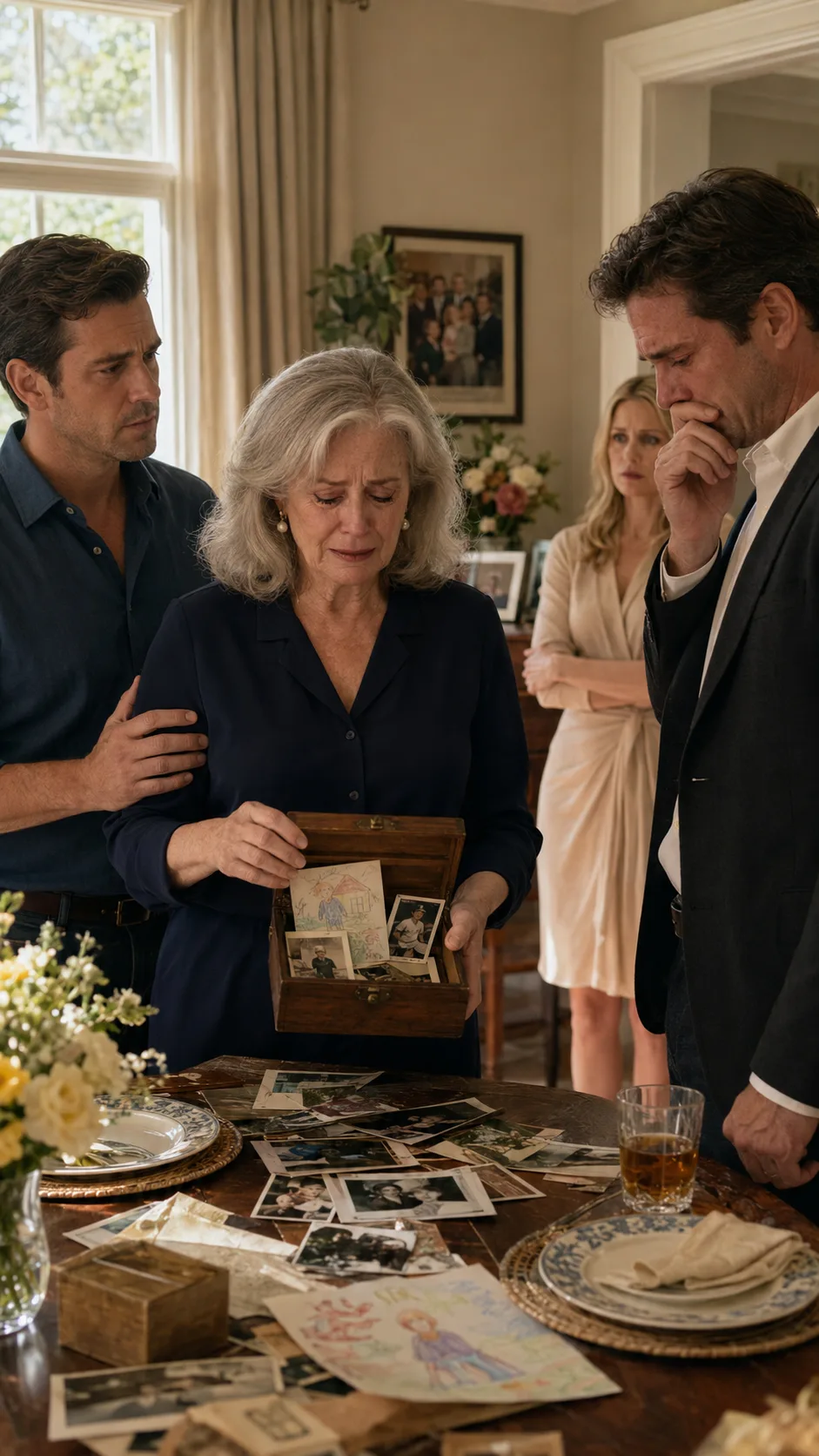
MY SON FOUND OUT I WASN’T HIS REAL MOTHER… THEN THE CHILD I LOST FOR FORTY YEARS CAME HOME
PART 1
For forty years, I believed I knew the shape of my life.
Chapter 1
MY SON FOUND OUT I WASN’T HIS REAL MOTHER… THEN THE CHILD I LOST FOR FORTY YEARS CAME HOME
PART 1
For forty years, I believed I knew the shape of my life.
It was not a grand life. It was not the kind people wrote books about or whispered over at country clubs. It was a small, steady life built in a yellow house on Maple Ridge Road in Westerville, Ohio, with a cracked driveway, white curtains I sewed myself, and a kitchen table that had survived homework, birthday candles, hospital bills, arguments, apologies, and every Sunday dinner my son ever complained about before asking for seconds.
My name is Margaret Collins.
And for forty years, my son was Ethan Collins.
I say was, not because he died.
Sometimes the living can disappear from you more cruelly than the dead.
Ethan came into my arms on a snowy January morning, wrapped in a blue hospital blanket, screaming with the kind of fury only a newborn can have. The nurse laughed and said, “He has strong lungs, Mrs. Collins.”
My husband Thomas stood
beside my bed with tears running down his face. He was a quiet man, a mechanic with grease permanently trapped beneath his fingernails and kindness permanently trapped in his bones. He took one look at Ethan and whispered, “That boy is going to change everything.”
He did.
He changed the way I slept. The way I ate. The way I prayed. The way I measured time.
Before Ethan, a year was twelve months.
After Ethan, a year was his first smile, his first fever, his first tooth, his first step across the living room rug while Thomas knelt with open arms and I screamed like he had won the Olympics.
Then Thomas died when Ethan was six.
A heart attack.
No warning. No goodbye.
One minute he was loading tools into his truck. The next minute our neighbor was banging on my front door, shouting my name like it was
breaking in his throat.
After the funeral, people came by with casseroles, sympathy cards, and advice I didn’t ask for.
“You’re still young, Margaret.”
“You’ll need help raising that boy.”
“Maybe you should sell the house.”
I smiled. I thanked them. Then I locked the door, sank to the kitchen floor, and sobbed into Thomas’s old flannel shirt while Ethan slept upstairs with a toy truck clutched to his chest.
The next morning, I got up.
Because mothers do.
I worked at the public library during the day and sewed curtains for neighbors at night. I cleaned houses on Saturdays when money got tight. I learned which bills could wait three days and which could not. I cut my own hair in the bathroom mirror. I watered down soup. I told Ethan I wasn’t hungry when there was only enough chicken for one plate.
He never knew.
At least, I
thought he never knew.
When Ethan was eight, he asked why I never bought new shoes.
I told him, “Because these still work.”
He looked down at my cracked brown flats and frowned. “When I grow up, I’m going to buy you fancy shoes.”
I laughed and kissed his forehead. “I don’t need fancy shoes.”
“Yes, you do,” he insisted. “You walk everywhere for me.”
That sentence lived in me for years.
It lived in me when I sold Thomas’s watch to pay for Ethan’s summer baseball league.
It lived in me when I stayed up until two in the morning helping him build a volcano for science class.
It lived in me when he got into Northwestern and I opened the acceptance letter in the kitchen before he came home, pressed it to my chest, and cried so hard I had to sit down.
It lived in me when I sold my wedding ring to cover the part of his tuition the scholarships didn’t touch.
Ethan never knew that part either.
I told him I had lost the ring washing dishes.
He believed me because children believe the stories that protect them from guilt.
By the time Ethan became a lawyer, people looked at us and saw a success story.
They saw a handsome man in tailored suits and a proud mother in modest dresses.
They did not see the nights I lay awake wondering if the furnace would last one more winter. They did not see the collection notices I hid in a cookie tin. They did not see me sitting in my car outside the bank, practicing how to ask for more time.
And I never wanted them to.
Because Ethan had made it.
That was enough.
For a while, he still came home on Sundays.
He would loosen his tie at my kitchen table and say, “Mom, you put too much butter in the mashed potatoes.”
Then he would take three servings.
He called me every Thursday evening on his way home from work.
“Just checking in,” he’d say.
I lived for those calls.
Then he met Vanessa.
Vanessa Parker was beautiful in a sharp, polished way. Blonde hair always smooth. Nails always perfect. Smile always measured. She worked in real estate and spoke about people the way other people spoke about houses.
Good investment.
Bad foundation.
Needs work.
The first time Ethan brought her to dinner, she looked around my house and said, “This is… charming.”
There was a pause before the word charming.
A pause that told me she had chosen it carefully because the first word in her mind had been smaller.
I tried to love her anyway.
She was going to be my daughter-in-law. She made Ethan happy, or at least she made him proud. He stood taller when she entered a room. He bought better suits. He stopped wearing the old watch Thomas had left him and replaced it with something silver and expensive.
At their wedding, I sat in the front row and cried quietly.
When Ethan danced with me, he leaned close and whispered, “Don’t cry, Mom.”
“I’m happy,” I said.
He smiled. “You always cry when you’re happy.”
That was true.
What I didn’t know then was that one day I would cry so much I would no longer be able to tell what kind of tears they were.
The change came slowly.
First, the Thursday calls became every other week.
Then Sunday dinners became “maybe next month.”
Then Vanessa started answering Ethan’s phone.
“He’s busy, Margaret.”
Not Mom.
Margaret.
At first I told myself she was just formal. Some people were like that.
Then one afternoon, I drove over with a pot roast because Ethan had texted that Vanessa was tired from a rough week. I stood on their porch holding the dish wrapped in towels, and Vanessa opened the door just wide enough to show half her body.
“Oh,” she said. “You should have called first.”
“I did,” I said softly. “Ethan said you weren’t feeling well.”
“He tells you too much.”
I laughed because I thought she was joking.
She was not.
Behind her, I heard Ethan say, “Who is it?”
Vanessa turned her head. “Your mother.”
There was another pause.
Then Ethan appeared, smiling, but not naturally. “Mom. Hey. We were just about to head out.”
I looked at his slippers.
“At six in the evening?”
His smile tightened. “Yeah. Dinner plans.”
I held out the pot roast. “Then take this for tomorrow.”
Vanessa reached for it before Ethan could. “Thank you, Margaret. That’s very thoughtful.”
She said thoughtful the way someone might say unnecessary.
On the drive home, I told myself not to be sensitive.
A lonely woman can turn small things into tragedies if she is not careful.
So I stayed careful.
I called less. I visited less. I waited to be invited.
Then, three years after their wedding, Vanessa got pregnant.
Ethan called me himself.
“Mom,” he said, and the word filled my chest with sunlight. “You’re going to be a grandmother.”
I sat down hard on the edge of my bed.
“Oh, Ethan.”
For the first time in years, he sounded like my boy again.
He laughed. “Don’t cry.”
“I’m not,” I lied.
Vanessa’s pregnancy changed everything for a few weeks. She allowed me to come over. She asked about Ethan as a baby. She accepted the tiny yellow blanket I had knitted.
Then one night at dinner, she placed her hand over her stomach and said, “We’re doing a full family health screening.”
Ethan nodded. “Genetic risks, inherited conditions, that kind of thing.”
I said, “Of course. Whatever helps the baby.”
Vanessa watched me over her glass of water. “They’ll need samples from close family members.”
“Anything you need,” I said.
Ethan reached across the table and squeezed my hand. “Thanks, Mom.”
That was the last time he touched me without hesitation.
The test was simple. A cheek swab. A little plastic tube. A form I barely read because Vanessa handled everything.
Weeks passed.
Then, on a rainy Tuesday afternoon in April, Ethan asked me to come over.
His voice sounded strange.
“Is everything all right?” I asked.
“Just come, please.”
When I arrived, Vanessa was sitting at the dining table with a folder in front of her. Ethan stood by the window, one hand on his hip, the other covering his mouth.
My heart started to beat wrong.
“What happened?” I asked. “Is the baby okay?”
Vanessa looked up.
“The baby is fine.”
I turned to Ethan. “Then what is it?”
He wouldn’t look at me.
Vanessa opened the folder and slid a paper across the table.
“Maybe you should explain this.”
I stared at the paper.
There were charts. Percentages. Words I recognized but could not arrange into meaning.
Ethan finally spoke.
“You’re not my biological mother.”
The room made a sound.
Or maybe I did.
I gripped the back of a chair. “What?”
Vanessa leaned back. “The DNA comparison shows no maternal match.”
“No,” I said. “That’s impossible.”
Ethan turned then. His face looked like someone had taken my son and carved him out from the inside.
“I thought that too.”
“There must be a mistake.”
“We ran it twice,” Vanessa said.
I looked at her. “Twice?”
Her eyes did not soften. “The first result was strange, so I requested confirmation.”
I looked back at Ethan. “You tested again without telling me?”
His jaw tightened. “I needed to know the truth.”
“The truth?” I whispered. “Ethan, I gave birth to you.”
Vanessa’s mouth moved slightly, almost a smile. “Apparently not.”
I stepped back as if she had slapped me.
Ethan said, “Did you know?”
The question hit harder than the paper.
I stared at him. “How can you ask me that?”
“Because someone had to know.”
“Not me.”
“Then how does this happen?” His voice rose. “How does a woman raise a child for forty years and not know he isn’t hers?”
I couldn’t answer.
Not because I was guilty.
Because my whole life had just cracked open beneath my feet.
I remembered the blue blanket. The nurse. Thomas crying. Ethan’s tiny fist wrapped around my finger. His first fever. His first word. His little arms around my neck after nightmares.
No test could erase that.
But the way Ethan looked at me told me it already had.
“I am your mother,” I said.
Vanessa stood. “Margaret, maybe biologically—”
“Don’t,” I said.
My voice was quiet, but she stopped.
I looked at Ethan. “Whatever that paper says, I am your mother.”
He looked away.
That was when I knew.
The test had not taken my son from me.
He had stepped away on his own.
PART 2
For the first three days after the DNA results, Ethan did not call.
I told myself he needed time.
I told myself shock can make people cruel.
I told myself a mother waits.
On the fourth day, I called him.
He didn’t answer.
On the fifth day, I sent a text.
No response.
On the sixth day, I drove to his house with a container of chicken soup because old habits are stubborn and love is foolish.
Ethan opened the door.
He looked tired.
For one beautiful second, I thought he might fall into my arms.
Instead, he stepped onto the porch and pulled the door almost closed behind him.
“Margaret,” he said.
Not Mom.
Margaret.
The container shook in my hands.
“I made soup,” I said, because the truth was too large to carry. “For Vanessa.”
His eyes dropped to it. “You shouldn’t have come.”
“I’m still your mother.”
He inhaled slowly. “I don’t know what you are right now.”
A neighbor’s dog barked somewhere down the street.
I remember that sound because sometimes the mind saves useless details when the heart is being destroyed.
“You don’t know what I am?”
He rubbed his forehead. “I don’t know who I am. I don’t know where I came from. I don’t know what was real.”
I held out the soup.
“This was real.”
He did not take it.
The door opened wider behind him, and Vanessa appeared.
“Ethan,” she said, “this isn’t healthy.”
Healthy.
As if I were an infection.
I looked past him at her. “I’m not here to upset anyone.”
“Then why are you here?”
“Because my son is hurting.”
Vanessa placed a hand on Ethan’s shoulder. “My husband is processing a major betrayal.”
I looked at Ethan, waiting.
He said nothing.
That silence did something to me no insult could have done.
I set the soup on the porch.
“Eat before it gets cold,” I said.
Then I walked back to my car with my hands empty and my chest burning.
That night, I opened the closet in the guest room where I kept Ethan’s childhood things. His baseball trophies. His school essays. The clay handprint he made in kindergarten. The Halloween costume I had sewn when he wanted to be an astronaut and we couldn’t afford a store-bought suit.
At the bottom of the closet was a wooden keepsake box Thomas had made when Ethan was born.
Inside was Ethan’s hospital bracelet.
I held it under the lamp.
Baby Boy Collins.
January 14.
Six pounds, nine ounces.
But beneath the bracelet, tucked inside an old envelope, was something I had forgotten existed.
A photograph from the hospital nursery.
Rows of newborns behind glass.
Thomas had taken it the day after Ethan was born because he thought all babies looked like angry potatoes and wanted proof.
I almost smiled.
Then I saw the bassinet next to Ethan’s.
Another baby boy.
The card was blurry, but I could make out the last name.
Harper.
My hands went cold.
The next morning, I called the hospital.
It had closed eighteen years ago.
The records had been transferred, archived, digitized, misplaced, redirected, and buried under enough bureaucracy to make grief feel efficient by comparison.
For two weeks, I made calls.
I spoke to women named Linda, Marcy, Judith, and one man who told me I needed a case number for a case no one would open.
Finally, a retired nurse from a Facebook group messaged me.
You’re looking for Grace Miller. She worked maternity that winter.
Grace lived in Dayton.
She was seventy-two, widowed, and according to her profile picture, fond of cardinals and church bake sales.
I drove to her house on a Thursday morning.
When she opened the door, she smiled politely until I said my name.
Then the smile died.
“You should come in,” she whispered.
Her living room smelled like lemon polish and old paper. She offered coffee. I couldn’t drink it.
I placed the nursery photo on her table.
“I need to know what happened.”
Grace sat across from me.
For a long time, she said nothing.
Then she covered her mouth with one trembling hand.
“I wondered if this day would come before I died.”
My breath caught.
“So there was something.”
She closed her eyes. “There was a snowstorm that night. The worst I had seen in years. Power flickered. Backup generators kicked on, then failed for nearly six minutes. We had three emergency deliveries, two nurses out sick, one doctor covering too many rooms.”
I waited.
“Two boys were born within eleven minutes of each other,” she continued. “Your son and the Harper baby. Same weight almost. Same dark hair. Both wrapped in blue blankets.”
My nails dug into my palms.
“Don’t say it like that,” I whispered.
Grace opened her eyes, wet and red.
“I noticed the bracelets looked wrong the next morning.”
The room tilted.
“You noticed?”
“I was twenty-nine. I had two children. I needed that job. When I told the head nurse, she said I was confused. She told me to keep my mouth shut unless I wanted to ruin families and lose my career.”
“So you let us take home the wrong babies?”
Her face crumpled. “I was a coward.”
I stood so fast the chair scraped behind me.
“I buried my husband with pictures of a son who wasn’t his blood. I sold my wedding ring for a child I loved with everything in me while another woman raised mine. Do you understand what you stole?”
Grace sobbed. “Yes.”
“No, you don’t.”
I grabbed the nursery photo, but my hand shook so badly I nearly tore it.
Grace reached for a small notebook on the side table.
“I wrote things down,” she said. “Not officially. Just names. Dates. What I remembered. I thought maybe one day…”
“One day what? Your conscience would become useful?”
She flinched.
I hated that I had become cruel.
I hated more that she deserved it.
She wrote a name on a piece of paper.
Daniel Harper.
Under it, an address in Chicago.
“I checked once,” she said. “Years ago. He became a doctor.”
My knees weakened.
A doctor.
My son.
My son?
The word felt impossible and sacred and wrong.
On the drive home, I pulled over twice because I couldn’t see through my tears.
I had lost Ethan.
Now I had discovered I had lost someone else first.
For forty years, there had been a child in the world with Thomas’s blood and maybe his eyes, and I had not sung to him, not held him through fever, not packed his lunch, not kissed his scraped knees.
That night, Ethan finally called.
For one wild second, I thought he knew. I thought some invisible thread had pulled him back to me.
But his voice was cold.
“Vanessa and I think we should talk about your estate plan.”
I sat down slowly.
“My what?”
“Your will. The house. Everything. We need clarity.”
I almost laughed.
Not because it was funny.
Because pain had become absurd.
“You just found out I may not have given birth to you, and your concern is my house?”
“That’s not fair.”
“No, Ethan. None of this is fair.”
He exhaled sharply. “I’m not trying to take anything. I just think boundaries matter.”
“Boundaries?”
“You have another family out there, apparently.”
The words stunned me.
“How did you know?”
A pause.
“Vanessa saw your messages on Facebook when you used her laptop last week.”
Of course.
I closed my eyes.
“So she knows about Daniel.”
“She thinks you’re trying to replace me.”
“And what do you think?”
Silence.
Then Ethan said, “I think I need to protect my family.”
I looked around my little kitchen, at the wallpaper Ethan had once spilled orange juice on, at the chair where Thomas used to sit, at the wall marked with pencil lines measuring Ethan’s height from age four to sixteen.
“I was your family,” I said.
He said nothing.
A week later, a letter arrived in my mailbox.
The return address was from Chicago.
My hands trembled before I opened it.
Dear Mrs. Collins,
My name is Daniel Harper. I believe we may need to talk.
I read the sentence three times.
He wrote that his adoptive mother had recently died and, while sorting through her things, he found old hospital paperwork that did not match what he had been told. He had taken a DNA test through a genealogy site. When I uploaded my sample after Grace’s confession, we matched.
Mother and son.
The words appeared on the screen in black and white.
But unlike the first test, this one did not take a child from me.
It opened a door.
Daniel asked if he could visit.
I cleaned the house like the president was coming.
I baked lemon cake because Thomas had loved lemon cake and I had no idea whether Daniel did. I changed clothes three times. I put on lipstick, wiped it off, then put it on again.
When the doorbell rang, I froze.
A grown man stood on my porch holding a bouquet of white tulips.
He was tall, with dark hair threaded slightly with gray at the temples. His eyes were blue.
Thomas’s eyes.
He looked at me for one second, and his face changed in a way that made my hand fly to my mouth.
“Oh,” he whispered.
I nodded, crying before I could speak.
He held out the flowers like a nervous schoolboy. “I didn’t know what to bring.”
I laughed through tears. “You brought yourself.”
His eyes filled.
Then he said the word that broke me open.
“Mom?”
Not loudly.
Not confidently.
Like he was asking permission from a wound.
I stepped forward and touched his face.
“I’m here,” I said. “I’m so sorry I wasn’t there before.”
Daniel folded into my arms.
He was forty years old.
He was a doctor.
He was a stranger.
He was my baby.
And he cried like someone who had been waiting his whole life to come home.
PART 3
Daniel stayed for dinner that first night.
He ate two slices of lemon cake and admitted he hated lemon-flavored desserts but didn’t want to hurt my feelings.
I laughed so hard I cried again.
“Your father loved lemon cake,” I told him.
Daniel looked down at his plate.
“My father,” he repeated softly.
I showed him pictures of Thomas. Daniel studied each one like he was trying to memorize a country he had been exiled from before birth.
“He had my eyes,” Daniel said.
“You have his stillness,” I told him. “When you listen, you don’t move. Thomas did that.”
Daniel smiled, but it trembled.
He told me about the Harpers.
His adoptive father had been distant, a man who believed providing money counted as love. His adoptive mother, Elaine, had been polite but cold. She had never hugged easily. Never saved school projects. Never attended pediatric residency graduation because she had a garden club trip already planned.
“I used to think something was wrong with me,” Daniel said. “Like there was some language of belonging everyone else spoke and I couldn’t learn.”
I reached across the table and took his hand.
“Nothing was wrong with you.”
His fingers tightened around mine.
“I know that now,” he said. “But I wish I had known it when I was ten.”
That sentence stayed with me.
After he left for his hotel, I sat at the kitchen table surrounded by two sons.
Ethan in photographs.
Daniel in blood.
And me somewhere between them, torn not in half, but into thirds: the mother I had been, the mother I should have been, and the woman I needed to become.
News of Daniel reached Ethan quickly.
Vanessa made sure of that.
She called me two days later.
Not Ethan.
Vanessa.
“We need to talk,” she said.
“About what?”
“About this man staying in your life.”
“This man is my son.”
“He is a stranger.”
“So am I, apparently.”
She sighed. “Margaret, don’t be dramatic.”
I almost smiled at the nerve.
“You helped my son stop calling me Mom. I think I’ve earned a little drama.”
Her voice hardened. “Ethan is vulnerable right now. Daniel showing up and calling you Mom is confusing for him.”
“Ethan is forty years old.”
“He’s hurt.”
“So am I.”
“You don’t understand. He feels replaced.”
I looked at the wooden keepsake box on the shelf.
“No,” I said. “He feels what it is like to step away and find someone still standing there.”
That evening, Ethan texted.
Dinner Sunday?
Two words.
After weeks of silence, two words were supposed to reopen the door he had slammed in my face.
I stared at the message for a long time.
Then I replied.
Yes. Daniel will be here.
Ethan did not respond.
Sunday came with bright cold sunlight.
I cooked pot roast, mashed potatoes, green beans, and apple pie because apparently I only knew how to prepare for heartbreak by feeding it.
Daniel arrived early. He wore a blue shirt and brought flowers again.
“You don’t have to keep bringing me flowers,” I said.
“I missed forty years,” he answered. “I’m behind.”
I had to turn away.
Ethan and Vanessa arrived fifteen minutes late.
Ethan stepped inside and stopped when he saw Daniel helping me carry dishes to the table.
His eyes moved to Daniel’s hand near my elbow.
Vanessa noticed too.
Her mouth tightened.
Dinner began politely, which is to say falsely.
Daniel asked about Ethan’s work. Ethan gave short answers. Vanessa moved food around her plate and watched everything.
Finally, Ethan set down his fork.
“So,” he said, “how long are we pretending this is normal?”
I froze.
Daniel put down his glass.
Vanessa leaned back slightly, as if she had been waiting for the show to begin.
I said, “Ethan.”
“No, let’s say it.” He looked at Daniel. “You found her. Congratulations.”
Daniel’s face remained calm. “I didn’t come here to take anything from you.”
Ethan laughed once. “Really? Because you’re sitting in my mother’s house, eating my childhood dinner, calling her Mom.”
My childhood dinner.
My mother’s house.
After weeks of Margaret, suddenly I belonged to him again because Daniel was in the room.
I felt something inside me stand up.
Vanessa spoke before I could.
“Ethan has a right to feel uncomfortable. This happened very fast.”
Daniel looked at her. “Forty years is not fast.”
She flushed.
Ethan pushed back his chair.
“You don’t know us.”
Daniel’s voice stayed low. “I know she kept a box of your life in her closet.”
Ethan looked at me.
I stood slowly and walked to the cabinet.
“No,” Ethan said. “Mom, don’t.”
Mom.
The word hit the room like glass breaking.
Vanessa noticed. Daniel noticed. Ethan noticed himself.
I took down the wooden keepsake box and carried it to the table.
My hands were steady.
For once, they were steady.
I opened the lid.
Inside were all the pieces of a boy who claimed not to know what was real.
His hospital bracelet.
His first tooth in a tiny envelope.
A crayon drawing of me with enormous yellow hair.
A baseball card he had cried over losing until I found it behind the dryer.
A letter from summer camp written in pencil.
I picked that one up.
“Dear Mom,” I read, my voice shaking. “Camp is okay but not as good as home. Please don’t forget me. I know you won’t but I miss you. Love, Ethan.”
Ethan’s face changed.
Vanessa reached toward the letter. “This isn’t helpful.”
Daniel’s hand came down on the table, not hard, but firm enough that she stopped.
“Don’t touch that.”
She stared at him. “Excuse me?”
He looked at her with a quietness that cut deeper than shouting.
“You don’t get to dismiss the proof of someone else’s love just because it makes your argument smaller.”
Ethan looked from Daniel to me.
I placed the letter in front of him.
“You asked what was real,” I said. “That was real.”
His mouth opened, then closed.
I lifted the baseball card. “This was real.”
I lifted the drawing. “This was real.”
Then I touched my chest.
“And I was real.”
Ethan’s eyes filled, but he blinked hard.
“You don’t understand what it felt like,” he said. “Finding out my whole life started with a mistake.”
Daniel stood then.
His chair did not scrape. He moved carefully, like a man holding back years of pain.
“You think you’re the only one?” he asked.
Ethan stared at him.
Daniel reached into his jacket and pulled out a small photograph.
He placed it on the table.
A little boy stood beside a birthday cake. No adults around him. No arms around his shoulders. His smile looked practiced.
“That’s me at seven,” Daniel said. “My adoptive mother forgot I hated chocolate cake. She got it every year because my adoptive father liked it.”
The room went quiet.
Daniel touched the edge of the photo.
“I had food. Clothes. Good schools. I became a doctor. People called me lucky.” He looked up, and his eyes were wet now. “But nobody kept my drawings. Nobody remembered I was scared of thunderstorms. Nobody sat outside my bedroom door after nightmares. Nobody sold a wedding ring to keep me in college.”
Ethan looked at me sharply.
I closed my eyes.
“Wedding ring?” he whispered.
Vanessa frowned. “What wedding ring?”
Ethan was staring at my bare left hand.
“You told me you lost it.”
“I did,” I said.
“No.” His voice cracked. “You sold it?”
I didn’t answer.
I didn’t have to.
The silence answered for me.
Ethan sank back into his chair as if something had struck his knees.
“All these years,” he whispered.
I said, “I didn’t want you carrying the cost of my love like a debt.”
Vanessa stood abruptly.
“This is exactly what I mean. She turns sacrifice into guilt.”
I looked at her.
For the first time, I saw her clearly.
Not as the woman who stole my son.
As a woman terrified of any love she could not measure, control, or profit from.
“What are you afraid of, Vanessa?” I asked.
She stiffened. “I’m not afraid.”
“Yes, you are. Since the day you met me, you acted like there wasn’t enough room for both of us in Ethan’s life.”
She laughed coldly. “That’s ridiculous.”
Daniel spoke quietly. “Then why did you run the second DNA test before telling either of them?”
Ethan turned.
“What?”
Vanessa’s face drained.
I looked at Daniel.
He continued, “The report had a timestamp. The confirmation test was requested under your email, Vanessa. Three days before Margaret knew anything.”
Ethan stood.
“You told me the lab automatically checked it.”
Vanessa crossed her arms. “Because I knew you’d panic.”
“You lied.”
“I protected us.”
“From my mother?”
“From a woman who might not be your mother!”
The sentence exploded across the room.
I flinched.
Ethan did too.
Daniel’s jaw tightened.
Vanessa pointed at the keepsake box.
“She had you wrapped around her finger. Every decision, every holiday, every emergency, there was Margaret. I was your wife, but she was always the saint in the room.”
Ethan stared at her like he had never seen her before.
“You pushed me away from her.”
“I helped you see the truth.”
“No,” he said. “You used the truth when I was too hurt to question you.”
Her face hardened. “And now what? You run back because she saved old papers?”
Ethan looked at the letter on the table.
Then at me.
Then at Daniel.
His voice dropped.
“No. I come back because I forgot who loved me before I knew how to earn it.”
Vanessa’s eyes flashed, but for the first time, she had no answer.
I wanted to run to Ethan then.
Every instinct in my body screamed for it.
My boy was crying.
My boy was hurting.
But another part of me, a quieter part born from weeks of being called Margaret, held me still.
Ethan stepped toward me.
“Mom,” he said.
The word broke in his mouth.
I closed my eyes.
I had imagined this moment so many times. I imagined forgiving him immediately. Holding him. Telling him it was okay.
But it was not okay.
Love can survive a wound and still need time to stop bleeding.
I opened my eyes.
“I love you,” I said. “I will always love you.”
He nodded, tears running now.
“But you do not get to return only because you are afraid Daniel will stay.”
His face crumpled.
“I know.”
“You do not get to call me Mom when you need comfort and Margaret when you need distance.”
“I know.”
“And you do not get to make my love compete with blood.”
Ethan covered his mouth with one hand.
Daniel looked down, giving us the privacy of his silence.
I reached for Ethan’s childhood letter and pressed it into his hand.
“You want to know who you are?” I asked. “Start with the boy who wrote this. Then become the man he thought he would be.”
Ethan broke then.
Not loudly.
Not dramatically.
He folded into the chair and sobbed like a child who had finally reached the end of pretending he wasn’t lost.
Vanessa whispered, “Ethan…”
He shook his head.
“Don’t.”
She stepped back.
For the first time, I saw fear in her face.
Not fear of losing money.
Not fear of losing status.
Fear of losing control over the story.
But the story had changed.
Weeks passed.
Ethan moved into the guest room at his house while he and Vanessa tried to decide what kind of marriage remained after so much resentment had been dressed up as protection. I did not ask for details. Some things a mother has no right to enter unless invited.
He began calling every Thursday again.
The first time, he said, “Hi, Mom,” and then cried so hard he had to hang up.
The second time, he stayed on the phone for twenty minutes.
The third time, he asked if he could come fix the loose railing on my porch.
I said yes.
Daniel drove from Chicago twice a month at first, then every other weekend. He learned I liked tea too hot and toast too dark. I learned he hated lemon cake, loved baseball, and still touched doorframes during thunderstorms as if checking whether the house would hold.
One Saturday, he found the height marks on the kitchen wall.
Ethan’s name was written there in pencil from age four to sixteen.
Daniel stood in front of them for a long time.
“I don’t have anything like this,” he said.
The grief in his voice was quiet, but it filled the room.
I picked up a pencil.
He looked at me. “What are you doing?”
“How tall are you?”
He laughed, but tears came fast.
“Mom, I’m forty.”
“And I’m late,” I said. “Stand straight.”
So Daniel Harper, pediatrician, grown man, lost son, stood against my kitchen wall while I marked his height beside Ethan’s sixteen-year-old line.
Then I wrote:
Daniel, age 40. Home.
He covered his face.
I hugged him from behind because that was all I could reach.
On Thanksgiving, both of my sons came.
Ethan arrived first with a pie from a bakery because he still couldn’t bake. Daniel arrived next with flowers, as always. Vanessa did not come. Ethan said they were taking time apart. His voice was sad, but clearer than before.
During dinner, there were awkward pauses.
Of course there were.
You do not repair forty years of hidden truth and six weeks of heartbreak with turkey and cranberry sauce.
But Ethan passed Daniel the gravy.
Daniel asked Ethan about his job.
Ethan asked Daniel about the children at his clinic.
No one performed happiness.
That made it feel more real.
After dinner, Ethan helped me wash dishes.
For a while, we stood side by side in silence, the way we had when he was a teenager pretending not to enjoy being near me.
Then he said, “I found something.”
I turned off the faucet.
“What?”
He dried his hands and pulled a folded piece of paper from his pocket.
It was old and soft at the creases.
“I wrote this when I was eight,” he said. “I found it in a box at home.”
He handed it to me.
In crooked pencil letters, it said:
When I grow up, I will buy Mom fancy shoes because she walks everywhere for me.
I pressed the paper to my mouth.
“I forgot about this,” I whispered.
“I didn’t,” he said.
I looked at him.
His eyes were wet.
“I remembered it the night you told me about the ring. I remembered your shoes. The brown ones with the cracked sides.” He laughed once, painfully. “I remembered thinking I’d save you someday.”
“You were a child.”
“I became a man and let you stand on my porch holding soup while I called you Margaret.”
My throat closed.
He knelt then.
Right there on my kitchen floor.
“Ethan, get up.”
“No.” He looked up at me, crying openly. “Not until I say this. You were my mother when I was sick. You were my mother when Dad died. You were my mother when I was scared, selfish, proud, and cruel. If blood is the only thing I understand, then I understand nothing.”
I touched his face.
He leaned into my hand like the boy he had been.
“I don’t deserve you,” he said.
“No,” I whispered. “But love was never about deserving.”
Behind us, from the dining room doorway, Daniel said softly, “That part I’m still learning.”
Ethan stood slowly and turned to him.
For a second, both men simply looked at each other.
Then Ethan said, “I’m sorry.”
Daniel nodded. “Me too.”
“For what?”
“For having what you lost.”
Ethan shook his head. “You didn’t take her from me.”
Daniel’s eyes shifted to me.
“No,” he said. “I think she was always big enough for both of us.”
That was when I finally cried happy tears again.
Months later, I changed my will.
Not because Vanessa had been wrong to fear it.
Because she had been wrong about why.
I left part of my estate to Ethan, part to Daniel, and part to a foundation named after Thomas. The Collins Family Truth Fund helped families separated by hospital mistakes, adoption secrecy, and buried records find answers with counseling before and after the truth came out.
At the small opening ceremony, Ethan stood on one side of me and Daniel on the other.
A reporter asked, “Mrs. Collins, after everything, how do you define motherhood?”
I looked at Ethan, the son I raised.
I looked at Daniel, the son I lost.
Then I looked down at my hands, older now, softer, marked by years of work no test could measure.
“Motherhood is not one thing,” I said. “It is blood sometimes. It is choice sometimes. It is sacrifice often. But mostly, it is staying. And when you fail to stay, it is having the courage to come back differently.”
Ethan lowered his head.
Daniel took my hand.
That evening, after everyone left, I returned home to the yellow house on Maple Ridge Road.
The porch railing was fixed.
There were white tulips on the table.
Two cars sat in the driveway.
Inside, Ethan was setting plates while Daniel overcooked the green beans and insisted doctors were allowed to be bad at vegetables.
For a moment, I stood unseen in the doorway.
My life had not returned to the shape I knew.
That life was gone.
The son I raised had broken my heart.
The son I lost had come home with his own broken pieces.
And I, who thought motherhood had been taken from me by a test result, had discovered something no paper could hold.
A mother can lose the truth.
She can lose years.
She can even lose the child she thought would never turn away.
But love, real love, does not vanish just because blood changes the story.
It waits.
It grieves.
It learns boundaries.
It opens the door when the apology is real.
And sometimes, after forty years of silence, it hears a grown man say “Mom” for the very first time and realizes the heart has rooms it never knew were empty.
Ethan saw me standing there and smiled carefully.
“Dinner’s almost ready, Mom.”
Daniel looked up from the stove. “He’s lying. I ruined the beans.”
I laughed.
The sound surprised all three of us.
Then I walked into the kitchen, between my two sons, and for the first time in a long time, I did not feel like a woman waiting to be chosen.
I felt like a mother.
Not because one child had my blood.
Not because one child had my history.
But because both of them, in their own wounded, imperfect ways, had finally come home.
THE END.
Chapter complete
You have reached the end of this chapter.
Continue reading
A few more worlds to get lost in after this chapter.




