AT 71, I REMARRIED—AND MY SON CALLED MY FIANCÉ A GOLD DIGGER IN FRONT OF EVERYONE
PART 1 — THE WOMAN EVERYONE THOUGHT WAS FINISHED
For eight years after my husband died, I ate breakfast at a table built for twelve.
Chapter 1
AT 71, I REMARRIED—AND MY SON CALLED MY FIANCÉ A GOLD DIGGER IN FRONT OF EVERYONE
PART 1 — THE WOMAN EVERYONE THOUGHT WAS FINISHED
For eight years after my husband died, I ate breakfast at a table built for twelve.
Every morning, I sat at the far end of that long walnut table in my house in Greenwich, Connecticut, with a silver coffee pot beside me and silence sitting across from me like an unwanted guest. The house had seven bedrooms, a glass sunroom, a library my late husband Henry had loved, and a garden so beautiful that people used to stop outside the gate just to look at the roses.
But beauty does not answer when you say good morning.
Money does not ask if you slept well.
And a big house can feel like a punishment when every room remembers someone who is gone.
My name is Rose Anderson. I was seventy-one years old when I learned that loneliness has a sound. It sounds like your own fork touching a china plate. It sounds like the heating system clicking on in an empty hallway. It sounds like your
son saying, “Sorry, Mom, we can’t come this weekend,” for the sixth weekend in a row.
My only son, Michael, was forty-two, handsome, polished, and always busy. He lived twenty minutes away with his wife, Lauren, and their two children. He drove a black Range Rover I paid for, lived in a house whose down payment came from me, and ran a boutique investment firm that somehow needed rescuing every year around tax season.
But if you asked him, he was self-made.
“Mom, you know I hate asking,” he would say whenever he needed money.
And I would pretend to believe him.
After Henry died, I became useful to my family in a very specific way. I was not asked to babysit because Lauren said the children had “structured schedules.” I was not invited to dinners unless it was a holiday. I was not consulted about family plans.
But when
Michael’s business loan came due, suddenly my phone rang.
When my granddaughter wanted private school, suddenly I was “Grandma Rose” again.
When Michael and Lauren wanted to renovate their kitchen, they invited me over for lunch and seated me in the middle of the construction zone, smiling like angels.
I knew what they were doing. Of course I knew.
A woman does not survive a marriage, motherhood, widowhood, and the business world without learning how to read a room.
But I loved my son. And love can make a fool of even an old woman who knows better.
Then I met Thomas Whitmore.
It happened at a hospital charity luncheon. I almost didn’t go. My friend Diane had dragged me there, insisting that I needed to “put on lipstick and stop haunting my own house.”
I wore a cream pantsuit, pearls, and my wedding ring, because after forty-six years of
marriage, my hand still felt naked without it.
Thomas was seated beside me at table eight.
He was seventy-four, tall but slightly stooped at the shoulders, with silver hair, warm blue eyes, and a quiet way of listening that made people speak more honestly than they intended. He did not introduce himself with titles. He did not ask what neighborhood I lived in. He did not glance at my jewelry, my watch, or the name printed on the donor card in front of my plate.
He simply looked at me and said, “You don’t seem very impressed by the chicken.”
I laughed for the first time that week.
“It tastes like it was threatened with seasoning but escaped,” I said.
He smiled. “That is the most accurate review I’ve heard today.”
By dessert, we were talking like old friends. He told me he had lost his wife eleven years earlier. I told him Henry had been gone eight years. We talked about grief the way people do when they are too tired to pretend it is noble. We talked about the strange cruelty of still wanting to be touched when everyone assumes age has cured you of needing tenderness.
When the luncheon ended, Thomas walked me to my car.
“Rose,” he said, “would it be too forward if I asked you to have coffee with me sometime?”
I looked at him for a long moment.
At seventy-one, you do not blush the way a girl blushes.
But something inside me warmed anyway.
“I think coffee would be nice,” I said.
Coffee became lunch. Lunch became walks in the botanical garden. Walks became Sunday drives along the coast. Thomas brought me yellow tulips because I once mentioned my mother had loved them. He learned I liked my coffee with cinnamon. He called before storms to ask if the house generator was working. He never once made me feel foolish for missing Henry.
That mattered.
A jealous man would have competed with a ghost.
Thomas respected mine.
Three months after we met, he kissed me outside a small bookstore in New Haven. It was gentle, almost questioning, and I cried before I could stop myself.
He pulled back immediately. “I’m sorry.”
“No,” I whispered. “Don’t be.”
“Then why are you crying?”
“Because I thought that part of my life was over.”
Thomas took my hand.
“Maybe it was only waiting.”
I did not tell Michael right away. Not because I was ashamed, but because some happiness is so fragile in the beginning that you want to protect it from people who only know how to measure things.
When I finally told him, we were standing in his kitchen. Lauren was arranging imported olives on a platter. My grandson was upstairs gaming. My granddaughter barely looked up from her phone.
“I’ve met someone,” I said.
Michael blinked. “Met someone?”
“A man. His name is Thomas.”
Lauren’s hand froze over the olives.
Michael stared at me as if I had announced I was joining a traveling circus.
“You mean a boyfriend?”
“I mean a companion,” I said carefully. “Someone I care about.”
“How old is he?”
“Seventy-four.”
“What does he do?”
“He’s retired.”
“Retired from what?”
I hesitated. “He said he worked in healthcare and real estate.”
Michael’s face changed.
It was subtle, but I saw it. The soft son disappeared, and the calculating man stepped forward.
“You don’t know?”
“I know enough.”
“No, Mom. You don’t. You know what he told you.”
Lauren set the olives down. “Rose, there are men who look for women like you.”
“Women like me?”
Michael folded his arms. “Lonely. Wealthy. Vulnerable.”
The word hit me harder than I expected.
Vulnerable.
Not alive. Not desirable. Not happy.
Vulnerable.
I picked up my purse.
“Thomas has never asked me for a dime.”
“They never do at first,” Michael said.
I looked at my son, really looked at him, and something in my chest tightened.
“Michael,” I said, “in the last eight years, do you know who has asked me for money the most?”
His mouth closed.
Lauren looked away.
I left before anyone could answer.
Two weeks later, Thomas proposed.
Not in a restaurant. Not with cameras. Not with some ridiculous display meant for strangers.
He proposed in my garden, beside the yellow tulips he had helped me plant. He got down on one knee very slowly, laughing because his knee cracked halfway down.
“Rose Anderson,” he said, holding out a small velvet box, “I don’t want your house, your money, or your perfect china. I want your mornings. I want your difficult opinions about soup. I want to hear you complain about the news. I want whatever time we are lucky enough to have.”
The ring was antique, modest, and beautiful.
I said yes before he finished asking.
When I told Michael, he did not congratulate me.
He said, “Absolutely not.”
As if I needed permission.
PART 2 — THE ENGAGEMENT PARTY THAT BECAME A TRIAL
I should have known the party would go wrong.
The signs were there.
Michael stopped returning my calls for three days after I announced the engagement. Then he showed up at my house without warning, walking through the front door with the key I had given him years ago.
I was in the sunroom with Thomas, looking over a small guest list.
Michael stood in the doorway and stared at Thomas like he had found a thief holding the family silver.
“We need to talk,” he said.
Thomas stood politely. “I can give you two privacy.”
“No,” Michael said sharply. “This concerns you.”
I closed the guest list.
“Careful, Michael.”
He turned to me. “Mom, do you even hear yourself? You’re planning a wedding at seventy-one.”
“Yes. I’m also planning to wear a dress, eat cake, and enjoy myself. Try to survive the scandal.”
“This isn’t funny.”
“No, it isn’t. You’re making my happiness sound like a medical emergency.”
Michael pointed at Thomas.
“What do you actually want from her?”
Thomas did not raise his voice.
“I want to marry her.”
“Convenient answer.”
“Michael,” I snapped.
But my son had already stepped into a version of himself I barely recognized.
He looked around the sunroom, at the imported tiles, the garden beyond the glass, the antique cabinet Henry bought me in Paris.
“How much do you know about her assets?” he asked Thomas.
Thomas’s expression hardened, just slightly.
“Less than you do, I imagine.”
Michael’s face flushed.
I stood. “That is enough.”
“No, Mom. You need someone to protect you.”
I laughed once, without humor.
“From whom?”
He did not answer.
Because we both knew.
The engagement party was held three weeks later in my garden. I considered canceling, but Thomas said, “Do not shrink your joy to make your son comfortable.”
So I didn’t.
I invited thirty people. Old friends. A few neighbors. Diane. My pastor. Thomas invited a handful of quiet, elegant people I had met only once or twice. One of them was Dr. Samuel Grant, a charming older man who seemed to know Thomas well.
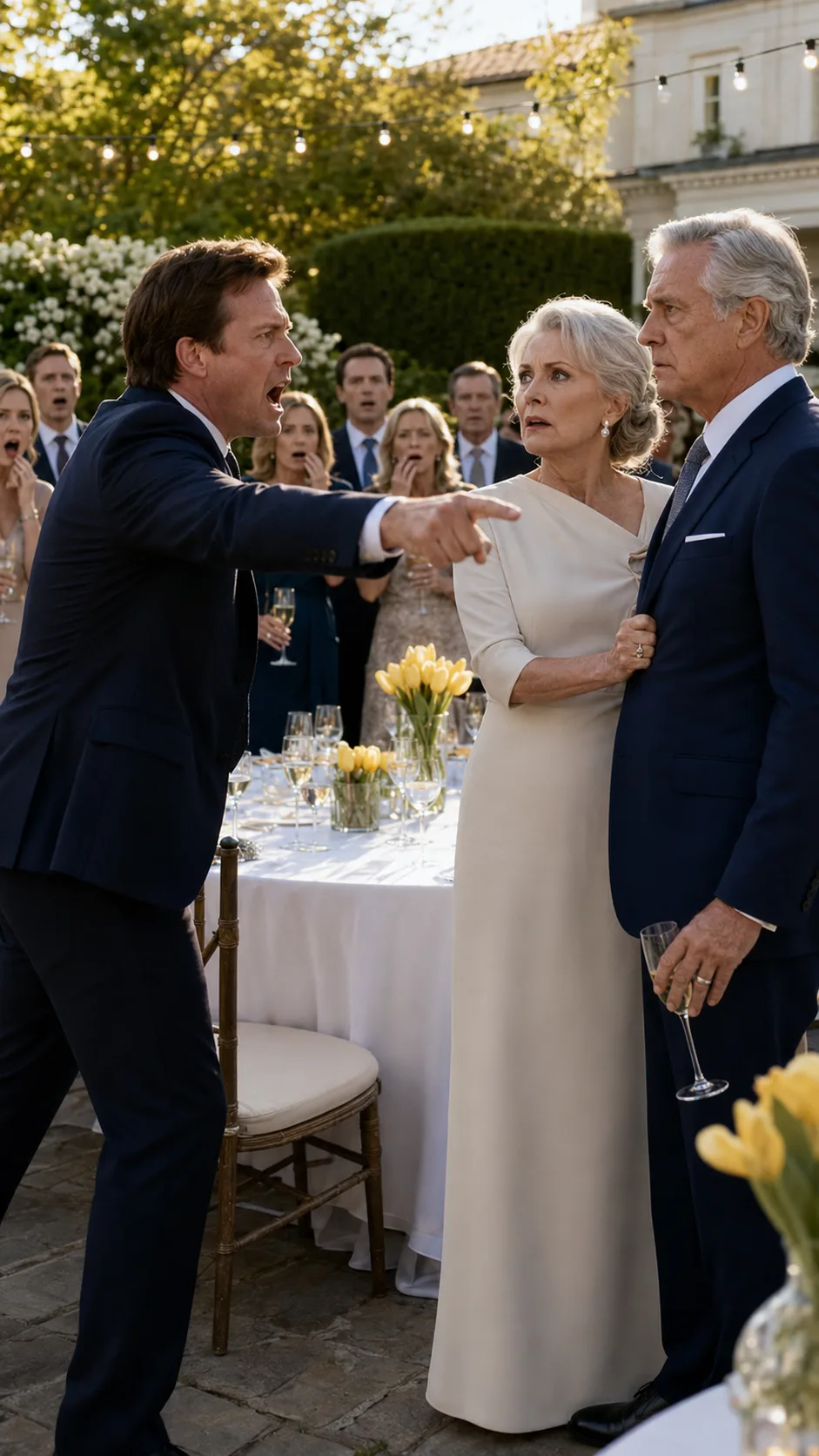
The garden looked beautiful. White linen tables sat beneath string lights. Yellow tulips filled glass vases. A small jazz trio played near the fountain. The late afternoon sun turned the windows gold.
I wore an ivory dress with long sleeves and pearl earrings Henry had given me on our thirtieth anniversary. Before the party began, I stood in front of the mirror, touching the pearls.
For a moment, guilt rose in me.
Not because I loved Thomas.
Because I had loved Henry first.
Thomas appeared in the doorway behind me.
“You look like you’re about to apologize to someone,” he said.
I looked at him in the mirror. “Maybe I am.”
He walked closer but did not touch me until I reached for his hand.
“Henry had you for forty-six years,” Thomas said softly. “I’m not taking anything from him.”
My eyes filled.
“I know.”
“I think he would want you to have someone beside you at breakfast.”
That nearly broke me.
Downstairs, guests laughed, glasses clinked, and for the first time in years my home sounded alive.
Michael arrived late.
Lauren came with him, stiff and pale in a navy dress. Their children followed, clearly bored. Michael did not kiss my cheek. He did not shake Thomas’s hand. He accepted champagne from a waiter and drank half of it in one swallow.
Diane leaned toward me.
“Your son looks like he swallowed a wasp.”
“Ignore him,” I whispered.
But some people do not allow themselves to be ignored.
After dinner, Thomas stood near the fountain and gently tapped his glass with a spoon.
“I promise I’ll be brief,” he said.
Everyone turned toward him.
I stood beside him, my hand tucked through his arm.
Thomas looked at me, and his face softened.
“I met Rose at a charity luncheon where the chicken was unforgivable,” he began.
People laughed.
“She made me laugh when I had forgotten how much I needed to. She speaks her mind. She waters plants like they are personal friends. She still talks to her late husband when she thinks no one hears, and I consider that one of the most beautiful things about her.”
A hush settled over the garden.
I squeezed his arm.
Thomas continued, “At our age, people like to speak of companionship as if it is a polite arrangement. But I am not marrying Rose because I need someone to pass time with. I am marrying her because every hour with her feels returned to me.”
That was when Michael stood up.
His chair scraped violently against the stone patio.
“Enough.”
The jazz trio stopped.
I turned slowly.
“Michael,” I said, “sit down.”
But he walked forward, glass still in his hand, jaw tight, eyes burning.
“No. I’m not going to stand here and listen to this performance.”
Thomas lowered his glass.
The guests stared.
Lauren whispered, “Michael, don’t.”
He ignored her.
He pointed at Thomas in front of everyone.
“This man is a gold digger.”
The words struck the party like a slap.
Someone gasped.
My granddaughter covered her mouth.
Michael’s voice rose.
“He found a rich widow living alone in a mansion, and now he’s playing the gentle old gentleman so he can get close to everything my father built.”
I felt Thomas’s arm go still under my hand.
I stepped forward. “You will stop right now.”
Michael looked at me with something worse than anger.
Pity.
“Mom, you’re lonely. You’re not thinking clearly.”
The garden blurred for half a second.
There it was.
Not concern.
Not love.
A verdict.
I was old. I was foolish. I was a wallet with failing judgment.
Michael turned to the guests.
“My mother is worth millions. Everyone here knows it. And suddenly this retired nobody wants to marry her?”
Thomas remained quiet.
That quietness enraged Michael more.
“What, nothing to say?” Michael snapped. “No defense? No story about true love?”
Dr. Samuel Grant stood from his table.
“Actually,” he said, “I have something to say.”
Michael turned. “And you are?”
Samuel looked at Thomas, then at me.
“I’m the chair of the Whitmore Medical Foundation.”
The name moved through the crowd like wind through leaves.
Whitmore.
Michael frowned. “What does that have to do with him?”
Dr. Grant’s voice was calm.
“Thomas Whitmore founded it.”
The garden went completely silent.
Michael blinked.
“What?”
Thomas closed his eyes for a second, as if the one thing he had hoped to avoid had just walked into the room wearing a name tag.
Dr. Grant continued, “He also founded Whitmore Medical Group. Twelve hospitals, five rehabilitation centers, three pediatric research institutes, and more assisted living communities than I can list from memory.”
Lauren’s face changed first.
Then Michael’s.
Dr. Grant looked directly at my son.
“Thomas is not after your mother’s money. Frankly, Mr. Whitmore could buy this house, the neighboring houses, and the street they sit on without noticing the transfer.”
No one laughed.
Michael’s mouth opened, but no words came out.
I turned to Thomas.
“Is that true?”
He looked embarrassed.
“Yes.”
I pulled my hand away.
Not in anger. In shock.
“You told me you worked in healthcare.”
“I did.”
“You didn’t tell me you owned half of it.”
A few guests chuckled nervously.
Thomas looked at me with pleading eyes.
“I wanted you to know me before you knew my résumé.”
Michael suddenly found his voice.
“That doesn’t prove anything. Rich men can still want more.”
I turned back to him.
And this time, I saw him clearly.
The boy I had loved was still in there somewhere, but he was buried under entitlement so thick I wondered if my money had helped build it.
“You came here to protect your inheritance,” I said.
His face tightened. “I came here to protect you.”
“No, Michael. If you wanted to protect me, you would have asked whether he was kind to me. Whether I felt safe with him. Whether I laughed again. You asked what he wanted from my assets.”
“Because that matters.”
“To you.”
His eyes flickered.
I stepped closer.
“You called me lonely in my own garden. You called the man I love a thief in front of my friends. You treated my happiness like a financial threat.”
“Mom—”
“No.”
The word came out sharper than I expected.
The entire garden seemed to hold its breath.
“You don’t get to say Mom right now and make this tender.”
PART 3 — THE INHERITANCE HE LOST BEFORE I DIED
I had not planned to say it that night.
My attorney, Caroline, had advised me to wait. She said emotions were too high. She said Michael would react badly. She said I deserved to enjoy my engagement party.
But there are moments in life when a person shows you so plainly who they are that delaying the truth becomes another form of lying.
I looked at my son and said, “Your monthly support ends next Friday.”
Michael stared at me.
“What?”
Lauren whispered his name, but he didn’t hear her.
I kept my voice steady.
“The business payments. The credit line. The private school supplement. The house expenses I have been covering quietly for six years. They end next Friday.”
His face went red, then pale.
“You can’t just cut me off.”
“I can.”
“I’m your son.”
“Yes,” I said. “Not my dependent.”
The words landed harder than I expected. My grandson looked up from his phone. My granddaughter’s eyes filled with confusion. Lauren looked like a woman watching a bridge collapse while she was still standing on it.
Michael stepped closer.
“So that’s it? You choose him over your family?”
Thomas moved slightly, but I touched his sleeve. This was not his fight.
“No,” I said. “I choose dignity over being used.”
Michael laughed bitterly.
“You think he loves you? You think this is some fairy tale?”
Thomas finally spoke.
His voice was low, but everyone heard him.
“I signed a prenuptial agreement before I proposed.”
Michael froze.
I turned to Thomas again.
“You what?”
Thomas reached into his jacket, then stopped, perhaps realizing this was not a moment for papers or proof. Instead, he held up both hands gently.
“My attorney prepared it. I waive any claim to Rose’s estate, home, investments, and personal property. I asked Caroline to send it to your attorney last week.”
Caroline, my attorney, who was standing near the tulip table, nodded once.
Michael turned toward her.
“You knew?”
Caroline looked at him coolly.
“I represent your mother. Not your expectations.”
A low murmur ran through the garden.
I almost smiled.
Almost.
Michael looked trapped now, but instead of apologizing, he reached for anger.
“So you all planned this? You set me up?”
I shook my head.
“No, Michael. You walked in exactly as yourself.”
That silenced him.
For one brief second, I saw the little boy he used to be—the child who had climbed into my lap during thunderstorms, the teenager who cried when his father taught him to drive, the young man who once promised he would always take care of me.
Then he was gone again.
Replaced by a man doing mental math in front of thirty witnesses.
Lauren stepped forward, her voice trembling.
“Rose, please. The children’s tuition—”
“The children are provided for,” I said. “I created education trusts for both of them. Those are untouched.”
Lauren’s eyes filled with tears of relief.
Michael looked furious.
“So everyone gets protected except me?”
“No,” I said. “Everyone gets loved. You are the only one being asked to grow up.”
He flinched.
The party ended soon after. Not with shouting. Not with some dramatic exit. Michael simply grabbed Lauren’s arm, then seemed to remember people were watching and let go. They left without saying goodbye.
That night, after everyone was gone, I sat in the garden alone.
The string lights glowed overhead. Half the champagne glasses were still on the tables. A yellow tulip had fallen from one vase and lay across the white linen like a small exhausted sun.
Thomas sat beside me.
“I’m sorry,” he said.
“For what?”
“For bringing my world into yours.”
I looked at him. “Your world didn’t accuse you of being a gold digger. My son did.”
He nodded.
“I should have told you everything.”
“Yes,” I said. “You should have.”
He accepted that. No excuses. No charming speech. Just silence.
That was one of the reasons I forgave him.
A lesser man would have tried to talk his way out.
Thomas only said, “I was afraid wealth would ruin what was simple between us.”
I laughed softly.
“Wealth usually ruins things when people hide behind it.”
He looked at me.
“Did I ruin us?”
I took his hand.
“No. But no more secrets.”
“No more secrets,” he said.
We married six weeks later in Maine, on a windy afternoon beside the ocean.
I did not wear white. I wore pale blue. Thomas wore a dark suit and yellow tulip pinned to his lapel because he said my mother deserved a seat at the wedding too.
Diane cried through the entire ceremony. Dr. Grant gave a toast that was mostly jokes about hospital food. Caroline attended and, for the first time in the fifteen years I had known her, drank two glasses of champagne.
Michael was not invited.
That decision hurt. I will not pretend it didn’t. A mother can close a door and still bleed on the other side of it.
He called the morning of the wedding.
I let it go to voicemail.
Then he called again.
And again.
Finally, I listened.
His voice sounded smaller than it had in the garden.
“Mom, I know you’re getting married today. I just… I think things got out of hand. I was worried, okay? Maybe I said it wrong, but I was worried. Call me.”
No apology.
Only revision.
I put the phone down and walked toward the shoreline, where Thomas was waiting for me.
After the wedding, I sold the Greenwich house.
People were shocked. Michael most of all.
“You’re selling Dad’s house?” he demanded over the phone.
“I’m selling my house.”
“That was our family home.”
“You visited it six times last year.”
“That’s not fair.”
“No,” I said. “What wasn’t fair was me growing old inside a museum while everyone waited to inherit the walls.”
He went quiet.
I bought a smaller home with Thomas on the coast of Rhode Island. It had wide windows, weathered floors, and a kitchen just big enough for two people to bump into each other while making coffee. I loved it immediately.
Every morning, Thomas made toast. I made coffee. We read newspapers at a round table meant for four.
Not twelve.
Four was enough.
Three months after the wedding, Michael came to see me.
He looked tired. Truly tired. Not polished. Not angry. Just worn down.
I met him on the porch while Thomas stayed inside.
For the first time in years, Michael did not arrive asking for money.
He stood with his hands in his coat pockets and said, “I lost the office.”
I waited.
“I couldn’t keep up the lease. Without your help, the numbers didn’t work.”
“I’m sorry,” I said.
He looked at the ocean.
“I blamed you at first.”
“I know.”
“I blamed Thomas too.”
“I know that as well.”
His jaw trembled slightly.
“Then Lauren asked me something.”
“What?”
“She asked how long I had planned to love you only if you stayed useful.”
The words hit both of us.
He wiped his face quickly, embarrassed.
“I didn’t have an answer.”
I looked at my son. Really looked at him.
There was no grand redemption in that moment. No music. No perfect forgiveness. Just a man standing before the mother he had wounded, finally seeing the wound.
“I was scared,” he said. “After Dad died, everything felt like it was slipping away. The company. The house. The life we had. And you were the last piece of it that still felt… guaranteed.”
“I am not an inheritance, Michael.”
“I know.”
“No,” I said softly. “You are beginning to know.”
He nodded.
Tears filled his eyes, and this time he did not hide them well.
“I’m sorry, Mom.”
There it was.
Not polished. Not strategic. Not followed by a request.
Just sorry.
I stepped forward and hugged him.
He broke a little in my arms.
I did not restore his allowance. I did not pay his office lease. I did not rescue his business.
But I invited him to dinner.
That was the beginning.
Not of the old relationship. That one had been built on silence and money and pretending not to notice what hurt.
This was something smaller.
Honester.
Harder.
Michael found work managing accounts for another firm. Lauren started visiting with the children once a month. Slowly, awkwardly, we became a family again—not the kind that performs closeness at holidays, but the kind that learns where the cracks are and stops stepping on them.
One evening, almost a year after the engagement party, my granddaughter asked me, “Grandma, were you scared to get married again?”
I looked across the kitchen at Thomas, who was burning garlic bread and pretending he wasn’t.
“Yes,” I said. “Very.”
“Then why did you do it?”
I thought about the empty breakfast table in Greenwich. I thought about Michael’s face in the garden. I thought about the word vulnerable and how easily people confuse age with weakness.
Then I smiled.
“Because being scared is not the same as being finished.”
Thomas looked over at me and winked.
At seventy-one, I had been called lonely, foolish, and easy to deceive.
But I was not any of those things.
I was a woman who had buried a husband, raised a son, built a fortune, survived silence, and still had enough courage left to open the door when love knocked again.
Michael thought my remarriage would cost him his inheritance.
He was wrong.
It gave him the first honest mother he had ever had.
And it gave me something even better than money, better than approval, better than a house full of expensive furniture.
It gave me mornings.
Warm coffee.
Yellow tulips.
A man who asked if I had eaten.
And the beautiful, terrifying freedom of choosing myself before it was too late.
THE END.
Chapter complete
You have reached the end of this chapter.
Continue reading
A few more worlds to get lost in after this chapter.




