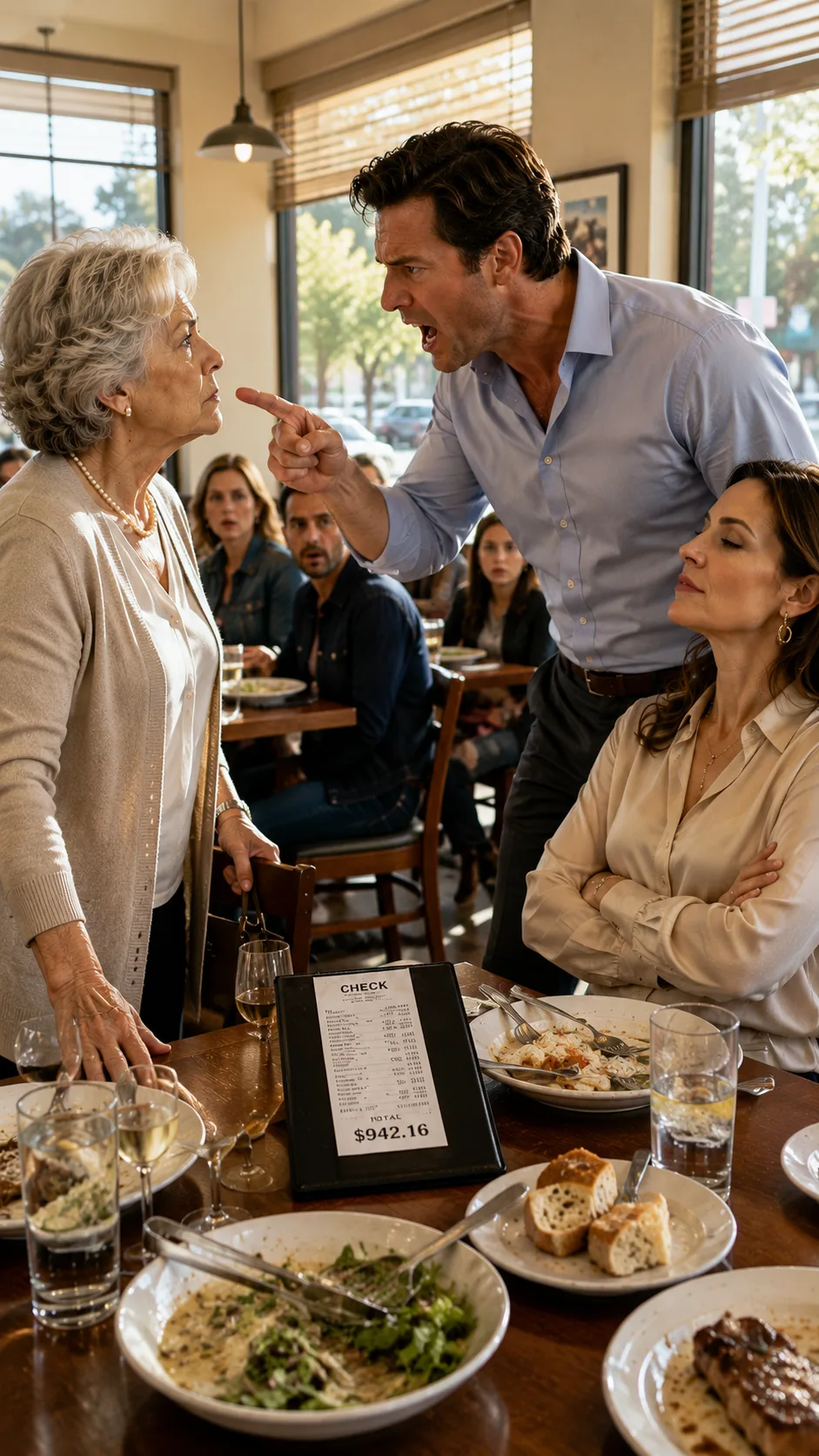
My son and daughter-in-law left me at a restaurant with a $942 bill.
Chapter 1
My son and daughter-in-law left me at a restaurant with a $942 bill.
What they didn’t know was that by the end of the year, they would be begging me to save the house they thought they owned.
And for the first time in my life, I would say no.
The waiter brought the check in a black leather folder and placed it gently on the table.
The folder landed between two empty chairs.
One belonged to my son, Donovan.
The other belonged to my daughter-in-law, Fedra.
Both had disappeared fifteen minutes earlier under the convenient excuse that Fedra had suddenly developed a migraine and needed to get home.
I stared at the folder.
Then I stared at Donovan’s perfectly folded napkin.
That hurt more than the bill.
A man rushing home because his wife is sick does not stop to fold a linen napkin.
A man who planned his exit does.
The total was $942.16.
I had ordered a six-ounce filet and
one glass of Pinot Noir.
The rest belonged to them.
The seafood tower.
The imported wine.
The Wagyu tasting menu.
The extra desserts for the children.
Every dollar on that receipt screamed the same message.
Mom will pay.
Again.
The waiter cleared his throat.
“Would you like to settle the bill, ma’am?”
I looked up.
“No.”
His eyes widened.
“I’m sorry?”
“I’d like to pay for my meal.”
A small smile appeared on his face.
The smile of a man who suddenly understood everything.
“Of course.”
Twenty minutes later, I walked out having paid exactly seventy-eight dollars and forty-three cents.
The restaurant manager assured me they would handle the abandoned balance.
I took a picture of the empty chairs.
Then I got into my car and drove home.
On the way, I made one phone call.
Marshall Reed answered on the second ring.
“What happened?”
I told him.
By the
time I finished, he was silent.
Then he sighed.
“I was wondering how much longer they could keep doing this.”
“What do you mean?”
“Rose, tomorrow morning. Nine o’clock. Bring every document related to the HELOC.”
The HELOC.
The home equity line of credit.
The biggest mistake I had ever made.
Or so I thought.
The next morning, I arrived at Marshall’s office.
Marshall had spent forty years in banking.
He was also my late husband Roland’s best friend.
If Roland trusted someone, I trusted them too.
Marshall spread several documents across his desk.
“Rose,” he said carefully, “how much do you think Donovan owes?”
“About a hundred thousand?”
Marshall laughed.
Not because it was funny.
Because it was tragic.
“Try six hundred thousand.”
I stared at him.
“No.”
“Yes.”
He slid a report across the desk.
Credit cards.
Personal loans.
Vehicle financing.
Private lending.
Business debt.
The list seemed
endless.
My hands trembled.
“Why would he do this?”
Marshall looked at me.
“Because every time he got into trouble, somebody rescued him.”
Somebody.
Me.
The words hit harder than I wanted to admit.
For years I had convinced myself I was helping.
In reality, I had become a safety net.
And people who never hit the ground stop fearing the fall.
Marshall pushed another file toward me.
“This is worse.”
I opened it.
My stomach dropped.
The down payment.
The three hundred twelve thousand dollars I gave Donovan in 2017.
The money from selling our beloved lake house in Tahoe.
The house Roland and I had owned for twenty-six summers.
The house where Donovan learned to swim.
The house where every family Christmas photo had been taken.
Donovan had told me he desperately needed that money.
He claimed he would lose the opportunity to buy his family home.
Marshall pointed to several pages.
“He lied.”
“What?”
“He qualified without your money.”
I felt the room spin.
Marshall continued.
“He could have bought the house himself.”
“Then why ask me?”
Marshall’s answer was simple.
“Because using your money allowed him to keep his investment portfolio intact.”
For several seconds I could not breathe.
I had sold the last piece of Roland.
Not because my son needed saving.
Because he wanted convenience.
That night I sat alone in my kitchen.
The same kitchen where Donovan used to do homework.
The same kitchen where he once promised to buy me a mansion when he grew up.
I cried harder than I had cried at Roland’s funeral.
Not because of money.
Because betrayal always hurts more when it wears the face of someone you raised.
Two weeks later, Fedra hosted a birthday party.
I wasn’t invited.
My granddaughter accidentally told me.
“Mommy said Grandma probably won’t come because she doesn’t understand these kinds of parties.”
I said nothing.
But I drove there anyway.
Nobody noticed me standing near the patio doors.
That was when I heard Fedra laughing.
“Honestly, Donovan’s mother is basically our emergency fund.”
Several women laughed.
Fedra raised her champagne glass.
“If things ever get really bad, she’ll save us again.”
The group laughed harder.
Then came the sentence that changed everything.
“One day that house will be ours anyway.”
I left before anyone saw me.
I never confronted her.
I didn’t need to.
Sometimes the most powerful response is silence followed by action.
Over the next four months, Donovan called more often than usual.
At first he pretended it was about family.
Then the requests started.
Five thousand dollars.
Ten thousand dollars.
Twenty thousand dollars.
Each request was denied.
Politely.
Firmly.
The first few times he sounded surprised.
The next few times he sounded irritated.
Eventually he sounded angry.
“Mom, why are you acting like this?”
I almost laughed.
Acting?
For years I had been acting.
Acting blind.
Acting generous.
Acting hopeful.
Now I was simply awake.
Then the cracks began to appear.
Donovan’s company lost a major client.
A business loan came due.
Credit card balances exploded.
Collection notices appeared.
For the first time in his adult life, nobody stepped in.
Three days before Christmas, my doorbell rang.
I opened the door.
Donovan stood there.
Fedra stood beside him.
Both looked exhausted.
The confidence was gone.
The expensive smiles were gone.
The superiority was gone.
Reality had finally arrived.
“Can we come in?” Donovan asked quietly.
I stepped aside.
They sat across from me at the dining table.
Fedra looked close to tears.
Donovan looked twenty years older.
Finally he spoke.
“We need help.”
I said nothing.
He swallowed.
“If we can’t make the payment next month…”
His voice broke.
“We’ll lose the house.”
There it was.
The sentence I had known was coming.
Fedra started crying.
“We’re desperate.”
I stood.
Walked to the hallway.
Opened a cabinet.
Returned carrying a thick folder.
Hope immediately appeared in Donovan’s eyes.
He thought it was money.
He thought I was saving him again.
I placed the folder on the table.
His smile vanished.
Inside were bank statements.
Loan records.
Property documents.
Emails.
Financial reports.
Years of evidence.
Proof of every lie.
Every manipulation.
Every secret.
Donovan stared at them.
His face turned pale.
Fedra stopped crying.
Neither spoke.
Finally I looked at my son.
“Do you know what hurt most?”
He lowered his eyes.
I continued.
“Not the restaurant.”
Silence.
“Not the nine hundred forty-two dollars.”
More silence.
“Not even the lake house.”
His shoulders shook.
Then I said the truth.
“The thing that hurt most was realizing I trusted you more than you deserved.”
For the first time since childhood, Donovan began to cry.
Not politely.
Not quietly.
He broke.
Completely.
“I’m sorry, Mom.”
I believed he meant it.
But apologies and consequences are different things.
The next six months were painful.
The luxury SUV was sold.
The expensive vacations disappeared.
The designer purchases stopped.
The house was sold.
They moved into a much smaller home.
Fedra hated every minute of it.
Donovan accepted it.
Because for the first time, he had no choice.
The rescue helicopter had finally left.
And he had to learn how to walk.
One afternoon the following summer, Donovan arrived at my house carrying a framed photograph.
I recognized it immediately.
The Tahoe lake house.
Roland stood on the dock.
Young Donovan stood beside him.
Both smiling.
My son handed me the picture.
“I found it in storage.”
I ran my fingers over the frame.
Neither of us spoke for a while.
Finally Donovan looked at me.
“I spent years thinking your money saved me.”
His voice trembled.
“But it was you.”
A tear rolled down his cheek.
“I’m sorry I forgot the difference.”
I looked at the man sitting across from me.
For years I had searched for the little boy who used to run barefoot across that dock.
The little boy who once promised to take care of me.
The little boy I thought had disappeared forever.
And suddenly I saw him again.
Not in the successful businessman.
Not in the expensive suits.
Not in the luxury house.
But in the broken man finally telling the truth.
I smiled.
Small.
Tired.
Real.
Then I reached across the table and squeezed his hand.
“Welcome back, son.”
THE END.
-I still remember the exact second everything changed.-
Chapter complete
You have reached the end of this chapter.
Continue reading
A few more worlds to get lost in after this chapter.




