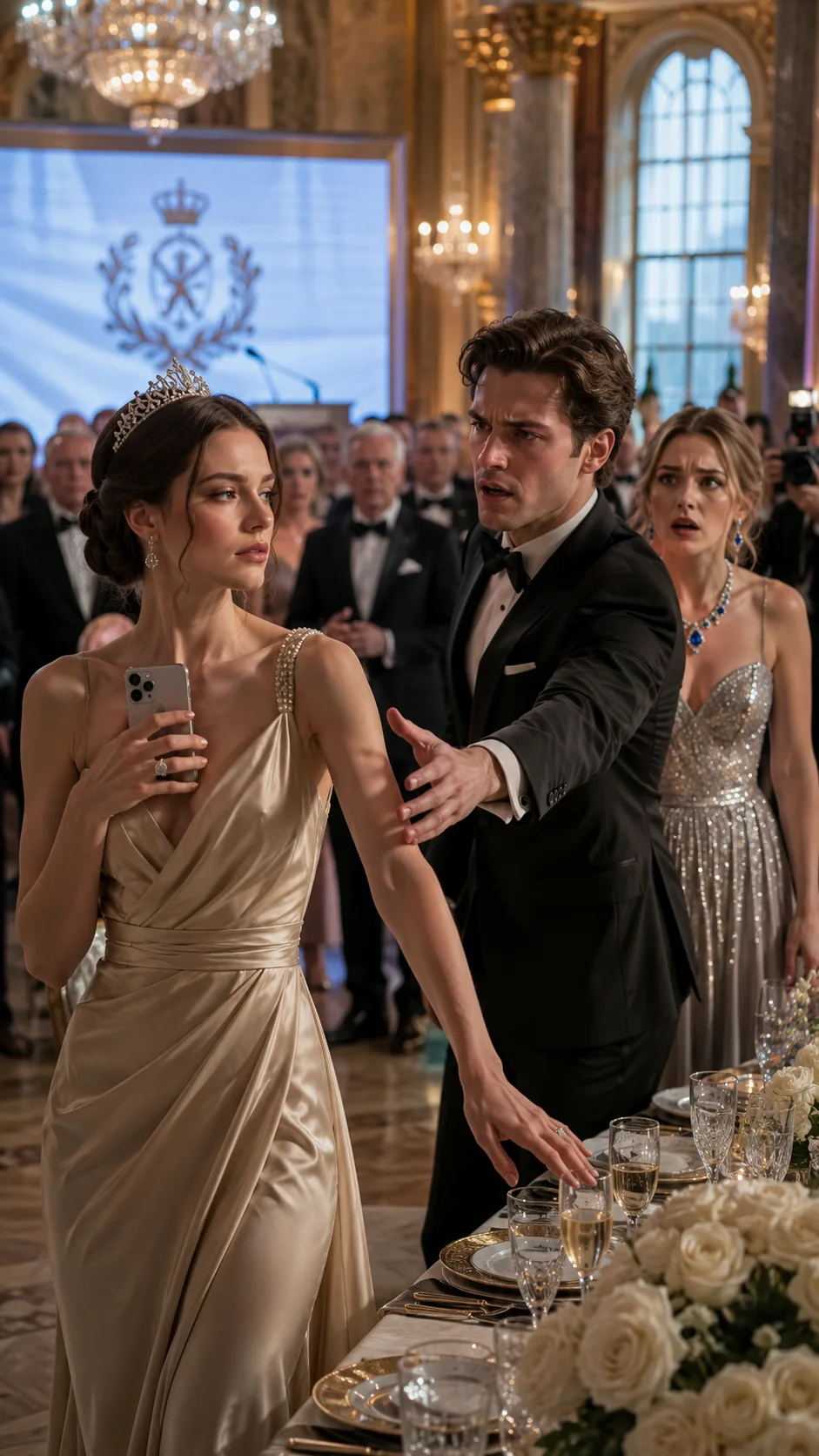
My Sister Sent One Wrong Message at the Royal Charity Gala and Destroyed the Marriage She Tried to Steal Forever
Princess Amelia Vale had learned to smile through things that would have broken other women in half.
Chapter 1
My Sister Sent One Wrong Message at the Royal Charity Gala and Destroyed the Marriage She Tried to Steal Forever
Princess Amelia Vale had learned to smile through things that would have broken other women in half.
She had smiled through royal dinners where her husband barely looked at her.
She had smiled through interviews where Prince Adrian praised her “devotion” with the warmth of a man reading from a government statement.
She had smiled when her half sister, Isabella, arrived late to palace events wearing borrowed pearls and pretending not to know they had come from Amelia’s private collection.
And she had smiled when Queen Mother Helena touched Amelia’s shoulder in front of reporters and called her “our patient little princess,” as if patience were a leash and Amelia had agreed to wear it.
But on the night of the Saint Verena Charity Gala, Amelia was tired.
Not weak.
Not defeated.
Just tired of being the only person in the palace still respecting vows everyone else had already thrown away.
The ballroom of Westmere Palace glittered like a dream built to hide rot. Crystal chandeliers hung
over six hundred guests. White roses filled silver urns. Gold-rimmed plates reflected the candlelight. Outside the tall windows, the capital shone under soft evening rain, every streetlamp blurred into gold.
The gala was supposed to raise money for children’s hospitals across Eldoria.
Amelia had spent nine months building the program.
She had visited wards without cameras.
She had sat beside children after surgeries.
She had rewritten budgets, begged donors, and pushed the royal council until they agreed to fund medical wings in the northern provinces.
Tonight was supposed to be about them.
Instead, the palace had turned it into another stage for Isabella.
Amelia saw it the moment she entered.
Isabella stood near the central table in a silver gown that shimmered like poured moonlight. Her blond hair fell in perfect waves over one shoulder. Around her throat was a sapphire necklace Amelia recognized instantly.
It had belonged to Amelia’s
mother.
The late Queen Rose had worn it at her final public appearance before the fever took her.
Amelia stopped walking.
Only for one second.
Then she kept moving.
Beside her, Adrian noticed. His hand tightened around the stem of his champagne glass.
“Don’t make a scene,” he murmured.
Amelia looked at him.
He was handsome in the way portraits were handsome. Tall, dark-haired, broad-shouldered, perfect in a navy royal uniform with medals polished to a cold shine. But his eyes were restless tonight. Not guilty enough to confess. Not cruel enough to stop.
“I haven’t said anything,” Amelia replied.
“That is exactly what I’m asking you to continue doing.”
My stomach dropped.
Not because I was surprised.
Because there it was again.
The expectation that my silence was part of my job.
Across the ballroom, Isabella saw Amelia watching the necklace. She lifted her chin and smiled.
Not apologetically.
Triumphantly.
Queen Mother Helena stepped between them before Amelia could reach the table. Helena was fifty-three, beautiful, polished, and cold enough to make kindness look like a costume she wore for cameras.
“My dear,” Helena said, kissing the air near Amelia’s cheek. “You look composed. Wonderful. Tonight is not the night for personal sensitivities.”
Amelia’s gaze shifted to Isabella’s necklace.
“That is my mother’s sapphire.”
Helena’s smile did not move.
“It was in the family vault.”
“It was in my private cabinet.”
“A royal jewel belongs to the crown.”
“My mother gave it to me.”
Helena leaned closer. Her perfume was sharp, expensive, suffocating.
“And your mother is dead. Do not let grief make you difficult in front of donors.”
The room around them laughed softly at some distant joke. Champagne glasses chimed. A string quartet played near the marble staircase.
Amelia’s face remained calm.
Inside, something old and loyal cracked.
Adrian stepped beside Isabella, not Amelia.
That was the first public cut of the night.
The second came at dinner.
Amelia’s seat had been placed at the royal table, as protocol required. She was crown princess by marriage and principal patron of the Saint Verena Fund. The chair beside Adrian belonged to her.
But when she approached, Isabella was already sitting there.
Her silver skirt spilled over the edge of the chair like she had been poured into Amelia’s place.
Amelia stopped.
The room noticed.
Not all at once. It moved like cold weather. First the nearby donors. Then two ministers. Then the photographers at the edge of the ballroom. Then the council table.
Isabella looked up with wide, innocent eyes.
“Oh,” she said. “Was this your seat?”
The room went silent.
Adrian did not stand.
Helena’s fingers tightened around her wineglass.
Amelia looked at the little white place card beside Isabella’s plate. It read: Princess Isabella Vale.
There was no Princess Isabella Vale.
Isabella was Lady Isabella Vale, Helena’s daughter from her first marriage, recognized by the palace as a noble relative but not royal by blood.
The title on the card was a lie.
A small lie.
A careful lie.
The kind of lie that showed rehearsal.
Amelia reached for the card.
Helena said softly, “Leave it.”
Amelia picked it up anyway.
Isabella smiled.
“Honestly, Amelia, it’s just a chair. Some women don’t mind standing behind the people they support.”
A few guests looked down at their plates.
Adrian finally spoke.
“Isabella, perhaps—”
But he stopped.
Because Isabella touched his wrist under the table.
Amelia saw it.
So did half the council.
Adrian looked away.
That was when Amelia understood.
This was no longer hidden.
It was being tested.
They wanted to know how much humiliation she would swallow before choking.
Amelia placed the card back on the table.
Then she pulled out the chair on Adrian’s other side and sat.
Gracefully.
Quietly.
Like nothing had happened.
That bothered them more than tears would have.
For the next hour, the gala moved forward under a surface so smooth it almost looked normal. Donors gave speeches. Cameras flashed. Children from the hospital choir sang on the balcony. Amelia clapped at the right moments. Adrian smiled when photographers aimed at him. Isabella leaned close to him too often. Helena watched Amelia like a guard watching a door.
The council members whispered behind crystal glasses.
Lord Whitcomb, chairman of the royal ethics committee, looked especially grim. He had served Amelia’s father before the old king died. He had known Queen Rose. He had once told Amelia that dignity was not silence; it was choosing the right moment to speak.
Tonight, Amelia wondered if the right moment had already passed her by.
Then her phone buzzed.
It was lying beside her plate, screen down, as all phones were supposed to be during formal royal dinners.
A second buzz followed.
Then a third.
Around the table, other phones began vibrating too.
One by one.
Council members glanced down.
Helena frowned.
Adrian’s face changed first.
It went pale before he even touched his phone.
Amelia turned hers over.
The notification at the top of the screen came from the official Royal Household Group.
A message from Isabella.
After the speech, come to my room. She still thinks you love her.
For one second, Amelia did not breathe.
The words sat there, small and black and undeniable.
No rumor.
No whisper.
No jealous accusation.
Just Isabella’s own message, delivered to the wrong people at the worst possible time.
The whole table froze.
Lord Whitcomb stared at his screen.
The finance minister slowly lowered his fork.
Princess Margaret, Adrian’s aunt, covered her mouth with two fingers.
Helena’s eyes snapped to Isabella.
Isabella had not noticed yet.
She was laughing at something the French ambassador said.
Then her own phone buzzed.
She looked down.
Her smile died.
I had imagined betrayal would roar when it finally came into the light.
It didn’t.
It made no sound at all.
It just sat in a group chat while a hundred powerful people read it.
Adrian moved suddenly.
“Amelia,” he said.
His voice was too low.
Too urgent.
“Give me your phone.”
Amelia looked at him.
He reached across the table.
Not slowly.
Not politely.
He tried to grab it.
The nearest guests gasped.
Amelia pulled her hand back before his fingers touched the screen.
“Adrian,” she said calmly, “do not embarrass yourself further.”
His jaw tightened.
“That message is private.”
A laugh almost escaped her.
Private.
He called it private now that it had become public.
Isabella stood so quickly her chair scraped against the marble floor.
“It was a joke,” she said.
No one answered.
“It was obviously a joke.”
Helena rose beside her, smooth as a blade leaving a sheath.
“Ladies and gentlemen,” Helena said, projecting her voice just enough for the nearest tables to hear, “there appears to have been a childish misunderstanding. A message meant for a family planning discussion has been misread in a most unfortunate way.”
Amelia looked at her.
“A family planning discussion?”
Helena’s eyes warned her.
“Amelia.”
Adrian leaned closer.
“Don’t do this here.”
That was the sentence that ended the last soft thing in her.
Don’t do this here.
Not because he was sorry.
Not because he loved her.
Because the chandeliers were bright, the donors were watching, and he could not control the story anymore.
Amelia stood.
The movement was so quiet that it pulled more attention than a shout.
The ballroom began turning toward her. Tables stilled. Reporters sensed blood in the water and lifted their cameras.
At the front of the ballroom, a large digital screen had been prepared for Amelia’s keynote speech. It displayed the Saint Verena crest against a pale blue background.
Amelia looked at Daniel Pierce, her communications director, standing near the control booth.
He was loyal.
Not loud.
Not dramatic.
But loyal in the way that mattered.
She lifted her phone slightly.
Daniel understood immediately.
He hesitated only once, looking toward Helena.
Helena’s face hardened.
“Daniel,” she snapped, “you will not—”
Amelia spoke without raising her voice.
“Put it on the screen.”
Daniel pressed a button.
The ballroom lights dimmed.
The digital screen behind the podium flickered.
Then Isabella’s message appeared across the giant display.
After the speech, come to my room. She still thinks you love her.
No one moved.
No one breathed.
Then a glass slipped from someone’s hand and shattered on the marble.
The sound cracked through the room like a verdict.
Isabella covered her mouth.
Adrian looked at the screen as if staring hard enough could make it disappear.
Helena stepped forward.
“This is outrageous,” she said. “This is a private family matter being twisted by a woman who has always been insecure about her role.”
Amelia turned to her.
For the first time all night, she smiled.
Not kindly.
Not cruelly.
Clearly.
“Insecure?”
Helena lifted her chin. “Yes.”
Amelia walked toward the podium. Every step sounded sharp in the silence.
She did not rush.
She did not tremble.
She reached the microphone and placed her phone beside it.
Then she looked at Isabella.
“You sent my husband a message during a charity gala for sick children,” Amelia said. “You told him to come to your room after my speech.”
Isabella’s eyes shone with panic.
“I didn’t mean—”
“You wrote that I still think he loves me.”
Adrian took one step forward. “Amelia, enough.”
She turned to him.
“No. Enough was when you let her wear my mother’s necklace. Enough was when you let her sit in my chair. Enough was when you made my dignity the price of your comfort.”
The room stayed silent.
Amelia faced the guests again.
Her voice did not break.
“A typo just did what this family was too cowardly to do. It told the truth.”
The words landed harder than any scream.
Reporters began typing. Cameras flashed. Someone at the council table whispered, “My God.”
Helena’s control slipped for half a second. Amelia saw it. The bare flash of rage under the royal mask.
“You ungrateful girl,” Helena said.
The microphone caught every word.
The ballroom heard it.
Helena realized too late.
Amelia looked at her.
“Thank you, Your Majesty. Please continue. The microphone is on.”
A few guests gasped.
Lord Whitcomb stood.
“Queen Mother Helena,” he said, voice formal and grave, “I strongly advise you to say nothing further.”
Helena ignored him.
“This family gave you everything.”
Amelia’s hand tightened once on the podium.
Then relaxed.
“My mother gave me my name. My father gave me my duty. The people gave me their trust. This family gave me a husband who thought betrayal was only wrong if it became visible.”
Adrian flinched.
For the first time that night, he looked ashamed.
But shame was not the same as remorse.
“Amelia,” he said, softer now. “Please. We can discuss this privately.”
“No,” she said. “You had privacy. You used it.”
Isabella began crying.
Real tears, maybe.
Or fear shaped like tears.
“Adrian,” she whispered. “Say something.”
Everyone watched him.
The prince who had been raised to speak for a nation could not speak for the woman he had chosen in secret.
He looked at Isabella.
Then at Amelia.
Then at the screen.
And in that pause, he lost both of them.
Amelia lifted a folder from beneath the podium.
Adrian’s eyes widened.
Helena noticed too.
“What is that?” Helena demanded.
Amelia opened it.
“These are the revised patronage documents for the Saint Verena Fund,” she said. “They were supposed to be signed tonight after my speech. As of this morning, the Queen Mother’s office attempted to transfer public-facing patronage duties from me to Lady Isabella.”
Isabella stopped crying.
Lord Whitcomb’s face darkened.
Amelia continued.
“The explanation given was that I had become emotionally unstable and unable to represent the foundation.”
Helena’s lips pressed into a thin line.
Amelia turned a page.
“But the medical board, donor committee, and hospital directors rejected the transfer because I am the only royal signatory who attended every funding review, every construction meeting, and every hospital visit.”
She looked toward the hospital children seated with their nurses near the front.
Her voice softened for them, but not for the palace.
“This charity belongs to them. Not to a family affair. Not to a palace lie. Not to any woman using sick children as a staircase to a crown.”
The applause began in one corner.
Small at first.
Then stronger.
A doctor stood.
Then a donor.
Then another.
Within seconds, half the ballroom was on its feet.
Helena looked around, stunned by the betrayal of public opinion.
Adrian stood alone beside Isabella.
The wrong side had never looked so visible.
Lord Whitcomb approached the podium.
“Princess Amelia,” he said, “the council will convene an emergency session tonight.”
Helena snapped, “You have no authority to—”
“I do,” he said. “When a royal patronage office is manipulated for personal advancement, when titles are misused in formal seating plans, and when there is credible evidence of conduct damaging to the crown, the council is obligated to act.”
Isabella’s face went white.
“Titles?” she whispered.
Amelia picked up the place card from the table. She had kept it.
Princess Isabella Vale.
She held it up.
“Another typo, I assume?”
No one laughed.
That made it worse.
Helena reached for the card, but Amelia stepped back.
“No,” Amelia said. “You’ve taken enough things that belonged to me.”
Adrian finally walked toward her.
There was desperation in his face now. It looked strange on him.
“Amelia,” he said. “I made mistakes.”
She looked at him.
“Mistakes are wrong turns. You built a road.”
His eyes reddened.
“I never wanted to hurt you.”
“You wanted me quiet. There’s a difference.”
He swallowed.
Around them, the entire kingdom watched through lenses and whispers.
“Tell me what you want,” he said.
Amelia glanced at the message still glowing on the screen.
Then at Isabella.
Then at Helena.
Then back at the man she had once loved with the embarrassing sincerity of a young princess who believed vows were sacred because she had never watched anyone break them.
“I want the marriage contract reviewed by the council,” she said. “I want Lady Isabella removed from all royal patronage duties pending investigation. I want my mother’s sapphire returned to the vault tonight. And I want every donor in this room to know the Saint Verena Fund will remain untouched by palace scandal.”
Helena stared at her.
“You think you can command this family?”
Amelia’s expression did not change.
“No,” she said. “I think I finally stopped asking it for permission.”
Lord Whitcomb turned to the royal guards at the side of the ballroom.
“Escort Lady Isabella to a private waiting room. She is not to leave the palace until the council has recorded her statement.”
Isabella grabbed Adrian’s sleeve.
“Do something.”
Adrian did not move.
That was the moment she understood him too.
He was brave enough to betray.
Not brave enough to protect.
The guards approached.
Isabella backed away, tears spilling now.
“You can’t do this to me,” she said to Amelia.
Amelia looked at the sapphire necklace on Isabella’s throat.
“I didn’t,” she replied. “You sent the message.”
One of the palace attendants stepped forward with a velvet tray.
Isabella touched the necklace as if it could save her.
Helena hissed, “Do not remove that in public.”
Amelia said, “She wore it in public.”
The attendant waited.
Everyone watched.
With shaking hands, Isabella unclasped the sapphire necklace and placed it on the tray.
For the first time all night, Amelia looked away.
Not because it hurt.
Because some things were too sacred to let hatred touch.
The attendant carried the necklace to Amelia.
She did not put it on.
She closed her fingers around it and held it like something rescued from a fire.
Adrian’s voice came quietly.
“I did love you.”
Amelia turned back.
For a second, the ballroom disappeared.
There was only the man she had married, standing beneath a chandelier, trying to offer a past tense like it could pay for the present.
She answered just as quietly.
“That may be the cruelest thing you’ve said tonight.”
He looked confused.
“Why?”
“Because it means you knew what love was supposed to be.”
He had no reply.
The council took control after that.
The gala did not end in chaos. Amelia would not allow it.
She returned to the podium, folded her hands, and gave the speech she had written for the children.
Her voice was steady.
She spoke about hospital beds, rural clinics, families sleeping in waiting rooms, and the duty of a crown to become useful when people suffered.
No one interrupted.
No one looked away.
By the time she finished, the donations had doubled.
By midnight, the palace had issued a formal statement announcing an internal review of Prince Adrian’s conduct, Queen Mother Helena’s office, and Lady Isabella’s unauthorized involvement in royal patronage affairs.
By morning, the world knew everything.
The message appeared on every front page.
After the speech, come to my room. She still thinks you love her.
Commentators called it the text that broke a royal marriage.
But Amelia knew better.
The message had not broken anything.
It had only revealed what was already broken.
Three weeks later, the council met in the private chamber beneath the old palace library.
Adrian arrived without medals.
Helena arrived without cameras.
Isabella did not arrive at all. She had left the capital two days earlier after signing a statement admitting she had used a restricted title on the seating plan and accepted jewels without proper authorization.
The affair, she claimed, had been “emotionally complicated.”
Amelia did not care what Isabella called it.
A knife was still a knife even if the person holding it cried.
The marriage review lasted four hours.
Adrian admitted enough to ruin himself but not enough to become noble. He said he had been lonely. Pressured. Confused. He said Amelia had become distant because of her duties. He said Isabella understood him.
Amelia listened.
When her turn came, Lord Whitcomb asked if she wished to make a statement.
She stood.
“I was not distant,” she said. “I was working. There is a difference men often pretend not to understand when a woman’s duty no longer revolves around comforting them.”
Adrian looked down.
“I kept my vows,” she continued. “Not because I was blind, but because I believed marriage deserved dignity even when love became difficult. Prince Adrian treated that dignity as permission. Lady Isabella treated my silence as weakness. Queen Mother Helena treated the crown as a tool for her daughter’s advancement.”
Helena’s mouth tightened.
Amelia placed the sapphire necklace on the council table.
“My mother once told me that a crown is not proven by who kneels to you. It is proven by what you refuse to kneel to.”
She looked at Adrian.
“I refuse to kneel to betrayal.”
The council granted formal separation that afternoon.
Adrian lost his public patronage roles for one year pending further review.
Helena’s office was stripped of authority over charitable assignments and seating protocol.
Isabella was barred from royal events indefinitely.
Amelia remained patron of Saint Verena.
A month later, she returned to the children’s hospital in the north.
No cameras had been invited.
But someone filmed her anyway.
A small girl with a shaved head from treatment handed Amelia a paper crown covered in crooked stars.
Amelia bent down and accepted it with both hands.
“Is this for me?” she asked.
The girl nodded.
“You looked sad on TV,” she said. “But you still talked about us.”
Amelia’s throat tightened.
She had survived palace dinners, public betrayal, and the ruin of a marriage.
But kindness from a child nearly undid her.
“I promised I would,” Amelia said.
The girl placed the paper crown over Amelia’s carefully pinned hair.
It sat crooked.
It was made of construction paper.
It was worth more than every sapphire in the vault.
That evening, as Amelia left the hospital, Daniel Pierce handed her a tablet.
“The final donation numbers came in,” he said.
She read them.
Then read them again.
The Saint Verena Fund had raised enough to build three new pediatric wings.
Not one.
Three.
Daniel smiled. “Turns out the public likes a princess who tells the truth.”
Amelia looked out at the hospital courtyard, where children were drawing chalk stars on the pavement.
For the first time in months, she breathed without feeling the palace around her ribs.
“What about the palace?” Daniel asked.
“What about it?”
“They’ll want a statement before the foundation announcement.”
Amelia considered that.
Then she handed the tablet back.
“Tell them this,” she said. “The charity survived the scandal because it was never built on their lies.”
Daniel nodded.
“And Prince Adrian?”
Amelia looked toward the sunset.
For a moment, she remembered him as he had been on their wedding day, nervous and smiling, promising her a lifetime beneath stained-glass windows.
Then she remembered his hand reaching across the table to steal her phone before the truth could breathe.
“He can keep his explanations,” she said. “I kept the work.”
Months later, the ballroom of Westmere Palace opened again for the annual winter reception.
Amelia attended alone.
She wore a deep blue satin gown, pearl earrings, and her mother’s sapphire necklace.
When she entered, the room shifted.
Not with pity.
With respect.
The kind that came slowly and stayed.
Adrian was there too, standing near the far wall in a black tuxedo, no longer the center of anything. He watched her as if seeing the cost of himself for the first time.
Amelia did not avoid his eyes.
She simply did not stop.
At the head of the ballroom, the new hospital wing designs glowed on the screen. No scandal. No stolen seat. No wrong message.
Just proof.
Lord Whitcomb approached her with a small bow.
“Your Highness,” he said, “the council has approved your proposal.”
Amelia turned.
“All of it?”
“All of it.”
The Saint Verena Fund would become independent from the Queen Mother’s office, protected by law from personal interference. Its leadership would be tied not to marriage, not to palace favor, but to documented service.
Amelia looked up at the screen.
Three hospitals.
Thousands of children.
A future that no affair could touch.
Across the room, Adrian started toward her.
He stopped halfway.
Maybe he realized there was nothing left to say.
Maybe he finally understood that apologies spoken after exposure were only another form of self-defense.
Amelia turned away before he reached her.
Daniel asked softly, “Are you all right?”
She thought about it.
The truth surprised her.
“Yes,” she said. “I am.”
Because once, she had feared the end of her marriage would make her smaller.
Instead, it had removed the people who kept asking her to shrink.
The music began.
The ballroom filled with movement.
And Princess Amelia Vale, the woman they had called too quiet, too patient, too loyal, walked beneath the chandeliers with her mother’s sapphire at her throat and no husband at her side.
She did not look abandoned.
She looked free.
THE END.
Chapter complete
You have reached the end of this chapter.
Continue reading
A few more worlds to get lost in after this chapter.