My father dropped the wrench when my son asked why Grandpa never came to his graduation.
Chapter 1
My father dropped the wrench when my son asked why Grandpa never came to his graduation.
It hit the garage floor once, bounced against the concrete, and rolled under the workbench where old oil stains had turned the floor dark. Dad did not bend to pick it up. He stood beside the half-repaired lawn mower with his sleeves rolled to his elbows, his veteran bracelet pressed against the pale skin of his wrist.
My son, Caleb, was eighteen then. Fresh uniform. Straight shoulders. The kind of boy who still believed men answered direct questions with direct words.
Dad kept his eyes on the mower.
“Not today,” he said.
Two words.
Caleb looked at me.
I looked at my father.
Across the garage, an old radio played a baseball game no one was listening to. A fly tapped against the dusty window. Dad reached for another tool, missed it, then closed his hand around nothing.
That was how he handled Afghanistan.
He did not lie.
He simply
removed the door.
For sixteen years, my father, Thomas Walker, lived as if the war had taken a room inside him and nailed it shut from the other side. He still paid his taxes early. He still sharpened kitchen knives for neighbors. He still mailed birthday cards with twenty-dollar bills tucked inside, even to nieces who never called back.
But some nights, the old house answered for him.
A chair scraping above us.
A glass breaking.
The bathroom faucet running at three in the morning until my mother walked down the hall and said his name through the door.
By sunrise, he would be outside already, raking leaves or fixing a fence post that did not need fixing.
Clean shirt.
Coffee black.
No explanation.
My older sister, Emily, was the only one he let close. She lived in Oregon, three hours away from the rest of us, in a small
house backed by pine trees and blackberry vines. Dad drove there every few months, always alone. He told us he was helping her with repairs.
Emily never corrected him.
She had our father’s eyes and our mother’s habit of folding napkins into tight squares when she did not want to speak. She was forty-one, unmarried, steady, and impossible to read. When Dad missed holidays, she defended him. When he forgot names, she covered for him. When he walked out of rooms because someone mentioned Afghanistan, she changed the subject before anyone else could move.
I called it loyalty.
Not kindly.
My younger brother, Mark, called it something worse.
“She likes being the chosen one,” he said once in the driveway after Christmas dinner, while Dad sat inside with his coat still on. “She knows things and makes sure we know she knows.”
I said nothing.
I believed him.
The year
Caleb graduated from military academy, we sent Dad an invitation with his name written by hand. My wife, Laura, chose the envelope. Cream paper. Blue ink. She said he would come if it felt personal.
Dad called two days later.
“I can’t make it.”
No reason.
I stood in the kitchen holding the phone while Laura set plates in the dishwasher behind me.
“It’s your grandson,” I said.
“I know.”
“He asked for you.”
Silence.
Then Dad said, “Tell him I’m proud.”
“Tell him yourself.”
The line stayed open.
Then it clicked dead.
A minute later, my phone buzzed.
Emily.
Don’t ask him about Afghanistan today.
I stared at the message until the screen went black.
Not today.
That was always the rule. Not Thanksgiving. Not birthdays. Not after one of his nightmares. Not when Caleb turned eighteen and announced he had enlisted. Not when my mother died and Dad stood beside her grave with both hands clenched around his hat.
There was never a day.
Caleb’s graduation chair stayed empty.
My son marched across the stage with his chin raised and his eyes fixed forward. When he returned to us afterward, he hugged Laura first. Then me. He looked over my shoulder, once, as if Dad might have arrived late and found a place near the back.
No one stood there.
Just folded programs on metal chairs.
After the ceremony, Caleb handed me an extra program.
“For Grandpa,” he said.
I put it in my jacket pocket.
It stayed there for three weeks.
I finally drove to Dad’s house on a Saturday morning and found him in the garage with the lawn mower. That was when Caleb, who had insisted on coming with me, asked the question.
“Why didn’t you come?”
Dad dropped the wrench.
Not today.
Caleb did not ask again. He stepped back, saluted once—not sharp, not ceremonial, just a boy trying to give an old man one last chance—and walked out to the truck.
Dad watched him leave.
His mouth moved.
No sound came.
I took the graduation program from my pocket and laid it on the workbench.
“Keep it,” I said.
Dad looked at the cover but did not touch it.
The next week, Emily called.
Her voice came through flat and close, like she was holding the phone too near her mouth.
“You need to come for Thanksgiving.”
“I came last year.”
“Come to Oregon.”
“I’m not driving three hours so you can tell me not to ask questions in person.”
She breathed once through her nose.
“Bring Laura and Caleb.”
That stopped me.
“Why?”
Dad’s voice came faintly in the background. I could not make out the words, but I knew the shape of them. Low. Cut short.
Emily covered the phone.
For a few seconds, all I heard was fabric against the receiver.
Then she came back.
“He wants the family together.”
“Since when?”
“Daniel.”
My name landed hard.
“What are you not saying?”
A cabinet door closed on her end. Or maybe a drawer.
“Just come,” she said.
We drove to Oregon through rain that turned the highway silver. Laura sat beside me with a pie on her lap, wrapped in foil. Caleb sat in the back seat in jeans and a dark coat, his phone in his hand, not looking at it.
“You don’t have to talk to him,” I said.
Caleb watched the trees pass.
“I know.”
“You can leave early.”
“I know.”
Then, after a mile, he said, “Does he hate the uniform?”
The wipers dragged across the windshield.
“No.”
“Then what?”
I tightened both hands on the wheel.
“I don’t know.”
That was the truth.
Emily’s house sat at the end of a narrow road lined with wet pines. A porch light burned yellow in the afternoon dark. Dad’s truck was already parked near the side fence, mud around the tires.
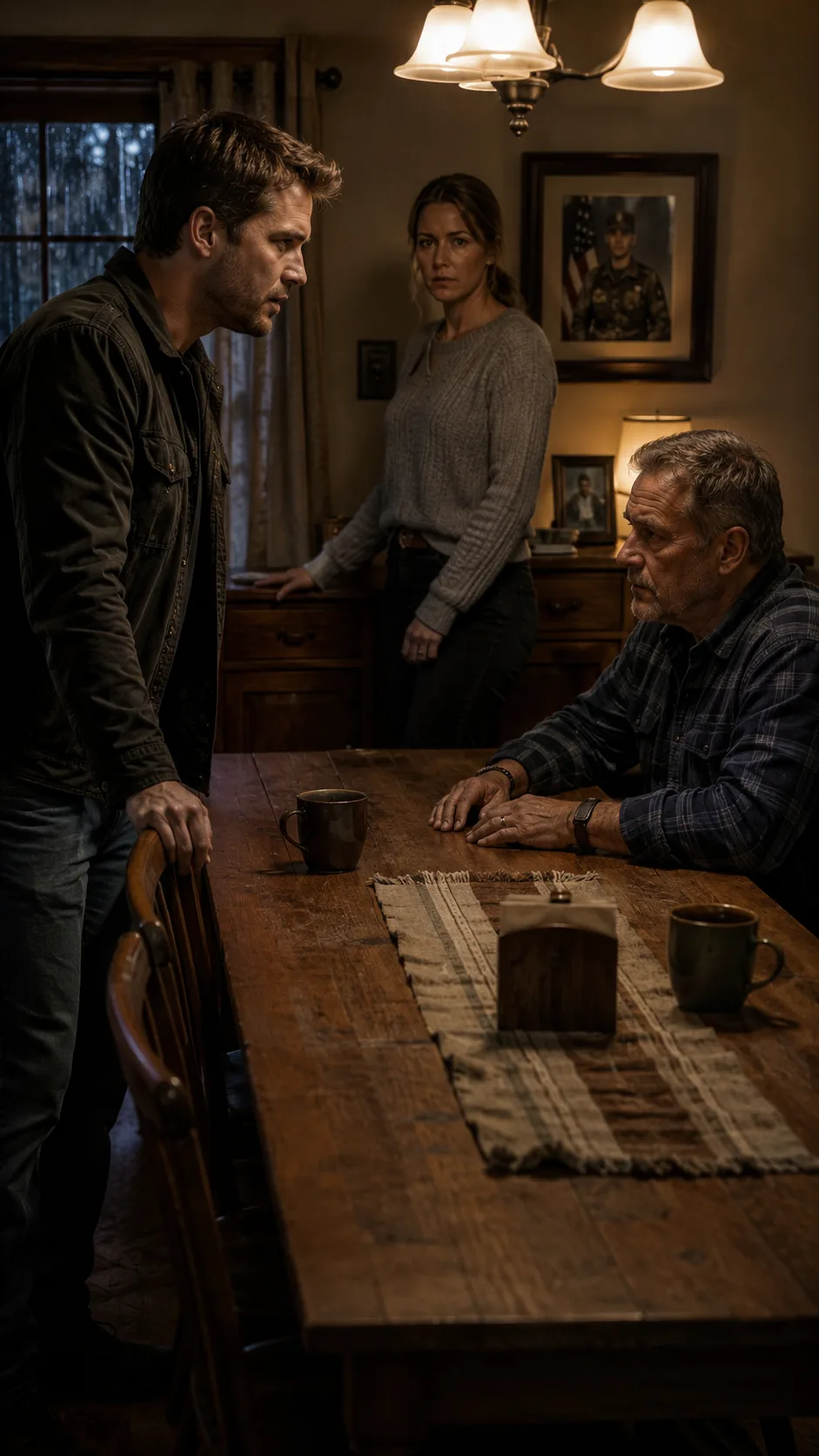
Inside, the dining room smelled of coffee, roasted turkey, and the lavender cleaner Emily used on every surface. The wooden table had been set for eight though only six of us were coming: Emily, Dad, Mark, his wife Andrea, Laura, Caleb, and me. There was an extra chair near the wall.
No place setting.
Just a chair.
I noticed it because its back leg was shorter than the others, and Emily had tucked a folded piece of cardboard beneath it.
The small things always told on her.
Dad sat at the end of the table, wearing a faded navy flannel shirt. His hair had thinned since summer. The lines around his mouth looked deeper, carved in by something that kept returning to the same place.
Caleb stepped inside.
Dad stood.
Not all the way.
His hand went to the back of his chair, and for half a second, I thought he might cross the room. Instead, he nodded.
“Caleb.”
“Sir.”
Laura touched my wrist.
Mark arrived ten minutes late with Andrea and a bottle of wine he knew Emily would not open. He kissed Emily on the cheek, clapped Dad on the shoulder too hard, and gave Caleb a grin that showed every tooth.
“So,” Mark said, pointing at my son’s short hair. “Government got another Walker.”
Caleb gave him nothing.
Dinner began with too many serving spoons and no prayer. Emily moved around the table filling plates, refusing help with a small shake of her head. Dad cut his turkey into pieces smaller than sugar cubes. Mark drank half his wine before the sweet potatoes made it around.
Andrea asked Laura about work.
Laura answered.
Caleb ate with the calm discipline of someone waiting for instructions.
Dad’s eyes moved to him and away. Again. Again.
The first crack came when Mark lifted his glass toward Dad.
“To the great mystery man,” he said. “Still keeping us all guessing.”
Emily’s fork stopped above her plate.
Dad kept cutting turkey that was already cut.
Mark smiled wider.
“What? We’re all adults here.”
“Eat,” Emily said.
“I am eating.”
“No,” she said. “You’re performing.”
The room went still.
Mark leaned back, glass in hand.
“That’s rich.”
Emily did not look at him.
Dad placed his knife beside his plate. Carefully. Too carefully.
Caleb watched the knife.
I watched Emily.
She was not just irritated. Her right hand had closed around her napkin and twisted it once, twice, until the white cloth became a rope.
Mark set down his glass.
“You know what? Maybe Daniel’s the only one with enough backbone to say it. Dad disappeared years ago. You built a shrine around his silence.”
“Stop,” Dad said.
The word was quiet.
Mark laughed once.
“No, Dad. Not this time. Caleb deserved better. Mom deserved better. We all deserved better.”
Dad’s hand moved to his bracelet.
Emily stood.
Her chair scraped back. The short-legged chair near the wall rocked once on its cardboard wedge.
“I said stop.”
Mark looked up at her.
“You don’t get to command the room.”
Emily’s mouth tightened.
“No. He does.”
She looked at Dad.
But Dad was staring at his plate.
That was when I noticed the cabinet.
The old side cabinet beside the window, the one with the framed military photograph on top, had a brass lock installed where a plain wooden knob used to be. I knew that cabinet. It had belonged to our grandmother. When we were kids, Emily kept board games in it. Monopoly money. Missing puzzle pieces. A cracked plastic timer from Scrabble.
Now there was a lock.
Small.
New.
I looked at the framed photograph above it. Dad in uniform, younger, standing with five men beneath an American flag. I had seen versions of that photo before. On Dad’s dresser. In an album Mom kept. On a memorial program for one of the men.
But this copy had something written on the bottom edge in black marker.
Oregon file stays with E.
My fork slipped against the plate.
Emily saw me notice.
Her eyes moved from the photograph to me, and for once she looked away first.
“What file?” I said.
No one answered.
Mark turned in his chair.
“What file?”
Dad pushed back from the table.
“I need air.”
“No,” I said.
The word came out sharper than I meant it to.
Dad stopped with one hand on the chair.
Caleb looked at me.
Laura said my name, low.
I stood.
The room seemed smaller with everyone seated except me and Emily. The lamp over the table made the plates shine. Rain tapped against the glass. Somewhere in the kitchen, the refrigerator motor kicked on and began its low hum.
“What file, Emily?”
She placed her napkin beside her plate.
Dad looked toward the hallway.
“Emily,” he said.
She closed her eyes once.
When she opened them, she reached into the pocket of her gray sweater and took out a small brass key.
Mark sat forward.
Andrea put her hand over his wrist.
“No,” Dad said.
Emily looked at him.
“You promised me I would never have to use it unless they made you small.”
Dad’s face changed.
Not much.
Enough.
His hand slipped from the chair back.
I looked from him to Emily.
“What does that mean?”
Emily walked to the cabinet.
“Sixteen years,” Mark said. “Sixteen years and now we get theater?”
Emily inserted the key.
The lock clicked.
Dad’s chair dragged back an inch.
Caleb stood without making a sound.
Emily opened the cabinet drawer and reached inside. Her hand disappeared beneath a stack of old table linens, then came out holding a sealed military folder wrapped with a faded band. The folder was worn at the corners. The kind of thing touched too many times and opened too few.
She held it against her chest for a second.
Dad’s voice broke through the room.
“Don’t.”
Emily turned.
Her face had no performance in it now. No defense. No patience.
“You asked me to keep it,” she said. “I did.”
Dad swallowed.
“They don’t need it.”
“They’re using the silence against you.”
Mark stood.
“What the hell is that?”
Emily carried the folder to the table.
My father lowered himself back into his chair as if his knees had forgotten their job.
Nobody moved.
Emily stepped between Dad and the rest of us, then placed the folder directly in the center of the table. It landed with a dull weight that moved the coffee cups.
“You want to know why he never slept?” she said.
The room answered with rain.
Dad reached for the folder.
His hand stopped halfway.
It hovered there, over the old wood, over the gravy stain near his plate, over the place where Caleb’s graduation photo had been set earlier beside the salt shaker.
Emily put her palm on top of the folder.
“Dad.”
He did not look at her.
His fingers curled once, then opened.
He lowered his hand.
Emily broke the seal.
The faded band came loose with a dry snap. She opened the folder and pulled out a report clipped together at the top, pages yellowed at the edges, official stamps ghosted across the corners. I saw black blocks where lines had been redacted. I saw numbers. Coordinates. Names. A date.
August 17.
The year after Dad deployed.
Emily turned the first page toward us.
Mark leaned in first.
Then he stopped leaning.
I saw it.
Walker, Thomas R.
My father’s name sat in the middle of the page, not as a story, not as an excuse, but as ink that had survived sixteen years of silence.
Beside it was the mission title.
Operation Hollow Ridge.
Caleb stepped closer.
The chair behind him tilted and settled back on all four legs.
Emily pointed to the date.
“This is why he screamed in his sleep.”
Dad closed his eyes.
No one reached for the wine. No one picked up a fork. The turkey sat cooling under the light, skin turning dull, gravy thickening in the boat.
I read the first paragraph.
A night operation near a village outside Khost Province.
A convoy diverted.
A civilian compound misidentified.
Radio failure.
Enemy fire from the ridge.
Then a line that had been circled in pencil.
Walker refused extraction until surviving minors were secured.
My mouth went dry.
Mark pulled the page closer.
Emily held it flat with two fingers.
“Don’t move it.”
He let go.
I kept reading.
Dad had been part of a classified recovery mission after an intelligence error led a unit toward the wrong compound. The official order had been to extract the American team once the ridge came under fire. Dad had refused to leave because two children and an interpreter were trapped in a storage room beneath the compound.
The interpreter’s name had been blacked out.
The children’s names had not.
Samir.
Nadia.
Ages seven and nine.
Caleb read over my shoulder.
His breathing changed.
Dad sat at the end of the table with his hands open now, palms against the wood. The veteran bracelet had slid down toward his knuckles.
Emily reached into the folder and removed a second page.
“This one came three years later.”
Dad’s chair creaked.
“Please.”
Emily paused.
The word was not an order.
It landed like a hand placed on a closed door.
For a second, she did not move.
Then Caleb spoke.
“Please what, sir?”
Dad looked at him.
Caleb did not blink.
“Please don’t let us know?” he said. “Or please don’t make you remember?”
Dad’s lips parted.
No answer came.
Emily laid down the second page.
It was a letter, copied and folded, the crease lines worn soft. At the top was an Oregon address. Emily’s address.
I looked at her.
“You had this mailed to you?”
She nodded once.
“Why?”
“Because he burned the first one.”
Dad’s jaw tightened.
Mark turned on him.
“You burned it?”
Dad stared at the table.
Emily tapped the letter.
“It was from the girl.”
Nadia.
The name sat between us now without a black bar over it.
Emily did not read the whole letter. She did not need to. She pointed to one paragraph near the bottom, and my eyes followed.
He carried my brother when the smoke was too much. He put his body over us when the second wall came down. He said in our language, “Keep breathing.” I do not know who taught him those words.
I looked at Dad.
My father, who never spoke of Afghanistan, had learned enough words in a child’s language to keep her alive under a collapsed wall.
A sound came from Mark.
Not speech.
Something smaller.
Emily turned another page.
A photograph slid loose and landed near my plate.
Two children stood outside a school somewhere dry and bright, older than they had been in the report. A teenage boy and a teenage girl. The girl held a sign with careful English.
Thank you, Sergeant Walker.
Dad pushed back from the table and stood.
The chair scraped.
Caleb moved aside.
Dad walked to the window, but there was nowhere to go. The rain had turned the glass black, throwing the dining room back at him in reflection. He stood facing his own outline with both hands at his sides.
Emily gathered the photograph before gravy could touch the corner.
“There’s more,” she said.
Dad shook his head.
“Enough.”
“No.”
Her voice did not rise.
But the room followed her now.
Not Mark. Not me. Not the anger we had carried in like luggage.
Emily.
She pulled out the third document.
“This is the part he never forgave himself for.”
I did not want to look.
I did.
The report described a second team pinned near the ridge. Dad’s closest friend, Staff Sergeant Lewis Crane, had been among them. Extraction could not reach both positions. Dad had been ordered to leave the civilians and return to the ridge team.
He disobeyed.
Because the children were alive.
Because the interpreter was bleeding.
Because the compound was collapsing.
Because choice, once made, does not return clean.
Lewis Crane died before the ridge team could be reached.
The room narrowed around the paper.
I remembered that name from childhood. Lewis. A man Dad used to call every Sunday before deployment. A man whose Christmas cards had stopped coming. A man whose widow once mailed my mother a box of baby clothes when Mark was born.
Dad had not just come home from war.
He had come home from a decision.
Mark sat down.
Hard.
Andrea put both hands in her lap and folded them until her knuckles went pale.
Caleb removed his cap from his coat pocket. I had not noticed he had brought it inside. He held it against his thigh.
I looked at Emily.
“How long have you known?”
She kept her eyes on the folder.
“Since I was twenty-five.”
“Why you?”
Dad answered before she could.
“Because she found me.”
We all turned.
He still faced the window.
The reflection showed his face in the black glass, older and thinner than the man in the photograph.
“The night your mother went to Denver for Aunt Ruth’s surgery,” he said. “Emily came home early from college. I was in the garage.”
Emily’s hand moved to the back of a chair.
No one interrupted.
Dad continued.
“I had Lewis’s pistol.”
Laura covered her mouth, but no sound came.
Dad looked down.
“Your sister took it from me.”
The refrigerator hummed.
The lamp buzzed.
Rain kept tapping.
Emily’s fingers tightened on the chair until the wood creaked.
“She made me sit on the floor,” Dad said. “Then she called a doctor. Then she called my commanding officer. Then she made coffee I never drank.”
Emily looked at him.
“You kept apologizing.”
Dad turned from the window.
“To Lewis.”
“No,” Emily said. “To us.”
He looked at me then.
Not past me.
At me.
My chest felt packed with gravel.
Dad walked back to the table and stood behind his chair. He did not sit.
“I was ordered not to discuss the mission,” he said. “Then later, when parts were cleared, I couldn’t make the words fit.”
Mark rubbed both hands over his face.
“You let us think you didn’t care.”
Dad nodded once.
“I know.”
“You missed Mom’s last Christmas dinner.”
“I know.”
“You missed Caleb’s graduation.”
Dad’s eyes moved to my son.
His mouth worked once.
“I know.”
Caleb stood straight, but his cap had crumpled in his hand.
Emily pulled one final item from the folder.
A sealed envelope.
My name was on it.
Daniel.
The handwriting was Dad’s.
I stared at it.
Emily slid it toward me.
“He wrote one for each of you after the garage,” she said. “He never mailed them.”
I did not touch it.
The envelope sat beside my plate, close enough that my knife reflected its edge.
Dad looked at it too.
“I thought explaining would make it worse,” he said.
I gave a short laugh with no humor in it.
“It did a pretty good job unexplained.”
He accepted that.
No defense.
No flinch.
Just the table between us and sixteen years sitting open on it.
Mark reached for his own envelope when Emily placed it down. He tore it open too fast and ripped the corner. Andrea touched his elbow. He shook her off, then pressed the torn paper flat with both palms.
Caleb had no envelope.
Of course he didn’t.
He had been a toddler when Dad wrote them.
Dad noticed at the same time I did.
He reached into the pocket of his flannel shirt and took out a folded program.
Caleb’s graduation program.
The cream paper was bent at the corner from being carried. On the front, beneath the academy seal, Dad had written in small block letters.
I stood outside.
Caleb saw it.
He looked up.
Dad held the program with both hands.
“I drove there,” he said. “I parked across the street.”
Caleb did not move.
Dad swallowed.
“When I saw the uniforms, I couldn’t get out.”
The words scraped.
“I watched from the truck.”
Caleb’s face stayed still, but his grip on the cap loosened.
Dad stepped forward and placed the program on the table, not near me, not near Emily.
In front of Caleb.
“I failed you,” he said.
Caleb looked at the program for a long time.
Then he picked it up.
Not forgiveness.
Not yet.
But he picked it up.
The room after that did not know what to do with itself.
The plates remained full. The wine Mark brought stayed unopened on the sideboard. Emily gathered the mission report pages, but she did not put them back in the folder yet. She laid them in order, smoothing each corner with the side of her hand.
Dad sat again.
This time, not at the head of the table.
He took the short-legged chair near the wall, the one with cardboard beneath it.
No one told him to move.
Mark read his letter in pieces, stopping after every few lines. Andrea stood behind him and rested a hand on his shoulder. He did not shake it off again.
Laura cleared plates that no one had finished. I helped her because standing still had become harder than moving. In the kitchen, the sink filled with warm water and turkey grease. My hands smelled like dish soap and metal.
Emily came in carrying coffee mugs.
“You don’t have to wash those,” I said.
She placed them by the sink.
“I know.”
For a while, we stood side by side without speaking.
Then I said, “I hated you for knowing.”
She leaned back against the counter.
“I know.”
“You could have told me.”
“No.”
I turned to her.
She looked older under the kitchen light.
“He wasn’t mine to expose,” she said. “Not until you all made silence into proof that he didn’t love you.”
I looked through the doorway.
Dad sat with Caleb at the table. They were not talking. Caleb had the graduation program open between them. Dad pointed at something in the ceremony list, then stopped, letting Caleb turn the page himself.
Small steps.
Emily picked up a towel and dried one mug.
“I got tired,” she said.
“Of keeping it?”
“Of watching him disappear while everyone called it stubbornness.”
The towel moved around the rim of the mug.
Then stopped.
“I got tired of being the only witness.”
After dinner, Mark went outside alone and stood under the porch roof with his phone in his hand. He did not call anyone. He just held it, screen dark, rain blowing against his shoes.
Andrea brought him his coat.
He put it on without looking at her.
Dad stayed until the house had gone quiet. Emily packed leftovers into containers and labeled them with blue tape. Laura wrapped the pie no one had cut.
Caleb stood by the military photograph on the side cabinet.
He read the black marker on the bottom edge.
Oregon file stays with E.
“Who wrote that?” he asked.
Dad came up behind him.
“Lewis.”
Caleb turned.
Dad pointed to the man standing beside him in the photo. Younger. Grinning. One hand lifted like he had been caught mid-joke.
“He said I lost everything,” Dad said. “Wallets. Maps. Gloves. He told Emily if anything ever mattered, she should hold it.”
Caleb looked at the photograph again.
“He knew her?”
Dad nodded.
“She was twelve when he taught her to change a tire in our driveway.”
Emily stood near the table with the folder against her chest.
“I forgot that,” she said.
Dad looked at her.
“No, you didn’t.”
She said nothing.
We left after ten.
The rain had softened to mist. Gravel shifted under our shoes as we walked to the truck. Caleb carried the folded graduation program in his coat pocket. I carried my unopened envelope.
Laura waited until we were on the road before she spoke.
“Are you going to read it?”
Streetlights passed over the windshield, one after another.
“Yes.”
But I did not read it that night.
I placed it on my dresser beside my watch and wallet. For three days, I walked past it. I picked it up once, felt the paper, and set it down again.
On the fourth morning, I opened it before work.
The letter was not long.
Dad did not explain the mission in detail. He did not ask me to understand. He did not write around what he had missed. He listed things like a man taking inventory of damage.
Your first house. I should have helped with the porch.
Mark’s surgery. I stayed in the parking lot.
Your mother’s last Christmas dinner. I was in the garage.
Caleb’s graduation. I was across the street.
Then one line near the bottom.
I loved you in ways that did not reach you.
I read that line twice.
Then I folded the letter along the same crease and put it back in the envelope.
Over the next month, small changes came without announcement.
Dad called Caleb on a Tuesday evening and asked about boot camp paperwork. Caleb answered in short sentences at first. By the end, he was sitting at the kitchen table with a pen, writing down advice about socks, blisters, and how to fold a letter so it survived rain.
Mark visited Dad alone.
He stayed twenty minutes.
The next week, he stayed an hour.
Emily kept the file in Oregon, but she made copies of the pages we were allowed to have. She put each set in plain envelopes, labeled by hand. No ceremony. No speech.
When Dad began therapy again, he did not tell us until his third appointment.
“I go Thursdays,” he said over the phone.
“That’s good.”
“I hate Thursdays.”
“I bet.”
He made a sound that almost became a laugh.
Not quite.
On Christmas Eve, we gathered at Emily’s house again. Same table. Same lamp. Same cabinet. The short-legged chair was still near the wall, but the cardboard wedge had been replaced by a proper wooden shim Dad had cut himself.
He arrived early and fixed it without asking.
Dinner was not easy.
Easy would have been false.
Mark still went quiet when Afghanistan came up on the news. Caleb still watched Dad’s hands when loud sounds hit. Emily still kept one eye on every room, the way people do when they have spent years listening for a crash.
But Dad sat at the table.
He stayed.
After dessert, Caleb took out the graduation program and placed it beside Dad’s plate.
“I kept it,” he said.
Dad touched the corner.
“I’m glad.”
No one applauded. No one made a toast. Emily poured coffee. Laura cut the pie too thin. Mark complained about it and then ate two slices.
The military photograph remained on the side cabinet, but the sealed folder was no longer visible. It did not need to be.
Before we left, I found Dad in the garage, where Emily kept boxes of old tools and Christmas decorations. He was tightening the handle on a snow shovel.
“You don’t have to fix everything,” I said.
He turned the screwdriver once more.
“I know.”
Then he handed it to me.
The handle was steady.
Outside, Caleb was waiting by the truck, breath white in the cold. Emily stood on the porch under the yellow light, arms crossed against the chill. Dad walked out beside me, slower than he used to, but not folded inward.
At the steps, he stopped.
“Daniel.”
I turned.
He looked at the truck, then at me.
“I should have opened the file myself.”
I put my hands in my coat pockets.
“Maybe.”
He accepted that too.
Emily came down one step.
Dad looked at her.
“You carried too much.”
She gave him the smallest smile I had ever seen from her.
“So did you.”
No one moved for a few seconds.
Then Caleb opened the passenger door and called, “Grandpa, you coming?”
Dad looked at me.
I looked at Emily.
She nodded toward the truck.
The old man walked down the steps.
And this time, he got in.
Chapter complete
You have reached the end of this chapter.
Continue reading
A few more worlds to get lost in after this chapter.




