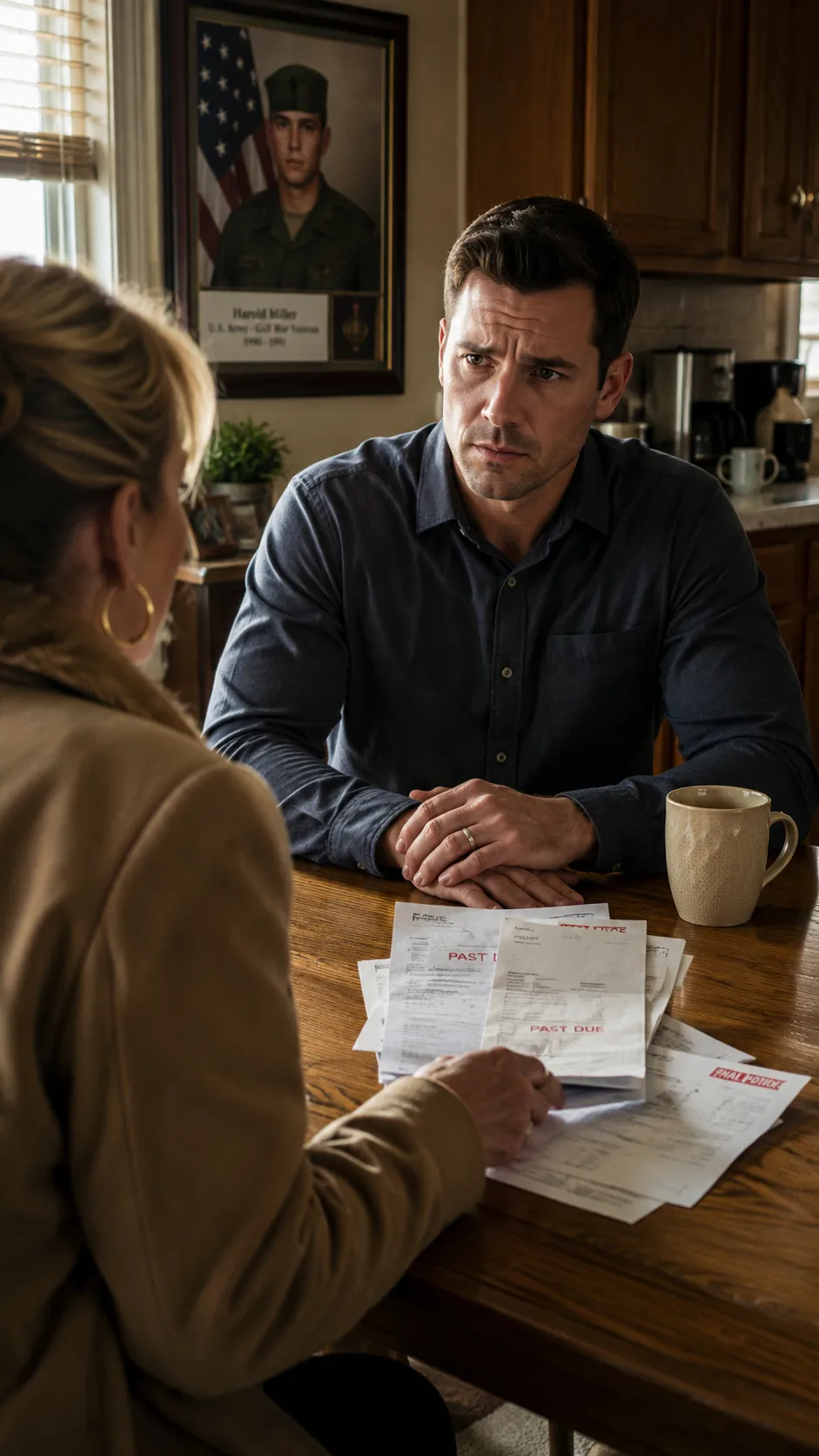
Rebecca pushed the stack of unpaid bills across my kitchen table like she was sliding a bad hand in a card game.
Chapter 1
Rebecca pushed the stack of unpaid bills across my kitchen table like she was sliding a bad hand in a card game.
I did not touch them.
Not yet.
Her fingers stayed on the top envelope, the one stamped in red across the corner. The nail polish on her thumb was chipped down the middle. Years ago, she would have tucked that hand under the table before anyone saw it. Rebecca Miller did not allow flaws to show unless she wanted something.
She wanted something that afternoon.
My coffee sat between us, untouched, with a pale ring forming at the edge of the mug. Behind her, my father’s military portrait hung on the wall in a plain wooden frame. He had been twenty-six in that picture, still broad through the shoulders, his Gulf War uniform pressed so sharp it looked cut from paper.
Rebecca did not look at it.
She never had.
“You’re doing well,” she said, and her eyes moved past my shoulder toward the hallway, the framed diploma, the small
things people inspect when they want to calculate your life. “You always were the lucky one.”
I folded my hands on the table.
No answer.
She gave a short laugh and lifted one bill. “I’m not asking for much, Daniel. Just enough to get through a few months.”
The word enough had a strange sound in her mouth.
Dad had used that word all his life.
Enough coffee left for the morning.
Enough gas to make it to Friday.
Enough money to send one more check to the university.
He never said the last one aloud. I would not learn that until years after he was gone, after I found the folder with his name on it and mine beneath it, written in the blocky handwriting he used for forms and grocery lists.
Rebecca tapped the envelope again.
Tap.
Tap.
Tap.
The sound took me back to our father’s kitchen,
to her heels against the old linoleum while she watched him count coupons beside the sink.
“Dad,” she had said once, leaning against the counter in a wool coat she bought on credit, “you know people are allowed to enjoy retirement, right?”
He kept drying the same plate.
That was his way.
He would rinse a plate, dry it, turn it over once to check for water spots, and slide it into the cabinet like he was placing something valuable into storage. He treated ordinary things with care because he knew what it cost to replace them.
Rebecca called it cheap.
I called it Dad.
Our house outside Ogden had two bedrooms, a roof that clicked in high wind, and a furnace with a personality. The living room smelled faintly of dust, lemon cleaner, and the tobacco Dad never smoked but somehow carried home from men at the veterans’ hall.
He kept a small American flag folded in a triangular case on the mantel, though I never knew whose it was. He never told war stories. He did not pose in uniform after he came home. He worked maintenance at a warehouse, fixed lawn mowers for neighbors, and drove a blue Ford pickup that coughed before it started.
Rebecca hated that truck.
She hated being dropped off in it. She hated the patched seat, the cracked dashboard, the glove box that wouldn’t stay shut unless Dad hit it twice with the heel of his hand. When she was sixteen, she made him stop two blocks from school.
“Just here,” she said.
Dad pulled over.
“Snow’s coming down,” he said. “I can take you to the front.”
“I said here.”
He nodded once and watched her step into slush in shoes too thin for January. She did not turn back. He waited until she reached the sidewalk before he drove off.
I was eleven in the passenger seat, holding my lunch bag on my lap.
“Why does she talk to you like that?” I asked.
Dad adjusted the heater knob though it already sat all the way right.
“She’s young.”
“She’s mean.”
He looked at the road. “Don’t copy her.”
That was the end of it.
By the time Rebecca left home, she had trained herself to speak like every room was beneath her. She married a man named Scott who sold insurance, moved into a subdivision with stone columns at the entrance, and corrected Dad when he called her house “nice.”
“It’s not nice, Dad,” she said. “It’s an investment.”
Dad stood in her foyer holding a casserole dish wrapped in foil.
“Looks nice to me.”
Scott laughed under his breath.
Rebecca heard him and smiled.
Small thing.
Sharp thing.
I saw Dad’s hand tighten on the foil edge until it wrinkled.
I did not defend him. I was nineteen, home from my first semester at the University of Utah, wearing a sweatshirt Dad had bought me from the campus bookstore during move-in weekend. It was dark red, too expensive, and still stiff from the tag. He had insisted.
“College kid needs a college shirt,” he said.
At the register, I saw him count bills from a paper envelope. Not a wallet. An envelope. He flattened each dollar with his thumb before handing it over, then put the receipt into his shirt pocket.
I wore that sweatshirt for ten years.
Rebecca noticed the logo at dinner.
“Must be nice,” she said, cutting into the casserole Dad had brought. “Some of us had to work through community college.”
Dad reached for the salt.
“You did good,” he said.
“That’s not the point.”
He set the salt back without using it.
No answer.
I worked too. I stocked shelves two nights a week at a grocery store and cleaned lab equipment on weekends. But my tuition was paid. My dorm deposit was paid. My books were paid. Every time I asked Dad where the money came from, he said the same thing.
“I planned.”
That was all.
I believed him because I wanted to.
People believe what lets them sleep.
During my junior year, I came home for Thanksgiving and found the house colder than usual. Dad wore two flannel shirts and a knit cap inside. The furnace made a low grinding sound from the hall closet.
“It needs repair,” I said.
“It works.”
“Dad.”
“It makes heat.”
“It makes noise.”
He smiled at the stove where he was stirring gravy. “Noise is free.”
Rebecca arrived two hours late with Scott and a bottle of wine she said was “probably too good for turkey.” She kept her coat on through dinner and glanced toward the vents every time the furnace groaned.
“Dad, this is ridiculous,” she said. “You get a veteran’s pension and still live like this?”
Dad passed the rolls.
No answer.
Scott looked up. “You do get one, right? From the Gulf?”
Dad’s fork paused above his plate.
“Yes.”
Rebecca leaned back. “Then where does it go?”
The room held still around the question. The gravy boat sat between us. One of the candles near the centerpiece had burned unevenly and spilled wax onto the tablecloth.
Dad picked up his water glass.
“Bills.”
Rebecca laughed once. “What bills? You don’t go anywhere.”
I watched Dad drink.
One swallow.
Then another.
He set the glass down carefully, lining it up with the edge of his placemat.
I said, “Leave him alone.”
Rebecca turned to me. “Of course you’d say that. You’re the beneficiary of Saint Harold’s mysterious budgeting.”
Dad stood before I could answer and carried his plate to the sink though half his food remained. He ran water over it for a long time.
The furnace groaned again.
That winter, I called him twice a week from campus. He always asked about grades first, food second, tires third. If I mentioned money, he changed the subject.
“I can apply for more aid,” I said once.
“You study.”
“I can take out loans.”
“You study.”
“I’m serious.”
“So am I.”
The line clicked faintly. Dad still used a corded phone in the kitchen because he said cordless phones vanished under couch cushions.
“Did you fix the furnace?” I asked.
“It’s behaving.”
That meant no.
I knew his language.
I did not know enough of it.
The first crack in Rebecca’s life appeared at Dad’s seventy-second birthday. She hosted dinner at her house, which meant she ordered food from a restaurant and put it in her own serving dishes. Dad wore a brown sport coat from the 1990s and brought a grocery store cake because he did not like showing up empty-handed.
Rebecca opened the door, looked at the cake, and said, “Dad, I told you I had dessert handled.”
He held the plastic lid with both hands.
“Chocolate.”
“We’re doing lemon tarts.”
“Kids like chocolate.”
Her children were teenagers by then. They stood behind her, looking at their phones.
Rebecca took the cake with two fingers like it might stain her.
Inside, Scott was pouring drinks. He had gained weight, lost hair, and started wearing golf shirts with small logos from resorts where he played badly and posted pictures anyway. He slapped Dad on the back too hard.
“Harold, still driving that antique?”
Dad took off his cap. “Truck starts.”
“That’s one standard.”
Rebecca laughed from the kitchen.
I watched Dad place his cap on the entry table, brim facing the door. He always did that, ready to leave even when he had just arrived.
At dinner, Rebecca announced that she and Scott were considering a second property near Park City. She said it in a way that required witnesses. Dad nodded, cut his chicken, and asked her daughter about school.
“Grandpa,” my niece said, not looking up from her plate, “Mom says you don’t believe in investments.”
Dad wiped his mouth with a napkin.
“Your mom says a lot.”
Rebecca’s fork stopped.
It was not much. From Dad, it was thunder.
Scott grinned. “Careful, Harold. She’ll put you in a better nursing home if you behave.”
Nobody laughed except him.
Dad looked at me across the table. His eyes stayed on mine for less than a second, then moved to the salt shaker.
Small thing.
I stored it.
After dinner, I found him alone in the garage, standing near Scott’s riding mower. The garage was heated, polished, and cleaner than Dad’s kitchen. Golf clubs leaned in one corner. Boxes labeled Christmas Luxury Décor sat stacked against the wall.
Dad held his cap in his hands.
“You ready?” I asked.
He nodded.
At the door, he paused near a shelf where Scott kept old magazines. A white envelope sat between two boxes, half-open, with red print showing through. Dad noticed it. So did I.
Past due.
He looked away first.
I did not mention it. Neither did he.
Three months later, Rebecca called me during my lunch break.
“Have you talked to Dad?”
“Yesterday.”
“Did he say anything about money?”
I stood beside the vending machine at work, holding a sandwich I no longer wanted.
“No. Why?”
“He asked if Scott knew someone who buys used tools.”
“Dad’s selling tools?”
“I guess.”
“What kind?”
“How would I know?”
Her voice was sharp, but there was a scrape under it.
I drove to Dad’s house that evening. His garage door was open. The pegboard above his workbench had empty outlines where tools used to hang, dust silhouettes shaped like wrenches and saws. The old red toolbox on the floor was open and half-empty.
Dad sat on a stool, cleaning a socket wrench with a rag.
“Selling these?” I asked.
“Some.”
“Why?”
“Don’t use them much.”
“You fixed Mrs. Callahan’s mower last week.”
He folded the rag.
“She paid me in zucchini.”
I stepped closer to the bench. “Are you short?”
He glanced toward the house, toward the kitchen window with the yellow curtain my mother had sewn before she died.
“No.”
“Dad.”
He closed the toolbox.
“Your last year costs more.”
There it was.
Not the whole truth.
Enough.
I looked at the empty pegboard. “I told you I could take loans.”
“And I told you no.”
“You’re selling tools.”
“I’m selling metal.”
“These are yours.”
He put one hand on the toolbox lid. His knuckles looked larger than they used to, the skin thin across them.
“So are you.”
I had no answer for that.
None.
A week later, a scholarship I had applied for came through late. It covered part of my spring tuition. I called Dad to tell him. He said, “Good,” then asked if I needed snow tires.
That was Dad.
He could take relief and turn it into concern within one breath.
After graduation, he sat in the audience wearing the brown sport coat and a tie with tiny flags on it. Rebecca came too, late, in sunglasses, carrying a gift bag that still had a store receipt taped to the handle. When my name was called, Dad stood before anyone else in our row.
He clapped with both hands high.
Once.
Twice.
Then he sat down because people behind him could not see.
After the ceremony, I found him near a tree outside the auditorium. He held the program folded in half, my name circled in blue ink.
“You did it,” he said.
“We did.”
He shook his head.
“No. You.”
Rebecca came up behind him. “Well, at least someone’s investment paid off.”
Dad turned the program over in his hand.
The corner bent.
He said nothing.
I should have said something that day. I should have taken the hit for him. I should have made Rebecca stand there and hear the truth, whatever piece of it I understood then.
Instead, I let the crowd move around us.
Cowardice can look like keeping peace.
Dad lived another twelve years after that. He attended my wedding in the same sport coat, met my son, taught him how to check tire pressure, and kept a little dish of peppermints near his chair because my daughter liked them. His truck finally died behind a grocery store, and he refused to let me buy him a new one.
“Used is fine.”
“Let me help.”
“You have kids.”
“So?”
“So buy them shoes.”
He bought a used sedan from a retired postal worker and kept it spotless. Rebecca laughed when she saw it.
“Dad, that thing looks like it belongs to a church secretary.”
He patted the hood.
“Probably drove careful.”
She rolled her eyes.
The last year of his life, his hands shook when he buttoned his cuffs. He hid it by wearing sweaters. He moved slower through rooms. Sometimes he stopped at the kitchen counter and looked at a drawer without opening it, as if trying to remember why he had come there.
I started visiting every Sunday.
Rebecca came when holidays required it.
At Christmas, she brought a large basket with imported crackers, smoked salmon, and a jar of mustard Dad could not open. She placed it on his table and looked around the kitchen.
“Dad, this house is depressing.”
He was sitting near the window, sunlight on his sleeve.
“It’s paid for.”
“That’s your answer to everything.”
“It’s a good answer.”
She crossed her arms. “You could have lived better.”
He looked at the small ceramic tree on the counter, the one my mother had painted in 1984. One green bulb was missing.
“I lived.”
Rebecca shook her head. “Barely.”
Dad’s eyes moved to me.
Not asking for rescue.
Just seeing if I had heard.
I had.
After he died, the house seemed smaller. The kitchen drawers held rubber bands, twist ties, batteries sorted by size, and receipts going back decades. Dad kept everything that might matter and many things that did not: a screw in a pill bottle, a grocery list from 2007, instruction manuals for appliances he no longer owned.
Rebecca arrived two days after the funeral with Scott and a cardboard box.
“What’s that?” I asked.
“For things I want.”
“We haven’t gone through anything yet.”
She set the box on Dad’s table. “I don’t want much. Just a few pieces.”
She took my mother’s ceramic tree, Dad’s flag tie, and the old mantel clock that had not kept proper time since 1998. She did not ask about his military papers. She did not open the desk drawer where his VA letters were stacked in labeled envelopes.
When the lawyer read Dad’s simple will, there was no money to fight over. The house was split between us. His car went to me because, as the will said, Daniel will maintain it. Rebecca made a sound through her nose.
“That’s perfect,” she said. “He even judged us in paperwork.”
The lawyer, a patient man named Mr. Alvarez, opened a small box and handed me a sealed folder.
“Your father left this specifically for you.”
Rebecca sat up.
“For him?”
Mr. Alvarez checked the page. “Yes.”
“What is it?”
He did not look at her. “A personal file.”
She turned to me. “Open it.”
I tucked it under my arm.
“Not here.”
Her mouth tightened.
Outside the lawyer’s office, she followed me to my car. The sky was white with snow clouds. Salt dust covered the curb.
“Why would Dad leave you a file?”
“I don’t know.”
“Of course you know.”
I unlocked my car.
She stepped closer. “He always favored you.”
I opened the door and placed the folder on the passenger seat.
“No,” I said.
She laughed, but her face did not move right.
“No? He put you through college. He showed up for you. He helped with your house. Don’t stand there and pretend.”
I looked at her then. Really looked.
Her lipstick had bled into the small lines around her mouth. One earring sat slightly lower than the other. For the first time, she looked less polished than arranged.
“He showed up where he was allowed,” I said.
She stared at me.
A snowflake landed on the folder through the open car door and melted into the brown paper.
I closed the door.
That night, after my children went to bed, I opened Dad’s folder at my dining table.
Inside were records.
Not letters first. Not photographs. Records.
Gulf War veteran pension statements. Bank withdrawal slips. Copies of checks made out to the University of Utah. Tuition receipts by semester. Housing payments. Bookstore charges. Insurance notices. His pension deposits marked in blue ink, then outgoing payments marked in black.
The numbers ran down the pages like a second biography.
His life, line by line.
In the back was a single sheet in his handwriting.
Daniel,
You asked once where it came from.
It came from years I do not talk about and work I was lucky to come home from. I did not need much. Your mother wanted both of you educated. Rebecca would not take my help after she married. You did.
Do not make a shrine out of this.
Use your life.
Dad
I read the page twice.
Then I set it down.
The house was quiet except for the refrigerator clicking on and off. My wife, Laura, stood in the doorway in her robe and did not ask me to explain. She walked to the table, read one receipt, and placed her hand beside mine.
Not on top.
Beside.
That was better.
I put the folder in the drawer of our kitchen cabinet, the one that stuck if pulled too fast. I did not tell Rebecca. I did not use the records as a weapon. Dad had refused to defend himself while living. I could not decide whether honoring him meant keeping his silence or breaking it.
So I kept the folder.
Years moved.
Rebecca’s life thinned in layers. Scott’s insurance business failed after a lawsuit. The Park City property vanished first. Then the house with the stone columns. Then the vacations became old posts she recycled on social media as “memories.” Scott left before the bankruptcy filing, taking his golf clubs and half of what little could still be divided.
Rebecca moved into a townhouse near Layton with beige carpet and a parking lot view. She said it was temporary.
Everything she disliked became temporary once it belonged to her.
At first, she called to complain about Scott. Then about lawyers. Then about her daughter, who had moved to Arizona and stopped answering long calls. Then the calls stopped altogether.
For eight months, nothing.
Then she knocked on my door with cracked purse handles and past due notices.
That afternoon, she sat in my kitchen with her coat still on, asking for help from the person she had always accused of taking too much.
My father’s portrait watched over her shoulder.
She pushed the bills closer.
“You know I wouldn’t come here if I had another option.”
I looked at the envelopes, then at the mug between us.
“Where’s Scott?”
“Gone.”
“The kids?”
She pressed her lips together and looked toward the window blinds.
“They have their own lives.”
“You told Dad that once.”
Her eyes snapped back to me. “Don’t start.”
I leaned back.
There it was.
Still there.
The old voice beneath the worn coat.
She gathered the bills, squared them against the table, and pushed them forward again with both hands. “I’m asking for a loan. Not a lecture.”
“A loan.”
“Yes.”
“How much?”
She named a number large enough to make the room quieter.
Laura was at work. The kids were at school. The house held only the ticking kitchen clock, the refrigerator hum, and Rebecca’s fingers tapping the top bill.
Tap.
Tap.
Tap.
Dad’s plate in the sink.
Dad’s truck two blocks from school.
Dad’s tools missing from the pegboard.
I stood.
Rebecca’s chin lifted. She thought I was getting a checkbook.
I walked to the old wooden drawer near the pantry.
“What are you doing?” she asked.
I pulled the drawer.
It stuck halfway.
I pulled harder, and it opened with a dry scrape that sounded too much like Dad’s kitchen.
Inside were spare keys, batteries, takeout menus, a roll of tape, and the folder. Brown paper. Soft corners. Dad’s handwriting across the tab.
Harold Miller — Pension / Daniel — Utah
I set it on the table between her bills and my cold coffee.
Rebecca stared at the folder.
“What is that?”
I sat down.
“Dad’s file.”
She laughed once, too quickly. “Dad had files for everything. He probably saved receipts for shoelaces.”
“He did.”
I untied the string.
Her hand moved toward her purse, then stopped.
The first page was a pension statement. I placed it flat in front of her.
She looked at it without leaning down.
“Okay.”
I placed the second page beside it. A bank withdrawal record.
Then a tuition receipt from the University of Utah.
Rebecca’s face changed by a fraction. One blink. Her fingers curled against the edge of her sleeve.
I placed another receipt.
Then another.
Fall semester.
Spring semester.
Housing.
Books.
Fees.
Each one connected to the same pension deposit dates Dad had marked in blue and black. His handwriting sat in the margins, small and square.
Paid.
Paid.
Paid.
Rebecca looked from one page to the next.
The red stamp on her own unpaid bill faced upward beside the folder.
Past due.
I did not speak.
Not yet.
She picked up one receipt and held it closer. Her thumb covered the university seal. Her other hand found the edge of the table.
“This doesn’t prove—”
I added the bank statements.
The room gave her no place to put the sentence.
Her mouth closed.
A car passed outside, tires hissing over wet pavement. The kitchen clock ticked above the back door. Dad’s portrait remained where I had hung it, plain frame, no medals displayed, no drama.
Rebecca lowered the receipt.
“He told me his pension went to bills.”
“It did.”
“These aren’t his bills.”
I looked at the pages between us.
“They were to him.”
She pushed the receipt back as though it had heat in it. “Why didn’t he say anything?”
I opened the folder to the final page.
Dad’s note.
I did not hand it to her yet.
“Because you made up your mind about him years before he could have answered.”
Rebecca’s fingers tightened around the envelope from the power company. The paper bent.
“That’s not fair.”
“No.”
I slid the pension records closer to her.
“Fair was him selling tools in the garage because my last year cost more.”
Her head turned slightly toward the window.
“Fair was him sitting in a cold house while you made jokes about his furnace.”
The words came out level.
Too level.
She looked back at me. “You never told me.”
“I didn’t know all of it.”
“But you knew he helped you.”
“Yes.”
“So you let him do it.”
I took that one.
I had taken it for years.
“Yes.”
Rebecca leaned back, and the chair legs creaked. “Then don’t sit there like I’m the only one who took from him.”
The sentence landed hard.
It deserved to.
I looked down at the folder. Dad’s handwriting sat at the top of the note, my name formed with a careful D.
“No,” I said. “I’m not.”
Rebecca’s eyes shifted.
I turned the note toward her but kept my hand at the bottom of the page.
“He wrote that you refused help after you married.”
Her lips parted, then shut.
I watched her face do the work.
A small line appeared between her eyebrows. Her eyes dropped to the paper, then moved away. She reached for her purse, opened it, closed it, opened it again.
No words.
I remembered something then. A memory I had not attached to anything.
Dad on the phone in the hallway when I was in college. His voice low.
“She won’t take it?”
Pause.
“Don’t tell her I offered.”
Pause.
“Just see if they need groceries.”
At the time, I had thought he was talking about a neighbor.
I leaned back from the table.
“He tried, didn’t he?”
Rebecca froze.
The kitchen changed around that question. The bills, the folder, the coffee mug, the portrait. All of it stayed still, but her hand stopped moving inside the purse.
I waited.
She pulled out a tissue, though she did not use it.
“Scott said no.”
“That’s not what I asked.”
She folded the tissue into a square.
Once.
Twice.
“Dad offered to help with our mortgage once.”
“When?”
She looked at the wall behind me. “After Scott’s first bad year.”
“And you said no.”
She pressed the tissue flat on the table.
“I told him we weren’t charity.”
There it was.
Miniature.
Ugly.
Alive.
Dad had offered. She had refused. Then she spent years mocking the modest life created by the money she was too proud to accept and too careless to understand.
I tapped the note once.
“He wrote it down.”
Rebecca reached for it.
I moved my hand.
“Read the records first.”
Her eyes came up.
For the first time since she entered my house, she had no older-sister voice ready. No little cut. No polished remark.
I slid the pension statements toward her instead of the bills.
She stared at them.
The red stamps on her envelopes looked louder now.
“You came here,” I said, “because your savings ran out.”
Her jaw worked.
“You came to the house paid for by the education he bought.”
She looked toward the hallway again, toward the framed diploma.
“But before you ask me for help, you need to see what you spent years laughing at.”
The kitchen clock ticked three times.
Tick.
Tick.
Tick.
Rebecca reached toward the first tuition receipt.
Her hand hovered over Dad’s signature.
It did not land.
I placed the final note beside it, but I did not push it all the way across. The corner lined up with the pension record. Dad would have liked that. He lined up everything: cups, keys, shoes by the door.
Rebecca’s eyes moved over the first line.
Daniel,
She stopped there.
Just my name.
That was enough to make her look at the portrait.
Not long.
Long enough.
Her unpaid bills sat between her elbow and the sugar bowl, bent from her grip. One envelope had slipped sideways, showing the amount due in a little window. I could have written a check. I could have ended the scene with mercy and made myself feel clean.
But Dad’s life was still open on the table.
And she had not finished reading.
“He didn’t live poorly,” I said. “He lived deliberately.”
Rebecca swallowed. The movement ran down her throat and disappeared beneath the collar of her coat.
“He could have told me.”
“He could have.”
“Why didn’t he?”
I looked at the note.
“Because he was Dad.”
Outside, the school bus hissed to a stop at the corner. A child laughed somewhere beyond the window. My daughter would be home soon, carrying her backpack with one strap hanging lower than the other. Dad used to fix that strap every Sunday without asking.
Rebecca touched the edge of the note.
This time, I let her take it.
She read the whole page without moving anything but her eyes.
At the line Rebecca would not take my help after she married, her thumb pressed into the paper until it bowed.
At Do not make a shrine out of this, her mouth pulled tight.
At Use your life, she set the note down as if lowering a glass too full.
She did not say sorry.
Not then.
She looked at the bills she had brought, then at the pension records, then at the portrait on the wall.
The portrait gave her nothing back.
That was fair.
The room after the folder opened did not feel like my kitchen anymore. It felt borrowed from Dad: the careful silence, the unpaid cost of every ordinary object, the weight of a man who could leave the room without raising his voice and still remain in it.
Rebecca sat with her coat collar touching her chin.
Her bills stayed untouched.
I gathered the tuition receipts first, one by one, stacking them in order. Fall before spring. Housing behind tuition. Books clipped separately because Dad had clipped them separately. My hands knew the sequence by then.
Rebecca watched.
“Are you going to help me?” she asked.
The question came out smaller than the first time.
I looked at her envelopes.
“Yes.”
Her shoulders moved as though she had been holding a breath she would never admit to holding.
“But not like this.”
She looked up.
I pushed her bills back toward her. “I won’t hand you money and let you walk out pretending Dad was the fool in this family.”
Her face tightened, but it did not harden all the way.
Good.
“I’ll call the utility company with you,” I said. “We’ll talk to the bank. I’ll pay what keeps you housed this month, directly. Then you’ll meet with a counselor Laura knows.”
“A counselor?”
“A financial counselor.”
She looked down at her purse.
The cracked handles had left two dark half-moons against the table.
“I’m not a child.”
“No.”
I tied the folder string.
“You’re Dad’s daughter.”
That stopped her.
It stopped me too.
The back door opened before either of us spoke again. My daughter came in with her backpack half-zipped, cheeks pink from the walk, one mitten missing.
“Hi, Aunt Rebecca,” she said.
Rebecca turned in her chair and arranged her face quickly. Too quickly.
“Hi, sweetheart.”
My daughter dropped her backpack near the chair and looked at the table. Children see papers the way adults see smoke.
“Is something wrong?”
I picked up the folder.
“No. Just grown-up paperwork.”
She nodded, took a peppermint from the small dish near the counter, and headed down the hall. Dad’s dish. Dad’s peppermints. I had kept them there after he died because my children reached for them without thinking.
Rebecca saw the dish.
Her eyes stayed on it longer than they had stayed on the portrait.
“I forgot he always had those,” she said.
I placed the folder back in the drawer.
The drawer stuck again before closing.
This time, I did not force it. I eased it back, lifted slightly, and let it slide into place.
Dad had taught me that.
Rebecca stayed until the sun moved off the kitchen floor. We called two companies, made one payment arrangement, and scheduled one appointment. I paid the electric bill directly over the phone. She gave the account number with a voice that kept catching on the last digit, so I took the paper and read it myself.
When she stood to leave, she reached for the folder drawer, then stopped.
“Can I…” She cleared her throat. “Can I read his note again sometime?”
I looked at the drawer.
“Next Sunday.”
She nodded.
At the door, she put on her gloves. One had a small hole near the thumb.
“Daniel.”
I waited.
Her eyes moved to the portrait across the kitchen.
“I called him cheap at the funeral reception.”
“I know.”
“I said the food was plain.”
“Yes.”
She pressed her lips together and opened the door.
Cold air entered the kitchen.
“I brought that food,” I said.
She turned back.
“Dad picked the menu before he died.”
Her hand tightened on the doorknob.
“He said people eat better when they recognize what’s on the plate.”
Rebecca looked down at the threshold.
Then she left.
I did not follow her outside. I watched through the window as she crossed the driveway, holding her purse close with one arm and her stack of bills under the other. She sat in her car for a while before starting it.
The engine caught on the second try.
Old sound.
Familiar.
Over the next months, Rebecca came every Sunday afternoon. At first, she said it was for paperwork. She brought unopened mail in a grocery bag and sat at the kitchen table with a pen, a calculator, and the stiff posture of someone trying not to ask too many questions.
Laura made coffee.
My children learned to leave the table clear by three.
Rebecca read Dad’s note only twice. The second time, she did not touch the paper. She leaned over it with both hands flat on the table and moved her lips silently through the lines.
After that, she asked about the tools.
“What tools?”
“The ones he sold.”
I told her what I knew. The empty pegboard. The red toolbox. The last year of tuition.
The next Sunday, she brought a socket wrench wrapped in a dish towel.
“I found this in my garage,” she said. “Scott must have borrowed it years ago.”
She placed it on the table.
It was Dad’s. His initials were scratched into the handle with a nail or a knife.
H.M.
Rebecca did not ask to keep it. She slid it toward me.
I kept it on the windowsill for a week, then hung it in my garage above my own workbench. Not as a shrine. Dad had warned me about that.
A tool should hang where work happens.
Rebecca did not become someone else. People rarely do. She still corrected waiters. She still used the phrase my standards when she meant her pride. She still flinched when bills arrived and reached for appearances before solutions.
But sometimes, before speaking of Dad, she stopped.
That was new.
The townhouse stayed hers. Scott did not come back. Her daughter visited in the spring, and Rebecca brought her to my house for Sunday dinner. We made pot roast, potatoes, green beans, and chocolate cake from a grocery store mix because Dad liked cake that tasted like childhood.
Before dinner, my niece stood in front of Dad’s portrait.
“He looks young,” she said.
Rebecca came up beside her.
“He was,” she said.
“Was he strict?”
Rebecca looked toward me, then back at the frame.
“He was careful.”
That word sat in the room better than cheap ever had.
After dinner, I washed plates at the sink. Rebecca dried them. She turned each one over once to check for water spots before sliding it into the cabinet.
I noticed.
So did she.
Neither of us mentioned it.
The furnace in my house clicked on, steady and warm. My daughter reached for a peppermint from Dad’s dish, unwrapped it, and left the paper on the counter. I picked up the wrapper, folded it once, and put it in the trash.
Rebecca leaned against the sink with the towel in her hands.
“Next Sunday?” she asked.
I handed her another plate.
“Yes.”
She dried it carefully.
No one laughed.
Chapter complete
You have reached the end of this chapter.
Continue reading
A few more worlds to get lost in after this chapter.




