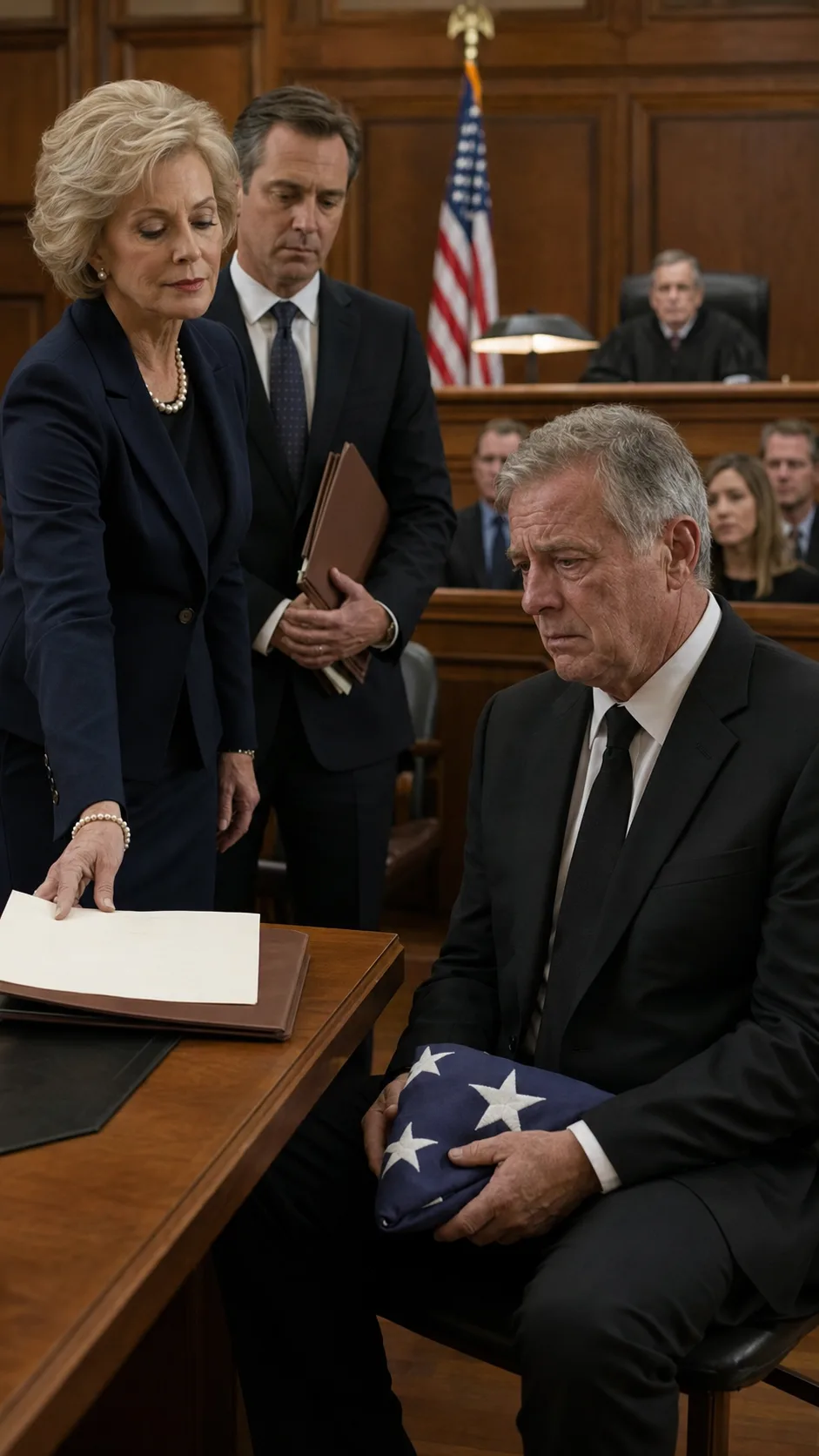
I was still holding my father’s funeral flag when my sister laid a will on the probate table and claimed the house he had built with his own hands.
Chapter 1
I was still holding my father’s funeral flag when my sister laid a will on the probate table and claimed the house he had built with his own hands.
The corners of the flag pressed into my palms.
Hard corners.
Eleanor did not sit when she entered the courtroom. She stood beside her attorney in a navy suit that looked too expensive for a morning in Salina, Kansas, with pearls at her throat and a leather folder tucked under one arm. She had worn the same pearls to Dad’s funeral three weeks earlier, standing at the front of the church as if grief had assigned seats and she had reserved the best one.
Dad would have hated the fuss.
Thomas Whitaker had been a decorated World War II veteran, though he never used those words. He kept his medals in a cigar box in the bottom drawer of his dresser, beneath old socks and a cracked leather belt. If anyone asked about the war, he changed the subject to the price of corn or whether the Royals had any
chance that season.
He liked black coffee.
No sugar.
No cream.
Every morning, even after his hands began to shake, he lined up his mug, his pills, and his VA envelopes on the kitchen table like a soldier preparing inspection. Eleanor said that was because he trusted her to handle things. I thought it was because order was the only thing age had not taken from him.
Then he died.
And Eleanor moved fast.
Too fast.
She emptied his bedroom before I could drive in from Wichita. She boxed his clothes, took his checkbook, changed the locks on the farmhouse, and told the funeral director she was the “primary decision-maker.” I let most of it pass because I did not want to turn my father’s death into a family fight.
Not yet.
At the church, she handed me the folded flag after the honor guard ceremony as if she were
giving me something that no longer mattered.
“You were always sentimental,” she said.
I held it anyway.
Three weeks later, in probate court, she opened her leather folder and pulled out a will none of us had ever seen.
Her attorney, Mr. Baines, adjusted his tie.
“Your Honor, this document clearly names Mrs. Eleanor Whitaker Caldwell as sole beneficiary of the estate.”
Sole beneficiary.
I looked down.
The flag did not move.
Our father’s estate was not grand. A farmhouse outside Abilene. Forty-two acres leased to a neighbor. A savings account. A truck that had not started since February. A cigar box full of medals, including the Silver Star he had refused to display.
But everything?
Eleanor’s attorney slid the will forward.
My cousin Ruth shifted in the gallery. A wooden bench creaked behind me. Somewhere near the back, someone’s phone buzzed once before being silenced.
A small thing.
Still,
I heard it.
Judge Hanley reached for the document, and Eleanor lifted her chin. She had always known how to arrange her face when people were watching. At Dad’s nursing home, she smiled at staff. At the bank, she used her married name. At family dinners, she spoke over everyone until people stopped trying.
She had handled everything.
That was her phrase.
I had heard it so many times it had become furniture in the room.
“I handled Dad’s bills.”
“I handled Dad’s appointments.”
“I handled the VA paperwork.”
“I handled the house.”
Now she had handled his will, too.
Mr. Baines cleared his throat.
“The testator was of sound mind at the time of signing.”
The judge looked over the page.
I saw the signature from where I sat.
Thomas A. Whitaker.
Smooth. Looping. Steady.
Too steady.
Dad had stopped writing that way three years before he died. The arthritis in his fingers made cursive impossible. By the end, his signature looked like fence wire caught in a storm, all broken lines and hard stops. He joked about it once while signing a birthday card for my daughter.
“Looks like a cow stepped in ink,” he said.
Then he laughed until he coughed.
That signature on Eleanor’s will did not belong to the man who had died in room 214 of the veteran care wing.
It belonged to the man he had been before Eleanor took over.
I leaned toward my attorney, a small-town probate lawyer named Denise Hart, and tapped the edge of the table.
“That’s not his signature,” I said.
She didn’t look at me. Her eyes stayed on the document.
“I know.”
Two words.
My fingers tightened around the flag.
Denise had come to me five days earlier after I called her about the locks. She asked for any records I had. I had almost nothing. Eleanor had taken Dad’s files from the farmhouse, including the metal box where he kept discharge papers, VA letters, and tax documents.
But Dad had given me one thing.
A coffee can.
He pressed it into my hands two months before he died, when Eleanor had stepped out to argue with a nurse about billing.
“Keep this,” he said.
Inside were buttons, old coins, a bent key, and a folded receipt from a bank in Junction City.
On the back of the receipt, in Dad’s broken handwriting, were six words.
Ask the VA about my checks.
That was all.
I thought he had been confused.
I almost threw it away.
Denise did not.
She called the Department of Veterans Affairs office in Wichita. Then she called again. Then she asked me whether Dad had ever filed a complaint about benefit payments.
I said no.
At least, I thought no.
The next day, a federal investigator called her back.
After that, Denise stopped saying much over the phone.
“Bring the flag,” she told me.
So I did.
And now Eleanor’s will was lying on the probate table, close enough for me to see the fake signature at the bottom.
Mr. Baines continued.
“Mrs. Caldwell served as primary caregiver during Mr. Whitaker’s final years. It is natural, and legally sound, that he chose to recognize that devotion.”
Devotion.
Eleanor lowered her eyes.
Perfect timing.
Ruth’s husband coughed into his fist. My nephew stared at the floor. The judge turned the page.
Denise stood.
“Your Honor, before this document is admitted, we ask the court to review additional records.”
Mr. Baines looked at her.
“What records?”
Denise did not answer him.
The courtroom door opened.
It was not loud.
The door simply pulled inward, and a man in a dark government suit stepped inside carrying a sealed file under one arm. He was in his fifties, square-shouldered, with an ID badge clipped to his jacket pocket. He paused near the back row, scanned the room, and walked forward without hurry.
Eleanor saw him.
Her hand stopped on the table.
Mr. Baines kept speaking for half a sentence before he noticed nobody was listening to him.
The man approached the front.
“Your Honor,” Denise said, “this is Special Investigator Raymond Ellis with the Department of Veterans Affairs.”
The judge removed his glasses.
“Approach.”
Investigator Ellis stepped between the benches and the counsel tables. He did not look at Eleanor first. He looked at the judge. Then he looked at the will.
A sealed VA file rested under his left hand.
Brown folder.
Red tape.
Federal label.
Eleanor’s pearls sat perfectly still against her throat.
Mr. Baines lifted one palm.
“Your Honor, I object to this theatrical interruption.”
Denise turned her head.
“No theater.”
The investigator placed the file beside Eleanor’s will.
Not on top of it.
Beside it.
The room narrowed around that table.
Judge Hanley looked from the forged will to the sealed file.
“What exactly am I reviewing?”
Investigator Ellis broke the tape.
Paper shifted inside the folder. Thick stacks. Copies. Forms. A notarized document with a blue seal. Benefit statements clipped by month. Medical notes. A handwritten complaint scanned into a federal record.
He set the first page in front of the judge.
“This file concerns Mr. Thomas Arthur Whitaker, veteran, United States Army, service number redacted for court submission.”
Eleanor’s attorney leaned forward.
“And relevance?”
The investigator slid another page forward.
“Financial exploitation report, initiated by the veteran.”
The gallery moved all at once.
Not loudly.
Just bodies adjusting.
Eleanor laughed once through her nose.
“My father was confused near the end.”
Investigator Ellis did not turn toward her.
“The first report was filed twenty-two months before his death.”
My mouth went dry.
Twenty-two months.
I looked at Denise.
She kept her hands folded.
The judge picked up the page. His eyes moved behind his glasses.
Mr. Baines reached toward the VA file.
The investigator placed one finger on the corner.
“Certified copies only, counsel.”
Baines withdrew his hand.
A small retreat.
The first one.
Judge Hanley turned to Eleanor’s will again.
“Mrs. Caldwell, this submitted will is dated March 12 of last year?”
Eleanor nodded.
“Yes, Your Honor.”
Her voice held.
Barely.
The investigator placed another document beside it.
“This notarized will was filed with Mr. Whitaker’s VA fiduciary review packet four years before that date.”
Denise slid a copy toward me.
I did not touch it at first.
Dad’s real signature sat at the bottom, rough but unmistakable, each letter dragging where his fingers had stiffened. He had left the farmhouse to all three surviving children equally. His savings were to pay any final medical bills first. His medals were to be donated to the county veterans museum unless the family agreed to display them together.
And the flag?
The flag was not in the will.
Of course not.
He had assumed we would know what to do with it.
My thumb pressed into one of the white stars.
Judge Hanley compared the documents.
“The signatures differ.”
Mr. Baines spoke quickly.
“Handwriting changes with age.”
Investigator Ellis opened another section of the folder.
“Yes.”
He placed two VA forms on the bench.
“These were signed by Mr. Whitaker in the same month as the disputed will.”
The judge leaned closer.
On the VA forms, Dad’s signature was jagged, slow, and cramped.
On Eleanor’s will, it was smooth as ribbon.
Nobody spoke.
Then Investigator Ellis turned one page.
“These are benefit disbursement records.”
Eleanor’s chair made a sharp sound against the floor.
She had shifted back.
Only an inch.
The investigator continued.
“Monthly veteran benefit payments were redirected through a joint account controlled by Mrs. Caldwell.”
Eleanor’s mouth opened.
Mr. Baines stood straighter.
“My client assisted with routine banking.”
The investigator placed three bank statements in a line.
“Routine withdrawals began two days after the account change. Cash withdrawals. Transfers. Payments to a private credit card not belonging to Mr. Whitaker.”
The judge looked at Eleanor.
“Mrs. Caldwell?”
She lifted her hand to her pearls.
“Dad asked me to manage expenses.”
“Did he ask you to transfer six thousand dollars to Caldwell Interiors?”
Her fingers stopped.
Caldwell Interiors was her husband’s remodeling business.
Ruth covered her mouth in the gallery.
Denise did not look away.
Mr. Baines bent toward Eleanor and spoke near her ear. She gave a small shake of her head. He spoke again. She shook it harder.
The investigator removed one final sheet.
A copy of a handwritten complaint.
Dad’s handwriting.
Broken.
Slanted.
Painfully slow.
Judge Hanley read aloud, but only the first line.
“My daughter Eleanor will not let me see my mail.”
He stopped there.
The rest stayed on the page.
I saw the words anyway. Not all of them. Enough.
Checks.
Phone.
Threatened.
Nursing home.
My sister made a sound that could have been a breath or a warning.
“Daddy was not well.”
Daddy.
She had not called him that since we were children.
The word landed badly.
Judge Hanley placed the complaint beside the forged will.
Investigator Ellis then reached into the folder and removed a signature comparison prepared by a forensic document examiner attached to the VA review.
“Preliminary findings show the disputed will was not signed by Mr. Whitaker.”
Mr. Baines objected.
The judge raised one hand.
Enough.
The attorney stopped.
Eleanor stepped forward and reached for the will.
It happened fast.
A flash of navy sleeve. Pearl bracelet. Her fingers almost touched the paper.
The bailiff moved in from the side and blocked her hand with his forearm.
“Ma’am.”
One word.
Eleanor froze.
Every face in the courtroom turned toward her.
The judge picked up the forged will, looked at it, and placed it away from the VA documents.
Not far.
Just far enough.
That movement did more than any speech could have done.
The will no longer sat at the center.
The VA file did.
I set the folded flag on the table.
Slowly.
The wood took its weight.
For the first time since the funeral, my hands were empty.
Judge Hanley looked at Eleanor.
“Mrs. Caldwell, you are not to touch any document on this table.”
She lowered herself back into the chair.
No one helped her.
Mr. Baines stared at the fake will as if it had become a snake.
Investigator Ellis placed a final packet before the judge.
“There is also evidence that Mr. Whitaker attempted to revoke Mrs. Caldwell’s access to his benefit account six months before death.”
My sister turned toward me then.
Not fully.
Just enough.
Her face had lost the courtroom polish. Powder gathered in the fine lines near her mouth. One earring sat slightly crooked. Her eyes moved from me to the flag and back again.
I said nothing.
There was nothing to add.
Dad had already spoken.
He had spoken in VA forms, bank complaints, broken signatures, and one coffee can pushed into my hands while my sister argued in the hallway.
Judge Hanley called for a recess.
No one stood at first.
The gavel had not struck hard, but the sound seemed to leave marks on the table.
Then the benches began to move. Ruth stepped into the aisle and stopped there, her purse hanging open from one shoulder. My nephew walked toward Eleanor, then turned away before reaching her. Mr. Baines gathered his papers, but he did not touch the forged will.
The bailiff did.
He placed it in an evidence sleeve.
Eleanor watched him seal it.
A neat plastic sound.
Denise touched my sleeve.
“Michael.”
I looked at her.
She nodded toward the flag.
I picked it up, but not the same way I had carried it in. Before, I had held it like proof that Dad was gone. Now it felt like something he had passed across a table and trusted me not to drop.
Outside the courtroom, Eleanor stood near a vending machine with her attorney. The machine hummed, selling stale crackers and orange soda under fluorescent light. Her husband was not there. Her children were not there. She held her purse against her ribs with both hands.
When I walked past, she spoke.
“You don’t know what it was like taking care of him.”
I stopped.
The flag rested against my chest.
“No,” I said. “But he tried to tell someone.”
Her mouth tightened.
“He was difficult.”
I looked down the hallway toward the courtroom door.
“So were you.”
Denise called my name from the clerk’s window. I walked away before Eleanor could answer.
By the end of the day, Judge Hanley refused to admit the disputed will. The real will from the VA file became the controlling document pending further review. The court froze the estate accounts. The forged will went to the county attorney. The benefit records went into a separate investigation.
Eleanor did not return for the next hearing.
Her attorney appeared without her and said she was “unwell.”
No one asked details.
The farmhouse stayed locked for two more months while investigators traced transfers, withdrawals, and forged authorizations. They found Dad’s missing mail in Eleanor’s basement, bundled by year with rubber bands. They found his check registers. They found envelopes he had addressed to the VA but never mailed because someone had taken his stamps and phone.
One envelope had my name on it.
Michael.
Nothing else.
Inside was a single page.
Dad had written slowly. Some words leaned into the next. Some stopped halfway and began again.
He did not accuse Eleanor directly. That was Dad. Even cornered, he left room for people to stand up on their own.
He wrote that he was tired.
He wrote that he wanted the house handled fairly.
He wrote that if I ever found the coffee can, I should not let anyone make me feel foolish for asking questions.
At the bottom, he added one line.
Your sister learned how to take before she learned how to ask.
I read it at the kitchen table in the farmhouse after the court gave me temporary access.
His mug still sat in the cabinet.
White ceramic.
Cracked handle.
Eleanor had taken the silver, the checkbooks, and the locked metal box, but she had left the mug because it was worth nothing.
I washed it.
Then I made coffee.
Black.
No sugar.
No cream.
The estate took nearly a year to settle. Eleanor pleaded guilty to reduced charges connected to the forged document and unlawful transfers. She was ordered to pay restitution from the sale of a lake property she and her husband had bought during the years Dad’s benefits disappeared. She avoided prison, but not the record. Not the county paper. Not the silence at family gatherings where her chair stayed open and no one moved to fill it.
The farmhouse did not go to one person.
Dad’s real will was followed.
My younger brother, Alan, wanted to sell immediately. He had medical bills and no attachment to Kansas dirt. I understood. Ruth said the land should stay in the family. Denise said the law did not care what anyone thought land “should” do.
So we made a different arrangement.
Alan received his share. Eleanor’s share was held against restitution. I bought out what remained with a small loan, the truck sold for parts, and the forty-two acres stayed leased to the neighbor whose cattle had been breaking our fence since 1988.
The medals went to the county veterans museum.
I delivered them myself.
The curator wore white cotton gloves and asked if Dad had spoken much about the war.
“No,” I said.
She opened the cigar box and lifted the Silver Star.
The ribbon had faded.
“He kept them under his socks,” I said.
She smiled without showing her teeth.
“That sounds about right.”
They placed his medals in a glass case beside a photograph of him at twenty-three, standing with other young men in uniforms too large for their bodies. In the picture, Dad’s hair was dark, his jaw narrow, his eyes fixed somewhere beyond the camera.
Below the case, the museum added a small card.
Thomas Arthur Whitaker
United States Army
World War II
Kansas Farmer, Father, Veteran
I stood there longer than I meant to.
A school group came through, noisy and restless, sneakers squeaking against the floor. One boy pointed at the medals and asked his teacher what they were for.
The teacher bent down and read the card.
I walked out before she finished.
The folded flag did not go to the museum.
It came home with me.
I placed it on the shelf above Dad’s kitchen table, where his VA mail used to sit in careful stacks. The coffee can stayed beside it. I put the bent key back inside, along with the bank receipt and his letter.
Sometimes, when I visit the farmhouse, I still find things Eleanor missed.
A grocery list behind the flour tin.
A rusted pocketknife in the shed.
A photograph of us as children taped inside an old tackle box, all three of us barefoot near a pond, Eleanor holding a stringer of bluegill while Dad crouched behind us with one hand on her shoulder.
She had been smiling.
Not the courtroom smile.
A real one.
I keep that photo in the tackle box.
Some things do not need to be rescued.
One Saturday in late October, I replaced the lock on the front door again. Not because Eleanor had a key. She had surrendered what she had. I replaced it because the old one stuck when the weather changed, and Dad used to curse at it every fall.
The neighbor’s cattle stood along the fence watching me work.
“Door giving you trouble?” Mr. Halpern called from his pickup.
“Same as always.”
He spat into the gravel.
“Your dad never fixed that right.”
“No,” I said.
Then I tightened the last screw.
Inside, the house smelled like dust, coffee, and old wood. The table sat where it always had. One chair tilted slightly because the back leg was shorter than the others. Dad had folded a matchbook under it years ago. The matchbook was still there.
I touched it with my shoe.
The chair held.
I made coffee in Dad’s mug and sat facing the window. Across the field, the wind moved through dry grass in flat silver waves. No one spoke over me. No one told me what had been handled. No one reached for papers before I could read them.
The flag stayed.
Chapter complete
You have reached the end of this chapter.
Continue reading
A few more worlds to get lost in after this chapter.




