The first thing I noticed after my father's funeral was that my sister stopped calling him Dad.
Chapter 1
The first thing I noticed after my father's funeral was that my sister stopped calling him Dad.
She started calling him "the estate."
Not every time.
Just often enough that I noticed.
"Have you talked to the estate attorney?"
"The estate needs to be settled."
"The estate can't sit untouched forever."
Each time she said it, the words landed differently.
Our father had been a decorated World War II veteran. In our town outside Lincoln, Nebraska, people still stopped me in grocery store aisles to tell stories about him.
He wasn't rich.
He wasn't famous.
But he was respected.
His medals hung in a shadow box near the living room fireplace. Every Veterans Day, local schoolchildren visited to hear him speak. He never bragged. Never exaggerated.
He simply showed up.
That was who he was.
When he died at ninety-eight, half the county attended his funeral.
Emily sat in the front row wearing black gloves and dark sunglasses.
She cried at the right moments.
Held people's hands.
Accepted condolences.
Everything looked perfect.
Too perfect.
Three days later she called a family meeting.
The attorney's office was crowded.
Relatives filled nearly every chair.
The reading of the will lasted less than fifteen minutes.
Then came the shock.
A recently updated will—signed only weeks before Dad's death—left almost everything to Emily.
The house.
The farmland.
Most of the savings.
His military memorabilia.
Even his truck.
I received a handful of personal items and a modest cash amount.
The room became quiet.
Not angry.
Just confused.
Because everyone knew what Dad had always said.
"Everything gets split equally."
For decades he repeated that sentence.
At birthdays.
At holidays.
At family dinners.
Equal.
Always equal.
Emily barely reacted to the announcement.
She simply folded her hands and nodded as if something expected had finally happened.
I remember staring at the signature.
Something about it bothered me.
Not enough to explain.
Just
enough to linger.
After the meeting, people approached Emily with questions.
She had answers ready for all of them.
"He changed his mind."
"He wanted things simpler."
"He talked to me about it."
The explanations arrived too quickly.
As if she had rehearsed them.
Maybe she had.
Maybe I was grieving and imagining things.
For several days I tried to convince myself that was true.
Then the small inconsistencies began.
One at a time.
A week after the funeral I ran into Mrs. Harper, Dad's longtime neighbor.
She frowned when I mentioned the will.
"Your father seemed worried before he passed."
I stopped.
"Worried about what?"
She shook her head.
"I don't know."
Then she hesitated.
"But somebody kept bringing paperwork."
That word again.
Paperwork.
I drove home thinking about it.
The next inconsistency appeared at the rehabilitation center where Dad spent time recovering after a fall.
A nurse remembered
him becoming frustrated whenever visitors arrived with documents.
"He didn't like signing things."
The nurse laughed softly.
"He complained about it more than once."
I didn't laugh.
Because Emily had visited him frequently during those final months.
Far more frequently than I had.
At the time I thought she was being a devoted daughter.
Now I wasn't sure.
I started looking through Dad's belongings.
Not searching for evidence.
Searching for peace.
Searching for something that would explain why everything felt wrong.
Instead, I found more questions.
Inside an old desk drawer sat a small notebook.
Dad rarely kept journals.
This wasn't a journal.
It was more like reminders.
Doctor appointments.
Phone numbers.
Medication schedules.
Then one sentence caught my eye.
Emily brought papers again today.
Nothing else.
Just that.
No explanation.
No context.
But it sat there on the page like a stone dropped into still water.
I couldn't stop thinking about it.
Emily brought papers again today.
Why write it down?
Why mention it at all?
That night I called the attorney.
I told him about the notebook.
There was a long silence.
Then he said something unexpected.
"The Department of Veterans Affairs has requested copies of several records."
I sat upright.
"What kind of records?"
"Estate-related documents."
My pulse quickened.
Including the will.
The attorney couldn't tell me much more.
Apparently the request stemmed from a review connected to veteran-benefit paperwork.
Routine.
At least that was the official explanation.
But it didn't feel routine.
Not to me.
Not anymore.
Weeks passed.
Emily behaved as though she had already won.
She began moving furniture from the house.
She sold equipment from the farm.
She spoke openly about renovation plans.
Whenever relatives questioned the situation, she repeated the same sentence.
"Father signed it."
Every conversation ended there.
Father signed it.
As though the matter had already been decided forever.
Then another strange thing happened.
Dad's longtime banker contacted me.
Not officially.
Just a personal conversation.
We met at a diner off Highway 6.
The coffee tasted terrible.
The waitress kept refilling it anyway.
The banker lowered his voice.
"Your father asked unusual questions near the end."
"What kind of questions?"
"He wanted to know whether documents could be changed after someone became seriously ill."
My stomach tightened.
"What did you tell him?"
"The same thing I'd tell anyone."
The banker leaned back.
"That depends on circumstances."
The conversation ended there.
But the damage was done.
Every new detail pointed in the same direction.
Something had happened during Dad's final weeks.
Something nobody wanted to talk about.
And somehow Emily stood at the center of it.
Then came the phone call.
The attorney wanted everyone back in his office.
Immediately.
No explanation.
No agenda.
Just attendance requested.
The tone alone told me this wasn't routine.
The morning of the meeting, the sky above Lincoln was gray and low.
The attorney's conference room filled quickly.
Family members arrived looking nervous.
Emily arrived looking irritated.
That difference mattered.
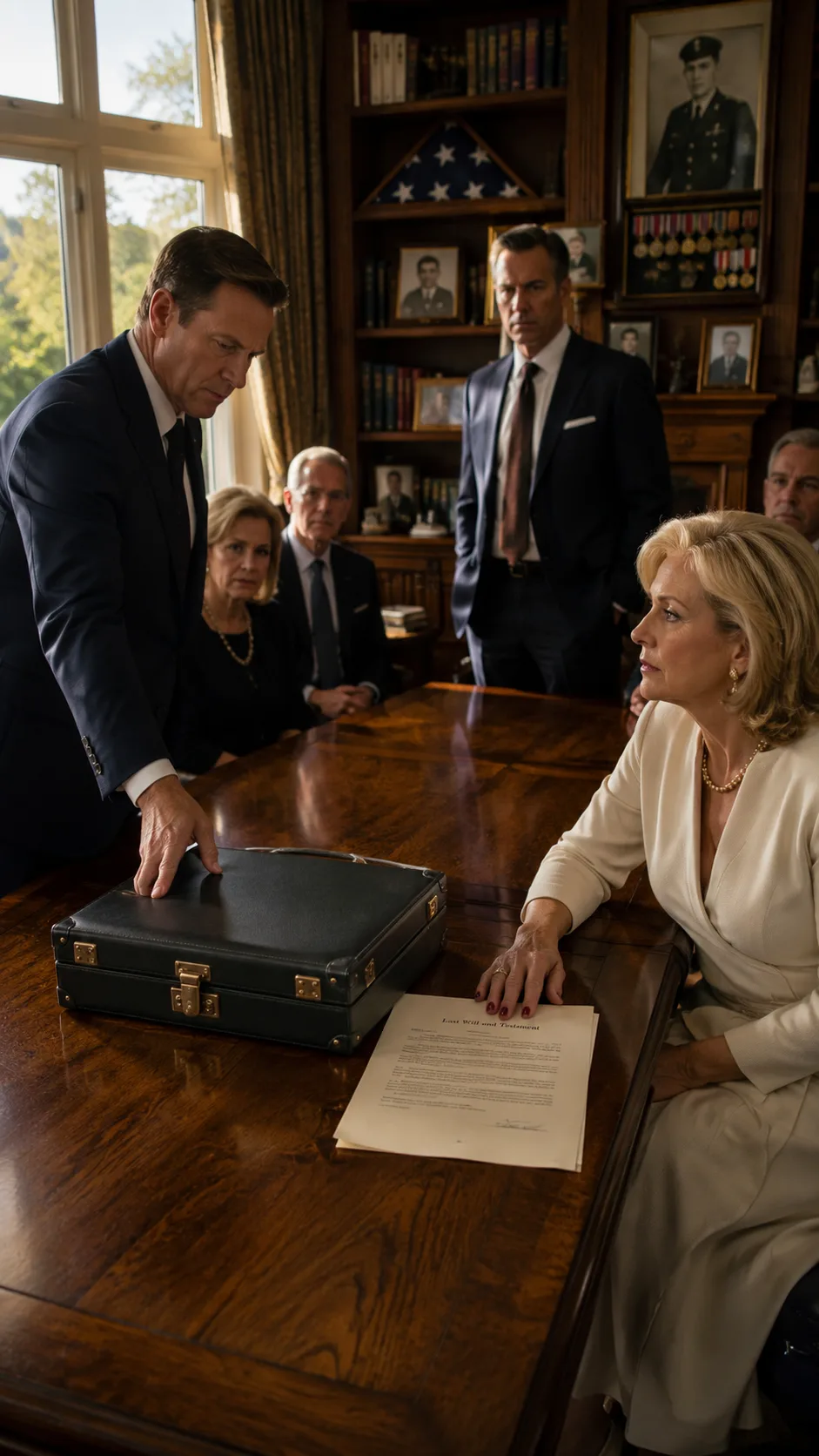
She wore an expensive cream-colored dress.
Gold jewelry.
Perfect makeup.
She walked into the room like someone forced to attend an unnecessary delay.
When she saw me, she rolled her eyes.
"Still chasing ghosts?"
I didn't answer.
She smirked.
Then she took her seat.
The attorney entered.
Not alone.
A man in a dark suit followed him carrying a black leather briefcase.
The room changed immediately.
Nobody knew why.
But everyone felt it.
The briefcase sat on the conference table.
Closed.
Motionless.
Suddenly nobody cared about the weather outside.
Nobody cared about small talk.
All attention drifted toward that black case.
Emily noticed too.
For the first time all morning, her confidence flickered.
Just briefly.
Then it returned.
The attorney cleared his throat.
"Thank you all for coming."
Nobody spoke.
The man beside him introduced himself as an investigator working with the Department of Veterans Affairs.
A murmur spread through the room.
Emily crossed her arms.
"What exactly is this about?"
The investigator didn't answer immediately.
Instead, he opened a folder.
Reviewed several pages.
Then looked toward the attorney.
The attorney nodded.
My cousin stopped tapping his foot.
An aunt lowered her coffee cup.
The room became silent.
Emily shifted in her chair.
The investigator placed one hand on the briefcase.
Then another.
Slowly.
Deliberately.
A strange memory flashed through my mind.
Dad teaching me how to bait a fishing hook when I was eight years old.
"Slow hands catch more fish."
For some reason, I thought about that now.
The investigator opened the briefcase.
The metal latch clicked loudly.
Everyone heard it.
He reached inside.
Removed a thick report.
Placed it on the table beside the will.
The sound echoed through the room.
Emily stopped moving.
The investigator opened the report.
Turned several pages.
Then another.
Then another.
He finally stopped at a highlighted section.
The attorney leaned forward.
Two relatives stood to get a better look.
Emily swallowed.
The investigator pointed to a paragraph.
Then he spoke.
"The signature on this will does not match the verified signatures of your father."
Nobody moved.
Nobody breathed.
Emily stared at him.
"What?"
The word barely left her mouth.
The investigator remained calm.
"Our forensic review determined the signature was likely produced by another individual."
The room exploded into whispers.
Emily pushed back her chair.
"That's ridiculous."
The investigator turned another page.
"There is more."
Emily's face drained of color.
The investigator continued.
"The signature appears to have been created approximately three weeks before your father's death."
Someone gasped.
An aunt covered her mouth.
A cousin dropped his pen.
The attorney looked directly at Emily.
For the first time since the funeral, she had no prepared answer.
No rehearsed explanation.
No confident smile.
Nothing.
Just silence.
The investigator wasn't finished.
He revealed visitor logs from the rehabilitation center.
Records showed repeated meetings involving paperwork.
The dates matched entries in Dad's notebook.
Emily brought papers again today.
The sentence suddenly carried weight.
Real weight.
The investigator placed photocopies on the table.
Each piece fit together like part of a puzzle.
One relative stopped looking at Emily and started looking at the evidence.
Then another.
Then another.
That was the moment everything changed.
Not when the report appeared.
Not when the investigator spoke.
When the room turned.
When every face slowly moved away from the will and toward my sister.
Power shifted.
Visibly.
Emily felt it too.
Her hand reached toward the document.
Stopped halfway.
She looked around searching for support.
Nobody came to her rescue.
Nobody spoke for her.
Nobody defended her.
The attorney folded his hands.
The investigator remained standing.
The evidence sat between them.
And for the first time since Dad died, Emily looked small.
Very small.
"I didn't forge anything."
Her voice cracked.
The sentence landed weakly.
The investigator didn't argue.
He simply pointed toward the report.
The evidence spoke for itself.
One by one, family members looked away from Emily.
A few looked embarrassed.
Others looked angry.
Most looked disappointed.
That seemed worse.
Far worse.
Because disappointment carries a different weight.
The meeting lasted another hour.
Questions filled the room.
Answers became fewer.
Emily eventually left before anyone else.
She walked out without speaking.
The door closed behind her.
Nobody followed.
Outside, rain had started falling.
Inside, the attorney carefully collected the documents.
The investigator packed away the report.
The black briefcase closed once more.
But everything was different now.
The story Emily had controlled for weeks had collapsed in a single morning.
Afterward, legal proceedings continued.
Investigations expanded.
Additional records surfaced.
The original estate plan eventually emerged.
Dad had never intended to disinherit me.
Not even close.
The estate was supposed to be divided equally.
Just as he had always promised.
Equal.
Always equal.
Months later, I returned to Dad's house.
The property felt quieter than before.
The medals still hung above the fireplace.
The old truck sat in the driveway.
A coffee stain remained on the workbench in the garage.
Small things survive longer than people expect.
I carried the notebook with me.
The same notebook containing the sentence that started everything.
Emily brought papers again today.
One line.
Seven words.
That was all.
Yet those seven words refused to disappear.
Neither did the truth.
I stood in the living room looking at Dad's photograph.
Outside, wind moved through the Nebraska fields.
The same fields he had worked for decades.
The same fields he wanted shared fairly.
The same fields that nearly became part of a lie.
I placed the notebook beside his framed military portrait.
Then I stepped back.
The room finally felt honest again.
And for the first time since the funeral, it felt like Dad was home.
Chapter complete
You have reached the end of this chapter.
Continue reading
A few more worlds to get lost in after this chapter.




