The pharmacy clerk slid Dad’s receipt across the counter and waited while I counted out twenties with my thumb.
Chapter 1
The pharmacy clerk slid Dad’s receipt across the counter and waited while I counted out twenties with my thumb.
Three left.
I kept one for gas, one for feed, and one for the hardware store because the upstairs window still rattled when the wind came off the north pasture. The clerk pretended not to watch. She had known me since high school, and people in small Montana towns have a way of looking away when they know too much.
“Your father doing all right?” she asked.
I folded the receipt and tucked it into the brown envelope I carried everywhere.
“He’s still arguing with the television.”
“That sounds like him.”
It did.
Dad had been ninety-one by then, a Korean War veteran with a back that bent forward and hands that still folded his napkin into a square after every meal. He could forget what day it was, forget whether he had taken his blood pressure pill, forget my birthday three years in a row, but he never forgot
how to polish his old boots.
Never once.
Every Saturday morning, he sat in the kitchen of our farmhouse with those boots between his knees, rubbing black wax into cracked leather that had not seen a parade in decades.
The farmhouse sat twelve miles outside Lewistown, off a gravel road that ate tires and disappeared under snowdrifts by January. It had belonged to my father since before I was born. White paint peeled from the porch rails. The barn leaned east. A rusted weather vane turned above the roof only when the wind felt cruel enough to move it.
I had been there for thirty-one years.
Not because I had no other place to go.
Because he had no one else who would stay.
My sister Elaine called every few months from Denver. Her number showed up on the landline, and Dad always made me answer first. He would sit
at the kitchen table, one hand on his coffee cup, pretending not to listen.
“How is he?” she would ask, when she remembered to ask.
“He’s slower.”
“Is he still in that house?”
Always that.
That house.
Not home.
I would tell her the furnace had gone out, or the roof needed patching, or the veteran benefits office had delayed another payment. She would say things like, “You should really consider selling,” or “Daniel, you cannot put your life on hold forever.”
Then she would ask if Dad had signed anything lately.
A strange question.
I did not notice at first.
The year before Dad died, his body narrowed until his old cardigan hung from him like it belonged to someone taller. He stopped going out to the barn. He stopped sitting on the porch in the evenings. He still kept his cedar chest locked at the foot of his
bed, and beside it, under a wool blanket, sat a dented metal lockbox with an Army sticker half peeled from the lid.
I had seen that box my whole life.
I had never opened it.
One night, after I helped him into bed, he caught my wrist with two fingers.
“Don’t let her sell it.”
I thought he meant the farmhouse.
“I won’t.”
His fingers tightened.
“No. Listen.”
I bent closer.
His eyes stayed on the lockbox.
“She’ll come polished.”
That was all he said.
Two weeks later, Elaine called again.
Dad was asleep in the recliner, his oxygen tube resting crooked under his nose. A basketball game played on mute. I stood by the kitchen sink and watched snow gather in the yard where the old tire swing used to hang.
“Has he changed the will?” Elaine asked.
No greeting.
Just that.
I turned off the faucet.
“What?”
“I mean, he should have everything current. At his age.”
“He’s sleeping.”
“Daniel.”
I waited.
“You’ve lived there rent-free for years,” she said.
The word stayed in my ear after I hung up.
Rent-free.
I looked at the brown envelope on the counter. It had split at one corner from being opened too often. Inside were receipts for property taxes, prescriptions, home repairs, hospital copays, propane deliveries, and checks made out to companies that would have shut us off if I had missed one month.
Thirty-one years.
I put the envelope in the drawer beside the silverware and locked the drawer with a key Dad used to keep on a red string.
The next morning, I found him at the kitchen table before sunrise.
He had the metal lockbox in front of him.
His hands rested on the lid, but he had not opened it.
“You need help?”
He shook his head.
“No.”
The coffee maker clicked behind us. The old refrigerator hummed. A fly moved slowly along the window, though it was too cold for flies.
Dad pushed the box away from him.
“County has copies.”
“Copies of what?”
He looked at me for a long time.
Then he stood with both palms pressed on the table and shuffled back toward his bedroom.
The box stayed there until noon.
I did not touch it.
Three months later, I found Dad in his chair with the television still on and one boot polished on the floor beside him.
The other boot sat dull and untouched.
That was how Elaine came home.
She arrived three days after the funeral in a cream coat too clean for our driveway. A black SUV pulled in behind her rental car, and a man in a navy suit stepped out with a leather portfolio under one arm.
I was on the porch, holding Dad’s cane.
Elaine looked at the cane first.
Then at the house.
“You haven’t changed anything,” she said.
I moved aside so she could enter.
Her lawyer introduced himself as Mr. Caldwell. He wiped his shoes twice on the mat before stepping inside. Elaine walked through the living room like a buyer at an estate sale, stopping near the fireplace to inspect the mantel, the framed photo of Dad in uniform, the old clock that had not kept correct time since 1987.
“We should sell before winter,” she said.
Dad’s ashes sat on the sideboard in a plain wooden box.
I looked at that box.
“Funeral was Tuesday.”
Elaine opened her handbag and pulled out folded papers.
“I’m not trying to be harsh.”
She always said that before sharpening the knife.
Mr. Caldwell placed his portfolio on the kitchen table. Same table where Dad had eaten oatmeal, sorted pills, and polished boots. Same table where I had filled out forms until my wrist cramped. Same table with a burn mark from a skillet Mom dropped before she died.
Caldwell slid a paper toward me.
“Your sister is prepared to handle the estate efficiently.”
I did not pick it up.
Elaine took off one glove finger by finger.
“We’re equal heirs.”
“The will says that?”
She glanced at Caldwell.
“The law recognizes both children.”
“That’s not an answer.”
Her mouth tightened, just a little.
Good.
Caldwell cleared his throat. “We can resolve this without conflict.”
I laughed once. It came out wrong.
“No.”
Elaine looked toward the hallway, toward Dad’s room.
“Where are his documents?”
“Safe.”
Her eyes moved back to mine.
“Safe where?”
I walked to the stove and turned off the burner under the kettle, though it had not boiled yet.
“County can ask for what it needs.”
Caldwell closed his portfolio.
That was when I knew.
They had not come to mourn.
They had come to measure.
Over the next week, Elaine went through town like a person reclaiming property. She met with a realtor. She spoke to a banker. She asked the county clerk about land boundaries and mineral rights. People told me afterward because people in small towns talk even when they pretend they do not.
At O’Malley Hardware, the owner stopped me near the paint aisle.
“Your sister asked if the barn could be torn down.”
I set two boxes of screws on the counter.
“Did she?”
“She said buyers like clean land.”
Clean land.
The barn still had pencil marks on a beam from when Dad measured Elaine and me every September until we stopped growing. Her last mark was higher than mine. She had bragged about it for three weeks.
I bought the screws and left.
That evening, I found a note taped to the farmhouse door.
Formal notice.
Probate claim filed.
My sister’s name appeared in bold type.
Elaine Harper, petitioner.
I took the paper inside and placed it beside Dad’s cane.
The house clicked and settled around me. Wind pushed against the windows. In the kitchen drawer, the brown envelope waited under the silverware tray.
I unlocked it and spread thirty-one years of paper across the table.
Receipts curled at the edges.
Some were faded.
Some still smelled faintly of ink and dust.
The oldest property tax slip had my father’s name on the top and my check number stapled to the back. I had paid it when I was twenty-seven, the year Dad’s truck transmission died and his benefits check went missing for six weeks.
I remembered that winter by the soup cans.
We ate a lot of soup.
I stacked the papers by year until midnight. Then I found something I did not remember saving.
A small yellow appointment card from the VA office in Billings.
Dad’s name.
My name below it.
Caretaker verification appointment.
No date on the back. Just a signature I recognized from the county veterans office.
Marlene Price.
Marlene had retired years ago. She had worn turquoise earrings and kept peppermint candies in a jar on her desk. Dad liked her because she never asked him to repeat war stories.
The card was not proof of anything.
Still, I set it aside.
The next day, I drove to the county courthouse and requested every estate document on file. The clerk, a young man with a silver nose ring and tired eyes, typed Dad’s name into the system.
“Thomas Walker?”
“Yes.”
He frowned at the screen.
“There’s a sealed military packet referenced here.”
I leaned forward.
“A what?”
“Service-related property file. Looks old.”
“Can I see it?”
He shook his head.
“Judge has to order it opened.”
“Why sealed?”
He kept reading.
“Filed under veteran homestead protection. Korean War era.”
My hand rested on the counter.
The laminate was chipped near the edge.
“Does it name anyone?”
“Can’t access it.”
He printed the docket sheet and slid it to me.
At the bottom was a line I had never seen before.
MILITARY SERVICE RECORDS — SEALED.
I carried that paper home in the passenger seat like it might speak if I kept quiet enough.
Elaine called that night.
I let it ring seven times before answering.
“You filed against me,” I said.
“You forced this.”
“No.”
“You refused to be reasonable.”
I looked at Dad’s empty chair.
Reasonable.
“You mean I refused to sell.”
“You lived there for three decades.”
“I cared for him.”
“You also got the house.”
“I got broken pipes.”
She made a small sound through her nose.
“Don’t be dramatic.”
I picked up Dad’s pill tray from the counter. Sunday through Saturday. Blue plastic. One lid cracked.
“See you in court.”
She hung up first.
The probate hearing was set for a Thursday morning in February. Snow still sat in dirty ridges along Main Street. The courthouse smelled like wet wool and old paper. Someone had left a Styrofoam coffee cup on the radiator outside the hearing room, and the lid had warped from the heat.
I arrived with my brown envelope, the VA card, the docket sheet, and Dad’s cane.
I do not know why I brought the cane.
Maybe because it had leaned beside every hard day for the last ten years.
Elaine was already there.
Cream coat again.
Gold watch.
Pearl earrings.
Caldwell stood beside her, speaking in a low voice. She saw the cane and looked away from it as if wood could accuse.
Aunt Linda sat behind Elaine. Two cousins sat behind me, though they had not visited Dad in eight years. One of them nodded without meeting my eyes.
Fine.
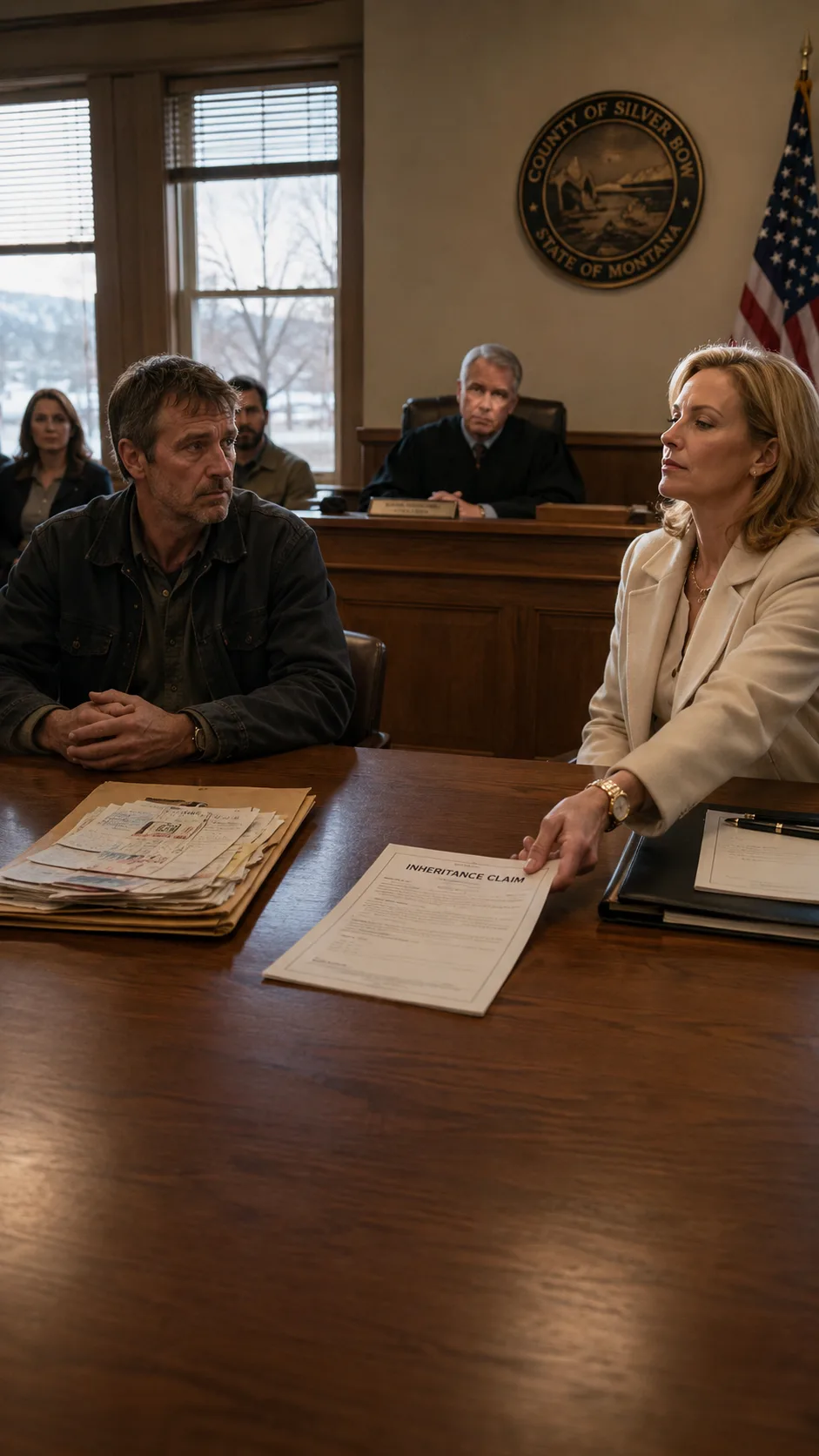
I sat at the table across from my sister.
My envelope looked poor beside Caldwell’s leather folder.
Elaine noticed.
She smoothed her coat with both hands.
The judge entered, and everyone stood.
Judge Harrow was a broad man with gray hair and glasses that slipped down his nose. He had known my father by sight. Most people in that county had.
We sat.
Caldwell began.
He spoke smoothly. He called Elaine “the decedent’s daughter.” He called me “the cohabiting adult son.” He said I had enjoyed exclusive use of the property for decades. He said the court should consider equitable distribution. He said my father’s intentions were unclear.
Unclear.
My hand closed around the top of Dad’s cane.
Elaine sat still through it all, chin lifted, eyes forward. She looked like a woman at a board meeting.
When Caldwell finished, the judge turned to me.
“Mr. Walker?”
I opened the envelope.
The first receipt stuck to another, and I had to separate them carefully.
Paper can humiliate a man.
I placed the property tax slips down first.
Then the pharmacy bills.
Then the propane receipts.
Then checks for roof repairs, hospital equipment, fence replacement, insurance premiums, and two ambulance trips after Dad fell during the night.
The table filled slowly.
Caldwell watched without touching anything.
Elaine crossed one ankle over the other.
“Receipts don’t change blood,” she said.
The judge looked at her over his glasses.
She closed her mouth.
I placed the VA appointment card on top of the stack.
Caldwell leaned forward.
“What is that?”
“A caretaker verification card.”
“Verification for what?”
“I don’t know.”
He sat back.
Elaine looked at the card for the first time.
There.
A crack.
The judge picked it up and read the signature.
“Marlene Price.”
“She worked veterans affairs,” I said.
“I know who she was.”
He set the card down and turned to the clerk.
“Bring in the sealed military records.”
Caldwell’s pen stopped moving.
Elaine’s hand went to her water glass. The rim clicked against her ring.
No one spoke.
The clerk rose from the side desk and left through the back door. The room waited with the kind of quiet that makes small noises rude. A coat sleeve brushed a bench. Someone swallowed. The radiator hissed.
Elaine leaned toward Caldwell.
He did not lean back.
The clerk returned carrying a faded packet with both hands.
It was larger than I expected, tied with thin cotton tape, the paper yellowed at the corners. A red county seal crossed the front. My father’s full name was typed on an old label.
Thomas Edward Walker.
Korean War Service Records.
The packet landed on the judge’s desk with a dry sound.
Not loud.
Enough.
Judge Harrow inspected the seal, then picked up a small letter opener. He slid it under the edge with care, as if the paper could bruise.
The tape loosened.
The seal split.
Elaine sat straighter.
Caldwell took his glasses off, wiped them once, and put them back on.
I kept both hands on Dad’s cane.
The judge opened the folder.
Inside were service papers, discharge copies, land documents, typed affidavits, and forms folded along old creases. The top page carried the United States Army emblem. Beneath it, a county filing stamp from years before I was born.
Judge Harrow moved the first documents aside.
He found a record with the words Veteran Homestead Protection printed across the top.
Caldwell reached for his pen again, but it rolled off his legal pad and tapped the floor.
No one picked it up.
The judge read silently for several seconds.
Then he looked at me.
Not Elaine.
Me.
My grip tightened on the cane.
He turned to the next page.
“Caretaker affidavit,” he said.
Caldwell stood halfway.
“Your Honor, may we review—”
“You may sit.”
Caldwell sat.
Elaine’s face did not move, but one hand disappeared under the table.
The judge read down the affidavit.
“This document was signed by Thomas Walker and witnessed by Marlene Price.”
The old appointment card lay beside my receipts.
Aunt Linda shifted on the bench.
The judge continued.
“It identifies Daniel Walker as the primary caretaker and financial supporter of the veteran homestead.”
Elaine turned toward me.
I did not turn back.
The judge lifted another sheet, thinner than the rest.
“This is a beneficiary designation attached to the protected homestead record.”
Caldwell’s chair scraped.
“Your Honor—”
The judge raised one hand.
Stop.
The room obeyed.
Elaine reached toward the folder before anyone told her she could. Her fingers stretched across the polished table, nails pale against the wood.
Caldwell caught her wrist.
Not hard.
Fast.
Her hand froze there, suspended between her claim and the record she had not known existed.
The judge read the line.
“The record names Daniel Walker as sole beneficiary of the farmhouse.”
Silence.
Not empty silence.
Full silence.
The kind that presses against wood, glass, paper, breath.
Elaine pulled her hand back, but Caldwell did not release her wrist right away. His thumb lifted. Then his fingers opened.
I looked down at the table.
Her clean inheritance claim sat on one side.
My receipts sat on the other.
Between them lay Dad’s service record, opened at last.
Judge Harrow turned the beneficiary form so both parties could see it. My name was there in typed letters, followed by Dad’s signature, a little shaky but unmistakable. He had signed the T the way he always did, with a long crossbar that ran too far to the right.
I knew that signature.
I had seen it on school permission slips, feed bills, birthday cards, and the back of checks when money had to stretch farther than money should.
Elaine stared at it.
Her lips parted, then closed.
Caldwell reached for the claim document and pulled it back toward his folder by an inch.
Just one inch.
Enough.
The room turned in pieces.
A cousin behind me leaned forward. Aunt Linda lowered her purse into her lap. The clerk looked at my receipts, then at the service packet. Judge Harrow kept his palm on the open file.
Elaine finally spoke.
“That cannot be current.”
The judge looked at the filing stamp.
“It was never revoked.”
“He was old.”
I heard the bench behind her shift.
Judge Harrow removed his glasses.
“Mrs. Harper.”
She stopped.
He put the glasses back on and continued reading the attached notes. There was a second affidavit. Then a county memorandum. Then a copy of Dad’s application for homestead protection connected to his veteran status and long-term care arrangement.
Every page carried the same direction.
Protect the farmhouse.
Recognize the caretaker.
Name Daniel.
Caldwell’s shoulders changed first. They dropped barely at all, but I saw it. He turned a page, then closed his folder halfway.
Elaine noticed that too.
“What are you doing?” she said.
He kept his voice low.
“We need to listen.”
“No. We need to object.”
“To what?”
She stared at him.
He did not help her.
The judge looked at my receipts again.
“Mr. Walker, are these the financial records you brought?”
“Yes.”
“May the court review them?”
I pushed the stack forward.
My fingers brushed the edge of the veteran homestead record.
The paper felt rough.
Old.
Judge Harrow took the top receipt and matched the date against the caretaker affidavit period. Then another. Then another. He did not read all thirty-one years aloud. He did not have to.
The pattern sat in front of him.
A life can become paper when no one believes the life.
The judge placed my final medical bill beside the service file.
The bill from Dad’s last week.
Room 214.
Oxygen support.
Cardiac monitoring.
My name listed as responsible party.
Elaine looked at that bill and turned away.
For the first time since she entered the room, her coat seemed too bright.
Judge Harrow closed neither folder.
“The court will admit the sealed service records and supporting financial documents into the estate record.”
Caldwell nodded.
Elaine did not.
The judge’s gavel did not slam. He simply set it down once, wood against wood.
“The claim for equal division of the farmhouse is denied pending final order.”
Elaine stood too quickly.
Her chair struck the wall behind her.
Caldwell rose with more care and placed one hand on the table, blocking her from reaching toward the file again.
“Elaine,” he said.
She looked around the room.
No one moved toward her.
Not Aunt Linda.
Not the cousins.
Not Caldwell.
The clerk gathered the service papers and placed a protective sheet over the beneficiary form. The judge signed a temporary order. My receipts remained spread across the table like old fence posts after snowmelt.
I sat there with Dad’s cane across my knees.
My sister picked up her handbag.
The gold watch on her wrist caught the window light.
She left without looking at the ashes that were no longer there, without touching the cane, without saying Dad’s name.
The door closed behind her.
Softly.
That made it worse.
After the hearing, the probate room emptied in slow pieces. Aunt Linda paused beside me long enough to touch the back of a chair, then changed her mind and walked out. One cousin said, “Daniel,” but nothing followed. His boots squeaked on the floor as he left.
Caldwell stayed behind to collect Elaine’s papers.
He slid the inheritance claim into his folder without looking at the title page.
“Mr. Walker,” he said.
I waited.
He glanced toward the door Elaine had used.
“I did not know about the service record.”
I nodded once.
Neither did I.
The clerk returned my original receipts in a new manila envelope, cleaner than the one I had brought. She handled them carefully. Maybe she handled all records carefully. Maybe the room had taught her something that morning.
“Do you want the old envelope back?” she asked.
I looked at the brown paper, split at the corner, soft from years of being carried.
“Yes.”
She gave it to me.
I put the clean envelope inside the old one.
Outside, the courthouse steps were wet with melting snow. Elaine’s rental car was gone. Tire tracks cut through slush at the curb. Caldwell stood under the awning, phone to his ear, speaking in short sentences.
I walked past him with Dad’s cane in one hand and the envelope under my arm.
My truck started on the second try.
Back at the farmhouse, the porch looked smaller than it had that morning. The wind had pushed snow against the bottom step. Dad’s boots were still by the kitchen chair, one polished, one dull.
I set the envelope on the table.
Then I picked up the dull boot.
The wax tin was where he had left it.
It took me twenty minutes to finish what he had started.
The final order came three weeks later.
The farmhouse stayed with me.
The land stayed with me.
The court entered Dad’s service records into the estate file, and Elaine’s claim died without another hearing. Caldwell mailed a formal notice withdrawing her remaining objections. The envelope had no handwritten note.
Elaine called once.
I let the phone ring.
After the seventh ring, the house went quiet again.
In April, I drove to the county veterans office and asked if Marlene Price was still living. The woman at the front desk gave me an address after making two calls and telling me she was not supposed to give addresses. Marlene lived in a small blue house with plastic tulips in the yard and a ramp up to the porch.
She was eighty-three and smaller than I remembered.
Her turquoise earrings were still there.
“I wondered when that file would open,” she said.
I sat across from her in a kitchen that smelled like toast.
“You knew?”
“I witnessed it.”
“Why didn’t he tell me?”
She stirred sugar into her tea for a long time.
“Some men can sign what they cannot say.”
That was all she offered.
It was enough.
The farmhouse took work that summer. I replaced the porch rail, fixed the upstairs window, and painted the kitchen cabinets the same pale green Mom had chosen when Elaine and I were kids. I kept Dad’s cane by the door, not because he needed it, but because the corner looked wrong without it.
People stopped by more than they used to.
Some brought pies.
Some brought apologies folded inside talk about weather.
I accepted the pies.
The rest could sit.
In September, I opened the cedar chest at the foot of Dad’s bed. The metal lockbox was inside now. The county had given it back after the estate closed. I expected medals, maybe letters, maybe photographs.
There were medals.
There were photographs.
There was also a note addressed to me in Dad’s blocky handwriting.
Daniel,
The house is not payment.
It is witness.
I read it once at the bedroom window.
Then again at the kitchen table.
That evening, I took the note outside and sat on the porch while the pasture darkened. The barn leaned east. The weather vane turned once, then stopped. A truck passed far down the road and disappeared behind the cottonwoods.
The next morning, I drove into town with the old brown envelope. At the pharmacy, the same clerk slid a receipt across the counter for my own blood pressure medicine this time.
I counted out the bills.
Two left.
She looked at the envelope under my arm.
“Still keeping records?”
I folded the receipt and put it inside.
“Yes.”
The farmhouse was quiet when I came home.
Not empty.
Quiet.
I placed Dad’s cane beside the kitchen door, set the envelope in the drawer, and left the key on the table.
Then I polished the other boot.
Chapter complete
You have reached the end of this chapter.
Continue reading
A few more worlds to get lost in after this chapter.




