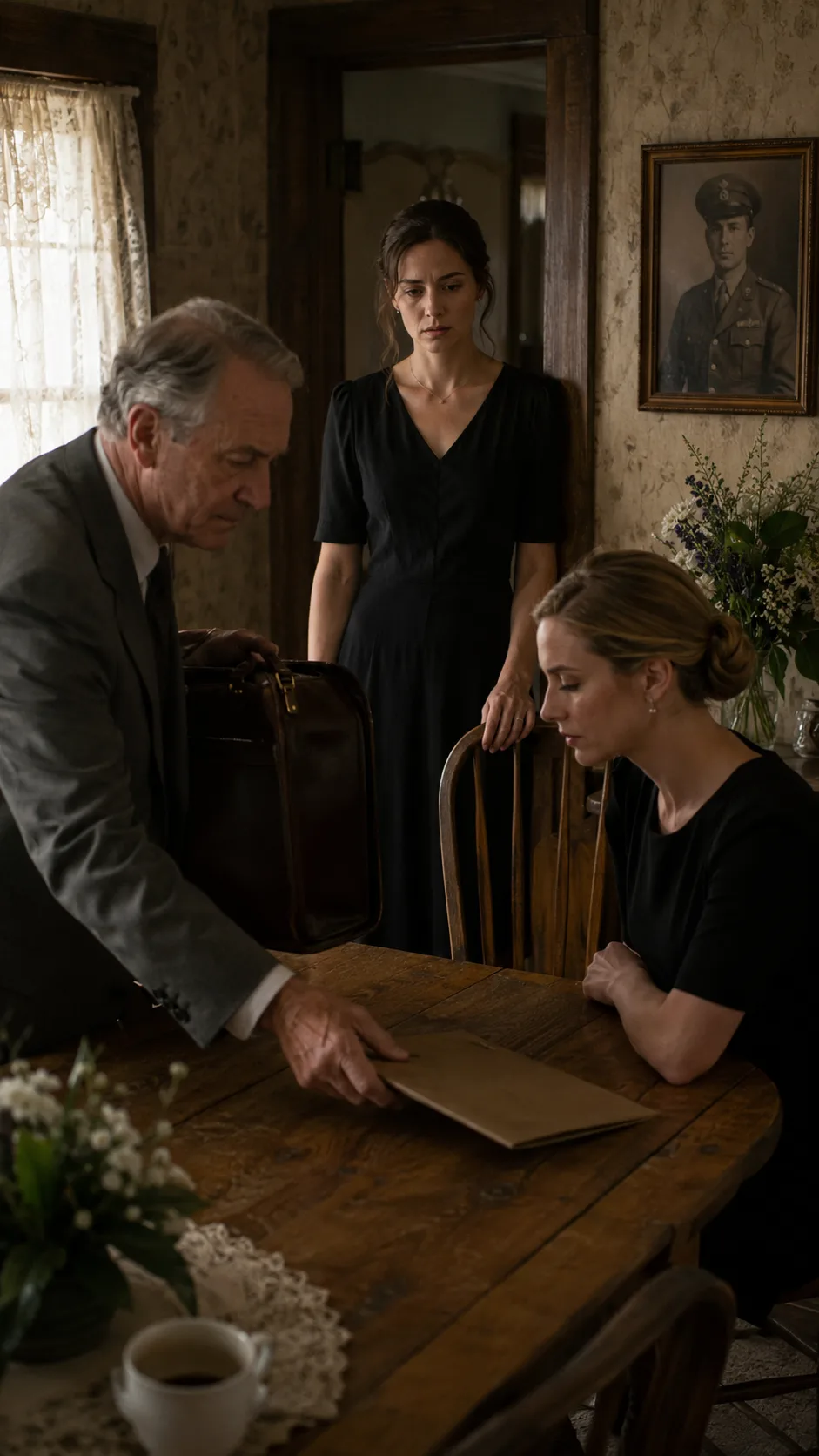
Clara Bennett held the casserole dish with both hands while her sister hugged their father first.
Chapter 1
Clara Bennett held the casserole dish with both hands while her sister hugged their father first.
The dish was still hot through the towel. Green beans, mushroom soup, crushed crackers on top. Her father had asked for it after church, not from Clara, but from Lily, who never cooked anything unless there were people around to praise her for trying.
Clara had made it anyway.
She stood by the kitchen counter in the farmhouse outside Knoxville and watched Lily press her cheek against Thomas Bennett’s shoulder. Lily was sixteen then, all bright hair and soft hands, wearing the blue dress their father had bought her from a store in town. Thomas patted Lily’s back twice.
“Looks pretty,” he said, touching the sleeve.
Lily smiled at Clara across his shoulder.
Clara looked down at the casserole.
Too hot.
Thomas took his place at the head of the table without asking who had cooked. Lily sat to his right. Clara sat on the left, where the chair leg
wobbled unless she kept one foot pressed against it.
Her father served Lily first.
That was how it worked.
No one wrote rules on paper in the Bennett house. They were built into chairs, into eye contact, into whose name got called from the porch when the truck pulled in. Lily got “Come see what I brought you.” Clara got “Help me unload.”
So Clara helped.
She carried feed sacks from the truck bed. She held flashlights while her father fixed fence posts after dark. She washed the dishes after Sunday meals because Lily said dish soap made her hands peel. At school, teachers called Clara dependable, which sounded like a compliment until she noticed no one used it for girls who were adored.
Clara kept a list in her head for years.
Lily got new boots before the county fair.
Lily got a used Honda when she turned seventeen.
Lily got her father in the front row at choir night, both hands folded over his belt buckle, face still and serious as if the whole church had been built so she could sing one verse.
Clara got corrected.
“Stand straight.”
“Don’t mumble.”
“College is expensive.”
That last one stayed.
She had been eighteen, sitting across from him at the same wooden table, with three brochures spread out between the salt shaker and his coffee mug. The University of Tennessee. Middle Tennessee State. A small teaching college two counties over.
Thomas Bennett had picked up the closest brochure, looked at the tuition number, and set it down.
“That’s expensive.”
Clara waited for another sentence.
None came.
Lily was in the living room, practicing a pageant walk in front of the television while their father’s military portrait watched from the wall. The portrait had been taken before Afghanistan carved lines beside
his mouth, before he came home quieter, before he started waking before dawn and sitting outside with coffee he did not drink.
Clara folded the brochures.
She did it neatly.
The next fall, Lily went to a private cosmetology program their father helped arrange. Clara took shifts at a hardware store and enrolled in community college part-time. She paid in installments. When the cashier printed receipts, Clara folded those too and tucked them into an old shoe box under her bed.
Her father never asked.
Years passed that way, with Lily moving through life like doors had been oiled for her and Clara learning which ones stuck.
At twenty-four, Clara rented a small apartment above a pharmacy in town and worked the front desk at a dental clinic. She took evening classes when she could afford them. One winter, her car broke down behind the clinic, and she called home only because the temperature had dropped below freezing.
Lily answered.
“Daddy’s resting,” she said. “Can’t you call someone else?”
Clara looked at her breath in the dark.
“I’ll figure it out.”
She did.
A mechanic named Ray towed the car and let her pay over three months. Clara sent the last payment in an envelope with a thank-you note. Ray taped the note beside his register. That small mercy stayed in town longer than most gossip.
Thomas heard about the car weeks later.
He came by the clinic with a paper sack from the diner. Inside was a biscuit sandwich wrapped in foil. He set it on Clara’s desk while she was filing insurance forms.
“Eat.”
Clara looked at him.
“I already ate.”
He nodded once and left the sack there.
No hug.
No apology.
The biscuit went cold before she touched it.
At thirty, Clara stopped expecting her father to explain himself. She visited on Sundays. She brought groceries when his knees started giving out. She filled his pill organizer because Lily said pill bottles made her anxious. She drove him to appointments and sat in waiting rooms with daytime television murmuring above her head.
Thomas talked more to nurses than to Clara.
He answered their questions with short military precision. Yes. No. Since March. Left knee worse than right. No dizziness.
When Clara asked the same questions in the truck, he looked out the window.
“I’m fine.”
He wasn’t.
His hands trembled when he buttoned shirts. He stopped climbing the back pasture. He let grass grow around the old shed where he once kept tools in perfect order. Dust covered his uniform portrait, but no one took it down.
Lily visited for birthdays and holidays, wearing perfume that clung to curtains after she left. She always brought store-bought desserts in clear plastic boxes and set them on the counter like gifts.
“Daddy, you need to let me handle the important stuff,” Lily would say, touching his shoulder. “Clara worries too much.”
Thomas never argued.
That silence fed Lily.
By the last year of his life, she had started speaking for him while he sat in the recliner, one hand on the armrest, the other curled around the remote.
“Daddy wants me to check the bank statements.”
“Daddy said I should keep the house keys.”
“Daddy trusts me.”
Clara heard it all.
She washed his coffee mug at the sink and watched the dark ring disappear under hot water.
One Saturday in October, Clara arrived with chicken soup and found Lily in the hallway outside their father’s bedroom, holding a small brass key.
“What’s that?”
Lily closed her hand.
“Nothing.”
Clara set the soup on the side table.
“That looked like Dad’s desk key.”
Lily gave a small laugh. “You always notice the strangest things.”
Clara looked past her into the bedroom. Thomas was asleep under the quilt their mother had made before she died. His mouth was slightly open. The room smelled of menthol ointment and old wood.
Lily slipped the key into her purse.
Clara saw it.
She said nothing.
That was the first crack.
Two weeks later, while helping Thomas sort medical paperwork, Clara opened the bottom drawer of his rolltop desk and found it unlocked. The little brass key was missing from the ring. The drawer held warranty papers, expired insurance cards, old VA appointment letters, and a photo of Lily at nineteen wearing a sash from the county fair.
At the very back was a brown envelope.
Clara touched it.
The paper was thick, government-issued, with a crease down the middle. Her father’s name appeared on the front along with a return address from a military finance office. The envelope was open, but empty.
Thomas spoke from behind her.
“Leave that.”
Clara turned.
He stood in the doorway in a flannel shirt, one hand against the frame.
“I’m sorting your papers.”
“Not that one.”
She put the envelope back.
His eyes moved to the drawer, then to her face, then away.
“Lily already looked through these?”
Thomas said nothing.
Clara closed the drawer.
The next day, Lily called before eight in the morning.
“Were you snooping in Daddy’s desk?”
Clara stood in her kitchen with a mug in her hand. The coffee had no sugar. She had forgotten to add it.
“I was helping him.”
“You always make everything sound noble.”
Clara set the mug down.
“What did you take from that drawer?”
Lily paused.
A car passed outside Clara’s apartment, tires hissing over wet pavement.
“You need to stop acting like there’s some conspiracy,” Lily said. “Daddy and I have always had our own relationship.”
“Our own relationship.”
Clara repeated the words after the call ended, not to keep them, but to hear how sharp they were.
By Christmas, Thomas could no longer hide how sick he was.
He refused the hospital twice. On the third morning, Clara found him sitting on the floor beside his bed, one hand gripping the nightstand, his breath coming short and hard. Lily arrived after the ambulance, wearing sunglasses even though the sky was gray.
At the hospital, Lily took the chair nearest the bed.
Clara stood.
Again.
Thomas slept most of that afternoon. Machines clicked beside him. His military ID card sat in a plastic bag with his wallet and keys.
Near evening, he opened his eyes while Lily had gone downstairs for coffee.
Clara leaned forward.
“Do you need anything?”
Thomas moved his hand slightly under the blanket. Not quite reaching. Not quite stopping.
“Desk,” he said.
Clara bent closer.
“What about it?”
His mouth worked once. No sound came. He shut his eyes, and the nurse came in to check the line in his arm.
Lily returned with a latte.
“What did he say?”
Clara looked at the plastic cup in Lily’s hand.
“Desk.”
Lily’s fingers tightened around the cup.
“He’s confused.”
Maybe.
Thomas Bennett died on a Thursday morning, before sunrise, while Clara was in the chapel downstairs lighting one of the small electric candles that never burned down.
Lily was listed as the family contact.
She told everyone that detail more than once.
At the funeral, Lily stood beside the casket and received people like she was hosting an event. She wore pearls. She nodded when old men from the VFW pressed folded flags into her hands and told her Thomas had been a good soldier.
Clara stood near the guest book.
She wrote down names when the line got long. She picked up tissues from beneath chairs. She helped an elderly neighbor find the restroom. She did not approach the casket until the room had almost emptied.
Thomas wore his dress uniform.
The medals looked heavier than he did.
Clara touched the edge of the casket, not his hand.
“Desk,” she said under her breath.
Nothing answered.
After the burial, they returned to the farmhouse. People brought casseroles, cakes, ham biscuits, plastic containers of potato salad. Men stood outside near the trucks. Women moved through the kitchen, opening drawers like they had lived there for years.
Lily stood in the dining room with a glass of sweet tea and announced that the lawyer would come by at four.
“Daddy wanted everything handled properly,” she said.
A cousin asked if Clara knew about the meeting.
Lily smiled without showing teeth.
“Clara’s here, isn’t she?”
Clara rinsed a serving spoon at the sink.
Water ran over her fingers until they turned red.
At four sharp, Mr. Harris arrived with a worn leather briefcase.
He had been Thomas Bennett’s lawyer for as long as Clara could remember, though she had only seen him at a distance—church picnics, county fundraisers, her mother’s funeral. He was tall, careful, with silver hair combed back and a way of holding papers that made people lower their voices.
The dining room cleared without being asked.
Only family remained. Clara. Lily. Two cousins. An aunt who had not visited Thomas in three years but now clutched a handkerchief like a witness. The old ceiling fan turned above them with a soft click at every rotation.
Lily took the chair closest to Mr. Harris.
Clara stayed near the doorway.
Mr. Harris noticed.
He said her name once.
“Clara.”
She stepped in but did not sit.
Lily folded her hands on the table.
“Daddy always trusted me with the important things.”
There it was.
The line landed exactly where Lily placed it, in the center of the table, beside the untouched coffee and the vase of funeral lilies already dropping pollen onto the wood.
Mr. Harris opened his briefcase.
He did not look at Lily.
The first thing he removed was not a will.
It was a sealed brown military folder.
The folder was worn at the corners, tied with a string, and marked with Thomas Bennett’s name in black ink. Clara saw the handwriting from across the room.
Her father’s.
Lily leaned forward.
“What is that?”
Mr. Harris placed the folder flat on the table.
“Your father left instructions.”
Lily reached for it.
He put one hand over the folder.
“Not yet.”
The fan clicked.
Once.
Twice.
Clara’s hand found the back of the same wobbly chair she had used as a child. Her thumb pressed into a nick in the wood, a mark from the year Lily had thrown a fork during dinner and Thomas had blamed Clara for laughing.
Mr. Harris untied the string.
He broke the seal.
Inside were military service records, folded with care. Deployment orders. Combat pay statements. Copies of bank deposit slips. The papers came out one by one and formed a neat line across the table.
Lily’s face did not move much at first.
Then she saw the dates.
“What is this?” she asked.
Mr. Harris placed another deposit slip beside the others.
“These weren’t inheritance transfers.”
The room went still.
Clara stepped away from the doorway.
One step.
Mr. Harris continued laying out records. Afghanistan combat pay. Special duty pay. Monthly deposits into an account no one at the table recognized. The amounts were not large at first. Then larger. Then steady, year after year, beginning when Clara was twelve years old.
Twelve.
Clara remembered that year by the cast on her wrist, by the summer Lily got riding lessons, by the afternoon Thomas had sold his fishing boat and said it was because he was tired of maintaining it.
Mr. Harris set down the next paper.
Lily reached again.
His hand stopped hers before her fingertips touched the page.
“This concerns Clara.”
Lily pulled back as if the paper had heat.
Clara heard someone shift behind her. Her aunt’s handkerchief stopped moving.
Mr. Harris removed one final document from the bottom of the folder. It was thicker than the rest, sealed inside a clear plastic sleeve. He turned it over and placed it in front of him, not yet facing Clara.
Lily looked at the lawyer.
Then at Clara.
For the first time that day, she did not speak.
Mr. Harris lifted the document and turned it around.
At the top was the name of an education fund.
Beneath it was Clara’s full legal name.
Clara Bennett.
Not Lily.
Not the estate.
Not shared family assets.
Clara Bennett.
The room narrowed to paper, wood, and the faint scrape of Mr. Harris’s sleeve against his jacket.
A small note had been clipped to the document.
The paper was yellowed, folded once, and written in Thomas Bennett’s square, disciplined handwriting.
For Clara’s education. From combat pay. Do not release until I am gone if I fail to tell her myself.
Clara read the line twice.
She did not touch it.
Mr. Harris slid the folder away from Lily and placed it directly in front of Clara.
“Your father put his combat pay here for twenty-two years.”
Lily’s chair made a small sound against the floor.
No one looked at her first.
That was new.
The cousins looked at Clara. The aunt looked at Clara. Even the ceiling fan seemed louder above them, clicking over the silence as if counting all the years no one had counted correctly.
Clara moved her hand from the chair to the table.
Her fingertips rested on the edge of the plastic sleeve.
The document did not move.
Lily stared at the deposit slips.
“But he paid for my school,” she said.
Mr. Harris nodded once.
“He helped you.”
Lily’s mouth opened.
Closed.
Mr. Harris tapped the education fund with one finger.
“This was different.”
Clara looked at the old military portrait on the wall. Young Thomas stared back from behind dusty glass, shoulders straight, uniform pressed, eyes not yet guarded by the years that would come later.
She looked back down.
There were more pages in the folder.
Receipts. Account statements. Copies of money orders. Notes in Thomas’s hand. Every year had a record. Every deposit had been labeled. Some were small enough to hurt more than the large ones.
Twenty-five dollars.
Forty.
Seventy-five after a month of overtime.
A note from the year Clara turned eighteen read: She brought brochures home today. Did not ask twice.
Clara covered that line with her hand.
Not to hide it from others.
To keep it still.
Lily stood abruptly.
“This doesn’t make sense.”
Her voice cracked around the last word, but no one helped her smooth it out.
“He never told her,” she said. “He never told any of us.”
Mr. Harris gathered the loose deposit slips with careful fingers.
“He tried to come see me last year. He asked how to transfer it without causing trouble.”
Clara looked at him.
Mr. Harris paused.
“He left before signing the release.”
The brass key flashed in Clara’s mind. Lily’s closed fist. The empty envelope. The phone call.
Clara turned to her sister.
“You opened his desk.”
Lily looked away.
The room saw it.
That was enough.
Mr. Harris reached into the briefcase and removed a second envelope, smaller, cream-colored, sealed but not military. Clara’s name was written across it.
“This was with the folder.”
He placed it on top of the education fund.
Clara did not open it there.
She picked it up and held it between both hands.
Lily’s eyes followed the envelope.
For once, Clara took something first.
The meeting ended without anyone announcing it. Chairs scraped. Someone coughed. The aunt folded her handkerchief into a square and placed it in her purse. The cousins stepped back from the table like they had been standing too close to a stove.
Lily remained seated.
Her hands rested in her lap.
Mr. Harris packed the duplicate records but left the folder with Clara. He gave her his card, though she already knew his office was beside the courthouse, with the green awning and the cracked step out front.
“No rush,” he said.
Clara nodded.
There was rush everywhere.
It just had nowhere to go.
When the house emptied, Clara stood alone in the dining room. The coffee had gone cold. Funeral flowers leaned over the vase. A stripe of dust marked the wall beneath the portrait where no one had cleaned behind the frame.
Lily came in from the kitchen.
She had removed her pearls.
“I didn’t know,” she said.
Clara looked at the sealed envelope in her hand.
“You knew there was something.”
Lily pressed her lips together.
A truck passed on the road outside. The sound faded behind the pasture.
“I thought maybe he was changing the will,” Lily said.
Clara looked at her then.
“So you took the key.”
Lily’s fingers curled against her dress.
“He always let me handle things.”
Clara placed the envelope on the table.
“No. You got used to reaching first.”
Lily flinched at that.
Clara did not apologize.
She carried the folder upstairs to her old bedroom, the one with pale yellow walls and a window that stuck in summer. Nothing much had changed. The bedspread was different. The mirror still had a small crack in the corner. Inside the closet, the shoe box where she once kept tuition receipts was gone, but she could still see the line it had left in the dust.
She sat on the floor.
The military folder rested across her knees.
For a long time, she listened to the house settle around her.
Then she opened the cream envelope.
The letter inside was short.
Clara,
I was better at saving than speaking. That is no excuse.
I saw what you gave up. I saw more than you thought.
I told myself I would hand this to you when I had the right words. I kept waiting for them. A soldier can sleep in dirt, follow orders under fire, and still turn useless at a kitchen table.
Use it. Finish what you wanted. Or start something else.
You were never the one I forgot.
Dad
Clara read it once.
Then again.
The paper shook slightly between her fingers, but she kept her grip.
Downstairs, a cabinet door closed. Lily was still in the house, moving through rooms that no longer belonged to her in the same way. Clara folded the letter along its old crease and placed it back in the envelope.
She did not go down right away.
The next morning, Clara met Mr. Harris at his office.
She wore the same black dress because she had not unpacked her overnight bag. The courthouse clock across the street chimed nine while Mr. Harris explained the fund, the account history, the taxes, the instructions Thomas had left. The money was real. More than Clara expected. Not rich-people money. Not the kind that bought ease without paperwork. But enough.
Enough to pay old debts.
Enough to finish her degree.
Enough to make the word expensive sound smaller.
Mr. Harris slid a pen toward her.
“You can take time.”
Clara looked at the signature line.
“I’ve taken enough.”
She signed.
Over the next month, Lily called six times. Clara answered twice.
The first call was full of explanations. Lily said she had been under pressure. Lily said their father had always made her responsible. Lily said Clara did not understand what it was like to be the one everyone expected to shine.
Clara held the phone away from her ear and watched rain gather on the pharmacy window across from her apartment.
“I’m not discussing Dad with you today.”
The second call came after Lily learned the house would not go to her outright. Thomas had left it to both daughters, but with Clara as executor. Mr. Harris explained that too, in the same careful voice he used for everything.
Lily did not come to the signing.
She sent an email instead.
Clara printed it, folded it, and placed it in a folder marked HOUSE. She had learned documentation from the man who had failed her in speech but not in paper.
By spring, the farmhouse was repaired.
Clara hired Ray, the same mechanic who had once towed her car, to fix the porch railing. He brought his teenage son to help. They replaced rotted boards, painted the trim, repaired the stuck window in Clara’s old bedroom. In the dining room, Clara cleaned the wall around Thomas’s portrait and found the wallpaper beneath it had stayed brighter than the rest.
She left the portrait there.
Not centered.
Just there.
Lily came by once while Clara was sorting boxes in the kitchen. She stood on the porch in sunglasses, holding a plastic container of cookies from a bakery.
“I didn’t know if I should come in,” Lily said.
Clara wiped her hands on a towel.
“You can.”
Lily stepped inside.
The house smelled like lemon oil and sawdust. The wobbly chair had been repaired. The table had been sanded but not refinished; Clara wanted the marks to remain.
Lily placed the cookies on the counter.
“I’m sorry about the key.”
Clara looked at her sister’s hands.
No pearls. No phone. No reach.
“That’s a start.”
Lily nodded.
She did not sit in their father’s chair.
That was new too.
In August, Clara enrolled at the University of Tennessee as a returning student. She chose education policy, not because the word education had been printed on the fund, but because she could not stop thinking about how many people lost years waiting for permission no one planned to give.
On the first day, she parked too far from the building and walked across campus with a canvas bag cutting into her shoulder. Students half her age moved around her in groups, carrying iced coffees, laughing, complaining about professors they had not met yet.
Clara stood outside the registration office and opened the folder Mr. Harris had given her.
The first tuition receipt slid out.
She folded it carefully.
Then she stopped.
She unfolded it and placed it flat inside the folder, uncreased.
Her phone buzzed.
A message from Lily.
Good luck today.
Clara read it twice and put the phone away without answering yet.
Inside the building, a clerk asked for her name.
Clara gave it.
The clerk typed, waited, then smiled at the screen.
“Your account has been paid.”
Clara looked down at the folder in her hands.
Through the glass doors behind her, the campus lawn stretched green under the late summer sun. Somewhere outside, a truck backed up with a beeping sound. Someone dropped a stack of books. The world kept making ordinary noise.
Clara stepped aside to let the next student approach the counter.
She opened her father’s letter one last time before class and touched the line written in his careful hand.
You were never the one I forgot.
Then she folded it, placed it behind the receipt, and walked down the hall.
This time, she did not stand at the back.
Chapter complete
You have reached the end of this chapter.
Continue reading
A few more worlds to get lost in after this chapter.




