My Sister Called From The ER And Told Me The Woman Upstairs Wasn’t My Wife
The Morning My Sister Told Me To Take My Son And Leave The House
My sister did not sound like herself when she called me that morning.
Chapter 1
My Sister Called From The ER And Told Me The Woman Upstairs Wasn’t My Wife
The Morning My Sister Told Me To Take My Son And Leave The House
My sister did not sound like herself when she called me that morning.
She was an emergency room doctor, which meant I had heard her voice under pressure before. I had heard her after twenty-hour shifts, after bad nights, after patients did not make it, after she had to speak carefully because there were things she could not tell me over the phone. Amelia could sound tired, clipped, distracted, even cold when the hospital swallowed too much of her.
But this was different.
This was fear.
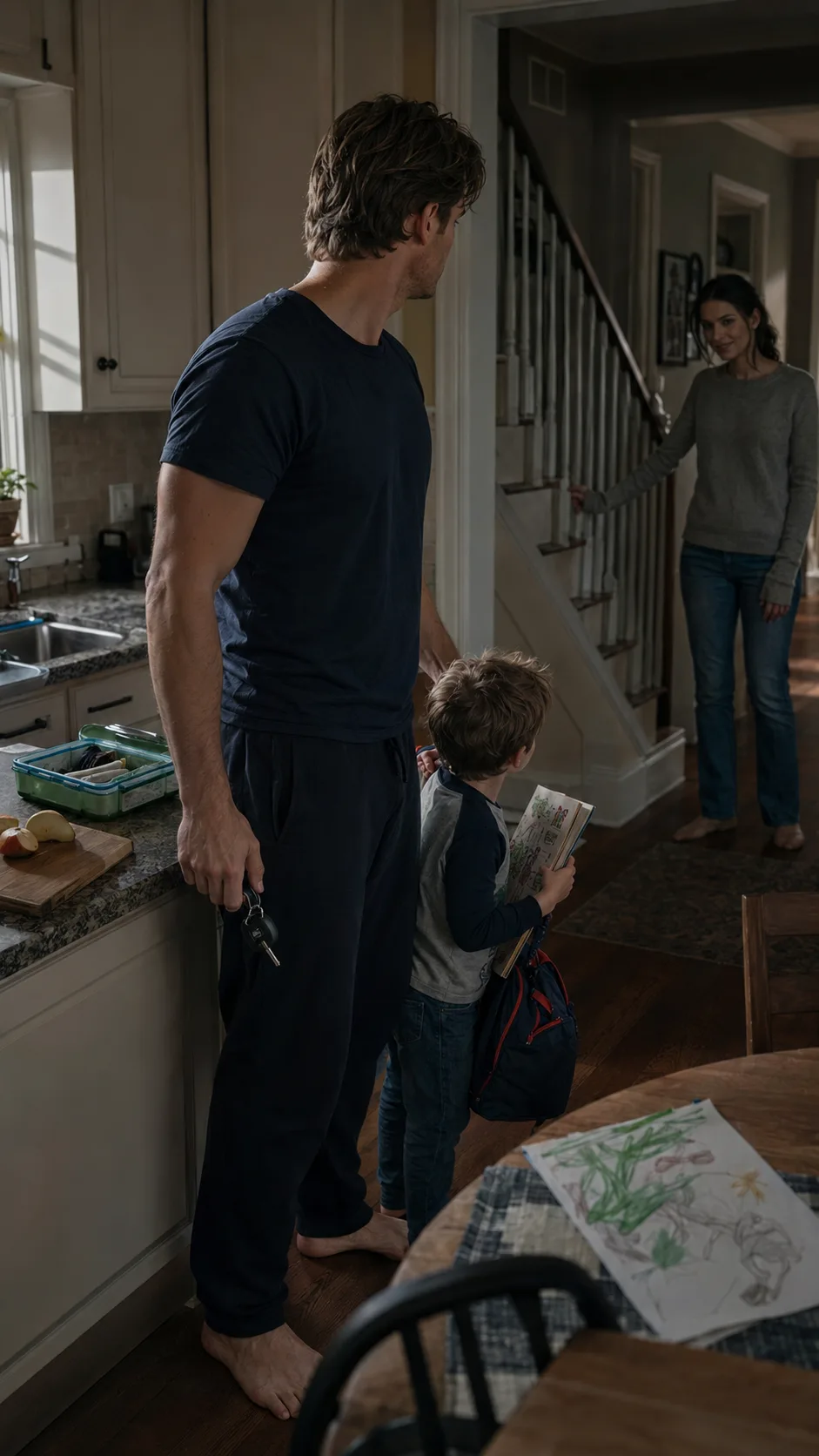
I was standing in our kitchen, barefoot on the hardwood floor, cutting an apple into thin slices for my son’s lunch. The sunlight was coming through the window over the sink, bright and harmless. The washing machine bumped upstairs in that familiar uneven rhythm it always made when Lindsay overloaded it with towels. My five-year-old son, Billy, sat at the kitchen table with a coloring book open in front of him, filling in a fire truck with
green crayon because he insisted red was “too obvious.”
Everything about that morning was ordinary.
That was the worst part later.
Nothing warned me.
No storm clouds. No broken glass. No strange car outside. No scream from upstairs.
Just the gentle clatter of breakfast dishes, the hum of the refrigerator, my son humming to himself, and my wife moving around above us as if our life was still intact.
Then my phone vibrated on the counter.
Amelia Tuttle.
I wiped apple juice from my fingers and answered with my shoulder holding the phone against my ear.
“Hey, Mel. You on break?”
She did not answer right away.
There was noise behind her—hospital noise, distant voices, wheels rolling, a monitor beeping somewhere—but Amelia herself was silent. Not busy-silent. Not annoyed-silent.
The kind of silence that makes your body understand danger before your mind does.
“Brandon,” she said at last, and my
hand stopped over the lunchbox. “I need you to listen to me very carefully.”
I frowned. “Okay.”
“No questions first. Just listen.”
That made the room feel colder.
I glanced toward Billy. He was bent low over his picture, tongue pressed between his teeth in concentration. Upstairs, the washing machine thudded again, then settled into a steady churn.
“What’s going on?” I asked.
“Is Lindsay there?”
The question was so strange that I almost laughed.
“Yeah,” I said slowly. “She’s upstairs. Why?”
Another pause.
“Are you sure?”
Now I did laugh, but it came out wrong. “Amelia, I can hear her doing laundry.”
On the other end of the call, my sister inhaled once. It sounded like she was trying to keep herself from breaking.
“Brandon,” she said, “that isn’t possible.”
The apple knife slipped slightly in my hand. I set it down.
“What do you mean?”
“I’m at County
General.”
“I know where you work.”
“Lindsay was brought in after a crash on Highway 52.”
The kitchen went still around me.
For a second, I heard every sound separately. The refrigerator motor. Billy’s crayon scratching paper. The washing machine upstairs. My own breathing, shallow and uneven.
“No,” I said.
“She was in her car. There was a collision with a truck. It happened over two hours ago.”
“No,” I repeated, louder this time, because volume felt like the only weapon I had. “You’re wrong. She’s upstairs.”
“Brandon.”
“She’s upstairs, Amelia.”
My sister’s voice dropped, and suddenly she was not the doctor anymore. She was my older sister, the one who had raised half of me after our parents died, the one who knew when I was lying even before I spoke.
“I identified her myself,” she whispered. “Her license. Her wedding ring. The scar on her left shoulder. It was Lindsay.”
My vision narrowed.
The kitchen counter seemed to tilt under my hand.
“That’s not possible,” I said, but the words had no strength left in them.
Billy looked up from the table.
“Daddy?”
I forced my face to relax so quickly it hurt.
“Keep coloring, buddy,” I said. “You’re doing great.”
He looked uncertain for a second, then went back to making the green fire truck greener.
Amelia was still on the line.
“If you can hear someone upstairs,” she said, each word careful, “then that person is not your wife.”
Right then, the washing machine stopped.
Not with the cheerful little chime it usually gave at the end of a cycle. Not with the clunking slow-down I knew by heart.
It cut off suddenly.
The silence after it was enormous.
I turned my eyes toward the ceiling.
For six years, that house had been predictable to me. Every stair that creaked. Every pipe that knocked in winter. Every window that stuck when it rained. I was a structural engineer; I trusted buildings because they followed rules. I trusted weight, pressure, angles, load.
But in that instant, my own house became unfamiliar.
A place with closed doors.
A place with someone listening above me.
“Brandon,” Amelia said, “do not confront whoever is in that house. Take Billy and leave. Right now.”
My mouth had gone dry.
“I don’t understand.”
“You don’t need to understand yet. You need to get your son outside. I’m calling the police.”
I looked at Billy again.
He had Lindsay’s hazel eyes. Green in the morning light, gold near the edges. He had my messy cowlick that never stayed down. He was humming softly, safe inside the last few seconds of childhood before fear touched him.
“Daddy,” he said without looking up, “can we go to the park today?”
I crouched beside him.
“We’re going for a little drive first,” I said. “Put your crayons in your backpack, okay?”
“Is Mommy coming?”
The question struck me so hard I almost could not breathe.
Above us, a floorboard creaked.
One soft sound.
Weight shifting.
My whole body went cold.
I slid the phone into my pocket without hanging up. Amelia’s voice came faintly from the speaker, muffled but urgent.
“Brandon? Are you moving?”
I stood slowly. Too fast might show fear. Too slow might give away that something was wrong.
Another creak.
Then a step.
Someone was coming down the stairs.
Billy heard it too. His face brightened.
“Mommy!”
He pushed back from his chair and started toward the hallway.
I caught his shoulder gently and pulled him against my side.
“Shoes first,” I said, trying to keep my voice ordinary.
The staircase curved down into view from the hallway beside the kitchen. I stared at it, and for one impossible second, I prayed. I prayed that Amelia had made a mistake. I prayed some paperwork had gone wrong. I prayed that grief and exhaustion had confused her.
Then she appeared.
Lindsay.
At least, that was what my eyes told me first.
Same gray sweater. Same dark hair tied back carelessly. Same height. Same narrow shoulders. Same way of pausing on the second-to-last step, one hand resting lightly on the railing.
But something inside me rejected the image.
It was not dramatic. Not obvious.
No mask slipping. No horror-movie grin.
Just a delay.
Her smile came half a beat after it should have, as though she had remembered she was supposed to smile and then placed it on her face.
“Who were you talking to?” she asked.
Her voice was Lindsay’s voice.
Soft. Warm. Familiar.
And wrong.
I held Billy close enough that he squirmed.
“Amelia,” I said.
Her eyes moved over my face. Fast. Measuring.
“Oh?” she said. “Everything okay?”
“Yeah. She just needed something.”
“What?”
The question came too quickly.
I felt my pulse in my throat.
“Nothing important.”
Billy twisted out from my grip and ran to her, wrapping his arms around her legs before I could stop him.
For one horrifying moment, I saw my son pressed against that gray sweater, his small cheek against the body of a stranger.
The woman touched his hair.
Not tenderly.
Correctly.
As if she knew what tenderness was supposed to look like.
“Daddy said we’re going for a drive,” Billy told her.
Her eyes lifted back to me.
“A drive?”
“Just to the store,” I said. “I forgot something.”
“What did you forget?”
She stepped down one stair.
I could see her eyes more clearly now. Lindsay’s were hazel, shifting, warm. This woman’s eyes were close enough in color to fool you in a hallway. But in the direct light, something was off. Not the shade exactly. The life behind them.
“I’ll be quick,” I said.
“I can go,” she offered immediately. “You stay here. You’re off today.”
“No, it’s fine.”
“Brandon.”
My name in her mouth made my stomach turn.
She smiled again.
That late smile.
“You look pale.”
“I didn’t sleep well.”
Her gaze flicked toward my pocket.
I wondered if she knew the call was still open. I wondered if she had heard Amelia. I wondered if she had already decided what to do if I tried to leave.
Then Billy grabbed my hand.
“Can we get muffins?”
The normalness of that sentence almost shattered me.
“Yeah,” I said. “Shoes.”
I moved carefully. Keys from the hook. Backpack from the chair. Billy’s sneakers by the door. No sudden movements. No running.
The woman who looked like my wife watched all of it.
At the front door, I felt her behind me.
Too close.
“Don’t be long,” she said.
I turned just enough to see her face.
“I won’t.”
The moment we stepped outside, the sunlight felt unreal.
The neighborhood looked exactly the same. Sprinklers clicked across lawns. A dog barked two houses down. Somewhere, someone was mowing grass. Mrs. Halpern from across the street raised one hand in a friendly wave.
I smiled back because panic would make people look.
I buckled Billy into his car seat with fingers that barely worked. He was still talking about muffins. Chocolate chip or blueberry. Maybe both. Could Mommy have one too?
I shut his door.
Only then did I look back at the house.
She was standing in the front window.
Still.
Watching.
Not waving.
Just watching.
I got into the driver’s seat and locked the doors so hard the click sounded like a gunshot in the quiet car.
My phone vibrated again in my pocket. Amelia’s voice came through, sharp and terrified.
“Are you out?”
“Yes,” I whispered.
“Keep driving. Police are almost there.”
I pulled away from the curb.
In the rearview mirror, two squad cars turned onto our street without sirens.
They moved slowly, cleanly, like they had done this a thousand times before and knew exactly how quickly a quiet house could become dangerous.
I parked half a block away because my legs would not carry me farther. Billy kept asking why we stopped. I told him we were waiting for a friend.
Through the windshield, I saw three officers approach my porch.
They did not kick the door in.
They did not shout at first.
They spread out with terrifying calm.
Before one of them could knock, the front door opened.
She stepped out.
The woman in Lindsay’s sweater.
She looked toward my SUV immediately, as if she had known exactly where I would be. Then she lifted her hands.
Not in panic.
In surrender.
The officers moved in, cuffed her, and guided her down the steps. She did not fight. She did not cry. She did not even look surprised.
As they put her in the back of the police car, she turned her face toward me.
For a moment, through the distance and glass and sunlight, she looked so much like my wife that grief hit me before fear did.
Then she smiled.
Too late.
Three hours later, I sat in a room at the police station with no windows and a metal table bolted to the floor.
Amelia sat beside me. She had not changed out of her scrubs. There was a faint stain on one sleeve, and every time I noticed it, my mind tried to understand whether it had anything to do with Lindsay, then recoiled before the thought could finish.
Billy was with a child services counselor down the hall, eating crackers and drawing more impossible green fire trucks.
The detective assigned to the case was named Daniel Vance. He was in his fifties, broad-shouldered, quiet, with a face that looked like it had learned long ago not to show too much.
When he came in, he carried a folder.
I hated that folder before he opened it.
“The woman taken from your residence is not Lindsay Tuttle,” he said.
Amelia’s hand tightened around mine.
“We know that,” I said, though my voice sounded like someone else’s.
“Her legal name is Elena Marris. She has used other names. Several.”
The name meant nothing. That made it worse. A stranger’s name should not have had the power to ruin my life.
“What is she?” I asked.
Detective Vance sat across from us.
“Identity theft. Fraud. Long-term impersonation. She’s not a burglar in the usual sense. She doesn’t just steal credit cards or passwords. She studies people. Women who resemble her enough that small changes can close the gap. Hair. Clothes. Makeup. Voice patterns.”
My stomach turned.
“She had been watching Lindsay?”
“For weeks, at least. Possibly longer.”
Amelia shut her eyes.
The detective opened the folder and laid out photographs.
Me taking trash bins to the curb.
Lindsay carrying groceries.
Billy on a swing at the park.
Our house from across the street.
Our kitchen window at night.
I could not touch the photos. I only stared at them while my life became evidence.
“We found a duplicated key in her bag,” Vance said. “We found notes about your routines. Your work schedule. Your son’s school drop-off. What your wife wore on certain days. Where she bought coffee. Which neighbor spoke to her most often.”
I swallowed hard.
“She was in my house this morning.”
“Yes.”
“When did she get in?”
“We believe while you were out running.”
I remembered the morning suddenly with sickening clarity.
The cold air before sunrise. My sneakers hitting pavement. Thirty-two minutes around the neighborhood. I had come back through the garage. The house had smelled like coffee. Lindsay had kissed my cheek while tying her hair.
Had that been Lindsay?
I gripped the table.
“She was there before Lindsay left?”
The detective did not answer immediately, and that silence told me enough.
“We’re still building the timeline,” he said. “But it appears Elena entered the house early. Your wife left soon after.”
“For work?”
He looked down at the folder.
“She was on Highway 52.”
The room closed in.
“The crash,” I said. “Was it an accident?”
“We are investigating the driver. We found evidence that Lindsay’s vehicle had been tracked.”
Amelia made a sound beside me, small and broken.
I looked at the detective.
“Tracked how?”
“A GPS device attached under the rear bumper. Not factory. Not yours.”
The room tilted again.
“She knew where Lindsay would be.”
“It appears so.”
“And then she went into my house.”
“She may have intended to establish herself there before anyone knew your wife was gone.”
I pressed both hands against my face, but there was nowhere to hide from the image. A stranger in my kitchen. A stranger touching my son’s hair. A stranger upstairs folding towels while Lindsay was dying on a highway.
“How could she think this would work?” I asked.
Vance’s expression did not change.
“Because sometimes people see what they expect to see.”
That sentence destroyed me in a way nothing else had.
Because I had seen my wife.
I had heard footsteps and assumed love.
I had seen a gray sweater and assumed safety.
I had heard a familiar voice and almost let my son walk into her arms.
The detective slid one final sheet from the folder.
It was a photograph of a page from a notebook. The handwriting was neat, careful, almost pretty.
Billy wakes at 6:15 if no school.
Brandon takes coffee black with two sugars.
Lindsay kisses his left cheek when rushed.
Scar: left shoulder.
Billy’s cowlick leans left.
Brandon does not study eyes unless face is in strong light.
I have time.
I stared at the last line until the words blurred.
I have time.
She had not been rushing.
She had been patient.
Building herself into my wife piece by piece.
Amelia covered her mouth with both hands.
“I’m sorry,” she whispered.
I turned to her.
For one insane second, I wanted to be angry at her. For calling. For saying the words. For making the nightmare real.
Instead, I reached for her hand.
“You saved Billy,” I said.
She shook her head, crying silently.
“You saved him,” I repeated, because it was the only truth I could hold.
Before they transferred Elena to county jail, I asked to see her.
Detective Vance told me it was a bad idea.
Amelia told me not to.
But I had one question burning so violently inside me that if I did not ask it, I thought it would poison whatever was left of my life.
So they put me in a small visitor room divided by thick glass.
When Elena entered on the other side, I had to grip the edge of the counter.
Without the gray sweater, without the soft kitchen light, without Billy calling her Mommy, the illusion weakened. She was not Lindsay. Not really. The shape was close. The hair was close. The mouth, the chin, the posture—all close enough to wound.
But she was not my wife.
She sat down slowly and picked up the phone.
I picked up mine.
For a moment, neither of us spoke.
Then she tilted her head in Lindsay’s way.
That almost made me lose control.
“Don’t,” I said.
Her eyebrows lifted.
“Don’t what?”
“Don’t do that.”
A small smile touched her mouth.
This time, I noticed the delay because I was waiting for it.
“Why?” I asked.
She looked at me through the glass as if the answer should have been obvious.
“You had a beautiful life.”
My hand tightened around the receiver.
“That’s your answer?”
“You don’t understand what it’s like,” she said softly. “To stand outside something warm and know you were never invited in.”
“You watched my family.”
“I learned your family.”
“You stalked my wife.”
“I studied her.”
“You walked into my house and let my son hug you.”
Something shifted in her face then. Not guilt. Not shame. Something like longing.
“Billy is sweet,” she said.
I slammed my palm against the counter. The guard by the door straightened.
“Don’t say his name.”
Elena blinked, but she did not flinch.
“You would have adjusted,” she said. “People do. They explain away little differences. A new perfume. A tired voice. A changed habit. Grief makes people miss things. Love makes them forgive more.”
“Lindsay was alive this morning.”
Her expression remained calm.
“She was leaving.”
“She was my wife.”
“She was going to be gone.”
“You knew about the crash.”
“I knew there was an opportunity.”
The room went quiet except for the faint hum of the fluorescent light above us.
I felt something inside me go still.
“You helped make that opportunity.”
She looked away for the first time.
Not long.
Just enough.
Then she looked back at me.
“You wouldn’t have known,” she whispered. “If your sister hadn’t been there, if the hospital had called later, if I had gotten one full day, you would have believed what you needed to believe.”
I thought of the kitchen. The apple slices. Billy’s green fire truck. The woman on the stairs asking who I had spoken to.
Maybe she was right.
That was the part I hated most.
I set the phone down.
On the other side of the glass, Elena leaned forward quickly, her calm cracking for the first time.
“Brandon.”
Hearing my name from her mouth one more time made me feel sick.
I walked away.
We buried Lindsay on a gray Tuesday under a sky that looked heavy enough to fall.
The service passed in fragments.
Amelia beside me, rigid with grief.
Billy holding a yellow flower in both hands.
A pastor speaking gently about love, memory, and returning home, while my son kept asking when Mommy’s long trip would end.
I told him pieces of the truth in the only language a five-year-old can carry. Mommy loved him. Mommy did not leave because she wanted to. Mommy was not coming back the way we wanted her to.
He cried when he understood just enough.
I cried because he did.
We moved the next week.
I could not stay in that house.
People told me not to make big decisions too quickly after loss. They meant well. But they had not stood in my kitchen and watched a stranger wearing my wife’s sweater touch my child’s hair. They had not heard footsteps from upstairs after learning the person they loved was gone. They had not looked at a front window and seen their life watching them from behind glass.
So I sold what I could, packed what mattered, and left the rest.
In our new apartment, nothing creaks the same way.
That should comfort me.
Sometimes it does not.
At night, after Billy falls asleep, I check the locks twice. Then a third time. I look through the peephole even when no one knocks. I keep curtains closed after dark. I memorize the sounds of the hallway outside our door because I no longer believe ordinary sounds are harmless.
Billy still colors fire trucks green.
Sometimes he asks about the house.
Sometimes he asks about Mommy.
Sometimes he wakes in the middle of the night and calls for her before remembering.
Those are the nights that break me quietly.
I am an engineer. I used to believe the strongest structures were visible. Beams. Walls. Foundations. Steel buried inside concrete. Things you could inspect, calculate, reinforce.
Now I know better.
The most important structures are invisible.
The exact way someone laughs when they are trying not to. The pressure of a hand on your shoulder. The rhythm of footsteps upstairs. The look in someone’s eyes when morning light hits them. The small details that make a person irreplaceable.
Elena thought she could copy those details.
She thought love was a pattern.
She thought a life was something she could enter if she learned the passwords, the schedules, the gestures, the sweater, the smile.
But she was wrong.
Because every morning, when Billy climbs into my bed and presses his warm forehead against my shoulder, I remember that love is not just recognition.
It is attention.
It is noticing.
It is knowing the difference between a smile that arrives naturally and one that appears half a second too late.
And still, every time my phone rings unexpectedly, my chest tightens.
Every time a floorboard creaks in the apartment above ours, I stop breathing.
Every time sunlight spills across the kitchen floor, I see that morning again.
The apple slices.
The green crayon.
The washing machine going silent.
And my sister’s voice, trembling through the phone, telling me to take my son and leave before the life I trusted swallowed us whole.
Chapter complete
You have reached the end of this chapter.
Continue reading
A few more worlds to get lost in after this chapter.




