“They sold the house yesterday.”
Those five words came from my aunt’s trembling voice, and for a moment, every sound in the café disappeared—the hiss of the espresso machine, the clatter of cups, the soft rain tapping against the window.
Chapter 1
“They sold the house yesterday.”
Those five words came from my aunt’s trembling voice, and for a moment, every sound in the café disappeared—the hiss of the espresso machine, the clatter of cups, the soft rain tapping against the window.
I sat there with my phone pressed to my ear, staring at my untouched tea.
“My parents sold our house?” I asked quietly.
Auntie Sora lowered her voice. “Hana, they didn’t just sell it. They held a celebration dinner. Your brother Jiho posted photos. Red envelopes, champagne, everyone smiling.”
My fingers tightened around the cup.
The house on Willow Lane was not just a house. It was the place where my grandmother taught me to fold dumplings at the kitchen counter. The place where I hid under the stairs during thunderstorms. The place where I used to measure my height against the wooden doorframe, beside the pencil marks my grandmother made with her careful hands.
It was the only place in the Park family where I had ever felt loved.
And my parents had sold it without telling me.
Not that I should have been surprised.
For years, I had
been the daughter they mentioned only when they needed someone to blame.
My younger brother, Jiho, was their golden son. He failed exams, lost money, crashed cars, and still my mother called him “sensitive.” I earned scholarships, worked three jobs, paid my own university fees, and my father called me “cold.”
When I refused to give Jiho my savings for his restaurant business five years ago, my mother stood in the doorway of that very house and said, “If you walk out today, don’t call this place home again.”
So I walked out.
But I never forgot the house.
A month before my grandmother died, she had held my hand in her hospital room. Her skin was thin and warm, her voice barely louder than the machines beside her.
“Hana,” she whispered in Korean, “this family will make you feel like you own nothing. But remember, a home is not
always kept by the loudest person.”
I thought she was speaking in riddles.
Years later, I finally understood.
Because three weeks before my parents sold the house, I received a letter from an old legal office downtown.
Inside was a copy of my grandmother’s private trust.
The house had never fully belonged to my parents.
Forty percent had been placed in my name when I was sixteen. My parents were allowed to live there, but they could not sell it without my written consent after I turned twenty-five.
I was twenty-nine now.
I had never signed anything.
That morning, I called the lawyer listed in the trust documents, Ms. Linh Tran. Her office smelled like cedar, paper, and rain. She was a sharp-eyed Vietnamese woman in her forties, dressed in a cream blazer, with the calm expression of someone who had watched many families destroy themselves over property.
She read
through the documents once, then twice.
Finally, she removed her glasses.
“Your parents had no legal right to complete a clean sale without your consent,” she said.
I let out a slow breath. “Then how did they do it?”
Ms. Tran turned the final page toward me.
There it was.
A signature.
My name.
Hana Park.
But I had not signed it.
The letters were too round, too careful. My real signature cut sharply upward at the end, like a door closing.
My stomach twisted, but my voice stayed even.
“That’s not mine.”
“I suspected as much,” Ms. Tran said. “The buyer’s legal team also noticed irregularities. The sale did not go to a private family as your parents claimed. It went to a holding company.”
“What company?”
She looked at me carefully.
“Mirae Heritage Holdings.”
For the first time that day, I almost laughed.
Mirae Heritage Holdings was mine.
Three years earlier, after working in architectural restoration and real estate investment, I had started a small company focused on saving old family homes from demolition. I used private trusts and holding companies to buy properties quietly before developers could tear them down.
I had not known my parents’ house was listed until my acquisition team flagged it as historically valuable.
The address appeared on my desk like a ghost.
Willow Lane.
My childhood home.
At first, I thought it was a mistake. Then I saw the listing description: “Vacant family property. Owners motivated. Suitable for luxury redevelopment.”
Vacant.
As if my grandmother’s altar had never stood in the living room.
As if the pencil marks on the doorframe were meaningless.
As if I had never existed.
So I made an offer through the company. Full price. No questions. Fast closing.
My parents accepted within twenty-four hours.
They had sold my childhood home to me without knowing it.
Ms. Tran watched my face as the truth settled between us.
“What do you want to do?” she asked.
I looked down at the forged signature again.
Five years ago, my mother had told me not to call that place home again.
Now the law called me its owner.
“I don’t want to fight in secret,” I said. “They humiliated me publicly for years. They told our relatives I abandoned the family. They told everyone I was ungrateful.”
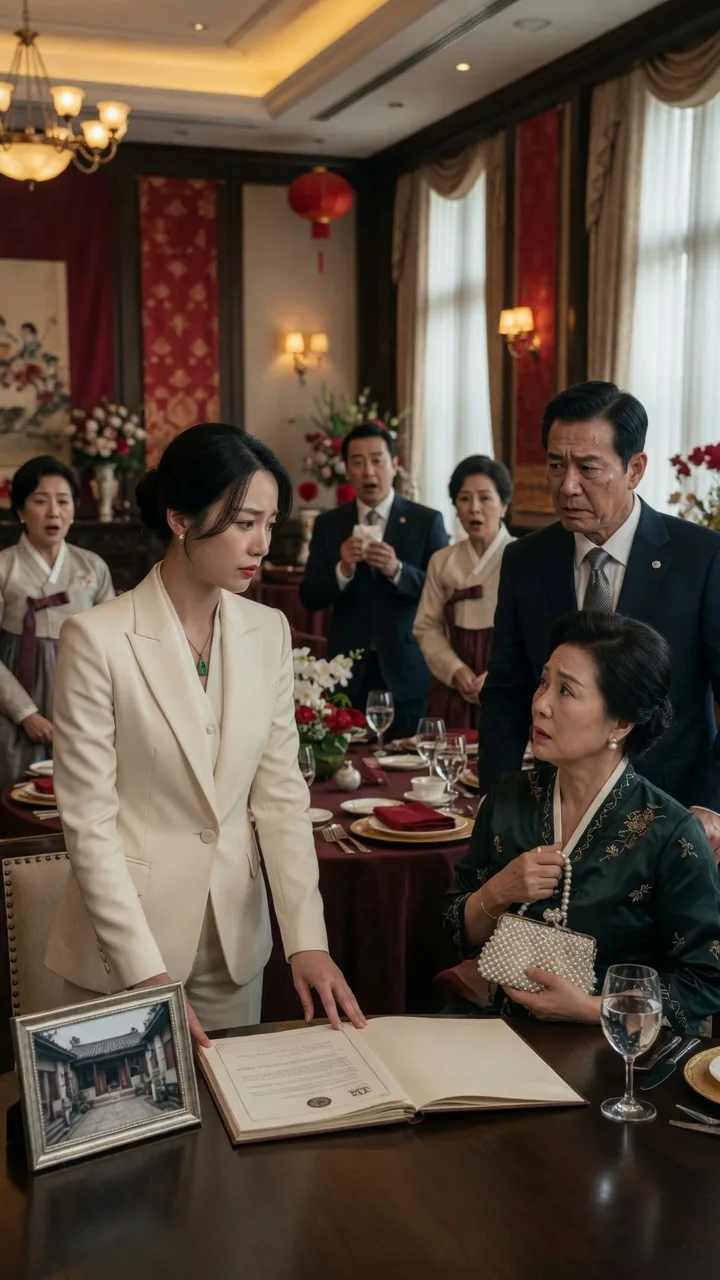
Ms. Tran leaned back slightly. “There is a family banquet tomorrow night. Your parents invited the buyer’s representative, according to the seller correspondence.”
“They invited my company?”
“Yes. They believe a senior representative is coming to discuss final renovation terms.”
I stood by the window. Outside, rain ran down the glass in silver lines.
I could see that house in my mind—the dark green gate, the persimmon tree, the cracked stone path my father always promised to fix but never did.
I remembered my mother’s voice: Don’t call this place home again.
A strange calm settled over me.
“Then I’ll go,” I said.
Ms. Tran’s expression did not change, but her eyes sharpened.
“As yourself?”
I picked up the folder and held it against my chest.
“No,” I said. “As the new owner.”
That night, I opened Jiho’s social media for the first time in years.
There they were.
My father in a navy suit, raising a glass. My mother wearing pearls, smiling like a woman who had won a war. Jiho standing between them, captioning the photo:
Finally sold the old house. Time for our family to move up.
Below it, relatives commented with congratulations.
A cousin wrote, “What about Hana?”
Jiho replied, “She left the family a long time ago.”
I stared at that sentence until the screen blurred.
Then I closed the app and opened the old wooden box my grandmother had given me before she died. Inside was a brass key tied with a red thread.
The key to the front gate.
I had kept it for thirteen years.
Tomorrow, I would use it again.
Chapter complete
You have reached the end of this chapter.
Continue reading
A few more worlds to get lost in after this chapter.




