glass lowered her eyes to the form in front of her. She was trying not to listen now. That made it worse.
I folded the affidavit once, carefully, and slid it into my bag.
“I never signed anything.”
Silence.
Not long. Not dramatic. Just enough for me to hear the old air conditioner click above the clerk’s desk.
Then my mother laughed.
It was small.
“Mara, don’t embarrass yourself.”
My fingers closed around the strap of my bag.
“Where’s Grandpa’s cedar box?”
“What?”
“His cedar box. The one from the bedroom shelf. The one with the brass latch.”
A pause.
“We threw old things out after the funeral.”
“You told me the house had already been cleared when I got there.”
“It had.”
“By who?”
Another pause.
My mother’s voice lost its shine.
“The money is gone,” she said. “We paid off Nolan’s debts and put a down payment on the lake cabin. Your father needed a new truck. We are not reopening this because you got sentimental two months late.”
Two months late.
They had buried Amos Reed on a Wednesday morning and called me Wednesday afternoon. My father said it had been “small and simple, the way he would have wanted.” Nolan sent a thumbs-up emoji under the obituary link. My mother told me not to come down angry because grief made people selfish.
I had driven anyway. By the time I reached the cemetery, the folding chairs were gone and tire marks cut through the damp grass near the service road.
Grandpa’s grave still had loose dirt on it.
Nobody waited.
“I’m at the courthouse,” I said.
My mother’s breath changed.
That was all.
A little catch. A shift through the receiver. A chair leg scraping somewhere on her end.
“Why?”
“Because I found a property listing.”
“What property listing?”
“The ranch.”
“Mara.”
“It said surface rights only.”
She said nothing.
I looked at the copy of the deed I had pulled that morning. Surface estate conveyed. Mineral estate reserved. Three words had made the room tilt.
Surface rights only.
I was a geologist. Those words did not sit quietly on a page for me. They shouted.
“You should go home,” my mother said.
“No.”
“You are stirring up things you don’t understand.”
I almost smiled.
That was my mother’s mistake. She always forgot what I understood when it came from dirt, rock, pressure, and time.
I had learned to read land before I learned to drive. Grandpa used to take me along the dry creek behind the barn and hand me little pieces of sandstone, shale, limestone. He never said they were pretty. He said pretty was what people called things when they didn’t know how to listen.
“Stone keeps records,” he told me once. “People lie. Land doesn’t.”
I still had the first arrowhead he helped me find, wrapped in tissue in my apartment drawer. He told me not to show my mother because she would either throw it away or sell it with a story attached.
He had laughed when he said it.
I had laughed too.
Not now.
“I’m going to see Martin Hale,” I said.
My mother went quiet.
There it was.
The name no one had used in front of me. The attorney whose brass office sign I had noticed that morning after a clerk mentioned old probate filings. The man whose office sat half a block from the courthouse, above a closed insurance agency, with dust on the stair rail and one live plant in the window.
“You don’t need to drag strangers into family business,” Mom said.
“Martin was Grandpa’s lawyer.”
“He was a drinking buddy with a law degree.”
“Then he won’t have anything useful.”
My mother’s voice sharpened.
“Do not go there.”
The toddler near the door kicked the plastic chair again.
I looked at the false signature on the affidavit, then at the clerk, then at the bright rectangle of afternoon on the courthouse floor.
“I already did.”
I hung up before she could answer.
Martin Hale’s office smelled like old paper, cedar oil, and coffee that had been reheated too many times. The waiting room had two brown chairs and a watercolor of red hills hanging crooked behind the reception desk. No receptionist sat there. A ceramic bowl held peppermints so old the wrappers had faded from green to almost white.
I was reaching for the bell when the inner door opened.
Martin Hale looked older than his voice on the phone. Tall, narrow, silver hair combed back, shirt sleeves rolled to the forearms. His eyes landed on my face and held there.
“Mara Reed.”
I nodded once.
He exhaled through his nose.
“I’ve been trying to reach you since the funeral.”
I did not move.
“My mother said there was no will.”
His jaw shifted. One muscle moved near his temple.
“Your mother said you wanted no contact.”
“She said I wanted nothing?”
“She said more than that.”
He stepped aside and opened the door wider.
I walked in.
His office faced Main Street. The blinds were half-closed, cutting the room into thin strips of sun and shadow. Files sat in careful stacks along one wall. On the desk, placed as if it had been waiting for me, was Grandpa’s cedar box.
I knew it before I saw the initials burned into the lid.
A.R.
The brass latch had a dark spot where Grandpa’s thumb used to press.
My throat tightened, but I did not touch it right away. I stood across from it like it might move if I reached too fast.
“My mother said that was thrown away.”
Martin rested one hand on the back of his chair.
“No,” he said. “She asked for it. Twice.”
“And you didn’t give it to her.”
“Amos gave me instructions.”
The office seemed smaller then. The traffic outside faded under the hum of an old ceiling fan.
Martin sat down, opened a drawer, and removed a folder sealed with two red tabs.
“Before we begin, I need you to answer something clearly. Did you ever sign a waiver of inheritance, a disclaimer, or any document giving up your interest in the Reed estate?”
“No.”
“Did anyone ask you to?”
“No.”
“Did you authorize your mother, father, or brother to sign on your behalf?”
“No.”
He nodded as if each answer was a nail going into wood.
Then he turned the cedar box toward me.
“Open it.”
I pressed the latch.
The box gave a soft click.
Inside were three documents, a small cotton pouch, and one folded envelope with my name in Grandpa’s handwriting.
Mara, when they finally make you ask.
Not if.
When.
My hand hovered over the envelope.
Martin did not rush me.
I took it out first.
Grandpa’s handwriting had gotten shaky in his last years, but it still leaned forward like it had somewhere to go.
Mara,
If Martin is giving you this, then I was right about them.
Do not waste your breath trying to convince people who already priced you out in their heads. Let them sell what they can see. Your grandmother used to say your mother could walk through a wheat field and notice only the fence. Your father could notice only the resale value of the fence. Nolan would try to borrow money against it.
You were the only one who ever asked what was under the field.
That is why I left it to you.
Do this carefully. Do not warn them. Do not cry in front of them. Bring paper. Bring Martin.
And remember what I told you.
The deepest things do not ask permission from the surface.
— Grandpa
I read it twice.
The last line blurred, then steadied. I folded the letter along the same creases and put it back in the envelope.
Martin waited.
“What did he leave?” I asked.
He lifted the first document.
“The severance deed.”
I knew the term. Seeing it with my grandfather’s signature at the bottom still sent a strange pressure through my ribs.
Five years earlier, Amos Reed had legally separated the surface estate from the mineral estate on the 200-acre ranch. The surface included the house, barn, grassland, access roads, fence lines, trees, creek bed, and improvements.
The mineral estate included oil, gas, shale, coalbed methane, and all rights of exploration, leasing, production, royalties, and reasonable surface use.
The surface estate went to my parents.
The mineral estate went to me.
All of it.
I placed my hand flat on the desk.
Martin slid the second document forward.
“This was negotiated but not executed before Amos died. He refused to sign until you saw it.”
The header read Apex Energy Resources.
I scanned the first page, then the second. Legal language. Maps. Geological survey references. A deep-shale gas formation beneath the northwest quadrant of the ranch. Seismic imaging. Estimated recoverable reserves. Proposed lease bonus. Royalty structure. Guaranteed minimums.
The number sat on page seven.
$4,700,000.
Not possible.
I read it again.
Signing bonus and guaranteed preliminary royalty schedule, subject to title confirmation and execution by mineral estate owner.
Mineral estate owner.
Me.
Martin watched me reach the page.
“Amos knew there was gas?”
“He suspected. You confirmed it once without knowing.”
I looked up.
“Me?”
“You sent him a long email from graduate school about the old formations under Kingfisher County. He printed it. Carried it around for a week.”
Grandpa had asked me questions after that. Not business questions. Rock questions. Pressure depth. shale quality. faulting risk. He pretended it was curiosity. He always pretended the important things were curiosity.
Martin tapped the third paper.
“This is where it turns ugly.”
It was the affidavit from the courthouse, but not the filed copy. This one had a sticky note attached with Grandpa’s handwriting.
If they use this, they have chosen their road.
I stared at the false signature again.
“How did he know?”
“He didn’t know exactly. He prepared for patterns.”
That sounded like Grandpa.
Martin opened another folder. Inside were clean copies of my real signature from letters, tax forms, and a mineral survey release I had signed years earlier for academic research. Beside them sat an analysis from a handwriting expert Martin had apparently retained as soon as he found the county filing.
My mother had not only forged my name. She had used a notary connected to Nolan’s failed landscaping business.
The stamp was real.
The signature was not.
My father had witnessed it.
Nolan had delivered it.
My mother had filed it.
All three names appeared in the chain.
I did not sit down. If I sat down, I might not get back up.
Martin closed the folder with two fingers.
“Your family sold the surface to a developer out of Edmond. Luxury rural lots. Gated access. Lakeview marketing language, even though the ranch itself is dry half the year.”
“That land isn’t suited for luxury lots.”
“No.”
“Drainage?”
“Bad.”
“Road?”
“Worse.”
“Mineral access?”
“Dominant.”
He said the word like a key turning.
“In Oklahoma,” he continued, “the mineral estate is dominant. You, as the mineral rights owner, have the right to use as much of the surface as reasonably necessary to access and produce the minerals. Apex knows this. Their attorneys know this. The developer may not.”
I looked at the map in the Apex packet.
The proposed drilling pad sat almost exactly where the developer’s brochure had marked “Phase One Estate Homes.”
I let out one breath.
“They sold a dream home site sitting on top of an industrial access plan.”
“Yes.”
“Can the buyer sue them?”
“Almost certainly.”
“Can they undo the sale?”
“Maybe. If they move fast. If the buyer accepts rescission. If fraud exposure scares everyone enough.”
“And the affidavit?”
Martin’s expression did not change.
“That is not a maybe.”
I looked toward the window. A man in a cowboy hat crossed the street carrying a box of printer paper. The ordinary world had kept moving while mine split in half.
“What happens now?”
Martin opened the cedar box again and removed the cotton pouch. He loosened the drawstring and poured a small jagged piece of sandstone into his palm.
I recognized it.
The creek bed behind the barn. Iron-stained edge. One side worn smooth where Grandpa used to rub his thumb over it.
“He wanted you to have that first,” Martin said. “Before the money. Before the fight.”
I took it.
The stone was warm from his hand.
For a moment, I was eight years old again, kneeling in red dust while Grandpa crouched beside me, showing me how layers held memory. My mother had stood on the porch that day, arms crossed, telling us lunch was getting cold. Nolan had been in the barn, trying to start the four-wheeler after being told not to touch it.
Grandpa had pressed the sandstone into my palm and said, “Don’t let anyone tell you dirt is empty.”
I closed my fingers around it.
“When?” I asked.
Martin’s eyebrows lifted.
“When do we tell them?”
A small line appeared at the corner of his mouth.
“I was hoping you’d ask.”
My parents had bought a lake cabin the color of wet cedar and called it modest.
It was not modest.
It had a wraparound deck, black-framed windows, stone columns, a private dock, and outdoor furniture arranged like a magazine had been paid to approve their lives. Nolan’s metallic-blue F-250 sat angled in the driveway where everyone arriving would have to see it. The temporary paper plate still hung under the dealer frame.
I parked behind it.
For a few seconds, I stayed in the rental car with both hands on the wheel.
The Apex folder sat on the passenger seat. The forged affidavit lay beneath it. Grandpa’s letter was zipped inside my bag. The sandstone rested in my jacket pocket, pressing against my hip.
From the deck came laughter.
Nolan’s laugh carried farthest. It always had. Too loud, too confident, the laugh of a man who believed volume could pay debts.
I got out.
The gravel shifted under my boots. Somewhere down by the water, a dock rope tapped against metal. Tap. Tap. Tap. The sound followed me around the side of the house.
They had not locked the gate.
They had not expected me.
My mother saw me first.
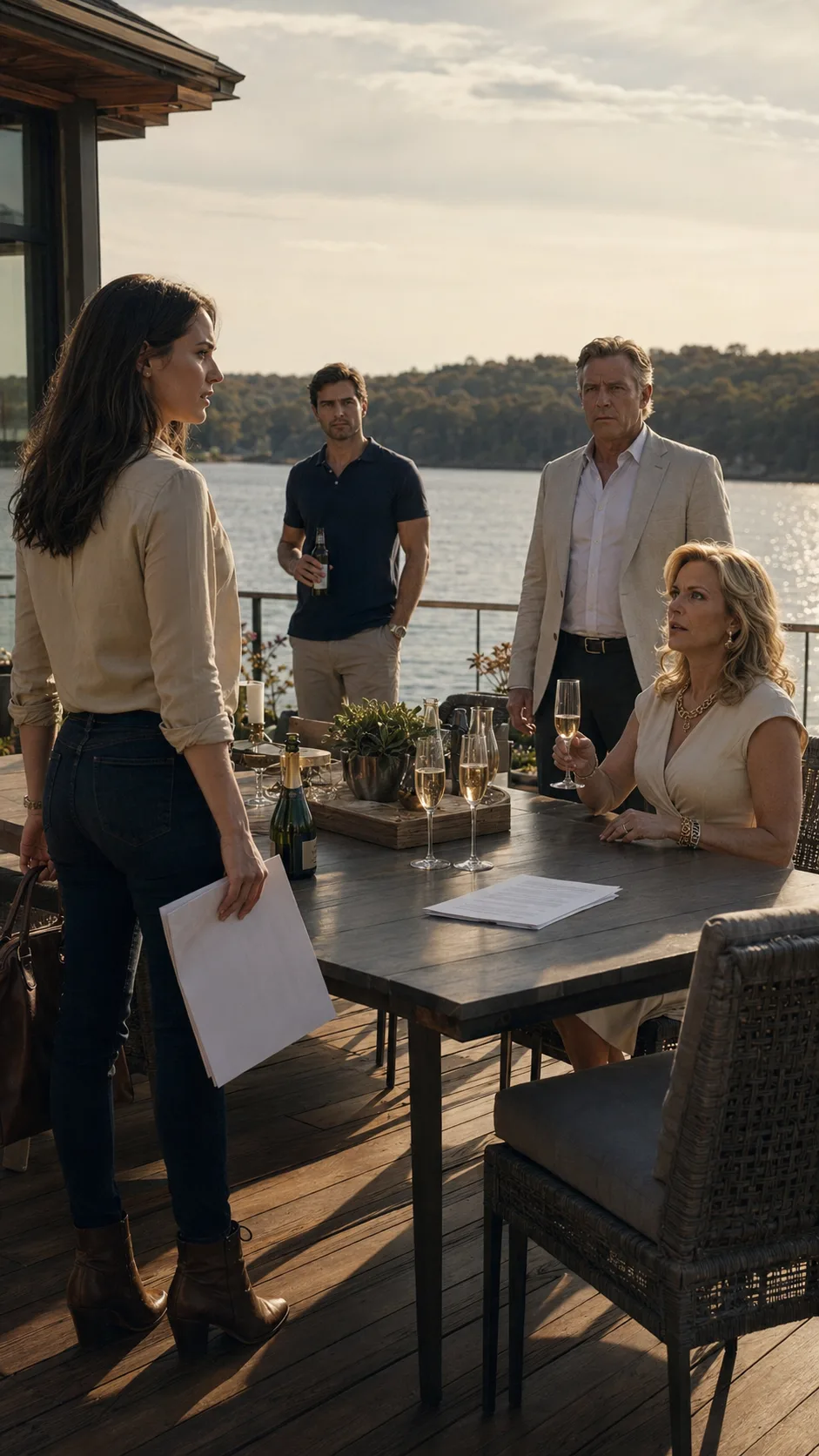
She sat at the patio table in a cream linen dress, one ankle crossed neatly over the other, gold bracelet catching the sun. A champagne flute rested between her fingers. My father stood near the railing, wearing a pale blue shirt and the expression he used on contractors. Nolan leaned back in a wicker chair with his boots on the lower rail, beer bottle loose in one hand.
On the table sat a cheese board, three champagne glasses, a stack of real estate brochures, and a small silver bowl of olives nobody had touched.
A celebration.
My mother’s smile tightened before it appeared.
“Mara.”
Nolan glanced at my bag and smirked.
“Look who remembered family exists.”
My father did not say hello. His eyes went to the side gate behind me, as if checking whether I had brought anyone.
Not yet.
I walked onto the deck without asking permission.
The champagne glasses stopped moving.
The lake behind them flashed gold in the late afternoon light. It was the kind of view my mother would have wanted photographed from the correct angle. No muddy bank. No septic cover. No unpaid bills.
“Mara, I told you on the phone,” she said, setting her flute down with care. “The money is gone. We paid off Nolan’s debts and bought this place.”
Nolan lifted his beer.
“Smartest thing anyone did with that dump.”
I looked at him.
He had Grandpa’s watch on his wrist.
Not a similar one. His.
The old field watch with the scratched face and cracked leather band. Grandpa had worn it every day except Sunday. Nolan had paired it with a new silver bracelet like he had styled an inheritance.
My fingers brushed the stone in my pocket.
“Take that off,” I said.
Nolan looked down at the watch, then back at me.
“This?”
I said nothing.
He smiled wider.
“Dad gave it to me. Said Grandpa would’ve wanted the man of the family to have it.”
My father’s jaw moved once.
My mother leaned forward.
“This is exactly why we didn’t call you before closing. You turn everything into an accusation.”
“You forged my name.”
The words sat between us.
My mother did not flinch. That was almost impressive.
Nolan did.
Only a little. His beer tilted, and foam crawled up the neck.
My father stepped away from the railing.
“Careful.”
I looked at him.
He used that word my whole life. Careful. Careful when I asked why Nolan got the truck after wrecking mine. Careful when I asked why Mom told relatives I was too busy to come home. Careful when Grandpa gave me his compass and Nolan threw a fit.
Careful always meant: stop before the truth makes us work.
I set my bag on the patio table.
The leather was old. It made a dull sound against the polished wood.
My mother’s eyes dropped to it.
“Whatever you think you found, Martin Hale is filling your head.”
“Martin Hale kept Grandpa’s cedar box.”
Her face changed.
There. Finally.
Not much. A small break near the mouth. A blink too late.
“You had no right to go through private things.”
“Grandpa left them for me.”
Nolan laughed.
“Sure he did.”
I opened the bag.
My father took another step closer.
“Mara.”
I removed the Apex Energy contract and held it flat in my hand. The first page was turned down so no words faced them yet. Just the weight of the packet. Thick. Official. Too large to dismiss as sentiment.
My mother looked from the folder to my face.
“What is that?”
I placed it on the table.
Not gently.
The glasses jumped. Champagne shivered in narrow bowls. One olive rolled off the silver dish and stopped near the table edge.
“I didn’t come for your six hundred and twenty thousand dollars,” I said.
Nolan snorted.
I slid the contract toward the center of the table.
“I came to talk about my four point seven million.”
The deck went still.
Not quiet. Still.
The lake kept moving. The dock rope kept tapping. A bird cut across the waterline. But at that table, nothing moved except my mother’s fingers, tightening around the stem of her glass.
Nolan leaned forward.
“What the hell are you talking about?”
I opened the contract to page seven and turned it toward them.
“The mineral lease Grandpa negotiated with Apex Energy before he died.”
My father stared at the page without reading it.
My mother read.
I saw the moment she found the number. Her chin lifted a fraction, then lowered again. The gold bracelet slid down her wrist and clicked against the glass.
Nolan stood.
“Mineral what?”
“The rights beneath the ranch.”
“We sold the ranch,” he said.
“You sold the surface.”
My father’s hand closed around the back of a chair.
“That is our land.”
“No,” I said. “It was Grandpa’s land. Now the surface belongs to the developer you sold it to. The mineral estate belongs to me.”
Nolan pointed at the contract.
“That’s fake.”
I looked at the watch on his wrist.
“You should be careful with that word.”
His face darkened.
My mother reached for the contract. I put two fingers on the top page before she could slide it away.
“Don’t.”
She pulled her hand back.
“Mara, you don’t understand how land works.”
I turned to my father.
“Tell her.”
He looked at me.
“Tell her what surface rights only means.”
His eyes shifted to my mother.
That told me enough.
He had known. Maybe not all of it. Maybe not the dollar amount. But he had known the listing was limited. He had known something sat outside the sale.
My mother’s head turned slowly toward him.
“Robert.”
He said nothing.
Nolan looked from one to the other.
“Dad?”
I took the survey map from the folder and unfolded it across the table, pushing the cheese board aside. Two olives rolled off and dropped onto the deck. One landed near my boot.
The proposed well pad was marked in red. Access road in black. Pipeline easement in blue.
“Here,” I said, tapping the red square. “Five-acre pad. Here, the access road. Here, temporary staging. Apex already has environmental review drafts, traffic plan, and preliminary surface use agreements ready.”
My mother’s skin lost color beneath the careful makeup.
“No.”
“Yes.”
My father’s voice came rough.
“They can’t put that there. We sold to a luxury developer.”
“That developer bought land subject to dominant mineral rights.”
Nolan stepped around the chair.
“Stop saying that like it means something.”
“It means the surface owner cannot block reasonable access to the minerals,” I said. “It means your luxury subdivision starts with drilling equipment.”
My father slammed his palm onto the table.
A champagne flute tipped, hit the wood, and rolled. My mother caught it before it fell.
“That land has our name on it.”
I looked at the spilled champagne spreading toward the Apex contract. I lifted the pages before the liquid reached them.
“No,” I said. “It has your paperwork on it. Those are different things.”
My mother stood slowly.
“You think you can walk in here and threaten us?”
“I am not threatening you.”
“You are jealous. That’s what this is. You couldn’t stand that Nolan got something.”
I stared at her.
Nolan got something.
Nolan got the funeral. Nolan got the watch. Nolan got the first call, the clean house, the sold ranch, the new truck, the soft version of every ugly thing.
I reached into my bag again.
My mother watched my hand.
“This is not about jealousy,” I said.
I pulled out the affidavit.
My father’s face went stiff.
“This is about fraud.”
Nolan’s beer bottle slipped in his hand. He caught it against his thigh.
I unfolded the paper and laid it beside the Apex contract.
The false signature faced up.
My mother did not look at it.
That was how I knew she knew every line.
“You filed this with the county clerk,” I said. “You swore I waived my claim. You used a notary tied to Nolan’s business account. Dad witnessed it. Nolan delivered it.”
Nolan backed up half a step.
“You can’t prove that.”
I looked at him.
“Martin already has the notary log.”
His mouth opened, then closed.
My father grabbed the affidavit.
I let him.
He stared at it as if paper might become something else under pressure.
“Mara,” he said. “This can be handled quietly.”
My mother turned on him.
“Robert.”
He did not look at her.
Good.
The first crack between them.
I took Grandpa’s letter from my bag, but I did not open it. I only placed the envelope on the table. My name in his handwriting faced upward.
My mother saw it.
For the first time since I arrived, she looked smaller than her clothes.
“You stole from me,” I said. “But that is not the part I can’t forgive.”
No one spoke.
“You buried him without me.”
The lake wind moved a corner of the survey map. I pressed it down with my palm.
“You told me there was no will. You told Martin I wanted no contact. You cleared his bedroom before I got there. You kept his watch, his box, his land, and you thought I would cry in my apartment until the paperwork dried.”
Nolan shifted.
“You always make everything about you.”
I looked at him.
“You wore his watch to celebrate selling him.”
His wrist dropped to his side.
My mother picked up the champagne flute again, though there was almost nothing left in it.
“You are being cruel.”
“No,” I said. “I am being specific.”
My father folded the affidavit once, then unfolded it. His hands were not steady.
“What do you want?”
“Three things.”
My mother’s eyes narrowed.
“There it is.”
I ignored her.
“One. You contact the developer before Monday and disclose that the mineral estate was severed and reserved.”
My father’s mouth tightened.
“Two. You return the money or negotiate rescission before they file against you.”
Nolan laughed once.
“The money’s gone.”
“Then sell the truck.”
He looked toward the driveway.
That hurt him. I saw it.
“Sell the cabin,” I said.
My mother’s fingers clenched.
“No.”
“Three. You confess to the forged affidavit in writing before Martin files the true will and supporting documents with the probate court.”
My father stared at me.
“And if we don’t?”
I picked up the Apex contract, tapped it square against the table, and put it back in my bag.
“Then Monday morning, Martin files everything. The will. The severance deed. The lease. The handwriting report. The notary log. The fraud complaint.”
My mother’s voice came low.
“You would send your own mother to prison.”
I looked at her cream dress, the gold bracelet, the champagne wet on the table, Grandpa’s watch on Nolan’s wrist, my fake signature lying between the glasses.
“You lost the right to call yourself that when you buried Grandpa without me.”
The words did not echo. Real life rarely gives you that courtesy. They just landed.
My mother sat down.
Not gracefully. The chair scraped hard against the deck, then caught. Her hand reached for the table but missed the edge. My father moved like he might help her, then stopped. Nolan watched the driveway, not me, like he was calculating how fast a truck could disappear and how much a used one would bring.
A phone rang inside the cabin.
No one moved.
The ringtone played four notes, stopped, then began again.
My father looked down at the affidavit.
“Who else knows?”
“Enough people.”
“That isn’t an answer.”
“It is the only one you get.”
My mother looked up then, and all the polish had drained out of her face. What remained was not guilt. Not exactly. It was the look of a person whose locked room had opened from the inside.
“Amos did this to us,” she said.
I almost stepped back.
Grandpa had been dead two months and she still needed him to carry the blame.
“No,” I said. “He left you the dirt.”
Her mouth tightened.
“You always thought you were better than us.”
I took the sandstone from my pocket and placed it on the table beside the affidavit.
Small. Red. Rough. Worthless to anyone who did not know where it came from.
“No,” I said. “I listened when he talked.”
Martin arrived twenty minutes later.
He did not come onto the deck at first. He stood by the side gate in his gray suit with a leather folder under one arm, looking more like a witness than a lawyer. My father saw him and closed his eyes.
My mother whispered something I did not catch.
Nolan said, “This is insane.”
Martin opened the gate.
“Afternoon,” he said.
No one answered.
He placed his folder on the table and removed three copies of the same letter.
Notice of Mineral Estate Ownership and Demand for Preservation of Records.
He gave one to my father. One to my mother. One to Nolan.
Nolan did not take his, so Martin set it on the table in front of him.
“You are all instructed not to destroy, alter, conceal, transfer, or dispose of any documents, financial records, communications, closing materials, estate records, personal property of Amos Reed, or proceeds from the surface sale.”
Nolan looked at my father.
“Can he do that?”
Martin adjusted his glasses.
“I just did.”
My mother’s face hardened again, but it no longer fit right. The edges shook.
“We need our own lawyer.”
“Yes,” Martin said. “You do.”
My father swallowed.
“What happens to the developer?”
“That depends on how quickly you correct the disclosure issue.”
“Disclosure issue?” I said.
Martin looked at me, and for a second I saw the dryness Grandpa must have liked in him.
“Fraud sounds harsh before dinner.”
Nolan cursed and walked toward the railing.
My father sat down at last. He looked suddenly older, not softer. Just worn, like someone had taken the frame out of him and left the shirt standing.
My mother remained upright.
She had always believed posture was proof.
“Mara,” she said. “We can still make an agreement.”
“No.”
“You haven’t heard it.”
“I heard you at the courthouse.”
She blinked.
“I heard you on the phone when you thought the sale was final. I heard you when you told me not to start. I heard you when you said Grandpa’s box was thrown away.”
Her mouth parted.
“I am done hearing you before paperwork.”
Martin’s pen clicked once.
Nolan turned from the railing.
“You really think Apex will pay you that much?”
I looked at him.
“That’s what bothers you?”
He said nothing.
“It isn’t whether you stole,” I said. “It’s whether you stole enough.”
His face twisted.
“You left.”
There it was again.
The old family verdict.
I walked toward him until only the corner of the patio table separated us.
“I left for college.”
“You didn’t come back.”
“I came back every month.”
“That’s not staying.”
“No,” I said. “Staying is not the same as circling a dying man until the papers are loose.”
His hand moved before he thought about it.
Not toward me. Toward the watch.
His fingers covered the cracked face.
I held out my palm.
“Give it back.”
He looked toward our father.
Dad did not move.
“Nolan,” Martin said.
The name carried no threat. It did not need one.
Nolan unclasped the watch. For a second, he held it tight, thumb pressed against the scratched glass. Then he dropped it into my hand.
It was heavier than I remembered.
I slipped it into my bag beside Grandpa’s letter.
My mother made a sound then. Not crying. Something smaller and uglier.
“You came here to humiliate us.”
I looked around the deck.
The champagne. The lake. The brochures. The new truck visible beyond the corner of the house. The cabin bought with land they had sold out from under a dead man and a forged daughter.
“No,” I said. “You scheduled that yourselves.”
The next week, the cabin went quiet.
Not physically. My mother filled silence with phone calls. My father called attorneys from the garage because he thought walls made conversations private. Nolan drove the F-250 twice before a lien notice scared him into parking it behind the house. The developer’s lawyer sent a letter so sharp Martin read the first paragraph twice and said, “Well, they are awake.”
The sale did not unwind cleanly. Nothing involving my family ever had.
The developer demanded rescission, damages, reimbursement of survey costs, and written confirmation of mineral title. My parents tried to argue they had sold in good faith. Then the developer’s attorney attached the property listing with surface rights only circled in red. After that, the good faith argument lost its legs.
My mother called me nine times in one afternoon.
I did not answer.
She texted once.
Your grandfather would be ashamed of this.
I printed it and added it to the folder.
Martin told me not to be petty.
Then he asked for a copy.
The probate filing happened on Monday at 8:17 a.m. I know because I watched the clerk stamp it. Not the same clerk from the copier. This one had purple nails and a cardigan with tiny embroidered lemons. She did not know what she was holding when she pressed the stamp down.
The real will.
The severance deed.
The mineral reservation.
The Apex negotiation packet.
The handwriting report.
The forged waiver.
The notary log.
Grandpa’s letter stayed with me. Some things did not belong in a public file.
At 10:42, my father called.
I let it go to voicemail.
At 10:44, Nolan called.
Voicemail.
At 10:51, my mother called from an unknown number.
I answered.
For three seconds, neither of us spoke.
Then she said, “They’re treating us like criminals.”
I looked out Martin’s office window at the courthouse steps.
“You filed a forged affidavit.”
“You keep saying that word.”
“Forged?”
“Like you enjoy it.”
I almost laughed. It came out as air through my nose.
“What word would you prefer?”
“We were trying to settle things.”
“You were trying to erase me.”
“You erased yourself years ago.”
I looked at Grandpa’s watch on my desk. Martin had helped me find a repair shop. The cracked leather was still cracked, but the mechanism ticked again.
“No,” I said. “You just got used to talking over me.”
My mother’s voice changed. Less sharp. More dangerous.
“You think money makes you untouchable now?”
“No.”
“Then what do you think it makes you?”
I looked at the Apex folder.
“Documented.”
She hung up.
By the end of the month, the lake cabin was listed.
No lakefront dream language this time. No “family retreat.” No “rare opportunity.” Just square footage, acreage, bedroom count, dock condition, and price reduced twice.
Nolan’s truck disappeared from the driveway six weeks after my visit. He posted nothing about it. That told me he had not sold it voluntarily. My father’s new truck stayed, but only because it was leased and cheaper to keep than break.
The developer settled with my parents after taking back nearly all the sale proceeds. Legal fees ate the rest. The notary lost her commission. Nolan’s landscaping account became part of the investigation because he had paid her three hundred dollars two days before the affidavit was stamped.
My parents avoided criminal charges only because they confessed before the district attorney received Martin’s full packet. It was not mercy. It was strategy. Restitution, cooperation, probation exposure, civil settlement, no prior felony convictions.
Martin explained all of it.
I listened.
Some victories arrive wearing work clothes.
Apex sent its final lease packet in a blue folder with silver lettering. I signed it in Martin’s office using my own pen. He watched every stroke. I did not rush.
My signature looked nothing like the forged one once I stopped being afraid of it.
The first payment arrived by wire on a Thursday morning.
I was brushing my teeth when my bank app froze.
Then reloaded.
Then showed more money than I had ever seen attached to my name.
I sat on the edge of the bathtub with toothpaste in my mouth for almost a full minute.
Then I rinsed, wiped the counter, and drove to the ranch.
No one lived there now.
The house still stood, though the porch sagged on the east side. The barn door hung crooked. Red dirt had blown against the fence in small drifts. The mailbox leaned toward the road, name faded to four pale letters.
R-E-E-D.
Apex equipment sat beyond the north pasture, arranged in neat industrial lines. Men in hard hats moved between trucks. Temporary mats covered the access road to protect the soil. The first pad site was marked with stakes and orange flags.
It should have looked like intrusion.
It did not.
It looked like what the land had been holding under its tongue.
I parked near the old creek bed and walked down alone. The grass caught against my boots. A grasshopper knocked itself against my jeans and vanished. The air smelled like dust, sun-warmed weeds, and diesel from the equipment over the rise.
I crouched where Grandpa used to crouch.
The creek was dry.
I picked through the stones until I found one with a red seam and a gray underside. Not as good as the one he had left in the cedar box, but close. I rubbed my thumb over the rough edge.
My phone buzzed.
Nolan.
I almost ignored it.
Then I answered.
He did not speak right away.
Behind him, I could hear wind. Maybe traffic. Maybe he was outside because nobody wanted him indoors with bad news.
“I heard they started moving equipment,” he said.
“Yes.”
“You really did it.”
I looked toward the orange flags.
“Apex did.”
“You know what I mean.”
I waited.
He breathed into the phone.
“Dad says Mom won’t come out of her room.”
I said nothing.
“She says you ruined everything.”
A hawk moved in a slow circle above the far fence.
“Did you call to tell me that?”
“No.”
His voice cracked on the edge of the word, and he covered it with a cough.
“I called because I found something.”
My hand tightened around the stone.
“What?”
“In the garage. At the old house. There’s a toolbox. Green metal one. Grandpa’s. Dad took it before the sale because he thought there might be silver coins in it.”
Of course he did.
“There weren’t,” Nolan said. “Just tools. Old receipts. Some pictures.”
I stood.
“What pictures?”
“You and Grandpa. Mostly. Some of Grandma. One of Mom when she was young.”
He paused.
“I was going to throw them out.”
I closed my eyes for one second.
One.
“But I didn’t,” he said.
“Why?”
The silence stretched.
“I don’t know.”
A truck beeped twice in the distance, backing up near the pad site.
“Bring them to Martin,” I said.
“Can I bring them to you?”
“No.”
He took that like a slap. I heard it.
“Yeah,” he said. “Okay.”
“Nolan.”
“What?”
“Take the watch off your mind. It’s already gone.”
He gave a small, empty laugh.
“I was going to ask if you’d sell it.”
“No.”
“I figured.”
He hung up first.
I stood in the creek bed until the phone screen went dark.
Two months later, the old house was cleaned out under court supervision. Martin hired a local company, but I came for the last day. I did not trust my parents not to send someone for whatever they thought still had value.
The green toolbox sat on the kitchen table when I arrived.
So did a shoebox full of photographs.
Nolan had brought them after all.
I looked through them in the kitchen where Grandpa used to make coffee thick enough to stain the spoon. The room still had the same yellowed curtains. One cabinet hung slightly open because the latch never caught.
There was a photo of me at nine, holding a chunk of shale like a trophy. Grandpa stood beside me, one hand on his hip, laughing at something outside the frame. Another showed Grandma in the garden, squinting into sun. Another showed my mother at maybe nineteen, sitting on the fence with her hair in a braid, smiling in a way I had never seen in real life.
I put that one aside.
I did not know why.
Near the bottom of the shoebox was a picture from the day Grandpa taught me to use a rock hammer. I remembered the heat. I remembered Mom yelling from the porch. I remembered Nolan sulking because Grandpa had told him not to swing the hammer near the truck.
In the photo, my small hand held the hammer wrong. Grandpa’s hand covered mine, correcting the angle.
On the back, he had written: Mara listens with her hands.
I sat down at the kitchen table.
For once, I did not try to stand through it.
Martin came in ten minutes later and found me sorting pictures into piles.
“Keep, scan, archive?” he asked.
“Keep, keep, keep.”
He nodded.
“That works too.”
My parents did not attend the final probate hearing. Their attorney appeared for them. He wore a gray suit and avoided looking at me. The judge confirmed the mineral estate in my name, accepted the corrected filings, and noted the forged affidavit had been withdrawn and superseded under settlement terms.
It sounded too clean.
Fraud should not fit into tidy sentences.
But paper likes order, even when people do not.
After the hearing, my father waited in the courthouse hallway.
He stood near a vending machine humming under fluorescent lights. He had lost weight. His shirt collar sat loose around his neck. For a second, I saw what he would look like at seventy.
I kept walking.
“Mara.”
I stopped.
Martin was beside me, but he stepped away just enough to give me the choice.
My father held a manila envelope.
“Your mother wrote you something.”
I did not take it.
“She should mail it.”
“She wanted me to give it to you.”
“Of course she did.”
His fingers tightened on the envelope.
“I know you think I was weak.”
I looked at him.
“I think you signed.”
His eyes dropped.
Fair enough.
He put the envelope on the window ledge between us.
“She kept saying it was what Amos meant to do. That he just never fixed the papers. That you wouldn’t care. That Nolan needed help.”
“And you believed her?”
He rubbed both hands over his face, then let them fall.
“I wanted to.”
There it was.
Not an apology. Not enough. But closer to truth than anything he had offered me in years.
I picked up the envelope.
Not because I forgave him. Because refusing it would have made him the center of the moment, and I was done giving him that.
“Goodbye, Dad.”
His mouth moved once.
I walked out before he found a smaller word to hide in.
I did not open my mother’s letter until that night.
It was three pages long.
She explained her fear. Her resentment. Her belief that Grandpa had favored me. Her anger that I left town. Her certainty that Nolan would fall apart without help. Her conviction that I had always landed on my feet and therefore needed less.
She did not write, I am sorry I forged your name.
She wrote, I am sorry it became this.
I folded the letter and placed it in a folder labeled Mother.
Not Mom.
Mother.
Then I opened Grandpa’s envelope again and read his last line.
The deepest things do not ask permission from the surface.
I read it once.
Then I put it in the top drawer of my desk beside his watch.
The ranch changed over the next year.
Not into a ruin. Not into the nightmare my mother described to relatives who still took her calls. Apex built one pad, one access road, and buried pipeline along the agreed route. They paid for surface protections even though the developer now owned that land again under a corrected agreement. A different buyer eventually purchased the surface at a lower price, fully informed, planning cattle and windbreaks instead of luxury homes.
The old house remained mine to visit through easement terms Martin negotiated with the new owner. Not to live in. Not to claim as a shrine. Just to enter the creek bed, the barn, and the small family cemetery where Grandpa rested under a simple stone.
I visited on the anniversary of the day they buried him without me.
No one else was there.
The grass around the cemetery fence had grown high. I brought shears and cut it down myself. The work took longer than I expected. Sweat ran down my back. Dust stuck to my wrists. I nicked my thumb on the fence latch and wiped the blood on my jeans.
Grandpa’s headstone had weathered at the edges.
Amos Reed.
Husband. Father. Grandfather.
Stone remembers.
Martin had arranged for that last line. I had not asked him to.
I set the sandstone from the creek on top of the marker.
Then the repaired watch.
Only for a minute.
I wanted him to have it in the sun.
The second royalty payment came that fall. I used part of it to fund a geology scholarship at the state university for students from rural counties. No gala. No plaque with my face. Just a fund in Grandpa’s name and one requirement: applicants had to write about a piece of land they knew by touch, not by price.
The first recipient wrote about a dry creek behind her grandmother’s trailer.
I approved it before finishing the second paragraph.
My parents moved into a smaller house outside town. Nolan took a job managing equipment for a contractor who did not know our family history until someone told him and he kept Nolan anyway. My mother stopped calling. My father sent one Christmas card with no message, just his name and hers printed by the store.
I put it in the folder.
Not the drawer.
The drawer was for things that still had a pulse.
One afternoon, Martin called and said there was a final item from the old house. The cleaning company had found it behind a loose board in Grandpa’s bedroom closet.
I drove down that evening.
Martin handed me a small tin box, rust around the hinge.
Inside were two things: a photograph of Grandma standing beside Grandpa in the north pasture, and a folded note in her handwriting.
Amos,
If you ever have to choose who gets the land, give Mara what is under it. She sees things the rest of them step on.
I sat in Martin’s office with the note in my hand until the streetlights came on outside.
Martin pretended to read a file.
He did that for twenty minutes.
When I finally stood, he looked up.
“All right?”
“No.”
He nodded.
“That’s allowed.”
I carried the tin box to my car and drove to the ranch instead of home.
The sun was almost gone when I reached the gate. The pad lights glowed in the distance. Machinery sat still for the night. Beyond the fence, the red dirt held the day’s heat.
I walked to the creek bed and took off my boots.
The ground was rough. Pebbles pressed into my soles. A thorn caught the hem of my jeans. I kept walking until I reached the place where Grandpa had first put sandstone in my hand.
I stood there with Grandma’s note folded in my pocket, Grandpa’s watch on my wrist, and the land quiet around me.
For years, my family had called me the one who left.
They never understood.
Leaving had taught me how to come back with maps.
I crouched, picked up a small red stone, and closed my hand around it.
The surface was never the inheritance.
THE END.