The first time I noticed something was wrong, it wasn’t because of what I saw.
Chapter 1
The first time I noticed something was wrong, it wasn’t because of what I saw.
It was because of what I didn’t hear.
My mother’s funeral in Indiana should have been filled with the usual small sounds — chairs shifting, quiet greetings, the soft friction of people trying to behave properly in grief. Instead, there was a kind of organized stillness, like everyone had agreed to hold their breath without saying it out loud.
I stood near the front of the chapel with my sister, Claire. We both wore black coats that still carried the cold from outside. My mother’s casket sat in the center of the room, closed, polished wood reflecting the soft ceiling lights like a dark mirror that refused to give anything back.
People had already arrived early. Neighbors. Coworkers. Church members. Faces I had known my entire life. They filled the pews in neat clusters, the way small-town gatherings always do — organized not by seating charts, but by familiarity.
My
father sat in the second row. Straight posture. Hands folded too tightly. He hadn’t cried yet, which somehow made everything feel heavier instead of controlled.
A photograph of my mother stood at the front. Smiling. The version of her we all agreed on.
But agreement has a way of breaking when people stop pretending.
The chapel doors at the back creaked once.
No one turned.
Not yet.
It was probably just staff, I thought. Someone checking arrangements. Someone making sure nothing went wrong in a room where everything already had.
But the sound came again. Heavier this time. A real door, not a hallway movement.
Still, no one reacted.
Then footsteps followed.
Measured. Even. Deliberate.
Claire’s fingers brushed my sleeve. A question without words.
I didn’t look back yet.
The chapel had already started to feel like it was waiting for something it didn’t want to name.
And then the
footsteps stopped.
Right at the entrance.
That was when the silence changed shape.
Not louder.
Not smaller.
Just aware.
Someone behind me finally turned. Then another person. Then a chain reaction moved through the pews like a slow ripple.
I turned last.
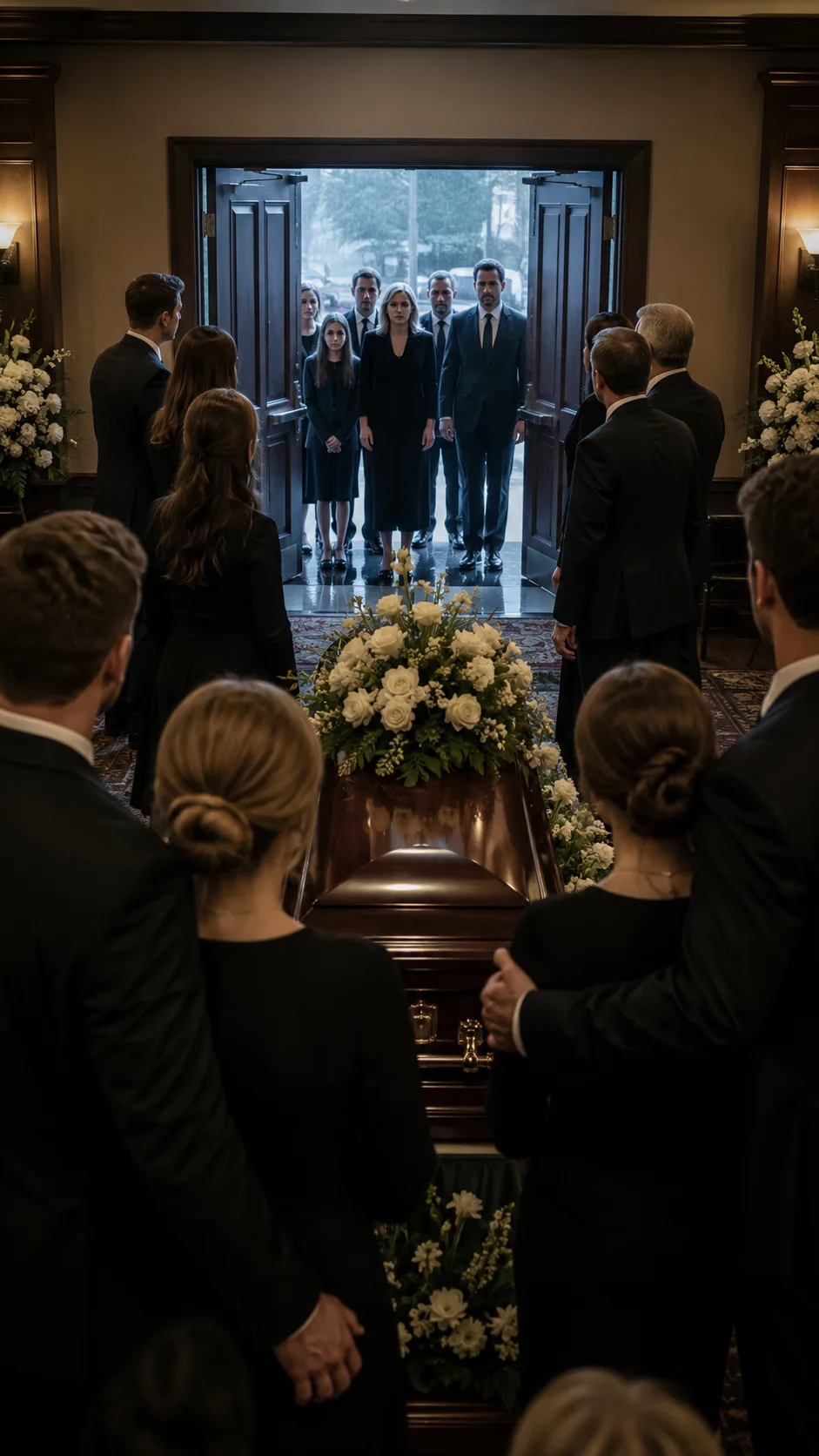
At the back of the chapel stood a group of people in black.
Not our black.
Different somehow. Sharper. More formal. Like they had arrived from a different version of the same event.
A woman stood at the front of them. Early fifties maybe. Composed posture, but her hands were clenched in a way that didn’t match her stillness.
Beside her was a man roughly my father’s age. Another woman slightly younger. Two men. A teenage boy.
A family.
Just not ours.
The woman took one step inside.
Then stopped again.
Her eyes moved across the room slowly, landing on the casket. Holding there longer than anyone else
had dared to.
Something in her expression tightened. Not confusion anymore. Recognition that didn’t know where to go.
My father stood halfway from his seat.
Then froze.
Claire leaned closer to me.
“Do you know them?” she whispered.
I didn’t answer.
Because I didn’t.
But I had the strange feeling that silence had already answered for me.
The group at the door began to walk forward.
Slowly.
Not like strangers entering a funeral.
Like people arriving late to something they had already been part of.
Each step down the aisle pulled attention like a thread tightening in real time. Chairs shifted. People leaned back slightly, giving them space without being asked.
The woman’s gaze never left the casket.
Not once.
And the closer they came, the more I noticed something unsettling in the details.
They weren’t lost.
They were confirming.
Halfway down the aisle, they stopped again.
Exactly where the light from the front windows met the shadowed middle of the chapel. As if they knew where to stand so everything else would become visible.
The woman’s eyes finally moved from the casket to the people around it.
And then she looked at me.
Not casually.
Not politely.
Like she was placing me somewhere she had already seen before.
My stomach tightened without permission.
My father took one step forward.
Then another.
“Who are you?” he said.
His voice wasn’t loud. It didn’t need to be.
The woman didn’t answer immediately.
Instead, she looked back at the casket again. Like she was checking something that could not be changed.
A long breath passed through the room.
Then she spoke.
“We were told this would be private,” she said.
Her voice was calm. Too calm for where she was standing.
My mother’s sister, Aunt Helen, stood up from the pew.
“Who are you people?” she repeated, sharper this time.
The woman finally stepped fully into the center aisle.
“We came because she was ours too.”
The words didn’t land immediately.
They hung there, incomplete, as if the room itself refused to accept them at first.
Claire let out a quiet sound beside me.
My father turned slightly, as if trying to process the sentence in parts.
“That’s not possible,” he said.
But the woman didn’t move.
She just nodded once, like she had already expected that answer.
Then she looked past him.
At the casket.
At the photograph of my mother.
Her face changed, just slightly. Not sadness. Something older than that.
“She told us she had one life here,” the woman said. “But that wasn’t true.”
The air shifted.
Not dramatically.
Subtly, like something inside the room had loosened.
A man from her group stepped forward and placed his hand lightly on the woman’s shoulder, as if grounding her. He looked around the chapel slowly, taking in faces, absorbing reactions.
My father’s voice broke the quiet again.
“Explain,” he said.
Just one word.
The woman exhaled through her nose.
And then she did something that made the entire room feel like it tilted.
She took a small step closer to the casket.
“I’m not here to ruin anything,” she said. “I’m here because I don’t think any of us understood her at all.”
A sound came from the back pews. Someone whispering too fast to be meaningful.
Claire’s hand tightened around my arm.
The woman turned slightly, gesturing behind her.
“This is my family,” she said. “We were with her for years.”
The word years changed everything without asking permission.
My father’s face stiffened.
“What do you mean, years?”
The teenage boy behind her shifted his weight.
My mother’s photograph at the front seemed suddenly less stable. Like it belonged to multiple rooms at once.
The woman finally walked closer to the casket.
Each step was slower now.
Deliberate.
Not hesitant.
Deciding.
She stopped directly in front of it.
Her reflection faintly visible in the polished wood.
“My name is Rebecca,” she said. “And she lived with us in Ohio when she said she was working here.”
A silence so complete followed that even breathing felt visible.
Ohio.
The word didn’t belong in this room.
Not here. Not now. Not in any version of the life we thought we knew.
My father shook his head once.
“No,” he said again. “She never left Indiana.”
Rebecca turned slightly.
“She did,” she replied. “Every other week.”
Claire let go of my arm.
Not because she wanted to.
Because her body had forgotten what it was holding.
My aunt stepped forward again, voice rising.
“This is a funeral,” she said. “Not a place for stories.”
Rebecca looked at her.
And for the first time, her calm cracked just enough to show something underneath.
“It’s not a story,” she said. “It’s her life.”
The words settled differently this time.
Heavier.
More specific.
My father walked closer to the aisle without realizing it. He stopped a few feet from Rebecca.
“What are you saying?” he asked, slower now.
Rebecca looked at him directly.
“I’m saying she had another family,” she said. “Us.”
The room did not explode.
It collapsed inward instead.
Quietly.
Not into chaos, but into reorganization. People shifted in their seats. Some looked at others. Some looked down. Some looked at the casket like it might finally explain itself.
My mother’s photograph remained unchanged.
Smiling.
Completely unaware of what had just been said in her name.
Rebecca reached into her coat pocket.
Not dramatically.
Not like a performance.
Like someone who had been holding something for a long time and had finally arrived at the place where it could no longer stay hidden.
She placed a small object on the edge of the casket.
A ring.
Simple. Worn.
My father froze.
My aunt inhaled sharply.
Claire stepped back half a step.
The room stopped moving entirely.
Rebecca’s voice softened, but only slightly.
“She wore this when she was with us,” she said. “She never took it off.”
My father stared at it.
Then at her.
Then at the casket.
“No,” he said again, but it was weaker now. Less like denial. More like repetition.
Rebecca didn’t argue.
She didn’t need to.
From the back, one of her sons spoke for the first time.
“She said you didn’t know,” he said quietly. “She said you wouldn’t understand.”
My father turned toward the boy.
“You knew her?” he asked.
The boy nodded.
“Better than you think.”
A long pause followed.
Then Rebecca did something unexpected.
She stepped back.
Not forward.
Back.
As if she had already said what she came to say.
But the damage wasn’t ending.
It was spreading.
My aunt sank into her seat slowly.
Claire stared at the casket like it had become unfamiliar.
My father stood between two lives that had never touched until this moment, and suddenly both of them felt incomplete.
Rebecca looked once more at the photograph of my mother.
“I don’t know which version of her you buried today,” she said. “But we buried another one too.”
Then she turned.
And began to walk back down the aisle.
Her family followed.
No one stopped them.
Not because they were allowed to leave.
But because no one knew which part of the truth they were supposed to hold onto first.
The chapel doors opened again.
Cold air entered.
And for the first time since the service began, the silence didn’t feel like grief.
It felt like correction.
The kind you can’t undo.
I stood there, watching them leave, realizing something I wasn’t ready to say out loud.
My mother hadn’t just lived a double life.
She had built two entire worlds.
And never told either one that the other existed.
The ring still sat on the casket.
No one touched it.
No one moved.
And in that stillness, the only thing left was the question no one had asked yet.
Which version of her was real.
Chapter complete
You have reached the end of this chapter.
Continue reading
A few more worlds to get lost in after this chapter.




