My Mother-in-Law Wanted a Grandson, Not My Daughters — But the Truth Destroyed Her Pride
PART 1
The first time my mother-in-law looked at my newborn daughter and sighed, I told myself I had imagined it.
Chapter 1
My Mother-in-Law Wanted a Grandson, Not My Daughters — But the Truth Destroyed Her Pride
PART 1
The first time my mother-in-law looked at my newborn daughter and sighed, I told myself I had imagined it.
I was lying in a hospital bed, twenty-six hours after labor, my hair stuck to my forehead, my body aching in places I didn’t even know could ache. Ryan stood beside me, one hand on my shoulder, the other touching the tiny pink blanket wrapped around our daughter.
“She’s perfect,” I whispered.
And she was.
Lily had a round face, a small rosebud mouth, and fists so tiny they looked like folded petals. She yawned once, and I felt my whole heart rearrange itself inside my chest.
Then Linda Collins stepped into the room.
Ryan’s mother was sixty-five now, but back then she was still in her late fifties, sharp-eyed, elegant, always dressed like she was attending a country club luncheon even when she was only visiting a hospital. She carried a blue gift bag.
Blue.
I remember staring at it, confused.
Linda walked to the bassinet, looked down at
Lily, and said, “Well. She has Ryan’s nose.”
Ryan smiled awkwardly. “Mom.”
Linda gave a thin little laugh. “What? I’m saying something nice.”
But she didn’t pick Lily up right away.
She stood there with that blue gift bag hanging from her wrist, staring at my daughter as though someone had delivered the wrong package.
Finally, she pulled out a tiny navy sweater with little baseball bats stitched across the front.
“I bought it before we knew,” she said. “No use wasting it.”
I was too tired to answer.
Ryan squeezed my shoulder. “It’s cute, Mom.”
Linda folded the sweater and placed it on the chair beside my bed.
“Maybe next time,” she said.
That was the first crack.
At the time, I told myself it meant nothing. Older people said careless things. Mothers-in-law took time to adjust. I was emotional because I had just given birth. Linda didn’t mean
it the way it sounded.
But over the years, “maybe next time” became the soundtrack of my marriage.
When Lily turned one, Linda gave her toy trucks and told everyone at the party, “I already bought these for the grandson I’m still waiting on.”
When Lily turned three and wanted a princess cake, Linda said, “There’s enough pink in this family to choke a horse.”
When I became pregnant again, she showed up at our house with a box of blue baby clothes and a silver rattle engraved with the initials “R.C. Jr.”
“We don’t even know what we’re having yet,” I said gently.
Linda touched my stomach as if she had ownership over it. “This one feels different. I can tell.”
Ryan laughed. “Mom thinks she’s psychic.”
I smiled because everyone else smiled.
But inside, something tightened.
I gave birth to Emma on a rainy Thursday morning.
She came
into the world screaming, furious, alive, beautiful. The nurse placed her on my chest, and Lily, who was three and wearing rain boots in the hospital room, climbed onto the chair and whispered, “Hi, baby. I’m your big sister.”
Ryan cried that day.
He really did.
He kissed my forehead. He kissed Emma’s tiny fingers. He pulled Lily into his lap and said, “Look at our girls.”
For a few hours, I believed we were safe.
Then Linda arrived.
This time, she didn’t bring a gift.
She stood at the end of my hospital bed, glanced at Emma, and said, “Another girl.”
Ryan’s face changed. Just for a second. Like he had heard the cruelty in it.
“Mom,” he said quietly. “Don’t.”
Linda raised both hands. “I’m only stating a fact.”
I held Emma tighter against me.
“She’s your granddaughter,” I said.
Linda looked at me then, really looked at me, and for the first time I saw something colder than disappointment.
Blame.
“Yes,” she said. “I know.”
After that, she stopped pretending.
Family dinners became trials.
At Thanksgiving, she would look across the table at my daughters and say things like, “The Collins name has always gone through sons. It’s a shame traditions end so easily.”
At Easter, she handed Lily a basket and said, “I suppose girls do look nice in dresses, at least.”
At Christmas, she gave Ryan an ornament shaped like a baby boy’s shoe.
“Just manifesting,” she said, smiling at me.
Ryan would rub the back of his neck. “Mom, come on.”
But he never said more than that.
That was the part that hurt most.
Not Linda’s words. Not really.
It was Ryan’s silence afterward.
Every time she cut me, he handed me a napkin and asked me to wipe away the blood quietly.
“She’s from another generation,” he would say on the drive home.
“She knows exactly what she’s saying,” I would answer.
“She doesn’t mean to hurt you.”
“She hurts the girls.”
That always made him go quiet.
Because he knew it was true.
Lily was old enough to understand tone before she understood words. She noticed when Linda smiled at little boys in restaurants and sighed at her. She noticed when her grandmother bought blue baby clothes “for the future” but never remembered her favorite book. She noticed when Emma drew a picture of our family and Linda asked, “Where’s the little brother?”
One night, when Lily was six, I found her standing in front of the bathroom mirror, pulling her ponytail back and tucking it under a baseball cap.
“What are you doing, sweetheart?” I asked.
She turned around quickly. “Nothing.”
I knelt beside her. “Lily.”
Her lower lip trembled.
“If I looked like a boy, would Grandma like me more?”
I felt something inside me break so quietly no one else heard it.
I pulled her into my arms and held her on the bathroom floor until her small body stopped shaking.
That night, I told Ryan, “This has to stop.”
He sat on the edge of our bed, his elbows on his knees.
“I’ll talk to her.”
“You’ve been saying that for years.”
“I know.”
“No, Ryan, I don’t think you do.” My voice was shaking. “Your daughter asked me if she needed to look like a boy to be loved by her grandmother.”
His face went pale.
“She said that?”
“Yes.”
He covered his mouth with both hands. For a moment, I saw the man I married. The man who cried when our daughters were born. The man who built Lily a treehouse even though he hated heights. The man who danced with Emma in the kitchen while pancakes burned on the stove.
Then his phone buzzed.
He looked down.
I saw the name on the screen.
Mom.
He silenced it.
But he didn’t call her back that night.
I thought that meant he had chosen us.
I was wrong.
PART 2
The medical appointment happened because Ryan wanted “answers.”
That was his word, not mine.
By the time Emma turned two, Linda had moved from hints to open suggestions.
“You’re both still young,” she told Ryan one Sunday afternoon while I was clearing plates in her dining room. “There are options.”
I froze in the doorway.
Ryan said, “Options?”
Linda lowered her voice, but not enough. “A man who wants a son shouldn’t have to give up because his wife can’t provide one.”
I waited for Ryan to explode.
I waited for the chair to scrape back, for his voice to rise, for him to say, “Don’t you ever talk about my wife like that again.”
Instead, he said, “Mom, stop.”
Two words.
Soft.
Tired.
Embarrassed.
Not angry.
That night, he said we should see a fertility specialist.
I stared at him from across the kitchen island.
“For what?”
“Just to know.”
“To know what, Ryan?”
He looked away.
I laughed once, but there was no humor in it. “You want to know why I keep giving you daughters?”
“That’s not what I said.”
“It’s what you meant.”
He ran a hand through his hair. “I’m under a lot of pressure.”
“From who?”
He didn’t answer.
I already knew.
The fertility specialist was a kind woman named Dr. Patel. She wore purple glasses and spoke with the careful calm of someone used to people arriving with fear wrapped around their throats.
She explained genetics. She explained chance. She explained that the sex of a baby is determined by the father’s sperm, not the mother’s body.
Ryan stared at the floor.
I watched his ears turn red.
Then she ordered tests.
I didn’t want them. Not because I was afraid, but because I knew what this was really about. It wasn’t medicine. It was Linda sitting invisibly between us, demanding proof that I was the problem.
The results came two weeks later.
I remember everything about that day.
The smell of antiseptic in Dr. Patel’s office. The way Ryan’s knee bounced. The soft hum of the air conditioner. The picture of a beach on the wall behind her desk.
Dr. Patel folded her hands.
“Megan, your results are normal.”
Ryan exhaled.
Then she turned to him.
“Ryan, your results show some significant male-factor fertility concerns. It doesn’t mean pregnancy is impossible, but it does mean the issue is not with Megan.”
Silence filled the room like water.
Ryan stared at her.
“Are you sure?”
Dr. Patel nodded. “Yes.”
He swallowed hard. “But we have two children.”
“You do,” she said gently. “And that’s wonderful. But based on these results, if you’re having difficulty conceiving again, Megan is not the medical concern.”
He didn’t speak the entire drive home.
I held the envelope in my lap and watched the city pass by the window.
When we pulled into the driveway, he finally said, “Please don’t tell my mother.”
I turned to him slowly.
“Excuse me?”
His eyes were wet. “Please.”
“Ryan.”
“She’ll never look at me the same.”
I laughed, shocked. “She hasn’t looked at me the same for seven years.”
“I know.”
“No, you don’t know. She has blamed me for something that was never even mine to carry.”
His voice cracked. “I can’t handle her knowing.”
That stopped me.
Because for all his weakness, I had rarely seen Ryan afraid.
Not annoyed. Not uncomfortable. Afraid.
“My dad was everything to her,” he said. “When he died, she put all of that family legacy stuff on me. The name. The house. The business. The grandson she imagined before I even met you.”
“You’re not responsible for her fantasy.”
“I know.”
“Then tell her.”
He shook his head. “I can’t.”
I should have walked away then.
I know that now.
But marriage is not one moment. It is a thousand tiny negotiations with your own heart.
Ryan cried in the car that day. He held my hand and said, “I’m sorry. I’ll do better. I’ll protect you. Just don’t tell her this. Please.”
So I didn’t.
I put the envelope in a small wooden box at the back of my closet, under old birthday cards and hospital bracelets from the girls’ births.
I told myself silence was mercy.
I told myself protecting my husband’s pride was part of loving him.
For almost three years, I carried a truth that could have freed me because I thought love meant not using it.
Meanwhile, Linda got worse.
She began inviting women to family events.
Not openly. Not like some dramatic villain in a movie. Linda was smarter than that.
She invited “old family friends.” Daughters of women from church. A divorced neighbor with “such a kind heart.” Ryan’s high school girlfriend, who had recently moved back to town and “always wanted a big family.”
At first, Ryan acted confused.
Then annoyed.
Then silent.
Silence became his native language.
When I confronted him, he said, “I can’t control who Mom invites.”
“You can control how you respond.”
“I’m tired, Megan.”
“So am I.”
He looked at me then, really looked at me, and said something I never forgot.
“Sometimes I feel like no matter what I do, I disappoint someone.”
I answered, “Then stop disappointing the two little girls who still believe you’re brave.”
He flinched.
But he still did nothing.
The week before Lily’s eighth birthday, Linda called me.
Not Ryan.
Me.
“I want to help with the party,” she said.
I almost dropped the phone.
“You do?”
“She’s my granddaughter.”
I heard something strange in her voice. Not warmth exactly, but effort.
I wanted to believe in it.
That was one of my flaws. Even after years of being hurt, I still left a small door open for people to become better.
“She wants a princess garden party,” I said carefully.
Linda paused.
Then she said, “Of course she does.”
I closed my eyes.
“Linda.”
“What? I said fine.”
“No comments at the party. Not one. Not about pink. Not about boys. Not about the family name.”
The line went quiet.
Then she said, “You’ve become very sensitive.”
“I’ve become very tired.”
Another pause.
“I’ll behave,” she said.
I should have known people like Linda don’t behave.
They wait for an audience.
The morning of Lily’s birthday was beautiful.
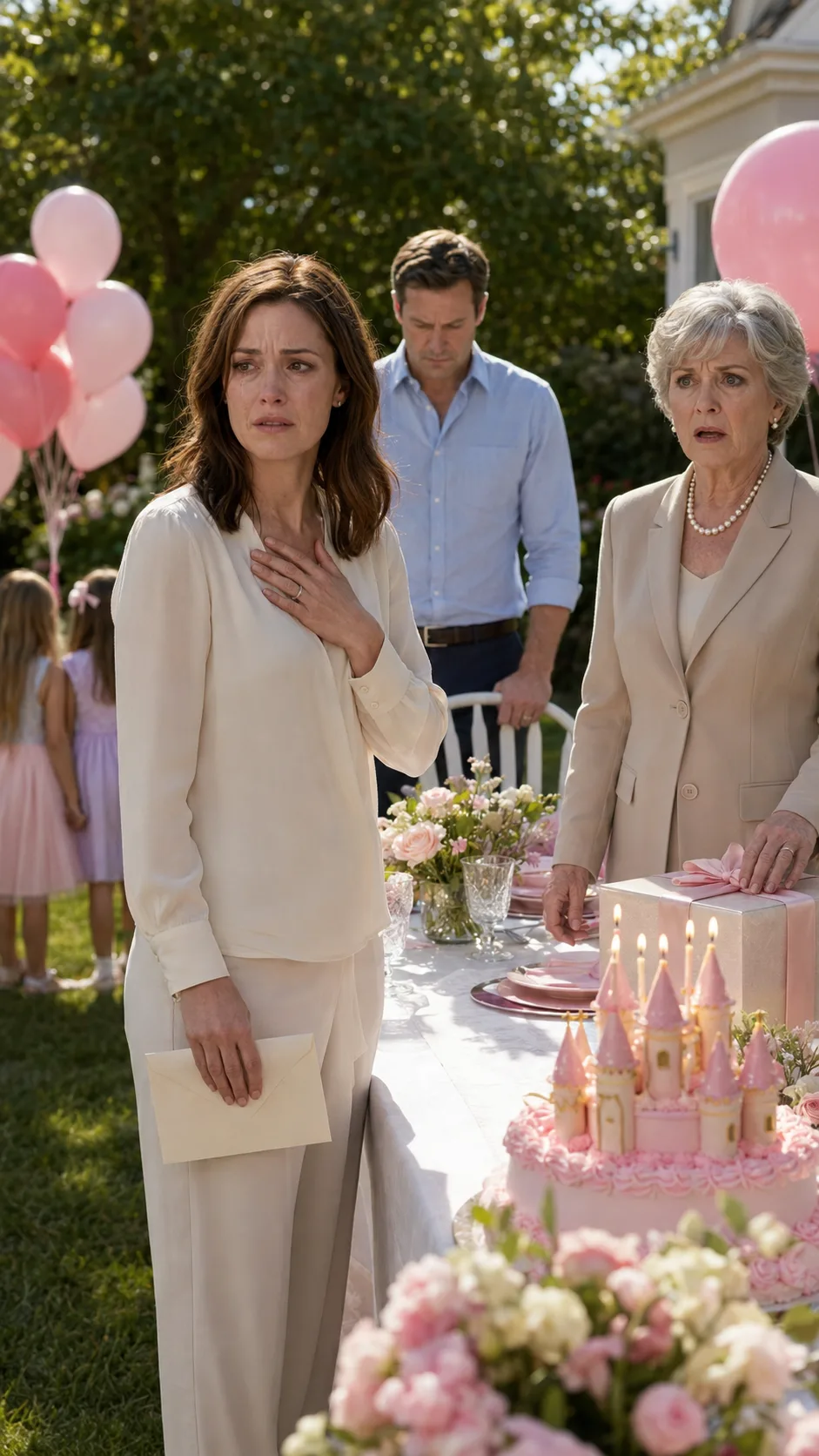
Sunlight spilled across the backyard. Pink balloons swayed over the lawn. The princess cake sat on a white table covered with flowers, candles, and tiny glass jars of lemonade. Lily wore a white dress with a pink bow in her hair. Emma insisted on wearing fairy wings.
For two hours, everything was perfect.
Lily laughed.
Emma chased bubbles.
Ryan grilled burgers and looked almost relaxed.
Linda arrived late in a beige suit, pearls around her neck, holding a large wrapped gift box with a pink ribbon.
I saw Lily run to her.
“Grandma!”
Linda bent down just enough to accept the hug.
“Happy birthday,” she said.
Not warm.
But not cruel.
I exhaled.
Maybe, I thought.
Maybe today would be different.
Then came the cake.
Everyone gathered around the table. Ryan lit the candles. Lily clasped her hands under her chin, smiling so wide I thought my heart would burst.
We started singing.
Linda didn’t sing.
I noticed because her silence stood out like a wrong note.
When the song ended, Lily leaned forward to blow out the candles.
But before she could, Linda tapped her spoon against a glass.
Once.
Twice.
Three times.
The backyard went quiet.
Ryan turned slowly. “Mom?”
Linda smiled at the guests.
“I just want to say something.”
My stomach dropped.
“Linda,” I warned.
She ignored me.
She placed her hand on the gift box and looked straight at Ryan.
“I love my granddaughter,” she began.
Lily smiled uncertainly.
Then Linda’s face hardened.
“But I won’t pretend anymore. This family needs a grandson. Not more pink dresses.”
The world stopped.
Lily’s smile disappeared.
Emma lowered her bubble wand.
A cousin coughed. Someone whispered, “Oh my God.”
Ryan stood frozen beside the grill.
I looked at him.
Say something.
Please.
Just once.
Say something.
Linda continued, her voice louder now.
“Ryan, you are still young enough to start over. You deserve a woman who can give this family what it needs.”
Lily turned to me.
“Mommy?”
That one word changed everything.
Because it wasn’t fear.
It was shame.
My daughter had heard her grandmother call her existence insufficient, and she had turned to me to find out whether it was true.
I looked at Ryan.
His mouth opened.
Closed.
Opened again.
Nothing came out.
And in that silence, my love for him changed shape.
It didn’t vanish. Love rarely does that cleanly.
But it stepped back.
It stopped making excuses.
It stopped kneeling.
I walked into the house.
Behind me, I heard Linda say, “See? She always runs away when the truth is spoken.”
I went upstairs to my closet. My hands were steady. That surprised me.
I opened the wooden box.
The envelope was still there.
Cream-colored. Slightly bent at the corner. Three years old and heavier than anything I had ever carried.
When I returned to the backyard, Ryan saw it first.
His face drained of color.
“Megan,” he whispered.
Linda turned.
I walked to the table and placed the envelope beside Lily’s untouched cake.
The candles were still burning.
To be continued… wait until you see the ending she never saw coming. I will Update later!!
Chapter complete
You have reached the end of this chapter.
Continue reading
A few more worlds to get lost in after this chapter.




