My Mother-in-Law Said I Came Into Her Family With Nothing...
Chapter 1
My Mother-in-Law Said I Came Into Her Family With Nothing...
PART 1
When I married James Parker, his mother looked me up and down in the church hallway and said, “Well, at least the dress is tasteful.”
That was the first compliment Margaret Parker ever gave me.
I was thirty, a junior accountant with student loans, a used Toyota, and a mother who had died leaving me exactly two things: a small savings account and a habit of never trusting what people showed on the surface.
James came from a family that looked rich in photographs. Big white house in Connecticut. Crystal chandelier in the dining room. Silver-framed family portraits. A grandfather clock that chimed every hour like the house itself had money.
But numbers always tell the truth before people do.
I noticed little things before anyone admitted them. Bills tucked under magazines. Credit card statements turned face down. James flinching every time his mother mentioned “family obligations.” His
father, Robert Parker, sitting alone in the den some evenings, staring at unopened envelopes like they were loaded weapons.
Still, I loved James.
He was kind in the ways that were easy. He brought me coffee when I stayed up late. He rubbed my feet after long tax seasons. He cried at our wedding when he saw me walking down the aisle.
But he had one weakness that grew bigger every year.
He could not stand up to his mother.
Margaret Parker was elegant, sharp, and impossible to ignore. At sixty-two, she still dressed like she was expecting a photographer at any moment. Cream blazers. Pearl earrings. Perfect silver hair. Perfect posture. Perfect cruelty wrapped in manners.
She never shouted in the beginning.
She sliced.
At Sunday dinner, she would say, “Emily is so practical. That must be useful, since she didn’t grow up with much.”
When James bought me
a bracelet for my birthday, she smiled and said, “How sweet. Simple things mean more to simple girls.”
If I cooked, she rearranged the dishes.
If I cleaned, she cleaned again after me.
If James praised me, she changed the subject.
For five years, I swallowed it.
I told myself marriage required patience. I told myself Margaret was lonely after Robert got sick. I told myself James would eventually see it.
Then I got pregnant.
For a while, everything softened.
James cried when I showed him the test. Margaret, for the first time, hugged me without hesitation. She pressed both hands to my stomach even though I was barely six weeks along and said, “A Parker grandchild.”
Not my child.
A Parker grandchild.
I noticed. I always noticed. But I let it pass.
The pregnancy was difficult. I was sick for months. I worked from home with a trash can
beside my desk. James tried, but he was often busy helping Margaret with “household matters,” which usually meant fixing financial disasters she refused to explain.
Robert died when I was seven months pregnant.
The funeral was gray and freezing. Margaret stood beside the coffin like marble. James broke down in the parking lot and sobbed into my shoulder while I held him with one hand and rested the other on my swollen stomach.
That night, after everyone left, I found Robert’s old cardigan folded over a chair in the den. A small handwritten note fell out of the pocket.
Emily, if you ever read this, forgive an old man for not saying enough while he had time.
I froze.
There was more, but James called my name from upstairs before I could read it. I folded the note and put it in my purse, meaning to read it later.
I forgot about it.
Three weeks after our son was born, Margaret remembered who she was.
Our baby, Noah, had come into the world after twenty-two hours of labor and an emergency procedure that left me pale, stitched, exhausted, and shaking every time I stood too quickly. James wept when he held him. Even Margaret cried.
For exactly nine days, she treated me like family.
On the tenth day, she came into the nursery carrying a white portfolio.
I was sitting in the rocking chair, Noah asleep against my chest. My hair was unwashed. My blouse had milk stains. My body felt like it belonged to someone else.
Margaret closed the door behind her.
“I thought we should handle something before emotions make everyone foolish,” she said.
I looked at the portfolio. “What is that?”
“Protection.”
“For who?”
“For my son.”
Noah stirred against me. I kept my voice low. “Margaret, I’m tired. Can we do this later?”
Her eyes moved over me, and for one second I saw something almost like disgust.
“This is exactly why it should be done now,” she said. “A woman has a baby, and suddenly she thinks she owns the bloodline.”
I stared at her.
She laid the portfolio on the changing table.
“It says that if this marriage ever ends, you will make no claim against Parker family property, inheritance, or household assets.”
My lips parted, but nothing came out.
Margaret gave a small, elegant shrug.
“You came into this family with nothing, Emily. If you leave, you should leave the same way.”
Noah’s tiny fingers curled against my blouse.
I looked down at my son because if I looked at Margaret, I was afraid I would say something I could never take back.
“I just gave birth to your grandson,” I said.
“And that is why we must be clear.”
“Does James know about this?”
She smiled.
Not warmly.
“James doesn’t need to be burdened with every practical detail.”
That was when I understood. She had not brought the portfolio because she thought I was greedy.
She had brought it because she thought I was weak.
And maybe for a long time, I had helped her believe that.
I did not scream. I did not throw her out. I did not wake the baby.
I said, “Leave it there.”
Margaret’s smile widened slightly. “Good girl.”
Good girl.
The words burned more than the incision across my body.
That night, after Noah finally fell asleep, I opened the portfolio at the kitchen table. The language was cold, formal, and insulting. It treated me less like a wife and more like a temporary guest who might steal silverware on her way out.
James came downstairs for water and found me staring at it.
“What’s that?” he asked.
I looked at him.
For one foolish second, I hoped he would be angry for me.
“Your mother brought it.”
He read the first page. His face changed. Not rage. Not shock. Discomfort.
“Emily…”
“She asked me to agree I won’t claim anything if our marriage ever falls apart.”
He rubbed his forehead. “She’s grieving.”
“She said I came here with nothing.”
“She shouldn’t have said that.”
“But?”
He looked away.
That tiny movement told me everything.
“But she worries,” he said softly. “Dad left things complicated. She’s scared.”
I almost laughed.
I was three weeks postpartum, bleeding, aching, sleeping in ninety-minute stretches, and somehow Margaret was the fragile one.
“Are you asking me to do this?” I asked.
“No. I’m not asking.”
“Are you telling her to stop?”
He said nothing.
The refrigerator hummed. The grandfather clock ticked in the hallway. Upstairs, Noah made a soft sound through the baby monitor.
I pushed the portfolio toward him.
“Then take it away from me.”
James hesitated.
Then he picked it up.
But the next morning, it was back on the kitchen counter.
PART 2
Numbers saved me because numbers never flattered anyone.
Two days after the portfolio appeared again, I sat in my home office while Noah slept in a bassinet beside my desk and opened every financial record I had touched since marrying James.
I did not begin because I wanted revenge.
I began because I needed to understand why Margaret was suddenly so desperate.
The Parker family liked to perform wealth. They hosted Thanksgiving with imported wine. Margaret donated to charity luncheons. The dining room looked like something from a magazine. But behind the wallpaper, everything was cracking.
The first clue was the property tax payment from four years earlier.
I remembered it because James had come home pale, saying his father had “forgotten” something important. The house was at risk of penalties. Robert had been too sick to handle it, and Margaret had been too proud to admit she had ignored the notices.
I paid it from my personal savings.
James promised to pay me back.
He never did.
Then there was the roof repair after the winter storm. Margaret called it “a temporary inconvenience.” The contractor called it emergency structural damage. James was embarrassed, Robert was in the hospital, and Margaret kept saying, “We can’t have the neighbors seeing tarps up there.”
I paid half.
Then the hospital bills.
Then the business loan from Robert’s failed antique shop.
Then credit cards Margaret had quietly opened under accounts connected to James, using them for furniture, catering, clothing, and “family appearances.”
Every time I had helped, James had presented it as temporary.
“Just until Mom gets organized.”
“Just until Dad’s estate clears.”
“Just until we sell something.”
But nothing was temporary when Margaret was involved.
I started building a spreadsheet.
Dates. Amounts. Accounts. Reasons. Source of payment.
By midnight, my hands were shaking.
By two in the morning, I had the total.
In six years, I had paid $187,432.16 toward Parker family debts, repairs, medical bills, penalties, and household emergencies.
Most of it from money I had earned before and during the marriage.
Some from the savings my mother left me.
Some from freelance accounting work I did after midnight while Margaret told people I was “lucky James provided so well.”
I sat there staring at the number until it blurred.
Noah woke and began crying. I picked him up, pressed him to my chest, and whispered, “Your mommy is not crazy.”
The next morning, Margaret found me printing papers.
She walked into my office without knocking.
“What are you doing?”
“Organizing.”
Her eyes flicked to the printer. “Organizing what?”
“Our household finances.”
The color drained from her face so quickly that I almost missed it.
Then she recovered.
“You should be resting, Emily. New mothers can become obsessive.”
There it was again. The soft insult. The polite dismissal.
I turned in my chair. “Did you know the house was almost placed under a collection action three years ago?”
Her expression sharpened. “That is not your concern.”
“I paid the overdue amount.”
“James paid it.”
“No. I did.”
She stepped closer. “You are confused.”
“I have the statement.”
For the first time since I had known her, Margaret Parker looked afraid.
It lasted less than a second.
Then she became ice.
“You listen to me,” she said. “You are tired. You are emotional. And you are digging through matters that belong to this family.”
I stood slowly, one hand on the desk because my body still hurt.
“I am this family.”
Her mouth tightened.
“No,” she said. “You married into this family.”
That sentence did something strange to me.
It did not break me.
It freed me.
Because suddenly I stopped hoping she would love me.
A person who sees you as temporary will never build a permanent place for you in their heart.
That evening, James came home to find his mother sitting in the living room, dabbing her eyes with a tissue.
I was feeding Noah.
Margaret had timed it perfectly.
“James,” she said in a trembling voice, “your wife has been accusing me of terrible things.”
I closed my eyes.
James looked at me. “Emily?”
“She walked into my office and saw me printing records.”
Margaret inhaled sharply. “Private family records.”
“Our records,” I said.
James shifted uncomfortably. “Maybe we should all calm down.”
I looked at him.
“Do you know how much I’ve paid for your mother’s emergencies?”
His jaw flexed. “This isn’t the time.”
“When is the time?”
Margaret stood. “You see? This is exactly why I wanted things clear. She has been keeping score.”
I laughed once.
It was not a happy sound.
“Keeping score? Margaret, I have been keeping this house from collapsing.”
Her face hardened. “Don’t be dramatic.”
James snapped, “Enough.”
For a moment, I thought he meant his mother.
Then he looked at me.
“Emily, please. You just had a baby. Maybe this is too much for you right now.”
The room went silent.
I looked at my husband — the man I had loved, defended, supported, protected — and realized Margaret had not destroyed me.
He had allowed her to.
I handed Noah to him.
“Hold your son.”
He took the baby, startled.
I walked upstairs, opened the drawer of my nightstand, and found Robert’s note.
The one I had forgotten.
I unfolded it with shaking hands.
Emily, if you ever read this, forgive an old man for not saying enough while he had time.
You saved this family more times than they deserved. Margaret knows more than she admits. James sees less than he should. I was too tired, too sick, and too ashamed to speak plainly.
There is a letter in the bottom drawer of my desk. It is for James. Give it to him when the truth finally costs you more than silence.
I stopped breathing.
Then I went to Robert’s old den.
The bottom drawer was locked.
But I knew where Robert kept the key.
He had once told me, smiling weakly from his recliner, “Margaret never checks behind books she doesn’t understand.”
The key was behind an old accounting manual he had borrowed from me years before.
Inside the drawer was a letter addressed to James.
And beneath it, copies of every payment I had ever made.
Robert had known.
Robert had kept proof.
Robert had been waiting for the day I would finally need it.
Three days later, Margaret announced a family dinner.
She called it “a healing meal.”
I knew better.
She invited James’s aunts, uncles, cousins, and even two family friends who had known the Parkers for decades. She ordered flowers. She polished silver. She wore pearls.
When I came downstairs wearing a pale blue blouse and carrying Noah, Margaret looked satisfied.
She thought I was walking into a trap.
I was.
But it was no longer hers.
PART 3
The dining room looked beautiful that night.
That was the cruelest part.
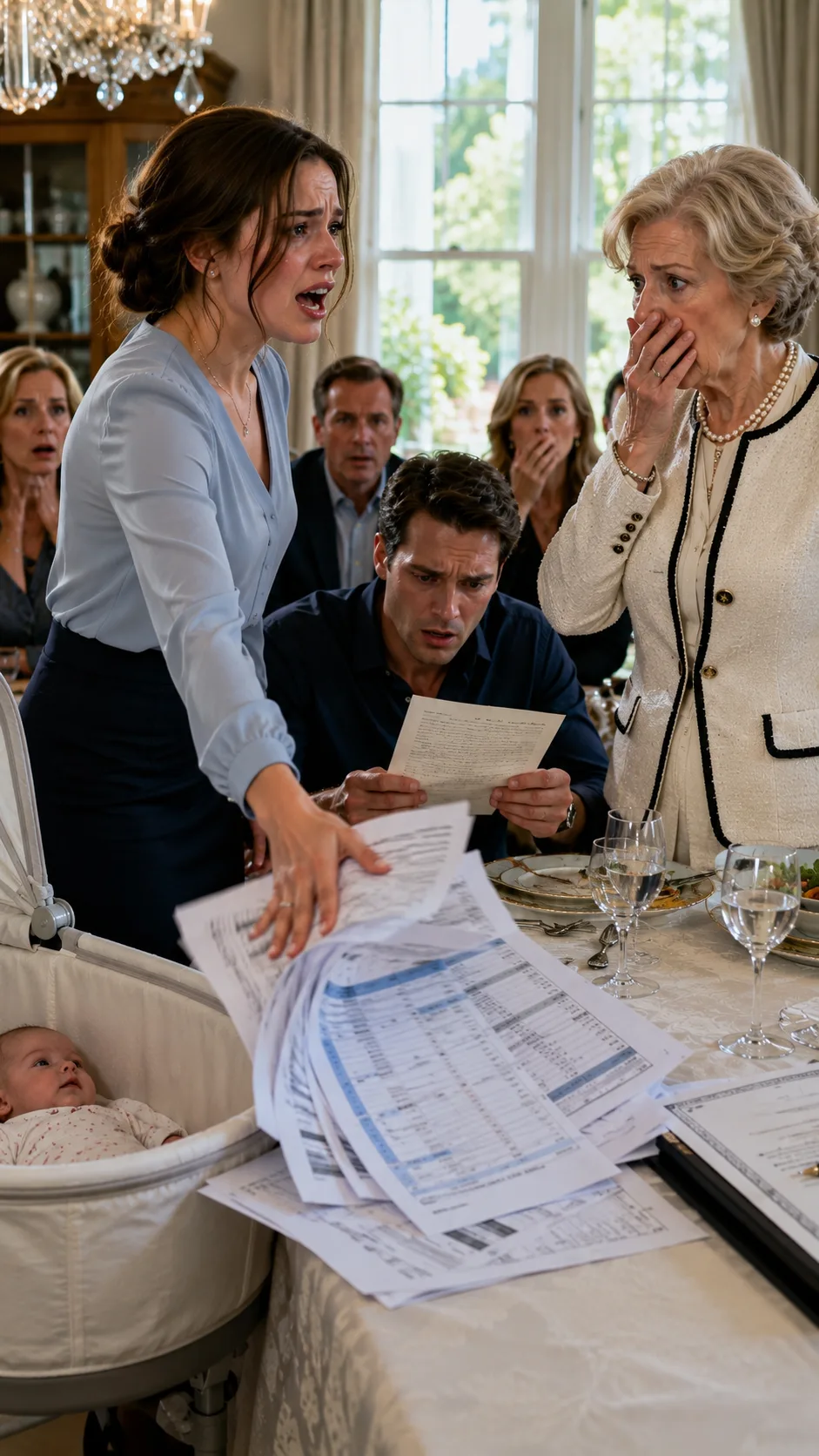
Sunlight poured through the tall windows, turning the chandelier into sparks. The white tablecloth was crisp. The wine glasses glowed. The plates were edged in gold. Anyone looking from outside would have seen a perfect American family gathered around a perfect table in a perfect house.
I sat beside Noah’s bassinet.
James sat beside me, quiet and tense.
Margaret stood at the head of the table like a queen preparing to pass sentence.
Dinner was awful in the way polite dinners can be awful. Forks clicked. People smiled too much. Margaret asked me how I was feeling with a sweetness so fake it made my teeth ache.
“Still recovering,” I said.
“Yes,” she replied. “Recovery takes longer when one is under strain.”
Aunt Linda gave me a pitying look.
I knew then Margaret had already told them some version of the story. Probably that I was unstable. Probably that I was making accusations. Probably that I was trying to get my hands on the Parker home while Margaret was grieving.
After dessert, Margaret tapped her spoon gently against her glass.
Everyone looked up.
“Before we finish,” she said, “there is a small family matter Emily and I need to settle.”
James went rigid.
I looked at him.
He did not speak.
Margaret lifted the white portfolio and placed it on the table.
No — not placed.
Displayed.
Like evidence.
“I believe transparency protects everyone,” she said. “Especially after recent misunderstandings.”
My heart slowed.
It was strange. I had expected fear. Instead, I felt very still.
Margaret pushed the portfolio toward me.
Then she placed a pen beside it.
“Emily, dear,” she said, smiling with all her teeth, “if your intentions are pure, this should take only a moment.”
James whispered, “Mom, don’t.”
She ignored him.
A cousin shifted in his chair. Aunt Linda stared at her lap.
I looked around the table and understood something important.
Some of them were uncomfortable.
None of them were surprised.
Margaret had prepared the room.
She had made me the threat before I entered it.
“Go ahead,” she said, louder now. “Show everyone this family has nothing to fear from you.”
My cheeks burned.
Noah moved in the bassinet, his tiny fist rising above the blanket.
I thought of my mother. A waitress who worked double shifts, paid every bill on time, and used to tell me, “Never beg people to see your worth. Put the receipt on the table.”
So I did.
I opened my handbag and removed the folder.
Not the white one.
Mine.
It was thick, heavy, and organized with colored tabs.
Margaret’s smile flickered.
I set it on top of her portfolio.
“What is that?” she asked.
“The part of the family history you keep forgetting.”
Then I opened it.
The first page was the property tax payment.
I turned it toward the table.
“This kept the county from placing penalties on the house four years ago.”
Margaret’s face hardened. “This is inappropriate.”
I placed down the roof repair invoice.
“This kept rain out of the nursery before there was a nursery.”
James slowly reached for the paper.
I placed down the hospital statement.
“This helped pay for Robert’s care when everyone said the insurance delay was temporary.”
The room had gone completely silent.
I placed down the business loan payoff.
“This closed the debt from the antique shop.”
Margaret grabbed the back of her chair.
“Enough.”
But I was no longer taking instructions from her.
I spread the spreadsheet across the table.
“And this is the total.”
James picked it up.
His eyes moved across the page.
Then stopped.
I watched the number hit him.
“Emily,” he whispered.
“One hundred eighty-seven thousand, four hundred thirty-two dollars and sixteen cents,” I said. “That is what I paid while your mother told people I brought nothing into this family.”
Margaret snapped, “She is twisting things.”
I reached into the folder again.
“Then maybe Robert twisted them too.”
The name landed like a plate breaking.
James looked up.
I unfolded his father’s letter and handed it to him.
His hands trembled before he even read the first line.
Margaret whispered, “Where did you get that?”
“From the drawer he told me to open when silence finally cost too much.”
James read.
No one moved.
I watched his face change line by line. Confusion first. Then pain. Then shame so deep it seemed to pull the breath out of him.
He sank back into his chair.
“What does it say?” Aunt Linda asked.
James swallowed.
His voice broke when he read aloud.
“Emily did not take from this family. She kept us standing when pride would have let everything fall.”
Margaret covered her mouth.
But I was not finished.
“There’s more,” I said.
James kept reading silently. Then his eyes filled.
“Dad says…” He stopped.
“Say it,” I whispered.
He looked at his mother.
“He says Mom knew.”
Every face turned to Margaret.
Her hand dropped from her mouth.
For the first time all night, she looked old.
Not elegant. Not powerful. Just old and exposed.
“I was protecting this family,” she said.
“No,” James said quietly. “You were protecting the story of this family.”
Margaret flinched as if he had slapped the table.
James stood.
The chair scraped loudly behind him.
He picked up the white portfolio his mother had brought. For one second, he held it like it was something poisonous.
Then he tore it in half.
Margaret gasped.
“James!”
He tore it again.
And again.
Paper fell onto the table like snow.
“I let you make my wife feel alone in her own home,” he said. “I let you turn her kindness into something suspicious. I let you call her temporary after she did what I should have done.”
He turned to me.
His face crumpled.
“I am so sorry.”
The apology came too late to erase the hurt.
But not too late to matter.
I stood and lifted Noah from the bassinet. He was warm and sleepy against my chest. Everyone watched me as if I might scream, cry, or storm out.
I did none of those things.
I looked at Margaret.
“For six years, I protected your dignity,” I said. “Tonight, I chose mine.”
Her eyes filled, but no tear fell.
“Emily,” she whispered, “I didn’t know it was that much.”
“Yes, you did,” I said. “Maybe not the number. But you knew enough.”
That broke something in her.
Her shoulders lowered. Her mouth opened, closed, then opened again with no sound.
For years, I had imagined what victory would feel like. I thought it would feel loud. I thought it would feel like watching Margaret finally lose.
It didn’t.
It felt like setting down a very heavy bag I had carried so long I forgot it was hurting me.
The dinner ended without dessert being cleared.
People left quietly. Some hugged me. Some apologized in vague, embarrassed ways. Aunt Linda cried and said, “We should have asked more questions.”
I wanted to tell her yes. She should have.
But I was tired.
After everyone left, Margaret remained in the dining room, sitting at the table beneath the chandelier.
James was upstairs putting Noah to sleep.
I came in to collect the last of my papers.
Margaret did not look at me.
“I hated you,” she said softly.
I stopped.
She stared at the torn pieces of her portfolio.
“I hated you because Robert trusted you. Near the end, he asked for you more than he asked for me. He said you understood things. Bills. Doctors. Decisions. I was his wife, and suddenly you were the one saving him from embarrassment.”
Her voice cracked.
“I felt replaced.”
For the first time, she sounded honest.
Not kind.
But honest.
I held the folder against my chest.
“You weren’t replaced,” I said. “You were helped.”
She nodded once, but tears slid down her face.
“I don’t know how to be grateful without feeling small.”
That sentence stayed with me.
Because it was the closest Margaret Parker had ever come to telling the truth about herself.
Over the next weeks, the house changed.
Not magically. Not all at once.
James found a financial counselor. He opened every account. He showed me everything. He apologized more than once, and when apologies were not enough, he changed his behavior.
The first time Margaret made a sharp comment about my parenting, James stopped her before I could blink.
“Mom,” he said, “do not speak to my wife that way.”
The room went silent.
Margaret looked startled.
So did I.
But James did not back down.
It was the first brick in a new foundation.
Margaret moved into the guest cottage behind the house three months later. She told everyone it was because she wanted “more independence,” but we both knew the truth.
The main house needed peace.
And I needed space to decide who I was when I was no longer surviving her.
One afternoon, she came over carrying a small velvet box.
I almost laughed.
It looked like another trap.
But inside was a thin gold bracelet.
“It belonged to Robert’s mother,” she said. “I was saving it.”
“For who?”
She looked at Noah playing on the rug, then back at me.
“For the woman who kept the Parker family standing.”
I did not take it right away.
She noticed.
“I don’t expect forgiveness because of jewelry,” she said quickly.
“Good.”
A small, sad smile touched her mouth.
“I’m learning.”
So was I.
I learned that love without boundaries becomes a slow disappearance.
I learned that silence can look like grace while quietly turning into resentment.
I learned that a family name is just a name if no one inside it has the courage to tell the truth.
And I learned that walking into a family with “nothing” can still mean bringing the one thing they lack most.
Strength.
Years later, when Noah asked why his grandmother lived in the cottage and not the big house, I told him the gentlest version.
“Sometimes grown-ups have to learn how to be kind from a little farther away.”
He accepted that, the way children accept simple truths adults spend years avoiding.
The white portfolio was gone.
The torn pieces had been thrown away the night of the dinner.
But Robert’s letter stayed.
I kept it in a frame inside my office, not where guests could see it, but where I could.
On the hardest days, I read one line again.
Emily did not take from this family. She kept us standing.
And every time, I remembered that night at the dining table — the sunlight, the scattered papers, Margaret’s frozen face, James’s trembling hands, and my son sleeping beside me while the truth finally rose louder than shame.
The day I entered the Parker family, they thought I came empty-handed.
They were wrong.
I came with patience. I came with loyalty. I came with love. I came with numbers, receipts, and the kind of quiet strength people mistake for weakness until the moment it stands up.
I did not steal that house.
I saved it.
And when they finally saw that, I no longer needed their permission to know my worth.
THE END.
Chapter complete
You have reached the end of this chapter.
Continue reading
A few more worlds to get lost in after this chapter.




