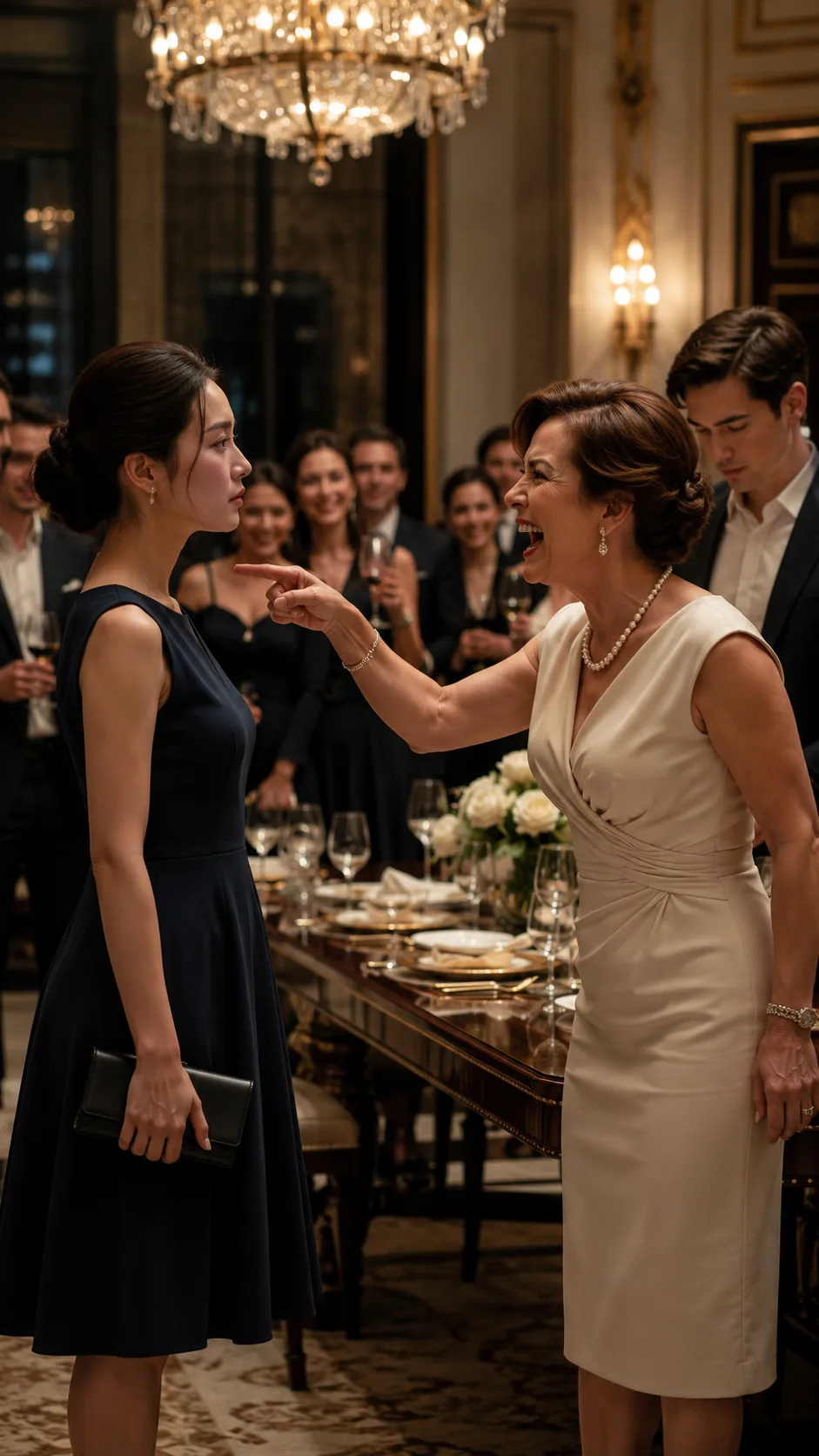
The hem of my navy dress caught on the corner of Evelyn Whitmore’s front gate before I even reached the house.
Chapter 1
The hem of my navy dress caught on the corner of Evelyn Whitmore’s front gate before I even reached the house.
I stopped on the stone path, freed the fabric carefully, and smoothed it with both hands. The dress was simple. Knee-length. Sleeveless. Bought from a clearance rack two winters ago and altered by a woman named Mrs. Alvarez who worked out of the back room of a dry cleaner beside a pharmacy.
It fit me.
That was the only luxury I needed.
The Whitmore mansion rose ahead of me with every window lit gold, the kind of house that never looked lived in, only displayed. White columns. Black iron balconies. A fountain shaped like three swans fighting over the same stream of water. Every time I walked toward that entrance, I felt the house watching what I wore before anyone inside did.
Mark waited by the front doors in a black suit, one hand in his pocket, phone in the other.
“You’re late,” he said.
I checked the time. “Four
minutes.”
“My mother notices.”
“Your mother notices napkin folds.”
He didn’t smile. He glanced at my dress, then toward the cars lining the driveway. His thumb moved across his phone screen. Not a message. A habit.
“She wanted formal,” he said.
“This is formal.”
“She meant Whitmore formal.”
There it was.
A whole family language hidden inside two words.
Whitmore formal meant not merely expensive, but visibly expensive. It meant fabric that announced its price across a room. It meant jewelry heavy enough to make silence. It meant women smiling through insults and men pretending the insult had been tradition.
I looked past him through the open doors. Inside, waiters moved across marble floors with silver trays. Music floated from somewhere deeper in the house, soft strings under the clink of glass. Evelyn had chosen real candles this time. She liked danger when someone else was responsible for cleaning wax.
“I’m here,” I said.
Mark put his phone away. “Just don’t start anything.”
I almost laughed.
Almost.
We had been married eleven months. In that time, I had learned one thing about the Whitmores: when they said don’t start anything, they meant don’t respond.
Evelyn appeared at the far end of the foyer before we crossed it.
She wore cream silk, pearls, and the kind of smile that made servants step faster. Her hair was shaped into soft brown waves. Her lipstick matched the roses placed in two tall vases beside the staircase. A diamond bracelet flashed at her wrist when she lifted one hand.
“Clara,” she said.
My name in her mouth always sounded borrowed.
“Evelyn.”
Her eyes dropped to my dress.
Not quickly. Not by accident.
She took her time with it, from shoulder seam to hem, then back up to my face.
“How brave,” she said.
Mark
touched my elbow lightly. A warning. Not comfort.
I stepped away from his hand.
Evelyn noticed. Her smile stayed where it was, but the skin beside her eyes tightened.
“Everyone is in the dining room,” she said. “Arthur’s anniversary deserves a full table.”
Arthur.
My father-in-law had been gone six months, and Evelyn had turned his death into an event calendar. Memorial brunch. Scholarship dinner. Library dedication. Tonight was meant to mark what would have been his sixty-fifth birthday, though Evelyn had renamed it the Whitmore Legacy Dinner on embossed invitations.
Arthur had been the only person in that house who ever spoke to me like I had arrived as myself and not as an error in Mark’s judgment.
The last time I saw him alive, he had been sitting in his study with two mugs of coffee between us, neither one touched. He asked about my work at the community clinic. Then he asked whether I was sleeping.
I said yes.
He looked at me over his glasses.
I changed the subject.
Three days later, he collapsed in the garden.
Evelyn moved through grief like a woman rearranging furniture. She covered Arthur’s study in white sheets and locked the door. She donated half his jackets. She told everyone he had left the family “in order.”
Mark stopped saying his father’s name unless his mother said it first.
I walked behind Evelyn into the dining room.
The table stretched beneath three chandeliers, polished so clean the candles reflected in long trembling lines. Thirty-two guests had already gathered: cousins, board members, charity friends, two women from Evelyn’s tennis club, a city councilman who laughed before anyone finished a joke. The men wore dark suits. The women wore satin and diamonds and faces trained not to show surprise too early.
At my place setting, there was no name card.
Every other seat had one.
Mine had a folded white napkin and a glass with a water stain near the rim.
Small things.
Evelyn loved small things. They were easier to deny.
Mark saw it too. His jaw moved once.
He said nothing.
I sat beside him anyway.
A waiter came with wine. Evelyn lifted her glass before anyone had taken their first sip.
“To Arthur,” she said, standing at the head of the table. “A man who understood family, legacy, and the responsibility of keeping standards.”
Glasses lifted.
I lifted mine halfway.
Evelyn’s eyes found me.
“To standards,” she added.
A cousin near the middle of the table smiled into her champagne.
The first course arrived: tiny squares of something pale on black plates, each one dressed with a green leaf that looked lost. The guests talked about property taxes, museum boards, a yacht someone was selling because “St. Barts has become unbearable,” and a private school scandal involving a headmaster and a forged transcript.
I ate two bites.
Mark checked his phone under the table.
“Expecting someone?” I asked.
“No.”
“You’ve looked at it twelve times.”
He set the phone face down. “Please don’t do this tonight.”
“Count?”
He exhaled through his nose.
Across the table, Evelyn watched us without looking like she was watching. She had that skill. So did the women around her. They could listen with the backs of their earrings.
The second course came. A waiter leaned close to place my plate and whispered, “Careful, ma’am, it’s hot.”
Evelyn snapped her fingers.
Not loud.
Just enough.
The waiter straightened.
“Mrs. Whitmore?” he asked.
“The place cards,” she said.
He looked at the table, then at my setting.
His face shifted.
“I’m sorry, ma’am. I’ll bring—”
“No need,” Evelyn said. “Some names don’t require labels.”
The table softened into polite laughter.
Mark’s fork stopped halfway to his plate.
I looked at him.
He lowered the fork.
Still nothing.
A roll sat near my plate, untouched, its crust split in the middle. Butter had started to melt in the dish under the chandelier heat. For some reason, that little shine of butter caught my attention and held it. A perfect room. A perfect table. A place set badly on purpose.
I placed my napkin on my lap.
Evelyn leaned back in her chair.
“You’re quiet tonight, Clara.”
“I’m eating.”
“Are you?”
A few people looked up.
She tilted her head. “I only ask because I know these dinners can be intimidating when someone isn’t accustomed to them.”
Mark put his hand around his wineglass. His knuckles changed color.
“Mother,” he said.
One word.
Thin.
Evelyn smiled at him. “What? I’m being kind.”
Nobody argued.
That was how Evelyn won. She never needed everyone cruel. Only quiet.
Dessert had not yet been served when the first real crack appeared.
A woman named Lydia, Arthur’s younger sister, leaned toward me from two seats down. She was smaller than Evelyn, sharper in the face, with gray hair pinned at the base of her neck. She had barely spoken all night.
“You came,” she said.
“I was invited.”
Her mouth pressed into a line. “By her?”
I looked toward Evelyn.
Lydia followed my glance, then reached for her water. Her hand shook just enough to make the ice touch glass.
“Arthur would have wanted you here,” she said.
Before I could answer, Mark’s phone buzzed on the table.
Evelyn saw the screen before he turned it over.
Her smile disappeared.
Only for a second.
I saw it.
The message preview was too far away for me to read, but I saw the sender name.
Hale.
Mark slid the phone into his pocket.
“Who is Hale?” I asked.
“No one.”
Lydia set her glass down.
Evelyn stood.
The scrape of her chair quieted the left side of the table. Then the right.
“My friends,” she said, lifting her champagne again, “before dessert, I want to thank everyone who has supported this family during a difficult year.”
She said difficult like she was accepting an award for surviving inconvenience.
“Arthur believed in continuity,” she continued. “He believed the Whitmore name meant something. That it should be protected from poor choices, poor judgment, and people who mistake access for belonging.”
Mark closed his eyes briefly.
There.
There it was.
My skin did not move. My hand stayed on my napkin.
Evelyn’s gaze settled on me.
“Clara, dear,” she said. “Would you stand?”
The room went still.
The waiter at the sideboard stopped with a tray balanced on one hand.
I didn’t stand.
Evelyn waited.
Thirty-two guests watched a woman at the head of a table ask another woman to rise like a child in school.
Mark turned toward me. “Just—”
“No,” I said.
A small word.
It landed badly.
Evelyn’s smile stretched.
“I beg your pardon?”
“I said no.”
The cousin with the champagne lowered her glass.
Evelyn walked from the head of the table slowly, one hand brushing the backs of chairs as she passed. Her bracelet tapped wood with each step. Tap. Tap. Tap.
She stopped beside me.
“Then I’ll stand for both of us,” she said.
She looked down at my dress.
The room followed her eyes.
“This family opened its doors,” she said, “and what did you bring into it?”
I could hear Mark breathing beside me.
Evelyn lifted a finger toward my shoulder, not touching the fabric, just close enough to make the gesture uglier.
“A clearance dress. A clinic salary. A mother who couldn’t afford a proper wedding gift.”
My fork lay across my plate. I moved it one inch to the left.
That was all.
Mark stood halfway. “Mother, enough.”
Evelyn did not look at him. “Sit down.”
He sat.
Not immediately.
But he sat.
Something behind my ribs went very quiet.
Evelyn turned to the guests with a small laugh. “You see? This is what I’ve been managing for almost a year. We tried kindness. We tried patience. We tried ignoring the obvious mismatch.”
Nobody laughed yet.
She needed one more push.
She always did.
She pointed at my dress.
“Look at that dress,” she said. “She still thinks she belongs here.”
The first laugh came from Evelyn’s sister.
Then the city councilman gave a short, careful chuckle. Someone else joined because power makes cowards rhythmic. The sound spread across the table in pieces, not joyful, not even truly amused. Permission disguised as humor.
I stood.
My chair moved back against the rug without a sound.
Evelyn’s smile sharpened. “There we are.”
I picked up my clutch from the table.
Mark touched my wrist.
“Clara,” he said.
I looked at his hand until he removed it.
Evelyn stepped closer, close enough that I could see powder gathered lightly beside her nose.
“You’re making everyone uncomfortable,” she said.
“Am I?”
Her eyes narrowed.
The room changed by half an inch.
Not enough to save me.
Enough for her to notice.
She raised her glass, but there was less champagne in it than she thought. Her hand tilted too far. A thin line slid down the side and touched her fingers.
She didn’t wipe it away.
“Don’t play brave in my house,” she said.
My house.
She had said it in hallways. In kitchens. In front of staff. On the phone with vendors. Once, she said it while I stood in Arthur’s study doorway, holding a box of his old clinic donation records, and she told me to put them down because charity was not the same as family.
Arthur had heard her that day.
He said nothing then.
But later, he found me in the garden and handed me a mug of coffee I didn’t want.
“Some houses,” he said, “remember who was kind inside them.”
I thought he meant it as comfort.
Maybe he meant it as instruction.
Evelyn pointed toward the dining room doors.
“Leave before dessert,” she said. “I won’t have you embarrassing this family any further.”
Nobody corrected her.
Nobody moved.
Then the doors opened.
Not wide. Not dramatic. Just enough.
A man in a dark suit stepped into the room with a black leather folder beneath one arm and a sealed white envelope in his hand. He had silver hair, square glasses, and the flat, careful expression of someone who knew the value of being unwelcome.
I recognized him from Arthur’s study wall.
Mr. Hale.
Family attorney.
Mark stood so fast his chair hit the table leg.
Evelyn turned.
The champagne line on her fingers caught the light.
“Who let you in?” she said.
Mr. Hale walked forward without answering. His shoes made almost no sound on the rug. He passed the councilman, passed Lydia, passed a waiter who stepped back so quickly the tray wobbled.
He stopped between Evelyn and me.
Then he placed the sealed envelope on the table.
White paper. Red wax. Arthur Whitmore’s initials pressed into the seal.
The room looked at it.
Evelyn reached first.
Mr. Hale’s folder came down over the envelope.
Not hard.
Enough.
“Mrs. Whitmore,” he said, “this is not yours to touch.”
Evelyn’s hand froze.
The laughter died in pieces.
A fork touched a plate near the far end. Someone pushed back a chair. One of the candles spat softly and leaned in its melted pool.
Mark looked at the envelope as if it had come alive.
“What is this?” Evelyn asked.
Mr. Hale removed a pair of reading glasses from his pocket and opened the folder.
“A scheduled delivery,” he said.
“I scheduled nothing.”
“No,” he said. “Arthur did.”
That name moved through the room without sound.
Evelyn lowered her hand slowly. “Arthur has been dead for six months.”
“Yes.”
“Then whatever theatrical stunt this is, you can take it outside.”
Mr. Hale looked at me.
Not at Evelyn.
“At Mr. Whitmore’s instruction, certain documents were to be presented at the first formal family gathering held in this house after the probate review.”
Evelyn laughed once.
It was not the same laugh.
“The estate was settled.”
“Portions of it were.”
Mark stepped closer. “Mr. Hale.”
The lawyer turned his head.
Mark stopped.
Two men, one with a mother behind him, one with a dead man’s instructions in his hand.
Mr. Hale broke the wax seal.
Evelyn’s fingers curled at her side.
The paper came out folded twice. Thick. Cream-colored. Arthur had always used that kind of stationery, even for notes about plumbing repairs or clinic donations. He said thin paper made serious words look temporary.
Mr. Hale unfolded the document and laid the first page on the polished table.
My name sat at the top.
Clara Bennett Whitmore.
Not Mark’s.
Not Evelyn’s.
Mine.
The room leaned without moving.
Evelyn stared at the page. Her lips parted, then closed. She placed one hand on the table as if the wood had shifted beneath her.
“That is not possible,” she said.
Mr. Hale slid the page an inch closer to me. “It is signed, witnessed, notarized, and filed.”
Evelyn’s eyes moved fast over the page. Not reading. Hunting.
“For what?” Mark asked.
His voice came out lower than before.
Mr. Hale opened the folder wider.
“For the transfer of controlling interest in the Whitmore Family Trust,” he said. “The residential estate, including this property, the attached land, the foundation voting seat, and the protected accounts named in Schedule C.”
The city councilman stopped holding his smile.
Lydia covered her mouth with two fingers.
Evelyn looked at Mark. For the first time that night, she seemed to expect him to save her.
He did not know where to stand.
I looked down at the document again.
My name.
Arthur’s signature beneath it.
The ink was blue.
I remembered that pen. He kept it in the top drawer of his desk, beside a little tin of peppermint candies he pretended were for guests.
Evelyn moved suddenly.
She reached for the paper.
Mr. Hale turned the folder, blocking her again.
“I said,” he repeated, “this is not yours to touch.”
Her face changed.
Not all at once. That would have been easier to watch. It changed in small failures. The smile left first. Then the chin. Then the eyes, which moved from Mr. Hale to the guests and found no one already laughing.
“This is fraud,” she said.
“No.”
“You helped her.”
“No.”
“She manipulated Arthur when he was ill.”
Mr. Hale’s mouth flattened. “Mr. Whitmore made the initial amendment eight months before his death.”
Eight months.
Before the hospital.
Before Evelyn locked his study.
Before the memorial brunch and the white flowers and the speeches about continuity.
Mark turned toward me.
“You knew?”
I did not answer because the truth would not fit into his tone.
I had not known about the house. Not the trust. Not the accounts. But I had known Arthur was afraid of something. I knew from the way he started asking me to document clinic donations. I knew from the way he asked whether Evelyn ever opened my mail. I knew from the note his former assistant sent me the week after his death.
Come tonight no matter what Evelyn says.
No explanation.
Just come.
Evelyn pointed at me again, but this time her hand was not steady.
“You stood here,” she said, “in that dress, pretending to be humiliated, and you planned this?”
I looked at her finger.
Then at the envelope.
Then at the table full of witnesses.
“You planned the humiliation,” I said.
The room held still.
Mr. Hale did not move.
Evelyn’s mouth opened.
I stepped closer to the table and placed my palm beside the document, not touching it, only close enough that everyone could see whose name was printed above Arthur’s signature.
“You were laughing inside my house.”
No one breathed loudly after that.
Even the candles seemed smaller.
Evelyn looked at the guests again. This time, she found lowered eyes. One cousin picked up her napkin and folded it badly. The councilman stared into his wineglass. Mark stood between his mother and me with his hands half-raised, as if there were still some invisible door he could hold shut.
There wasn’t.
Mr. Hale turned another page.
“There is more,” he said.
Evelyn whispered something I couldn’t hear.
Mr. Hale read from the document anyway.
Arthur had written conditions into the trust. Not sentimental ones. Practical ones. Evelyn would retain a monthly allowance, provided she vacated the main residence within thirty days. Mark would remain a beneficiary only if he did not contest the amendment or assist anyone who did. The foundation seat transferred immediately. The protected accounts were to be reviewed for unauthorized withdrawals.
At that, Lydia lowered her hand from her mouth.
Evelyn’s head turned toward her.
Lydia looked back.
Not kindly.
Not fearfully.
Just back.
Mr. Hale removed a second document.
“This concerns the withdrawals from the clinic fund,” he said.
A sound left Evelyn’s throat.
Small.
Ugly.
Mark looked at his mother.
“What withdrawals?”
Evelyn snapped, “Be quiet.”
It was the wrong room for that voice now.
Mr. Hale set the second document beside the first. The paper made a soft sliding sound across the table.
Arthur’s clinic fund.
The one meant to cover surgery grants and emergency medication costs. The one Arthur had asked me to help audit after I found three rejected pharmacy requests with the wrong account stamp.
I had thought it was clerical.
Arthur had not.
Mr. Hale looked toward me. “Mr. Whitmore requested that Mrs. Clara Whitmore receive full authority to reopen the fund under independent oversight.”
My fingers touched the table edge.
The wood was cold.
Evelyn took one step back. Her heel caught slightly on the rug. Mark reached toward her, but she pulled away before he touched her arm.
“You can’t do this,” she said.
Mr. Hale closed the folder.
“It has been done.”
A waiter near the sideboard lowered his tray onto a small table because his hand had started to shake. One roll slipped and landed against a folded napkin. Nobody picked it up.
Evelyn looked at me then.
Really looked.
Not at my dress. Not at my lack of diamonds. Not at the version of me she had built for rooms like this.
At me.
“You think this makes you one of us?” she said.
I picked up the document.
Arthur’s signature sat at the bottom of the page, firm and blue and final.
“No,” I said. “It means I don’t need to be.”
Mark flinched as if the words had touched him first.
Evelyn turned to him. “Say something.”
He looked from her to me, from me to the document, from the document to the thirty-two people who had heard too much to pretend later.
“Clara,” he said.
My name sounded different now.
Useful.
I slid the document back to Mr. Hale.
“No.”
He blinked.
One word could do a lot when saved long enough.
Evelyn’s chair remained at the head of the table, empty. Her champagne glass still stood beside her plate, the rim marked faintly with lipstick. The dessert plates had never been brought out. In the center of the table, the flowers looked overarranged and suddenly foolish, white roses leaning into one another as if they had also been told to behave.
Mr. Hale gathered the documents into the folder but left the envelope on the table.
“For your records,” he said to me.
Not to Evelyn.
That was the moment some people finally understood.
A woman from the tennis club stood and murmured something about an early morning. Her husband followed too quickly. The city councilman checked his phone, though it had not made a sound. Guests began leaving in soft, embarrassed clusters, avoiding Evelyn the way people avoid broken glass before admitting they saw who dropped it.
Lydia came to me last.
She touched the back of a chair instead of my arm.
“Arthur tried to tell me,” she said.
I looked at her.
She swallowed. “I should have asked better questions.”
The apology did not ask to be forgiven. That made it easier to hear.
Mark stayed near the wine cabinet, the same place he had stood when I arrived. His phone was in his hand again, but the screen was black. He kept looking at it like it might tell him which woman still owned his future.
Evelyn had not left.
She stood near the head of the table with one hand pressed flat against the wood. Her pearls sat perfectly. Her dress had not wrinkled. Only her mouth betrayed the work of staying upright.
“You won’t manage this house,” she said.
I picked up my clutch.
It felt lighter than before.
“I won’t manage it like you did.”
Mr. Hale cleared his throat. “Mrs. Whitmore, my office will contact you tomorrow regarding access, staff, and the residence transition.”
Evelyn stared at him.
Then she laughed.
One short sound.
Nobody joined her.
That was all it took for the laugh to die.
I walked past Mark without touching him. He said my name once. I did not stop. In the foyer, the marble floor reflected the chandelier above me, broken into long shapes by the movement of departing guests.
At the front doors, I paused.
The night air came through cool and clean. Behind me, inside the dining room, Evelyn said something sharp to Mr. Hale. He answered in a voice too low to hear.
For the first time since I had married into that family, I left the house without feeling watched by it.
Thirty days later, Evelyn moved out of the Whitmore mansion with four garment trucks, two lawyers, and a security guard who had once carried her shopping bags.
She did not look at me when she left.
She wore black sunglasses though the sky was gray. Her pearls were gone. A mover dropped one of her hat boxes near the fountain, and the lid rolled across the driveway until it stopped against the stone swans.
Nobody ran to pick it up.
Mark contested nothing.
That was Mr. Hale’s advice, and for once, Mark followed advice that did not come from his mother. He moved into a downtown apartment with glass walls and no family portraits. He called me twice the first week. Then once the next. Then not at all after I sent him the separation papers through Hale’s office.
He signed them.
His signature looked hurried.
The review of the clinic fund took four months. The withdrawals were worse than Arthur had feared. Evelyn had not stolen with one dramatic hand. She had done it in pieces. Administrative fees. Event reimbursements. Consulting transfers. Little cuts made over years by someone who believed nobody would question a woman wearing pearls at a charity podium.
The foundation board removed her name from the annual gala.
Lydia sent me the article without comment.
I printed it and placed it in Arthur’s old desk drawer, beside the tin of peppermint candies I found half-full under a stack of property files.
I reopened his study in spring.
The room smelled like paper, cedar, and dust. The white sheets came off the furniture one by one. I kept his desk. I kept the green lamp with the crooked shade. I kept the chair where he used to sit when he asked questions people avoided answering.
The mansion changed slowly after that.
Not softer.
More honest.
The dining room table stayed, but I removed the name cards from storage and donated the silver chargers. The fountain was repaired because one of the swans had been leaking into the stone base for years and nobody had cared unless guests were coming.
The clinic fund reopened under an independent board. The first grant paid for medication for a retired bus driver named Mrs. Bell, who sent a thank-you note written in blue ink on thin paper. I taped it inside the desk drawer where Arthur had kept his pen.
The navy dress stayed in my closet.
Not preserved. Not framed. Not treated like armor.
Just there.
One evening, nearly a year after the Legacy Dinner, I wore it again.
There was no event. No photographers. No chandelier dinner. Just a small meeting at the clinic with three board members, two nurses, and a tray of sandwiches from the grocery store because the caterer canceled and nobody died from paper plates.
After the meeting, I returned to the mansion alone.
The front gate opened without catching my hem.
Inside, the foyer was quiet. No music. No waiters. No Evelyn at the end of the marble hall measuring my worth by fabric and price.
On Arthur’s desk, Mr. Hale had left one final envelope from the estate archive. It contained a short note in Arthur’s handwriting.
Clara,
A house is only as good as the person who stops cruelty at the table.
A.
I read it once.
Then again.
Outside, the fountain kept running in the dark.
I folded the note and placed it beside the first envelope, the one Evelyn had tried to touch before the room learned who it belonged to.
Then I turned off the study lamp.
The house stayed mine.
Chapter complete
You have reached the end of this chapter.
Continue reading
A few more worlds to get lost in after this chapter.