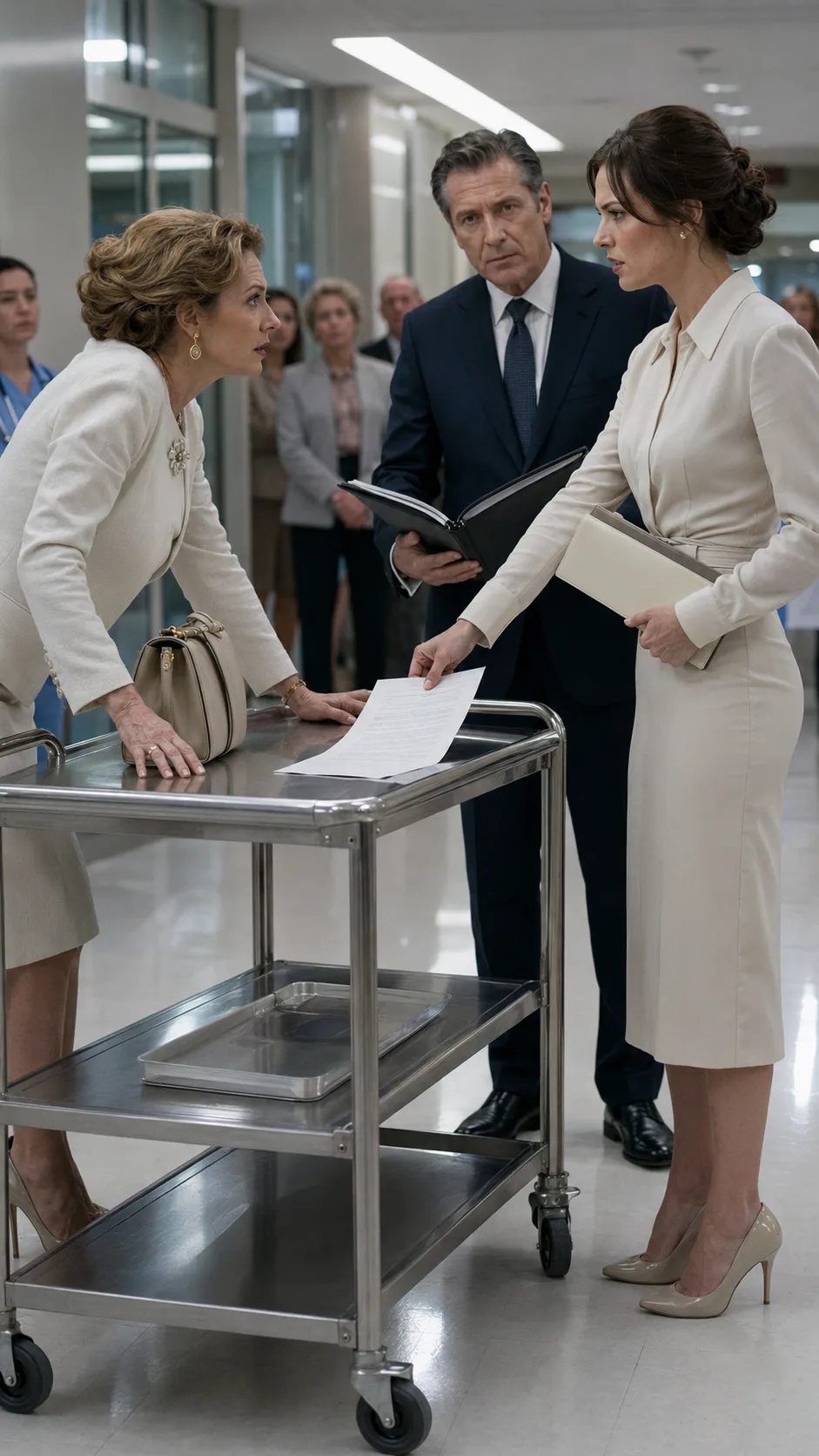
The first thing Margaret Whitmore did when she saw me in the hospital corridor was move her handbag onto the metal cart between us.
Chapter 1
The first thing Margaret Whitmore did when she saw me in the hospital corridor was move her handbag onto the metal cart between us.
Not set it down.
Claim it.
The bag was cream leather with gold clasps, polished enough to catch the overhead lights. It sat beside a thin stack of papers, a paper cup of untouched coffee, and a folded blanket someone had left there hours earlier. The cart was supposed to hold medical trays, not family weapons, but that night it became the clean silver table where Margaret planned to finish what she had started months before.
I stood on the other side of it with my folder pressed against my ribs.
Behind me, Room 412 stayed closed.
My husband, Daniel, was inside. The doctors had limited visitors after the procedure, and his mother had spent the last two days deciding that meant she could speak for him, for me, and for every decision that had led us here.
She wore white wool, pearl earrings, and the expression of a woman
who had already rehearsed her grief in a mirror.
“You came,” she said.
Her voice was low enough that only I heard it, but she had turned her body toward the corridor benches, where Daniel’s aunt, two cousins, and his older brother sat pretending to look at their phones.
I glanced at the door to Daniel’s room. The small rectangular window was covered by a beige privacy curtain.
“I was called,” I said.
Margaret’s mouth tightened.
Thomas Hale stood two steps behind me in a navy suit, his dark portfolio tucked under one arm. He was not the kind of attorney who filled silence to prove he belonged in a room. He watched. He waited. He noticed the small things people did before they lied.
Margaret noticed him too.
“Still bringing help,” she said. “Even to a hospital.”
Thomas did not answer.
Good.
She liked a reaction. She liked a
flinch even more.
I had given her both for nearly three years.
The first week after my wedding, Margaret had told me the family used linen napkins only because paper looked careless. The second month, she asked why Daniel’s shirts came back from the dry cleaner with “that apartment smell.” By our first anniversary, she had stopped pretending the comments were accidents.
She never said I was not good enough.
She said Daniel had been raised with standards.
She never said I was unwanted.
She asked whether I ever felt tired living in a house that carried another family’s name.
She never raised her voice when Daniel was in the room. She saved that for kitchens, hallways, coat rooms, and once, the ladies’ lounge at a charity dinner where she told two women I had “mistaken patience for acceptance.”
Daniel heard enough over time to know.
Not everything.
Enough.
That
was why he had changed the clause.
Margaret had never read past the first page.
A monitor beeped somewhere behind the nurses’ station. An elevator opened with a soft chime. A young nurse in blue scrubs walked by with a clipboard and slowed for one step too many.
Margaret smiled at her.
Then she looked back at me.
“You should go home,” she said. “This is not a good night for a scene.”
The folder pressed harder against my ribs.
I had carried it from the parking garage in both hands, even though Thomas had offered three times to take it. It was ridiculous, how heavy paper could feel when every sheet inside it had waited too long.
“I’m not making one,” I said.
“No.” Margaret gave a small laugh. “You usually let other people do that for you.”
Daniel’s aunt lifted her head from the bench.
His brother, Peter, looked at the floor.
That was how it always worked. Margaret spoke. Everyone calculated the cost of disagreeing with her. Then they stayed quiet and called it dignity.
Thomas took half a step closer.
Margaret saw it.
Her fingers touched the stack of papers on the cart. She pushed the top sheet forward just an inch, making sure I saw the court heading at the top.
There was no real text visible from where I stood, just blocks of lines and a stamped corner.
She had come prepared.
Of course she had.
“I have copies,” she said. “For everyone who needs clarity.”
I looked at the paper.
She had used expensive stationery clips. Gold ones.
At a hospital.
“Clarity,” I said.
Her smile lifted.
Peter shifted on the bench.
Margaret turned slightly toward the family members behind her, as if the corridor had become a dining room and she was about to make a toast.
“Daniel trusted me to keep order when he couldn’t,” she said. “Some people see illness as an opportunity. I see responsibility.”
A woman near the nurses’ station looked up.
I kept my hands still.
Thomas had warned me in the car.
Let her speak first.
Let her build it herself.
People like Margaret did not lose because someone argued better. They lost because they could not stop performing long enough to read the trap in front of them.
“She has had months to do this properly,” Margaret continued, still looking at the benches. “Months. And yet here we are, outside my son’s hospital room, with folders, lawyers, and more confusion.”
She touched the paper again.
Her ring clicked against the metal cart.
Once.
Then again.
I remembered that ring from every holiday dinner. It caught candlelight whenever she lifted a glass, whenever she pointed toward a serving dish and corrected someone, whenever she touched Daniel’s shoulder as if reminding the room who had known him first.
“You can say this to me,” I said. “You don’t need an audience.”
Margaret looked pleased.
That was the opening she wanted.
“I did say it to you,” she said. “For years.”
A cousin inhaled and looked away.
Thomas’s portfolio shifted against his hand.
Margaret leaned over the cart, not close enough to seem crude, close enough to make the posture clear.
“You did not listen.”
The hospital corridor seemed to narrow around us.
Glass doors on one side. Beige walls on the other. A row of plastic chairs. A vending machine humming at the far end. Someone had spilled coffee near the trash can, and a brown crescent had dried on the floor.
A useless detail.
I stared at it for half a second anyway.
Then I looked back at her.
Margaret slid the paper toward me with two fingers.
“Take this,” she said. “Leave quietly. Let Daniel recover without another performance.”
I did not touch it.
Her eyes dropped to my folder.
“What is that supposed to be?”
Thomas answered before I could.
“Supplemental material.”
Margaret turned her head slowly toward him.
“You were not asked.”
“No,” Thomas said. “I was retained.”
Her nostrils flared once.
Small.
But there.
Peter stood from the bench and then stopped, caught between instinct and training. His wife tugged lightly at his sleeve. He sat back down.
Margaret watched all of it.
Her control returned quickly.
“You people always make simple matters theatrical,” she said. “My son is recovering. This family has already been through enough. And now she arrives with a hired man and a folder, hoping sympathy will do what common sense would not.”
Her words landed neatly.
Clean little stones.
I looked at Daniel’s closed door again.
Two nights before the procedure, he had sat at our kitchen table with a blanket around his shoulders, thinner than he wanted me to notice, and pushed a sealed cream envelope toward me.
“If my mother brings out the first packet,” he said, “don’t argue over it.”
I had stared at him.
He tapped the envelope once.
“Make them read the clause.”
That was all.
He had been too tired to explain the rest. Or maybe he had already explained enough over three years and I had been too busy surviving Margaret to understand what he had been building behind the scenes.
Thomas had known.
The judge had known.
Daniel had known.
Margaret had not.
That was why she was smiling.
She reached into her handbag and pulled out another copy of the same paper. She held it up just enough for the family behind her to see the top.
“Since there is confusion,” she said, “I will make it plain. The court acknowledged that I am the appropriate family representative for medical and family decisions while Daniel cannot speak for himself.”
There was a faint movement behind me. Thomas, perhaps. Or the nurse.
I kept my gaze on Margaret.
She had left out three words.
Limited temporary basis.
They were small words. Boring words. Words people skipped when they thought the conclusion already belonged to them.
She set the copy down with precision.
“And since certain people have made themselves difficult,” she said, “I am asking you, one last time, to step aside.”
A long quiet followed.
Not silence.
Hospitals never go silent.
There was the beep of a machine behind a door, the soft squeak of rubber soles, the elevator cable hum, the low voice of a nurse taking a call at the station.
But around the cart, no one spoke.
Margaret took that quiet as agreement.
She always had.
“You still think anyone here believes you?” she said.
There it was.
Not the cruelest thing she had ever said.
Not even close.
But it was public. It was cleanly aimed. It invited witnesses to choose sides before the truth entered the room.
I placed my folder on the cart.
The sound was soft.
Margaret’s eyes flicked down.
Thomas moved beside me now, close enough that his sleeve brushed mine.
I opened the folder.
Inside, the first page was plain. No drama. No red marks. No dramatic stamp. Just a copy of the order Margaret had quoted from, with one section flagged in blue at the bottom.
My fingers were steadier than I expected.
I slid the page out and laid it over her copy.
Margaret’s hand moved before her face did.
Just a small reach toward the corner.
Thomas put his portfolio down beside the page.
She stopped.
I looked at her hand. Then at her face.
“Read the clause you skipped.”
Her mouth pulled into something that wanted to be a smile and failed halfway.
“That envelope changes nothing.”
I had not mentioned the envelope.
Peter stood again.
This time no one pulled him back down.
Margaret heard herself a second too late. Her fingers curled against the edge of the cart.
Thomas opened his portfolio.
The cream letter case inside matched the folder I had carried. Smooth, plain, folded at the flap. Daniel had chosen it because his father used to keep old family photographs in cases like that.
Margaret’s eyes fixed on it.
For one second, she looked less like a woman in pearls and more like someone standing in front of an unlocked door she had sworn was sealed shut.
Thomas lifted the letter case and set it on the cart.
No flourish.
The red seal faced upward.
Margaret’s sister stood from the bench.
“What is that?” she asked.
Nobody answered her.
Margaret looked at Thomas.
“You cannot open that here.”
Thomas’s hand rested beside the seal.
“I can.”
“This is a hospital corridor.”
“It is also where you chose to present the order.”
Her jaw worked once.
The nurse at the station had stopped typing. Two staff members stood at the end of the hall, not approaching, not leaving. The family had become very still in the way people do when they know they are witnessing something they may later have to describe carefully.
Margaret looked at me.
Her voice dropped.
“Do not do this.”
Not loud.
Not polished.
There.
That was the first honest thing she had said all night.
I did not answer.
Thomas broke the seal.
The sound was smaller than it should have been.
Just paper giving way.
Margaret’s hand lifted, then stopped above the cart as if her body remembered she had an audience before her fear did.
Thomas opened the envelope and removed a folded page.
I knew what it said because I had read it in Thomas’s office that morning while the blinds rattled softly from the air conditioner and my coffee went cold beside me.
I knew the date.
I knew the judge’s initials.
I knew the second paragraph.
I knew the sentence Daniel had insisted on adding after the first hearing, when Margaret’s attorney had framed me as emotional, unprepared, and disruptive.
I knew the clause that took effect only if anyone tried to remove me from Daniel’s side under the first order.
Thomas unfolded the page.
Margaret stared at the document as if staring could close it again.
Peter stepped closer.
His shoes made one short sound against the floor.
Thomas read the first line under his breath, confirming the page.
Then he raised his voice.
“Supplemental judicial clarification,” he said.
Margaret’s face changed at the word supplemental.
Not much.
Enough.
Her sister looked at her.
I watched Margaret’s hand. The ring had stopped clicking.
Thomas continued.
“The temporary authority granted to Margaret Whitmore is limited to administrative coordination only and does not supersede the spousal authority of Evelyn Whitmore in medical presence, family access, or personal decision consultation.”
Peter looked at me.
Then at his mother.
Margaret’s lips parted.
Thomas turned the page slightly so the marked section faced the corridor.
“In the event of conflict,” he read, “Evelyn Whitmore retains primary recognized standing.”
The paper lowered half an inch.
That was the moment the corridor moved without anyone crossing it.
Peter stepped away from the bench and toward my side of the cart. Daniel’s aunt brought one hand to her throat. The nurse at the station looked down, then away, as if giving me privacy after all the damage had already been made public.
Margaret did not move.
Her eyes remained on Thomas, but they were not seeing him now.
She was counting.
Every copy she had brought.
Every sentence she had said.
Every witness she had invited.
Every person who had heard her ask whether anyone believed me.
I reached into my folder and removed the final sheet.
Not the judge’s page.
Daniel’s.
His handwriting filled half of it, uneven but clear, written the night before he went back into the hospital. He had asked Thomas to hold it until the order was clarified. Not because it had legal weight. Because it had his voice.
Margaret saw the handwriting.
That broke the last part of her posture.
Her shoulders dropped before she caught them.
“What is that?” Peter asked.
I kept the page in my hand.
Thomas looked at me once.
My choice.
I had thought I would want to read it aloud. In the car, in the elevator, in the corridor while Margaret sharpened her words against me, I thought that moment would feel like a door opening.
It did not.
Daniel’s letter was not for Margaret to perform around.
I folded it once and placed it back in my folder.
Margaret watched the movement as if I had taken something from her.
Maybe I had.
The right to use him one more time.
Thomas closed the judge’s page and laid it flat on the cart.
Margaret’s copy remained underneath mine. Her gold clip had slid crooked across the corner.
A useless little thing.
I fixed it with one finger.
Then I looked at her.
“The judge already ruled.”
She swallowed.
No one missed it.
“No,” she said. “That is not—”
The rest did not come.
Her mouth stayed open for a moment, then closed.
Peter came to stand beside me, not touching me, not speaking. It was the first time in three years he had chosen a side without softening the choice afterward.
Margaret looked at him.
He looked back.
The corridor had belonged to her when I arrived. Her papers. Her handbag. Her family arranged behind her like furniture.
Now the cart stood between us with her copy under mine, the judge’s clarification on top, and Thomas’s hand resting beside it.
No one had raised a voice.
No one had needed to.
The door to Room 412 opened.
A nurse stepped out, checked the hall, and hesitated at the number of people standing there.
“Mrs. Whitmore?” she said.
Margaret lifted her chin automatically.
The nurse looked at me.
“Your husband is asking for you.”
My throat tightened, but I did not move right away.
Margaret’s face went pale in small stages.
First around the mouth.
Then under the eyes.
Then everywhere the fluorescent light touched.
She took one step toward the door.
The nurse shifted her body just slightly, not blocking her, simply standing where the doorway narrowed.
“Only one visitor right now,” she said.
Margaret looked at the nurse like she had been slapped by a sentence.
Then she looked at me.
I picked up my folder.
The cream letter case stayed on the cart with Thomas. The judge’s page stayed flat. Margaret’s copy stayed underneath, smaller now though the paper had not changed size at all.
I walked past her.
She did not reach for me.
She did not speak.
Inside Room 412, the lights were dimmer. Daniel was propped against white pillows, skin pale, hair flattened on one side, a pulse monitor clipped to his finger. He looked exhausted and annoyed at the same time, which was so painfully like him that I almost laughed.
Almost.
“You took too long,” he said.
His voice was rough.
I stepped closer to the bed and took his hand.
His fingers closed around mine with surprising strength.
“She read it?” he asked.
“Thomas did.”
Daniel’s eyes shifted toward the door.
“Loud enough?”
I nodded.
He closed his eyes for a second.
Not relief.
Not victory.
Something quieter.
I sat beside him.
On the small table near his bed sat a plastic cup with melting ice, a folded hospital menu, and the cheap blue pen he had used to sign intake forms. The pen cap was cracked.
I noticed that instead of the doorway.
Instead of the corridor.
Instead of Margaret standing outside with all her copies and no room left to use them.
Daniel opened his eyes again.
“She’ll say I was pressured,” he said.
“I know.”
“She’ll say you planned it.”
“I know.”
“She’ll say Thomas tricked her.”
“He didn’t.”
Daniel’s mouth twitched.
“No. She tricked herself.”
We sat without speaking for a while.
Through the door, voices moved up and down the corridor. Not loud. Not arguing. Just the low rearrangement that happens after a family stops pretending the old order still works.
When Thomas entered ten minutes later, he carried the cream letter case and my folder.
He did not bring Margaret’s copies.
“Your mother left,” he said to Daniel.
Daniel looked at the ceiling.
“Of course she did.”
“Peter stayed.”
That made Daniel turn his head.
Thomas nodded toward the hall. “He’s speaking with the nurse.”
Daniel’s hand tightened around mine.
The next few days did not become simple.
People like Margaret do not disappear because a document embarrasses them. They retreat, rename the wound, and tell a cleaner version somewhere else.
She called Peter before sunrise.
She called Daniel’s aunt.
She called one of Daniel’s cousins and said she had been “misled in a vulnerable setting.” By noon, three people had heard three versions.
But the hospital corridor had witnesses.
Not dramatic ones.
Useful ones.
A nurse who remembered Margaret presenting papers. A staff member who saw Thomas open the envelope. Peter, who had finally grown tired of translating his mother’s pride into concern.
Margaret did not come back to Room 412 that week.
She sent flowers with no card.
White lilies.
Daniel stared at them from the bed until I moved them to the windowsill. By the afternoon, the room smelled too sweet, so the nurse took them away without being asked.
Peter visited the next evening.
He stood at the foot of Daniel’s bed with both hands in his coat pockets, looking older than he had in the corridor.
“I should have said something sooner,” he said.
Daniel did not make it easy for him.
“Yes.”
Peter nodded once.
“I know.”
That was all.
No speeches. No family healing under soft light. No sudden repair large enough to insult what had been broken.
But Peter came back the next day.
And the next.
On the fourth visit, he brought Daniel a terrible paperback thriller from the gift shop and placed it on the bed like an apology he knew better than to name.
Daniel picked it up, read the back cover, and said, “This looks awful.”
Peter said, “It was the least awful.”
Daniel kept it.
Margaret’s attorney sent a letter two weeks later requesting a “private family discussion.” Thomas answered with one paragraph and a copy of the clarification order. No meeting was scheduled.
Daniel recovered slowly.
Too slowly for his temper.
He hated the walker. He hated the bland food. He hated the way people lowered their voices around him as if volume might break something. But every morning, he sat up a little longer. Every afternoon, he walked one more stretch of hallway.
The first time he passed the metal cart outside the nurses’ station, he stopped.
It was not the same cart.
Of course it wasn’t.
But it looked close enough.
He rested one hand on the handle and looked at me.
“She put her bag here?”
I pointed to the top shelf.
“Like a flag.”
He laughed once, then winced and held his side.
“Worth it,” he said.
A month later, Daniel came home.
Margaret did not visit.
She wrote instead.
A long letter on thick paper, addressed to Daniel only. He left it unopened on the kitchen table for three days. On the fourth, he slid it across to me.
“You can read it if you want.”
I looked at the envelope.
Cream paper.
No seal.
“No,” I said.
He studied me.
Then he tore it in half without opening it.
Not angrily. Not for show. Just once down the middle, then once again, and dropped the pieces into the trash under the sink.
The kitchen was quiet afterward.
The same kitchen where he had given me the first sealed envelope. The same table. The same uneven chair leg that tapped whenever someone leaned too hard on the left side.
I pressed one hand against the tabletop.
The chair did not move.
In spring, Daniel returned to work part-time. Peter came by on Sundays. Thomas sent holiday cards with no personal message beyond his signature, which somehow made them feel warmer.
Margaret remained in the distance, where she could still be important to herself.
At a family memorial months later, I saw her across a private garden, dressed in pale gray instead of white. She stood beside a stone fountain, speaking to two women who nodded carefully.
Then she saw me.
For a second, the old shape returned to her face.
The measuring.
The calculation.
The performance gathering itself.
I waited.
She looked past me and saw Daniel walking beside me, one hand at my back, not because I needed support, but because he wanted the contact there.
Peter was on his other side.
Margaret’s mouth closed.
No words came.
We passed her without stopping.
On the far side of the garden, Daniel leaned slightly toward me.
“You okay?”
I looked at the fountain. At the folded memorial program in my hand. At the place where Margaret still stood behind us, no longer close enough to touch the day.
“Yes,” I said.
And this time, I was.
Chapter complete
You have reached the end of this chapter.
Continue reading
A few more worlds to get lost in after this chapter.