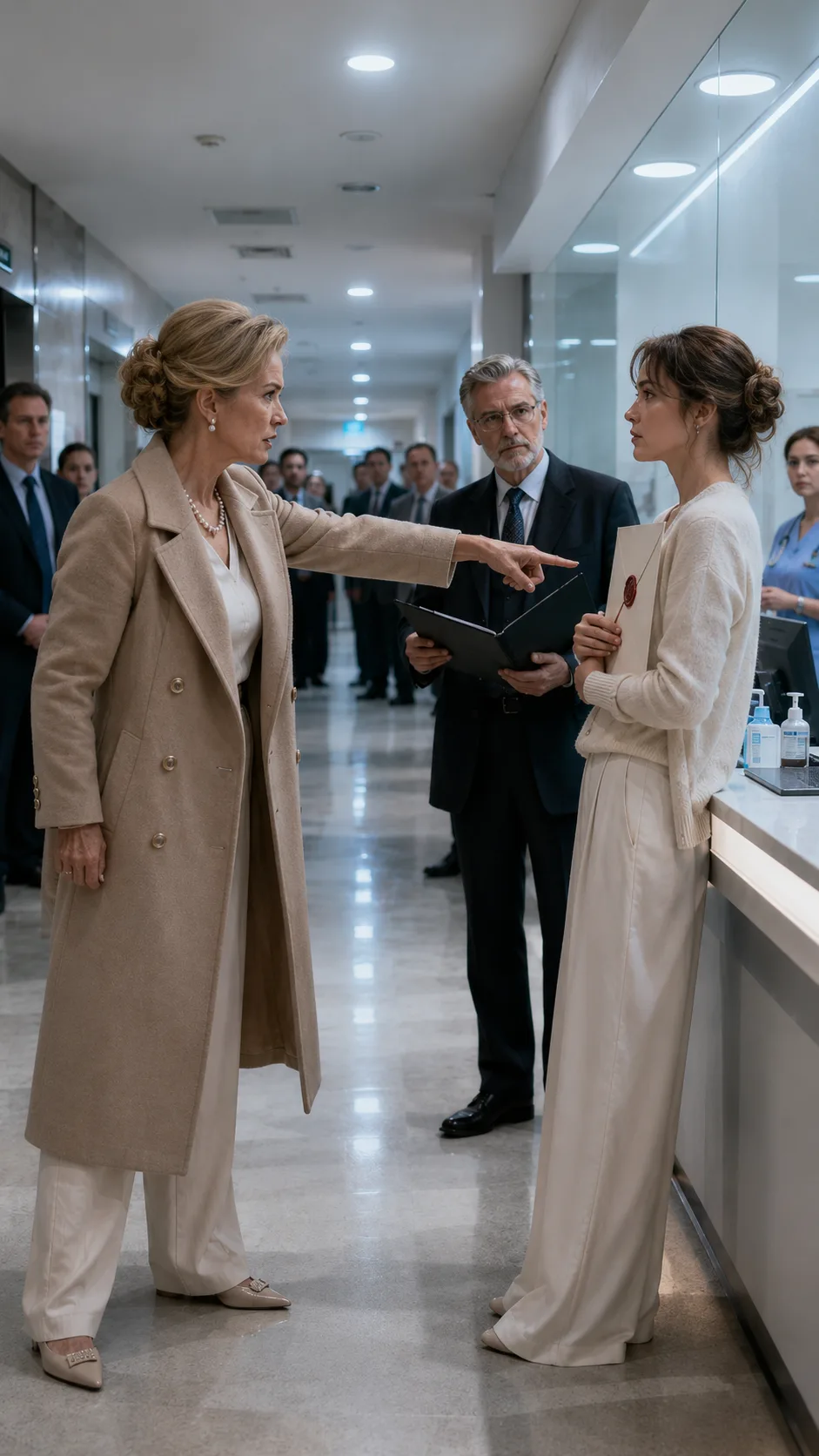
The elevator doors opened with a soft chime, and Margaret Whitmore was already standing there like she owned the entire hospital corridor.
Chapter 1
The elevator doors opened with a soft chime, and Margaret Whitmore was already standing there like she owned the entire hospital corridor.
She wore a beige wool coat over a silk blouse, pearl earrings, pearl necklace, cream heels, not one strand of blonde hair out of place. It was almost midnight, but Margaret looked dressed for a charity luncheon. Behind her stood three relatives, a private nurse, and her nephew Daniel, who always arrived when there was something ugly to watch.
I stepped out carrying a cream letter case against my chest.
Margaret’s eyes went to it first.
Then to my face.
Then back to the letter case.
“Elena,” she said, like my name had dirt on it.
I did not answer. The corridor smelled of disinfectant and cold coffee. Somewhere down the hall, a machine beeped in a steady rhythm behind a half-closed door.
My husband, Thomas, was in Room 417.
Three days earlier, he had collapsed in his office during a board dinner. His mother had called me only after
the ambulance had already taken him away. By the time I arrived, she had already spoken to the doctors, the hospital administrator, the family lawyer, and every relative with a last name worth using.
She had not spoken to me.
Not properly.
Not once.
I had spent the last seventy-two hours sitting outside Thomas’s room because Margaret kept finding reasons I should not be inside it. Doctor consultation. Family-only update. Private prayer. Rest period. Medical paperwork. One excuse after another, each one delivered with a smooth face and a hand on the door.
That night, I had gone home for forty minutes to change clothes and pick up the letter case from the drawer Thomas had shown me six months before.
“Elena,” he had said then, standing in our bedroom with the rain hitting the window. “If anything happens and my mother starts moving too quickly, take this to Victor.”
Victor was the Whitmore family adviser. Not warm. Not friendly. Not cruel either. He dealt in documents, silence, and fees.
I had asked Thomas what was inside.
He only said, “The part she hopes no one reads.”
At the time, I thought he was being dramatic.
Thomas came from old money. Old money had a language of its own. Clauses. Trusts. Addendums. Private agreements. Side letters. Decisions made at polished tables before dinner was served.
I grew up above my mother’s bakery, where every bill was paid by hand and every receipt was clipped to the refrigerator with a magnet shaped like a strawberry.
Margaret had never let me forget that.
The first time I met her, she looked at my shoes before she looked at me.
The second time, she asked whether my mother’s bakery took card payments yet.
The third time, she told Thomas, in front of me,
that kindness was not the same as compatibility.
He married me anyway.
For seven years, Margaret called me polite names with sharp edges. Simple. Unprepared. Sentimental. Unsuitable.
When Thomas got sick, those edges turned into blades.
She stopped pretending.
The elevator doors closed behind me. Margaret stayed where she was, positioned directly between me and the hallway to Room 417.
Not blocking.
Just standing.
A nurse behind the reception counter glanced up, then looked back at her clipboard too quickly.
Margaret noticed.
She always noticed witnesses.
“You were told visiting hours are limited,” she said.
“I’m not here for visiting hours.”
Daniel shifted behind her, phone in his hand. Not raised. Not yet.
Margaret’s mouth tightened at one corner.
“You have always mistaken access for importance.”
I kept both hands around the letter case.
Her eyes dropped again.
“What is that?”
“A letter case.”
“I can see that.”
“Then you don’t need to ask.”
A small sound came from Daniel. Almost a laugh. He covered it with a cough.
Margaret did not turn toward him. She did not have to. The room already knew who she allowed to laugh.
She stepped closer. Her perfume moved with her, powdery and expensive, cutting through the hospital smell.
“Thomas is resting,” she said. “He does not need another scene.”
Another.
That word did what she meant it to do.
The nurse behind the counter lowered her pen. A man in a dark suit at the far end of the corridor stopped walking. One of Thomas’s cousins, Amelia, looked toward the floor.
No one asked what Margaret meant.
No one ever asked Margaret to explain herself.
She could suggest an entire accusation with one word and let everyone else build the shape around it.
“I need to see Victor,” I said.
Margaret’s expression changed by a fraction.
There it was.
The first crack.
“Victor is busy.”
“He told me to come.”
That was not true.
Not exactly.
Victor had not told me to come. I had called him from the taxi and said I had Thomas’s cream letter case. He had been silent for four seconds.
Then he said, “Where are you?”
I said, “On my way to the hospital.”
He said, “Do not let anyone open it before I arrive.”
Then the line went dead.
Margaret watched me for a moment too long.
“Victor has served this family for thirty years,” she said. “He does not answer to you.”
“No,” I said. “He answers to what Thomas signed.”
Daniel’s phone came up half an inch.
Margaret saw it. Her chin lifted slightly, performing for the camera that was not yet recording.
“You should be careful,” she said. “Words can make people look desperate.”
I looked at her pearls.
They were the same ones she wore at our wedding.
Back then, she had kissed the air beside my cheek and said, “Welcome, dear,” while her fingers pressed just a little too hard into my arm.
Thomas had noticed.
Later that night, after the reception, he took my wrist in his hand and kissed the place where her nails had left four small half-moons.
“I know what she is,” he said.
I had smiled, still in my wedding dress, still too proud to admit I needed the comfort.
“Then why does she still scare me?”
Thomas had looked toward the ballroom doors, where his mother stood laughing with donors.
“Because she never raises her voice.”
Now, in the hospital corridor, Margaret raised it just enough.
“Elena, leave.”
The word moved down the hallway.
A doctor’s head turned at the nurse station. Amelia folded her arms. Daniel lifted his phone higher.
I did not move.
Margaret’s eyes hardened.
“You heard me.”
“I did.”
“Then walk to the elevator.”
“No.”
The word landed flat. Not loud. Not dramatic. Just there.
Margaret blinked once.
Behind her, Daniel stopped pretending not to record.
The nurse at the desk stood very still.
Margaret smiled.
Not because she found anything funny.
Because she had found the audience she wanted.
“You think carrying a little case makes you brave?”
I adjusted my grip. The red seal pressed into my palm.
“It makes me prepared.”
Margaret’s smile thinned.
Then she did something she had never done in seven years.
She laughed at me openly.
Not behind a glass of champagne. Not across a dinner table. Not with a polite phrase wrapped around the insult.
Openly.
In a hospital corridor.
Outside her son’s room.
In front of staff, relatives, and strangers.
“Oh, Elena,” she said. “You still don’t understand where you are.”
I looked past her shoulder.
Victor had stepped out of the elevator.
He wore a dark overcoat, gray scarf, and rectangular glasses. His silver hair was slightly messy, which was the closest I had ever seen him to disordered. In one hand, he carried his black leather portfolio.
He did not hurry.
Victor never hurried.
But his eyes were on the letter case.
Margaret followed my gaze.
For the first time that night, her face did not move quickly enough to hide the calculation underneath.
“Victor,” she said.
He inclined his head.
“Margaret.”
Not Mrs. Whitmore.
Margaret.
A small thing. But everyone in that family heard rank in small things.
Daniel lowered his phone a little.
Victor stopped beside me, not behind Margaret.
Another small thing.
Margaret’s gaze moved between us.
“I was just explaining to Elena,” she said, “that tonight is not appropriate.”
Victor looked at me.
“Do you have it?”
I held out the cream letter case.
Margaret’s hand shot forward.
She did not touch it.
She stopped just above it, fingers spread, palm hovering over the red seal.
The movement was fast enough that the nurse behind the counter took a small step back.
Victor looked at Margaret’s hand.
Then at her face.
“Do not,” he said.
Two words.
Low.
Clean.
Margaret’s hand stayed in the air for a second longer.
Then she lowered it.
Slowly.
Her smile returned, but it sat wrong now.
“You make this sound very theatrical,” she said.
Victor took the letter case from me with both hands.
He did not open it.
Not yet.
He turned it over and examined the seal.
The red wax bore Thomas’s initials.
T.W.
I had stared at that seal for the entire taxi ride. I had thought about breaking it myself. I had thought about throwing it away. I had thought about asking Thomas what he had been afraid of when he gave it to me.
But Thomas was upstairs with tubes in his arm and a bandage at his temple.
So I had held the case.
That was all.
Margaret stepped closer to Victor.
“This is unnecessary,” she said. “Thomas’s wishes were already reviewed.”
Victor looked at her.
“By whom?”
The question was quiet enough to sound ordinary.
Margaret’s lips parted.
“By the court,” she said.
“Which decision?”
“The only one that matters.”
Victor slid one finger under the edge of the portfolio clasp.
The black leather opened with a soft click.
He pulled out a thin folder, placed it on the reception counter, then laid Thomas’s cream letter case beside it.
Now there were two objects between Margaret and me.
One black.
One cream.
One old.
One unopened.
The nurse looked at them. So did Daniel. So did Amelia. So did every person who had spent three days pretending not to notice that Margaret was pushing me out of my husband’s hospital room one polite phrase at a time.
Margaret’s voice dropped.
“Victor.”
There was warning in it.
Victor did not look up.
“You said the judge’s decision was already reviewed.”
“It was.”
“Then you won’t mind if we confirm the final clause.”
Margaret’s pearls shifted as she inhaled.
A tiny sound.
Barely there.
But I heard it.
Because I had spent seven years listening to the sounds Margaret made when she was deciding how much damage she could do without leaving marks.
“This corridor is not the place,” she said.
“No,” I said.
Every head turned toward me.
I had not meant to speak.
But the word came out, and once it did, there was no putting it back.
Margaret looked at me like I had touched something expensive with dirty hands.
“No?” she repeated.
I stepped to the counter.
The letter case was inches away.
I placed both palms flat on either side of it.
The surface was cold.
“The corridor became the place when you told me to leave in front of everyone.”
Margaret’s eyes narrowed.
Victor’s hand paused over the seal.
Daniel’s phone came up again.
This time, Margaret did not stop him.
Good.
Let him record.
Let him keep it forever.
Margaret turned slightly toward the relatives behind her.
“You see?” she said. “This is exactly why Thomas wanted distance. She turns everything into a performance.”
I looked at Amelia.
At Daniel.
At the nurse who had stopped pretending to write.
At Victor.
Then back to Margaret.
“Open it,” I said. “Read what she hid.”
The words did not come out loud.
They did not need to.
Margaret’s face changed.
Not fully.
Just enough.
Her upper lip lost its curve. Her eyes cut to Victor’s hand. Her fingers pressed against the side seam of her coat.
Victor broke the seal.
The sound was small and dry.
Wax giving way.
Paper shifting.
The hospital corridor seemed to shrink around it.
Margaret took one step forward.
Victor looked at her once.
She stopped.
He opened the cream case.
Inside was a folded sheet, thick and pale, with Thomas’s signature across the inner flap. Beneath it was another page, thinner, official, stamped in blue at the corner.
Victor unfolded the first page.
He read silently.
His face did not change.
That made it worse.
Margaret reached for composure and put it on like jewelry.
“Well?” she said.
Victor did not answer her.
He turned to me.
“Elena, did Thomas give this to you personally?”
“Yes.”
“When?”
“Six months ago.”
Margaret let out a sharp breath.
“There is no need for testimony.”
Victor looked at her.
“No one asked for testimony.”
Daniel’s phone shifted in his hand.
Margaret’s nephew had always loved watching other people fall. Now he was watching his aunt balance on the edge of something he did not understand.
Victor read the first page again.
Then he lifted the second.
The stamped page.
Margaret’s hand moved toward her necklace.
She caught herself before touching it.
“Victor,” she said, voice lower now, “you are making a mistake.”
“No,” he said. “I made it three days ago.”
Margaret went still.
So did I.
Victor looked at the blue stamp.
“When you showed me the judge’s decision, you showed me page one and page two.”
Margaret’s mouth tightened.
“That was the decision.”
Victor lifted the thin page slightly.
“This is page three.”
The corridor went quiet in pieces.
First the nurse stopped moving.
Then Amelia’s arms unfolded.
Then Daniel lowered his phone just enough that the recording caught the floor for half a second.
Margaret did not look at any of them.
She looked only at Victor.
“Where did you get that?”
Victor tapped the cream letter case once.
“Thomas put it where you would never think to look.”
Margaret turned toward me.
For a second, all the polish was gone.
Then she recovered.
“You opened my son’s private papers.”
I shook my head.
“No. He gave them to me.”
“He was under stress.”
“He was protecting himself.”
“He was protecting this family.”
“No,” I said. “He was protecting me from it.”
The words stood between us.
Margaret looked like she wanted to slap them out of the air.
She did not move.
Too many witnesses.
Victor unfolded the page completely.
The overhead light passed through the edge of it, thin and sharp.
He read the first line aloud.
Not loudly.
Victor did not need volume. People leaned in for him.
“The court acknowledges the supplemental declaration filed under seal by Thomas Whitmore.”
Margaret’s face did not move.
Victor continued.
“The declaration clarifies that any temporary medical access limitations shall not remove spousal priority unless fraud, coercion, or incapacity is proven.”
A man down the corridor shifted his weight.
The word spousal reached me and stayed there.
I had not known how badly I needed to hear it until it was spoken in front of the people who had tried to erase it.
Margaret’s voice sliced through.
“That changes nothing.”
Victor turned the page toward her.
“Read the next line.”
“I don’t need to.”
“Margaret.”
The way he said her name made Daniel lower the phone completely.
Margaret looked at the page.
Her eyes moved once.
Then again.
Her face stayed arranged, but her hand slid off the counter.
Victor read it for everyone else.
“In the event of conflicting family claims, Elena Whitmore retains primary authority regarding hospital access, medical updates, and all immediate decisions concerning Thomas Whitmore’s personal care.”
No one spoke.
The nurse behind the counter looked at me differently.
Not warmer.
Not kinder.
Just accurately.
Like my shape in the room had finally been corrected.
Margaret stared at the page.
“That was not in the copy I received.”
Victor’s eyes stayed on her.
“No,” he said. “It was not.”
A thin red line appeared along Margaret’s cheekbone.
She turned to me.
“You knew.”
“I knew there was something inside.”
“You let me stand here and speak.”
“You chose to speak.”
Her jaw moved once.
No words came.
Victor placed the page flat on the counter and turned it slightly so the nearest relatives could see the blue stamp. Amelia stepped forward first. She did not touch the page. She only looked.
Then she looked at Margaret.
That was the first real shift.
Not the document.
Not Victor’s voice.
Amelia’s eyes.
Margaret saw it too.
“Amelia,” she said.
Amelia did not answer.
Daniel looked from the page to his phone, then tucked the phone into his coat pocket.
Too late for loyalty.
Too late for pretending.
Victor pulled another sheet from his black folder.
“This is the acknowledgment I signed after reviewing the incomplete copy Margaret provided.”
Margaret’s head turned sharply.
“Victor.”
He placed it beside the judge’s page.
“And this is my correction.”
The nurse behind the counter said nothing, but her hand moved to the visitor control panel.
A small click.
The glass door leading toward Room 417 unlocked.
I heard it.
Margaret heard it too.
Her eyes went to the door.
Then to me.
For three days, that door had been her wall.
One click, and it was not hers anymore.
I picked up the cream letter case.
My fingers had left faint marks along the side where I had held it too tightly.
Margaret stepped into my path.
Not enough to block me.
Just enough to remind me what she had been doing all along.
“Elena,” she said.
For the first time that night, my name sounded different in her mouth.
Not kinder.
Smaller.
I waited.
She glanced toward the relatives.
Then toward Victor.
Then toward the nurse.
Every witness she had gathered was still there.
Only now they were not arranged behind her.
They were around her.
“Thomas would not want this scene,” she said.
I looked at the door to Room 417.
The light above it was dim.
Inside that room, my husband was asleep beneath hospital blankets, unaware that his mother had tried to turn a corridor into a courtroom and lost control of both.
“No,” I said. “He prepared for it.”
Margaret’s mouth opened.
Closed.
Opened again.
“That is not—”
She stopped.
The sentence had nowhere to go.
Victor gathered the papers with careful hands.
“Margaret,” he said, “you should sit down.”
That did it.
Not the judge’s clause.
Not my name.
Not the unlocked door.
That sentence.
Victor telling Margaret Whitmore to sit.
Her face drained by degrees.
She looked suddenly older under the hospital lights. The pearls were still perfect. The coat still expensive. The hair still pinned. But the body inside all that polish had lost its place.
I walked past her.
She did not stop me.
The nurse pressed a button behind the counter and nodded once.
I pushed open the glass door.
Room 417 was quieter than the hallway.
Thomas lay on the bed with his head turned slightly toward the window. His skin looked pale against the pillow. A clear tube ran beneath his nose. His left hand rested on top of the blanket, fingers loose.
I stood at the foot of the bed for a moment.
The cream letter case hung at my side.
Outside, voices lowered. Victor’s voice. Margaret’s. Amelia’s. A nurse asking someone to move away from the desk.
Inside, only the monitor kept time.
I walked to Thomas’s left side and took his hand carefully.
His fingers were warm.
“I brought it,” I said.
He did not answer.
Of course he did not.
But his thumb moved.
Barely.
Once.
Maybe it was nothing. Maybe nerves. Maybe the body doing what bodies do when machines and medicine keep them floating somewhere between sleep and waking.
I held his hand anyway.
“You were right,” I said. “She moved quickly.”
His thumb moved again.
This time I did not question it.
The door opened behind me.
Victor stepped in alone.
He did not come far. He stayed near the wall, portfolio under one arm.
“Hospital administration has updated the access list,” he said.
I nodded.
“Margaret?”
“In the waiting area.”
“Is she leaving?”
“Not yet.”
That sounded like her.
Victor looked at Thomas.
Then at me.
“I owe you an apology.”
I turned toward him.
“For what?”
“For accepting the incomplete copy.”
“You trusted her.”
“I should have trusted the missing page.”
That was as much confession as Victor ever gave.
He reached into his portfolio and pulled out the judge’s third page, now inside a protective sleeve.
“Thomas filed this under seal because he believed Margaret would challenge your authority if he became incapacitated.”
The word sat in the room.
Incapacitated.
Clinical.
Cold.
I looked at Thomas’s hand in mine.
Victor continued.
“He also left instructions for me. If the clause was needed, I was to support its enforcement immediately.”
“But you didn’t know the clause existed.”
“No.”
“Because she hid it.”
Victor’s jaw tightened.
“Yes.”
I looked through the glass panel beside the door.
Margaret sat in the waiting area with her back straight, hands folded over her purse. Amelia sat two chairs away from her. Not beside her. Two chairs away.
That gap said enough.
Daniel stood near the vending machines, pretending to check messages.
No one stood behind Margaret now.
The hospital corridor had rearranged itself.
Victor followed my gaze.
“She will attempt to explain it,” he said.
“I know.”
“She will say she was protecting Thomas.”
“I know.”
“She may say you manipulated him.”
I looked back at Thomas.
“She has said worse.”
Victor was quiet.
Then he said, “Not in front of me again.”
I turned.
He looked almost embarrassed by the sentence.
Not emotional. Not soft. Just a man who had drawn a line and found it late.
“Thank you,” I said.
He nodded once and left.
For the next hour, no one came into the room except medical staff.
No relatives.
No whispered orders.
No pearl necklace flashing under the lights outside the door.
I sat beside Thomas and watched the city lights reflect in the dark hospital window.
At 2:13 a.m., his eyes opened.
Only a little.
Enough.
“Elena,” he said.
His voice was rough, thin, almost swallowed by the room.
I leaned closer.
“I’m here.”
His fingers tightened around mine.
“Case?”
“Opened.”
His eyelids lowered, then lifted again.
“Margaret?”
“Waiting area.”
His mouth shifted. Not quite a smile.
“Loud?”
“Very.”
“Good.”
A small laugh escaped me before I could stop it.
It came out broken at the edges.
Thomas turned his head a fraction.
“You okay?”
I looked at the cream letter case on the chair beside me.
The red seal was broken now. The wax cracked in two clean pieces.
“No,” I said.
His thumb brushed my knuckle.
“But I’m still here.”
His eyes closed.
His hand stayed in mine.
By morning, Margaret had gone home.
She did not say goodbye.
She left behind a paper coffee cup on the waiting-room table, lipstick on the rim, half full.
Amelia was the one who threw it away.
Two weeks later, Thomas came home.
Not to the Whitmore estate.
To our house.
The smaller one Margaret had always called temporary.
The one with the blue front door and the crooked mailbox Thomas never fixed because he said it gave the place character.
Margaret called twice the first week.
Thomas did not answer the first call.
I did not answer the second.
On the third, he picked up.
He listened for forty seconds.
Then he said, “You do not speak to Elena through me anymore.”
I was in the kitchen cutting bread.
The knife stopped halfway through the loaf.
Thomas looked at me while Margaret spoke on the other end.
His face stayed calm.
“No,” he said. “You don’t decide that.”
Another pause.
Then he hung up.
He set the phone face down on the table.
The old Thomas would have explained. Smoothed. Managed. Asked me to understand that his mother was difficult but still his mother.
This Thomas reached for the bread knife.
“Too thick?” he asked.
I looked at the uneven slice on the board.
“Very.”
He cut the next one worse.
We ate it anyway.
A month later, Victor sent the final packet by courier.
Not to Margaret’s house.
To mine.
Inside was a certified copy of the corrected hospital authority record, the judge’s full decision, and a short handwritten note from Victor.
No apology this time.
Just six words.
“She no longer receives incomplete copies.”
I placed the note inside the cream letter case.
The broken red seal remained in the bottom corner.
I thought about repairing it once.
Then I left it as it was.
Some things should show where they were opened.
Margaret did not disappear from our lives.
Women like Margaret do not vanish. They wait for rooms to become useful again.
But she never again stood between me and a hospital door.
She never again said the judge had erased me.
And when Thomas returned to the hospital three months later for a follow-up appointment, Margaret arrived in the same beige coat, the same pearls, the same perfect hair.
She stopped at the reception counter.
I was already there.
Victor stood beside me.
The nurse glanced at the screen and said, “Mrs. Whitmore, you’re listed as primary contact.”
Margaret’s eyes moved to me.
For one second, the old smile tried to return.
It failed.
I picked up the visitor badge from the counter.
This time, no one asked me to leave.
Chapter complete
You have reached the end of this chapter.
Continue reading
A few more worlds to get lost in after this chapter.




