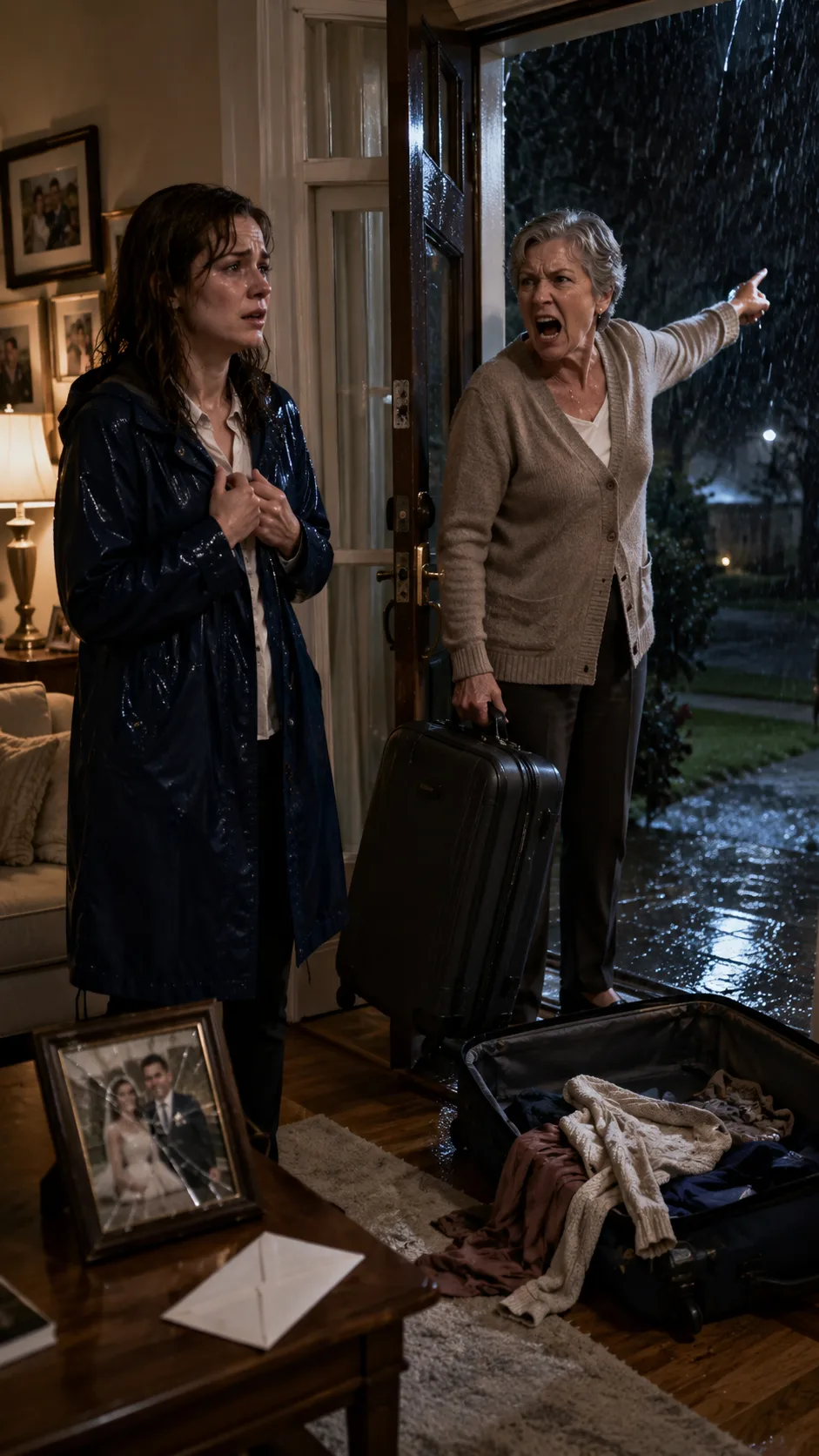
My Mother-in-Law Locked Me Out in the Rain — But I Came Back as...
Chapter 1
My Mother-in-Law Locked Me Out in the Rain — But I Came Back as...
Part 1
The night my mother-in-law threw me out of my own house, it was raining so hard the gutters sounded like they were breaking apart.
I remember that sound more than anything.
Not her voice.
Not the suitcase hitting the porch.
Not even the way my husband told me, over the phone, that maybe I should just leave for the night.
I remember the rain.
Because for seven years, I had done everything quietly.
I loved quietly. I worked quietly. I paid bills quietly. I swallowed insults quietly. I let people call my home “Michael’s house” because correcting them felt small and embarrassing. I let my mother-in-law, Diane Brooks, walk through my kitchen like she had built it brick by brick. I let my husband laugh awkwardly whenever she said things like, “My son has always had such good taste,” while looking at the curtains I had chosen, the
table I had refinished, the flowers I had planted.
I was thirty-five years old, an elementary school teacher, and I had spent most of my adult life teaching children to use kind words.
But kindness, I learned, becomes dangerous when people mistake it for permission.
Diane had never liked me.
She never screamed at me in the beginning. That would have been too obvious. Diane specialized in tiny cuts.
At family dinners, she would say, “Natalie is so lucky Michael doesn’t care about status.”
At Christmas, she gave me a cookbook and said, “Maybe this will help you keep up with how the Brooks family entertains.”
When I got promoted to lead teacher at my school, she smiled and said, “That’s sweet. Children must be easy compared to real work.”
Michael would squeeze my knee under the table.
“Mom doesn’t mean anything by it,” he’d whisper later.
But she did.
Diane meant every word. She wrapped cruelty in manners and served it with coffee.
The worst part was not that she disliked me. I could have survived that. The worst part was that Michael always needed me to understand her, but never needed her to understand me.
“She’s lonely,” he would say.
“She’s old-fashioned.”
“She’s just protective.”
After his father died, Diane clung to Michael like he was the only proof that her life still mattered. I understood grief. I had lost my own mother before I married Michael. My mother, Laura, was the reason I even had the house in the first place.
She had worked for thirty years as a nurse. She never bought designer bags, never took fancy vacations, never spent money on herself. When cancer took her faster than any of us expected, she left me a small inheritance and a handwritten letter.
Buy yourself safety,
sweetheart.
Not luxury. Not approval. Safety.
I used that money as the down payment on a modest two-story house in a quiet Pennsylvania suburb with maple trees on the street and a porch just big enough for two rocking chairs. I bought it six months before I married Michael.
The house was in my name.
Only mine.
Michael knew that. Of course he knew. He helped me paint the guest room pale blue. He carried boxes into the kitchen. He kissed me on the empty living room floor and said, “This is where we start.”
But when Diane came over for the first time and said, “My son bought such a beautiful home,” Michael didn’t correct her.
I looked at him.
He looked away.
Later, he told me, “It’s not worth making it awkward.”
That sentence became the theme of our marriage.
So I let it go.
I let Diane believe whatever made her feel powerful. I told myself the truth did not need to be shouted to be real.
Then came the Friday night Michael flew to Chicago.
He was going for a business conference, only three days. Diane had been staying with us for two weeks because her condo was being renovated. She complained about everything: the brand of coffee I bought, the way I folded towels, the “cheap” plates I used for dinner even though they had belonged to my mother.
That Friday, I came home late from school. One of my students, Caleb, had cried during dismissal because his mother forgot his winter coat again, and I stayed with him until someone came. My shoes were soaked from the parking lot. My hair was frizzed from the rain. I was carrying a canvas bag full of spelling tests and construction paper.
The moment I opened the front door, I knew something was wrong.
The living room lights were all on.
My desk drawer was open.
Papers were scattered across the coffee table.
And Diane stood in the middle of the room holding a white envelope.
My envelope.
The one I kept tucked behind my lesson planner.
“Where did you get that?” I asked.
Diane turned slowly. Her face had that satisfied tightness I had seen before, the look she wore when she thought she had finally caught someone being exactly as awful as she had always suspected.
“I found it,” she said.
“In my desk?”
“In this house.”
I set my school bag down carefully. “Diane, that was in my private drawer.”
She lifted the envelope. “Cash. Almost eight hundred dollars.”
“That’s mine.”
Her eyebrows rose. “I assumed that was obvious.”
I stepped toward her. “It’s money I saved for my classroom. Some of my kids don’t have supplies. I was going to buy coats, books, snacks—”
“Oh, please.” She tossed the envelope onto the coffee table. “Don’t insult me with charity stories.”
My stomach tightened. “Excuse me?”
“You’ve been hiding money in my son’s house.”
There it was again.
My son’s house.
I took a breath. “This is my home too.”
Diane laughed once, sharp and ugly.
“No, Natalie. This is the home Michael allowed you to live in.”
Something in me went still.
For years, I had imagined what I would say if she ever pushed too far. I thought I would be eloquent. Strong. Maybe even intimidating.
Instead, I just stood there in my damp cardigan, exhausted from teaching eight-year-olds how to spell “beautiful,” staring at a woman who had gone through my belongings and decided I was the thief.
“Please put the envelope back,” I said.
Diane’s eyes narrowed. “You don’t give orders here.”
“I’m not giving orders. I’m asking you to respect me.”
“Respect?” Her voice rose. “You want respect while you hide money from your husband?”
“My husband knows I save for my students.”
“Does he know you keep cash like you’re planning an escape?”
That was when she turned and walked upstairs.
At first, I didn’t follow. I thought she was leaving the room to cool down. I stood there shaking, trying to call Michael. It went to voicemail.
Then I heard the closet door open above me.
A drawer slammed.
Something heavy hit the floor.
I ran upstairs.
Diane was in my bedroom pulling my clothes out of the closet.
“What are you doing?” I shouted.
She didn’t answer. She grabbed my sweaters, my jeans, the black dress I wore to my mother’s funeral, and shoved them into my suitcase.
“Stop.” I reached for the suitcase handle. “Diane, stop!”
She yanked it away. “I should have done this years ago.”
“This is insane.”
“No. What’s insane is watching my son waste his life on a woman who came in with nothing and still thinks she deserves everything.”
Those words landed so hard I could not speak.
Came in with nothing.
I looked around the bedroom. The curtains I had sewn with my mother’s old machine. The bed I had paid for. The framed photo of my mother on the dresser. The house that still held her handwriting in a box in the attic.
I said, very quietly, “You have no idea what I came in with.”
Diane zipped the suitcase with such force the metal teeth screamed.
Then she dragged it down the stairs.
I followed her, barefoot, begging now. I hated myself for begging, but I did.
“Please. Don’t do this tonight. It’s pouring outside.”
She reached the front door and threw it open.
Wind rushed in, cold and wet. Rain blew across the entryway. The porch light flickered. Outside, the yard was a blur of black trees and silver water.
Diane lifted the suitcase.
“Get out.”
I froze.
She shoved the suitcase over the threshold. It landed on its side, burst open, and my clothes spilled across the wet porch.
Then she pointed into the storm.
“Get out of my son’s house. A woman like you was never worthy of the Brooks name.”
Part 2
I called Michael six times before he answered.
By then, I was standing on the porch in the rain, clutching my coat around me while Diane stood inside the doorway like a guard at a gate. My suitcase lay open at my feet. A cream sweater my mother had given me was soaking in a puddle.
When Michael finally picked up, his voice was thick with sleep.
“Nat? What’s going on?”
I could barely hear him over the rain.
“Your mother threw me out.”
Silence.
Then, “What?”
“She went through my desk. She found the classroom money. She packed my suitcase and threw it onto the porch.”
Behind me, Diane said loudly, “Tell him the truth.”
I turned away from her. “Michael, I need you to tell her to let me back in.”
He sighed.
That sigh changed everything.
Not a gasp. Not anger. Not concern.
A sigh.
“Natalie, I’m in Chicago.”
“I know where you are.”
“I have a presentation in the morning.”
“Your wife is standing outside in a storm.”
Another pause.
Then he said, “Maybe it’s better if you stay somewhere tonight.”
I closed my eyes.
“Are you serious?”
“Just until everyone calms down.”
“Everyone?” I whispered. “I’m the one outside.”
“Mom gets worked up. You know that.”
The rain ran down my face like tears, but I had already stopped crying.
“No,” I said. “I don’t know that. I know you keep calling cruelty a personality.”
“Natalie—”
“She threw me out of my own home.”
His voice sharpened. “Don’t start that right now.”
I opened my eyes.
There it was.
Not confusion. Not surprise.
Fear.
Michael knew exactly what I meant.
“Your mother still thinks this house is yours,” I said.
He lowered his voice. “This is not the time.”
“When was the time, Michael? The day she said I was lucky to live here? The day she told your cousins I married up? The day she rearranged my kitchen because she said Brooks women know better?”
“Natalie, please.”
“No,” I said. “You let her believe I was a guest in the house my mother helped me buy.”
Diane’s face changed behind me. Just slightly. Her mouth parted, then hardened again.
Michael whispered, “We can talk when I get back.”
I looked at the open suitcase, the wet sweater, the cracked picture frame that had fallen from the side pocket.
“We will,” I said. “But not as the woman you left on the porch.”
I hung up.
For a long moment, Diane and I stared at each other.
“What did you mean?” she asked.
I picked up my suitcase.
“Ask your son.”
Then I walked into the rain.
I didn’t have the strength to drive far. My hands were shaking too badly. I made it to a small motel ten minutes away, but the front desk clerk said they were full because of a power outage on the other side of town.
So I slept in my car.
Or tried to.
I parked under the awning of a closed pharmacy and sat in the driver’s seat, soaked to the bone, with the heater running and my phone face-down in the cup holder. Around 2 a.m., a message from Michael appeared.
Mom says you exaggerated. We’ll fix this Sunday.
I stared at those words until they blurred.
We’ll fix this.
As if I had broken something.
At 5:40 in the morning, I drove to school. Not because I planned to teach. It was Saturday. The building was closed. But I had a key, and my classroom was the only place in the world where I still knew exactly who I was.
Room 204 smelled like crayons and pencil shavings. The desks were arranged in groups of four. Paper snowflakes hung from the ceiling. On the board, in my own handwriting, were the words:
Kindness is what you do when nobody is clapping.
I sat at my desk and finally cried.
Not pretty crying. Not silent movie tears.
I folded over with my face in my hands and sobbed so hard my ribs hurt.
At 7:15, my phone rang.
It was my mother’s old lawyer, Thomas Miller.
I had not spoken to him in almost two years, not since he helped me update some insurance paperwork.
“Mrs. Brooks?” he said. “I’m sorry to call so early. I received a voicemail from you last night, but the audio was mostly rain.”
I had forgotten I called him.
Sometime after Michael’s message, sitting in the car, half numb and half furious, I must have dialed Thomas because his number was still saved under Mom’s Estate.
“I’m sorry,” I said, wiping my face. “I didn’t mean to bother you.”
His voice changed. “Are you safe?”
That simple question nearly broke me again.
“Yes,” I lied.
“Where are you?”
“My classroom.”
“Do you need me?”
I looked at the board. Kindness is what you do when nobody is clapping.
Then I looked at my wet shoes, my muddy hem, the suitcase beside my desk.
“Yes,” I said. “I think I do.”
Thomas arrived forty minutes later with coffee, a dry coat, and the calm expression of a man who had watched families destroy themselves over things they never bothered to understand.
I told him everything.
He listened without interrupting. When I finished, he opened his leather folder and removed copies of the home purchase paperwork, the deed, the inheritance transfer records, and my mother’s letter.
I touched the letter first.
Buy yourself safety, sweetheart.
Thomas said gently, “Your mother was very clear about why she wanted the house protected.”
I nodded.
“She said love should have a home,” I whispered. “But a woman should always have a door she owns.”
Thomas looked at me over his glasses. “Then perhaps it’s time to use the door.”
I called Michael once more before going back.
He didn’t answer.
So I sent one message.
I’m going home.
Then I drove back through streets washed clean by the storm.
By the time we arrived, the rain had stopped. The sky was pale gray. Water dripped from the porch roof. My sweater was still lying near the step where I had dropped it.
Diane opened the door wearing the same beige cardigan from the night before.
Her eyes flicked from me to Thomas.
“What is this?”
I stepped onto the porch.
“This is me coming home.”
She laughed, but it sounded thinner than usual.
“You don’t live here anymore.”
Thomas stepped forward. “Mrs. Diane Brooks?”
She looked offended that he knew her name. “Yes.”
“My name is Thomas Miller. I represent Natalie Brooks regarding this property.”
Diane’s face tightened.
“This is a family matter.”
“It became a property matter when Mrs. Brooks was removed from her own residence.”
She looked at me with pure disbelief. “Your own residence?”
I took the papers from Thomas.
For once, my hands did not shake.
“Yes,” I said. “Mine.”
Diane stared at the pages like they were written in another language.
“This house belongs to Michael.”
“No,” I said. “It never did.”
Her mouth opened.
Closed.
Opened again.
I continued, because if I stopped, I might lose my nerve.
“I bought this house before the wedding with the money my mother left me. Michael knew. He always knew. He just let you believe otherwise because it was easier than correcting you.”
Diane gripped the doorframe.
“That’s not true.”
Thomas said, “It is.”
She snapped, “I wasn’t speaking to you.”
“No,” I said. “But you should listen to him.”
Her eyes flashed. “You planned this.”
I almost laughed. “Planned what? To be thrown out in the rain?”
“You hid this from me.”
“You never asked. You only assumed.”
Diane looked past me toward the street, as if hoping Michael would appear and fix the world she preferred.
He did not.
So I said the sentence I had rehearsed only once in my head but had carried in my chest for seven years.
“You were right about one thing last night. Someone needs to leave this house.”
She looked back at me.
I held her gaze.
“But it isn’t me.”
Part 3
Michael came home that afternoon.
By then, Diane was sitting on the cream sofa with a mug of untouched tea in front of her. Thomas had left after making sure I was comfortable staying in the house. I had changed into dry clothes, made a pot of coffee, and gathered Diane’s belongings from the guest room into neat piles.
Not thrown.
Not shoved.
Not scattered.
Folded.
Because I refused to become the woman who had hurt me.
When Michael walked in, he looked older than he had two days before. His hair was messy, his tie loosened, his suitcase still in his hand.
His eyes went first to his mother.
Then to me.
“Natalie,” he said.
I stood at the kitchen island. “Michael.”
Diane rose immediately. “Tell her.”
Michael swallowed. “Mom—”
“Tell her this is your house.”
He looked at the floor.
The silence was answer enough.
Diane’s face crumpled in a way I had never seen before. Not because she felt sorry for me. Not yet. Because her son had embarrassed her with the truth.
“You let me believe it,” she whispered.
Michael set down his suitcase. “I didn’t know how to correct you.”
Diane laughed bitterly. “You didn’t know how?”
“I was tired of fighting.”
“With me?” she asked.
“With everyone!” he snapped.
The room went still.
Michael dragged a hand through his hair. “I was tired of being between you two. I thought if I just let small things go, they’d stay small.”
I stared at him. “They didn’t stay small, Michael. They became my life.”
He looked at me then, really looked.
At my swollen eyes. At the bruise-colored shadows under them. At the damp suitcase still standing near the stairs.
“I know,” he said quietly.
Diane sat back down, stunned by his raised voice. For once, she did not have a ready insult.
I picked up the white envelope from the coffee table. The classroom money was still inside, wrinkled now at the edges from damp air.
“You accused me of hiding money,” I said to Diane. “This was for Caleb, Madison, Jalen, and three other children whose parents are struggling this winter. I was going to buy coats and books.”
Diane looked away.
I placed the envelope on the table.
“And while we’re discussing hidden money, Michael, maybe you should tell your mother who paid her condo fees last year when she fell behind.”
Diane’s head snapped up.
Michael closed his eyes.
I had not planned to say it. But the truth, once invited in, rarely stops at the doorway.
“What?” Diane said.
Michael’s voice was rough. “Natalie did.”
Diane looked at me.
I said, “You were grieving. You were embarrassed. Michael asked if we could help. I said yes.”
Diane’s mouth trembled. “You?”
“Me.”
She stood slowly. “No. Michael told me he handled it.”
“I know.”
Michael whispered, “Nat.”
I turned to him. “No. She needs to know. She needs to know that the woman she called unworthy kept her lights on. She needs to know that I paid for the guest bathroom repair she blamed me for. She needs to know that when she told everyone I didn’t understand family, I was quietly helping yours.”
Diane pressed a hand against her chest.
For the first time since I had met her, she looked small.
Not weak.
Just small.
Like a woman who had spent years building a throne out of assumptions and suddenly realized it was made of paper.
“Why didn’t you tell me?” she asked.
I smiled sadly. “Because I thought kindness counted even when nobody knew.”
My classroom sentence came back to me, and with it came my mother’s voice.
Buy yourself safety.
I had bought the house.
But I had not lived safely in it.
Michael moved toward me. “I should have told her. I should have stopped this years ago.”
“Yes,” I said.
He flinched.
I didn’t say it cruelly. I said it because truth did not need cruelty to hurt.
Diane looked between us. “Are you throwing me out?”
The question hung in the room.
Last night, she had not asked me where I would go. She had not cared if I had a coat, a room, a safe place to sleep. She had tossed my clothes into the rain and called it justice.
I thought about doing the same.
For one second, I wanted to.
Then I saw my mother’s letter on the coffee table, where Thomas had placed it before he left.
Safety, sweetheart.
Not revenge.
“You have three days,” I said. “I’ll help you find a place if you need one.”
Diane stared at me.
“You would help me?”
“No,” I said softly. “I would help Michael make sure his mother is safe. There’s a difference.”
Her eyes filled.
I had never seen Diane cry. Not at her husband’s memorial. Not when Michael missed Thanksgiving one year. Not when she broke her wrist and refused pain medicine because “Brooks women don’t make scenes.”
But now one tear slipped down her cheek.
“I was afraid,” she whispered.
I said nothing.
She looked down at her hands. “After Michael’s father died, everything felt like it was being taken away from me. My house. My marriage. My place. Then he married you, and you were kind, and calm, and he listened to you in ways he never listened to me.”
I wanted to feel sympathy.
Part of me did.
But another part of me was still standing barefoot in the rain.
“So you decided I was the enemy,” I said.
Diane nodded once, barely.
“I decided it before I knew you.”
That sentence hit differently from all the others.
Because it was the closest thing to honesty she had ever given me.
Michael sat down heavily in the chair across from her. “Mom, you hurt my wife.”
Diane covered her mouth.
He continued, voice shaking. “And I let you. I kept thinking silence was keeping the peace, but it was just leaving Natalie alone.”
I turned away before he could see what that did to me.
Because yes.
That was exactly it.
Diane had thrown me out.
But Michael had left me there long before the rain.
Over the next three days, the house changed.
Not physically. The sofa stayed where it was. The curtains still moved softly in the morning light. The kitchen still smelled like coffee and lemon soap.
But the air shifted.
Diane packed quietly. She did not apologize dramatically. She did not fall to her knees. She did not suddenly become warm and gentle. Real change, I learned, is not cinematic at first. It is awkward. Uneven. Embarrassed.
On the second day, she stood in the doorway of my classroom while I packed donated coats into boxes.
“I didn’t know you did all this,” she said.
I looked up. “You never asked what I did.”
She nodded.
Then she picked up a red child’s coat and folded it.
No speech. No tears.
Just one folded coat.
It was not forgiveness.
But it was the first useful thing she had done for me.
On the third day, Michael helped her move into a short-term apartment fifteen minutes away. Before she left, Diane stood in the living room holding her purse with both hands.
“Natalie,” she said.
I waited.
Her chin trembled slightly, but she kept her eyes on mine.
“I was wrong about the house.”
I almost smiled. “Only the house?”
She closed her eyes briefly.
“I was wrong about you.”
Michael stood behind her, silent.
Diane looked toward the coffee table, where the cracked wedding photo had been removed. In its place was a framed picture of my mother standing on the porch the day I got the keys.
Diane’s voice dropped.
“Your mother must have loved you very much.”
“She did.”
“She was smarter than I was.”
I didn’t argue.
After Diane left, Michael and I stood in the quiet house.
For the first time in seven years, there was no third presence between us.
No Diane’s voice from the guest room.
No unspoken tension at the dinner table.
No invisible rule that I had to be gracious while being wounded.
Michael said, “Can we fix this?”
I looked at him.
The man I loved was still there. I could see him under the fear, under the habit, under all the years of choosing the easier silence.
But love was no longer enough to make me disappear.
“I don’t know,” I said honestly.
His face fell.
“I want to,” I added. “But I won’t go back to being quiet just so everyone else can feel comfortable.”
He nodded. “I don’t want you to.”
“You don’t get to say that once. You have to live it.”
“I know.”
I walked to the front door and opened it.
The porch was dry now. The storm had passed, leaving the air clean and cold. The maple trees dripped in the yard. On the steps, faint mud stains remained where my suitcase had burst open.
Michael came to stand beside me.
“I should have come home,” he said.
“Yes,” I answered.
“I should have told her the truth.”
“Yes.”
“I should have protected you.”
I looked at him.
“No, Michael. You should have stood beside me. I can protect myself.”
His eyes filled, and he nodded.
That evening, I took my mother’s letter from the box upstairs and placed it in a frame beside her photo.
Buy yourself safety, sweetheart.
For years, I thought safety meant having my name on the deed.
But that night taught me safety was bigger than ownership.
Safety was being able to speak without begging.
Safety was refusing to shrink inside rooms you paid for with grief and courage.
Safety was opening your own front door, standing in your own light, and knowing that if someone had to leave, it would not be you.
A week later, I returned to school with six new winter coats, a box of books, and no white envelope hidden in my desk.
When Caleb put on his new coat, he zipped it all the way to his chin and grinned.
“Mrs. Brooks,” he said, “it’s really warm.”
I smiled for the first time in days.
“Good,” I told him. “That’s what it’s supposed to be.”
That afternoon, I drove home before sunset. The house glowed softly from the street, porch light on, curtains open, no one waiting inside to judge how I entered.
I parked in the driveway and sat for a moment with my hands on the wheel.
Then I walked up the steps.
The same steps where I had stood in the rain.
The same door Diane had tried to close against me.
I unlocked it with my own key.
And this time, when I stepped inside, I did not feel lucky to be there.
I felt home.
THE END.
Chapter complete
You have reached the end of this chapter.
Continue reading
A few more worlds to get lost in after this chapter.




