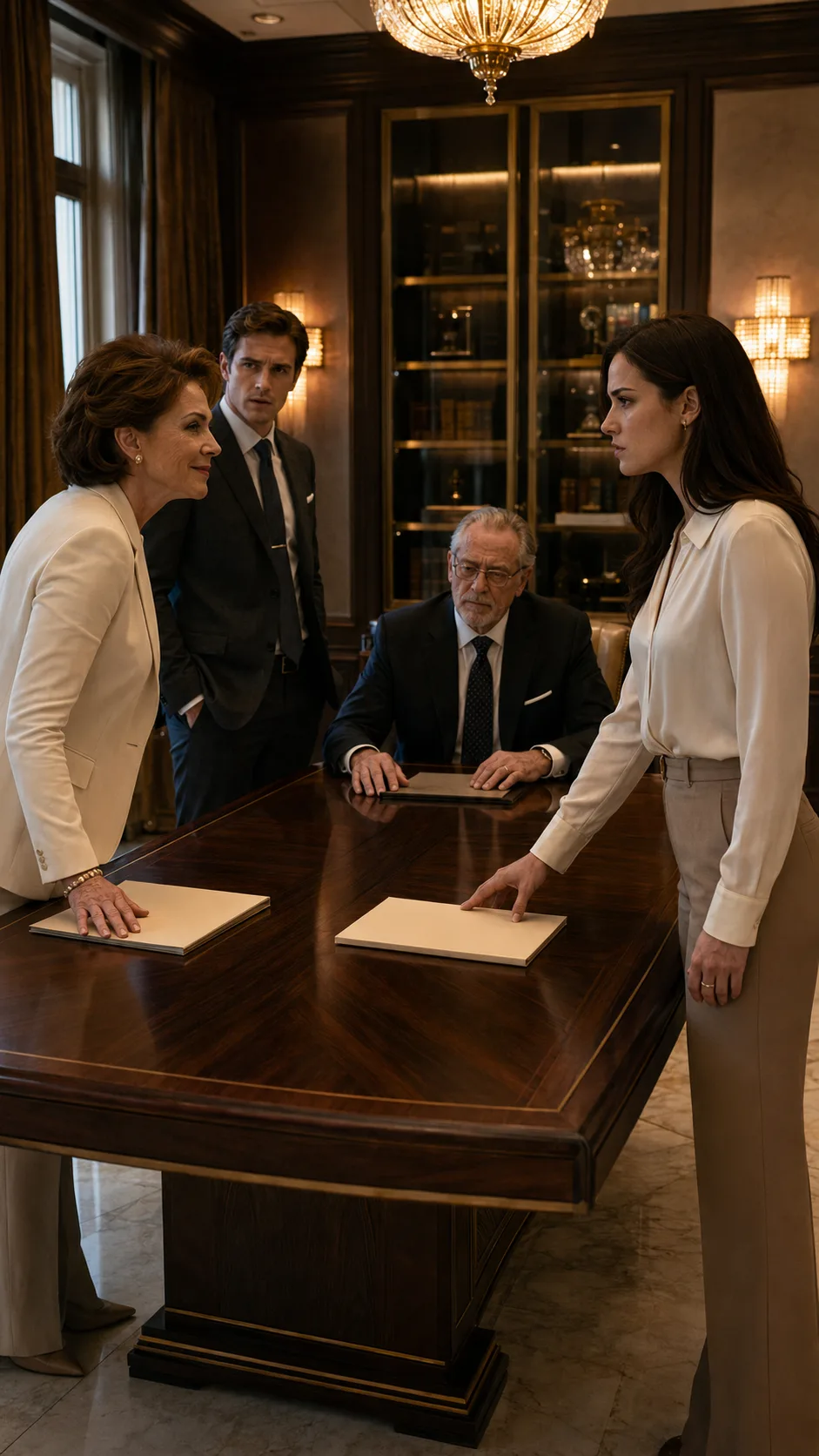
My mother-in-law smiled before I even touched the chair.
Chapter 1
My mother-in-law smiled before I even touched the chair.
She stood beside the polished walnut table in Mr. Harris’s private office, one hand resting on a cream-colored folder, the other curled around the strap of her pearl purse. The chandelier above her made the pearls at her ears shine like small trophies.
Daniel stood behind her.
My husband.
His hands were in the pockets of his charcoal suit, shoulders relaxed, mouth tilted like he was trying not to look pleased. He always thought silence made him innocent.
It never did.
“Claire,” Margaret said, drawing out my name like she was tasting something sour. “You’re late.”
I wasn’t late.
The appointment was at ten. The clock above the glass document cabinet showed 9:56.
Mr. Harris looked up from the leather blotter at the far side of the table. He had been my father-in-law’s notary for almost twenty years, a quiet man with silver hair, square glasses, and the patient face
of someone paid to listen while rich families lied politely.
“I’m early,” I said.
Margaret laughed once.
Short.
Sharp.
Daniel looked at the floor.
The office smelled of old paper, furniture polish, and coffee that had gone cold in a porcelain cup near Mr. Harris’s elbow. Outside the tall windows, the city moved behind a thin gray morning, but inside that room everything looked sealed away from real life. Dark wood walls. Brass handles. Marble floor. A table wide enough to keep people from reaching each other.
Margaret liked rooms like that.
Rooms that made her feel official.
She tapped the folder under her hand.
Twice.
“I hope you understand why we’re doing this properly,” she said. “No more confusion. No more emotional claims.”
I held my own slim ivory folder against my ribs.
It was thinner than hers.
That was probably why she didn’t notice it at first.
Daniel
noticed.
His eyes dropped to it once, then moved away too quickly.
I had learned Daniel’s tells over eight years of marriage. The way he ran his thumb along his wedding band when he was hiding something. The way he answered questions with a cough. The way his mother could speak for him and he would let her, because cowardice looked better in an expensive suit.
“Sit down,” Margaret said.
I didn’t.
Mr. Harris removed his glasses and folded them carefully.
“Mrs. Whitmore,” he said, looking at Margaret, “perhaps we should wait until everyone is settled.”
Margaret gave him the kind of smile she used on staff.
“Of course.”
Then she looked back at me.
She did not move from the head of the table.
That was Margaret’s talent. She could take control of a room without raising her voice. She would place a purse on a chair, a hand
on a folder, a glance on a person, and somehow everyone understood where they were allowed to stand.
I had spent years shrinking around those rules.
At family dinners, she chose where I sat.
At fundraisers, she introduced me as “Daniel’s wife” and nothing else.
At my father-in-law’s funeral, she took the front row and left me in the second, even though Thomas Whitmore had been the only person in that family who ever treated me like I belonged.
Thomas had squeezed my hand two weeks before he died and said, “Claire, never let them tell you what you already know.”
I hadn’t understood him then.
Now I did.
Margaret slid the cream folder across the table toward the empty chair in front of me.
The ribbon around it was pale gold.
Everything she owned looked prepared for display.
“Let’s not make this more uncomfortable than it needs to be,” she said.
Daniel cleared his throat.
“Claire,” he said, “Mom just wants this finished.”
Mom.
Not Mother.
Not Margaret.
Mom.
He was thirty-four years old and still let that word close doors.
I looked at him for a few seconds.
He looked past me.
That was enough.
I placed my folder on the edge of the table but kept my hand over it.
Margaret’s eyes flicked down.
Only for a moment.
Then her smile returned.
“What’s that?”
“A copy.”
“Of what?”
I didn’t answer.
Mr. Harris’s eyes moved from my hand to Margaret’s folder. He didn’t speak, but one finger tapped once against the blotter.
A small thing.
A warning, maybe.
Or a man remembering something he had hoped not to need.
Margaret pulled out the chair on her side of the table and sat as if the room had been waiting for her permission. Daniel remained standing behind her right shoulder. He looked like a son at a school meeting, not a husband in the middle of a marriage.
Two relatives had come with them. Daniel’s aunt, Vivienne, and his cousin Richard. They stood near the glass cabinets, whispering low enough to pretend it wasn’t rude.
Vivienne gave me a small, practiced smile.
The kind people give before watching someone fall.
I had seen it before.
The first time was at our wedding reception, when Margaret told the florist to move my mother’s table farther from the stage because “the photos would look cleaner.” The second was when Daniel forgot my birthday and Margaret sent me a bracelet with a note that said, “Marriage is about grace.” The third was six months ago, when I found out Daniel had been meeting with a broker about selling the lake house.
Thomas’s lake house.
The only place in the Whitmore family that had ever felt warm.
He had taught me how to make coffee in that kitchen. He had shown me the crooked floorboard near the fireplace. He had told me where he kept the old fishing rods, even though I never fished.
After he died, Margaret stopped calling it the lake house.
She started calling it “the asset.”
That was the first crack.
The second came when Daniel left his laptop open.
He wasn’t careless often, but arrogance makes people lazy. An email sat open on the screen, buried under a chain about “family consolidation.” I only read three lines before he came back into the room.
Three lines were enough.
Transfer expected after notary confirmation.
Spousal consent not required if title remains under Whitmore estate structure.
Claire likely unaware of amendment.
I had stood in our kitchen with the dishwasher humming behind me, one hand on the counter, the screen reflecting in the black window over the sink.
Claire likely unaware.
That phrase stayed with me.
Not hurt.
Not betrayed.
Just filed.
The next morning, I called the one person Margaret had always underestimated: Thomas’s former assistant, Evelyn Park.
Evelyn had worked for Thomas for twenty-seven years. She knew where every copy was kept, which drawer stuck in winter, which lawyer preferred phone calls, and which family member lied badly.
When I asked her about an amendment, she didn’t answer immediately.
I could hear paper moving on her end.
Then she said, “Claire, did no one tell you?”
No one had.
Of course no one had.
Thomas had signed two deeds before he died.
The first kept the lake house within the Whitmore estate structure, the version Margaret loved because it sounded proper and old and untouchable.
The second transferred ownership after his death to a private trust.
My trust.
Not because I asked.
Not because I expected it.
Because, as Evelyn later told me, Thomas had said, “She’s the only one who ever loved that place like a home.”
The second deed had been filed quietly.
Legally.
Completely.
Margaret had only seen the first.
And Daniel, judging from the email, thought the second was an amendment he could bury or delay until the sale was done.
He forgot that documents leave footprints.
People do too.
“Claire,” Margaret said, pulling me back into the office, “we’re all adults here.”
Vivienne’s bracelet clicked against her coffee cup.
Richard shifted near the cabinet.
Mr. Harris sat very still.
Margaret untied the ribbon around her folder.
Inside were papers arranged with the clean confidence of someone used to being believed. She slid the top sheet out and turned it toward me, but not far enough for me to read.
Performance.
Always performance.
“This confirms what Daniel and I have already discussed,” she said. “The lake property remains under family management.”
I watched Daniel.
His mouth tightened at the word “family.”
“Daniel and you,” I said.
Margaret’s smile thinned.
“Yes.”
“Not Daniel and me.”
“You were invited today.”
“That wasn’t what I said.”
Daniel finally looked at me.
“Claire, don’t start.”
I almost laughed.
Not because it was funny.
Because of the precision of it. He had lied. He had hidden a sale. He had let his mother summon me to a notary’s office to be corrected like a child, and still the danger in the room, to him, was that I might start.
Margaret placed one manicured finger on the paper.
“This is why we wanted Mr. Harris present. No more private interpretations. No more sentimental attachments.”
The word sentimental landed softly.
A silk glove over a slap.
I remembered Thomas standing on the lake house porch with a blanket around his shoulders, too thin in the autumn wind, saying, “Your mother-in-law thinks anything without a price tag is weakness.”
He had smiled when he said it.
Then coughed into a handkerchief.
I had made tea. He had pretended to drink it.
Daniel hadn’t come that weekend.
He had a golf trip.
Margaret leaned back in her chair.
“You may keep some personal items from the property,” she said. “I’m not unreasonable.”
The relatives near the cabinet grew quiet.
Even they knew she had gone too far.
I looked down at the folder beneath my palm.
Ivory cover. No ribbon. No ornament.
Just paper.
The real kind.
“What personal items?” I asked.
Margaret’s eyebrows rose.
“The little things Thomas let you use. Books. Kitchenware. That old blue blanket, if you’re attached to it.”
Daniel stared at the wall.
Coward.
A small, hard word.
I kept it behind my teeth.
Mr. Harris put his glasses back on.
“Mrs. Whitmore,” he said to Margaret, “before we proceed—”
“No,” she said, and the word cut the room cleanly. “Let’s proceed now.”
She turned the paper toward me fully.
“Sign the acknowledgment.”
The line was quiet, but the meaning was not.
My hand stayed on my folder.
“Why?”
Daniel stepped forward.
“Because it’s easier.”
“For whom?”
His eyes flashed, then cooled.
“For everyone.”
Margaret looked pleased with him.
That might have been the worst part. Not the document. Not the betrayal. That small approval between them, mother to son, after he finally said something cruel enough to be useful.
I pulled the chair out and sat.
The legs scraped once over the marble.
Everyone heard it.
I did not reach for her paper.
Margaret’s smile returned, wider now.
“There we are,” she said. “Now we can behave like civilized people.”
Vivienne lifted her cup but didn’t drink.
Richard checked his phone and stopped when Margaret glanced at him.
Mr. Harris looked at me.
Not at the paper.
At me.
I wondered how much he knew. Whether Thomas had sat in this same room months before his death, hands thinner than anyone wanted to admit, voice steady as he told Mr. Harris what he wanted done.
I wondered if Margaret had laughed then too, somewhere else, unaware that the room had already moved without her.
Margaret pushed the acknowledgment form closer.
“Daniel has been generous,” she said. “He could have handled this without inviting you.”
I looked at my husband.
“Did you invite me?”
He said nothing.
Margaret answered for him.
“This family protects its own.”
I let my hand lift from my folder.
Daniel’s eyes dropped to it again.
This time Margaret noticed.
Her head turned slowly.
“What is that?” she asked.
I opened the folder just enough to see the top page inside.
The copy Evelyn had sent by courier.
The certified stamp.
The second recording number.
Thomas’s signature.
Mine as trustee.
I closed it again.
“A copy,” I said.
Margaret gave a soft laugh.
“You said that already.”
“And you asked already.”
Her face changed.
Not much.
A tiny tightening near the mouth.
The first real crack.
Daniel shifted behind her.
“Claire,” he said. “What did you bring?”
I looked at him.
The question was almost honest.
Almost.
“You should know.”
“I don’t.”
“No,” I said. “You hoped I didn’t.”
Mr. Harris lowered his gaze to the table.
Margaret’s hand moved toward her folder, flattening the first page as if pressure could make it stronger.
“This is ridiculous,” she said. “Mr. Harris, tell her this meeting concerns the recorded deed.”
“It does,” Mr. Harris said.
Margaret relaxed.
Then he added, “The question is which one.”
The room went quiet enough to hear the air conditioner above the cabinet.
Daniel’s face lost color one shade at a time.
Margaret turned toward Mr. Harris.
“What do you mean, which one?”
He didn’t answer her.
He looked at me.
“Mrs. Whitmore, do you have something you’d like entered into the record for today’s review?”
Mrs. Whitmore.
He had called Margaret that earlier.
Now he called me that too.
Margaret heard it.
Her eyes sharpened.
I picked up my ivory folder.
Not fast.
Not with a flourish.
I lifted it with both hands and placed it in the center of the walnut table.
The sound was soft.
Paper on wood.
That was all.
Still, Daniel flinched.
Margaret stared at it.
For one second, her smile stayed in place. The kind of smile a person keeps because their face hasn’t received the message yet.
Then it faded.
“What is that supposed to be?” she asked.
I slid the folder toward Mr. Harris.
“Open it.”
Margaret laughed.
It came out thin.
“You really think bringing your own papers changes anything?”
I didn’t look at her.
Mr. Harris reached for the folder.
Daniel took one step forward.
“Wait,” he said.
Mr. Harris stopped with his fingers on the cover.
Margaret turned sharply.
“Daniel.”
He swallowed.
I watched his hand. His thumb found his wedding band.
There it was.
His tell.
“What is in that folder?” he asked me.
I leaned back in my chair.
“The part your email called an amendment.”
The words landed cleanly.
Vivienne lowered her coffee cup to the saucer.
Porcelain clicked.
Daniel’s eyes widened, then narrowed.
Margaret looked between us.
“What email?”
No one answered.
Mr. Harris opened the ivory folder.
The first page lifted under his hand. The paper made that dry, ordinary sound paper always makes, as if it had no idea it could split a family.
Margaret stood.
Not fully at first.
Her chair shifted back half an inch.
“Mr. Harris, I object to this being reviewed without context.”
Mr. Harris looked over his glasses.
“This is a notary office, Mrs. Whitmore. Not a theater.”
Richard coughed into his fist.
Vivienne stared at the floor.
Margaret’s face hardened.
She put one palm on the table and leaned forward.
“Claire has been confused since Thomas died. She formed an attachment to the property that was never appropriate.”
I heard Thomas’s voice in my head.
Never let them tell you what you already know.
My hand rested open on the table.
Still.
“Read the second deed,” I said.
Mr. Harris looked down.
His eyes moved across the page.
Line by line.
No one spoke.
Daniel stood frozen behind his mother, one foot forward, one hand half-raised like he might stop the moment if he could decide where to put his fingers.
Margaret’s pearl earrings trembled slightly.
Maybe from her breath.
Maybe from the room changing around her.
Mr. Harris turned to the second page.
Then the third.
He adjusted his glasses.
Margaret said, “This is absurd.”
Mr. Harris did not look up.
“Recorded eight months ago,” he said.
Daniel’s hand dropped.
Margaret blinked.
“What?”
Mr. Harris continued, voice even.
“Executed by Thomas Edward Whitmore, witnessed properly, recorded under the amended transfer structure.”
Margaret’s palm flattened harder against the table.
“You’re reading it wrong.”
Mr. Harris finally looked at her.
“I am not.”
The sentence was simple.
It hit harder because of that.
I pushed Margaret’s cream folder back toward her with two fingers.
Not far.
Just enough to move it out of the center.
Mr. Harris set the second deed on top of the table, turned it so the others could see the stamp, and tapped the lower half of the page once.
“This one changes the owner,” he said.
The room stopped pretending.
Vivienne’s mouth parted.
Richard looked at Daniel.
Daniel looked at me.
Margaret did not move.
For once, nobody moved for her.
Mr. Harris slid the document closer to the center.
“The lake property is held by the trust named here. Mrs. Claire Whitmore is the designated trustee and controlling party.”
Margaret’s hand lifted from the table.
Slowly.
As if the wood had burned her.
Daniel whispered, “Claire.”
I turned my eyes to him.
He had said my name like a doorbell. Like he expected me to answer.
I didn’t.
Margaret reached toward the second deed.
Mr. Harris placed his hand flat over the top corner before she could touch it.
“Certified copies remain in my custody,” he said.
Her fingers stopped in the air.
That was the moment.
Not when he read the words.
Not when Daniel’s face went pale.
That hand.
Margaret Whitmore, stopped from touching what she believed belonged to her.
In front of everyone.
Her mouth opened.
“That is not—”
Nothing came after it.
No polished sentence.
No family speech.
No correction dressed as concern.
Just four broken words and a room full of witnesses.
I picked up the blue pen near the blotter and placed it across Margaret’s acknowledgment form.
The one she had wanted me to sign.
The pen rolled once, then stopped.
“You wanted this done properly,” I said.
Mr. Harris sat back.
Daniel closed his eyes for half a second.
Margaret looked at me as if I had changed shape in front of her.
I hadn’t.
I had only stopped shrinking.
No one spoke for a while.
The chandelier hummed faintly above us. Somewhere outside the room, a phone rang twice and went unanswered. The coffee beside Mr. Harris had a thin brown ring around the inside of the cup.
Ordinary things.
Still there.
Margaret sat down slowly.
This time the chair did not make a sound.
Daniel moved first. He came around the table, not toward me exactly, but toward the space between me and his mother.
Too late.
Always there when there was nothing useful left to do.
“Claire,” he said, voice lower now. “We can talk about this.”
I looked at the second deed on the table.
Then at his wedding band.
“Your broker already did.”
His face tightened.
Margaret turned on him.
“What broker?”
Daniel didn’t answer.
He looked younger than he had five minutes ago. Not innocent. Just exposed.
Mr. Harris gathered the papers with precise hands.
“One at a time,” he said. “If there are questions about attempted sale activity, they should go through counsel.”
Margaret’s head snapped toward him.
“Counsel?”
He held her gaze.
“Yes.”
The word sat there.
No one liked it.
Vivienne picked up her purse from the chair near the cabinet.
Richard followed her lead.
They left without saying goodbye.
People with old money always know when a room has become expensive to remain in.
Margaret stayed seated.
Her eyes were on the deed.
Not on me.
Not yet.
“You knew,” she said.
I didn’t answer.
She looked up.
“You came here knowing.”
“Yes.”
Daniel rubbed a hand over his mouth.
“Why didn’t you tell me?”
The question almost made me tired.
I turned toward him.
“I learned from you.”
That one landed.
His hand dropped from his face.
Margaret’s lips pressed together until they disappeared.
Mr. Harris placed the second deed back inside my ivory folder and pushed it toward me.
“Keep that copy safe,” he said.
“I will.”
He hesitated.
Then, more quietly, “Thomas was very clear.”
Margaret’s face went still.
For the first time all morning, I saw something move behind her eyes that was not anger. Not regret. Not exactly.
Recognition.
Thomas had outplayed her.
Not loudly.
Not cruelly.
Just completely.
I stood and picked up my folder.
Daniel stepped toward me.
“Claire.”
I waited.
He looked at the floor, then back at me.
“We should go home and discuss this.”
Home.
The word had been used badly for so long.
I held the folder at my side.
“I am going home,” I said.
Margaret’s eyes lifted.
“To the lake house?”
I looked at her.
She knew the answer.
That was enough.
I walked past Daniel. He did not reach for me. Maybe he knew better. Maybe he simply couldn’t decide what a husband should do when he had spent too long being a son.
At the door, Mr. Harris called my name.
I turned.
He opened the small drawer beside him and took out an old brass key on a faded blue ribbon.
My throat tightened before I could stop it.
Thomas’s lake house key.
I knew the ribbon. I had tied it there myself after he kept losing the key in the kitchen drawer.
Mr. Harris held it out.
“He asked me to give you this after the review,” he said.
I crossed the room and took it.
The brass was warm from his hand.
Margaret watched.
Daniel watched.
Neither of them spoke.
The drive to the lake house took two hours.
I did not turn on music. I let the road speak in its own way: tires over wet pavement, wipers once every few minutes, wind pressing against the windows as the city loosened behind me.
Daniel called three times.
Then he texted.
Then he stopped.
Margaret didn’t call.
She would never give me the satisfaction of hearing her voice before she found a new angle.
The lake was gray when I arrived. Quiet. The house stood at the end of the gravel drive with its cedar siding dark from morning rain, porch chairs stacked crookedly against the wall, one shutter hanging slightly uneven like it had for years.
Thomas had refused to fix it.
“Gives the place character,” he used to say.
I unlocked the front door with the brass key.
The entry smelled faintly of dust, pine, and cold stone from the fireplace. Someone had covered the furniture with white sheets, but the kitchen still had the blue tiles I loved, and the old clock above the sink still ticked three minutes slow.
I set the ivory folder on the kitchen table.
Then I found the blue blanket folded in the pantry cupboard, exactly where Thomas used to keep it.
Not because it was valuable.
Because it was ours.
I took it to the porch and sat with it over my knees as the rain thinned over the lake.
The phone buzzed once.
A message from Daniel.
Please don’t make this ugly.
I looked at the words until the screen dimmed.
Then I placed the phone face down beside me.
Inside the house, the folder waited on the kitchen table. The deed was safe. The key was in my pocket. The room was mine now in the only way that mattered.
Not because paper said so.
Because someone had seen me clearly enough to protect what I loved.
Three weeks later, Daniel moved into a serviced apartment downtown.
He called it temporary.
His lawyer called mine the next morning.
Margaret tried to contest the transfer, then withdrew when Mr. Harris produced the recording trail, Thomas’s handwritten instruction letter, and a note in Evelyn Park’s careful handwriting documenting every meeting.
Margaret did not apologize.
People like Margaret rarely do.
She sent a courier for “family items” from the lake house. I returned Daniel’s golf clubs, three framed photographs, two boxes of crystal glasses, and a silver serving tray Margaret had always hated because Thomas bought it at a flea market.
I kept the blue blanket.
On the first warm Saturday of spring, I opened every window in the lake house.
Dust lifted in the light.
I painted the kitchen cabinets a softer shade of cream, repaired the crooked shutter, and replaced the dead roses near the porch with lavender.
Evelyn visited in April.
She brought Thomas’s old fishing hat and a loaf of lemon bread wrapped in wax paper. We ate slices at the kitchen table, the same table where the ivory folder had rested that first day.
“He was worried they’d make you doubt yourself,” she said.
I looked out at the lake.
“They did.”
Evelyn nodded.
“But not forever.”
After she left, I found a small envelope tucked under the fishing hat.
My name was written on the front in Thomas’s uneven hand.
Inside was a note no longer than four lines.
Claire,
A house is only wood until someone makes it kind.
You did that before it was yours.
Now keep it that way.
I read it once.
Then again.
Then I folded it carefully and placed it in the top drawer beside the brass key.
That evening, the lake turned gold under the last light, and the house settled around me with its old ticks and creaks.
The floorboard near the fireplace still bent under my foot.
The clock above the sink still ran three minutes slow.
And for the first time in years, no one was standing between me and the door.
Chapter complete
You have reached the end of this chapter.
Continue reading
A few more worlds to get lost in after this chapter.