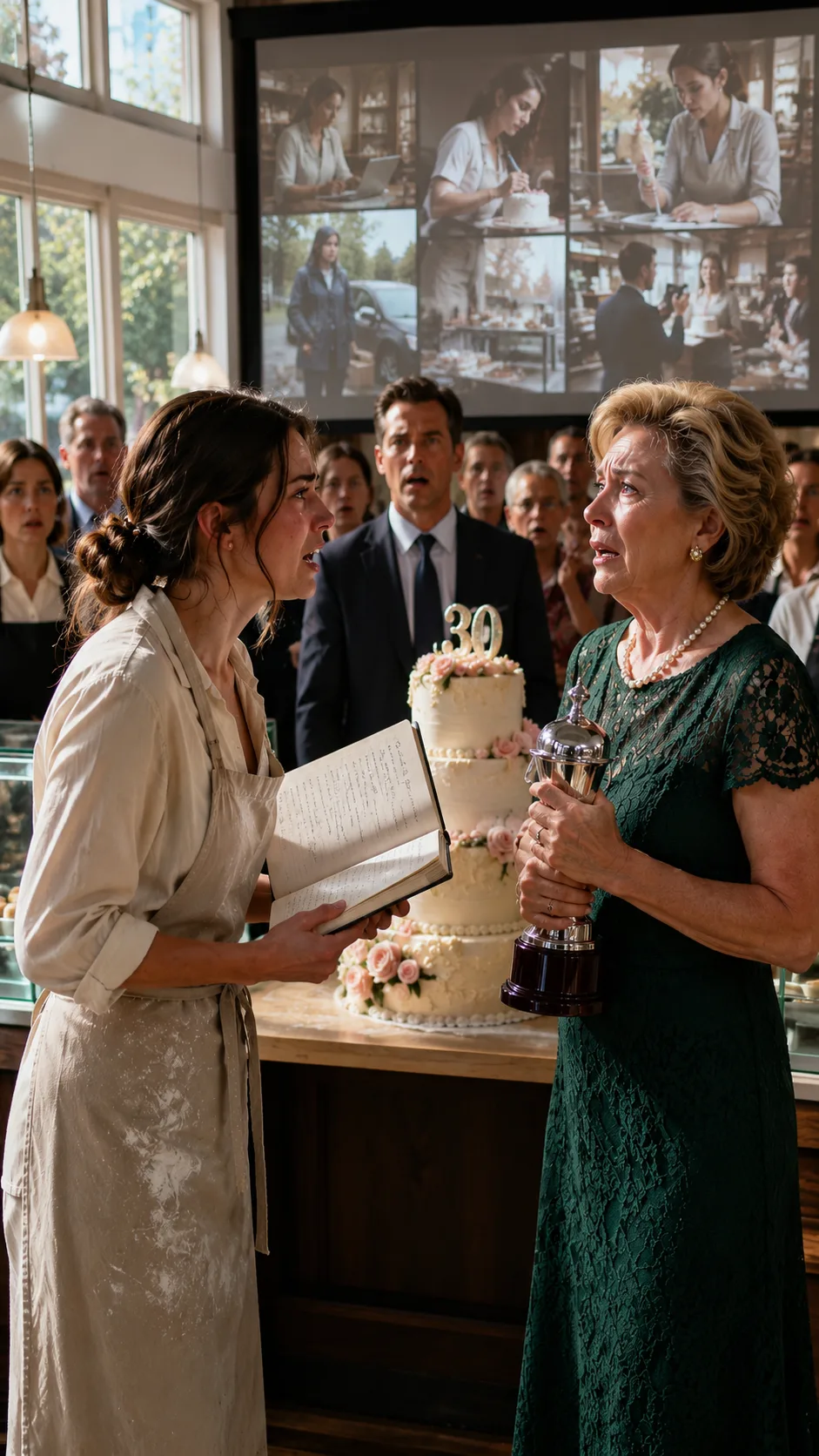
My Mother-in-Law Accepted an Award for My Work — But One Video Destroyed Her Perfect Lie
Part 1
The first thing I learned about Bennett’s Bakery was that it smelled better than it looked.
Chapter 1
My Mother-in-Law Accepted an Award for My Work — But One Video Destroyed Her Perfect Lie
Part 1
The first thing I learned about Bennett’s Bakery was that it smelled better than it looked.
The smell was warm butter, cinnamon, vanilla, toasted almonds, and sugar melting into something that made strangers slow down outside the window. But the place itself looked tired. The paint on the front door had peeled at the corners. The glass display case had scratches from thirty years of elbows and impatient fingers. The sign above the register still said “Cash Only” even though half the town paid with their phones.
When I married James Bennett, everyone told me I was lucky.
“Bennett’s Bakery is a town treasure,” they said.
“Carol built that place from nothing,” they said.
“You’re marrying into a legacy.”
I believed them.
Carol Bennett, my mother-in-law, certainly believed it. She moved through the bakery like a queen returning to her court. She wore pearl earrings even when she was only stopping by for ten minutes. She called the regular customers “my people.” She kept framed newspaper
clippings on the wall from years ago, back when the bakery had won local awards and lines stretched out the door on Sunday mornings.
But by the time I entered the family, the lines were gone.
The first week after our honeymoon, I found three overdue notices hidden behind a stack of holiday cake boxes in the back office. The second week, I watched a supplier refuse to unload flour until James paid half the balance owed. The third week, one of the part-time bakers quit because her paycheck was late for the second month in a row.
James stood behind the counter that morning, rubbing his forehead.
“I don’t know what happened,” he muttered.
Carol, who had come in wearing a cream blazer and lipstick the color of cherries, sighed dramatically.
“What happened,” she said, “is that people don’t respect tradition anymore.”
I was standing near the oven, tying
my apron. “Maybe tradition needs help.”
Carol turned toward me slowly. Her eyes moved from my face to my flour-dusted hands.
“Sweetheart,” she said, smiling without warmth, “you’ve been here three weeks.”
I nodded. “I know.”
“This bakery has been here thirty years.”
“I know that too.”
“Then maybe listen before you try to fix what you don’t understand.”
James gave me that look husbands give when they want peace more than truth.
“Olivia,” he said gently, “Mom knows this place.”
And just like that, I became quiet.
For a while.
I had been a pastry chef before marrying James. Not a famous one. Not one with cookbooks or television appearances. But I had worked in kitchens since I was nineteen. I knew how to stretch ingredients, how to cost a menu, how to redesign a display case so people bought with their eyes before their wallets. I knew when
a cake was too sweet for modern customers and when a crust needed salt more than sugar.
More than anything, I knew when a business was dying.
Bennett’s Bakery was dying.
Slowly, politely, with framed memories on the walls and Carol’s perfume floating over unpaid bills.
So I started working after everyone left.
At first, I told myself I was only helping. I stayed an extra hour to clean the ovens properly. Then two hours to test a lemon mascarpone tart. Then three hours to photograph cookies by the front window, because natural light made them look softer than the yellow bulbs above the display case.
I made an Instagram account for the bakery. Carol hated it.
“Our customers don’t need that nonsense,” she said.
“Our old customers don’t,” I replied. “New ones might.”
She raised an eyebrow. “You think you know our customers better than I do?”
I looked at the empty café tables.
“I think we need more of them.”
That was the first time she stopped pretending to be amused by me.
But the posts worked.
A photo of my honey-lavender cupcakes got shared by a local food blogger. A short video of me glazing strawberry danishes brought in a group of college girls the next morning. I started a weekend family box with mini pastries, cinnamon rolls, and handwritten notes. Parents came in with kids. Kids pressed their faces against the glass. People started ordering birthday cakes again.
The bakery breathed.
And Carol took credit for every breath.
A customer would say, “These raspberry almond croissants are incredible.”
Carol would sweep in before I could answer.
“I taught Olivia everything,” she would say, placing one hand on my shoulder. “She’s finally learning the Bennett way.”
The first time, I laughed because I thought she was joking.
The second time, I froze.
The third time, I said, “Actually, this recipe is one I developed last month.”
Carol smiled at the customer, then looked at me as if I had dropped a tray on purpose.
“What Olivia means,” she said, “is that I encouraged her to experiment.”
After the customer left, she pulled me into the back hall.
“You embarrassed me.”
My mouth fell open. “I embarrassed you?”
“You corrected me in front of a customer.”
“I told the truth.”
Carol stepped closer, lowering her voice. “In this family, we don’t fight over credit like children.”
I almost laughed. Not because it was funny, but because the woman stealing credit from me had just called me childish for noticing.
That night, James found me at the kitchen table with my laptop open and spreadsheets scattered around me. I had calculated supplier costs, projected seasonal sales, and a plan to pay down the bakery’s oldest debt within fourteen months if we stopped wasting money on products that didn’t sell.
He kissed the top of my head.
“You’re amazing,” he said.
I looked up at him. “Then why don’t you say that when your mother tells people she taught me everything?”
He sighed.
And I hated that sigh.
It was the sound of a man preparing to ask his wife to swallow something sharp because he didn’t want to touch it.
“Liv, Mom’s proud. That’s all.”
“She’s not proud of me. She’s using me.”
“She’s older. The bakery was her whole life.”
“It’s becoming mine too.”
He sat across from me, tired eyes soft but useless.
“Can you just let her have it sometimes?”
I stared at him.
“Let her have what?”
“A little recognition.”
I looked down at the spreadsheet. At the numbers I had fought with all evening. At the notes from suppliers I had begged for extra time. At the list of new recipes I planned to test before sunrise.
“A little,” I said.
That was what I gave Carol.
A little.
Then a little more.
Then so much that one day, I looked around and realized I was standing in the dark while she stood under every light I had paid to turn back on.
Part 2
The year we saved the bakery, Carol told everyone she had expected it all along.
“We just needed to return to our roots,” she said during a small interview with the local paper.
I was standing behind the reporter, holding a tray of orange-cardamom brioche I had created after six failed attempts and one burned saucepan.
The reporter asked, “Mrs. Bennett, what inspired the new menu?”
Carol didn’t even glance at me.
“Experience,” she said. “After thirty years, you learn what people need before they know it themselves.”
Mia, one of our youngest employees, dropped a stack of napkins behind the counter.
I looked over.
Her face was bright red.
After the reporter left, she followed me into the kitchen.
“You can’t keep letting her do that,” she whispered.
I slid a tray into the oven. “Do what?”
Mia stared at me.
“Olivia.”
I wiped my hands on my apron. “She’s James’s mother.”
“And you’re the reason we still have jobs.”
I smiled, but it came out tired. “That’s kind of you.”
“It’s not kind. It’s true.”
Mia had started at the bakery when she was twenty-one, shy and nervous, asking if she could work mornings because she was taking community college classes at night. I had trained her on the register, then on decorating cupcakes, then on customer service. She saw things most people didn’t. She saw me sit in the storage room after closing with my head in my hands. She saw me carry flour sacks when James forgot to reorder help. She saw me sleep for twenty minutes on a folded tablecloth before the Valentine’s Day rush.
She also saw Carol.
Carol arriving at noon and complaining the croissants were too dark.
Carol taking photos with cakes she had not touched.
Carol telling customers, “My Olivia still needs guidance, but she has potential.”
My Olivia.
As if I were a project.
As if I were dough she had shaped.
The final straw came three weeks before the bakery’s thirtieth anniversary.
Carol called a family meeting in the café after closing. James was there. His younger sister Rebecca came with her husband. A few cousins sat at the tables, eating leftover cookies. Carol stood near the display case with a green folder pressed to her chest.
“I have wonderful news,” she announced.
James smiled. “What news?”
Carol lifted her chin. “The town business association is giving Bennett’s Bakery a special anniversary award.”
I actually felt happy.
For one full second.
Then Carol continued.
“They’re calling it the Soul of the Bakery award. And they’ve asked me to accept it at the anniversary celebration.”
The room erupted with congratulations.
Rebecca clapped. James hugged his mother. A cousin said, “Nobody deserves it more.”
I stood still behind the counter.
Mia, who was wiping the espresso machine, stopped moving.
Carol looked at me and smiled.
“Don’t worry, Olivia. I’ll mention your help.”
Your help.
My help.
I heard the ovens humming behind me. I heard the refrigerator click on. I heard the blood rushing in my ears.
James noticed my face and came over.
“Hey,” he said quietly. “You okay?”
“Did you know?”
He hesitated.
That was enough.
“You knew.”
“Mom told me yesterday.”
“And you didn’t think to tell me?”
“I was going to.”
“When? After she accepted the award?”
His jaw tightened. “Liv, please don’t make this ugly.”
I laughed once.
It was a small, ugly sound.
“I’m making it ugly?”
Carol approached, still holding the folder.
“Is there a problem?”
I looked at her. “Who nominated you?”
She blinked. “Excuse me?”
“Who nominated you for the award?”
Her smile thinned. “Several people understand what I’ve done for this bakery.”
Mia stepped forward before I could stop her.
“That’s funny,” she said. “Because we all know who’s been doing the work.”
Carol’s eyes snapped toward her.
“You’re an employee. Remember that.”
Mia’s hand tightened around the rag she was holding.
“And you’re barely here,” she said.
The room went silent.
Carol looked as if Mia had slapped the pearls off her neck.
James said, “Mia, that’s enough.”
“No,” I said.
Everyone turned to me.
My voice surprised even me. It wasn’t loud. It wasn’t shaking. It was worse.
It was done.
“No, James. It’s not enough. None of it is enough. Your mother doesn’t get to rewrite reality just because everyone is too polite to correct her.”
Carol’s face hardened.
“After everything I allowed you to do here?”
“Allowed me?”
“This is my family’s bakery.”
“It was closing.”
A cousin sucked in a breath.
Carol stepped closer. “Careful.”
I took off my apron and placed it on the counter.
James looked alarmed. “Olivia.”
I turned to him. “Did you ever ask how the suppliers got paid last winter?”
He frowned. “What?”
“Did you ever ask why the payroll cleared when the account was short?”
Carol’s eyes flickered.
Just once.
But I saw it.
James looked between us. “What are you talking about?”
Carol spoke quickly. “This is not the time.”
I almost told him everything right then.
That I had used my personal savings.
That I had taken weekend catering orders under the bakery’s name and put every dollar back into the business.
That I had negotiated with vendors who would no longer take Carol’s calls.
That I had sat across from our landlord with a payment plan while Carol told her bridge club she was “mentoring the younger generation.”
But I stopped.
Not because I was afraid.
Because I finally understood something.
Carol didn’t fear losing the bakery.
She feared losing the story.
And if I told the truth in that small room, she would twist it by morning.
So I picked up my bag.
“I’ll bake for the anniversary,” I said. “Because the bakery deserves that. But after that, things change.”
Carol gave a cold little laugh.
“You think people came back because of you?”
I looked at the display case full of my recipes.
“No,” I said. “I think they came back because the bakery finally stopped pretending yesterday was enough.”
Then I walked out.
For the next three weeks, I worked harder than I ever had.
Not for Carol.
Not for James.
For the bakery.
For the employees who depended on their checks.
For the customers who brought their kids after school.
For the old man who bought one blueberry muffin every Tuesday and told me his wife used to love this place.
For myself.
What I didn’t know was that Mia had started recording.
Not secretly in a cruel way. Not to trap anyone. She had been making behind-the-scenes clips for the bakery’s anniversary slideshow. At first, it was harmless: me decorating cookies, me pulling bread from the oven, me laughing with staff during a failed batch of caramel. Then she started noticing the contrast.
Me arriving before sunrise.
Carol arriving when cameras appeared.
Me carrying boxes in the rain.
Carol telling a reporter, “I still personally oversee every detail.”
Me sitting in the office with bills.
Carol placing her hand over mine in front of customers and saying, “She’s come so far under my guidance.”
Two nights before the anniversary, Mia came to me while I was piping roses onto the celebration cake.
“Olivia,” she said carefully, “I need to show you something.”
She opened her laptop.
The video was twelve minutes long.
By the end of it, I couldn’t speak.
There I was, night after night, month after month, year after year. Not glamorous. Not perfect. Tired. Sweaty. Sometimes crying. Sometimes laughing. Always working.
And there was Carol, appearing only for applause.
I closed the laptop gently.
“No.”
Mia’s face fell. “But—”
“No, Mia.”
“People need to know.”
“I’m not turning the anniversary into a battlefield.”
“She already did.”
I looked toward the front of the bakery, where Carol had ordered gold balloons and a banner with her old newspaper photo enlarged in the center.
Mia lowered her voice.
“She’s going to erase you in front of everyone.”
I whispered, “Then let her.”
Mia stared at me like she didn’t recognize me.
But the truth was, I didn’t recognize myself either.
Part 3
The morning of the anniversary, I arrived at four-thirty.
The town was still dark. The bakery windows reflected my own face back at me as I unlocked the door. I looked older than thirty-five. Not because of wrinkles, but because of what silence had carved into me.
I turned on the ovens.
By six, the kitchen smelled like vanilla sponge, browned butter, espresso cream, roasted peaches, and sugar syrup. By eight, the staff arrived. By ten, the display cases were full. By noon, the three-tier anniversary cake stood in the center of the café, covered in pale buttercream roses and tiny gold flakes.
Carol arrived at one.
The party started at two.
She walked in wearing an emerald lace dress, pearl necklace, and the expression of a woman prepared to be adored. She kissed the air beside my cheek.
“Beautiful cake,” she said.
“Thank you.”
She leaned closer. “Try to smile today, Olivia. This day means a great deal to me.”
I looked at her.
“It means a great deal to me too.”
Something in my voice made her pause.
Then Rebecca called her name, and Carol turned toward the guests.
The bakery filled quickly. Relatives. Customers. Local reporters. The mayor. Suppliers who had once threatened to cut us off and now shook James’s hand like everything had always been fine. The staff wore white shirts and black aprons. Mia avoided my eyes.
I knew she was upset with me.
I didn’t blame her.
For the first hour, everything went smoothly.
People complimented the cake. Carol accepted the compliments.
People praised the new menu. Carol nodded as if she had dreamed every recipe.
One woman said to me, “You must be so proud to have learned from Carol.”
I smiled until my cheeks hurt.
Then the ceremony began.
A small podium had been placed near the cake. Behind it, a projector screen hung against the back wall, ready for the anniversary slideshow. James stood beside me, his hand lightly touching my lower back.
“You did a great job,” he whispered.
I looked at him.
“Did I?”
He frowned, confused.
Before he could answer, the host tapped the microphone.
“Today we celebrate thirty years of Bennett’s Bakery, a beloved family business that has fed this town through birthdays, graduations, weddings, and Sunday mornings.”
Everyone clapped.
The host continued, “And now, we are honored to present the Soul of the Bakery award to Mrs. Carol Bennett.”
Carol rose before he finished saying her name.
The applause was loud.
She walked to the podium slowly, soaking in every second. She accepted the trophy with both hands. She kissed the host’s cheek. Then she turned to the room.
“I don’t know what to say,” she began.
I almost laughed.
Carol always knew what to say.
“This bakery has been my life,” she continued. “My heart. My sacrifice. For thirty years, I have poured myself into these walls.”
People nodded.
“I have protected our family recipes. I have trained those who came after me. I have guided Olivia, my daughter-in-law, and watched her grow from someone who knew very little about our traditions into someone useful to this business.”
Useful.
The word landed in my chest like a dropped pan.
James stiffened beside me.
Carol smiled down at me.
“Olivia is a lucky young woman,” she said. “Not every daughter-in-law gets a mother who teaches her how to succeed.”
A few people clapped politely.
My hands went cold.
Carol lifted the trophy higher.
“If this bakery survived, it is because I refused to let it die.”
That was when the screen behind her turned on.
At first, I thought it was a mistake.
The room went dimmer as the projector brightened. Carol turned, smiling, expecting old photos.
Instead, my face appeared on the screen.
It was security camera footage from the kitchen.
2:17 a.m.
I stood alone at the steel table, hair falling loose from my bun, both hands pressing dough. There were dark circles under my eyes. A notebook lay open beside me.
No one moved.
The clip changed.
I was in the office, speaking into the phone.
“I understand the balance is overdue,” my recorded voice said. “But if you give us two more weeks, I can send half now and half after the weekend orders clear.”
James’s hand fell from my back.
The clip changed again.
Rain hammered the windshield of my car. I carried bakery boxes across a driveway, holding my coat over them so they wouldn’t get wet.
Another clip.
I sat on the floor of the storage room, counting cash into envelopes labeled with employees’ names.
Mia’s voice came from somewhere behind the crowd, small but clear.
“I made the slideshow.”
Carol spun around.
“Mia, turn it off.”
Mia stood near the laptop, pale but steady.
“No.”
A gasp moved through the room.
Carol’s face twisted. “You have no right.”
Mia’s hand hovered over the keyboard. “I didn’t make anything up.”
The video continued.
Carol appeared on screen now.
She stood near the front display case, adjusting her necklace while a local reporter waited.
“Move that tray closer,” she said in the footage. “The camera should see me with the new cakes.”
A staff member asked, “Should Olivia explain the recipe?”
Carol laughed.
“No, sweetheart. People want the Bennett story, not the kitchen notes.”
The room went completely still.
I felt James turn toward me.
“Olivia,” he whispered.
But I couldn’t look at him.
The video changed one final time.
I was in the kitchen, late again, speaking to Mia without knowing the camera was still running.
Mia asked, “Why do you let Carol say she taught you everything?”
On screen, I smiled tiredly.
“Because if I correct her, James gets hurt. If I stay quiet, only I do.”
Someone in the room made a soft, broken sound.
It was Rebecca.
Carol’s hands shook around the trophy.
“This is disgusting,” she said, but her voice was thin now. “This is a family celebration.”
I walked forward.
Not fast. Not dramatically. Just one step, then another, until I stood beside her at the podium.
The room watched us.
For years, I had imagined what I would say if the truth ever came out. I thought I would be furious. I thought I would shout. I thought I would list every unpaid bill, every sleepless night, every recipe she stole with a smile.
But standing there, beside a woman clutching a trophy like a life raft, I didn’t feel rage.
I felt tired.
And free.
I reached for the old recipe notebook sitting near the cake. Mia must have placed it there. The cover was stained with butter and coffee. The corners were bent. Some pages were wrinkled from steam.
I opened it and turned it toward the room.
“These are not secrets,” I said. “They’re just things nobody asked to see.”
Carol whispered, “Don’t.”
I looked at her.
“Why?”
Her mouth opened, then closed.
“Because they’ll think I did nothing.”
“No,” I said softly. “They’ll think you did something once. And then couldn’t bear that someone else did something after you.”
Her eyes filled.
That was the first honest thing her face had done all day.
James stepped toward us.
“Mom,” he said, voice rough. “Is it true? Did Olivia pay the suppliers last winter?”
Carol stared at the floor.
“Carol,” he said.
She snapped, “I was trying to protect this family.”
I turned to him. “I used my savings.”
His face changed.
Not all at once.
Piece by piece.
His eyebrows drew together. His mouth opened slightly. His eyes shifted from me to his mother, then back to me.
“How much?” he asked.
“Enough.”
“That’s not an answer.”
“No,” I said. “It’s the only answer I’m giving in front of everyone.”
Carol began crying then, but not beautifully. Her chin trembled. Her mascara gathered under one eye. The trophy lowered slowly until it rested against her stomach.
“I was the bakery,” she said. “Before you came, I was the one people came to see. I knew every customer. I knew every wedding cake, every birthday order. Then suddenly everyone wanted your lemon tarts and your online boxes and your little videos. I didn’t know where I belonged anymore.”
The room stayed silent.
For the first time, Carol sounded less like a queen and more like an old woman terrified of an empty throne.
I breathed in slowly.
“You could have stood beside me,” I said. “You chose to stand on top of me.”
Her eyes squeezed shut.
James looked ashamed. “Olivia, I should have seen it.”
“Yes,” I said.
The word was simple.
It hurt him more because I didn’t soften it.
“You should have.”
He nodded, eyes wet. “I’m sorry.”
“I know.”
But sorry did not erase years.
A man in the crowd stood up. Mr. Henry, one of our oldest customers, leaned on his cane and looked at Carol.
“I remember when Olivia came to my house with a box of pastries,” he said. “She asked what my wife used to buy before she passed. Next week, orange rolls were back in the case.”
He turned to me.
“My Margaret loved those.”
His voice cracked.
“She would have liked knowing who remembered.”
Then Mia started clapping.
One clap.
Then another.
Then the staff joined.
Then the customers.
Then Rebecca.
Finally, almost the whole room was standing.
I did not smile. Not at first.
Because this was not victory the way people imagine it.
Victory did not feel like fireworks.
It felt like setting down a heavy tray you had carried so long your arms forgot how to be empty.
Carol looked at the trophy in her hands.
Then, slowly, she held it out to me.
I shook my head.
Gasps moved through the crowd.
“I don’t want it,” I said.
Carol blinked through tears.
“You deserve it.”
“Maybe.”
“Then take it.”
I looked around the bakery. At the cake. The staff. The customers. The sun coming through the windows. The display case full of recipes I had built from exhaustion and hope.
“No,” I said. “I don’t need your trophy. I need my name.”
Carol’s lips parted.
I turned to the crowd.
“My name is Olivia Bennett. I am the head baker of Bennett’s Bakery. I created the current menu, rebuilt the customer base, negotiated the vendor plans, and kept this place open when it was days from closing.”
My voice shook once, but I did not stop.
“And I am done pretending silence is kindness.”
No one spoke.
Then James stepped beside me.
“My wife saved this bakery,” he said.
I looked at him.
He looked back, tears standing in his eyes.
“And I let her do it alone.”
That confession broke something open in me. Not enough to fix everything. But enough to let air in.
Carol covered her mouth with one hand.
“I’m sorry,” she whispered.
I turned to her.
“I believe you.”
Her shoulders dropped in relief.
“But I don’t trust you yet.”
The relief vanished, but she nodded.
That was new.
Carol Bennett, for once, did not argue with the truth.
The rest of the celebration changed shape after that. People still ate cake, but quietly at first, like they were learning how to stand in a room after the walls had moved. The reporter asked me for an interview. I said yes, but only if Mia and the whole staff were photographed with me.
Carol sat at a corner table with Rebecca, holding a cup of coffee she never drank.
James stayed near me, not touching me unless I reached for him first.
That evening, after the last guest left and the floor was sticky with spilled punch, Carol came into the kitchen.
I was washing frosting from a bowl.
She stood near the doorway.
“I don’t know how to be forgotten,” she said.
I turned off the water.
“You were never being forgotten.”
She looked at me like she wanted to believe it.
“You were being joined,” I said. “There’s a difference.”
Her face crumpled.
“I hated you for being good at it.”
“I know.”
“I hated that James looked at you like you had answers I didn’t.”
“He didn’t look closely enough at either of us.”
That made her laugh once through tears.
“No,” she said. “He didn’t.”
For a moment, we were not enemies. We were two women standing in a kitchen that had consumed us in different ways.
Carol wiped her cheek.
“What happens now?”
I looked at the ovens, the racks, the flour bins, the life I had nearly lost myself inside.
“Tomorrow we open at six,” I said. “The menu stays. The staff gets raises when the spring numbers come in. And the story on the wall changes.”
“The story?”
I nodded toward the framed newspaper clippings in the café.
“No more pretending one person built this place.”
Carol swallowed.
“And me?”
“You can be part of the story,” I said. “But not all of it.”
The next morning, Bennett’s Bakery opened with a line outside.
The article had gone live before sunrise.
The headline read: “Bennett’s Bakery Celebrates 30 Years and the Woman Who Rebuilt It.”
For once, the photo showed the truth.
Mia stood on my left. James stood on my right. The staff filled the frame behind us. Carol was there too, slightly to the side, not erased, not centered.
Just present.
At seven-thirty, Carol walked in wearing a simple cardigan instead of pearls. She tied on an apron without making an announcement.
Mia froze.
James froze.
I raised an eyebrow.
Carol looked at me and said, “Where do you need me?”
It was not enough.
But it was a beginning.
I handed her a tray of unfilled cream puffs.
“Start there.”
She nodded and carried them to the worktable.
A customer near the register pointed at the orange rolls in the case.
“These are wonderful,” she said. “Who made them?”
Carol’s hand paused over the tray.
Everyone in the bakery seemed to hold their breath.
Then Carol looked toward me.
“Olivia brought those back,” she said. “She remembered what mattered.”
I looked down before anyone could see my eyes fill.
The bakery smelled like butter, sugar, and something new.
Not forgiveness.
Not yet.
But maybe room for it.
And for the first time since I married into the Bennett family, I was not standing in anyone’s shadow.
I was standing in the light I had earned.
THE END.
Chapter complete
You have reached the end of this chapter.
Continue reading
A few more worlds to get lost in after this chapter.




