I spent twenty-two years telling people my mother didn't love me.
Chapter 1
I spent twenty-two years telling people my mother didn't love me.
If you had asked me why I left home at fifteen, I would have answered without hesitation.
Because Rose Bennett threw me out.
That was the story.
The only story.
And for most of my life, I never questioned it.
I grew up in a small town outside Albuquerque, New Mexico, in a weather-beaten house that always smelled faintly of coffee and desert dust. It wasn't much, but when I was young, it felt like the whole world.
Back then, it was just my mother and me.
My father had died when I was six—or at least that's what I was told.
There were no grandparents around.
No cousins.
No family gatherings.
Just Rose.
She worked long shifts at a diner off Route 66 and somehow kept food on the table even when money was scarce.
When I was little, I adored her.
When I turned fifteen, I hated her.
The change happened in a single afternoon.
I came home from school to find two suitcases sitting beside the front door.
At first I thought we were moving.
Then I saw my mother standing in the kitchen.
She looked like she hadn't slept in days.
"Pack the rest of your things," she said.
I laughed.
I thought she was joking.
She wasn't.
I remember every detail.
The faded yellow curtains.
The hum of the refrigerator.
The way her hands wouldn't stop shaking.
"Where am I supposed to go?" I asked.
"You'll stay with your uncle."
"I don't have an uncle."
"Yes, you do."
That was the first strange thing she ever said.
But I was too angry to notice.
I shouted.
She shouted back.
Then she said the sentence that followed me for the next twenty-two years.
"You need to leave. Today."
No explanation.
No apology.
No hug.
Nothing.
Just
those words.
Three hours later I was sitting on a bus headed toward Illinois.
I cried the entire trip.
Rose never came after me.
Never called.
Never wrote.
At least not that I knew.
For years I waited.
Then I stopped.
Eventually anger became easier than hope.
I finished high school in Illinois living with a man named Frank Bennett—a distant relative I had never met before that day.
Frank was kind but quiet.
Whenever I asked about my mother, he changed the subject.
I assumed she had told him not to discuss her.
I built a life anyway.
Community college.
Construction work.
Marriage.
Divorce.
A few good years.
A few bad ones.
Through all of it, one belief remained constant.
My mother chose to get rid of me.
And that belief hardened with age.
Then one Tuesday morning, my phone rang.
The number was unfamiliar.
"Mr. Bennett?"
"Yes."
"My
name is Sandra. I'm calling from St. Joseph Medical Center in Albuquerque."
I sat up immediately.
The nurse hesitated.
"Your mother listed you as her emergency contact."
I almost laughed.
Emergency contact?
After twenty-two years?
"She's very sick."
Silence.
Then came the question.
"Can you come?"
I should have said no.
Part of me wanted to.
Instead I booked a flight.
Two days later I walked into her hospital room.
The woman in that bed barely resembled the mother I remembered.
Her hair had turned silver.
Her shoulders looked smaller.
Fragile.
For a long moment neither of us spoke.
Then she smiled.
Not a big smile.
Just enough to recognize me.
"Daniel."
Hearing my name in her voice felt strange.
Like opening a box you forgot you owned.
"I came because the nurse called," I said.
She nodded.
"I know."
That was our entire conversation.
For the first week.
I visited every day.
We talked about weather.
Doctors.
Hospital food.
Anything except the past.
And every single day, I noticed the same thing.
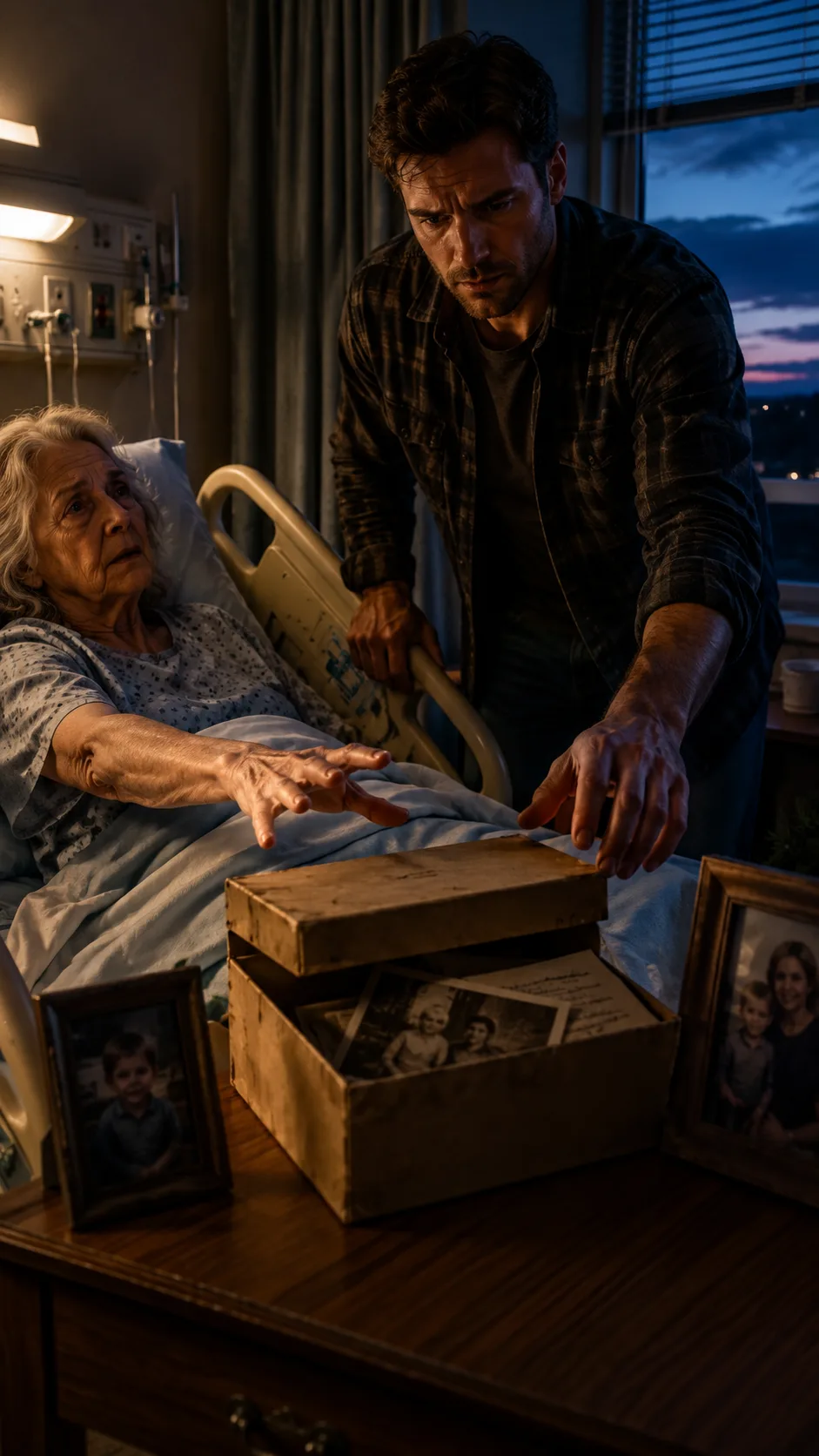
An old cardboard box sitting on the bedside table.
It wasn't large.
Maybe the size of a shoebox.
The corners were worn.
The lid had been taped and retaped over the years.
Rose never let it leave her sight.
If a nurse moved it, she moved it back.
If someone set a tray in front of it, she cleared the space.
The box mattered.
I just didn't know why.
One afternoon I arrived early.
Rose was asleep.
The box sat beside her.
For the first time, I considered opening it.
My hand even touched the lid.
Then her eyes opened.
Immediately.
As if she had sensed it.
She looked at my hand.
Then at the box.
Neither of us said a word.
I pulled away.
The next day her condition worsened.
Doctors came and went.
More tests.
More whispered conversations in hallways.
That night I stayed longer than usual.
The room was dark except for a small lamp.
Rose stared at the box.
Then she looked at me.
Finally she spoke.
"Tomorrow."
Just one word.
Tomorrow.
The next afternoon she asked the nurse to leave.
Then she motioned for me to sit beside her.
I did.
Her breathing sounded shallow.
Careful.
Measured.
As if every breath required effort.
Then she pointed toward the box.
"Open it."
For a moment I didn't move.
After twenty-two years of questions, the answer suddenly felt terrifying.
Still, I reached for the lid.
Inside were dozens of photographs.
Letters.
Receipts.
Newspaper clippings.
And one photograph lying on top.
I picked it up.
The picture showed my mother standing beside a tall man I had never seen before.
Both were smiling.
Both looked young.
I turned the photo over.
A handwritten note covered the back.
Keep Daniel away from him. Promise me.
My stomach tightened.
"What is this?"
Rose closed her eyes.
Then opened them again.
Tears gathered immediately.
"The man in that photograph wasn't your father."
I frowned.
"What?"
She pointed weakly toward the picture.
"That's your father."
The room went silent.
I stared at her.
Then at the photograph.
Then back at her.
"No."
"It's true."
For a moment I couldn't breathe.
Everything I knew suddenly felt unstable.
"My father died."
Rose shook her head.
"No."
I stood.
The chair scraped loudly across the floor.
"You lied to me?"
"For your safety."
I laughed once.
A bitter sound.
"Safety?"
Her chin trembled.
Then she reached into the box and pulled out an old newspaper clipping.
I took it.
The headline froze me.
Federal Fugitive Captured After Interstate Investigation.
Below the headline was the same man from the photograph.
My father.
Rose watched my face.
"He wasn't a good man, Daniel."
I couldn't speak.
"He disappeared when you were six."
I stared at the article.
"He came back when you were fifteen."
My head snapped up.
"What?"
Tears slid down her cheeks.
"He found us."
Every muscle in my body tightened.
Rose continued.
"He wanted you."
The room suddenly felt smaller.
"He told me if I didn't let him take you, he'd come anyway."
I looked at the photograph again.
At the note.
At the article.
At the dates.
Everything lined up.
Everything.
Rose took a shaking breath.
"The only person I trusted was Frank."
My uncle.
Illinois.
The bus ticket.
The sudden move.
The strange goodbye.
All of it.
Not rejection.
Protection.
"You sent me away."
"Yes."
"To save me."
"Yes."
Twenty-two years of anger cracked in a single second.
I sat back down.
Slowly.
The woman I'd hated for half my life wasn't the villain of the story.
She was the person who sacrificed everything.
Rose wiped at her eyes.
"I knew you'd hate me."
I couldn't answer.
Because she was right.
I had hated her.
For decades.
She looked toward the window.
"I thought you'd come back sooner."
That hurt more than anything else.
Because she had waited.
All those years.
Every photograph in the box proved it.
There were pictures of my high school graduation.
Pictures from my wedding.
Pictures from newspaper articles mentioning construction projects I'd worked on.
I never sent any of them.
She had found them herself.
Collected them.
Saved them.
Every milestone.
Every achievement.
Every year.
Without me knowing.
"I never stopped watching over you."
My throat tightened.
"I never stopped being your mother."
For the first time since arriving in Albuquerque, I cried.
Not loudly.
Not dramatically.
Just quietly.
Like a man mourning twenty-two years he could never get back.
Rose reached for my hand.
I took it.
And this time, I didn't let go.
She passed away three weeks later.
Peacefully.
The funeral was small.
Just a few friends from town.
The nurses who had cared for her.
And me.
Afterward, I took the cardboard box home.
Today it sits on a shelf in my living room.
I open it sometimes.
Not because I need answers anymore.
But because it reminds me of something important.
The deepest wounds in our lives are not always caused by betrayal.
Sometimes they're caused by sacrifices we don't understand until it's too late.
And every time I see that photograph, I remember the truth my mother carried alone for twenty-two years.
Rose Bennett never abandoned her son.
She saved him.
Even if it cost her everything.
THE END.
Chapter complete
You have reached the end of this chapter.
Continue reading
A few more worlds to get lost in after this chapter.




