Elena Whitmore found the missing button under her father’s recliner two weeks after his funeral.
Chapter 1
Elena Whitmore found the missing button under her father’s recliner two weeks after his funeral.
It was small, brown, and shaped like the ones from the cardigan he wore every winter, even when the house was too warm. She held it between her thumb and forefinger, crouched beside the chair, and stared at the indentation his slippers had left in the rug.
The room still smelled faintly of cedar, throat lozenges, and old paper.
Her father had kept the den in perfect disorder. Stacks of history books leaned against the wall. A coffee mug full of dull pencils sat on the windowsill. There was a chipped ceramic owl on his desk that Elena had made in fourth grade, ugly enough that she had tried to throw it away twice. He had rescued it both times.
Now the house had gone too clean.
Her mother had been through it.
That was the first thing Elena noticed after the funeral. Not the silence. Not the empty hallway.
Not the way the grandfather clock seemed louder without her father humming along to it.
The drawers had been arranged.
Her father never arranged anything. He believed useful things should stay where a hand remembered them. Receipts in the top desk drawer. Extra batteries inside a blue mug. Old birthday cards in a shoebox beneath the filing cabinet.
But now the drawers slid open too easily. Papers had been squared. Rubber bands had been sorted by size. The shoebox was gone.
Elena stood in the den with the button in her palm when her mother appeared in the doorway.
Patricia Whitmore did not knock inside her own house. She paused just long enough to make other people feel caught.
“You’re still here,” Patricia said.
Elena closed her fingers around the button.
“I’m clearing Dad’s books.”
“That can wait.”
Patricia wore black, but not mourning black. Not the rumpled, shapeless kind
people fall into when grief has weight. Her dress was tailored. Her pearl earrings sat perfectly against her neck. Her reading glasses hung from a thin gold chain, polished enough to catch light from the hall.
She looked ready for a meeting.
Maybe she was.
“There are papers we need to handle,” Patricia said.
Elena stood.
“What papers?”
“Estate papers.”
The word estate sounded wrong in Patricia’s mouth. Elena’s father would have hated it. He called the house “the place with the leaky gutter.” He called the lake cabin “that mosquito trap.” He called his savings “your mother’s worry fund.”
Patricia turned away before Elena could answer.
“Dining room,” she said. “Ten minutes.”
No please.
Never please.
Elena set the button on her father’s desk beside the ceramic owl. One small thing back where it belonged.
Then she followed.
The dining room table had already been prepared.
That was how
Elena thought of it later. Prepared. Not set. Not used. Prepared like a stage.
There was a folder in front of Patricia’s seat. A black pen beside it. A glass of water that no one drank. The chairs had been pushed in except one: Elena’s, pulled back just enough to tell her where to sit.
Her mother sat at the head of the table.
Not her father’s chair.
The other end.
It still mattered.
Elena sat without touching the pen.
Patricia opened the folder and removed three pages. She placed them in front of Elena, tapping the top sheet once with a manicured nail.
“You’ll need to sign this acknowledgment.”
Elena looked down.
The document was clean. Too clean. Legal language filled the page in tight blocks, but her eyes went straight to the signature line near the bottom.
Her father’s name was already there.
Arthur James Whitmore.
Her mouth went dry.
She did not pick up the paper.
“What is this?”
“A copy of your father’s final will.”
“Final?”
“Yes.”
Patricia’s voice had the soft firmness she used with waiters, pharmacists, and anyone she thought might challenge her if allowed too much air.
“He amended it after his diagnosis. He wanted things simple.”
“Dad never said that.”
“He didn’t tell you everything.”
That sentence stayed on the table between them.
Elena looked at the second page.
The house to Patricia. The accounts to Patricia. The lake cabin to Patricia. The small investment fund her father had once called Elena’s “escape hatch” to Patricia.
Elena read the third page.
Then she read the first again.
Her name was wrong.
Elena Marie Whitmore.
Her middle name was Mae.
Her father knew that better than anyone. He had picked it after his grandmother, a woman Elena had never met but had heard about so often she could picture the yellow kitchen where she made peach jam.
Elena placed one finger beside the typed name.
“This is wrong.”
Patricia did not look down.
“It’s a clerical issue.”
“It’s my name.”
“It doesn’t change the meaning.”
“It should have been corrected.”
“Your father was very sick.”
Elena finally looked up.
Her mother’s face was still. Not blank. Managed.
That was worse.
Patricia slid the pen closer.
“Sign the acknowledgment, Elena.”
“No.”
A small word.
The room changed around it.
Patricia’s fingers rested on the edge of the folder. The pearl on her left earring trembled once, barely visible.
“No?” she said.
“I want to speak to an attorney.”
“You don’t need one.”
“I want one.”
Patricia leaned back.
The chair gave a quiet wooden creak.
“You are making this harder than it needs to be.”
Elena folded the papers and pushed them back.
“No. I’m making it slower.”
Patricia’s face did not move, but something in her eyes sharpened.
“Be careful with that tone.”
Elena almost laughed.
She was thirty-one years old. She had signed leases, paid taxes, sat through performance reviews, buried her father, and cleaned dried medicine from the bathroom sink with a toothbrush.
And still, her mother could use one sentence and make the room feel like childhood.
Elena stood.
“I’m taking a copy.”
Patricia’s hand came down on the pages.
“No.”
Elena looked at the hand.
Red nail polish. Thin gold wedding band. Perfect skin stretched tight over raised veins.
Her father’s signature sat half-covered beneath her palm.
“Why not?”
“Because it’s unnecessary.”
“Then it shouldn’t matter.”
Patricia lifted the papers and placed them back into the folder.
The conversation ended because Patricia decided it had.
That was how it had always worked.
Elena left the dining room without the copy.
But she had seen enough.
The first call came the next morning at 8:15.
“Elena, it’s your mother. I expect you to come by this afternoon. We can finish this properly.”
The second came at 3:40.
“This delay is disrespectful to your father’s memory.”
The third came after dinner.
“You are behaving like a stranger.”
Elena listened to all three while standing barefoot in her kitchen, a mug of cold coffee beside the sink. She did not call back.
The next day, she called the attorney whose name appeared on the document.
A receptionist answered. Elena gave her father’s name, then Patricia’s, then her own. There was a pause long enough for Elena to hear office sounds through the phone: typing, a printer, someone coughing in the background.
“I’m sorry,” the receptionist said. “Mr. Whitmore was never a client here.”
Elena looked at the yellow sticky note where she had written the number.
“Are you sure?”
“Yes.”
“Could there be another office location?”
“No. We have one office.”
Elena sat down.
The mug of coffee left a ring on the counter.
“Can you check again?”
The receptionist’s voice changed. Not kinder exactly. More careful.
“I already did.”
“Thank you.”
Elena hung up and stood in the kitchen until the refrigerator clicked on.
A fake attorney.
A wrong middle name.
A signature that floated where her father’s always pressed.
By itself, each mistake could have been explained.
Together, they made a shape.
The shape had her mother’s fingerprints on it before Elena had proof.
The nurse called two days later.
Her name was Lauren, and she had worn purple sneakers during every shift. Elena remembered that because her father used to call her “the woman with the grape shoes” when medication made him too tired for names.
“Elena?” Lauren said.
“Yes.”
“This is Lauren Reeves. I took care of your father at St. Agnes.”
Elena gripped the phone.
“Is everything okay?”
A useless question. Her father was dead.
Lauren did not answer it.
“I probably shouldn’t call you.”
Elena walked away from the kitchen window.
“What happened?”
“There were visitor logs,” Lauren said. “And cameras.”
Elena stopped.
“You need to request them.”
“Why?”
Lauren breathed out through her nose.
“I can’t say much. But your father asked for something to be documented near the end. I thought the family had already handled it.”
“What did he ask?”
A pause.
“He asked if the room camera was working.”
Elena’s hand tightened around the phone.
“The room camera?”
“It’s standard in certain monitored rooms, especially when patients are at fall risk. Families sign the disclosure during admission.”
“My mother signed everything.”
“I know.”
Another pause.
Then Lauren said, “Ask for the visitor logs from the last week. Especially the night before his final decline.”
“What time?”
“After two.”
The line went quiet for a second.
“Lauren.”
“Yes?”
“Why are you telling me this?”
Lauren’s voice dropped.
“Because he was kind to me when my son was sick. He remembered his name every time I came in.”
Then she hung up.
Elena stood in the middle of her apartment, phone still in her hand.
The next voicemail from Patricia arrived six minutes later.
“Elena, I am done waiting. If you think silence is going to intimidate me, you are mistaken.”
Elena played it twice.
Then she saved it.
The hospital resisted at first.
They sent forms. Then different forms. Then a records clerk named Dennis told Elena that camera access required legal authorization and a written request connected to estate matters or suspected misconduct.
Elena wrote the words carefully.
Suspected misconduct.
She printed the request at a copy shop between a nail salon and a vape store. The printer jammed twice. A teenage employee wearing one earbud fixed it with the patience of someone who had seen adults panic over worse.
“Legal stuff?” he asked.
“Family stuff,” Elena said.
He nodded like that explained everything.
She mailed one copy.
Then she emailed another.
Then she drove to St. Agnes and delivered a third to the records office in person.
Dennis was smaller than his voice.
He sat behind a counter with a plastic nameplate and a jar of peppermints. Elena placed the folder in front of him.
“My father was Arthur Whitmore. Room 417. I’m requesting visitor logs and any retained camera footage from the week before his death.”
Dennis adjusted his glasses.
“You know this can take time.”
“I know.”
“Sometimes footage is overwritten.”
“I know.”
He looked at her then.
Not at the form. At her.
“Who told you to ask?”
Elena said nothing.
Dennis tapped the papers into a neat stack.
“I’ll see what’s available.”
“Thank you.”
On the way out, Elena passed room 417.
The door was open. Empty bed. Stripped mattress. A yellow caution sign leaned against the wall because the floor had been mopped.
She stood outside for three breaths.
Then she kept walking.
Her father’s room had been small, but he had filled it with little systems.
A crossword book on the right. Water cup on the left. Phone charger looped around the bedrail so it would not fall. A folded green blanket from home at his feet. He had hated hospital blankets.
Patricia had hated the green one.
“It looks shabby,” she had said.
Dad had closed his eyes and smiled.
“So do I.”
Elena remembered that now with a force that made her reach for the hallway rail.
Not crying.
Just holding.
The attorney came three days after the hospital visit.
Not the fake one from Patricia’s document.
The real one.
His name was Daniel Serrano, and his office smelled like lemon polish and old carpet. He wore suspenders under his suit jacket and had a small scar across one eyebrow. Elena noticed because he touched it whenever he was choosing words.
“Your father came to see me four months before he died,” he said.
Elena sat across from him, both hands wrapped around a paper cup of water.
“My mother knew?”
“No.”
“Are you sure?”
“Yes.”
“How?”
“He asked us not to notify her.”
Elena stared at the cup.
A bubble clung to the inside rim.
“Why?”
Mr. Serrano opened a file.
“I can’t speak for everything he believed. I can only tell you what he signed.”
He slid a copy across the desk.
This will was eight pages, not three.
Her name was correct.
Elena Mae Whitmore.
The house, the cabin, the investment account, the watch collection, the savings account, and a sealed letter, all to Elena. A modest trust to cover Patricia’s living expenses for five years, paid monthly, with no direct access to the principal.
Elena read that line twice.
No direct access.
Her mother would have seen that as a slap.
Her father would have seen it as a lock.
“There’s a letter?” Elena asked.
Mr. Serrano nodded.
“It was to be released only after probate began, unless there was a challenge to the will.”
“And if there was?”
“We release it to you.”
Elena looked up.
“There is a challenge.”
“Yes,” he said. “I suspected there might be.”
He opened a drawer and removed a sealed envelope.
Her father had written her name across the front.
Mae-bird.
No one else called her that.
Elena took the envelope, but she did not open it in the office.
She carried it to her car.
Then she sat in the parking lot with the engine off while people came and went around her with grocery bags, briefcases, and paper cups of coffee.
The envelope felt heavier than paper.
At last, she opened it with her car key.
Mae-bird,
If you are reading this, then your mother has either tried to take what I left you, or I lost the chance to tell you first.
I am sorry for both.
There are things I kept quiet for too long. That is on me. Not on you.
Twenty-one years ago, before you were old enough to understand why your mother and I stopped speaking at dinner, I discovered that she had emptied the education account your grandmother left for you. She told me it was temporary. It was not. She used some of it to cover debts I did not know existed, and some to help her brother after he signed my name to a loan.
I stayed.
I told myself I was protecting you from a broken home. Maybe I was protecting myself from looking like a fool.
Over the years, I found other things. Smaller at first. Then not small. Signatures. Transfers. Missing mail. Calls she said never came.
I should have acted sooner.
I am acting now.
What I leave you is not revenge. It is repair.
Keep records. Trust paper. Trust dates. Trust the part of yourself that notices when something does not fit.
Do not let her make you feel cruel for telling the truth.
Love,
Dad
Elena read the letter once.
Then again.
Then she folded it along the same creases and placed it back inside the envelope.
A woman parked two spaces over struggled with a toddler and a leaking juice box. The child dropped a blue mitten even though it was May. Elena got out, picked it up, and handed it back.
“Thank you,” the woman said.
Elena nodded.
Then she sat back down and stared at the steering wheel.
Trust paper.
Trust dates.
Trust the part of yourself that notices when something does not fit.
Her phone buzzed.
Patricia.
This time, Elena answered.
“Hello.”
A small silence.
“So you do remember how phones work,” Patricia said.
Elena looked at the envelope on the passenger seat.
“What do you need?”
“I need you to stop embarrassing this family.”
“No.”
The word came easier now.
Patricia’s breath changed.
“You have no idea what you’re doing.”
“I have a pretty good idea.”
“You’re being influenced.”
“By who?”
“People who don’t understand our family.”
Elena almost smiled.
There it was. The family. Always the family. Never the facts.
“I spoke to Daniel Serrano,” Elena said.
Silence.
Not long.
But real.
Patricia recovered.
“I don’t know who that is.”
“Yes, you do.”
“No, Elena. I do not.”
“He drafted Dad’s real will.”
Patricia laughed once.
It was small and dry.
“Your father was medicated and confused for months.”
“He signed it before the worst of the illness.”
“You wouldn’t know.”
“I have the date.”
“Dates can be made to say many things.”
“So can signatures.”
Patricia stopped.
Elena looked through the windshield at a man feeding coins into a parking meter.
“Be very careful,” Patricia said.
“I am.”
“No, you are being foolish. If you continue down this road, I will have no choice.”
Elena leaned back.
“What choice?”
Patricia’s voice smoothed.
“I will file a report.”
“For what?”
“Forgery. Elder manipulation. Theft, if necessary.”
Elena closed her eyes.
There it was.
The threat made public before the act.
“You would accuse me of forging Dad’s signature?”
“If you force me to defend myself.”
“You mean if I refuse to hand you the estate.”
“I mean if you continue behaving like this.”
Elena opened her eyes.
The parking meter flashed red.
“Do what you think you need to do,” she said.
“Elena.”
“No. Do it.”
Patricia said nothing.
Elena ended the call first.
That night, she made copies.
She copied the real will. The fake will. Her father’s letter. The attorney confirmation. The hospital request. The voicemails, transcribed and saved. The visitor log when Dennis finally sent it. The document scan from the hospital drawer.
Patricia Whitmore. Visitor entry: 2:04 a.m. Exit: 2:23 a.m.
Room 417.
Three days before death.
A still image came with it.
Not full video yet. Just a frame.
Her mother beside the bed.
Drawer open.
Folded papers in hand.
Her father’s eyes open.
Elena enlarged the image until pixels broke around his face.
He had been awake.
He had seen her.
Her hand went flat against the table.
The apartment was quiet except for the old radiator knocking behind the wall.
Elena printed the image.
Then she placed it in the folder.
The folder grew thicker.
Patricia’s threats grew cleaner.
By Tuesday, she no longer left voicemails. She sent emails.
Elena,
Since you have chosen not to cooperate, I am documenting all further communication.
You have refused to acknowledge the validity of your father’s final legal documents. You have inserted yourself into estate matters beyond your authority. You have contacted third parties in an attempt to undermine lawful proceedings.
I strongly advise you to reconsider.
Mother
Elena read the email while standing in line at the grocery store, holding a carton of eggs and a bag of lemons she did not remember picking up.
The man in front of her tried to use an expired coupon. The cashier was fifteen and tired. Life moved around Elena in ridiculous little circles.
She bought the lemons.
She did not need lemons.
At home, she placed them in a blue bowl on the counter and answered.
Patricia,
I have retained copies of all documents. Future communication should go through counsel.
Elena
She did not have counsel yet.
Not officially.
But she had Mr. Serrano, and she had paper, and she had dates.
That was enough for one sentence.
The police report threat arrived Thursday morning.
A text this time.
I am going to the precinct at 10:30. Last chance to resolve this privately.
Elena looked at the message for a long moment.
Then she checked the clock.
8:52.
She showered. Dressed in dark slacks, a cream sweater, and the beige coat her father had bought her after she got her first real job. He had said it made her look like someone who knew where the good coffee was.
She packed the folder in her canvas tote.
At the door, she hesitated.
Then she went back to the den.
The house was not hers yet. Not legally. Not fully. But she had a key, and Patricia was at her hair appointment every Thursday morning before errands. Predictable people mistake routine for control.
Elena unlocked the front door and stepped inside.
The air smelled of furniture polish.
Her father’s den was colder than the rest of the house. The button still sat beside the ceramic owl where she had left it. Patricia had not noticed it, or had not cared.
Elena picked up the button and placed it in her coat pocket.
One small weight.
Then she left.
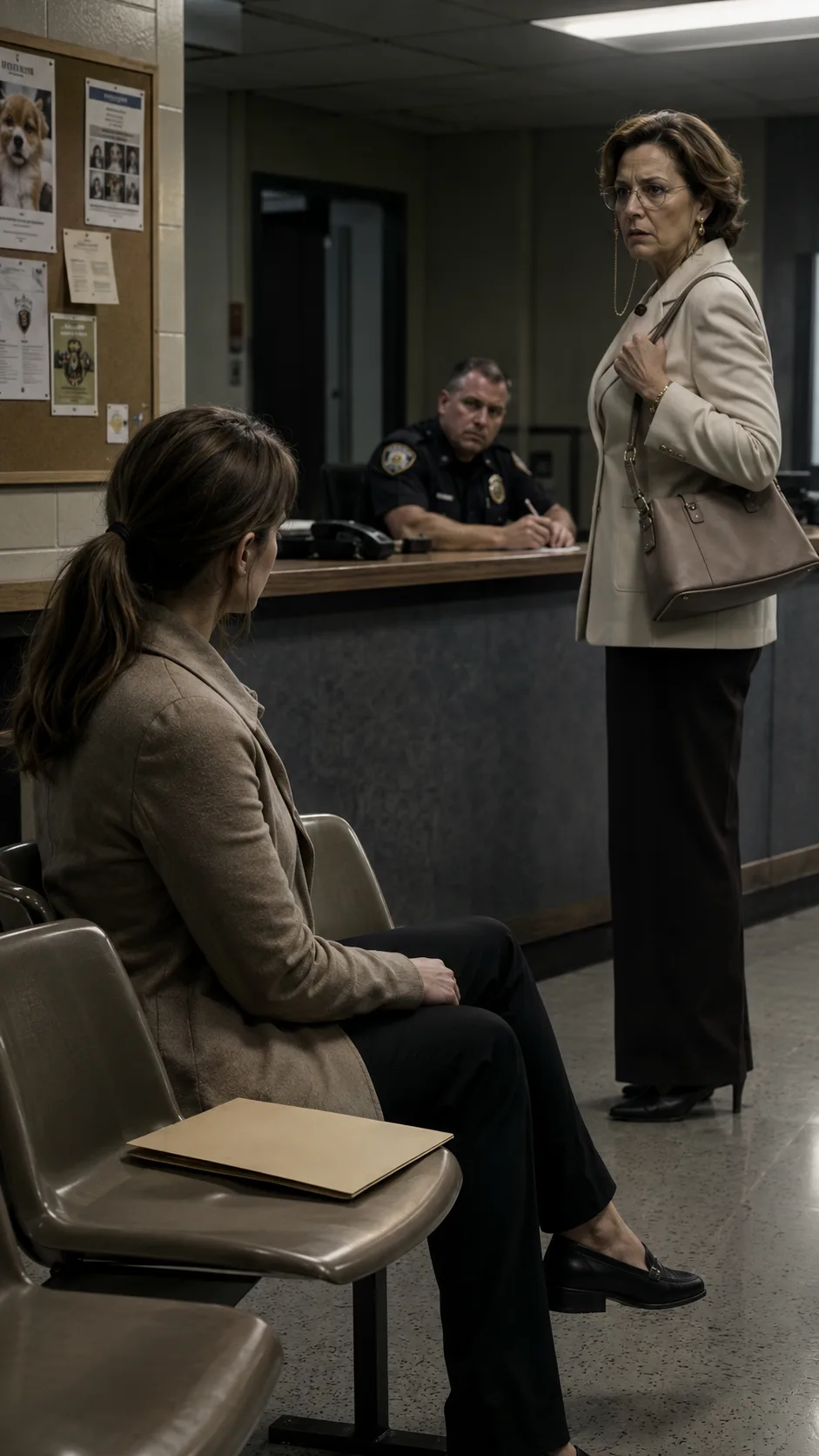
The Millbrook Police Department looked exactly the way it had when Elena was a child and her father brought her there for a bicycle safety day.
Linoleum floors. Fluorescent lights. A bulletin board with missing pets, a neighborhood watch notice, and a faded flyer for a blood drive that had already passed. A row of plastic chairs lined the wall near the front desk.
A man in a baseball cap sat at the far end, filling out a form with a chewed pen. A woman with a stroller argued quietly on the phone near the doors. Behind the counter, a desk officer looked at Elena over reading glasses.
“Can I help you?”
Elena set her tote on the chair beside her.
“I’m waiting for someone.”
“This isn’t really a waiting area.”
“She’s coming to file a police report against me.”
The officer lowered his pen.
Elena took out a card.
“Daniel Serrano is the estate attorney. I have documents relevant to the report she intends to make.”
The officer looked at the card, then at Elena.
“What kind of report?”
“Forgery.”
His eyebrows moved slightly.
“You forged something?”
“No.”
The man in the baseball cap stopped writing.
Elena kept her eyes on the officer.
“My mother says I did.”
The officer sighed through his nose, not unkindly.
“Family dispute?”
“Yes.”
“Estate?”
“Yes.”
He pushed the card back.
“Sit tight.”
Elena sat.
The plastic chair was hard and cold through her coat.
Ten minutes passed.
Then twenty.
The woman with the stroller left. The man in the baseball cap was called through a side door. The phone behind the desk rang twice and went unanswered until another officer came out and picked it up.
Elena opened her tote and checked the folder again.
Fake will.
Real will.
Dad’s letter.
Attorney note.
Hospital visitor log.
Still image from room camera.
Voicemail transcripts.
Email printouts.
She touched each tab once.
No drama.
Just proof.
At 10:34, the front door opened.
Patricia walked in.
Cream blazer. Pearl earrings. Reading glasses on a chain. Taupe handbag. Hair shaped into soft waves that did not move when she turned her head.
She stopped when she saw Elena.
Only for a second.
But Elena saw it.
The desk officer saw it too.
Patricia stepped forward.
“I’m here to file a report,” she said. “About my daughter. She forged my signature on a legal document.”
The officer looked toward Elena.
Elena stayed seated.
“I know,” she said. “That’s why I’m here too.”
Patricia turned.
For a moment, neither of them spoke.
A fluorescent bulb hummed above the bulletin board. Someone down the hall laughed once, then a door closed.
Patricia’s fingers tightened around the strap of her handbag.
“Officer,” she said, without looking away from Elena, “I would prefer to make my report without interruption.”
“You’ll get your chance,” the officer said.
Elena patted the empty chair beside her.
“Sit down, Mom.”
“I will not.”
“Please.”
Patricia’s jaw moved.
That word had always annoyed her most when it came without need. Please meant Elena was still offering manners, not surrender.
Elena leaned back slightly.
“What I have to say involves Dad’s hospital room at two in the morning, three days before he died. And I think you’d prefer to hear it here, quietly, before it becomes part of the official record.”
Patricia’s face did not change.
Her feet did.
One heel shifted back half an inch.
Elena saw it.
The officer did too.
“What are you talking about?” Patricia said.
Elena reached into her tote.
Slow.
Not theatrical.
Careful.
She lifted out the manila folder and placed it on the chair beside her. The folder made a flat sound against the plastic.
The officer stopped writing.
“There’s a camera in that corridor,” Elena said. “And there’s a camera in the room.”
Patricia looked at the folder.
Not Elena.
The folder.
“And the document you placed in Dad’s bedside drawer,” Elena continued, “the one you want them to believe I forged, has your fingerprints on it.”
“That is absurd.”
“Maybe.”
Elena opened the folder.
Her mother’s eyes followed every movement.
“The visitor log says you entered room 417 at 2:04 a.m. and left at 2:23. The hospital retained a still from the room feed. You’re standing beside the bed with the drawer open.”
Patricia turned toward the officer.
“This is a grieving daughter inventing stories.”
Elena removed the photograph.
She did not hand it to Patricia.
She handed it to the officer.
He looked at it for a long moment.
Then he placed it flat on the counter.
Patricia did not look.
That was how Elena knew.
A person accused unfairly reaches for proof. Patricia avoided it like heat.
“The real will is in here,” Elena said. “Notarized. Witnessed. Dated three months before he passed. Filed with Daniel Serrano.”
Patricia’s lips parted.
Elena removed the copy and set it on top of the folder.
“Every cent to me, except a five-year monthly trust for you. No direct access to principal. Dad signed it himself.”
“Elena.”
That was the first time Patricia said her name like a warning and not a command.
Elena looked up.
“He knew what you did twenty years ago.”
The officer’s gaze moved between them.
Patricia’s hand slipped from her handbag strap.
For a second, she looked older than fifty-five. Not weak. Not sorry. Just exposed.
“This is not the place,” Patricia said.
“You chose the place.”
“Elena.”
“You chose the report.”
Patricia looked toward the front doors.
Then at the officer.
Then at the folder.
Elena reached into the inside pocket and removed her father’s letter.
Not to show.
Not yet.
Just enough for Patricia to see the handwriting on the envelope.
Mae-bird.
The color left Patricia’s face in small stages.
The officer cleared his throat.
“Mrs. Whitmore, do you still want to file the report?”
Elena did not look at him.
She looked at her mother.
Patricia stared at the envelope.
Her throat moved once.
“I need to sit down,” she said.
Elena did not move the folder from the empty chair.
Patricia looked at it.
Then she sat in the chair on the other side.
Farther away.
The officer took the photograph, the visitor log, and the attorney card into the back.
He told both women not to leave.
Patricia sat with her knees together, handbag on her lap, fingers laced tightly over the clasp. Elena could hear the tiny click of her mother’s ring against the metal.
For ten minutes, neither spoke.
Then Patricia said, “Your father was cruel.”
Elena turned her head.
Patricia stared straight ahead.
“He knew what that would do.”
Elena waited.
Patricia’s mouth tightened.
“He could have handled it privately.”
Elena almost answered.
Then she thought of the education account. The loan. The signatures. The fake will beside an oxygen machine. Her father awake in a hospital bed, watching his wife open a drawer at 2:04 a.m.
“No,” Elena said. “He tried private for twenty years.”
Patricia’s eyes flicked toward her.
“You think you know marriage?”
“I know paper.”
Patricia gave a small laugh with no warmth in it.
“He made you this way.”
Elena reached into her coat pocket and touched the button.
“No,” she said. “You did.”
The officer returned with another woman, this one in plain clothes with a badge clipped at her belt. Detective Marsh, she said. Calm voice. Short gray hair. No performance.
She asked Patricia if she wanted to make a statement.
Patricia asked for an attorney.
That was the cleanest sentence she had said all morning.
Detective Marsh nodded.
Then she asked Elena to provide copies of everything in the folder.
Elena did.
One tab at a time.
Fake will.
Real will.
Hospital log.
Still image.
Voicemail transcripts.
Emails.
Dad’s letter stayed in the folder.
Detective Marsh noticed.
“And that?”
“Personal,” Elena said.
“Relevant?”
Elena looked at Patricia.
Patricia looked at the floor.
“Yes,” Elena said. “But not for her first.”
The detective accepted that for the moment.
Patricia left the precinct forty minutes later without filing the report.
She did not look at Elena when she passed.
Her heels clicked across the linoleum, measured and hard, but uneven near the door.
Elena remained seated after she was gone.
The officer handed back the attorney card.
“You okay to drive?”
Elena looked at him.
A strange question.
A normal question.
“Yes.”
Outside, the sun was too bright.
The world had not adjusted itself to match the morning. Cars still passed. A delivery truck idled near the curb. Someone had dropped a fast-food receipt on the sidewalk, and it scraped against the pavement in the wind.
Elena unlocked her car and sat behind the wheel.
She did not start the engine right away.
She opened the folder and took out her father’s letter.
The paper had softened at the creases from being read too many times in too few days.
Do not let her make you feel cruel for telling the truth.
Elena read that line once.
Then she folded the letter and placed it back.
Probate took months.
Patricia fought at first.
Of course she did.
She hired an attorney who wrote letters with heavy phrases and thin arguments. She claimed confusion. Then coercion. Then emotional distress. She suggested Elena had influenced Arthur during illness. Mr. Serrano answered each claim with dates, signatures, witnesses, and medical capacity records.
The fake will became its own matter.
Detective Marsh called twice. Then three times. Elena gave statements. Lauren gave one too. Dennis from records provided chain-of-custody notes with the enthusiasm of a man who had waited years for someone to appreciate proper documentation.
Patricia was not dragged away in handcuffs.
Life rarely gives people the scene they imagine.
Instead, she shrank by paperwork.
A court order. A hearing. A judge who read silently for a very long time. Patricia sitting with her attorney, back straight, face powdered, eyes fixed on nothing.
The real will stood.
The fake one did not.
The trust remained.
The house became Elena’s.
On the day she changed the locks, she found three more things missing from the den: the shoebox of birthday cards, her father’s fountain pen, and the green blanket from the hospital.
Patricia denied taking them.
Elena did not argue.
She had learned the shape of denial too well to keep touching its edges.
She bought new locks. Paid the locksmith. Signed the receipt on the hood of his van.
Then she walked through the house room by room.
Dining room.
Kitchen.
Hallway.
Den.
Her father’s recliner still sat near the window. The rug still held the shape of his feet. The ceramic owl still watched from the desk with its uneven eyes.
Elena took the button from her coat pocket and placed it in the owl’s chipped bowl.
It was not fixed.
Nothing was.
But it was kept.
That evening, she opened the windows though the air was cold. The house breathed dust and lemon polish and something older beneath both.
Her phone buzzed at 8:15.
Patricia.
Elena looked at the screen until it stopped.
A voicemail appeared.
She did not play it.
Not then.
She made tea in her father’s mug, the one with the faded blue rim, and sat in the den while the sky outside turned the windows black.
The house made its old sounds around her.
Pipe knock.
Floor creak.
Clock tick.
For years, those sounds had belonged to someone else’s rules.
That night, Elena let them be only sounds.
The next morning, she went to the dining room with a cardboard box and cleared the table.
Patricia’s folder was gone. The black pen was gone. The glass of water was gone.
Elena wiped the surface with a damp cloth, then dried it with a towel from the kitchen.
Near the edge, she found a faint scratch in the wood. Her father had made it years ago while helping her build a model volcano for sixth grade science class. Patricia had complained for a week.
Elena ran her finger along the mark.
Then she set the ceramic owl in the center of the table.
Ugly.
Crooked.
Still there.
Chapter complete
You have reached the end of this chapter.
Continue reading
A few more worlds to get lost in after this chapter.




