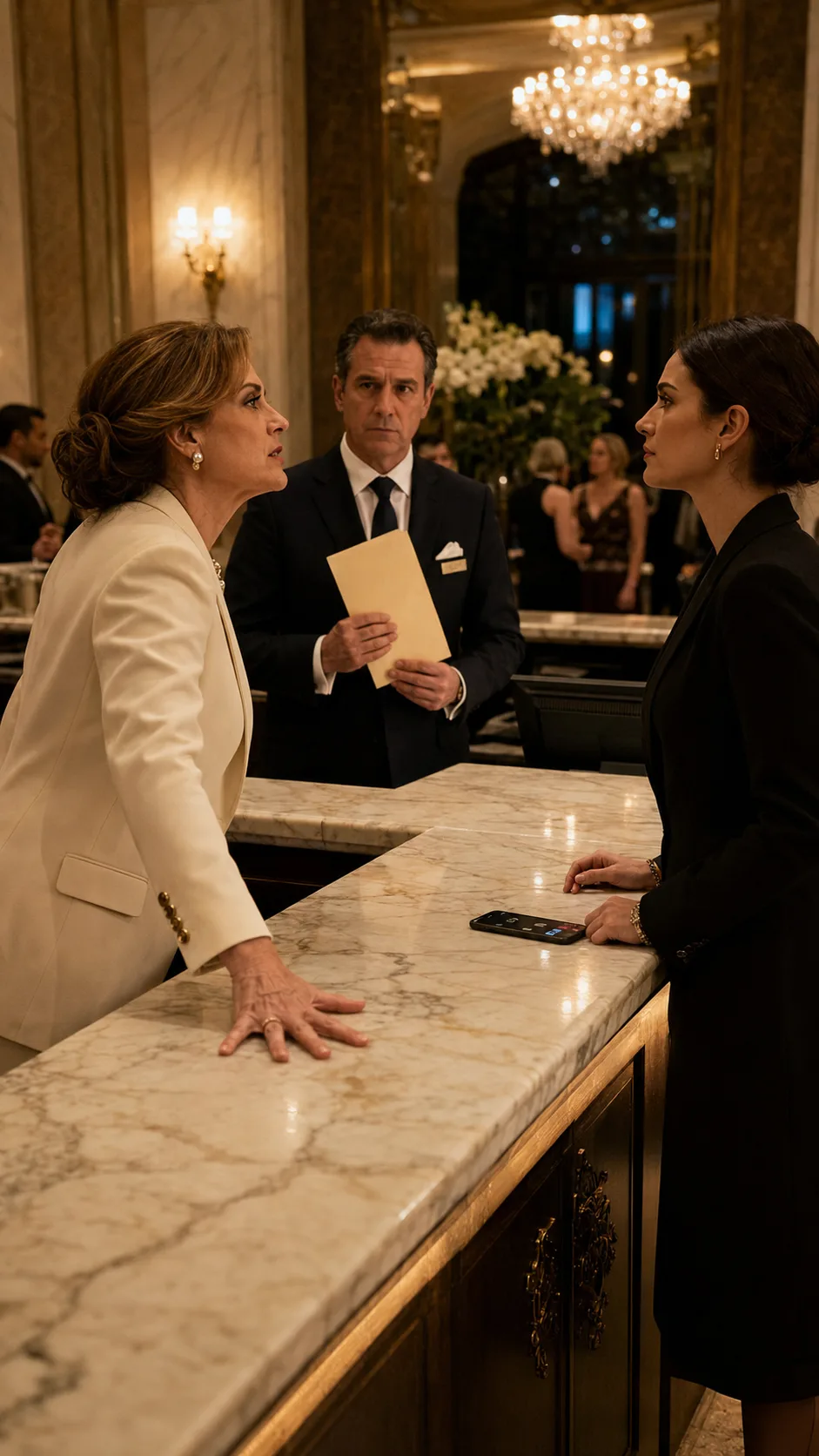
I kept my phone facedown on the marble counter and watched my mother correct the receptionist’s posture without touching him.
Chapter 1
I kept my phone facedown on the marble counter and watched my mother correct the receptionist’s posture without touching him.
“Stand straight when you speak to me,” she said.
The young man behind the desk blinked once. His badge said Noah. His hands hovered over the keyboard like he had forgotten what he was supposed to type.
The Aurora Grand Hotel had only been open for six months, but my father had spent nearly eight years planning it. Twenty-seven floors of glass and stone. A lobby that smelled faintly of white lilies and expensive coffee. Brass elevators polished so well people checked their faces in them before stepping inside.
My mother had never liked the lobby.
Too modern, she had said.
Too cold.
Too much like me.
She stood under the chandelier wearing a cream blazer with gold buttons, pearl earrings, and the same soft smile she used for photographers at charity dinners. The smile never reached her eyes. It never had.
Beside her, my brother Adrian checked his cufflinks
as if this were a delay before dinner, not the final hour of a family war that had begun before my father was even buried.
“You’re holding up the desk,” I said.
My mother turned her head toward me.
Only her head.
“Guests belong at the desk,” she said. “You are no longer a guest.”
Noah looked at me, then quickly looked down.
The phone under my hand buzzed once against the stone.
I didn’t pick it up.
My mother noticed that too.
She noticed everything when she thought she was winning.
The first crack in our family had not been loud. It had been a missing key card.
Three weeks after my father’s funeral, I came to the Aurora Grand to collect a box from his private office. His reading glasses. A leather notebook. A tiny silver horse he used to keep beside the window because I had given
it to him when I was eight.
My card didn’t work in the elevator.
Security came before I could ask anyone why.
They were polite. Too polite.
“Mrs. Whitmore updated the access list this morning,” the guard said.
Mrs. Whitmore.
My mother.
Not my father’s wife. Not my grieving mother. Not even Margaret.
A title.
A wall.
I called Adrian from the lobby. He answered on the fifth ring with restaurant noise behind him.
“Don’t make this dramatic, Elena,” he said.
“I need Dad’s things.”
“You need to stop pretending you’re part of operations.”
“Operations?”
He sighed into the phone. I could hear glassware behind him. Someone laughed.
“Mother has the judge’s preliminary direction. Dad’s estate structure is being honored. The hotel remains under family stewardship.”
Family stewardship.
That was how rich people stole from each other without using ugly words.
“My name is on the development trust,” I said.
“No,” Adrian said. “Your name was on an old version.”
The elevator doors opened beside me. A couple stepped out with shopping bags and the easy smiles of people who had never had to prove they belonged anywhere.
Adrian lowered his voice.
“You should go home.”
I looked up at the chandelier my father had chosen himself. He had sent me photos of three options from Italy and asked which one looked less arrogant.
I picked the largest one.
He laughed for ten minutes.
“I am home,” I said.
Adrian ended the call.
After that, the hotel became a stage my mother controlled.
She invited investors for lunch in the restaurant where my father used to taste every sauce twice. She replaced my father’s office furniture and sent the old desk to storage without telling me. She hosted a private memorial dinner in the ballroom and seated me near the back, between a cousin I hadn’t seen since college and a woman who asked whether I was still “doing art.”
I wasn’t doing art.
I had designed the first guest experience model for the Aurora Grand when my father was still calling it a foolish dream with beautiful margins.
I had negotiated with the architect after the first design came in too cold. I had found Lucas, the manager, after three interviews with candidates who treated hospitality like theater. Lucas treated it like responsibility.
My mother called that sentimental.
My father called it the reason the hotel would work.
The second crack came in a brown storage box.
Lucas called me two nights after my access card stopped working.
He didn’t say much.
“Your father left something in Archive Room B,” he said. “Your mother asked me to clear it.”
“Then clear it.”
“I think you should see it first.”
I met him before sunrise through the service entrance because my mother had eyes everywhere by then. The kitchen smelled of bread and stainless steel. A pastry chef nodded at Lucas and pretended not to see me.
Archive Room B was behind laundry storage, past a row of white uniforms hanging in plastic.
Lucas unlocked it with a physical key.
Not a card.
Inside were old vendor files, guest ledgers from my grandfather’s hotel days, framed menus, photographs, and three sealed boxes with my father’s handwriting across the top.
One said: Elena — only if they forget who built this with me.
Lucas stood by the door while I opened it.
Inside was not a deed. Not a simple document my mother could dismiss as outdated.
It was worse for her.
It was a chain.
Letters between my father and the trust attorney. Minutes from private ownership meetings. Revised hotel succession instructions. A recorded board consent. A notarized statement transferring final operational authority to me if my mother or Adrian attempted to remove me before the estate review ended.
And at the very bottom, wrapped in blue ribbon, was a cream envelope with my father’s wax stamp.
Not opened.
Lucas looked at it but did not touch it.
“Your mother asked for all sealed family materials yesterday,” he said.
“Did she know this existed?”
His face did not change.
“She knew there was an archive.”
That was enough.
I took photographs of everything. Lucas made certified scans through the hotel’s internal archive system, the one my father had insisted on keeping separate from family access. Then he placed the cream envelope into the hotel safe and entered a chain-of-custody note with two witnesses.
My mother would hate that phrase.
Chain of custody.
It turned rich-family whispers into paper.
The first hearing came four days later.
My mother wore navy.
Adrian wore gray.
I wore black because it was the only color I could trust myself in.
The judge was not old, not theatrical, not impressed by the room. She listened while my mother’s attorney spoke about stability, legacy, business continuity, emotional strain, the need to avoid sudden disruption.
I sat with my hands folded.
My attorney, Mr. Hale, slid the scanned archive packet forward and said very little.
The judge read for nine minutes.
My mother did not look at me once.
At the end, the judge asked one question.
“Where is the original sealed envelope?”
Mr. Hale answered, “In the Aurora Grand’s private archive safe, Your Honor. Verified by hotel management.”
My mother turned then.
Not fully.
Just enough.
A tiny movement.
The judge gave preliminary instructions. No operational changes. No asset movement. No public claim of final authority until her written decision was released and verified with the original sealed material.
My mother heard something else.
She heard time.
And time, to her, was always something she could buy.
Two days later, Adrian called me.
I let it ring until it stopped.
He called again.
Then a message arrived.
Mother wants this settled quietly. Come to the hotel at eight. Bring your attorney if you need the costume.
I sent it to Mr. Hale.
He replied: Do not go alone.
I went alone anyway.
Not because I was brave.
Because my father had taught me that some rooms only reveal themselves when people think you have no protection.
The Aurora Grand lobby glowed at night. Gold light ran across the marble floor in long strips. The chandelier threw tiny reflections onto the ceiling. Guests moved through the space with soft voices and rolling luggage, unaware that the people near the front desk were about to turn the lobby into a courtroom without wooden benches.
My mother was already there.
Of course she was.
Adrian stood beside her, speaking to Noah at the desk. Lucas was nowhere in sight.
My mother saw me through the reflection in the brass elevator doors.
She did not turn immediately.
She waited until I was close enough for the guests near the flower arrangement to hear her.
“You came,” she said.
I placed my phone on the counter.
Facedown.
“Yes.”
Adrian smiled.
“Still dramatic.”
I looked at Noah.
“Good evening.”
His throat moved.
“Good evening, Ms. Whitmore.”
My mother’s smile sharpened.
“Not for long.”
There it was.
Small. Public. Polished.
The knife wrapped in linen.
She opened her purse and removed a folded paper from her attorney’s office. Not the judge’s final order. Not anything sealed. A summary of their position printed on heavy stock.
She laid it on the counter as if paper became truth when expensive enough.
“The judge reviewed the matter,” she said. “The family structure stands. Adrian and I are authorized to proceed.”
Noah looked at the paper.
He did not pick it up.
“Ma’am, I can call Mr. Vale,” he said.
Lucas.
My mother tapped the paper once.
“You can update the registry.”
“I don’t have authority to—”
“I said update it.”
The businessman near the elevators slowed his walk. A woman in a silver dress glanced over the rim of her champagne glass from the lobby bar.
My mother loved an audience.
She had always known how to turn witnesses into furniture.
I kept my hand near my phone.
Adrian leaned one elbow against the counter.
“Elena, this is embarrassing,” he said. “You lost. Just accept it privately.”
I looked at him.
His tie was crooked by one millimeter. My father would have reached over and fixed it without saying a word.
Adrian had hated that.
“Did you read the actual direction?” I asked.
He laughed through his nose.
“She’s still trying.”
My mother turned to Noah.
“Check the ownership registry.”
Noah didn’t move.
“Now,” she said.
His fingers touched the keyboard.
Then stopped.
A small thing.
My mother saw it.
So did I.
Her voice lowered.
“Do not make me call the board in front of your guests.”
Noah’s hands left the keyboard.
Behind the desk, the office door opened.
Lucas stepped out.
He wore a dark suit, a white pocket square, and the expression of a man who had chosen a side long before he entered the room. In his hands was the cream envelope from Archive Room B.
My mother’s body went still.
Adrian straightened.
The paper she had placed on the counter suddenly looked thin.
Lucas walked to the center of the desk but did not set the envelope down.
Not yet.
My phone buzzed again under my palm.
I turned it over.
The call had connected.
Mr. Hale’s number showed first, then merged audio. The judge’s clerk had joined the line. Mr. Hale had arranged it that afternoon after my mother’s attorney notified him of “an informal administrative correction” at the hotel.
Informal.
Administrative.
Correction.
Three soft words for a public theft.
A woman’s voice came through the speaker.
“Ms. Whitmore, this is Judge Carver.”
The lobby went quiet in pieces.
Not all at once.
First Noah stopped typing. Then the silver-dressed woman lowered her glass. Then the businessman by the elevator let go of his suitcase handle and turned.
My mother stared at the phone.
“Your Honor,” she said. “This is not an appropriate—”
Judge Carver cut in.
“Bring the sealed envelope to the desk.”
Lucas looked at me.
I gave one small nod.
He stepped closer.
My mother’s hand moved.
Not much.
Just enough to reach toward the envelope before Lucas could place it down.
I put my palm flat on the marble.
“No.”
The word landed between us.
My mother looked at my hand as if it were a stain.
“Elena,” she said, “don’t make a scene.”
I almost laughed.
Not because anything was funny.
Because my mother had built the scene, lit it, invited the audience, and placed herself beneath the chandelier.
I only refused to leave when the curtain rose.
Judge Carver spoke again.
“Open it there.”
Adrian’s face changed first.
His smile stayed, but his eyes moved to our mother. Quick. Searching.
He had not known.
That was the third crack.
My mother had not told him everything.
Lucas placed the cream envelope on the counter. The hotel archive stamp sat in the corner. My father’s wax seal held the flap closed, pressed with the small horse crest he had used on private letters after my grandfather died.
My throat tightened around nothing.
I kept my hand still.
Lucas slid one finger under the flap.
My mother leaned forward.
“That material is private family property.”
Judge Carver replied through the phone.
“It is evidence entered by chain of custody.”
My mother’s jaw moved once.
No sound.
The seal lifted.
A soft tear of wax and paper.
Noah stepped back from the keyboard. A guest near the flowers whispered, then stopped when the woman beside her touched her arm.
Lucas removed the folded page.
He opened it carefully, the way he opened handwritten guest complaints from people who mattered less than they believed. His eyes moved over the first line.
Then he looked at me.
Only for a second.
He placed the page flat on the marble and turned it so the judge on the phone, my attorney through the call, Noah behind the desk, and my mother in front of it all could hear him read.
“This is the judge’s verified final direction,” Lucas said.
My mother’s fingers curled against the edge of the counter.
Lucas continued.
“Pending full estate closure, operational authority over Aurora Grand Hotel remains with Elena Whitmore. Any registry change requested after the preliminary hearing is void.”
Adrian stepped back.
One half step.
The kind a person takes when the floor has not moved, but their body no longer trusts it.
My mother stared at the page.
The lobby did not erupt.
No one gasped.
No one clapped.
The absence of sound was worse.
People simply watched her become smaller under the light.
She reached for the paper.
Lucas moved it back by two inches.
Not aggressively.
Not dramatically.
Just enough.
Judge Carver’s voice came through again.
“Mrs. Whitmore, you were instructed not to alter control records.”
My mother lifted her chin.
“That is not what I did.”
Noah looked down at the registry screen.
His face answered before his mouth did.
Judge Carver asked, “Was a change requested tonight?”
Noah swallowed.
“Yes, Your Honor.”
My mother turned on him.
“Noah.”
He flinched, then looked at the phone.
“Yes,” he said again. “Mrs. Whitmore requested Elena’s name be removed.”
Adrian closed his eyes for one second.
My mother did not.
She kept staring at me, as if I had betrayed her by keeping proof of what she had done.
“You planned this,” she said.
I looked at the envelope.
Then at the paper.
Then at the phone.
“No,” I said. “Dad did.”
That was the first time her face broke.
Not loudly.
Not fully.
A tiny collapse around the mouth. A loosened grip on the counter. The pearls at her ears trembling once when she breathed in.
Judge Carver’s voice stayed even.
“The registry will remain unchanged. Mr. Vale, secure the original. Mr. Hale, submit the archive scan by morning.”
“Yes, Your Honor,” Lucas said.
“Yes, Your Honor,” Mr. Hale said through the call.
My mother picked up her printed paper from the counter.
Her hand was not steady.
Adrian reached for her elbow. She pulled away before he touched her.
“Elena,” he said.
I looked at him.
He had used my name differently that time.
Not as a warning.
Not as a joke.
As if he had found it written somewhere and was unsure what it meant now.
“Did you know?” I asked him.
His mouth opened.
Closed.
That was answer enough.
My mother folded her paper once, too sharply, leaving a crooked crease.
“This is temporary,” she said.
No one replied.
Not me.
Not Lucas.
Not Noah.
Not the judge.
The phone screen dimmed.
I tapped it once to keep the call alive.
My mother looked around the lobby then.
A mistake.
She saw the businessman by the elevator. The women near the flowers. The bartender standing still with a towel in one hand. Noah behind the desk. Lucas with the opened envelope. Adrian, no longer beside her in quite the same way.
She had wanted witnesses.
She had them.
Her heels clicked once as she stepped back from the counter.
Then again.
Adrian followed after two seconds, not immediately. That delay said more than anything he could have said.
At the brass elevators, my mother stopped and turned.
“You think this makes you your father’s daughter?”
I picked up my phone.
“No,” I said. “He already did that.”
The elevator doors opened.
She stepped inside.
Adrian looked at me through the narrowing gap. For a second, he looked like the boy who used to hide broken things under my bed because he knew I would take the blame faster.
Then the doors closed.
The lobby returned slowly.
A suitcase rolled.
Someone coughed.
The bartender set the towel down.
Noah stood behind the desk, pale, both hands flat beside the keyboard.
“I’m sorry,” he said.
“You did your job.”
He looked at the opened envelope.
“I almost didn’t.”
“But you did.”
Lucas resealed the contents inside a clear archive sleeve and signed the custody log on a clipboard Noah handed him. His handwriting was neat. My father had liked that about him.
“Your father said this might happen,” Lucas said.
I looked at him.
“When?”
“The day before the opening.”
The chandelier reflected in the marble between us.
“He stood here,” Lucas said, “right where you’re standing. He said, ‘If they ever try to make her ask permission to enter, give her the room back before she has to ask twice.’”
I pressed my fingers against the edge of the counter.
The marble was cold.
For weeks, I had imagined my father leaving me documents because he trusted my business judgment. Because I had earned the hotel. Because he knew my mother would try to take it.
All of that was true.
But the sentence Lucas gave me was smaller.
Sharper.
He had thought of the exact wound.
Not the company.
Not the estate.
The door.
My right to walk in.
Judge Carver ended the call after confirming the next morning’s filings. Mr. Hale stayed on for thirty seconds more.
“Go home, Elena,” he said.
“I’m already here.”
He didn’t argue.
After we ended the call, Lucas slid a key card across the counter.
Black.
No logo.
My father’s private access card.
“I was instructed to give this to you only after the envelope was opened,” he said.
I stared at it.
A tiny silver horse was embossed in the corner.
Not the hotel crest.
My horse.
The one from his office window.
I picked it up.
Noah watched me like he was afraid the lobby might shift again.
It didn’t.
The Aurora Grand stood exactly where it had stood all night. Marble. Brass. Glass. White lilies. Chandelier light.
Only the room had changed owners in the eyes of everyone who mattered.
I walked to the private elevator.
This time, the card worked before I even fully pressed it to the reader.
The doors opened without hesitation.
My father’s office had been rearranged, but not completely erased.
My mother had replaced the desk, yes. Removed the chair. Changed the art.
But the window still looked over the city. The skyline still reflected in the dark glass. And in the corner, on a low shelf no one had bothered to clear, sat the tiny silver horse I had thought was gone.
I picked it up.
Dust marked its back.
A small, ordinary thing.
I set the black key card beside it and stood there until the city lights blurred into shapes I could no longer name.
The next morning, the story stayed quiet in the papers but loud where it mattered.
The board withdrew my mother’s temporary access before noon. Adrian resigned from the hotel advisory committee by email, three sentences, no apology. My mother’s attorney filed an objection, then withdrew it after Judge Carver requested the lobby security audio.
I did not watch the footage.
I didn’t need to.
For two weeks, my mother sent messages through other people.
A cousin called to say family matters should remain private.
An aunt asked whether I was proud of myself.
Adrian sent one text.
She didn’t tell me about the envelope.
I believed him.
That did not repair anything.
But belief and forgiveness are different doors.
I answered two days later.
I know.
Nothing more.
The Aurora Grand kept running.
Guests checked in. Couples ordered champagne. The restaurant sent back three steaks in one night because the new chef over-salted everything when nervous. Lucas hired a better night auditor. Noah stopped flinching when wealthy guests raised their voices.
I moved my father’s old desk back into his office.
Not because I wanted to live inside his shadow.
Because it fit the room.
On the first Friday of the next month, I stood behind the reception desk for twenty minutes during the evening rush. Lucas said owners shouldn’t do that.
I told him my father had.
He handed me a stack of room keys and said nothing else.
A woman in a green coat came to the desk with a tired child asleep against her shoulder. Her reservation had been entered under the wrong date. The hotel was nearly full.
Noah started to apologize.
I looked at the screen, then at the little girl’s shoes dangling above the floor.
“Put them in 1806,” I said.
Lucas glanced over.
“That’s a premium suite.”
“It has a sofa.”
The woman closed her eyes for one second.
The child slept through it.
When they left, Noah smiled down at the keyboard.
“Your father used to do that.”
“I know.”
That night, after the lobby emptied, I walked to the counter where my mother had placed her hand and declared victory.
The marble had been polished. No mark remained.
I set the tiny silver horse there for a moment.
Just for a moment.
Then I picked it back up and carried it upstairs.
The door opened the first time.
Chapter complete
You have reached the end of this chapter.
Continue reading
A few more worlds to get lost in after this chapter.