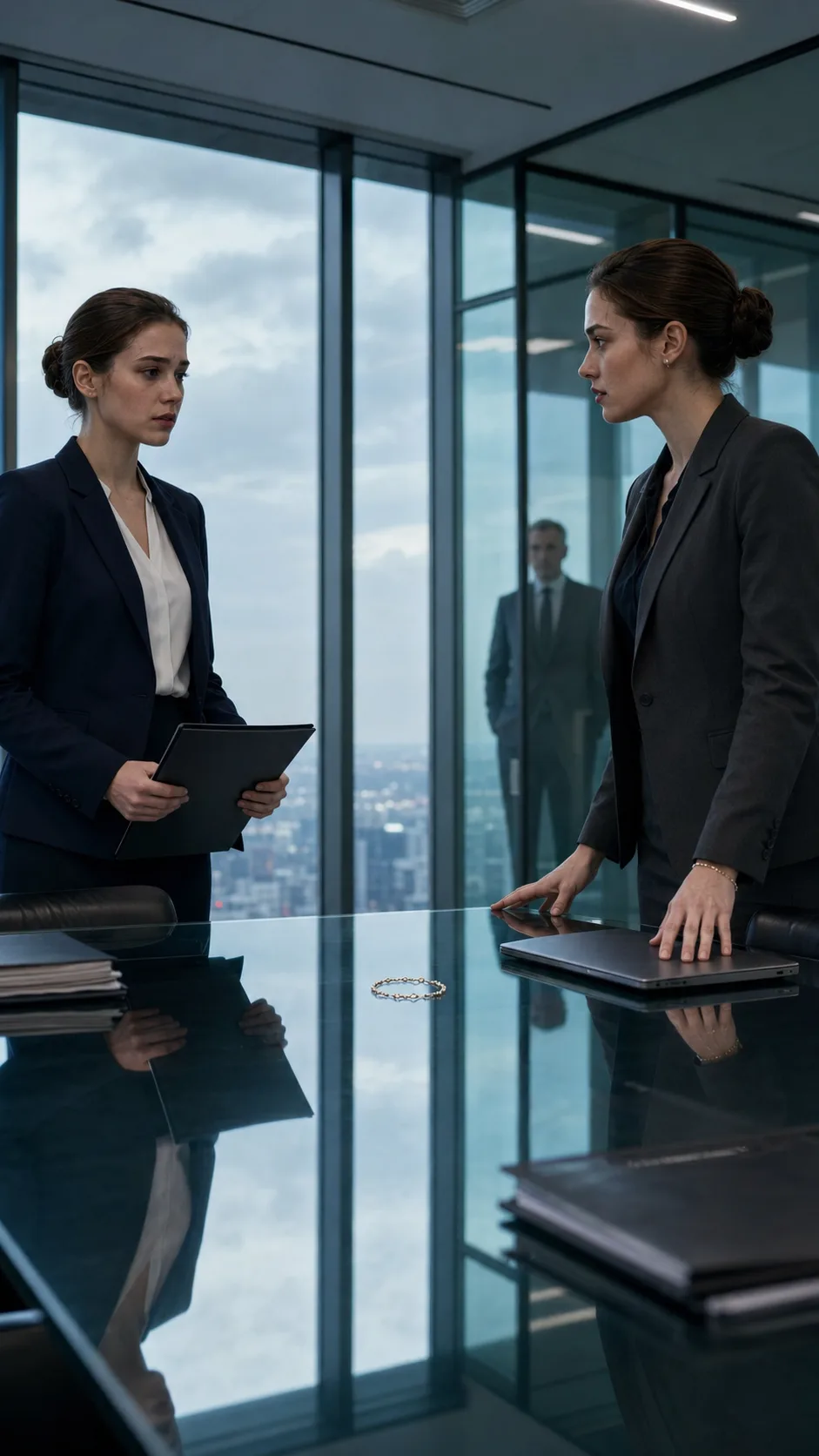
Emma Miller noticed the coffee stain on her folder five minutes before the interview.
Chapter 1
Emma Miller noticed the coffee stain on her folder five minutes before the interview.
It sat near the bottom corner, a pale brown crescent that looked harmless from far away and careless up close. She rubbed it with her thumb anyway, once, twice, until the paper beneath the folder cover softened under the pressure.
No use.
She turned the folder over and held the clean side out.
The lobby of Vale & Cross Technologies was built to make people feel smaller. White marble floors. Glass walls. A reception desk that curved like a blade. Behind it, three assistants moved without lifting their voices, each wearing a headset and the same polite expression.
Emma stood near a silver planter with a dying orchid and watched employees pass through security gates without stopping. Their badges opened doors before they reached them.
Her visitor badge did not.
It hung from a thin blue lanyard against her white blouse, slightly crooked because her hands had not been steady
when she clipped it on. She corrected it in the reflection of the elevator doors.
There.
Still crooked.
She left it.
The elevator chimed. A young man in a fitted gray suit stepped out with a phone at his ear. He glanced at Emma’s badge, then at the folder in her hand. Not rude. Not kind. Just enough to remind her she did not belong here yet.
Emma stepped in.
The doors closed.
Thirty-eight floors.
She watched the numbers climb and tried to rehearse the answer she had written on the train that morning.
Why Vale & Cross?
Because your international strategy division is one of the few places still hiring candidates without Ivy League networks.
No.
Because I believe in ethical growth across emerging markets.
Better.
Because I need this job more than I have ever needed anything, and I am tired of pretending desperation is ambition.
She pressed
her folder against her ribs.
Not that.
Floor twenty-one passed. Then twenty-six. Then thirty-three.
Her phone buzzed.
MOM: You there yet?
Emma typed with one thumb.
Almost.
Another message came before the signal faded.
MOM: Your father would be proud.
Emma stared at the words until the elevator doors opened.
She did not answer.
The thirty-eighth floor was quieter than the lobby. Carpet swallowed each step. A wall of glass showed the city below, hard and gray under a low sky. The receptionist on that floor checked Emma’s name, smiled, and asked her to wait near a row of leather chairs.
A man in his late forties approached five minutes later.
“Emma Miller?”
She stood too quickly. The folder slipped against her palm.
“Yes.”
“I’m Andrew Hale from Human Resources.” He held out his hand. His smile had been used many times that morning. “We’re ready for you.”
He led
her down a hallway lined with framed awards. Innovation. Excellence. Leadership. Words polished until they had no fingerprints left on them.
At the end of the hall, Andrew stopped outside a glass-walled conference room.
“You’ll meet with me first, and then Ms. Cross will join for strategy questions.”
Emma nodded.
The door opened.
Ms. Cross was already inside.
Emma stopped at the threshold.
The woman at the far end of the table looked up from a black folder.
Same cheekbones.
Same dark eyes.
Same narrow scar above the left eyebrow, thin as a paper cut.
For half a second, Emma thought she had seen her own reflection caught at the wrong angle in the glass wall. Then the woman moved, and the reflection did not.
Andrew gave a small laugh.
“Well,” he said. “That’s unusual.”
Emma did not move.
The woman closed the folder with two fingers and stood.
“Vivian Cross,” she said.
Her voice had Emma’s shape but not Emma’s softness. It was lower. Cleaner. Trained by rooms that expected to listen.
Emma took her hand.
Their fingers touched.
Both of them pulled back a fraction too late.
Andrew looked between them with the bright discomfort of a man trying to keep a meeting from becoming a story.
“Genetics,” he said. “Always full of surprises.”
Vivian did not smile this time.
“Please sit.”
Emma took the chair closest to the door. Vivian sat opposite her. Andrew sat at the side with his tablet open, already typing.
The first questions came from him. Employment history. Project coordination. Why she had left Grant & Selby after the restructuring. Whether she was comfortable with international clients.
Emma answered cleanly.
She had practiced.
Her voice did not shake.
Almost.
Vivian watched more than she spoke. She turned one page in Emma’s resume. Then another. Her nails were short, unpainted, and pressed flat against the paper each time Emma said something measurable.
Revenue tracking.
Vendor negotiation.
Crisis response.
When Emma mentioned crisis response, Vivian’s eyes lifted.
“Define crisis.”
Emma adjusted her sleeve under the table. “A situation where delay costs more than action.”
Vivian looked at her for another second.
“Good answer.”
Andrew typed.
A vent clicked above them, sending cold air down over the table. Emma noticed a tiny chip in the glass near her water cup. Someone had tried to polish it smooth. It still caught the light.
The interview continued.
It should have become easier.
It did not.
Vivian asked about her education, then her former manager, then why her references came mostly from colleagues instead of executives.
Emma folded her hands in her lap.
“My last director left the company before the layoffs. The executive team changed after that.”
“Convenient,” Vivian said.
Andrew glanced up.
Emma looked at Vivian.
The word sat between them with the weight of something chosen.
“I can provide additional references,” Emma said.
Vivian leaned back. “I’m sure you can.”
Andrew cleared his throat and moved to the next section.
Ten minutes later, Vivian asked, “Where did you grow up?”
The question did not belong beside the others.
Emma answered anyway. “Northbridge.”
Vivian’s pen stopped.
“Northbridge General Hospital?” Vivian asked.
Emma looked at Andrew. He was still typing, but slower now.
“I was born there,” Emma said. “Yes.”
Vivian’s fingers tightened around the pen.
The plastic gave a small sound.
Andrew’s tablet went dark. He tapped it awake again.
Vivian looked down at the resume. “Mother’s name?”
Emma sat still.
“That isn’t on my application.”
“No,” Vivian said. “It isn’t.”
Andrew leaned forward. “We don’t need to—”
“Margaret Miller,” Emma said.
The room changed without moving.
Vivian lowered the pen.
Andrew’s hand hovered above the tablet.
Emma heard the air-conditioning again. The low electrical hum. A faint squeak from the leather chair as Vivian shifted back, not far, just enough to put both feet flat on the floor.
“Andrew,” Vivian said, “please leave us.”
He blinked. “I’m sorry?”
“Leave us.”
“This is a formal interview.”
“Then note that the strategy portion requires privacy.”
Andrew looked at Emma, then Vivian, then the glass door behind him.
“I don’t think—”
Vivian lifted her eyes.
He stood.
The chair legs brushed the carpet with a soft scrape. He collected his tablet, then paused near the door.
“I’ll be right outside.”
Vivian waited.
Andrew left.
The door clicked shut.
Then Vivian stood and locked it.
Emma rose halfway from her chair.
“Why did you lock the door?”
Vivian walked past the head of the table to a low credenza built into the wall. Her reflection moved beside her in the glass, slim and controlled, except for one hand. That hand opened and closed once before she touched the drawer.
“Sit down,” Vivian said.
Emma did not.
Vivian opened the drawer and took out a square of tissue paper.
She carried it back to the table.
The city stood behind her, cold and distant.
Vivian unfolded the tissue.
A baby bracelet lay inside.
Old gold. Worn edges. A tiny plate at the center.
Vivian set it on the glass table.
The bracelet made a small sound that should not have been loud.
Emma looked at it.
Two sets of initials had been engraved on the plate.
E.M.
V.M.
She did not touch it.
Vivian pushed it forward with one finger.
“Do you recognize it?”
Emma’s mouth opened. No answer came.
Her mother kept a box on the top shelf of the linen closet. Hospital card. First lock of hair. A yellowed birth announcement. A baby bracelet wrapped in cotton, too small to seem real.
E.M.
V.M.
Emma had asked about the second set of initials when she was eight.
Her mother had sat on the edge of the bathtub and told her she had a twin sister who died before she could come home.
Vivian watched her face.
“You do.”
Emma sat down because her knees had stopped helping.
“My sister died,” Emma said.
Vivian’s lips pressed together.
“That’s what they told you?”
Emma reached for the bracelet. Her hand stopped before touching it.
“That’s what happened.”
Vivian pulled a chair out and sat across from her again. She did not look like an interviewer now. She looked like someone who had spent years opening locked boxes and finding another lock inside each one.
“I was adopted through Grayfield Family Placement,” Vivian said. “Private agency. Closed records. Expensive attorneys. Every request denied.”
Emma shook her head once.
“No.”
Vivian opened the black folder in front of her. Inside were photocopies, clipped pages, emails printed on thick paper. Not the materials of a job interview. A different meeting had been hiding under this one.
“I found your name three weeks ago,” Vivian said. “I didn’t know you had applied here until yesterday.”
“That’s not possible.”
Vivian slid one page across the table.
Emma did not read it.
Her phone buzzed in her pocket.
Both women looked down.
The screen showed her mother’s name.
Emma had not answered the last message.
The phone buzzed again.
Vivian stared at it.
“Answer,” she said.
Emma looked up. “Why?”
Vivian’s voice lost its corporate polish for one second. “Because I need to hear her lie.”
Emma picked up the phone.
Her thumb hovered above the green button.
This was not how truth entered a room. Truth should knock. It should bring a warning. It should give a person time to sit, to lock the door from the inside, to decide which version of herself would survive the first question.
The phone buzzed a third time.
Emma answered and put it on speaker.
“Mom?”
“Oh, good,” Margaret said. “I was worried the signal dropped. Are you finished already?”
Emma looked at Vivian.
Vivian looked at the phone.
“No,” Emma said. “I’m still here.”
There was a pause. A kettle hissed faintly in the background at her mother’s house. Emma could picture the old stove, the chipped blue mug, the kitchen calendar still open to the wrong month because Margaret never turned it until someone else did.
“Is everything all right?” Margaret asked.
Emma swallowed. “There’s someone here.”
Vivian’s fingers closed around the edge of the table.
Emma said, “Her name is Vivian Cross.”
Silence.
Then a sound came through the phone.
Not a word.
Not a cry at first.
Just one broken breath.
Vivian leaned closer.
“Mrs. Miller,” she said.
The phone speaker crackled.
Margaret made that sound again, smaller this time.
Emma gripped the side of the table. “Mom?”
“No,” Margaret said.
The word came out thin.
Vivian’s face did not change, but her fingers went white against the glass.
Margaret said, “They told me one of you didn’t survive.”
Andrew appeared outside the glass wall.
He had returned with his tablet in one hand and a paper cup in the other. He stopped when he saw both women leaning toward a phone in the middle of the table.
The cup tilted.
A little coffee touched the plastic lid.
Vivian turned her head toward Emma.
“Who told her?”
Emma stared at her mother’s name glowing on the phone screen.
“Mom,” Emma said. “Who?”
Margaret did not answer.
Vivian stood.
She crossed to the door and pulled the blinds halfway closed with one sharp motion. The glass stripes cut Andrew into pieces. His mouth moved. No sound came through.
Vivian returned to the table, opened her laptop, and typed a password so fast Emma saw only the movement of her hands.
“Vivian,” Emma said.
Vivian did not look up.
“Stop,” Emma said.
Vivian opened a file.
Emma saw scanned pages stacked in a digital folder. Hospital records. Adoption papers. Old corporate memoranda. A signature line she knew before she let herself read the name.
Charles Miller.
Her father.
Emma’s father had been dead for four years, but his handwriting had not aged. Slanted letters. Hard pressure on the capital M. He used to sign birthday cards with the same impatience.
Vivian turned the laptop halfway.
“No,” Emma said.
Vivian turned it fully.
The document on the screen had been scanned poorly. Gray shadows at the edges. A date from twenty-seven years ago. A private settlement agreement. Names blacked out in several places, but not all.
Emma did not read every word.
She read enough.
Corporate liability.
Discretion.
Transfer of guardianship.
Debt satisfaction.
Grayfield Family Placement.
Vale & Cross Technologies.
Emma’s folder slid from her lap and hit the carpet.
Her mother’s voice came from the phone.
“Emma, listen to me.”
Emma did not pick up the folder.
Vivian tapped the screen with one finger.
“Your father owed them money,” she said. “Not a small amount. He was attached to a failed supplier contract before this company went public. They buried the debt. He gave them something in return.”
Margaret began to sob, but Emma could not look at the phone.
Andrew knocked on the glass.
Once.
Then again.
Vivian ignored him.
Emma stared at the signature.
Her father had taught her to ride a bike in the church parking lot because the street near their house had too many potholes. He had held the back of the seat and lied that he was still holding it after he let go. He had cut apples with a pocketknife and given her the clean slices. He had driven her to school when Margaret worked early shifts.
He had also signed this.
The same hand.
The same name.
“Did you know?” Emma asked.
Margaret cried harder.
Emma lifted the phone from the table.
“Did you know?”
“I knew there had been papers,” Margaret said. “I knew your father handled them. I was still in the hospital. They said your sister was gone before I woke up properly. They said there was no body because of complications. They said—”
“Who said?”
Margaret’s breath came through the speaker in pieces.
“Your father. And a man from the agency.”
Vivian closed her eyes for one second.
Only one.
Then she opened them and looked toward the glass door.
Andrew had taken out his phone.
Vivian noticed.
She stepped away from the table and unlocked the door before Emma could speak. Andrew nearly stumbled back when she opened it.
“Ms. Cross,” he said. “I need to understand what’s happening.”
Vivian held the door with one hand.
“You will.”
Andrew looked past her at Emma, the phone, the bracelet, the laptop.
“This meeting is not appropriate,” he said.
Emma stood.
Her folder lay on the floor by her chair. She left it there.
“No,” she said. “It isn’t.”
Andrew straightened. “Ms. Miller, I think we should reschedule.”
Vivian laughed once.
It was a small sound.
No humor in it.
“You’re worried about scheduling?”
Andrew’s face tightened. “I’m worried about confidentiality.”
Vivian stepped aside, leaving the laptop visible from the doorway.
“Good,” she said. “Start there.”
Andrew looked at the screen.
His eyes moved once, then stopped.
He recognized the company name, at least. Maybe the file format. Maybe the old legal department header in the corner. Maybe just enough to understand that the room no longer belonged to HR.
Emma watched him.
For the first time since she had entered the building, no one was evaluating her.
No one asked about her experience.
No one cared about the coffee stain on her folder.
Andrew lowered his phone.
Vivian turned back to Emma.
“There are more files,” she said.
Emma looked at the bracelet.
“Why did you keep this in your desk?”
Vivian’s hand moved toward it, then stopped.
“Because I wanted proof before I let myself hate the wrong person.”
Margaret’s voice came from the phone again.
“Please,” she said. “Emma. Come home.”
Emma picked up the phone.
Her thumb hovered over the red button.
For twenty-seven years, home had been a house with a linen closet, a mother who clipped coupons, a father who mowed the lawn every Saturday even in October, and a story about a baby who never came home.
Now home was a speakerphone asking to be believed after the truth had already crossed the table.
Emma ended the call.
The screen went black.
Andrew shifted near the door. “This needs to go to legal.”
Vivian looked at him.
“It already did,” she said.
Andrew’s face lost color.
Vivian reached into the black folder and removed another document. This one was newer. Clean paper. Fresh stamp. A complaint filing. Names listed at the top.
Vivian Cross.
Grayfield Family Placement.
Vale & Cross Technologies.
Emma read her father’s name again in the supporting statement.
Dead men could still fill a room.
Vivian placed the new document beside the old bracelet.
“I filed yesterday,” she said. “I expected to be suspended by lunch.”
Andrew stepped back into the hallway.
“You filed against the company while conducting interviews?”
“No,” Vivian said. “I conducted interviews while waiting to see whether the company would lie to another Miller woman in the same building.”
Emma looked at her.
That sentence landed harder than any accusation.
Vivian had not invited her here.
The company had.
The same company that had sealed her sister behind a contract now had her resume in a folder and her visitor badge on record.
Andrew said, “I’m calling General Counsel.”
Vivian nodded.
“Use speaker.”
He did not.
He walked down the hall instead, fast enough that his shoes made sharp sounds on the carpetless section near the elevators.
Vivian watched him go.
Then she shut the door again, but she did not lock it.
Emma bent and picked up her folder from the floor.
The coffee stain faced upward now.
She almost smiled.
Almost.
“What happens now?” Emma asked.
Vivian sat down slowly.
“I lose my job,” she said. “You probably don’t get one here.”
Emma looked at the documents.
“And him?”
Vivian knew who she meant.
“Your father?”
Emma nodded.
Vivian’s mouth tightened. “The dead are difficult to prosecute.”
Emma looked toward the laptop.
“But the living aren’t.”
Vivian did not answer.
The next hour did not feel like an hour. People arrived in layers. First Andrew with a woman from Legal whose badge hung from a black cord. Then security, not close enough to touch anyone, but close enough to remind them where power usually stood. Then another executive Emma had seen once in an online interview about corporate responsibility.
No one asked Emma to leave.
No one offered her water.
The legal woman tried to close the laptop.
Vivian placed her hand on it.
“Don’t.”
The woman looked at her. “This is proprietary material.”
Emma picked up the baby bracelet.
It was lighter than she expected.
She placed it beside her phone, closer to herself.
“So was I,” Emma said.
The legal woman stopped.
Security looked at the floor.
Vivian leaned back, and for the first time, she looked tired in a way no suit could hide.
The executive cleared his throat.
“Ms. Miller, we understand this appears personal.”
Emma looked at him until he stopped.
He adjusted his tie.
Vivian slid the complaint filing toward him.
“It became corporate when your predecessors put it in writing.”
He did not touch the paper.
The room filled with careful language. Allegations. Internal review. Historical context. Agency relationship. Pending investigation.
Emma heard all of it as if it came from behind thick glass.
She watched hands instead.
The legal woman’s pen tapping against her folder.
Andrew’s thumb rubbing the edge of his tablet.
The executive’s wedding ring turning around his finger.
Vivian’s hand resting near the bracelet but not touching it again.
At some point, Emma’s phone lit up with six missed calls from her mother.
She turned it face down.
Not yet.
By four in the afternoon, Vale & Cross Technologies had placed Vivian on administrative leave, asked Emma to sign a nondisclosure agreement she did not touch, and offered to arrange a private car home.
Emma declined all three when the last one was directed at her.
“I came by train,” she said.
The legal woman slid the NDA closer.
Emma slid it back.
“No.”
Andrew avoided her eyes.
Vivian collected the copies from the table, but she left one page in front of Emma.
The old settlement.
“Take a photo,” she said.
The legal woman spoke sharply. “Absolutely not.”
Emma had already lifted her phone.
The camera clicked.
One tiny sound.
The room went still again.
Security did not move.
The executive looked at the legal woman, then away.
Vivian closed the folder.
“Good,” she said.
They left together, not because they had planned to, but because neither of them wanted the other to walk out alone.
The hallway outside the conference room seemed longer than it had that morning. Employees looked up from glass offices as they passed. Some recognized Vivian. Some looked at Emma and then looked again.
Two faces.
One badge.
One folder with a coffee stain.
At the elevator, Vivian pressed the down button.
Neither spoke until the doors opened.
Inside, Emma stood on the left. Vivian stood on the right. Their reflections appeared in the steel doors when they closed.
The same scar.
The same eyes.
Different lives.
The elevator dropped.
Emma looked at the bracelet in her palm.
“You can have it,” Vivian said.
Emma shook her head.
“It’s yours.”
Vivian looked at it. “It has both initials.”
Emma closed her fingers around the chain, then opened them again.
“Then we’ll decide later.”
Vivian nodded once.
The elevator doors opened into the lobby.
The marble looked brighter now, almost cruel.
Outside, rain had started without ceremony. People moved under black umbrellas, shoulders tucked, phones held under chins.
Vivian stopped under the awning.
“I have a car coming,” she said.
Emma nodded.
“I have a train.”
Vivian looked at the street. “Do you want me to come with you?”
Emma looked at this woman who had her face and not her history. A stranger. A sister. A corporate executive who had kept a baby bracelet in a drawer and built a case against the place that paid her.
“Not yet,” Emma said.
Vivian accepted that.
She took a business card from her pocket, then looked at it and gave a dry breath through her nose. The card had the company logo in raised silver.
She turned it over and wrote a number on the back.
“Personal phone,” she said.
Emma took it.
A black car pulled up.
Vivian opened the door, then paused.
“Emma.”
Emma looked at her.
Vivian touched the scar above her eyebrow. “How did you get yours?”
Emma touched her own without thinking.
“Fell against a coffee table when I was three.”
Vivian looked at her for a long second.
“I had mine when they got me.”
The driver waited.
Vivian got in.
The car pulled away.
Emma stood under the awning until the taillights disappeared into traffic.
Then she walked to the train station in the rain.
Her mother was waiting on the front porch when Emma reached the house after dark.
Margaret had not turned on the porch light. She sat in the shadow beside the potted basil plant, wrapped in the beige cardigan she wore when the heat bill ran high.
Emma stopped at the bottom step.
Margaret stood.
Neither of them moved closer.
The house behind her looked exactly the same. Blue curtains. Brass door handle. Scratched mailbox. A ceramic duck near the welcome mat that Emma had hated since middle school.
Margaret held a tissue in one hand.
Emma held the bracelet in the other.
“Did he sell her?” Emma asked.
Margaret covered her mouth.
That was enough.
Emma climbed one step.
Then another.
Margaret reached for her.
Emma stepped aside and opened the front door herself.
Inside, the hallway smelled like lemon cleaner and old wood. Her father’s coat still hung on the hook beside the stairs, though no one had worn it in four years.
Emma looked at it.
Margaret said, “I thought if I questioned it, I would lose you too.”
Emma turned.
“You already had.”
Margaret sat at the kitchen table and told the story in pieces, not because it hurt too much to say all at once, but because some lies had lived so long they had roots in every sentence.
The difficult pregnancy.
The emergency delivery.
The drugs that blurred the first day.
Charles returning from the hallway with a doctor Margaret never saw again.
One baby placed in her arms.
One empty blanket.
No funeral.
No certificate she could hold.
A husband who said grief made people ask cruel questions.
Years later, Margaret found a payment record hidden behind old tax forms. Charles told her it was medical debt. She believed him because the alternative required a different kind of courage.
Emma listened without interrupting.
The kitchen clock ticked above the sink.
At midnight, she went upstairs to the linen closet and took down the memory box.
Inside, wrapped in cotton, was the other bracelet.
E.M.
V.M.
The pair matched.
Not perfectly. One had a tiny dent near the clasp. The other had a darker scratch across the plate.
Emma laid them side by side on her childhood bed.
Then she took a picture and sent it to Vivian.
No words.
Vivian replied three minutes later.
I’m here.
The investigation became public nine days later.
Not because Vale & Cross wanted it public. Companies like that did not bleed in daylight unless someone opened a vein where cameras could see it.
An anonymous packet reached two journalists, a state regulator, and a nonprofit that had spent years tracking illegal private adoption arrangements. Emma never asked Vivian whether she had sent it.
Vivian never asked Emma who had photographed the settlement agreement.
Grayfield Family Placement closed its office within a month. Its director resigned before the hearing and appeared two weeks later with a lawyer who did most of the talking. Vale & Cross Technologies released a statement about legacy misconduct and cooperation with authorities.
Emma read it at her kitchen table.
Legacy misconduct.
Two words for a baby removed from her mother and turned into a line item.
Her father’s name appeared in the second article.
Charles Miller, deceased.
Former procurement consultant.
Personal debts.
Alleged private arrangement.
Emma printed the article and put it in the memory box, not because she wanted to keep it, but because hiding paper had built the first prison.
She met Vivian again on a Sunday morning at a small café near the river.
No conference room.
No glass table.
No HR manager behind a door.
Vivian arrived first and sat with her back to the wall. She wore jeans, a black sweater, and no badge. Without the suit, she looked both younger and harder to place.
Emma placed the two bracelets on the table between them.
The waitress came by with coffee and pretended not to notice.
Vivian picked up the scratched one.
Emma picked up the dented one.
For a while they talked about small things. Coffee. Train delays. How neither of them liked olives. How both of them cracked their left knuckles when reading.
Then Vivian said, “I don’t know how to be your sister.”
Emma turned the bracelet in her hand.
“Good,” she said. “I don’t know either.”
Vivian looked at her.
Emma pushed the sugar bowl aside and made room in the center of the table.
“We can start there.”
Margaret asked to meet Vivian three times before Vivian agreed.
The first meeting lasted twelve minutes.
Margaret brought flowers.
Vivian did not take them.
The second meeting lasted half an hour.
Margaret brought no flowers.
Better.
The third meeting happened in Emma’s kitchen, where Vivian stood under the clock and looked at the coat still hanging by the stairs.
Emma took it down that night.
She did not throw it away.
She folded it, placed it in a box, and wrote Charles on the lid with a black marker.
No Dad.
Not anymore.
Six months after the interview, Emma received an email from a company she had never applied to. The subject line was simple: Strategy Operations Role.
Vivian had not sent it.
Andrew had.
He had resigned from Vale & Cross after the internal review and joined a smaller firm across town. His email was brief, careful, and stripped of corporate shine.
You deserved a real interview. This one will be that.
Emma stared at the message for a long time.
Then she closed her laptop and went to the linen closet.
The memory box was still on the shelf, but it no longer felt hidden. Inside were two baby bracelets, a hospital card, printed articles, Vivian’s old business card turned backward, and the visitor badge from Vale & Cross.
Emma took out the badge.
The plastic had a scratch across her printed name.
She placed it on the table beside her clean resume folder.
No coffee stain this time.
The next morning, she entered a different office building on the fourteenth floor, not the thirty-eighth. The table was wood, not glass. The receptionist had a chipped red mug beside her keyboard. Nobody looked like Emma when she walked in.
Andrew stood when he saw her.
“Emma Miller,” he said.
She shook his hand.
This time, she did not sit near the door.
She chose the chair at the center of the table, placed her folder down clean side up, and set both hands beside it.
Outside the window, traffic moved under a pale sky.
Her phone buzzed once.
A message from Vivian.
Good luck.
Emma turned the phone face down and looked across the table.
“I’m ready,” she said.
Chapter complete
You have reached the end of this chapter.
Continue reading
A few more worlds to get lost in after this chapter.




