Jess found the missing serving spoon in the drawer with the batteries.
Chapter 1
Jess found the missing serving spoon in the drawer with the batteries.
It was wedged between a roll of packing tape, three birthday candles, and the little screwdriver Marcus always said he needed but never put back. She held it up for a second, still warm from the dishwasher, and looked toward the dining room where his cousins were already rearranging her chairs without asking.
“Found it,” she called.
No one answered.
Of course.
The house was loud by eleven in the morning. Not cheerful loud. Not yet. More like furniture scraping, children running, coats landing on the wrong bench, someone asking where the bathroom was even though they had been there every Thanksgiving for five years.
Jess wiped the spoon with a dish towel and slid it into the bowl of mashed potatoes.
The potatoes were done. The stuffing was done. One turkey was resting under foil on the counter while the second one took up the whole oven like a
tenant with legal rights. The green beans waited in a casserole dish because Frank always arrived with his own version and expected hers to disappear quietly.
She had been up since seven.
Coffee first.
Then pie crust.
Then onions.
Then a call from her mother that lasted eight minutes and ended with, “You don’t have to host them every year, sweetheart.”
Jess had looked around the kitchen while her mother spoke.
The pale cabinets she had painted herself two summers ago. The cracked tile near the refrigerator she kept meaning to replace. The brass knob on the pantry door that stuck if you pulled it too hard. The mortgage statement folded under the mail clip by the back door.
“I know,” Jess had said.
But she did host them.
Every year.
Not because she loved the noise. Not because Marcus’s family made her feel wanted. Not because Frank and Diane
ever stopped referring to the house as “Marcus’s place” when they thought she was in another room.
She hosted because the house was hers.
That mattered more than she liked admitting.
Her mother had given her the down payment after selling the little condo in Phoenix. Jess had been twenty-seven then, newly married, still foolish enough to believe generosity solved distance. Marcus had smiled in every inspection photo. He had walked through each room saying where they could put shelves, where the nursery might go one day, where his father’s old leather chair would fit if Frank ever decided to “downsize.”
The loan had gone in Jess’s name.
The deed had gone in Jess’s name.
Marcus had said it was cleaner that way because his credit had taken a hit after a failed business idea he never liked discussing.
“It’s just paperwork,” he had told her then.
Jess had believed
him.
Five years later, paperwork had become the only thing in the marriage that did not lie.
She checked the oven timer.
Twenty-six minutes.
“Jess?” Marcus appeared in the doorway wearing a dark shirt she had ironed that morning because he claimed he couldn’t find the steamer. His hair was damp from a shower he had taken while she was peeling carrots.
“Yes?”
“My dad’s here.”
Jess looked past his shoulder.
Frank stood in the front hall in a navy blazer.
A blazer.
At Thanksgiving.
He had one hand in his pocket and the other on Marcus’s shoulder, like he had just handed him instructions before sending him into a meeting. Diane, Frank’s wife, was behind him with a foil-covered casserole and a smile that did not move high enough to reach her cheeks.
“Great,” Jess said.
Marcus stayed where he was.
“He asked if your mom was coming.”
“No. She’s with Aunt Laura.”
“I told him.”
Jess dried her hands.
Marcus looked toward the counter, then the oven, then the floor.
There was a nick in the wood near his shoe where his nephew had dropped a toy truck the previous year. Jess had meant to sand it out. She had not.
“Is there something else?” she asked.
“No.”
He said it too quickly.
Jess folded the towel and laid it flat beside the sink.
Marcus had been too careful for two weeks.
Careful with his words. Careful with his phone. Careful with the way he ended calls when she entered a room. He had also stopped complaining about money, which was how Jess knew the money conversation had moved somewhere else.
Labor Day had been the first sign.
Frank had stood by the grill with his second beer and said, “You know, estate planning gets messy when property sits under the wrong name.”
Jess had been slicing watermelon.
“The wrong name?” she asked.
Frank smiled like a man explaining taxes to a child.
“I just mean, young couples don’t always think long-term.”
Marcus had laughed too loudly and changed the subject to football.
Jess remembered the knife in her hand. The clean red line of watermelon split open on the cutting board. The drip of juice across her wrist.
She had asked Marcus about it that night.
He had said Frank was old-fashioned.
Then he had rolled over.
That was the whole conversation.
By noon, the family took over every corner of the house. Diane rearranged the flowers on the entry table. Aunt Carol asked whether Jess still worked “that finance job,” though Jess had been senior operations manager for three years. Frank opened wine he had brought and placed the corkscrew in the drawer Jess never used for bar tools.
The kids’ table went in the hallway because twenty-three people could not fit around a table built for ten, even with two folding leaves and the extra chairs from the garage.
Jess moved through the rooms with plates in both hands.
“Can I help?” Marcus’s sister, Lauren, asked from the doorway.
Jess looked at her.
Lauren already had a glass of wine and a toddler clinging to one leg.
“You can keep people out of the kitchen.”
Lauren glanced behind her at three cousins trying to sneak rolls from the counter.
“I’ll do my best.”
That was something.
Not enough.
But something.
Frank entered the kitchen at 1:18.
Jess knew because the oven timer showed twelve minutes left, and the second turkey needed to rest before carving. Frank came in without knocking against the doorframe. He carried his casserole in both hands like an offering.
“Where do you want the famous green beans?”
“The side counter is fine.”
He looked at the counter.
It was full.
Jess moved a bowl of cranberry sauce and made space.
Frank set the casserole down, then looked around the kitchen. His eyes moved over the mail clip by the back door. Over the little desk in the breakfast nook. Over Jess’s tote bag hanging on a chair.
He noticed everything.
Men like Frank always did when they wanted something.
“Beautiful house,” he said.
Jess took the oven mitts from the drawer.
“Thank you.”
“You’ve done a lot with it.”
“We have.”
Frank’s smile grew patient.
“Of course.”
The word sat there.
Jess opened the oven.
Heat rushed up into her face.
Frank did not move.
“Marcus has always needed someone organized,” he said. “He gets big ideas. Needs structure.”
Jess slid the roasting pan forward carefully.
The turkey skin was deep gold. One wing had darkened too much near the end, but that could be hidden with herbs.
“Could you move back a little?” she asked.
Frank stepped aside.
Barely.
“You two doing okay?” he asked.
Jess lifted the roasting pan and set it on the stovetop.
“We’re fine.”
“Marriage works better when both people pull the same direction.”
Jess closed the oven with her hip.
“Frank.”
He raised both hands.
“Just fatherly advice.”
“You’re not my father.”
The kitchen went still around them.
A cousin laughed in the dining room. A child shouted something about a missing sock. The dishwasher hummed through its drying cycle.
Frank looked at Jess for one beat too long.
Then he smiled again.
“No,” he said. “I suppose I’m not.”
He left the kitchen with his hands in his pockets.
Jess stood with the oven mitts still on.
After a while, she removed them and placed them beside the stove. She took one breath. Then she reached for her tote bag.
The manila envelope was still inside.
She had packed it that morning under her wallet and a packet of tissues.
Inside were copies of the closing documents. Bank records. Mortgage statements. Her mother’s wire transfer confirmation. A printed email from Marcus dated five years ago saying, “It makes more sense in your name until I clean up my credit.”
She had not planned to use it.
That was what she told herself.
She slid the bag back onto the chair.
At two-thirty, the first turkey was carved. At three, Diane asked if they were waiting for a blessing. At three-oh-five, Frank said he would “say a few words,” which made three people lower their heads before he even began.
Jess stood near the kitchen doorway holding the bread basket.
The dining room looked almost pretty.
Candles down the center. Brown leaves scattered over the table runner. Water glasses catching the chandelier light. The good plates from her grandmother’s cabinet, though Marcus had called them too formal that morning and asked why she cared so much.
People filled every chair.
Diane sat at Frank’s right. Lauren sat near the middle with her toddler on her lap. Marcus was not beside Jess’s chair. He had chosen the seat two places down, with his mother between them.
That was new.
Jess noticed.
She noticed everything now.
Frank sat at the head of the table.
He had not asked.
He never asked.
“Before we eat,” he began, raising his glass.
Jess shifted the bread basket against her hip.
Here came the speech.
Frank thanked Diane for the casserole. He thanked “the ladies” for making the meal possible, though he looked at Jess only after Diane nudged him under the table. He mentioned family, tradition, legacy, and how important it was to protect what had been built.
Legacy.
Jess’s fingers tightened on the basket handle.
Marcus reached for his water.
He did not drink.
Frank continued.
“A family is more than blood,” he said. “It’s shared responsibility.”
Lauren looked at Jess.
Quickly.
Then away.
Jess stepped toward the table and began placing rolls in the empty spaces between dishes. A small one fell sideways against Aunt Carol’s plate. Jess straightened it.
Frank sat down.
The room loosened.
Someone laughed softly. Someone told a child to stop poking the cranberry sauce. Diane lifted the foil from her casserole with a little flourish.
Then Frank tapped his knife against his glass.
Three times.
Not loud.
Enough.
The sound moved through the room like a match dragged across stone.
Jess was at the far end of the table, reaching across to refill the bread basket from the extra tray. Her hand stopped above the rolls.
Frank stood again.
Marcus looked down.
“Before we eat,” Frank said, “I want to take care of a small piece of business.”
No one spoke.
Small.
Jess set one roll into the basket.
Then another.
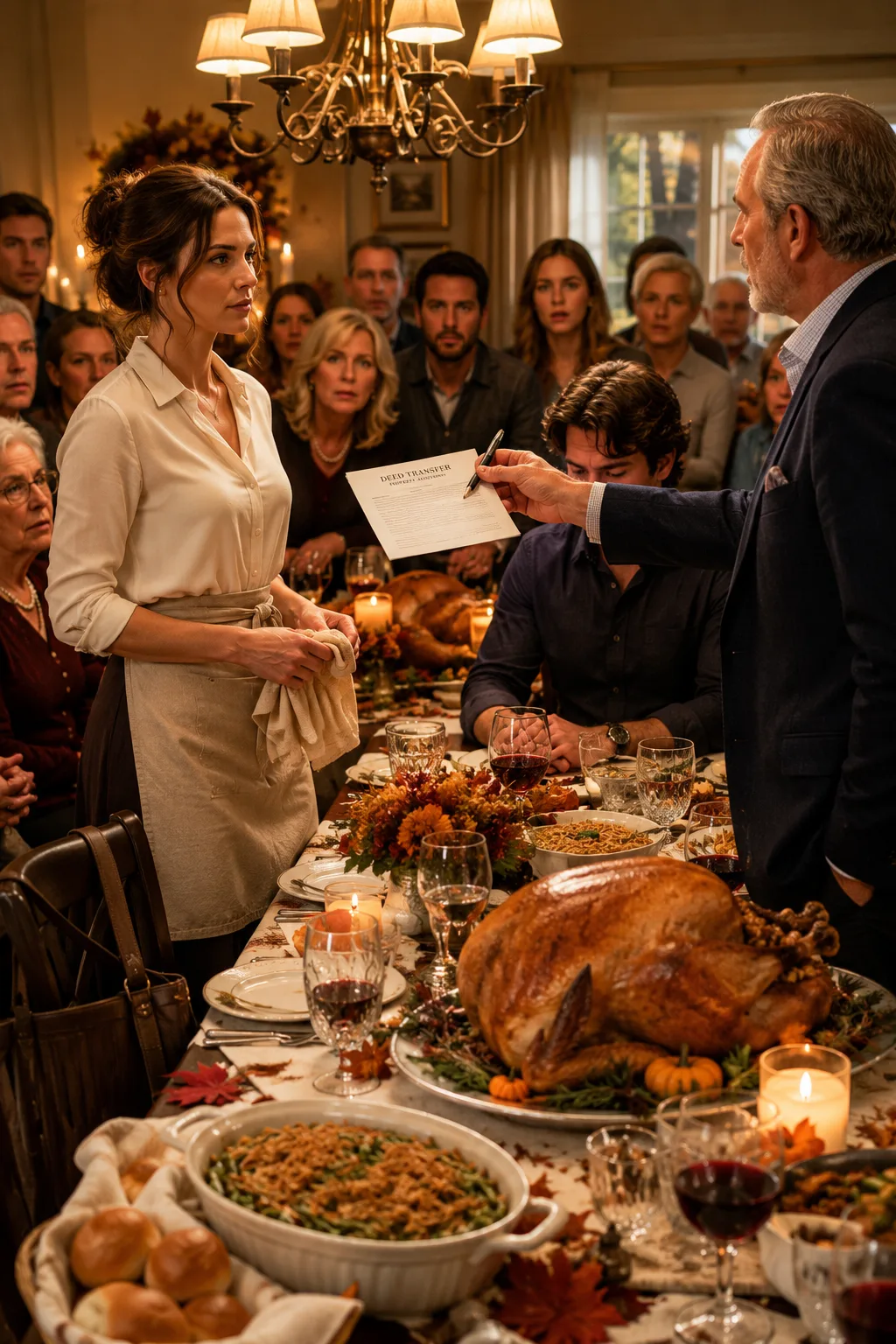
Frank reached into the breast pocket of his blazer and pulled out a folded document.
White paper.
Blue signing tabs.
A black pen clipped to the top.
Jess looked at Marcus.
His face had gone flat.
Not surprised.
Not confused.
Flat.
That was worse.
Frank unfolded the papers with care. He smoothed them against the table near his plate, then lifted them so everyone could see enough to know it was official without reading a word.
“Jess, sweetheart,” he said.
The room shifted.
A few people looked at their plates. A few stared at the document. One of the children in the hallway asked why Grandpa Frank was standing again.
Diane whispered, “Not now.”
Frank ignored her.
“Marcus and I talked,” he said, “and we all agreed it makes more sense to have the property deed in the family name instead of just yours.”
Jess held the bread basket.
Twenty-two people looked at her.
The turkey sat between them, carved cleanly on one side. Steam rose from the gravy boat. A candle near the centerpiece leaned to the left because its base had softened.
Marcus stared at that candle.
Frank extended the papers across the table.
The pen came next.
“If you could just sign here.”
Nobody moved.
A fork hovered near Aunt Carol’s mouth. Lauren’s toddler dropped a roll onto the floor and no one bent to pick it up. Diane closed her eyes for one second, then opened them and looked at her hands.
Jess placed the bread basket down.
Carefully.
The wicker touched the table with a soft scrape.
She wiped her hands on her apron.
Once.
Twice.
She did not reach for the pen.
Frank kept holding it out.
“Jess,” he said, with the patient tone he used when pretending he was doing someone a favor. “No need to make this awkward.”
Jess looked at the papers.
Then at the pen.
Then at the man holding both.
“When you say family name,” she said, “whose name specifically did you have in mind?”
Frank’s mouth stayed in the shape of a smile.
“Well,” he said, “Marcus and mine, shared with—”
“Shared with who?”
The word landed cleanly.
A chair creaked.
Marcus moved his glass two inches to the left.
Frank lowered the document a fraction.
“It’s a formality.”
“No,” Jess said. “It’s a house.”
No one picked up a fork.
The room did not become silent all at once. It happened in layers. The hallway kids stopped whispering. The cousin by the window stopped chewing. The ice in someone’s glass cracked softly and then settled.
Jess untied the apron from behind her waist.
The knot caught once.
She pulled again.
It came loose.
Frank watched her hands.
So did Marcus.
“You haven’t made a single mortgage payment on this house,” Jess said. “Marcus hasn’t either.”
Marcus’s shoulders tightened.
Frank’s smile slipped.
Only slightly.
Jess folded the apron once and draped it over the back of her chair.
“I’ve made sixty payments,” she continued. “My mother helped with the down payment. My name is on the loan. My name is on the deed. That is not confusion. That is the record.”
Frank gave a small laugh.
A bad one.
The kind meant to tell the room when to relax.
Nobody followed him.
“Jess, this is family business,” he said.
“This is my house.”
Diane looked up at that.
Lauren did too.
Marcus still did not.
Jess turned toward him.
“Did you agree to this?”
His hand was around the water glass now. The glass had condensation on it. His thumb made a clean mark through the fog.
“Jess,” he said.
That was all.
Her name.
Like it was a request.
Like it was a warning.
“Did you agree to this?” she asked again.
Frank cut in.
“Marcus understands the bigger picture.”
“I asked Marcus.”
The room held.
Marcus swallowed.
His eyes flicked to Frank.
Then to his mother.
Then to the centerpiece.
“It’s complicated,” he said.
Jess nodded.
Not at him.
Not really.
At the room.
So everyone could see the answer had arrived, even if he had dressed it in smaller words.
“It’s not,” she said.
Frank placed the paper on the table and tapped the blue tab with the pen.
“Enough. We’re not putting private matters on display.”
Jess looked around the table.
At the cousins who had eaten food she cooked for years. At the aunts who asked her for recipes and then called the house Marcus’s. At Diane, who had once told Jess she was lucky Frank respected independent women. At Lauren, who was staring at her brother with a look Jess had not seen before.
Then Jess looked at Frank.
“You brought a deed transfer to Thanksgiving dinner.”
Frank’s jaw moved.
No sound came out.
“You asked me to sign it in front of twenty-two people.”
Frank’s fingers tightened around the pen.
“You made it public.”
A small sound came from the hallway. One of the children had dropped a plastic cup. It rolled once and stopped against the baseboard.
Jess reached down to the bag hanging from her chair.
Marcus lifted his head.
Frank changed first.
His face did not collapse. Men like him had practice. But something in his eyes sharpened. He had expected hesitation. Maybe embarrassment. Maybe tears. Maybe a whispered argument in the kitchen after dinner while everyone pretended not to listen.
He had not expected the bag.
Jess pulled out the manila envelope.
Thick.
Plain.
Prepared.
She placed it beside the turkey.
The envelope looked ugly against the table. Too office-like. Too dry. It did not belong near cranberry sauce and candles and polished silver.
That was why it worked.
Frank stared at it.
“What is that?” Marcus asked.
His voice was smaller now.
Jess opened the metal clasp and slid out the papers. She did not rush. She did not make a show of it. The first page was the closing statement. The second was the deed. The third was the mortgage payment history. She placed them in a neat stack beside Frank’s document.
“Everything in here proves how this house was purchased,” she said. “And by whom.”
Aunt Carol leaned forward before she could stop herself.
Diane whispered Frank’s name.
Frank did not look at her.
Jess picked up the payment history.
“Sixty payments,” she said. “All from my account.”
She placed it down.
“My mother’s down payment contribution.”
Another page.
“Marcus’s email agreeing the house would remain in my name.”
Marcus pushed back from the table slightly.
The chair legs scraped the floor.
“There’s context,” he said.
Jess looked at him.
“There always is.”
He did not answer.
Frank reached for the papers.
Jess placed one hand on the stack.
Not hard.
Just enough.
“No.”
Frank’s hand stopped.
His face reddened from the neck upward.
“You are embarrassing yourself,” he said.
Jess looked at the document he had brought.
“No,” she said. “I’m done letting you do it for me.”
The words did not come out loud.
They did not need to.
A strange thing happened then.
Nobody defended Frank.
For years, Jess had watched that family move around him like furniture arranged around a fireplace. People laughed when he laughed. They stopped when he stopped. They let him carve the turkey, choose the vacation house, decide which cousin had made a bad investment, which niece had married poorly, which neighbor had overpaid for landscaping.
At that table, with his pen still in his hand and his papers exposed beside hers, nobody moved toward him.
Lauren bent down, picked up her toddler’s dropped roll, and set it on a napkin.
Diane folded her hands in her lap.
Marcus looked at the floor.
Frank was alone at the head of the table.
It did not suit him.
“You’re part of this family,” he said.
“I am,” Jess replied. “Which is why I’m saying this at the table instead of through a lawyer.”
The word lawyer moved through the room faster than any shout could have.
Marcus stood halfway.
“Jess, come on.”
“No.”
He stopped.
She looked at him for the first time without trying to make his silence into something kinder.
“Behind those papers,” she said, “there is a document for you.”
Marcus stared at the envelope.
“What document?”
Jess did not answer right away.
She slid the top stack aside and revealed another folder, thinner than the first.
No label.
No decoration.
Just his name written in black ink.
Marcus saw it.
His face lost its color.
Frank saw it too.
Diane covered her mouth with two fingers.
Jess pushed the folder toward Marcus’s place setting.
“You can look at it when you’re ready.”
Marcus did not touch it.
No one asked what it was.
They knew enough.
That was the thing about families like this. They could pretend not to see a bruise on a marriage for years, but when paperwork appeared, they understood language perfectly.
Frank looked from Jess to Marcus.
“What did you do?” he asked his son.
Marcus still did not touch the folder.
Jess took her chair and sat down.
She unfolded her napkin.
Placed it on her lap.
Picked up her fork.
The whole table watched her.
“I won’t be signing anything today,” she said. “I hope everyone enjoys the food.”
For several seconds, nobody breathed normally.
Then Lauren reached across the table.
She took a bread roll.
Quietly.
She placed it on her plate and buttered it with slow, careful strokes.
Diane picked up the serving spoon and put green beans on her plate from Jess’s casserole, not Frank’s.
A cousin cleared his throat and asked someone to pass the potatoes.
The meal resumed in broken pieces.
Frank sat down last.
He did not eat.
Marcus sat with the folder beside his plate and both hands under the table. Jess could see his knee bouncing once, then stopping, then starting again.
No one gave thanks aloud.
Not that year.
The children in the hallway recovered first. They always did. They asked for more rolls. One wanted only turkey skin. Another spilled juice and cried because the napkin had cranberries on it. Life kept making small demands, even when adults tried to destroy each other with legal documents.
Jess ate three bites of turkey.
It was slightly dry.
She almost laughed.
After all that, the turkey was dry.
No one commented.
Frank left before dessert.
He stood, buttoned his blazer, and said he had a headache. Diane rose with him, though she moved like someone who had not agreed to leave but knew the ride home depended on it.
At the front door, Frank turned back.
Jess stood in the hall with her arms at her sides.
The chandelier light from the dining room reached only half of his face.
“This isn’t finished,” he said.
“No,” Jess said. “It’s documented.”
He looked past her toward Marcus.
Marcus stayed in the dining room.
Frank opened the door himself.
Cold air entered the house.
Then he was gone.
Diane lingered for one second.
She looked at Jess, then at the floor between them.
“I’m sorry about dinner,” she said.
It was not enough.
It was still something.
Jess nodded once.
Diane left.
The house emptied slowly after that. Coats were found. Shoes were matched. Leftovers were packed in containers Jess did not want back. Aunt Carol hugged her too tightly and said nothing useful. Lauren stayed until the end, wiping counters without being asked.
Marcus did not move from the dining room.
The folder remained beside his plate.
At nine-thirty, the last car pulled out of the driveway.
The house settled.
Jess stood in the kitchen, scraping plates into the trash. Cranberry sauce had dried along the edge of one dish. A fork had fallen behind the trash can. Someone had put a wine glass in the pantry.
Lauren came in holding the kids’ table cloth.
“Do you want me to wash this?”
“No. Leave it.”
Lauren folded it anyway.
The two women worked in silence for a minute.
Then Lauren said, “I didn’t know.”
Jess rinsed a plate.
“I know.”
“I mean it.”
“I know.”
Lauren looked toward the dining room.
“He told Dad you wanted to sell the house eventually.”
Jess turned off the faucet.
There it was.
Not the whole story.
Enough.
“He said that?”
Lauren nodded.
“He said you were worried about taxes. That Dad could help protect the property. That you were too proud to ask.”
Jess dried her hands on the towel.
The towel was damp from a full day of use. It smelled faintly like onions and dish soap.
“That sounds like him,” she said.
Lauren’s eyes moved to Jess’s tote bag.
“What’s in the folder?”
Jess looked toward the dining room.
“Separation papers.”
Lauren closed her eyes.
Just once.
Then she picked up another plate.
“Okay,” she said.
No advice.
No lecture.
No defense.
Jess liked her more for that.
At ten-fifteen, Lauren left through the side door with two containers of stuffing and one pie Marcus’s mother had forgotten. Jess locked the door behind her and stood with her forehead almost touching the glass.
Outside, the yard was dark except for the porch light. The maple tree near the driveway had lost most of its leaves. A few still clung to the branches, curled and stubborn.
Marcus was still at the table.
Jess found him there when she returned.
The candles had burned low. The turkey carcass sat on the platter, stripped and tilted. His folder was open now.
He had read it.
Maybe once.
Maybe five times.
He looked up when she entered.
“You planned this.”
Jess picked up two empty glasses.
“No,” she said. “I prepared for it.”
“That’s the same thing.”
“It isn’t.”
He rubbed both hands over his face.
His wedding ring flashed under the chandelier light.
“My dad pushed too hard.”
Jess looked at him.
“That’s your version?”
Marcus leaned back.
The chair creaked under him.
“I didn’t think he would do it at dinner.”
“But you knew.”
He did not answer.
There it was again.
His favorite shelter.
Silence.
Jess placed the glasses on the sideboard.
“You told Lauren I wanted to sell the house.”
Marcus’s face changed.
A small change.
Enough.
“I was trying to make them understand,” he said.
“Understand what?”
“That this setup wasn’t fair.”
Jess laughed once.
Not loudly.
Not kindly.
“Fair.”
He stood.
“I live here too.”
“You live here because I carried us while you figured things out.”
“That’s not fair.”
“No. It’s accurate.”
He looked toward the front hall, where his father had stood with the blazer and the threat.
“Jess, you don’t know what it’s like to have him in your ear.”
She turned fully toward him.
“Then stop giving him mine.”
Marcus had no answer for that.
The dishwasher hummed from the kitchen. The last candle flickered near the centerpiece. The crooked one had finally burned itself into a pool of wax that spread across the small glass holder.
Jess walked to the table and picked up Frank’s deed transfer.
She read only the first page.
Marcus’s name.
Frank’s name.
No Jess.
Not even hidden in the fine print as courtesy.
She folded it once.
Then again.
Marcus watched her.
“What are you doing?”
“Keeping it.”
“For what?”
“For the lawyer.”
His mouth opened.
Closed.
The word had landed differently now that the house was empty.
“Jess.”
She put the folded document into the manila envelope.
“Not tonight.”
“We should talk.”
“We did.”
“No, we didn’t.”
She looked at the table.
At the turkey bones. The bread basket. The empty chair where Diane had sat. The folder by Marcus’s plate. The pen Frank had forgotten and left near the gravy boat.
Then she looked at her husband.
“You talked with your father,” she said. “You planned with your father. You sat at my table and let him ask me to sign away my home.”
Marcus’s eyes dropped.
“That was the conversation.”
He touched the folder.
“Are you really doing this?”
Jess picked up the pen Frank had left behind.
It was heavier than it looked.
Black lacquer.
Gold trim.
A rich man’s little weapon.
She placed it on top of the envelope.
“I already did.”
Marcus sat down again.
For a while, neither of them moved.
The house made its late-night sounds around them. Pipes settling. Refrigerator clicking on. A branch scraping lightly against the upstairs window.
Jess gathered the last plates.
She did not ask him to help.
At midnight, the kitchen was clean enough. Not perfect. Nothing was perfect. A cranberry stain remained on the rug. One folding chair was still in the hallway. The trash bag was too full and would have to wait until morning.
Marcus had gone upstairs to the guest room.
Not their room.
He had taken the folder.
Jess stood alone in the dining room.
The table was bare now except for the centerpiece. Dried leaves. Orange berries. The crooked candle, ruined and small.
She picked it up.
Wax had hardened along one side like it had tried to escape and stopped.
She carried it to the trash.
Then she changed her mind.
She set it on the windowsill instead.
Her mother called the next morning before eight.
Jess answered with one hand around a mug of coffee and the other resting on the manila envelope.
“How bad was it?” her mother asked.
Jess looked at the dining room.
At the empty head of the table.
At her own chair.
At the place where Frank had stood and held out the pen like he owned the air.
“The turkey was dry,” Jess said.
Her mother was quiet.
Then she said, “And?”
Jess looked at the envelope.
“And the house is still mine.”
Outside, a truck passed. Somewhere down the street, a neighbor’s child laughed. The world had the nerve to keep going.
Jess took her coffee to the table and sat at the head.
Just once.
The chair felt strange.
Then it didn’t.
She drank her coffee before it got cold.
Chapter complete
You have reached the end of this chapter.
Continue reading
A few more worlds to get lost in after this chapter.




