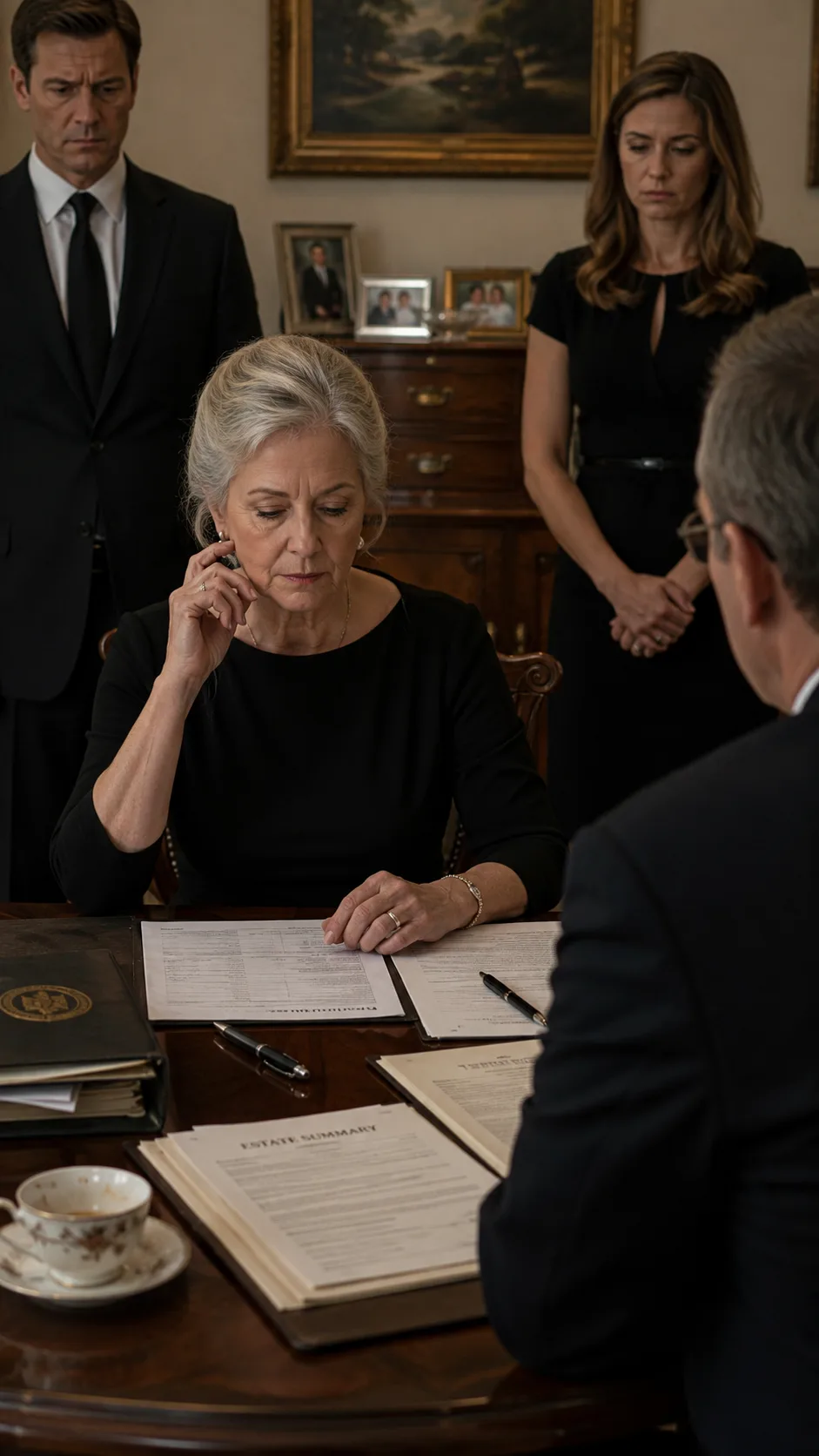
The pen rolled off the estate packet and tapped twice against the leg of the dining table.
Chapter 1
The pen rolled off the estate packet and tapped twice against the leg of the dining table.
Nobody picked it up.
My son Daniel stood behind my left shoulder with his arms folded, staring at the place where the pen had fallen as if a small accident could delay probate. My daughter Claire took one step toward it, then stopped when our lawyer bent down first. Thomas Reid was nearly sixty, with a careful spine and the kind of black suit men wear when they expect grief to behave itself.
He placed the pen back beside my hand.
“There’s no rush,” he said.
There was.
Not on paper, maybe. But in the house, yes.
The funeral flowers had already begun to brown at the edges. The casserole dishes had names taped under them in blue painter’s tape. Someone had left a coffee cup on the piano, and the ring it made on the wood looked almost rude. Henry would have noticed that. He noticed everything when it
belonged to us.
Especially this room.
Our dining table was the first piece of furniture we bought after we moved into the house on Ashbury Lane. Cherry wood, too large for the two of us then, too formal for weeknights, too expensive for a young couple with a mortgage that made me check the mailbox before Henry got home. He had laughed when I worried over the price and said, “One day we’ll fill it.”
He was right.
Children. Birthdays. Thanksgiving. College acceptance letters. The night Daniel told us he was getting married. The Sunday Claire brought her newborn daughter over and Henry held that baby like a court document, careful at the edges.
Now the table was covered with his death.
Bank statements. Insurance forms. A certificate with a raised seal. The first draft of the estate distribution. A neat stack of documents with my name typed at the
top: Margaret Ellen Hale, surviving spouse.
Surviving.
That word kept appearing.
I rubbed my thumb over my wedding ring. It turned halfway around my finger with no resistance. Since Henry’s final month in the hospital, I had lost enough weight that the ring slipped if I washed my hands too fast.
Daniel cleared his throat.
“Mom, Thomas already explained it. Dad made this simple.”
Simple.
Claire gave him a look.
He looked away.
The wall clock ticked above the china cabinet. Henry had hated that clock but refused to replace it because his mother gave it to us. Every hour, it released a dry little chime that sounded like a spoon striking bone.
Thomas opened the first folder.
“The house remains with you. The retirement accounts are already designated. The investment account transfers directly. This is mostly confirmation.”
Mostly.
I turned toward the hallway. From where I sat, I could
see the study door standing half open. Henry’s desk was inside. So was the locked drawer cabinet.
That cabinet had bothered me for thirty-eight years.
It was dark walnut, waist-high, with brass handles and one drawer at the top that Henry always kept locked. He called it his tax drawer. Then his business drawer. Then, after retirement, his private drawer. He never said those words with suspicion. He said them as if privacy were a normal room inside marriage, and a good wife knew where the door was.
I had known.
I had stayed outside it.
Two days after the funeral, when I put away his cuff links, I had tried the drawer once. Not because I expected anything. Because the key was gone, and the absence of it made the brass lock look newly important.
The drawer didn’t open.
That was all.
Except it wasn’t.
At the funeral reception, a woman I did not know had stood in the hallway beside the study for nearly a full minute. She wore a beige coat and black leather gloves, too polished for a neighbor, too still for someone who had come only to pay respects. I remembered her because she didn’t look at Henry’s portrait on the mantel. She looked into the study.
Then she touched the locked drawer cabinet with two fingers.
Just two.
Like she had touched it before.
I had been holding a tray of coffee cups. One cup rattled against another. The woman turned, saw me, and walked out through the side door before I could ask her name.
By morning, I had decided she was someone from Henry’s office days.
By afternoon, I had decided she was nobody.
That evening, the funeral guest book told me otherwise.
Vivian Cross.
No address.
Just a name written in blue ink, with a long, slanted V and a small tear in the paper where the pen had pressed too hard.
I did not tell Daniel or Claire. They were already sorting Henry into categories they could manage. Clothes for donation. Files for Thomas. Tools for Daniel’s garage. Books for Claire’s boys.
A husband is harder to sort.
A father is easier.
Thomas slid a paper toward me.
“This one simply acknowledges the inventory.”
I reached for the pen.
The doorbell rang.
No one moved.
The sound came once, clean and deliberate.
Claire glanced toward the foyer. Daniel swore under his breath and started around the table. I lifted one hand.
“I’ll answer it.”
“Mom, stay there.”
“I can open a door.”
My chair legs scraped the rug. Thomas stood halfway, then sat when I gave him a look. The house had been too full for days, and now it had that hollow after-funeral quiet, when every footstep seemed to ask permission.
I walked past the piano, past the framed photograph of Henry receiving an award from the Chamber of Commerce, past the umbrella stand he insisted we keep though neither of us used umbrellas.
The woman in the beige coat stood on my porch.
Her auburn hair was pinned at the back of her neck. Her gloves were in one hand. In the other, pressed against her chest, was a worn leather folder tied with string.
No flowers.
No casserole.
No sympathy card.
“Mrs. Hale,” she said.
I looked at the folder.
Then at her face.
“You came to the funeral.”
“Yes.”
“You left before speaking to me.”
Her fingers tightened around the folder.
“Yes.”
Behind me, Daniel’s shoes struck the hallway floor. He stopped close enough that I could feel his impatience at my back.
“This isn’t a good time,” he said.
The woman did not look at him.
“I need to speak before she signs anything.”
There it was.
Not hello.
Not I’m sorry.
Before she signs.
Daniel stepped beside me, blocking part of the doorway with his shoulder.
“This is private.”
The woman’s chin lifted a fraction.
“It stopped being private when he made me a promise.”
The hallway clock gave one small tick.
I held the door open wider.
“Come in.”
Daniel turned to me. “Mom.”
I walked back toward the dining room without answering.
The woman followed. Her steps were careful, not hesitant. She had been inside this house before. I knew it by the way she did not pause at the foyer mirror, did not glance toward the living room, did not search for the dining room.
She already knew.
Claire stood when we entered. Her eyes moved from the woman’s coat to the folder and stayed there.
Thomas closed his legal binder.
I returned to my chair at the head of the table.
The woman stood opposite me, separated from my family by polished cherry wood, estate papers, and thirty-eight years of marriage.
“What is your name?” I asked.
“Vivian Cross.”
Claire’s lips parted.
Daniel gave a short laugh. Not amusement. Something smaller.
“And who exactly are you?”
Vivian placed her gloves on the table edge. Black leather. The left thumb was worn pale at the seam.
“I was with Henry.”
No one asked what that meant.
Nobody needed to.
Claire sat down too quickly. The chair knocked against the leg of the sideboard. Daniel took his phone from his pocket, then put it back without unlocking it.
Thomas folded his hands.
“Ms. Cross, this is an estate meeting. If you believe you have a legal claim, you can contact my office.”
“I did.”
Thomas’s fingers stopped moving.
Vivian reached into her coat pocket and removed a white envelope. She set it on the table, face up. Thomas’s office address was printed on it. Unopened.
He looked at it for two seconds too long.
“I receive a great deal of mail.”
“I sent three.”
Claire turned toward him.
“Thomas?”
He did not answer her.
Vivian kept the leather folder pressed against her chest.
I looked at the unopened envelope. My husband had trusted Thomas with everything. Our wills. The house deed. The trust for the grandchildren. The medical directives that were supposed to make the end cleaner than it was.
Three letters.
Unopened.
I shifted one estate paper aside with my fingertips.
“If this is about money, leave,” I said.
Vivian looked at the chair Henry had always used at the far end of the table. It remained pulled out half an inch. I had not pushed it in since the funeral reception.
“He promised me half.”
Daniel moved first.
“My father would never write that.”
Vivian’s eyes moved to him.
“Then read his handwriting.”
The room narrowed around that sentence.
Henry’s handwriting had been on everything. Birthday cards. Grocery lists. Notes left on the kitchen counter. The labels he wrote for boxes in the attic. Even in his last week, when his hand trembled too much for a full sentence, he signed the discharge papers with the same slanted H he had used since college.
Thomas’s voice changed.
“Ms. Cross, do you have a document?”
Vivian did not answer him.
She looked at me.
“I didn’t come here to embarrass you.”
Daniel laughed again.
“You show up after my father’s funeral claiming half of my mother’s estate, and that’s your line?”
“Daniel,” Claire said.
“No. She should leave.”
Vivian lowered the folder to the table.
Not loudly.
That made it worse.
The leather touched the wood beside the estate packet, and the room changed shape. Until then, she had been a woman with a claim. Now she had brought an object. Something tied. Something kept.
Thomas leaned forward.
I did not.
My hand lay beside the pen. I looked down and saw a crescent mark in the skin where the ring had turned.
“Where did you get that folder?” I asked.
Vivian’s thumb ran once across the string.
“From the locked drawer.”
The sideboard seemed to come closer.
Claire stood again.
“What drawer?”
I did not look at the hallway.
Vivian did.
The study door remained open. From my chair, I could see the walnut cabinet in a strip of afternoon light. The brass lock was dull. The drawer face was smooth except for one scratch near the handle, a scratch Henry blamed on the movers when we renovated the den.
“How did you open it?” I asked.
Vivian reached into her coat pocket again.
This time she brought out a key.
Small. Brass. Familiar in a way I did not want to name. It had a red paper tag tied to it with cotton string. Henry used those tags in the basement. Pipes. Paint cans. Old Christmas lights.
The tag said H.H. private.
Daniel took a step toward her.
She closed her hand around the key.
“No.”
One word.
He stopped anyway.
Thomas rose from his chair.
“Everyone, please sit.”
No one sat.
Vivian set the key beside the folder. The tag faced up.
My daughter covered her mouth with two fingers, but only for a second. Then her hand dropped to her side.
I remembered Henry’s hospital drawer. His watch. His reading glasses. The tin of peppermint drops he kept though he was not supposed to have them. No key.
I remembered the funeral reception. Vivian in the hallway. Her fingers on the walnut cabinet.
I remembered myself deciding she was nobody.
The coffee cup on the piano sat in the next room, making its round stain in silence.
Thomas looked at me.
“Margaret, you don’t have to proceed with this in your home.”
My home.
I nearly smiled at that.
The house had become a place other people spoke around. The children whispering in the kitchen. Thomas arranging papers. Neighbors leaving food and touching my arm. Everyone treating Henry’s empty chair as something fragile.
Vivian had walked in and placed a key on the table.
I picked up the pen.
Daniel’s shoulders loosened, as if I had returned to sense.
Instead, I used the pen to slide the estate packet away from the center of the table.
The papers moved with a dry scrape.
“Open it,” I said.
Vivian’s face did not change.
Her hands did.
The right hand flexed once before she untied the string. Her fingers were steady after that. The knot came loose. She lifted the flap of the leather folder and opened it toward herself, not toward the room, as if even now she could choose how much damage entered.
A smell came out first.
Old paper.
Cedar.
The faint trace of Henry’s study, where he kept a block of sandalwood in the top drawer because he said old houses had old-house breath.
Vivian removed a bundle of letters tied with faded blue ribbon.
Claire made a sound. Small. Cut off.
Daniel said, “No.”
Vivian slid the first envelope free.
The paper was cream-colored, yellowed at the edges. My name was not on it.
Vivian Cross.
Written in Henry’s hand.
The H was not there, of course. But the V was. The same long pressure, the same slight downward slash. I had seen him address enough Christmas cards to know the shape of every letter he made when he tried to be elegant.
Thomas came around the side of the table.
“May I?”
Vivian did not hand it to him.
She slid it to me.
It stopped inches from my hand.
I stared at it until the letters blurred into shapes and returned. Vivian Cross. Vivian Cross. Vivian Cross.
Thirty-eight years, and I had never seen my husband write another woman’s name like that.
Not on a seating chart.
Not on a check.
Not anywhere.
I picked up the envelope.
The flap had already been opened. Inside was one folded sheet.
My thumb caught against the crease.
“Where did you get this?” I asked.
Vivian pointed toward the study.
“From the drawer he thought no one would open.”
Daniel turned toward the hallway. He took two steps, stopped, then looked back at the key lying beside the folder.
Thomas stood near my shoulder now. Close enough to read if I allowed it. Close enough to catch me if I fell, maybe, though I had no intention of giving anyone that duty.
I unfolded the paper.
Henry’s handwriting filled the page.
Not a note.
Not a card.
A letter.
Dear Vivian.
The first two words sat at the top like a door left open.
I did not read aloud. Not yet.
My eyes moved down the page because eyes do what hands cannot stop. Henry wrote of time. Of regret. Of promises made after midnight. Of a life he divided so carefully that both women had received only half the truth and all of the damage.
Then Vivian’s finger entered the page.
She did not touch the writing. She pointed near the bottom.
There, in black ink, was the sentence that made Thomas inhale through his nose.
If anything happens to me before I make this right, you are to receive half of what I leave behind. I owe you that much, and Margaret must never destroy what was ours.
Margaret.
My name in the same line.
Not wife.
Not family.
Margaret.
Thomas leaned closer.
“Mrs. Hale…”
I lowered the letter flat onto the estate packet.
The legal papers disappeared beneath it.
“Read it aloud,” I said.
Thomas did not move.
Daniel did.
He reached for the letter.
I placed my hand over it.
“Don’t.”
He froze with his fingers above mine.
For the first time since he was a boy, Daniel obeyed me without arguing.
Claire moved around the table and stood behind Thomas. Her eyes stayed on the page.
Vivian remained opposite me, one hand near the remaining letters, the other at her side. Without the folder against her chest, she looked smaller. Not weaker. Just less hidden.
Thomas picked up the letter by its edges.
He read the sentence.
No one interrupted.
His voice was flat, professional, stripped of the careful warmth he had used with me all morning. When he reached my name, he paused half a beat, then continued.
Margaret must never destroy what was ours.
Daniel looked at Vivian then. Not at her face. At the bundle of letters.
“How many?” he asked.
Vivian untied the blue ribbon.
The letters spread slightly under her hand.
“Twenty-six.”
Claire backed into the chair behind her. The chair tilted, then struck the floor on all four legs.
Twenty-six.
Not one mistake. Not one week. Not one hidden weekend that could be folded into the history of a long marriage and filed under weakness.
Twenty-six letters meant time.
Dates.
Ink.
Postage.
Decisions.
Thomas set the first letter down. He did not place it back on the estate packet. He placed it in the center of the table, where everyone could see the handwriting.
The room began to rearrange itself around that page.
Daniel no longer stood behind me as protection. He stood beside me, looking down like a man reading a verdict he did not understand. Claire’s hand rested on the back of my chair. Thomas’s briefcase remained open, but his documents had lost their authority. Vivian’s envelope from his office sat unopened near the sugar bowl, suddenly more important than every certified copy in the room.
I looked at Vivian.
“Why now?”
Her throat moved.
“He asked me not to come while he was alive.”
I waited.
She looked at Henry’s empty chair.
“And I listened too long.”
Daniel slammed his palm onto the table. The coffee cups jumped. One spoon fell into a saucer with a bright little crack.
“You don’t get to talk about listening.”
Vivian did not step back.
“No.”
The single word landed without defense.
Claire’s voice came from behind me.
“Were there others?”
Vivian shook her head.
Daniel turned on her.
“You expect us to believe anything you say?”
“No.”
She reached into the folder and removed a smaller envelope. This one was sealed with tape that had yellowed and lifted at the corners.
“For Margaret,” she said.
My name was written across the front.
Again, Henry’s hand.
Not the careful public handwriting from the first envelope. This was the quick version. The version from notes on the counter.
Margaret — only if she asks.
The room waited for me to reach.
I did not.
Thomas asked, “When was this written?”
Vivian checked the back.
“Six weeks before he died.”
Six weeks.
Henry was still at home then. He still sat in the sunroom with a blanket over his knees and told me not to fuss with the thermostat. He still asked for oatmeal with brown sugar and only ate two spoonfuls. He still held my hand at night because his own hands had gone cold.
Six weeks before he died, he had written my name on an envelope and given it to her.
My fingers loosened from the first letter.
The paper stayed flat.
“Open it,” I said.
Thomas reached out.
“No,” I said.
Vivian opened it.
Inside was a single page. She unfolded it, scanned the first line, then stopped. For the first time since entering the house, she looked away from me.
“What does it say?” Claire asked.
Vivian placed it on the table and turned it so I could read.
Margaret, if you are reading this, then I failed both of you longer than any man has a right to fail two women.
The rest waited under my hand.
Henry had always liked long sentences when he wanted forgiveness. He wrote them in anniversary cards after arguments, winding one excuse into another until the apology became a hallway with no door.
I read silently.
He wrote that he met Vivian before his first heart surgery, when he was scared and too proud to say so at home. He wrote that it should have ended. He wrote that it didn’t. He wrote that Vivian never asked him to leave me at first, then did, then stopped asking. He wrote that he kept a separate savings account and changed his mind about it so many times that the account became larger than courage.
Then the final paragraph.
The drawer contains the letters because I could not burn them and could not bring them into the light. If Vivian comes after I am gone, do not call her a liar. I made the promise. I made the mess. I left you both to clean it.
Thomas removed his glasses.
Daniel walked out of the dining room.
His footsteps went down the hall, then stopped near the study. A second later, the locked drawer cabinet rattled.
Once.
Twice.
He came back without the key.
Vivian watched him, but said nothing.
I folded Henry’s letter along the same crease he had made.
The wall clock chimed.
One.
Two.
Three.
No one breathed around the sound until it finished.
Thomas gathered the estate packet and slid it back into his folder.
“We can’t proceed today,” he said.
Daniel laughed from the doorway. It sounded scraped out.
“Because of some letters?”
Thomas looked at him.
“Because of potential claims, undisclosed assets, and written intent.”
“Intent isn’t a will.”
“No,” Thomas said. “But hidden accounts may be a different matter.”
Vivian’s hand moved to the folder again.
“There are statements.”
Daniel stared at her.
The table had become hers without her taking a seat.
She opened the back pocket of the folder and removed a thin stack of folded bank records. Thomas accepted them this time. He scanned the first page, then the next. His mouth settled into a line I had seen only twice before, both times when someone had made a legal problem worse by believing manners would hide it.
“Henry maintained an account under a trust designation,” he said.
Claire closed her eyes, then opened them.
Daniel said, “For her?”
Thomas did not answer quickly.
“For both, perhaps. We need to review.”
Both.
That word had no furniture in my house.
I stood.
The chair pushed back against the rug. Everyone looked at me then, as if my standing required explanation.
I took off my wedding ring and placed it beside the first letter.
Not hard.
Not dramatic.
Just beside it.
The gold band rolled once, struck the folded edge of Henry’s page, and stopped.
“Thomas,” I said, “take copies of everything.”
Vivian’s eyes moved to the ring.
“And the originals?” she asked.
I looked at the leather folder. The ribbon. The key. The handwriting that had crossed years without my permission.
“The originals stay on this table until I decide what to do with the dead man who wrote them.”
No one corrected me.
After that, the room emptied in pieces.
Daniel went outside and stood in the driveway with his phone pressed to his ear, though I could hear no words through the window. Claire walked to the kitchen and opened cabinets without taking anything out. Thomas made calls from the living room, his voice low, his legal tone returned but sharpened.
Vivian remained in the dining room.
She did not sit.
Neither did I.
The letters lay open between us like place settings for a meal no one could eat. One envelope had slid under the edge of a coffee cup. The saucer held a crescent of cold brown liquid. Henry hated cold coffee.
I picked up the cup and carried it to the kitchen.
Claire stood at the sink, running water over a clean spoon.
She turned it over and over beneath the stream.
“Mom.”
I poured the coffee out.
The dark liquid struck the drain and disappeared.
“Not now,” I said.
She nodded once.
When I returned, Vivian had put her gloves back on. The folder stayed open.
“I can leave,” she said.
“Without the letters?”
She looked at the table.
“No.”
I almost admired that.
Almost.
Thomas came back with a scanner app open on his phone and a portable folder from his briefcase. He photographed every page. Vivian watched each letter as if he were handling something alive. I watched my husband’s words move from paper to screen.
By dusk, the estate meeting had become an inventory of betrayal.
Dates. Accounts. A storage unit. A post office box. A notarized note that was not enough to change the will but enough to keep the lawyers busy. Henry had been careful in every way except the one that mattered.
He had assumed death would silence him.
Instead, it gave his handwriting the room.
Vivian left after Thomas sealed copies in a document bag. She took the originals because they were hers; I allowed it because keeping them would not make me more married.
At the door, she paused.
“I didn’t want your house,” she said.
I looked at her beige coat, the worn glove thumb, the folder under her arm.
“What did you want?”
She did not answer for a long time.
Then she said, “To stop being a drawer.”
The porch light turned on automatically over her head. Henry installed that sensor himself because he said no one should stand in the dark at our door.
Vivian walked down the steps.
Daniel did not speak to me for three days.
On the fourth, he arrived with a cardboard box of Henry’s office things from the study. He set it inside the foyer and said he couldn’t do it. His face had gone unshaven, and his shirt was buttoned wrong at the throat.
I opened the box after he left.
Inside were pens, old receipts, a cracked magnifying glass, two pocket calendars, and a small packet of red paper tags tied with cotton string.
I touched one tag.
Blank.
The lawyers worked for months.
Vivian did not receive half of everything. Henry’s will could not be rewritten by guilt dressed as a letter. But the hidden account existed, and so did the trust language attached to it. There were negotiations, filings, signatures, and one meeting in Thomas Reid’s office where Vivian and I sat on opposite sides of a conference table while men used careful words for ugly things.
In the end, she received enough to buy a small house near the coast.
I kept Ashbury Lane.
Not because I wanted victory.
Because the house had belonged to my life too.
Daniel apologized in my kitchen one Sunday with his hands wrapped around a mug he never drank from. Claire cleaned out Henry’s closet with me and did not ask to keep his sweaters. We donated most of them. One navy cardigan stayed in a bag by the back door for two weeks before I drove it to the shelter myself.
The locked drawer cabinet remained in the study.
For a while, I left it open.
Empty.
Anyone who passed could see inside. Daniel saw it. Claire saw it. The grandchildren saw it and asked if Grandpa kept treasure there.
“No,” I said.
Just that.
Spring came without asking the house for permission. The hydrangeas along the fence turned green first, then blue. I hired a man to refinish the dining table, and when he pointed to the coffee ring on the piano, I told him to leave it.
One mark could stay.
On the anniversary of Henry’s death, a letter arrived from Vivian. No return address I recognized. Inside was a single photograph of the ocean taken from a porch. On the back, she had written only two words.
I’m done.
I put the photograph in the locked drawer.
Then I closed it.
The key hangs now on a hook beside the kitchen door, under the umbrella Henry never used. Anyone can see it. Anyone can take it down.
No more drawers.
Chapter complete
You have reached the end of this chapter.
Continue reading
A few more worlds to get lost in after this chapter.




