Richard’s dinner plate was still warm when he kissed the top of my head and reached for his keys.
Chapter 1
Richard’s dinner plate was still warm when he kissed the top of my head and reached for his keys.
“Client call,” he said.
Again.
The roast chicken sat between us, untouched on his side. I had made it because he used to like lemon and rosemary on Sundays, back when he came home before dark and left his phone on the kitchen counter without turning it face down. The potatoes had crisped around the edges. The green beans had gone limp in the steam.
I watched him button his coat with one hand.
“Tonight too?” I asked.
He did not look at me right away. His eyes went to the hallway mirror first, checking the knot of his tie, smoothing the front of his charcoal suit.
“Quarter-end numbers,” he said. “You know how it is.”
I didn’t.
Not anymore.
He picked up his leather briefcase from beside the door. The brass latch had a scratch across it from the year our son, Nathan, dragged it down the front steps
while pretending to go to work like Daddy. Richard had laughed then. He carried Nathan on his shoulders for the rest of the afternoon.
That briefcase looked heavier now.
Richard opened the door.
Cold air came in.
“Don’t wait up.”
I smiled because I had learned the shape of that smile over thirty-one years. Small. Polite. No teeth.
“I won’t.”
He paused at that, just long enough for me to see his hand tighten around the briefcase handle. Then he left.
The house settled around the sound of his car pulling out of the driveway. I stood beside the table until the headlights slid across the kitchen wall and disappeared.
The chicken cooled.
I wrapped his plate, put it in the refrigerator, and wiped the counter twice though there was nothing on it. Then I climbed the stairs to the room Richard called his office and I called the room
he kept locked whenever he was home.
The door was open.
That was the first mistake.
A narrow gap, no wider than my finger, showed a line of yellow light across the hallway carpet. Richard was careful about doors. Careful about drawers. Careful about every small thing that made a house feel shared while keeping parts of his life sealed away.
I pushed the door with two fingers.
The room smelled like old paper, shoe polish, and the cedar blocks he kept in his desk drawers. His computer monitor was black. His chair was pushed in. On the wall behind the desk were framed photographs from company dinners, golf tournaments, charity banquets, every version of Richard Whitman that other people applauded.
My version had left a drawer unlocked.
I did not go in at first.
I stood there with my hand on the doorframe, listening to the heating vent click
beneath the window. A sensible woman would have closed the door and gone downstairs. A loyal wife would have waited for an explanation.
I had been both.
Enough.
The top drawer held pens, paper clips, business cards, and a silver letter opener his father had given him when he made partner. The second held tax folders arranged by year. The bottom drawer resisted when I pulled it.
Something was caught behind it.
I knelt, worked my hand into the gap, and felt fabric. A scarf. Faded blue silk with a loose hem.
Mine.
I had worn it to our twentieth anniversary dinner. Richard had told me I looked elegant, then spent half the meal outside taking a work call.
Inside the scarf was an old phone.
Black. Heavy. A crack across one corner.
For a second, I only held it. The screen was dark, the edges cold against my palm. It should have been useless. Forgotten. Dead.
Then I saw the charger tucked beneath a stack of tax folders.
Richard had kept both.
I plugged it in at his desk.
The charging symbol blinked onto the screen.
One small light.
I sat in his leather chair and waited while the house made its night sounds around me. Pipes. Wind. The refrigerator downstairs. My own breath, too loud in a room that had never belonged to me.
The phone came on after seven minutes.
No photos.
No contacts.
No messages except a few old system alerts.
Almost clean.
Almost.
There was one saved voicemail.
No name.
Only a date from eleven years earlier.
June 3.
I remembered that date because it was the night Richard missed our daughter Claire’s college graduation dinner. He had called from “work” and told us to start without him. Claire cut the cake with her brother standing beside her, both of them pretending not to check the front window every time a car passed.
I pressed the voicemail.
A woman’s voice filled the room.
“Don’t forget Tuesday. Same hotel. Same account. And please don’t use Richard’s card again.”
I stopped breathing through my mouth.
The woman laughed once, low and familiar, like she had said the same thing many times.
“Martin, you promised me you’d be careful.”
Martin.
I played it again.
Then a third time.
The phone grew warm in my hand. I set it on Richard’s desk and stood up too quickly, knocking one of his framed photographs flat. It was from a company holiday party. Richard had his arm around me in the picture, his smile open, his hand resting on my shoulder like proof.
I turned the frame facedown.
Downstairs, the refrigerator hummed.
I did not sleep.
By morning, I had made coffee so strong it left grit at the bottom of the mug. I spread Richard’s tax folders across the dining table and searched every paper I had ignored for years because he said he handled the complicated things.
There were accounts I knew.
Mortgage. Retirement. Joint savings.
Then there were references to transfers that made no sense.
M.W. Holdings.
M. Whitaker Consulting.
Regular withdrawals from one business account into another, then payments from that account to a woman named Celeste Vale.
The amounts were neat.
Three thousand.
Five thousand.
Ten thousand, twice a year, every June and December.
I found a bank envelope in the back of the drawer, sealed but not glued. Inside were printed statements. Not ours. Not his company’s official accounts.
Martin Whitaker.
Same initials.
Same fake name.
My coffee went cold beside the papers.
At eight-thirty, Richard called.
I let it ring until it stopped.
At eight-forty, he called again.
This time I answered.
“You weren’t in bed,” he said.
“No.”
A pause.
“I got in late.”
“I know.”
“I didn’t want to wake you.”
“You didn’t.”
He exhaled through his nose, that small sound he made when he thought I was being difficult.
“I have meetings all day,” he said. “Don’t make dinner.”
“I won’t.”
He waited for me to ask where he would be. I didn’t.
The line clicked.
I sat at the dining table with the old phone, the bank records, and thirty-one years arranged in piles around me.
At ten, I called Marianne Cole.
Richard had trusted Marianne for fifteen years. Family lawyer. Estate planning. Contracts. The woman who had drawn up our wills and once sent me a handwritten note after my mother died. She was careful, reserved, and impossible to flatter.
Her assistant put me through after I said it was urgent.
“Eleanor?” Marianne said.
“I need to know if a man can open accounts under a different legal name.”
Silence.
Then paper moved on her end.
“Why are you asking?”
“Because my husband did.”
She did not comfort me. That was why I kept talking.
I read her the names. Martin Whitaker. M.W. Holdings. Celeste Vale. I told her about the phone, the voicemail, the transfers. I told her I had not confronted Richard.
“Do not do that alone,” she said.
Four words.
I gripped the edge of the table.
“I want him to hear it in front of someone who knows what papers mean.”
“Come to my office at seven,” she said. “Bring everything.”
“Richard?”
“I’ll call him myself.”
“What will you say?”
“The truth,” she said. “That we need to discuss inconsistencies in the estate file.”
That word made me look up.
Estate.
Richard and I had signed those papers together. Or I had signed what he slid in front of me while he spoke over the details.
My hand moved to my wedding ring.
It still fit.
Barely.
By six-thirty that evening, I was sitting in Marianne’s waiting room with the old phone wrapped in my scarf inside my purse. The bank statements were in a folder on my lap. A wall clock ticked above a row of law books nobody had touched in years. There was a small candy dish on the side table filled with peppermints.
I took one.
I didn’t eat it.
Marianne opened her office door at exactly seven.
She wore a gray blazer and reading glasses on a chain. Her hair was pulled back. She looked at the folder first, then at me.
“Come in.”
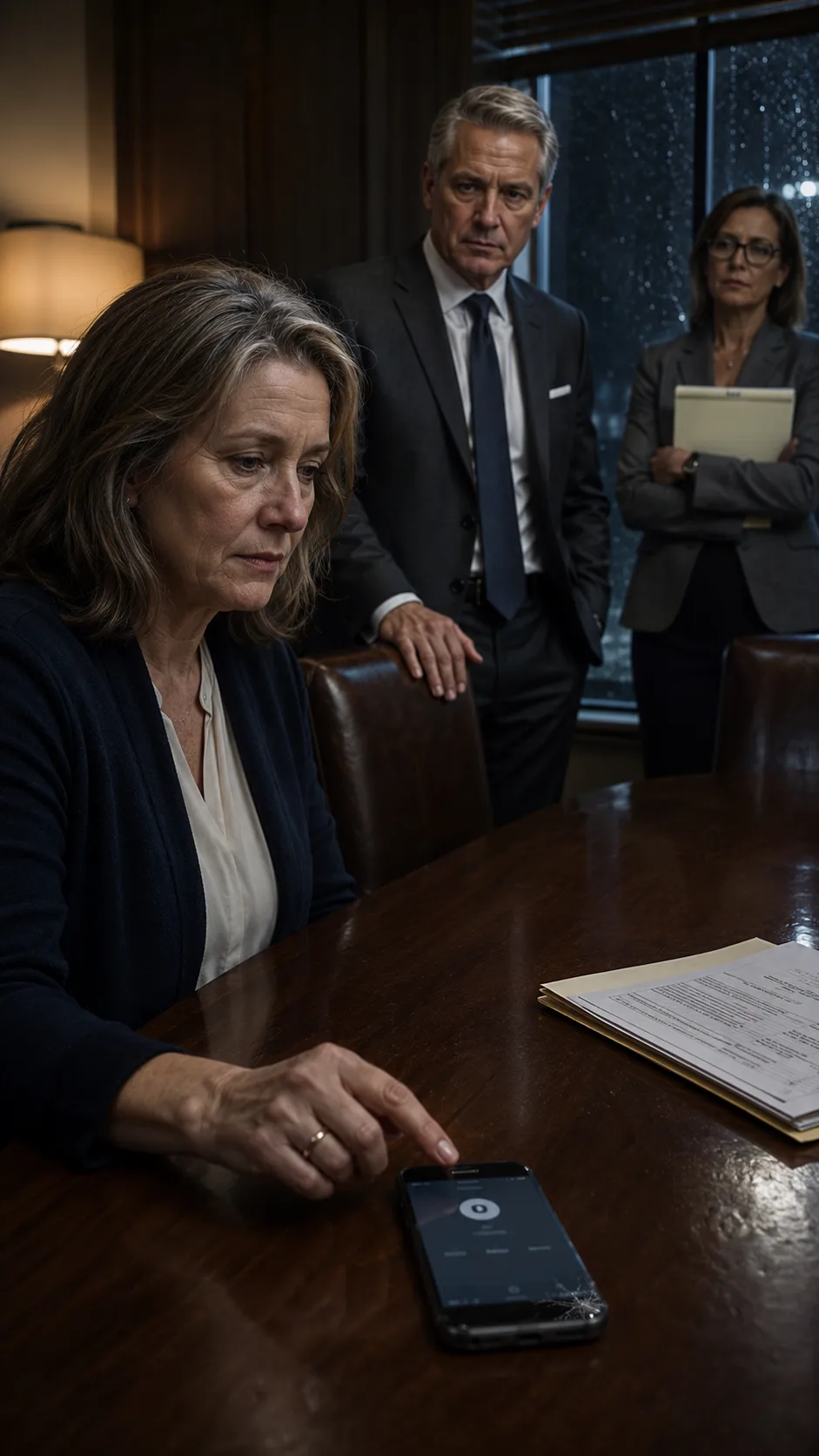
Her office faced the street. Rain pressed against the window glass, turning the city lights into broken lines. A long dark conference table filled the center of the room. Two leather chairs on one side. One on the other.
I sat on the side with only one chair.
Marianne noticed.
She said nothing.
I placed the folder on the table. Then the phone, screen down.
It looked smaller there.
At seven-eleven, Richard arrived.
I heard him before I saw him. His voice in the hallway. Confident. Warm. The voice he used with receptionists, bank managers, hotel staff, anyone he needed to believe he was reasonable.
Then the door opened.
He stopped when he saw me.
Only for a second.
“Eleanor,” he said. “I didn’t know you’d be here.”
Marianne closed the door behind him.
“She requested the meeting.”
Richard turned toward her with a polite smile that did not reach the lines beside his eyes.
“About what?”
Marianne nodded to the chair across from me.
“Sit down.”
He didn’t.
That was his second mistake.
Instead, he placed one hand on the back of the leather chair and looked at me like I had brought him a household problem. A bill. A broken appliance. A small embarrassment he would fix before dinner.
“What is this?” he asked.
I touched the edge of the phone.
His eyes followed my hand.
The room changed by inches.
The rain ticked against the window. Marianne stood near the glass with a yellow legal pad against her chest. The desk lamp threw a warm circle across the table, catching the cracked corner of the phone.
Richard saw the crack.
His fingers tightened on the chair.
I turned the phone over.
His face did not move much. Richard had practiced stillness. Boardrooms had taught him that. But a muscle jumped once near his jaw.
“What are you doing with that?” he asked.
I looked at the screen.
The voicemail file waited there.
One old thing.
“Answering a question,” I said.
He gave a small laugh.
“Eleanor, don’t start.”
Marianne’s pen stopped moving.
Richard looked at her, then back at me.
“I had a long day,” he said. “Whatever this is, we can discuss it at home.”
“No.”
The word landed harder than I expected.
He blinked.
I opened the folder with my left hand. The top sheet slid halfway out. M.W. Holdings. Martin Whitaker. Account ending 4419.
Richard saw the name.
This time he stepped closer.
“Where did you get those?”
“In your drawer.”
“My private files?”
“Our house.”
His mouth flattened.
Marianne moved from the window to the end of the table. She did not sit.
Richard adjusted his cuff with the hand not gripping the chair. His watch flashed under the light.
“You’ve misunderstood business documents,” he said.
“Then explain them.”
“I don’t owe an explanation in a room staged like an ambush.”
“You came here.”
“Because Marianne called me about our estate documents.”
Marianne looked over her glasses.
“I did.”
He turned on her.
“And now you’re allowing this?”
“I’m observing.”
Richard smiled again, thinner this time.
He pulled the chair back and sat, but not fully. Half perched. Ready to stand. Ready to leave.
“I don’t know what she thinks she found,” he said, “but those late nights were work.”
There it was.
The same word.
Work.
He had said it in kitchens, hotel lobbies, hospital hallways, parked cars, anniversary dinners, Christmas mornings. He had placed it between us so many times it had become furniture.
I looked down at the phone.
The voicemail icon glowed.
Richard followed my eyes.
“What is on that phone?” he asked.
I did not answer.
He leaned forward and reached across the table.
“Give it to me.”
I pulled it back.
His fingers landed on empty wood.
A single tap.
Marianne lowered her legal pad.
Richard’s hand stayed there, flat on the polished table. His wedding ring reflected beside the lamp’s yellow circle.
I dragged the folder closer to me with two fingers.
The bank records slipped out farther.
Celeste Vale’s name appeared on the second page.
Richard saw it.
His nostrils flared once.
“You have no right,” he said.
I placed my thumb above the voicemail.
“You gave me the right every night you said work.”
He looked at Marianne.
“This is marital theatrics.”
Marianne did not move.
I pressed play.
The voicemail clicked, then hissed. Static filled the room, thin and old.
Richard’s hand lifted from the table.
The woman’s voice came through the speaker.
“Don’t forget Tuesday.”
Richard’s mouth opened.
Closed.
“Same hotel. Same account.”
Marianne looked down at the folder.
“And please don’t use Richard’s card again.”
The rain kept tapping the glass.
The voice on the phone gave that small laugh.
“Martin, you promised me you’d be careful.”
Martin.
I slid the first bank record beside the phone.
Martin Whitaker.
M.W. Holdings.
Transfer line: Celeste Vale.
Richard reached for the papers.
I placed my palm flat on top of them.
Not hard.
Enough.
The voicemail ended with a soft click.
Nobody spoke.
Richard stared at the phone as if it had crawled out of a grave and placed itself on the table. His hand hovered above my folder, bent slightly at the fingers. He lowered it slowly, but not onto the papers.
Marianne stepped closer.
“May I?” she asked.
I moved my palm.
She picked up the first bank statement. Then the second. Her eyes scanned the names, dates, account numbers, transfer amounts. She placed the pages side by side, aligning them with the phone.
Richard stood.
The chair scraped backward against the floor.
“This is being taken out of context,” he said.
Marianne looked at him.
“Is Martin Whitaker your legal name?”
“No.”
“Is M.W. Holdings your company?”
He looked at me, not her.
“Eleanor, stop this.”
I pressed the side button on the phone. The screen stayed lit.
Marianne turned a page.
“Did you authorize transfers from this account to Celeste Vale?”
Richard picked up his phone from his pocket, then put it down on the table. He picked it up again.
“Celeste was a consultant.”
“For eleven years?” Marianne asked.
He did not answer.
The room leaned away from him without anyone moving much. Marianne stood closer to my side of the table now. The papers were in front of me. The phone was in front of me. Richard was across from both.
He looked smaller standing there.
Not old.
Exposed.
“Eleanor,” he said.
My name sounded strange in his mouth.
“Who is she?” I asked.
His eyes flicked to Marianne.
“Not here.”
“Here.”
He rubbed his thumb against the face of his watch.
“She’s nobody.”
The voicemail sat between us, still glowing.
I tapped the screen again.
Richard lunged—not far, not violently, just fast enough to show the truth before he could hide it. His hand shot toward the phone.
Marianne’s voice cut across the table.
“Do not touch that evidence.”
Evidence.
That word stopped him.
His hand froze above the phone.
A man who had built thirty-one years out of smooth sentences stood in a lawyer’s office with his fingers suspended over an old voicemail he could not unsay.
I picked up the second bank statement and turned it toward Marianne.
“There are more.”
Richard stepped back.
One step.
Then another.
His back touched the chair behind him.
Marianne placed the first statement on top of the folder and slid it back toward me, not toward him.
That was when Richard stopped looking at the papers and started looking at the door.
Marianne capped her pen.
“I will need copies of everything,” she said.
Richard gave a short laugh, but it cracked at the edge.
“You represent both of us.”
“I prepared mutual estate documents,” she said. “That is different.”
“You can’t use any of this.”
“I can advise Mrs. Whitman to preserve it.”
Mrs. Whitman.
For years, that name had felt like a shared roof. On Marianne’s tongue, it became mine.
Richard’s phone began vibrating on the table.
All three of us looked down.
The screen lit up.
Celeste.
No last name.
Just Celeste.
Richard grabbed it too quickly.
Too late.
Marianne saw it.
I saw it.
He silenced the call and slipped the phone into his pocket.
No one asked who it was.
The office lights hummed overhead. Somewhere down the hall, a printer started and stopped. The peppermint I had taken in the waiting room was still in my coat pocket, wrapped in clear plastic.
Marianne gathered the statements in order.
“Eleanor,” she said, “we should schedule another meeting tomorrow morning.”
Richard turned toward me.
“You are not doing this.”
I stood for the first time that night.
The chair did not scrape. I lifted my purse, placed the old phone inside, then tucked the folder under my arm.
Richard watched every movement.
“You’ll destroy our family,” he said.
I looked at his hand. The watch. The wedding ring. The fingers that had tapped tables while I apologized to our children for his absence.
“Our family already knows how to survive without you at dinner.”
He stepped back as if I had touched him.
Marianne opened the office door.
Richard did not move.
I walked past him, close enough to smell his cologne. Same scent as the night before. Same polished shoes. Same charcoal suit.
Different man.
In the hallway, the receptionist had gone home, leaving only a small lamp burning on her desk. The candy dish sat untouched except for the missing peppermint in my pocket. Rain ran down the glass front doors.
Marianne walked me to the elevator.
“Do not answer calls from him tonight,” she said.
“I won’t.”
“Send me scanned copies when you get home.”
“I will.”
The elevator opened.
Before I stepped inside, Richard’s voice came from the office.
“Eleanor.”
I turned.
He stood in the doorway now, one hand on the frame. For the first time in years, he looked unsure of where to put himself.
“I made mistakes,” he said.
Marianne’s face did not change.
I kept my thumb on the elevator button.
“Use her name,” I said.
He swallowed.
Nothing came out.
The elevator doors closed before he found another sentence.
I drove home through rain that blurred every traffic light. At the house, I parked in the driveway and sat there with both hands on the steering wheel. The porch light was still on. Richard had installed it after I tripped carrying groceries one winter and split my lip on the steps. For two weeks afterward, he had walked me from the car every night like devotion could be scheduled.
The house looked the same.
That bothered me most.
Inside, his dinner plate was still in the refrigerator. I took it out, peeled back the plastic wrap, and scraped the chicken into the trash. The lemon slice stuck to the plate until I pushed it with the fork.
Then I went upstairs.
Richard’s office door was open because I had left it that way. The facedown photograph still lay on the desk. I picked it up.
There we were at the company party. Richard smiling. My hand on his arm. A Christmas tree behind us, gold lights blurred into little stars.
I removed the photograph from the frame and set the empty frame back on the shelf.
The house phone rang at 10:14.
Then again at 10:19.
Then my cell phone.
Richard.
Richard.
Richard.
At 10:32, a text appeared.
We need to talk before you do something stupid.
I took a screenshot and sent it to Marianne.
Her reply came one minute later.
Do not respond.
So I didn’t.
The next morning, I met Marianne with copies of everything. She brought in a forensic accountant named Peter who wore a brown suit and had ink on his left thumb. He spread the statements across the table with the care of someone sorting bones.
The accounts were worse than I knew.
Richard had moved money through fake consulting invoices. He had opened business accounts tied to a rented office suite. He had listed Martin Whitaker as an authorized name on internal company records, not legal filings, just enough to move money without questions from people who trusted him.
There was a second apartment.
Hotel charges.
Tuition payments for someone named Lila Vale.
I touched that paper.
“Who is Lila?”
Peter looked at Marianne before answering.
“Most likely Celeste Vale’s daughter.”
The room went quiet.
Marianne turned one page.
“The payments started when she was eight.”
Eight.
I thought of Claire at eight, missing her front tooth, waiting at the window in pajamas because Richard promised he would be home before bedtime. I thought of Nathan at ten, pretending not to care when Richard left his baseball game in the third inning for “work.”
Another child had been paid for.
Mine had been explained away.
Two weeks later, Richard’s company placed him on leave pending internal review. The word “leave” sounded gentle. The men on the board did not look gentle when they came to the house in dark coats and asked for his laptop.
Richard blamed me.
He left messages from blocked numbers. He sent flowers I put straight into the outside bin. He came by once and stood on the porch while I watched from the upstairs window.
He had never liked waiting outside.
Good.
Celeste called me only once.
I almost ignored it, but curiosity has its own teeth.
Her voice was older than the voicemail, rougher around the edges.
“I didn’t know about you at first,” she said.
I leaned against the kitchen counter.
“But you knew later.”
She said nothing.
A truck passed outside.
“Did he tell you his name was Martin?”
“For a while.”
“And after?”
“He said Richard was complicated.”
I almost laughed.
Complicated.
That was the word people used when ugly things wore expensive clothes.
“Did you love him?” she asked.
I looked at the refrigerator, at the empty space where his covered plate used to wait.
“I washed his socks.”
She stayed on the line.
Then she said, “Lila doesn’t know everything.”
“That is not mine to carry.”
“No.”
The call ended.
I never spoke to her again.
The divorce moved faster than Richard expected because money leaves tracks, and his tracks had names on them. Martin Whitaker became a phrase in conference rooms, court filings, and phone calls with accountants. Richard hated hearing it. Every time someone said the name, his mouth tightened.
He offered settlements.
I declined the first two.
The third came with the house, my retirement share, restitution from the hidden accounts, and a signed statement admitting he had concealed marital assets. Marianne read every line before I touched the pen.
Richard sat across from me in another conference room, not hers this time. He looked thinner. His suit still cost more than sense, but his collar sat loose around his neck.
“You’re enjoying this,” he said.
I signed the first page.
Then the second.
“No.”
He leaned forward.
“After all these years?”
I capped my pen and looked at his left hand.
He had taken off his ring.
There was a pale circle where it had been.
“That’s the first honest thing your hand has done,” I said.
Marianne coughed once into her fist. Peter stared very hard at a spreadsheet.
Richard pushed back from the table.
The chair scraped.
I heard that sound often afterward in my memory, but it changed over time. At first, it was the sound of him leaving. Later, it became the sound of space being made.
I sold the house six months later.
Claire cried in the kitchen, but quietly, with her palm pressed against the doorframe where we had marked her height in pencil. Nathan walked through every room and took pictures of strange things. The old vent cover in his bedroom. The chipped blue tile in the laundry room. The crack in the driveway shaped like a branch.
I gave them what they wanted.
I kept the scarf.
The old phone stayed in a safety deposit box until the divorce was final. Then Marianne asked if I wanted it destroyed.
I held it one last time in her office. The cracked corner still caught my thumb. The voicemail was backed up in legal files now, no longer needed as the only proof.
“No,” I said. “Not destroyed.”
“What then?”
I turned the phone over in my hand.
“Dead is enough.”
She nodded.
I took it home, placed it in the bottom drawer of my new desk, and did not wrap it in anything.
My apartment was smaller than the house, with morning light in the kitchen and a grocery store close enough to walk. The first night there, I made toast for dinner and ate it standing at the counter. No roast chicken. No covered plate. No headlights across the wall.
Just toast.
The next Sunday, I bought rosemary at the market because I wanted the smell without the memory owning it. I roasted potatoes in a small pan, opened the window even though the air was cold, and listened to rain strike the fire escape.
My phone rang while I was washing the cutting board.
Richard.
I watched his name flash on the screen until it stopped.
Then I deleted the contact.
The rosemary kept its scent on my hands.
That was enough.
Chapter complete
You have reached the end of this chapter.
Continue reading
A few more worlds to get lost in after this chapter.




