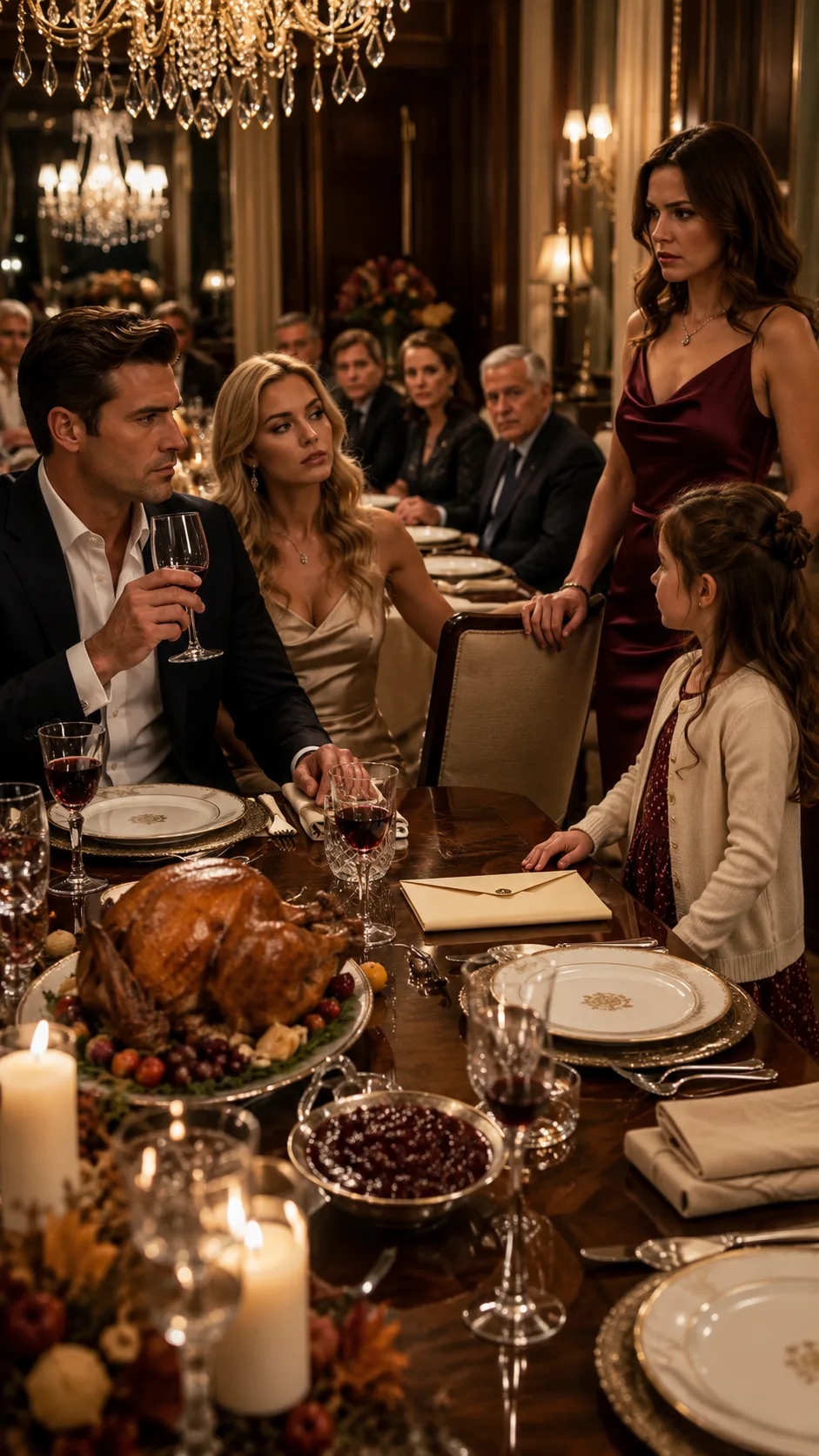
The carving knife slipped against the turkey bone at 5:42 p.m., and the sound carried through the dining room like a warning nobody wanted to name.
Chapter 1
The carving knife slipped against the turkey bone at 5:42 p.m., and the sound carried through the dining room like a warning nobody wanted to name.
I steadied the bird with the fork and kept my wrist still.
The house was already full.
Candles burned along the center of the mahogany table. The good china sat beneath gold-rimmed chargers. My mother-in-law, Patricia, had moved the silver gravy boat two inches to the left because she said the arrangement looked “unbalanced,” though what she meant was that I had touched it first. My sister-in-law, Meredith, had poured herself wine before the prayer. Her husband, Grant, kept checking his phone under the table and pretending he wasn’t.
At the far end of the room, my daughter Lily sat on the bottom stair in her cream cardigan, picking at the sleeve cuff with her thumb.
She had been quiet since breakfast.
That was not like her.
Lily was eight, which meant silence usually came with a fever, a secret, or a question she had decided adults were too slow
to answer. That morning, I found her in the hallway outside Mark’s study, standing barefoot on the runner carpet, looking at the closed door.
“Did Daddy say something to you?” I asked.
She shook her head.
Her hair had come loose from the half-up ribbon I tied before the guests arrived. A soft brown strand stuck to her cheek.
“Grandpa’s room smells different,” she said.
My hand stopped on the linen napkins.
Mark’s father, Arthur Whitmore, had died eight months earlier. People still called the house “Arthur’s house,” even though nobody had said his name at dinner since the funeral. Mark hated hearing it. Patricia corrected guests whenever they mentioned him too fondly.
“He was complicated,” she always said.
Lily had loved him without complication.
Every Sunday, Arthur took her to the greenhouse behind the east wing and let her water the basil with a dented copper can. He taught
her to count the old stairs by tapping each banister post. He called her “the little judge” because she hated when people skipped rules in board games.
When he died, Mark locked Arthur’s study and told me there were “business documents” inside.
I did not have the key.
That was normal in our marriage by then.
Most things were normal if they happened long enough.
I wiped my hands on a towel and looked toward the front door.
“Go wash up,” I told Lily. “People will be here soon.”
She did not move right away.
Then she said, “Grandpa told me not to let anyone move the black folder.”
I turned.
“What folder?”
Her eyes slid toward the study again.
Before she answered, Mark’s voice came from behind me.
“Claire.”
Just my name.
One hard syllable.
He stood at the end of the hallway in a dark dinner jacket, already
dressed, already annoyed. He had shaved carefully. His hair was combed back from his forehead, thick and glossy in the chandelier light. He looked like the kind of man who got photographed at charity luncheons and trusted every camera to forgive him.
“Kitchen,” he said.
Not a request.
I folded the towel over the back of a chair.
Lily went upstairs.
Mark waited until she was out of sight before he walked closer.
“Tonight needs to go smoothly.”
I glanced at the silver platters lined along the sideboard. “It will.”
“I mean you.”
There it was.
The first cut of the evening.
I picked up the cranberry spoon and set it beside the bowl. “I know how to host Thanksgiving.”
“You know how to take things personally.”
The dining room lights warmed the polished wood around us. Outside the tall windows, November darkness pressed against the glass. The house was beautiful in the way old money teaches beauty to behave: carved moldings, deep rugs, brass lamps, nothing too new, nothing too loud.
I had spent three days making sure every surface shone.
Mark had spent three days avoiding home.
A cufflink glinted at his wrist when he adjusted his sleeve. “Vanessa is coming.”
The spoon slipped slightly in my fingers.
Not enough to fall.
“From work,” he added.
I looked at him.
He looked back.
Neither of us blinked first.
Vanessa Hale was not from work in any way that mattered. She was twenty-eight, blonde, polished, always photographed at Mark’s side during Whitmore Foods investor events. She wore dresses that looked simple until you stood close enough to see the stitching. She laughed with her head tilted back when Mark spoke, even when he said nothing funny.
People had mentioned her to me with soft voices.
I had seen one message on Mark’s phone six months ago, just one, because he left it faceup on the bathroom counter.
Can’t wait until she stops pretending this is still her life.
I did not confront him then.
There were reasons.
There are always reasons people stay quiet before they are ready to be loud.
“Thanksgiving is family,” I said.
Mark smiled. It did not touch his eyes. “Then act like family.”
He walked back toward the foyer before I could answer.
The front bell rang at six.
Patricia arrived first, wrapped in camel wool and criticism. Meredith followed with a bottle of wine she told me was “too good for cooking.” Grant came in behind her, distracted and pale, as if he had already spent the evening somewhere else and regretted arriving here.
At six-seventeen, Mark opened the front door himself.
Vanessa stood under the porch light in a champagne silk dress, holding a small white box tied with ribbon.
She did not look surprised to see me.
That bothered me more than the dress.
“Claire,” she said, smiling. “Your home is stunning.”
Your home.
Not our.
Not the house.
She held out the box. “Macarons. I wasn’t sure what one brings to a family Thanksgiving.”
Patricia appeared beside me.
“How thoughtful,” she said, and took the box before I could.
Mark placed one hand at the small of Vanessa’s back and guided her inside.
Not touching.
Claiming.
Lily watched from the stair landing.
Her small fingers tightened around the railing.
I saw it.
No one else did.
Dinner began with Patricia’s prayer, which thanked God for legacy, family, and the “continuation of strong leadership.” Mark bowed his head at the word leadership. I looked at Arthur’s empty chair at the far end of the table.
The black leather folder was not there yet.
I noticed because I was looking for it.
That was the first thing that made my stomach go still.
Arthur’s chair had been left untouched for every family meal since the funeral. His reading glasses were gone. His pipe box was gone. Even the small brass bell he used to call for tea after his surgery had disappeared.
But that chair remained.
Now a stack of papers sat on it.
A black leather legal folder rested on top.
Mark had put it there.
The meal started carefully.
People spoke about safe things. Weather. Traffic. A vineyard Patricia had visited. A foundation dinner Mark was chairing in December. Vanessa talked about donor strategy with a brightness that made every sentence sound practiced.
I served the turkey because I always served the turkey.
Mark sat at the head of the table.
Arthur’s chair stayed empty.
My chair was to Mark’s right. It had been mine for nine years.
Vanessa sat in it.
That happened so quietly it took the room two seconds to understand.
I was standing beside the sideboard with the platter when Mark pulled out my chair, and Vanessa lowered herself into it as if the seating chart had been written on stone. Patricia adjusted her napkin. Meredith lifted her glass. Grant stared down at his plate.
Lily’s fork stopped halfway to her mouth.
I held the platter.
The turkey steam rose against my wrist.
Mark looked at me and said, “Set another plate.”
That was all.
I set another plate.
Not beside him.
There was no space beside him.
I placed it near the middle of the table, between Meredith and Grant, where a cousin usually sat when cousins bothered to come.
Then I stood there for one breath too long.
Mark noticed.
His smile sharpened.
“Claire,” he said. “Don’t make guests uncomfortable.”
Vanessa touched the stem of her wine glass. “I can move.”
She made no motion to move.
Patricia leaned toward her. “Don’t be silly. You’re perfectly fine.”
Perfectly fine.
In my chair.
In my house.
With my daughter watching.
I sat between Grant and an empty place setting and folded my napkin in my lap.
The linen felt stiff.
Lily did not eat. She kept looking at the black folder on Arthur’s chair. Every few minutes, Mark glanced that way too.
That was the second thing.
At first, I thought he was worried about Vanessa.
Then I saw his thumb.
It tapped once against the base of his wine glass every time Lily looked at the folder.
Tap.
Pause.
Tap.
Arthur had done the same thing when he was thinking through a contract.
Mark had hated that habit.
Now he had it.
Vanessa leaned toward him halfway through dinner and said something I could not hear. Mark smiled and brushed his knuckles against hers under the table.
I saw that too.
People think the worst part is the betrayal.
It is not.
The worst part is how ordinary the room looks while it happens.
Candlelight still behaves. Plates still shine. People still ask for salt.
Meredith asked me for more sweet potatoes without looking at my face.
I passed them.
Grant’s knee bounced under the table. The movement shook his fork against the plate.
Click.
Click.
Click.
Patricia finally turned toward me.
“Claire, dear, you forgot the green beans.”
They were directly in front of her.
I stood, lifted the dish, and placed it beside her elbow.
“There,” I said.
Patricia smiled with her mouth closed. “Thank you.”
Vanessa watched me stand.
Her eyes followed my hand as I set down the serving dish.
Then she turned slightly toward Mark and spoke just loud enough.
“You make it look easy, having help.”
The words landed cleanly.
Nobody asked what she meant.
Nobody needed to.
Lily set her fork down.
Too carefully.
I looked at her and gave the smallest shake of my head.
Not here.
Not now.
She looked back at me with Arthur’s eyes.
That was the third thing.
Arthur had not left much softness in Mark, but somehow Lily had inherited it whole. She had his patience. His stubbornness. His way of staring at a person until the truth became embarrassed.
A laugh rose from Vanessa’s side of the table. Mark had said something low, and she covered her mouth with her fingertips, like a woman trained in mirrors.
Then she reached back and touched my chair.
Two fingers on the carved wood.
The chair was empty now because she had shifted forward, but her hand rested there as if she were keeping it.
Mine.
That one gesture did something no sentence had done.
It made the room smaller.
I placed my palm flat beside my plate.
One second.
Two.
Mark saw.
His eyes cut to my hand, then to my face.
“Problem?” he asked.
The room waited.
I looked at Vanessa’s fingers on the chair.
“No.”
Mark leaned back, lifted his glass, and smiled at the family.
“To honesty,” he said.
Vanessa laughed first.
Short and bright.
Patricia followed with a thin smile. Meredith drank too quickly. Grant rubbed his thumb along the edge of his knife.
I did not lift my glass.
Neither did Lily.
Mark noticed that too.
His smile stayed in place, but the muscles beside his mouth moved.
“Claire,” he said, still looking at the room. “The turkey’s dry near the edge. Bring the center cut.”
The carving set lay beside the platter near me.
I picked up the fork.
The handle was warm from the table.
I stood and reached for the knife.
Then Lily spoke.
“Mommy already sat down.”
No one moved.
It was not loud. It was not dramatic. It was just a child stating a fact adults had tried to bury under silver and candlelight.
Mark turned toward her slowly.
“Lily.”
His voice had a warning in it.
Lily’s fingers curled around the edge of the table.
“She didn’t eat yet.”
Vanessa lowered her gaze to her plate, but I saw the tiny smile at the corner of her mouth.
Patricia set her fork down.
“Children should not correct adults at dinner.”
Lily looked at Patricia.
“Grandpa did.”
That was when Mark’s glass touched the table.
Not hard.
Hard enough.
“Enough,” he said.
One word.
The entire table obeyed.
Except Lily.
She looked at Arthur’s empty chair again.
The black folder sat there like a closed mouth.
Mark followed her gaze and stood.
Too fast.
His chair pushed back against the rug. “I need that.”
Grant looked up.
Patricia said, “Mark.”
He ignored her and walked to Arthur’s chair.
But Lily was smaller and closer.
She slipped from her seat and reached the chair before he did. Her little hand went under the black leather folder, not inside it, under it, as if she already knew where to look.
Mark stopped.
I stood.
No one told me to sit down.
Lily pulled out a cream envelope with a dark red wax mark pressed over the flap.
The room changed around that envelope.
Not loudly.
Not all at once.
But the forks lowered. The glasses stopped. Meredith’s lips parted. Grant leaned back as if a wire had been pulled tight across the table.
Mark’s face did not move for one full second.
Then he smiled.
It was worse than if he had shouted.
“Sweetheart,” he said, “that is grown-up paper.”
Lily held the envelope to her chest.
“Grandpa gave it to Mr. Bell.”
The name moved through the room.
Thomas Bell.
Arthur’s attorney.
Patricia’s hand tightened around her napkin.
Mark took one step toward Lily. “Give it to me.”
Lily stepped back.
Small step.
Huge room.
I moved before I decided to.
My body crossed the space between us, and I stood beside my daughter, one hand behind her shoulder. Mark’s eyes flicked to my hand.
Vanessa finally removed her fingers from my chair.
“Claire,” Mark said.
“Don’t.”
My voice surprised even me.
Not because it was loud.
Because it was not.
Mark looked down at the envelope. “You don’t know what you’re holding.”
Lily looked up at me.
“Grandpa said Mommy should read it.”
The room waited for me to take it.
I did not.
“Then read it,” I said.
Mark’s hand shot out.
Not at Lily.
At the envelope.
I placed my hand in front of his wrist.
Barely touching him.
Enough.
He stared at my hand as if it had appeared from somewhere he did not own.
“Move,” he said.
I kept my palm where it was.
“No.”
The word sat between us.
Vanessa shifted in my chair. The silk of her dress made a soft sound against the seat.
Mark’s eyes cut toward the guests. He remembered them then. The room. The witnesses. The family he had spent years performing for.
He drew his hand back.
“Fine,” he said, smiling again. “Let’s hear whatever performance my father arranged from the grave.”
Patricia inhaled through her nose.
Lily placed the envelope on the table.
It lay between the turkey and Vanessa’s wine glass, cream paper against dark wood, sealed and heavy with all the things adults had failed to hide.
The wax seal had cracked slightly from Lily’s hand.
She looked at me for permission.
I nodded.
Her small fingers opened the flap. She slid out several folded pages. The top sheet had Arthur’s initials at the bottom and Thomas Bell’s firm letterhead at the top.
Mark’s face changed at the letterhead.
There.
Not fear.
Recognition.
The first page shook slightly in Lily’s hands, so I reached out and held the bottom corner steady for her.
Lily began to read.
“I, Arthur James Whitmore, being of sound mind…”
Mark made a sound under his breath.
Patricia closed her eyes.
Meredith whispered, “Oh God,” and then pressed her lips together.
Lily continued. Her voice was careful, each word pulled from the page like she was reading in class.
“…do hereby revoke all prior informal instructions regarding Whitmore House, Whitmore Foods Holdings, and associated family assets.”
Grant’s fork slipped from his hand onto the plate.
Clink.
Vanessa looked at Mark.
Mark did not look back.
His eyes were fixed on the page.
I had heard of the company my whole married life. Whitmore Foods began with Arthur’s grandfather and a cold-storage warehouse near the river. Mark had grown up calling it “my company” before he ever worked a full day there. By the time Arthur grew sick, Mark had already started moving through the offices like inheritance was a job title.
He had told me not to worry about documents.
He had told me wives did not need to understand corporate structures.
He had told me plenty.
Lily reached the next paragraph.
She stumbled on the word beneficiary.
I helped her sound it out.
“Beneficiary,” she repeated.
Mark’s hand closed around the stem of his glass.
I heard the faint crack before anyone else did.
Not the glass breaking.
His control.
Lily read on.
“My son, Mark Whitmore, has repeatedly demonstrated a willingness to treat family property as personal entitlement rather than stewardship.”
Patricia’s eyes opened.
Mark stood.
“No.”
Just that.
Lily stopped reading.
I looked at him.
He pointed at the paper, but his finger did not stay steady. “That is not the final version.”
Thomas Bell’s voice came from the doorway.
“It is.”
Everyone turned.
The attorney stood near the dining room entrance in a charcoal suit and dark overcoat, a leather briefcase in one hand. He must have entered through the side hall. Mrs. Keller, our housekeeper, stood behind him with her coat still on, looking at the floor.
Mark’s face lost color in pieces.
First around the mouth.
Then under the eyes.
“Who let you in?” he asked.
Thomas Bell did not move farther into the room yet.
“Arthur did.”
Mark laughed once. It came out wrong. “Arthur is dead.”
“Yes,” Bell said. “And this house is no longer yours to control.”
No one breathed loudly after that.
Bell walked to the table with measured steps. He did not take the document from Lily. He only placed a second copy beside it, thicker, with blue tabs along the edges.
“Your father instructed me to deliver this copy if the original envelope was disturbed before formal transfer was complete.”
Mark looked at Lily.
That was the moment I understood.
He had been watching the folder all night because he knew something was there.
Not everything.
Enough.
Enough to be afraid of a child with an envelope.
Bell turned to me.
“Mrs. Whitmore, the transfer became effective thirty days after Arthur’s passing.”
I did not speak.
The chandelier light seemed too warm. The table too long. The room too full of people who had spent years treating me like furniture with a wedding ring.
Bell placed one finger on the second page.
“Whitmore House is held in trust for you. The voting shares of Whitmore Foods Holdings transferred to your name. The remaining family assets listed in Schedule C were assigned to your control under Arthur’s final signed directive.”
Vanessa’s hand slid off the armrest of my chair.
It landed in her lap.
Lily looked up at me.
“Mommy?”
I touched her shoulder.
“I’m here.”
Mark stepped back from the table.
Only half a step.
But the room saw it.
A man who had spent the evening at the head of the table had moved away from the document in the center.
Patricia pushed herself upright. “Arthur would never do that.”
Bell opened the folder to a page with a photograph clipped inside.
Arthur sat in his study, thinner than he had been in life, wearing his brown cardigan, one hand resting on a stack of papers. Beside him stood Thomas Bell. On the desk, clear as daylight, sat the cream envelope.
The date stamp in the corner was six weeks before Arthur died.
Bell did not explain the photograph.
He did not have to.
Meredith set her wine glass down.
Grant leaned forward and looked at the document like he was seeing Mark for the first time.
Mark reached toward Bell’s folder.
Bell closed it.
“Careful,” Bell said.
One word.
It stopped him.
Vanessa stood then, but not all the way. She rose halfway from my chair, glanced at Mark, then at the table, then at me.
Nobody told her where to sit.
That was its own answer.
Lily looked down at the page again.
“Should I keep reading?”
Mark turned to her.
“No.”
I looked at my daughter.
“Yes.”
The word came out clean.
Lily swallowed and read the line Bell had already summarized, the line that made every corner of the room belong to someone else.
“I leave these assets to my daughter-in-law, Claire Whitmore, who understood the meaning of family when my son understood only ownership.”
The room took that sentence.
One person at a time.
Patricia’s face folded inward, not with sorrow, not yet, but with calculation failing in public. Meredith covered her mouth. Grant looked at me and then looked away, too late to pretend he had not understood every dinner before this one.
Mark picked up his glass.
Put it down.
Picked it up again.
His hand did not know what to do without authority in it.
Vanessa whispered his name.
He did not answer.
I reached for my chair.
The chair Vanessa had used.
The chair her fingers had claimed.
She moved back from it.
Not because I asked.
Because the room did.
I pulled it out and sat down.
For the first time that evening, I sat at my own table.
The seat was still warm.
That detail bothered me more than I expected.
I folded my napkin over my lap, the way Patricia always said I did too casually. Then I looked at Bell.
“Is there anything else?”
Bell nodded.
“Yes.”
Mark’s head snapped toward him.
Bell removed one final page from the folder. It was not long. Only a few paragraphs. Arthur’s signature sat at the bottom, shaky but unmistakable.
“This is a personal note,” Bell said. “Arthur asked that it be read only if Mark challenged the will in front of witnesses.”
Mark’s chair scraped backward.
“No.”
Bell looked at me.
The choice was mine.
That was new.
I looked at Lily first. She stood beside me, envelope in both hands. Too much room. Too many adults. Too many things a child should not have to understand at dinner.
I held out my hand.
She came to me and leaned against my side.
“Read it,” I said.
Bell lifted the page.
“To Claire,” he read. “I am sorry I mistook quiet for weakness. I watched you keep peace in rooms where others mistook your patience for permission. I watched my son inherit my ambition and none of my restraint. That is my failure, not yours.”
Mark turned away.
Not enough to leave.
Enough to hide his face from Bell.
Bell continued.
“This house was never meant to reward the loudest voice. It was meant to protect the person who held the family together when the rest of us confused pride with legacy.”
Patricia sat down slowly.
The movement made the candle nearest her tremble.
Bell read the last line.
“Claire, sit at the head when you are ready.”
The paper lowered.
The room did not recover.
No toast followed. No argument filled the silence. Even Vanessa did not move toward the door yet. She stood beside the chair she had occupied, both hands clasped in front of her dress, suddenly looking like a guest who had overstayed by years.
Mark looked at me then.
Really looked.
Not at the wife who served. Not at the woman he expected to absorb embarrassment and call it grace. Not at the person he had placed between the gravy and the green beans.
At the owner of the room.
His mouth opened.
“That is not—”
He stopped.
There was nowhere for the sentence to go.
Bell placed the note on the table and stepped back.
Lily climbed into the chair beside me without asking. She rested the cream envelope on her lap and flattened one bent corner with her thumb.
Outside, wind moved against the windows.
Inside, someone’s forgotten fork lay on the rug near Grant’s shoe.
Nobody picked it up.
Mark left the dining room seven minutes later.
Not dramatically.
That would have given him too much shape.
He pushed his chair in halfway, then stopped when he realized it was no longer his place to make the room neat. He walked past Vanessa without touching her. She followed after a moment, one hand pressed to her stomach, the white ribbon from her macaron box still looped around her wrist like a joke nobody had the energy to laugh at.
Patricia stayed seated.
For once, she did not correct the table.
Meredith helped clear plates because guilt sometimes needs something to carry. Grant gathered the wine glasses and dropped one in the kitchen sink. It did not break. He stood there staring at it for several seconds anyway.
Bell remained long enough to explain what had to happen next. He spoke carefully, as if Lily’s ears changed the shape of every legal word.
Mark would be removed from operational control of the company pending formal board transition. The house staff would answer to me. Patricia’s residence arrangement would continue for ninety days unless I chose otherwise. Vanessa had no legal position in anything, which everyone knew before he said it and still needed to hear.
Lily fell asleep on the library sofa before dessert.
Her cardigan sleeve was still stretched from where she had picked at it all day.
I covered her with Arthur’s old plaid throw from the chair by the fireplace. For the first time since his death, nobody told me not to touch his things.
At eleven, I walked back into the dining room.
The candles had burned low. Wax leaned over the brass holders. The turkey sat carved open on its platter, cold and uneven. Cranberry sauce had dried at the edge of the silver bowl. My chair remained pulled out slightly, angled toward the table as if someone had left in the middle of a sentence.
Arthur’s chair waited at the far end.
I stood behind it.
My hands rested on the carved wood.
The same carving matched my chair. I had never noticed that before.
Mark appeared in the doorway.
His jacket was gone. His shirt sleeves were rolled once, badly. He looked smaller without witnesses.
“We need to talk,” he said.
I looked at the table.
“No.”
He stepped into the room. “Claire.”
“No,” I said again.
This time he stopped.
The word had changed shape between us.
He looked toward Arthur’s chair, then toward mine.
“My father was sick.”
“He signed six weeks before he died.”
“He was angry.”
“He was clear.”
Mark rubbed both hands over his face. The gesture made him look tired instead of powerful, which was not the same thing as innocent.
“Vanessa doesn’t matter,” he said.
I turned my head then.
Not much.
Enough.
The chandelier above us held the last of the candlelight in its crystals. Every reflection looked like a small, separate flame.
“She mattered when you brought her to my table.”
He looked down.
I waited for apology.
A real one.
Not the kind that begins with pressure and ends with blame.
None came.
“I can fix this,” he said.
There it was.
Not us.
This.
I lifted Arthur’s note from the table and folded it once.
“No, Mark. You can pack.”
His face tightened.
“For how long?”
I walked past him toward the doorway.
“That depends on how quietly you do it.”
He did not follow.
The next morning, the house sounded different.
No slammed doors. No voice from the study. No Patricia calling for coffee before the kettle had even boiled. Mrs. Keller opened the curtains in the dining room and stopped when she saw me sitting at Arthur’s end of the table.
Not Mark’s end.
Arthur’s.
I had not planned it.
I had walked in, placed my coffee down, and sat where the morning light reached first.
Mrs. Keller smiled.
Only a little.
“Breakfast, Mrs. Whitmore?”
I looked at the chair beside me where Lily had left the cream envelope, now empty and flattened. A small crescent of red wax still clung to the flap.
“Yes,” I said. “For two.”
Lily came down ten minutes later in pajamas and socks that did not match. She climbed into the chair beside me and looked at the table, then at me.
“Are we allowed to sit here?”
I poured syrup onto her pancakes.
“We are.”
She thought about that.
Then she moved her plate closer to mine.
Mark’s things were removed from the study by noon. Bell supervised. Not because I asked him to. Because Arthur had arranged that too.
Patricia moved out before the ninety days ended. She left behind three boxes of crystal, one cracked portrait frame, and a handwritten note that said only, Claire, I hope you understand I was protecting my son.
I did not answer it.
Meredith called two weeks later and asked if she could bring Lily a book Arthur had once promised her. She cried in the driveway but did not ask to come in. Grant sent company files through Bell and resigned from Mark’s side venture without ceremony.
Vanessa disappeared from the charity board website before Christmas.
Mark fought the will for six months.
Then the witnesses from Thanksgiving gave statements.
Every one of them.
Even Patricia.
Especially Patricia.
The challenge ended in a conference room with no candles, no turkey, no champagne dress, no little girl holding an envelope. Just signatures, tired attorneys, and Mark sitting across from me with a pen he did not want to use.
He signed.
His hand moved quickly.
Like speed could save pride.
Afterward, he looked at me across the table and said, “You’ll regret taking everything.”
I placed Arthur’s note into my folder.
“I didn’t take it.”
I stood.
“You lost it at dinner.”
The first Thanksgiving after that, Lily and I used the same silver gravy boat Patricia had called unbalanced.
We set it exactly where we wanted.
The table was smaller that year. Mrs. Keller came. Thomas Bell came with his wife. Meredith brought pie and did not mention Mark once. Lily made place cards in purple marker and drew tiny turkeys on each one.
At the head of the table, she placed one card with my name.
Not Mrs. Whitmore.
Not Mommy.
Claire.
She asked if that was okay.
I looked at the carved chair, the candles, the cranberry sauce in Arthur’s silver bowl.
Then I looked at my daughter.
“It’s perfect.”
She grinned and ran back to the kitchen to steal a roll before dinner.
I sat down before anyone arrived.
No one had to tell me where I belonged.
I already knew.
Chapter complete
You have reached the end of this chapter.
Continue reading
A few more worlds to get lost in after this chapter.