The hostess at Bellamy’s smiled at me like she had been trained not to notice blood on a white dress.
Chapter 1
The hostess at Bellamy’s smiled at me like she had been trained not to notice blood on a white dress.
“Good evening,” she said. “Reservation name?”
I looked past her shoulder.
The restaurant glowed the way expensive places always glowed when they wanted money to look gentle. Brass lamps. White tablecloths. Dark wood. Glasses thin enough to break under a hard breath. A waiter crossed the room with a silver tray balanced on one hand, and for some reason, the sound of his polished shoes on the marble bothered me more than the call I had received twenty minutes earlier.
A wrong call.
That was what the girl from Bellamy’s had said.
A small mistake.
“Mrs. Whitmore,” she had asked through the phone, “are we still confirming the rose package for tonight?”
I had stood in my kitchen with one hand on the dishwasher handle.
“Rose package?”
“Yes, ma’am. Corner table. Champagne. Proposal setting.”
The dishwasher had hummed against my knees. A spoon knocked somewhere inside it, small and stupid
and ordinary.
“My husband booked that?”
A pause.
Then a different voice came on. Older. Smoother.
“I’m sorry, ma’am. There may have been an internal mistake.”
There was no mistake. Daniel had used the account tied to my name because it was convenient. He had used the restaurant we went to on our second anniversary because he had no imagination. He had used the corner table because he liked being seen by people he would never have to answer to.
The hostess waited.
I could have given Daniel’s name.
I could have turned around.
Instead, I said, “Claire Whitmore.”
Her eyes flicked down to the screen. One second. Two.
“Yes, Mrs. Whitmore. Your party is already seated.”
My party.
That almost did it.
I tightened my fingers around the black leather folder under my arm. The folder had belonged to my father before he got sick. He used to carry
it to his office every morning, even after the corners started wearing down. It still had a faint dent on the front where he pressed too hard with his thumb.
“Take me to them,” I said.
She hesitated only long enough to prove she understood.
Then she picked up two menus she did not need and led me into the restaurant.
I saw the flowers first.
White roses in a low crystal vase, trimmed short, arranged like they were trying not to take up too much space. Daniel had refused those exact roses for our anniversary dinner three years earlier.
“Too dramatic,” he had said, scrolling through his phone. “You like making things look serious.”
Vanessa liked them, apparently.
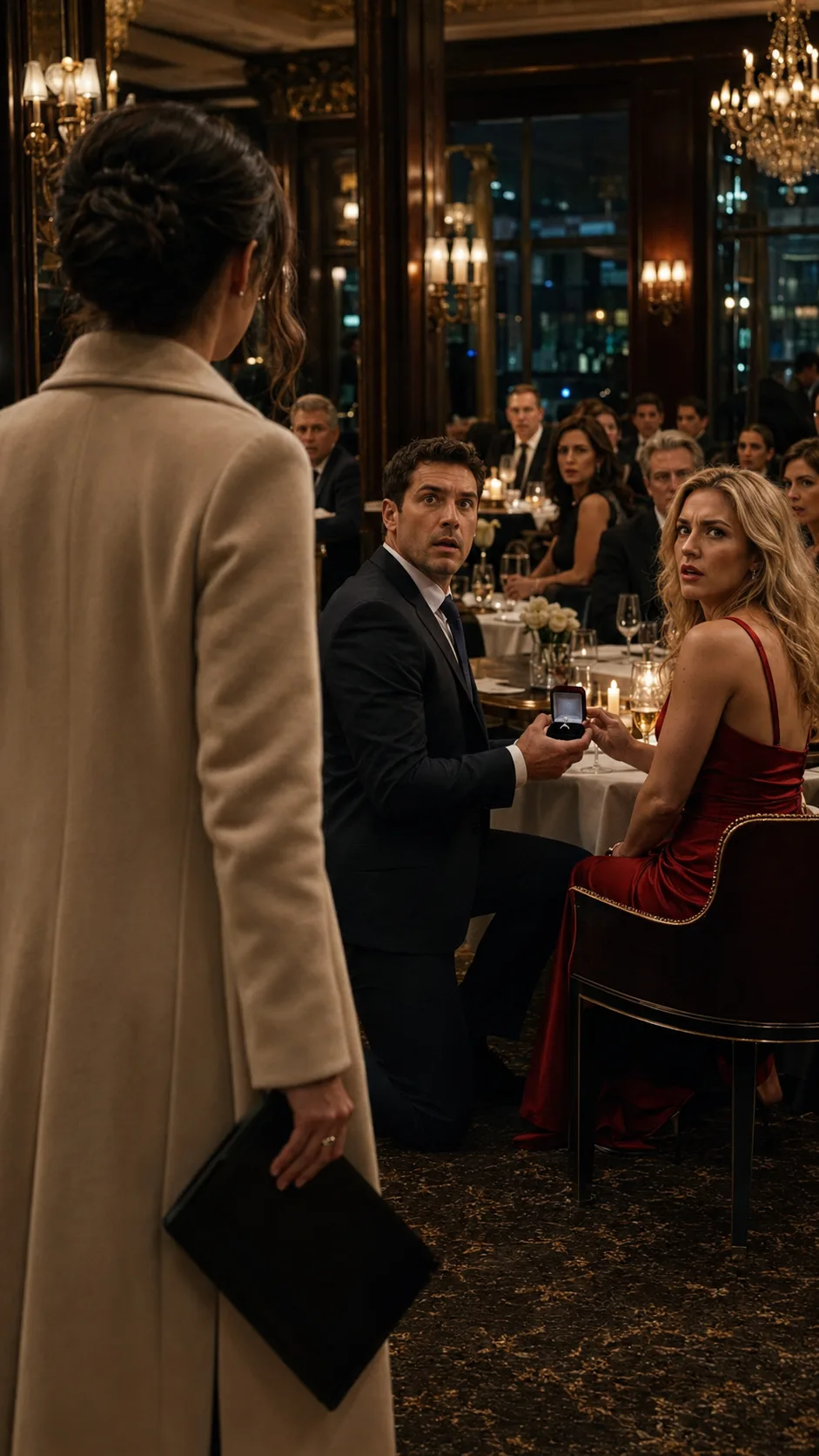
She sat at the corner table with her blonde hair poured over one shoulder and a red satin dress that caught every candle on the table. Her posture was perfect. Chin
lifted. Wrist soft beside her champagne flute. She was the kind of woman who checked every reflective surface without moving her head.
Daniel was not seated.
He was on one knee.
The ring box was open in his hand.
A diamond sat inside it, white and clean and bright enough to insult every plate in the room.
The hostess stopped walking.
I did not.
Two tables turned first. A gray-haired man with a burgundy pocket square lowered his fork halfway to his plate. A woman near the window pressed her napkin to her mouth but did not eat. Somewhere behind me, a glass touched a table with a tiny click.
Daniel had not seen me yet.
He was looking up at Vanessa.
His mouth was moving.
I could not hear the words over the low restaurant murmur, but I recognized the expression. That careful, practiced face. The one he used when he wanted to look honest without being inconvenienced by honesty.
Vanessa saw me first.
Her eyes shifted over his shoulder. Her lips parted just enough.
Daniel followed her gaze.
The ring box stayed open.
For three years of marriage, Daniel had always recovered quickly. A forgotten birthday became my overreaction. A missing transfer became accounting confusion. A lipstick mark on his cuff became a joke about dry cleaning. He never ran from the room. He rearranged the room around himself until it looked like everyone else had misunderstood the furniture.
Not this time.
His face went still.
Then his hand tightened around the ring box.
I stopped beside the empty chair across from Vanessa.
The hostess had disappeared. Or moved back. I did not look.
Daniel rose too fast. His knee bumped the table leg. Vanessa’s champagne trembled in its glass.
“Claire,” he said.
My name sounded wrong in his mouth.
Vanessa placed one hand on the edge of the table. Her red nails pressed into the white cloth.
Daniel closed the ring box halfway, then seemed to decide that hiding it was worse. He opened it again.
“You should not be here,” he said.
A man at the nearest table stopped chewing.
I set the folder on the back of the empty chair.
“Bellamy’s called me.”
Daniel’s eyes moved to the folder and back to my face.
“That was a mistake.”
“No,” I said. “That was yours.”
Vanessa inhaled through her nose. It was a small sound, but close enough for me to hear.
Daniel lowered his voice. He always did that when people were watching. It made him feel dignified.
“Do not make this public.”
I looked at the ring.
“You chose the table.”
His jaw moved once.
Vanessa lifted her chin. “This is between you and Daniel.”
“No,” I said. “It is between Daniel and whatever account paid for that ring.”
A chair scraped behind me.
Daniel’s face changed again. Not much. Just enough.
There it was.
The first crack.
The ring had not come from his savings. Daniel had a good job and a better vocabulary for excuses, but he did not have seventy-two thousand dollars sitting around for a diamond. He had bills he pretended were investments. He had credit cards he called business tools. He had a taste for expensive rooms and other people’s money.
My father used to say Daniel spent like a man who believed receipts were rude.
I should have listened harder.
Vanessa looked at Daniel.
He did not look back at her.
“Claire,” he said, “step away from the table.”
A waiter stopped near the service station with a bottle of red wine tucked against his forearm. The bottle hung there, forgotten.
I touched the folder with two fingers.
Daniel saw it.
“What is that?”
“You know.”
“I don’t.”
“You should.”
Vanessa laughed once. Short. False. It landed badly.
“Is this your performance?” she said. “Because he already made his choice.”
I turned to her.
She was prettier up close. Not softer. Prettier in the polished way expensive stores are pretty, with nothing on the shelves you actually need.
“He made several,” I said.
Daniel stepped between us.
“Enough.”
That word had ended many conversations in my house. It had closed doors. It had made me stop asking about withdrawals, late meetings, hotel bar charges, and the way Vanessa’s name first appeared in our life as “V. Monroe — client dinner.”
Enough.
I reached for my wedding ring.
Daniel noticed before I pulled it off. His eyes dropped to my hand, and for the first time since I had walked in, he looked less like a man being watched and more like a man being counted.
The ring stuck at my knuckle.
My hands were cold.
I twisted once.
It came free.
The band was plain gold. Daniel had picked it because he said he liked simple things. My father had paid for it because Daniel’s bonus had been “delayed.” I had not known then that Daniel’s bonus had gone to a weekend in Napa while I stayed home with a leaking kitchen sink and a plumber who asked me twice if I wanted to call my husband.
I placed the ring beside the proposal box.
Gold next to diamond.
Vanessa looked at it like it had dirt on it.
Daniel did not move.
“Pick that up,” he said.
“No.”
“Claire.”
“There’s my name again.”
He swallowed.
The waiter with the wine stepped backward. The bottle shifted in his hand.
I opened the folder.
Daniel reached across the table.
I placed one hand flat on the cover before he touched it.
He stopped.
The first page was the restaurant confirmation. Bellamy’s. Tonight. Corner table. White rose proposal package. Deposit charged to Whitmore Holdings Private Reserve.
My account.
Not his.
Daniel’s signature sat near the bottom beside the authorization line, clean and confident.
I slid it toward him.
“Read it.”
He did not.
Vanessa leaned forward, but Daniel put one hand out to stop her.
That was a mistake.
She saw it.
The hand. The quick block. The panic he had hidden from me but not from her.
“What is that?” she asked him.
“Nothing,” he said.
I turned the second page.
The bank statement.
The transfer date.
The jewel purchase.
The name of the private account my father had moved into my sole control six months before he died, when he still had enough strength to sign his own name and enough suspicion left to ask me whether Daniel had ever asked for my passwords.
I had lied.
I told my father no.
He had looked at me from his hospital bed and tapped the folder with two fingers.
“Then keep this anyway.”
At the time, I thought he was being careful.
Now I knew he had been saying goodbye with instructions.
Daniel’s hand hovered above the paper.
“Close that.”
“Why?”
Vanessa’s voice sharpened. “Daniel.”
He ignored her.
The manager approached from the far side of the restaurant. Middle-aged, silver hair, black suit, a napkin folded over one arm as if this were still about service.
“Mrs. Whitmore,” he said.
Vanessa turned her head toward him.
Daniel’s mouth tightened.
The manager looked at the folder. Then at me. Then at Daniel.
No one at the table spoke.
The restaurant did not go silent all at once. That only happens in bad movies. It happened in pieces. One couple stopped whispering. A knife stopped moving against ceramic. The waiter with the wine set the bottle down without pouring it. A woman behind Vanessa lowered her phone into her lap.
Daniel noticed every piece.
He picked up the ring box again because he needed something in his hand.
“Claire,” he said, “you are confused.”
I laughed once.
It surprised him.
Not because it was loud. It was not. Because it was not the sound he expected from me.
“About the ring?”
He glanced at Vanessa.
“About everything.”
“Then explain it.”
He looked around.
Wrong move.
The room was no longer furniture to him. It had eyes.
Vanessa sat back. Her hand left the table edge and moved toward the diamond. Not touching it. Close enough to claim it if the story recovered.
Daniel saw her hand move.
He went for the version of himself he trusted most.
The husband with patience.
The man wronged by a dramatic wife.
The reasonable one.
“This is not the place,” he said.
I turned the bank statement toward Vanessa.
“You liked the place until I arrived.”
Vanessa read the first line.
Her face did not collapse. It rearranged. Pride first. Confusion second. Calculation third.
Daniel snapped the folder shut with his palm.
The sound cracked across the table.
A few people flinched.
I looked at his hand on my father’s folder.
He removed it.
Good.
“Leave,” he said.
The word was smaller than “enough.”
I picked up the folder and opened it again.
Vanessa stood from her chair.
The chair legs scraped the floor. Not loud. Long enough.
Her red dress caught on the armrest for half a second. She tugged it free without looking down.
“Daniel,” she said, “tell me she’s lying.”
He turned toward her.
That was when I saw the second diamond.
Not in the box.
On her wrist.
A bracelet. Tennis diamonds, thin and bright. I knew it because I had circled one just like it in a magazine years ago while waiting for Daniel at an airport lounge. I had not asked for it. I only liked it. Daniel had taken the magazine from my hand and said, “You always choose things like you expect life to pay you back.”
Vanessa wore it like a small, glittering answer.
I looked at her wrist.
Then at Daniel.
He saw me see it.
I pulled the third page from the folder.
The jewelry invoice.
Ring.
Bracelet.
Same card.
Same account.
Two gifts.
One betrayal.
I placed it flat on the table.
Vanessa looked down.
A red nail tapped once against her glass.
Daniel spoke before she could.
“You have no right to drag her into this.”
That one almost made sense if a person hated language.
I said, “You bought her with my money.”
He stepped closer.
Not enough to touch me. Enough to warn.
“One more word,” he said, “and I will make sure you regret this.”
The manager shifted beside the table.
Not toward Daniel.
Toward me.
That movement changed the shape of the table. Daniel’s shoulders lifted half an inch. He noticed.
“Sir,” the manager said, “please lower your voice.”
Daniel turned on him. “This is a private matter.”
The manager did not step back.
“The reservation is under Mrs. Whitmore’s account.”
Vanessa’s face went pale under the candlelight.
Daniel looked like he had been slapped without a hand being raised.
I slid the restaurant confirmation beside the ring. Then the bank statement. Then the jewelry invoice.
Three pages.
Three quiet little witnesses.
My wedding ring sat between them and the proposal diamond.
No one touched anything.
Daniel’s phone buzzed on the table.
Once.
Twice.
He did not pick it up.
I knew who it was before the screen lit long enough to show the caller name.
MOTHER.
His mother had always called during trouble before it had a chance to become blame. She had called me the week after our wedding to ask if I had “settled into Daniel’s rhythm yet,” as though marriage were a house where only one person owned the key.
Daniel glanced at the phone.
I did too.
“Answer it,” I said.
“No.”
“Why not?”
His hand curled into a fist beside the phone.
Vanessa looked at the screen.
That was new for her.
I could see the question arrive.
Mother?
I had not planned to use the phone. I had planned the folder, the ring, the invoices. I had planned the quiet. I had not planned for Daniel’s mother to call at the exact moment her son’s second proposal began to rot on a white tablecloth.
The phone buzzed again.
Daniel flipped it face down.
Too late.
Vanessa had seen enough.
“You told her?” she said.
Daniel turned toward her. “Not now.”
“You told your mother about me?”
“Vanessa.”
That name did something to me.
Not because he said it. Because of how he said it. Careful. Managed. As if I were the disruption and she were the fragile object.
I took the last page from the folder.
Daniel did not know that page existed.
My father’s amendment.
A short document, notarized six months before his death. It moved the private reserve out of Daniel’s reach permanently, closed every authorized spousal access route, and required dual verification for withdrawals over five thousand dollars. Daniel’s signature on the jewelry purchase authorization meant he had used a temporary access key from an old business file.
A key that should have expired.
A key he had no reason to possess.
The date proved it.
The date was everything.
I set the amendment down.
Daniel stopped looking at Vanessa.
“What is that?”
I did not answer him.
I looked at the manager.
“Can you bring your billing copy?”
He nodded once and turned to the hostess stand.
Daniel reached for my arm.
He stopped before he touched me.
Not because he chose restraint.
Because three tables were watching his hand.
I looked at his fingers suspended in the air.
“Do it,” I said.
He dropped his hand.
The manager returned with a printed receipt on a small black tray. He placed it beside the documents like he was setting down a verdict.
“Mrs. Whitmore,” he said, “this is the copy tied to tonight’s reservation.”
Daniel’s throat moved.
Vanessa did not sit.
The bracelet on her wrist flashed once when she moved her hand away from the table.
I picked up the receipt.
The authorization code matched the expired access key.
My father’s amendment sat under my palm.
Daniel had used a door my father had already locked.
He had found an old key and trusted no one would check the hinge.
I placed the receipt beside the proposal ring.
“Daniel,” Vanessa said, and her voice had lost the polished edge.
He ignored her again.
Another mistake.
I turned the receipt toward him.
“You used my father’s reserve.”
“Stop.”
“After his access lock.”
“Stop.”
“After he was dead.”
The nearest table went still.
No knife. No glass. No breath loud enough to hide behind.
Daniel looked at the receipt, then at the amendment, then at the ring box still in his hand.
For the first time since I had met him, he looked at something he could not rename.
The manager stood beside me.
Vanessa stood across from me.
Daniel stood between a diamond he could not pay for and a wife he thought would never bring paperwork to dinner.
I removed my hand from the folder.
The pages stayed open.
Daniel’s mouth opened.
Nothing came out.
Vanessa looked at the bracelet on her wrist as if it had grown colder.
Then she unlatched it.
The tiny clasp took longer than she wanted. Her fingers slipped once. Twice.
The sound of the bracelet hitting the table was softer than my ring had been.
But the room heard it.
Daniel turned to her. “Vanessa.”
She did not look at him.
I picked up my wedding ring.
Not to put it back on.
I set it on top of the receipt.
One gold band. One stolen authorization. One diamond box still open between them.
Daniel’s phone buzzed again, face down, useless.
The manager looked directly at me.
“Ma’am,” he said, “would you like us to cancel the charge and close this table?”
Daniel snapped his head toward him.
“You don’t ask her that.”
The manager did not move.
“It is her account.”
Daniel’s hand tightened around the ring box until the hinge creaked.
Vanessa stepped back from the table.
Not far.
Far enough.
I looked at Daniel.
He had threatened to bury me in a room full of people who now knew exactly where he had been digging.
“Cancel the proposal,” I said. “Keep the table.”
The manager nodded.
Daniel tried to speak.
“That’s not—”
He stopped.
He looked down at the ring box.
Then at Vanessa’s bracelet on the table.
Then at my father’s folder.
No one helped him finish.
The waiter with the wine finally moved. He took the bottle from the service station and carried it away without pouring a drop.
Vanessa sat down again, but not in the same way. Her back no longer touched the chair. One hand lay open on her lap, empty. She kept looking at the bracelet as if it belonged to someone else.
Daniel stayed standing.
The ring box lowered slowly until it rested against his thigh.
The diamond still faced upward.
Ridiculous thing.
Bright as ever.
The manager collected the billing folder from the table, but not my documents. He asked me if I wanted a private room. I said no. He asked if I wanted security. I looked at Daniel before I answered.
“No.”
Daniel’s face twitched.
He wanted security. Not for danger. For dignity. For someone official to move the scene somewhere smaller.
I gave him nothing smaller.
I picked up the amendment, the statement, the invoice, and the receipt copy. I stacked them carefully, edges aligned. My father used to tap papers square before signing them. The sound had annoyed me when I was younger. Tap, tap, tap. Order made audible.
I tapped the stack once against the table.
Daniel watched my hands.
“You planned this,” he said.
I slid the papers back into the folder.
“No. You planned it. I arrived.”
Vanessa made a sound that might have been a laugh if it had more air in it.
Daniel turned toward her, but she had already picked up her purse.
“Don’t,” he said.
That was all.
Don’t.
Not stay. Not forgive me. Not I can explain.
Just don’t, because he was tired of people moving without permission.
Vanessa looked at him the way I should have looked at him years earlier.
Then she took the bracelet from the table with two fingers and placed it beside the ring box.
“I don’t wear debt,” she said.
She walked out past the bar, past the hostess, past a table of people pretending not to watch her face.
Daniel did not follow.
He looked at me instead.
The old version of him searched for the old version of me. The one who would lower her voice first. The one who would say we could discuss it at home. The one who would care more about the people watching than the thing being watched.
I closed the folder.
Home no longer belonged in that sentence.
The manager returned with my coat check tag, though I had never given him my coat. He must have picked it up from the hostess stand. Another tiny kindness from a man who understood restaurants were built from timing.
“Your car can be brought around,” he said.
“Thank you.”
Daniel stepped closer.
The manager shifted.
Daniel saw it and stopped.
“Claire,” he said.
I waited.
He looked down once. At the ring. At the papers. At the table where his new life had been arranged and canceled before dessert.
“My mother called,” he said.
I almost smiled again.
“You should answer.”
“She’ll ask what happened.”
I looked at the phone, still face down beside the unused champagne.
“Tell her the truth.”
His lips parted.
That was too much for him.
I walked out through the restaurant with the folder under my arm and no ring on my finger. The hostess held the door for me. Her smile was gone now. Better. Human.
Outside, the night had a wet shine to it. The sidewalk reflected the restaurant windows, gold broken into pieces by passing tires. A delivery cyclist rolled by with one hand on the handlebars and a paper bag swinging from the other.
My driver was not there. I had not called one.
For a moment, I stood under the Bellamy’s awning and listened to the city do what restaurants cannot. Horn. Brakes. A man laughing into his phone. Steam rising from a grate.
My hands started to shake once the door closed behind me.
I let them.
Then I opened the folder again.
The documents were still there. My father’s amendment on top. His signature firm, slightly slanted, heavier on the last letter. I ran one finger near it, not over it. The paper was too important for that.
Daniel called eight times before midnight.
I did not answer.
His mother called twice.
I let it ring.
At 12:14, Daniel sent a message.
We need to talk before this becomes legal.
I looked at the words until the screen dimmed.
Before this becomes legal.
I took a screenshot and sent it to my attorney.
By nine the next morning, the private reserve had been frozen for investigation. By noon, the bank confirmed improper access. By four, Bellamy’s sent the full authorization record, security stills, and the table charge history to my attorney’s office.
Daniel’s company placed him on administrative leave the following Monday.
Not because of the affair.
Companies forgive affairs faster than fraudulent access.
Vanessa did not call me. She mailed the bracelet to my attorney in a padded envelope with no note. The diamond ring went back to the jeweler after Daniel’s card failed on the final balance. That part I learned from a copy of the collection notice sent to our house.
Our house.
That lasted eleven more days.
I moved into my father’s old apartment first, the one above his office on Mercer Street. It smelled faintly of dust, leather, and the lemon oil his assistant used on the shelves. The elevator made a tired clunk before it opened. The kitchen faucet whined for two seconds every time I turned it on.
I slept better there.
Daniel fought the divorce for six months. Not because he wanted the marriage. Because he hated the record. He wanted the financial misconduct sealed. He wanted the restaurant incident described as “a private misunderstanding.” He wanted the ring removed from every version of the story.
My attorney asked me what I wanted.
I placed my father’s black folder on her desk.
“Accuracy.”
She nodded and wrote that down.
The final hearing was short. Daniel wore a gray suit I had bought him for a charity board dinner. He did not look at me until the judge asked if both parties understood the settlement. Then he looked over like I might rescue his last sentence.
I did not.
The private reserve stayed mine. The house sold. The bank referred the access issue to internal fraud review, and Daniel accepted a quiet settlement that was not quiet enough for his career to survive untouched.
His mother sent me one letter.
I did not open it.
I placed it in the folder behind the Bellamy’s receipt, still sealed.
A year later, I went back to Bellamy’s.
Not to reclaim anything.
I had a meeting nearby and arrived early, and the rain started hard enough to make taxis disappear. The hostess was different. Younger. She asked if I had a reservation.
“No,” I said. “Just coffee.”
They gave me a small table by the window.
Not the corner.
The restaurant looked less golden in daylight. The wood had scratches. One chandelier bulb was out. A chair at the next table had a loose brass tack on the back.
The waiter brought coffee in a white cup with a chip near the handle.
I liked that.
I opened my bag and took out my father’s folder. The leather had softened more at the corners. I had stopped carrying it every day, but some meetings still deserved him.
The hostess passed with menus.
A couple near the bar laughed over something on a phone.
No one looked at me.
I turned my left hand over on the table.
No ring.
Just the faint pale mark where one had been.
The waiter came back with the check.
“Take your time,” he said.
I did.
Then I paid with my own card, signed my own name, and walked out before the rain stopped.
The table stayed mine.
Chapter complete
You have reached the end of this chapter.
Continue reading
A few more worlds to get lost in after this chapter.