My Husband Left Me to Die in Labor Then I Returned to His Wedding Holding Our Living Daughter Alive Safely
The storm came for the house before my husband did.
Chapter 1
The storm came for the house before my husband did.
It slammed itself against the windows like something furious and alive, rattling the old glass panes in their frames, burying the hedges, swallowing the driveway, erasing the street beyond the front steps until our neighborhood looked less like a suburb and more like the edge of the world.
I remember standing in the upstairs hallway with one hand braced against the wall and the other pressed beneath my ribs, where my daughter had been shifting restlessly for the past hour.
At first, I thought the pain was fear.
Then it came again.
Sharper.
Lower.
Dragging through my spine like a hooked wire.
“Vincent,” I called.
My voice sounded too small inside the dark house.
The power had gone out thirty minutes earlier. The backup generator, which Vincent had promised to service, never started. Every expensive lamp, every polished surface, every framed photograph of our perfect marriage had disappeared into shadow.
Another contraction rolled through me, and this time I bent forward, fingers clawing at the wallpaper.
“Vincent!”
His footsteps came from the study.
Slow.
Measured.
Not hurried. Not frightened.
That should have been the first warning.
When he appeared at the end of the hallway, he was wearing his dark wool coat over a pressed shirt, as if he had been expecting to leave. In one hand, he carried the hospital bag I had packed myself three weeks earlier. In the other, he held a folder.
Even in the dim blue light from the storm outside, I recognized the seal on the papers.
Life insurance.
My mouth went dry.
“Why do you have those?” I asked.
Vincent looked at the folder, then back at me. For six years, I had known every version of his smile. The charming one he used at charity dinners. The patient one he gave reporters.
The tender one he practiced whenever my father’s old business partners were in the room.
This smile was none of them.
This one was empty.
“Because tonight needs to be tidy,” he said.
I laughed once because the sentence made no sense, because pain was splitting me open, because I was still foolish enough to believe there had to be some explanation that did not end with my husband looking at me like a problem.
“Vincent, I’m in labor.”
“I know.”
The baby moved inside me, hard enough to steal my breath.
I reached toward him. “Please. We need to go. The hospital said if the contractions—”
He stepped aside before my hand could touch his sleeve.
Behind him, another figure emerged from the darkness at the staircase.
His mother.
Evelyn Thorne wore cream cashmere and pearls, her silver-blond hair pinned perfectly at the nape of her neck, as if
blizzards and childbirth and blackouts were simply inconveniences that happened to lesser women. Her face held no shock. No concern.
Only calculation.
I stared at her.
Then I looked back at my husband.
Something inside me became cold before the storm ever touched my skin.
For years, they had treated me like glass.
Vincent called me delicate in public. Evelyn called me soft. His friends joked that my father, William Prescott, had left his entire estate and voting shares to a girl who preferred quiet rooms and warm tea. They laughed when I left investment dinners early. They smiled when Vincent answered business questions meant for me.
Pretty little Grace, they said.
The lamb of the Prescott family.
Too gentle to bite.
Too trusting to guard her own inheritance.
Maybe I helped them believe it. Maybe after my father died, grief hollowed me out so completely that I let Vincent fill the silence with decisions. He handled meetings. He read documents. He spoke for us at board dinners. I mistook control for protection because I was lonely and pregnant and desperate to believe I had not married a man who saw me as an unlocked vault.
But that night, in the hallway, with my daughter pressing toward life inside me, the truth finally stood there wearing my husband’s face.
“The trust,” I whispered.
Evelyn’s mouth tightened.
Vincent did not deny it.
My father had been careful. Too careful for Vincent’s taste. The house was mine. The company shares were mine. The family trust would pass to my child once she was born, keeping Vincent’s hands away from the core of Prescott Holdings forever. But if I died before giving birth, the legal route became murkier. Vincent, as my husband, would gain temporary control over several assets while the estate was contested.
Enough control to strip the place bare.
Enough time to sell what mattered.
Enough room for Evelyn to rebuild the Thorne family fortune using my father’s money.
The second contraction hit so hard I cried out.
“Vincent,” I begged, because some pathetic part of me still remembered the man who once held my hand in a museum and told me I made the world feel less cruel. “This is your child.”
His expression flickered.
Not with love.
With annoyance.
“My child,” Evelyn said quietly from behind him, “would have been raised under chaos. The baby makes everything complicated.”
Everything.
Not dangerous.
Not tragic.
Not heartbreaking.
Complicated.
My daughter was not a grandchild to her. She was an obstacle with a heartbeat.
Vincent moved suddenly.
He grabbed my upper arm. His fingers dug through the sleeve of my sweater. I tried to pull back, but pain had left my knees weak. He dragged me toward the stairs, past the portraits, past the nursery door I had painted pale yellow with my own hands, past the framed wedding photograph where he had looked at me like I was something holy.
“Stop,” I gasped. “Vincent, stop. Please.”
He did not stop.
At the front door, the wind howled so loudly it sounded like a crowd screaming. He opened it, and the cold hit me like a wall. Snow blew into the foyer, dusting the polished floor, whipping around Evelyn’s expensive shoes.
I turned to her.
For one last impossible second, I thought maybe motherhood would call to motherhood. Maybe she would see my belly, hear my breathing, understand there was a child coming into the world.
Evelyn only looked at Vincent and said, “Do it before someone sees.”
Then my husband shoved me outside.
I fell across the porch steps.
The impact knocked the air from my lungs. White exploded around me. Snow filled my hair, my mouth, the collar of my sweater. My side struck the edge of the step, and for several terrifying seconds I could not inhale.
The hospital bag landed beside me.
The folder did not.
Vincent stood framed in the doorway, warm light from a single emergency lantern glowing behind him. Evelyn watched over his shoulder.
“Don’t try to come back in,” he said.
I lifted one shaking hand. “The baby…”
He stared down at me as if I had mentioned a broken glass.
“You won’t make it to morning.”
Then he closed the door.
The lock turned.
That sound was quieter than the storm.
But it was the sound I heard forever.
For a moment, I lay there on the porch of the house my father had bought for me, the house Vincent had moved into after promising to protect me, the house where my daughter’s crib waited upstairs beneath a mobile of silver stars.
I could not feel my fingers.
I could barely feel my legs.
The snow kept falling sideways, driven by the wind so fiercely it burned wherever it touched skin. I tried to scream, but the cold swallowed the sound.
Then my daughter kicked.
Not gently.
Not like the soft flutter I had loved for months.
She kicked with all the force her tiny body had, as if knocking from inside me.
As if saying, I am still here.
That was the moment I stopped begging my husband to save me.
I turned my face from the locked door and began to crawl.
The porch steps seemed endless. My body protested every inch. The hospital bag strap tangled around my wrist, and I dragged it behind me because I could not think clearly enough to let it go. Snow packed beneath my nails. My breath came in thin, ragged bursts.
“Stay with me,” I whispered to my daughter. “Please, sweetheart. Stay with me.”
The driveway had vanished beneath drifts. Vincent’s gold-painted mailbox stood at the edge of the property like a cruel little monument to the life he had stolen. He had chosen that color the month after moving in, saying black was too ordinary for a Prescott estate.
I crawled past it.
Past the buried shape of his car.
Past the hedges bent beneath snow.
Past the place where my father used to stand in summer, waving at me when I came home from college.
The world narrowed to three things.
Pain.
Cold.
My daughter.
I do not know how far I made it before the headlights appeared.
At first, I thought I was hallucinating.
Two yellow beams cut through the whiteout at the corner of the road, wide and high, moving slowly. A snowplow. The engine growled like a living creature in the storm.
I tried to stand.
My body refused.
So I lifted one arm.
The plow kept coming.
For one sick second, I thought it would pass me. I thought I would disappear beneath the snow ten yards from help while Vincent slept warm in my house.
Then the brakes shrieked.
The truck stopped crooked in the road.
A woman jumped down from the cab, bundled in a heavy orange coat and knit hat, her gray hair whipping loose around her face.
“Oh my God,” she shouted, running toward me. “Honey, can you hear me?”
I grabbed her sleeve with fingers I could no longer feel.
“Hospital,” I managed.
She was already pulling off her gloves, already wrapping me in something thick and woolen, already looking toward my dark house.
“Who left you out here?”
I tried to answer, but another contraction crushed through me and my vision sparked black around the edges.
The woman leaned close. “What’s your name?”
“Grace,” I whispered. “Grace Thorne.”
Her eyes widened. People in our city knew the Prescott name. They knew Vincent’s face from business pages and charity events.
Then I forced out the words that saved my life twice.
“Call the police.”
The woman froze.
“My husband thinks I’m going to die,” I said, clinging to her with the last strength I had. “Let him keep thinking that.”
Something changed in her face.
She stopped being horrified and became sharp.
“My name is Martha,” she said. “And you’re not dying in my truck.”
She half-carried, half-dragged me into the heated cab, wrapped me tight in a blanket that smelled of wool and diesel, and drove through the blizzard with one hand on the wheel and the other gripping her radio. She called dispatch. She called the hospital. She called the police.
I remember the orange flash of emergency lights outside the hospital entrance.
I remember nurses shouting.
I remember someone saying the baby’s heartbeat was there, fast but strong.
I remember begging them not to let Vincent near me.
Then the ceiling lights stretched into a blur, and darkness took me.
When I opened my eyes again, the storm was gone.
The room was dim and quiet. Machines beeped softly nearby. My throat hurt. My whole body felt bruised, heavy, distant.
But there was warmth on my chest.
I looked down.
My daughter slept against me, wrapped tightly in a pale blanket, her tiny mouth open, one hand curled beneath her chin.
Alive.
So impossibly alive.
A sound broke out of me that was half sob, half prayer.
The nurse beside the bed touched my shoulder. “She’s healthy,” she said gently. “Small, but strong.”
Of course she was.
She had dragged me through snow from the inside.
A man stood near the far wall, giving me space. Gray-haired, broad-shouldered, with tired eyes and a badge clipped to his belt.
“Mrs. Thorne,” he said, “I’m Detective Aaron Miller.”
I held my daughter closer.
He did not rush me.
That was why I trusted him.
He let me drink water first. He let the nurse check the baby. He waited until I could speak without shaking too hard. Then he listened as I told him everything.
The folder.
The insurance policy.
The trust.
Evelyn’s words.
Vincent’s hands.
The porch.
The lock.
The way he had looked down at me and decided my life was worth less than access to my father’s money.
Detective Miller wrote very little. Mostly, he watched my face and asked careful questions. When I finished, I expected him to stand up, call officers, storm my house, drag Vincent out by the collar.
Instead, he sighed.
Not because he doubted me.
Because he believed me enough to know how dangerous Vincent was.
“He has money,” Miller said.
“And lawyers,” I replied.
“And influence.”
“And a mother who plans better than he does.”
The detective’s mouth tightened. “Then we need more than your statement. We need him trapped by his own choices.”
I looked down at my daughter.
She opened her eyes for one brief second, dark and unfocused, then closed them again.
“What do you need from me?” I asked.
Miller studied me for a long moment. “You told Martha your husband thinks you’re dead.”
“Yes.”
“Then for now,” he said, “let’s not correct him.”
So Grace Thorne died in the blizzard.
At least, that was what the city believed.
The hospital sealed my records under a protected order. Martha gave her statement and disappeared back into her quiet life with the fierce loyalty of someone who understood exactly why silence mattered. Detective Miller worked with the district attorney and a judge who had known my father.
Three days after the storm, a woman’s body was found near an abandoned service road outside the city. She had no identification, no family searching for her, no one to speak her name. The police did not exploit her death. They used the confusion Vincent had created around mine.
A wedding ring, identical to mine, was shown to him.
He identified it.
Of course he did.
He wanted the body to be me.
The local news called it a devastating tragedy. Heiress Grace Thorne and unborn child presumed lost in historic blizzard. Beloved husband devastated. Family requests privacy.
I watched the broadcast from a safe house two towns away with my daughter asleep beside me.
Vincent stood outside the house in a black coat, snow melting on his shoulders, eyes red in exactly the right way. He told reporters he had tried to reach me. He said the storm had separated us. He said grief had no language.
Evelyn stood beside him, pressing a silk handkerchief beneath eyes that held no tears.
I did not cry watching them.
Something inside me had gone beyond tears.
Vincent moved quickly after my funeral.
Too quickly.
He filed petitions. He requested authority. He tried to access accounts. He asked questions about the trust through lawyers pretending to be respectful. But Detective Miller had already warned the right people. The trust stalled. The company board delayed. The bank requested documentation. Every door Vincent expected to open remained politely, mysteriously locked.
And as months passed, his mask began to slip.
Miller kept listening.
Phones.
Meetings.
Private conversations.
People with money often believe walls protect them. They forget employees hear things. Drivers wait in silence. Assistants read calendars. Caterers notice arguments. Lawyers talk in careful rooms, but greed leaks through doors.
Evelyn grew impatient. Vincent grew desperate.
And then came the engagement announcement.
Nine months after he had left me in the snow, my husband announced that he would marry Celeste Harrington, daughter of one of the richest men in the state. The newspapers called it a union of influence and renewal. Society blogs praised his courage for finding love after tragedy.
I stared at their engagement photo until my hands stopped shaking.
Celeste looked beautiful.
Young.
Polished.
Unaware.
Maybe she loved him. Maybe she loved the version of him he had manufactured for her. Either way, she was walking toward the same altar where I had once stood, trusting the same smile.
The wedding would take place at Prescott House.
My house.
That was Evelyn’s touch. She wanted the city to watch Vincent claim what he had failed to steal legally. She wanted champagne poured under my chandeliers, vows spoken beneath my father’s ceiling, another bride photographed on my staircase.
She wanted to bury me twice.
Detective Miller called me the morning the invitation was released.
“You don’t have to be there,” he said.
I looked across the room where my daughter, Lily, sat on a blanket grabbing at a stuffed rabbit with fierce concentration.
“Yes,” I said. “I do.”
By the time the wedding day came, winter had retreated.
The sky was clear. The air was bright and cold. Sunlight glittered over the estate lawns where the snow had once tried to bury me. Prescott House looked magnificent from the outside, its stone walls washed gold in the afternoon light, its windows shining.
Inside, the ballroom had been transformed.
White flowers climbed every column. Chandeliers blazed. Champagne moved through the crowd on silver trays. Guests whispered behind jeweled fingers about how fast Vincent had remarried, then drank anyway because scandal tastes better with expensive wine.
I waited in the vestibule behind the closed oak doors.
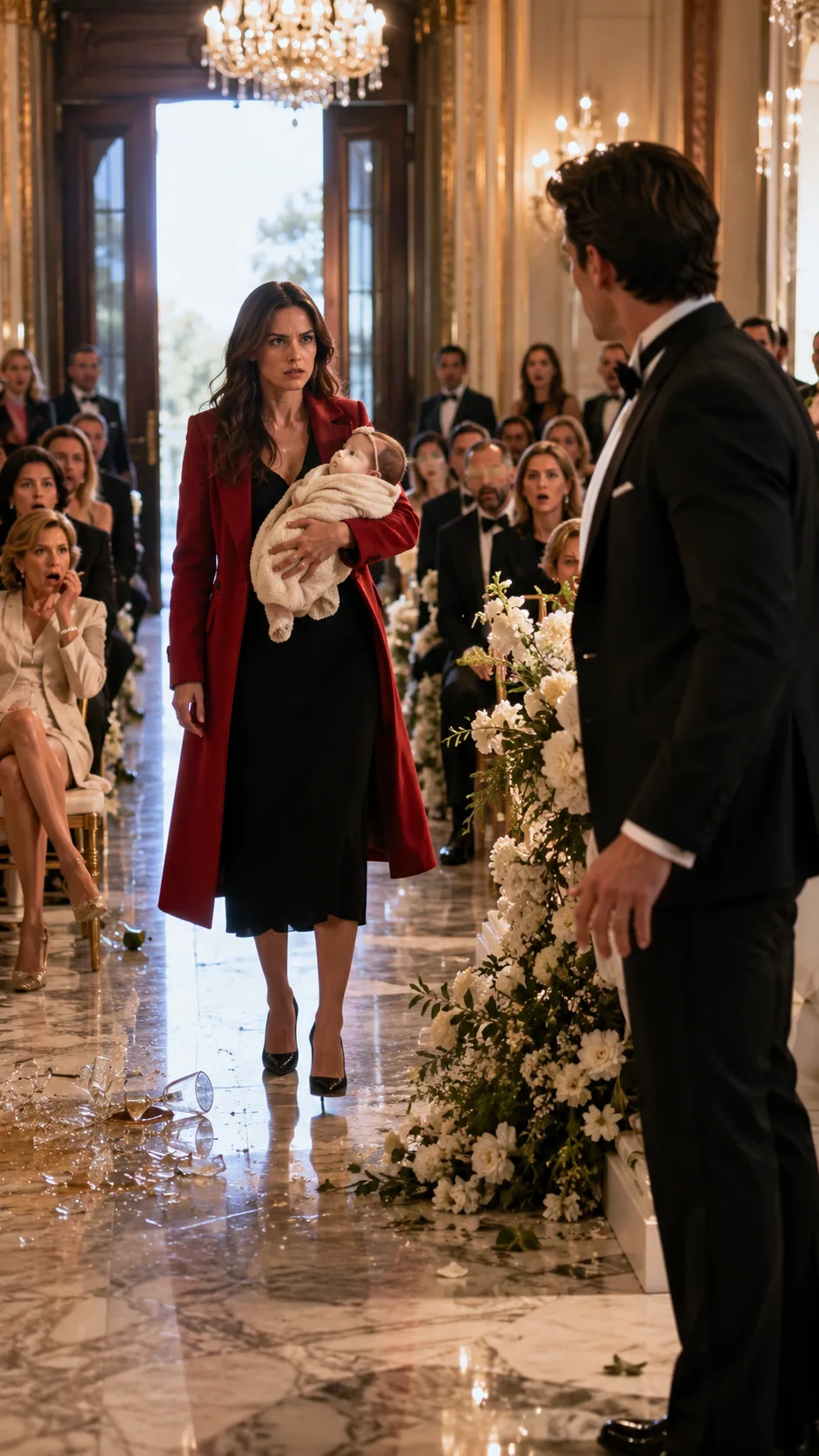
Lily rested in my arms, calm as if she understood that this house belonged to her before she could even speak. She wore a cream dress under a soft blanket. Her tiny fingers curled around one button of my red coat.
I wore black beneath it.
Not because I was mourning.
Because Vincent was about to.
Detective Miller stood beside me, listening through a small earpiece. Officers were positioned at the exits. The microphones had already caught enough. Vincent and Evelyn had spoken too freely that morning in the library, panicked over frozen funds, angry that my death had not delivered what they expected.
But Miller wanted the arrest clean.
Public.
Undeniable.
The string quartet began the final processional.
I closed my eyes.
For one second, I was back on the porch.
Snow in my mouth.
The lock turning.
My daughter kicking.
Then Lily made a soft sound against my shoulder.
I opened my eyes.
I was not on the porch anymore.
The officiant’s voice floated through the doors.
“If anyone present knows a reason these two should not be joined…”
Detective Miller gave one nod.
The doors opened.
The music stumbled, then died.
Every head in the ballroom turned.
At first, no one understood what they were seeing. Their eyes moved over my red coat, my black dress, the baby in my arms. Confusion passed through the room like wind through grass.
Then someone gasped my name.
Vincent turned from the altar with the easy smile of a groom expecting some late guest, some amusing interruption, some inconvenience money could smooth over.
His eyes met mine.
The smile vanished.
All the color left him so quickly he looked carved from wax.
Celeste, standing beside him in white lace, followed his stare. Her bouquet trembled in her hands.
I stepped into the aisle.
My heels struck the marble one slow click at a time.
Click.
Click.
Click.
That sound moved through the silence like a countdown.
Evelyn sat in the front row, draped in pale silk and diamonds. The moment she saw me, her champagne flute slid from her fingers. It hit the floor and shattered, sending glass skittering across the marble at her feet.
No one moved to clean it.
No one moved at all.
I walked past the guests who had once called me fragile. Past board members who had let Vincent speak over me. Past women who had pitied my supposed death over brunch. Past men who had shaken Vincent’s hand while he played grieving widower.
At the altar, I stopped.
Not close enough for Vincent to touch me.
Never again.
His lips moved twice before sound came out.
“You’re dead.”
The words were barely human.
I looked at him, and for the first time since the night of the storm, I smiled.
“Disappointed?”
Celeste turned on him. “Vincent… what is happening?”
He did not look at her. He could not take his eyes off me, or the child in my arms.
“That’s impossible,” he said.
Lily shifted against my chest. I adjusted her blanket so the room could see her face.
“No,” I said. “What was impossible was crawling through a blizzard while in labor because my husband locked me outside to die. But I managed.”
A wave of sound broke through the room.
Gasps.
Whispers.
A chair scraping backward.
Evelyn stood abruptly. “This is a grotesque performance. Security!”
Her voice cracked on the final word.
I turned my head toward her.
“You called my daughter a complication.”
Her face hardened. “You unstable little—”
“Careful,” Detective Miller said.
He stepped out from the side of the altar and raised his badge.
The room changed instantly.
Uniformed officers entered through the side doors. Two more appeared at the back of the ballroom. Guests stood, craning their necks, phones lifting before officers ordered them down.
Vincent backed away.
His shoulder struck a tall arrangement of white roses. The vase rocked but did not fall. His hands were shaking now. Not dramatically. Not like a villain in a play. Small, ugly tremors at the ends of his fingers.
“You don’t understand,” he said to Miller. “She’s been ill. She’s confused. She disappeared. My mother and I were grieving.”
I laughed softly.
The sound surprised even me.
“Grieving?” I asked. “You tried to access my trust before the obituary finished circulating.”
His eyes flicked to Evelyn.
That tiny glance damned them both.
Celeste slowly lowered her bouquet. Her face had gone pale with horror. “Vincent,” she whispered, “tell me she’s lying.”
He opened his mouth.
Nothing came out.
So I spoke for him.
“He threw me onto the porch during a blackout,” I said. “Your future mother-in-law watched. They locked the door while I was in labor. They thought if I died before my daughter was born, they could take what my father left me.”
Evelyn’s polished mask finally cracked.
“You have no proof,” she snapped.
Detective Miller looked at her calmly. “Actually, Mrs. Thorne, we have several recordings, financial filings, witness statements, sealed medical documentation, and your conversation from the library this morning.”
Evelyn froze.
Vincent turned toward his mother with pure panic in his eyes.
There it was.
Not love.
Not remorse.
Only fear of being caught.
Miller stepped closer.
“Vincent Thorne,” he said, voice carrying cleanly through the ballroom, “you are under arrest for the attempted murder of Grace Thorne and the attempted murder of your unborn child.”
The room erupted.
Celeste staggered away from Vincent as though he had become contagious. Her father rose from the front row, face dark with fury. Guests shouted questions. Someone began sobbing. Somewhere behind me, a woman whispered, “The baby is alive.”
Miller turned slightly.
“Evelyn Thorne, you are under arrest for conspiracy to commit murder.”
Evelyn recoiled when the officers approached her.
“How dare you touch me?” she hissed. “Do you know who I am?”
One officer took her wrist.
Another picked up the silk wrap that had fallen from her shoulders.
“I know exactly who you are,” I said.
She looked at me then.
Really looked.
For six years, Evelyn had seen a quiet wife. A useful girl. A soft place in a hard family. She had mistaken silence for emptiness and gentleness for weakness.
Now she saw what had crawled out of the snow.
Vincent’s legs seemed to fail when the cuffs closed around his wrists. He did not fight. Men like him rarely do when the room stops obeying them. He only stared at Lily.
For one strange second, I wondered if he felt anything.
Regret.
Loss.
Recognition.
But his eyes were not on her face.
They were on the child who had ruined his plan by surviving.
That was the last kindness he ever gave me.
He reminded me not to pity him.
As officers led him down the aisle, the same aisle where he had expected to marry another woman beneath my chandeliers, he passed close enough for me to hear him breathe.
“Grace,” he said, desperate now. “Please.”
That word.
Please.
The same word I had used on the night he locked me out.
I held my daughter closer.
“You taught me what that word is worth to you,” I said.
He had no answer.
They dragged him past the broken glass, past the flowers, past the guests who now looked at him not as a grieving widower, not as a powerful heir, not as a charming businessman, but as exactly what he was.
A coward who had failed to kill his wife.
Evelyn followed in handcuffs, still trying to keep her chin raised, still trying to look untouchable. But her shoes slipped slightly on the marble near the spilled champagne, and for one brief moment, the great Evelyn Thorne looked old, frightened, and ordinary.
The ballroom doors opened again.
This time, the sunlight was warm.
I walked out before the questions could reach me. Before the cameras. Before the apologies. Before anyone could tell me how brave I was, as if bravery had been a choice instead of the only road left.
Outside, the air smelled of thawed earth and spring branches.
The driveway was clear.
The steps were dry.
The porch where I had once lain in the snow stood bright beneath the afternoon sun.
I stopped there.
Lily woke in my arms and blinked up at me. Her tiny hand reached clumsily toward my face, brushing my chin.
I kissed her fingers.
“You brought me home,” I whispered.
Behind me, Prescott House no longer felt haunted.
It felt waiting.
My father’s house.
My daughter’s inheritance.
My life.
For months, Vincent had believed winter had buried me.
He was wrong.
Winter had only buried the woman who once trusted him.
The woman who stood on those steps now was something else entirely.
And she was not leaving.
THE END.
Chapter complete
You have reached the end of this chapter.
Continue reading
A few more worlds to get lost in after this chapter.