The note was folded once on the kitchen counter, pinned under the brass fruit bowl we never used.
Chapter 1
The note was folded once on the kitchen counter, pinned under the brass fruit bowl we never used.
Take care of the old woman in the back room.
No hello. No apology for the flight delay he had ignored. No message asking whether I had eaten since leaving the hotel conference room at six that morning. Just those nine words in David’s blunt handwriting, written with the same black pen he used to sign checks and birthday cards and the mortgage forms he always insisted I let him handle.
My suitcase stood beside the island, one wheel still tilted because the cab driver had dropped it too hard on the curb. My coat was damp at the shoulders. The house was too quiet.
That was the first thing.
David liked noise. Sports commentary from the living room. Celeste’s voice notes playing from his phone. A business podcast left running while he cooked. Even when he was not home, the house usually carried some trace of him, some screen
humming in another room, some lamp left on, some evidence that he had passed through like a man who expected everyone else to clean around him.
That night, there was only the refrigerator and the low tick of the clock above the pantry.
Then I smelled it.
Old medicine. Stale air. Something sour beneath it, trapped in heat.
I left the note on the counter and walked down the hall.
The back room had been David’s storage room when I moved in. Golf clubs he never used. Celeste’s holiday decorations. Boxes of tax records he claimed were too important to throw out but never important enough to organize. Six months earlier, he had started keeping it locked.
“Insurance paperwork,” he told me the first time I asked.
Then: “You don’t need to go in there.”
Then: “Mara, please don’t start.”
After a while, I stopped asking. Not because I believed
him. Because marriage, I had learned, could train a person to walk around locked doors until the whole house became a map of what not to touch.
The door was not locked now.
The knob turned too easily in my hand.
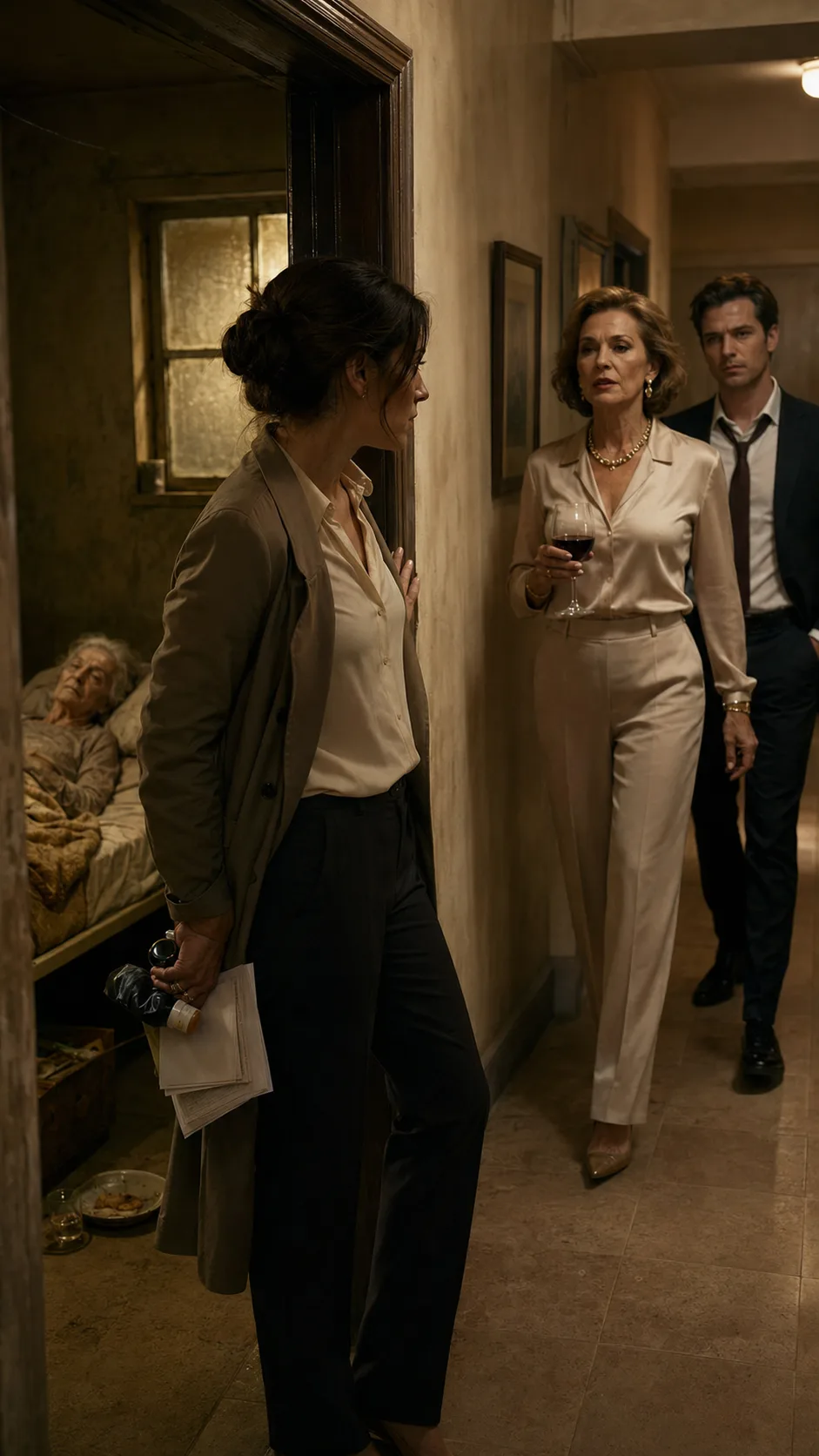
The room hit me with hot air. The window had been sealed shut with strips of tape yellowed at the edges. A narrow cot had been pushed against the far wall beneath a crooked shelf. On it lay David’s grandmother, Evelyn Whitaker, wrapped in a blanket that looked too thin to warm her and too dirty to comfort anyone.
For a second, I did not move.
She had been sharp the last time I saw her. Ninety-one, yes, and small enough that her cardigan sleeves swallowed her hands, but sharp. She had sat at Celeste’s dining table with one eyebrow raised while David explained cryptocurrency to her like she
had not survived three recessions and run a hardware store for forty-two years.
Now her cheekbones pressed against skin the color of old paper. Her lips were cracked. One hand hung over the side of the cot. On the floor beside her sat a tray of food gone hard at the edges. A glass of water was placed just beyond the reach of her fingers.
“Oh my God.”
I pulled out my phone.
Her hand caught my wrist.
The grip was dry and cold and much stronger than it should have been.
“Don’t call anyone yet,” she said.
Her voice scraped, but the words were clean.
“Mrs. Whitaker—”
“Evelyn.” Her eyes moved to the doorway, then back to me. “First, you need to see what they’ve done.”
I looked down at the phone in my hand. The emergency screen glowed against my palm.
She squeezed once.
“Under the bed.”
I crouched. My knees touched dust. Beneath the cot, half hidden behind an old shoe box, was a small metal lockbox. The lid was not latched. Someone had closed it in a hurry.
Inside were pill bottles, legal papers, a silk scarf wrapped around something rectangular, and a stack of handwritten notes folded into quarters.
I opened the scarf first.
A recorder.
Small. Black. Old-fashioned, the kind with actual buttons instead of a phone app. A strip of masking tape on the back had one word written in shaky blue ink.
Kitchen.
The top paper beneath it was a power of attorney document.
At first, I read it like my mind had lost traction.
Evelyn Whitaker, principal.
David Aaron Whitaker, agent.
Celeste Marie Whitaker, witness.
David’s signature was already on it. Celeste’s initials appeared at the bottom of each page. Evelyn’s line was blank.
Not signed.
Not yet.
Below that were transfer drafts. Property. Bank accounts. Her remaining shares in Whitaker Hardware, the small chain Celeste had been trying to sell since the day Evelyn stepped back from daily control. There were notes about competency evaluations, medication timing, phrases underlined in Celeste’s slanted hand.
Confused during visit.
Agitated when questioned.
Unable to recall dates.
The pill bottles were labeled with Evelyn’s name. The dosages made my fingers go still. I had spent enough years arranging my father’s prescriptions after his stroke to know when a schedule looked like care and when it looked like someone trying to bury a person under fog.
I turned one bottle in my hand.
Two tablets every four hours as needed.
The note tucked under it said: give before lawyer.
I looked at Evelyn.
She watched my face and did not blink.
“They forged this?”
“Tried to.” Her mouth tightened around the words. “David has greed. Celeste has nerve. Neither has patience.”
A board creaked somewhere outside the room.
Evelyn’s eyes shifted past me.
I slid the papers back together, but not into the box. I folded the power of attorney once and tucked it under my coat. The recorder went into my right hand. One pill bottle into my left. I pushed the box back halfway beneath the cot, enough to hide the mess without pretending nothing had been touched.
Celeste’s voice floated down the hallway.
“Mara? You’re home.”
Silk on tile. A wine glass chiming lightly against a ring.
“Did you find our little burden?”
Evelyn closed her eyes.
Not from weakness.
From disgust.
I stood.
My body wanted to move fast. Call emergency services. Call the police. Call every number at once until strangers filled the house and forced the truth out into the open. But Celeste was in the hallway, and David was somewhere behind her, and Evelyn’s hand had closed around my wrist for a reason.
The first person who panicked would lose the room.
I stepped out and pulled the door halfway closed behind me.
Celeste stood near the framed print of the Tuscan vineyard she had given us for Christmas and then criticized us for hanging too low. She wore cream silk trousers and a matching blouse that caught the hall light like liquid. Her hair was set, her lipstick fresh, her gold bracelet resting against the stem of a wine glass.
Not a strand out of place.
David leaned behind her against the wall with his tie loosened and his sleeves rolled up. He looked tired in the expensive way men called tired when someone else had done the hard parts for them.
“There you are,” he said. “I figured you’d handle it.”
I kept my right hand behind my back.
Celeste glanced at the closed part of the door.
“How is she?”
“She needs a doctor.”
David exhaled through his nose and looked toward the ceiling.
“Mara.”
One word. A warning dressed as my name.
Celeste lifted her glass. “She has episodes. At her age, every little discomfort becomes a performance.”
A performance.
The tray on the floor. The glass out of reach. The tape on the window.
I looked from Celeste to David.
He straightened slightly. “We were going to talk to you before you got dramatic.”
“You left me a note.”
“You were coming home,” he said. “And you’re better at those things.”
“What things?”
His eyes flicked toward the back room.
“Care. Comfort. All of that.”
Celeste smiled over the rim of her glass. “Women are usually better at recognizing when another woman needs tenderness.”
The recorder dug into my palm.
Evelyn needed water. A doctor. Air. Someone to sit beside her and say her name like she had not already been reduced to an obstacle between David and an inheritance.
I lowered my eyes.
It was what David expected from me. The smaller posture. The soft answer. The silence that let him believe he had won before he had even started.
“Of course,” I said. “Tell me what you need.”
Celeste’s shoulders relaxed first.
David’s face softened into that look I had once mistaken for affection and later recognized as relief at not being challenged.
“I knew you’d understand,” he said.
I nodded once.
Then I walked past them into the kitchen.
“Where are you going?” Celeste asked.
“To get her water.”
“Use the plastic cup,” David said. “Not the good glasses.”
I stopped beside the sink.
There was a plastic cup on the drying rack. Blue. Cracked at the rim. I filled it, carried it back down the hall, and stepped into the room before either of them could block me.
Evelyn’s eyes opened when I bent beside her.
I held the cup while she drank. Not much. Three small sips. Water ran down one corner of her mouth, and I wiped it away with the cleanest corner of the sheet.
“Recorder,” she said.
“I have it.”
“Kitchen first.” Her breath rasped. “Then the office.”
“There are more?”
Her hand moved under the blanket. Slow. Careful. She pulled out a second strip of masking tape, this one folded over itself.
Safe.
I stared at it.
She gave the smallest nod.
The hallway creaked again.
I tucked the tape into my pocket and stood with the cup in my hand. David was waiting at the threshold now. He was no longer leaning. His gaze moved from my face to my coat, to my hands, to the slight bulge where the folded paper sat beneath the fabric.
“What did she say?”
“She asked for water.”
His mouth pulled tight.
Celeste appeared behind him. “Evelyn gets suggestive when she is tired. Don’t let her upset you.”
I looked at David.
“Why is she here?”
“My mother thought it would be easier.”
“Easier than what?”
“Don’t interrogate me in my own house.”
My own house.
The mortgage payments came from our joint account. The down payment had come from the sale of the condo I owned before I married him. The kitchen he stood in, the floor under his shoes, the locks on the doors he thought he controlled, all of it had been softened and paid for by my willingness to believe marriage meant shared ground.
Celeste touched David’s arm.
“Not now.”
But David had seen enough in my face to understand I was not where he had left me.
He stepped closer. “Give me what you’re holding.”
My fingers tightened around the recorder.
“Why?”
“Because I said so.”
The old version of me would have heard that tone and moved around it. A joke. A compromise. A quiet retreat to keep dinner from becoming a fight. David had built a marriage out of those retreats and called it peace.
I walked past him.
Not fast. Not slow enough to look dramatic. Just past him, into the small sitting room off the hall, where a narrow console table stood beneath a mirror. Celeste had placed a bowl of decorative keys there years ago and complained when I used it for mail.
I set the plastic cup down first.
Then the pill bottle.
Celeste’s eyes sharpened.
“Where did you get that?”
I placed the folded power of attorney beside it.
David moved.
One step.
I put the recorder down last and kept my finger on it.
His shoes stopped against the tile.
The mirror above the table caught all three of us. Celeste in cream silk with her wine glass lifted. David behind her, tie undone, mouth half open. Me between them and the room where his grandmother lay trying to breathe.
“Pick that up,” David said.
I looked at the document. “You signed it.”
His jaw moved once.
Celeste set her wine glass on the table too hard. Red wine jumped against the side, but none spilled.
“Mara, you don’t understand estate matters.”
“I understand signatures.”
“That paper is private.”
“Then why was it under her bed with sedatives?”
David’s hand opened and closed beside his thigh.
Celeste laughed once. A thin sound.
“You think you’ve found some grand conspiracy because an old woman needs medication?”
I pressed the recorder button.
For half a second, there was only static.
Then Celeste’s voice came out of the little black box, thinner but unmistakable.
“She doesn’t need to be alert for the lawyer. Alert is exactly the problem.”
David’s face changed by degrees.
Not all at once.
First the eyes. Then the mouth. Then the color under his skin.
The recorder crackled again.
His voice followed hers.
“If she signs before Friday, the sale can close before Mara gets back.”
Celeste turned toward him, and for once there was no performance in her face.
The house went quiet around the recording.
On the tape, a cabinet shut. A spoon clinked against glass.
Then Evelyn’s voice, weaker than I had ever heard it.
“I know what you’re doing.”
Celeste again.
“No, Evelyn. You know what we tell the doctor you know.”
The tape hummed.
David reached for the recorder.
I did not move my hand.
He stopped less than an inch away from my fingers.
“Mara,” he said.
There it was again.
My name as a leash.
I looked at him.
“Were you going to wait until I was unpacked?”
Celeste stepped closer. “Turn it off.”
“No.”
“You are making a mistake.”
“No.”
Two letters. Clean. Small enough to fit between us and still leave no room.
David looked toward the back room. “She put you up to this.”
“She showed me what you hid.”
“She’s confused.”
“She remembered where the recorder was.”
Celeste’s lips pressed together.
The tape kept playing.
David’s voice again: “If Mara asks, we say Grandma had a spell and Mom brought her here because the facility was full.”
Celeste: “Mara asks too much.”
David: “Mara does what I tell her when it matters.”
The sentence sat in the room like a dead thing.
I let it.
Celeste looked at me then. Not at the recorder. Not at the paper. Me.
For the first time since I had known her, she seemed to calculate without enough numbers.
“You don’t want police in your marriage,” she said.
“I don’t have a marriage.”
David’s head snapped toward me.
I picked up my phone from my coat pocket with my free hand and tapped the emergency screen I had left open.
“Mara, wait.”
I called.
The operator answered on the second ring.
I gave the address. I said there was an elderly woman being kept without proper care. I said there were medications and possible forged legal documents. I said she needed medical attention immediately.
David cursed under his breath and turned away, then turned back because there was nowhere useful to go.
Celeste reached for her wine glass. Her fingers missed the stem once before finding it.
The operator stayed on the line.
“Is she breathing?” the voice asked.
“Yes.”
“Is she conscious?”
“Yes.”
“Are you safe?”
I looked at David.
He had both hands raised now, palms out, as if the house itself had become a courtroom and he wanted the walls to believe he had not touched anything.
“Yes,” I said. “For now.”
Sirens did not come right away.
They never do in stories people tell later. There is always a stretch of time where everyone has to stand inside what they have done before the world arrives to name it.
David tried to talk first.
“You don’t know how this looks.”
“I know exactly how it looks.”
“She wanted to leave the facility,” he said. “She begged Mom.”
Celeste turned sharply. “David.”
Too late.
“What facility?” I asked.
His mouth shut.
The operator’s voice came faintly from the phone, asking me to stay on the line.
I set it on speaker and placed it beside the recorder.
Two devices on the table now. One holding what they had said. One carrying what they were saying.
David saw that and stopped again.
Good.
Celeste noticed half a second later.
Her hand dropped from the wine glass.
I opened the folded tape from my pocket. Safe.
Evelyn had not meant a metal safe in some bank.
She had meant the wall safe in David’s office. The one behind the framed diploma he liked to point out whenever clients visited. He told people it held passports and insurance papers.
Celeste followed my gaze down the hallway.
“Don’t,” she said.
The word came out smaller than she intended.
I picked up the power of attorney and walked toward the office.
David blocked the hall.
He had always been taller than me. He had used it casually, standing too close during arguments, leaning over tables, filling doorways. I had spent years stepping back to keep space from becoming another kind of fight.
This time, I did not step back.
The operator said, “Ma’am?”
“I’m still here.”
David looked at the phone. Then at me.
He moved aside.
His shoulder brushed the wall.
A framed vacation photo tilted crooked when he hit it. The four of us in Newport two summers earlier: Celeste in linen, David smiling with one hand at my waist, Evelyn seated in a sunhat, me squinting into too much light. Celeste had hated that photo because Evelyn looked happiest sitting beside me.
The office smelled of leather and printer ink.
I went to the diploma.
David came in behind me but stayed by the doorway now. Celeste hovered behind him, her wine untouched on the table down the hall.
I lifted the frame.
The wall safe was there.
“Combination,” I said.
David shook his head.
I looked back toward the hallway where the operator listened from my phone and the recorder sat beside forged papers.
“Fine.”
Celeste closed her eyes briefly.
“David,” she said. “Open it.”
He turned on her.
“You told me—”
“Open it.”
The keypad beeped under his fingers. Once. Twice. Four numbers. The safe clicked.
Inside were passports, yes.
And envelopes.
One was labeled with Evelyn’s name.
One with mine.
I pulled mine out first.
The flap had been opened and resealed badly.
Inside was a copy of our prenuptial agreement.
I had signed one before the wedding. David insisted it protected both of us. I had read it twice with my own lawyer before signing. No debt sharing. Premarital assets separate. Joint property split by contribution.
This copy had pages I had never seen.
A clause assigning my premarital condo proceeds into the marital estate.
An acknowledgment of debt responsibility for David’s private business loan.
My signature appeared at the bottom.
Not mine.
Close, but not mine.
The M was wrong.
Small detail.
Enough.
I held it up.
David’s face emptied.
Celeste sat down in the office chair behind him, but she did not seem to know she had done it until the wheels rolled back and hit the desk.
“You forged mine too.”
David said nothing.
From the hallway, Evelyn’s voice called out, cracked but clear.
“Found it, didn’t she?”
No one answered her.
The first siren touched the end of the street then, thin through the windows.
Celeste stood too quickly and gripped the desk.
“We can fix this privately.”
“No.”
“You don’t know what prosecutors do to families.”
“I know what families did here.”
David rubbed both hands over his face.
“It was debt,” he said.
Celeste’s head turned toward him.
“What?”
David looked at me like he had decided confession was a tool, not a consequence.
“I was going to put it back.”
The siren grew louder.
“The sale would have covered everything. Grandma wasn’t using the stores. You weren’t supposed to come home until tomorrow morning.”
I looked at him for a long moment.
Not because I needed to understand. Because he had finally stopped pretending there was a version of this where he had loved anyone more than his own escape.
Celeste stepped between us.
“She is my mother,” she said.
Evelyn’s voice carried from the back room.
“Then come say that where I can see you.”
Celeste did not move.
Blue and red light washed once across the office wall.
Then again.
The house changed color.
Two paramedics came in first. A police officer followed. Then another. The hallway filled with boots, radios, latex gloves, questions. I answered what I could. I handed over the pill bottles. I showed them the room. I played the recorder from the beginning.
David tried to speak over it twice.
The officer told him to stop.
Not loudly.
He stopped anyway.
Celeste sat in the hallway chair with her wine glass still on the console table, untouched. Her jewelry looked too bright under the police lights. David stood near the kitchen with one officer between him and the door. His tie hung loose around his neck, the knot ruined by his own hands.
Evelyn was lifted carefully onto a stretcher.
She turned her head as they wheeled her past me.
“My purse,” she said.
I looked back into the room.
A black leather purse sat under the cot, tucked beside the metal box. I had missed it. I brought it to her. She slid one hand inside with effort and pulled out a key.
Not a house key.
Small. Silver. Old.
She pressed it into my palm.
“For the store office,” she said. “Top drawer. Blue folder.”
A paramedic adjusted the blanket around her.
“You need to rest,” I said.
She looked toward David, then Celeste.
“I rested enough.”
They took her out through the front door.
The night air rushed into the house behind them, cold enough to clear the hallway.
I stood there holding the key.
David looked at it like it had teeth.
“What blue folder?” I asked.
He did not answer.
Celeste did.
“She doesn’t know what she’s saying.”
The officer beside David looked at me.
“Do you want that included in the report?”
Celeste’s mouth closed.
I looked at the key in my hand.
“Yes.”
By dawn, Evelyn was in the hospital with fluids running into her arm and a nurse who wrote down every medication name twice. A social worker came before breakfast. My lawyer answered on the third ring and arrived before the coffee in the waiting room had gone cold.
The blue folder was collected later that morning from Whitaker Hardware’s old office, the original store downtown with creaking floors and a bell over the door. Inside were copies of Evelyn’s updated will, a letter to the board, notarized statements, financial records, and a handwritten note dated three weeks earlier.
If David or Celeste attempts to declare me incompetent, remove them from all estate authority immediately.
At the bottom, in Evelyn’s neat hand, she had written my name.
Not as heir.
As witness.
Because six months earlier, at Celeste’s birthday dinner, I had been the only person who noticed Evelyn’s hand shaking and asked whether she wanted soup instead of steak. A small thing. Too small to matter to anyone who counted love in property lines.
It had mattered to her.
David called me seventeen times that afternoon. I did not answer. Then came the texts.
We need to talk.
You don’t understand the whole picture.
My mom is spiraling.
Please don’t let strangers ruin our family.
The last one came at 4:12 p.m.
I love you.
I read it once in the hospital cafeteria with a paper cup of bad coffee cooling beside my hand. Then I set the phone facedown.
Across the room, Evelyn slept beneath a clean blanket. Her hair had been combed away from her face. Someone had placed water within reach.
Within reach.
That was all it took to make a room look human again.
Over the next week, things moved with a speed I had never seen in our marriage. Protective orders. Medical evaluations. A temporary freeze on estate transfers. My lawyer filing for separation before David could move money out of our accounts. Investigators taking the recorder and the documents. Celeste’s name removed from Evelyn’s emergency contacts.
David came to the hospital once.
He wore the same dark coat he wore to funerals and client meetings. He brought flowers from the expensive shop near our house, white lilies wrapped in brown paper.
Evelyn refused to see him.
So he waited by the elevator until I came out.
“You’re really doing this?” he asked.
I looked at the flowers.
“They smell too strong for a hospital room.”
His fingers tightened around the stems.
“Mara, I made mistakes.”
“No.”
His face twitched.
“You don’t get to rename crimes because you regret the audience.”
The elevator opened behind him. A nurse stepped out pushing an empty wheelchair. David moved aside, and for once, it was not because he chose to.
He looked smaller under fluorescent light.
I did not stay to watch him leave.
Three months later, the house sold.
Not to pay David’s debts.
To cut the last shared wall between us.
I kept only what was mine: my books, my grandmother’s mixing bowl, the blue coat I had worn home from the airport that night, and the brass fruit bowl that had pinned down his note on the counter.
The note itself went into an evidence sleeve.
Celeste’s cream silk blouse appeared in a newspaper photo weeks later when reporters covered the civil case involving Whitaker Hardware. She wore pearls to court. David wore a navy suit and kept his hands folded in front of him. Neither looked at Evelyn when she entered with a cane and a nurse beside her.
Evelyn did not look at them either.
She looked at the judge.
Then she sat down.
The criminal charges took longer. Things always do when money teaches people how to delay truth with paperwork. But delays are not the same as escape. David’s private business loan surfaced. So did emails. So did drafts. So did one message from Celeste reminding him to increase Evelyn’s dose before the lawyer arrived.
The prosecutor read that one aloud.
David stared at the table.
Celeste adjusted her bracelet.
Evelyn reached over and patted my hand once.
Outside court, a reporter asked her whether she felt betrayed by her family.
Evelyn looked at the microphones and then at me.
“My family was the person who brought me water,” she said.
That clip went everywhere.
I did not watch it more than once.
A year after the night I found the note, Whitaker Hardware reopened its original downtown store after renovations. Evelyn insisted on being there for the ribbon cutting, wearing a blue cardigan and lipstick the color of raspberries. The bell over the door had been polished but not replaced. She said some sounds deserved to survive.
I stood beside her, holding the ribbon steady while she cut it with oversized scissors.
No speeches.
No grand lessons.
Just the door opening, the bell ringing, and customers stepping over the threshold onto floors that had held three generations of footsteps.
That evening, I went back to my new apartment. Small kitchen. Secondhand table. Windows that opened.
On the counter, I kept the brass fruit bowl.
Empty.
Clean.
No note beneath it.
I poured a glass of water and set it on the nightstand before I slept.
Within reach.
Chapter complete
You have reached the end of this chapter.
Continue reading
A few more worlds to get lost in after this chapter.