boutique hotels from New York to Palm Beach and had taught me before I could drive that a woman should never enter a room without knowing how to leave it.
But I was tired of men who saw my last name before they saw me.
So Grant got Evelyn Hart, the woman with the red umbrella and rain in her hair.
He said he loved her.
For a while, I believed him.
Then I married him.
Then I funded him.
Quietly. Strategically. Completely.
When Grant’s company, Ashford Urban Group, nearly collapsed during its second expansion, I moved money through a private investment vehicle my grandmother had built decades before. When he needed introductions, I made them without putting my fingerprints on the glass. When banks hesitated, I arranged reassurance. When he needed a hotel partner for his first landmark renovation, the Whitmore Group signed.
Grant called it fate.
I called it love.
That was my first mistake.
My second was letting him believe love meant silence.
By the time Sienna entered his life, I had already learned the special loneliness of being married to a man who worshiped his reflection in your eyes but resented you for being the mirror.
He met her at a charity gala in Miami, where she had been paid to post three stories and mention the sponsor’s name correctly. Within two months, she was wearing Cartier bracelets that matched the ones I found on our joint credit card statement under “client gifting.” Within four, she was seated beside him at dinners where I was told the table was full. By five, her birthday party was being held in my family’s hotel.
And by six, I knew everything.
Not because I followed him.
Not because I screamed.
Not because I checked his phone while he slept beside me like a stranger.
Because Grant made the mistake most arrogant men make.
He underestimated the woman who had made him powerful.
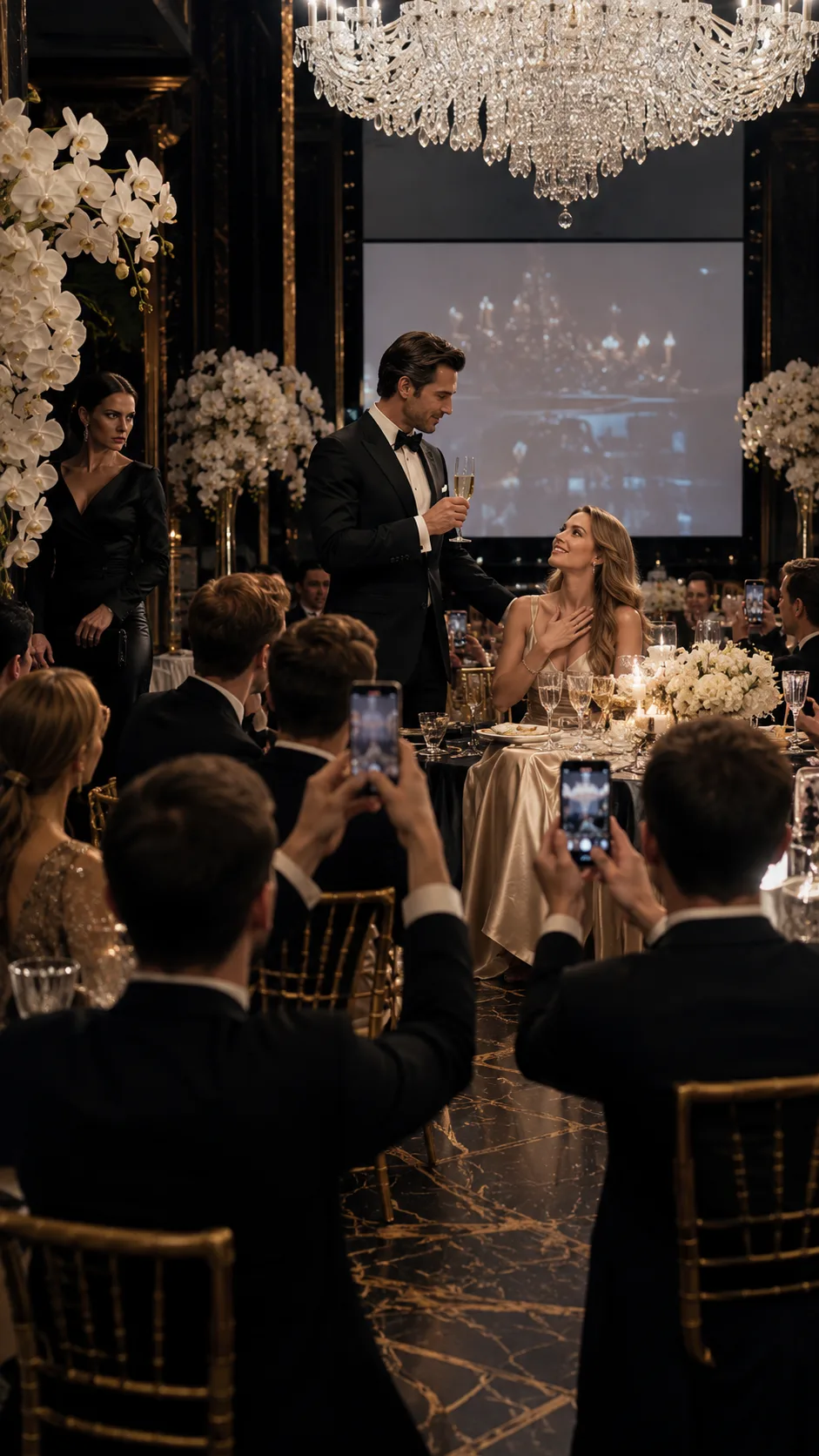
I watched from the back of Sienna’s party as Grant stood to speak.
He tapped his glass with a silver knife, and the room obediently hushed.
Sienna lifted her chin with practiced surprise. Cameras rose. Phones glowed. Someone whispered, “This is going to be so romantic.”
I felt my assistant, Naomi, step beside me.
“Mrs. Ashford,” she murmured, “you don’t have to do this.”
I looked at my husband.
His tuxedo fit perfectly. His smile looked expensive and empty. He rested one hand on the back of Sienna’s chair, close enough to claim her without touching her.
“Oh,” I said softly, “I absolutely do.”
Grant began.
“I met her on a rainy afternoon in New York,” he said, voice warm with performance. “I ducked into a coffee shop to escape the storm, and there she was, fighting with a red umbrella like the city had personally offended her.”
A ripple of laughter moved through the guests.
My throat went still.
Naomi inhaled sharply.
Grant smiled at Sienna.
“She let me share her table, even though I was dripping water all over her shoes. She ordered black coffee. I ordered tea, because I was trying to seem more interesting than I was.”
More laughter.
He paused with the timing of a man who had told this story many times.
“And then she looked at me and said, ‘You don’t have to pretend. The rain already made you honest.’”
My words.
My exact words.
Sienna pressed her fingers to her lips, as if touched by a memory she had never lived.
Grant continued, and each sentence was a small, elegant murder.
He described my umbrella. My laugh. My coffee order. The book I had been reading. The way we walked six blocks under the same broken umbrella because neither of us wanted the moment to end.
Only in his version, the woman was Sienna.
The guests melted.
The cameras recorded.
The internet waited.
“And ever since that day,” Grant said, lifting his glass, “I have known that some people don’t enter your life. They rescue it.”
Sienna’s eyes shone.
I almost admired her.
Not for stealing my husband. Husbands cannot be stolen unless they first decide to wander.
No, I admired the nerve it took to sit there wearing another woman’s memory like borrowed diamonds.
Grant finished with a flourish.
“To Sienna. My storm, my shelter, my second chance.”
The room erupted.
I waited three seconds.
Long enough for the applause to peak.
Long enough for the phones to stay up.
Then I walked forward.
CHAPTER 2: The Birthday Toast That Broke the Internet
The first thing people noticed was not my face.
It was the silence I carried.
Some women enter a room begging to be seen. Others enter it with such certainty that the room remembers it was built around them.
I had spent years becoming the second kind.
My heels struck the marble in clean, measured notes. The pianist stopped playing. A waiter froze with a tray of champagne. The event photographer lowered his camera, then lifted it again because instinct is stronger than manners.
Grant stared as if I had risen from a grave he personally purchased.
“Evelyn,” he said, but the microphone caught it, and my name passed through the speakers like a warning.
Sienna turned.
For the first time that night, her expression was not camera-ready.
I held out my hand to the host, a young man in a velvet jacket who looked like he would rather be trapped in an elevator with a tiger than between a wife and a mistress.
“The microphone,” I said.
He gave it to me.
Grant moved quickly, too quickly.
“Evelyn, this is not the time.”
I looked at him.
He stopped.
It is amazing how a man can forget the sound of your voice until he hears the version of it that no longer loves him.
I faced the room.
“Good evening,” I said. “For those of you who don’t know me, my name is Evelyn Ashford.”
A murmur moved through the crowd.
Someone whispered, “His wife?”
Someone else said, “I thought they were separated.”
We were not.
Grant had simply discovered that if you stop bringing your wife places, people will invent an explanation polite enough not to embarrass themselves.
I smiled.
“First, let me wish Sienna a happy birthday. Twenty-nine is a beautiful age. Old enough to know better, young enough to pretend you don’t.”
A few nervous laughs slipped out before people could stop them.
Sienna’s cheeks flushed.
Grant’s jaw hardened.
“Evelyn,” he said quietly, “don’t.”
I ignored him.
“That was a lovely speech, Grant. The rain. The coffee shop. The red umbrella. The woman who told you the rain had already made you honest.”
I turned to Sienna.
“Did he tell you that line was yours?”
Her lips parted.
The ballroom became so quiet I could hear ice settling in glasses.
Sienna looked at Grant, then back at me. She tried to laugh, but it came out too thin.
“I don’t know what you think you’re doing.”
“No,” I said gently. “That has been the problem from the beginning.”
I lifted my phone.
Behind me, the large screen that had been looping soft-focus footage of Sienna’s birthday shoot changed.
Naomi stood at the media table with a calm expression and one finger on the controls.
The screen showed a photograph.
A small coffee shop with fogged windows.
Maribel’s on Madison.
Eleven years earlier.
There I was, younger, rain-soaked, laughing beside a red umbrella turned inside out. Grant stood beside me, grinning at me with an expression I had not seen on his face in years.
A collective gasp rolled through the room.
Sienna went pale.
Grant looked toward the media table. “Turn that off.”
Naomi did not move.
I kept my eyes on the guests.
“That photo was taken by the owner of Maribel’s, who thought we looked like a romantic comedy she wanted to remember. She sent it to me the week after Grant proposed.”
The screen changed again.
A scanned page from Grant’s old journal appeared, his handwriting large and slanted.
Rain. Red umbrella. Evelyn said the rain made me honest. I think I met my wife today.
The room shifted.
Not loudly. Worse.
Quietly.
People began to understand, and rich people hate understanding anything that requires them to take a side in public.
Sienna’s mother, seated near the front, covered her mouth.
A man in a navy suit whispered, “Oh my God.”
Phones were still recording.
Good.
Grant stepped toward me. “This is private.”
I turned the full force of my smile on him.
“No, Grant. You made it a speech.”
The guests reacted before they could pretend not to.
A sharp breath here. A hand to the chest there. Someone laughed once, not because it was funny, but because cruelty revealed in satin always has a strange theater to it.
Grant lowered his voice.
“You are embarrassing yourself.”
That was when something inside me, something I had kept polished and civilized for years, finally stood up.
I faced him.
“No. I am correcting the record.”
He blinked.
“For eleven years,” I said, “I protected your pride like it was a family heirloom. I let you tell people you built your company alone. I let you accept awards for doors I opened. I let you stand in front of cameras and thank your ‘team’ while your wife sat at home editing your speeches, cleaning up your risks, and pretending not to notice the lipstick on your collar because the world is kinder to successful men than humiliated women.”
Grant’s face tightened.
I saw anger arrive before guilt.
It always did.
“Evelyn,” he said, “enough.”
“No,” I said. “Not nearly.”
Sienna stood now, her chair scraping against the marble. “This is my birthday.”
I looked at her.
For a heartbeat, I saw the girl beneath the silk. Not innocent. Not helpless. But younger than the room she had tried to conquer.
“Yes,” I said. “And now it’s memorable.”
Her eyes filled, but I did not trust tears from women who filmed themselves crying in designer bathrooms for engagement.
Grant reached for my arm.
I stepped back before he could touch me.
The movement was small, but everyone saw it.
So did the cameras.
“Do not,” I said softly.
He froze.
Maybe it was the microphone.
Maybe it was the witnesses.
Maybe it was the fact that for the first time in years, he did not know what I owned.
I turned back to the room.
“You all came here tonight for a love story,” I said. “So let me give you the ending.”
CHAPTER 3: The Woman He Thought He Owned
A week before Sienna’s birthday, Grant had come home smelling like her perfume.
White amber. Peony. Something sugary beneath it that made the elevator feel smaller.
He found me in the library of our Upper East Side townhouse, reading contracts beneath a green banker’s lamp. He hated that lamp. He said it made the room look like an old money law office.
That was precisely why I kept it.
“There’s an event next Friday,” he said, loosening his tie. “A birthday thing. Client-related.”
I turned a page.
“For Sienna?”
He paused just long enough.
Then he smiled.
The smile was careful. Patient. The smile men use when they believe a woman is being emotional instead of accurate.
“She’s valuable to the campaign. Her audience overlaps with our buyers.”
“Does her audience know you’re married?”
His expression cooled.
“Don’t start.”
There it was.
The phrase that turns a wife’s pain into poor manners.
I closed the folder in front of me.
“Grant, I’m going to ask you once. Are you in love with her?”
He laughed.
Not because the question was funny.
Because honesty had become inconvenient.
“I’m not doing this tonight.”
“You’re doing something.”
He looked around the library, at the first editions, the brass clock, the portrait of my grandmother above the fireplace.
Then he looked at me.
“You know what your problem is, Evelyn? You think restraint makes you powerful. It doesn’t. It makes you cold.”
I remember that clearly because I almost smiled.
Men call women cold when they can no longer find the handle.
He stepped closer.
“Sienna makes people feel alive. She doesn’t sit in dark rooms judging everyone. She celebrates life. She understands the image I need.”
“The image,” I repeated.
“Yes,” he snapped. “The image. Do you know what it’s like dragging a ghost through every room? Do you know how exhausting it is to be married to someone who never needs anything?”
I did need things.
I needed loyalty.
I needed tenderness.
I needed the man I loved not to hand my memories to a woman who mistook attention for intimacy.
But women like me are trained early not to bleed where predators can smell it.
So I said nothing.
Grant mistook my silence for defeat.
He always did.
He walked to the bar cart, poured himself bourbon, and said, “Don’t come Friday. You’ll make everyone uncomfortable.”
I looked at the amber light through the glass.
“Of course,” I said.
He exhaled, relieved.
That was his last mistake.
Because while Grant was sleeping upstairs that night, I sat beneath the green lamp and opened the file Naomi had delivered.
Six months of invoices.
Hotel bills.
Jewelry receipts.
Emails.
Shell payments from Ashford Urban Group marked as “digital partnership expenses.”
A draft press release announcing a new lifestyle development brand with Sienna as “creative muse.”
And one more document.
The one that made me stop breathing.
A proposed divorce settlement.
Not sent.
Not discussed.
Prepared.
Grant planned to offer me the townhouse, a quiet payout, and the “dignity of privacy.” In exchange, I would release all claims to Ashford Urban Group, including any historical capital contributions that were “unofficial, indirect, or undocumented.”
I read that sentence three times.
Unofficial.
Indirect.
Undocumented.
He wasn’t just leaving me.
He was trying to erase me.
The next morning, I called my grandmother’s attorney, a woman named Margaret Bell whose smile had frightened billionaires since 1987.
“Is it time?” Margaret asked.
I looked out at the city, the glass towers burning gold in the morning sun.
“Yes,” I said. “But I want it clean.”
Margaret gave a small laugh.
“My dear, clean is expensive.”
“I know.”
“How public?”
I thought of Grant telling Sienna my love story in advance, because I knew him well enough to recognize rehearsal when I heard one. I thought of him warning me not to come. I thought of all the women who had swallowed humiliation because dignity was mistaken for silence.
“As public as he made it,” I said.
That was how the plan began.
Not with rage.
Rage is messy. Rage stains carpets and makes headlines easy to dismiss.
No, the plan began with paperwork.
We traced the investment vehicle that had supported Grant’s company from its second year. We confirmed the clauses he had never bothered to read because he thought anonymous money was stupid money. We activated the conversion rights tied to three emergency funding rounds. We verified his misuse of company funds for personal gifts and private travel. We prepared board notices, legal holds, and a press statement so elegant it could cut glass.
Then Margaret asked me the question she had been waiting to ask for years.
“Does he know the Whitmore Group owns the Avery Ballroom?”
I smiled for the first time in days.
“No,” I said. “Grant believes the hotel is simply a venue partner.”
Margaret sighed with satisfaction.
“Men really do make their own traps. We merely provide lighting.”
By Friday afternoon, everything was ready.
Grant believed I would stay home.
Sienna believed she was about to be crowned.
The guests believed they were attending a birthday party.
And I?
I arrived through the private entrance beneath my grandmother’s hotel, where the staff still called me Miss Evelyn when no one important was listening.
In the service elevator, Naomi touched my shoulder.
“Are you sure you want to do it yourself?”
I looked at my reflection in the polished steel doors.
Black gown.
Red mouth.
No ring.
“I loved him myself,” I said. “I’ll bury the lie myself.”
Now, in the ballroom, with every phone raised and every face fixed on mine, I saw Grant beginning to understand.
Not all of it.
Not yet.
Just enough to be afraid.
I lifted the microphone again.
“Many of you know my husband as the founder of Ashford Urban Group,” I said. “A self-made man, as he likes to say.”
Grant’s eyes sharpened.
There it was.
Not fear for our marriage.
Fear for his brand.
“The truth is,” I continued, “Ashford Urban Group survived its early years because of a private trust called Red Umbrella Capital.”
The screen behind me shifted.
A simple logo appeared: a red umbrella over clean black lettering.
A murmur moved through the room.
Several investors leaned forward.
Grant stared at the screen as if it had slapped him.
I smiled.
“Surprise, darling.”
To be continued...




