My Husband Brought His Mistress Into My Penthouse and Let Her Call Herself “Mrs.
Chapter 1
My Husband Brought His Mistress Into My Penthouse and Let Her Call Herself “Mrs.
Harlow” — But When She Answered My Private Phone, One Billion-Dollar Conversation Left Them Both Frozen in Silence
The first time I realized my marriage was not dying—it was being quietly replaced—was not when I found another woman’s hairpin in my bathroom or lipstick on the rim of a glass that was supposed to be untouched, but when I came home earlier than expected on a rain-heavy Thursday in Manhattan and saw my own silk robe being worn by someone who laughed like she had always belonged in my life.
The penthouse on the seventy-second floor of the Harlow Tower had always been designed to feel like silence made expensive. Floor-to-ceiling glass overlooked the Hudson River, the furniture was curated in muted tones that screamed restraint rather than wealth, and every object had been selected by me over the course of four years, during a time when my husband Grayson
Harlow still pretended that we were building something together instead of him simply inheriting my attention and calling it partnership.
But that evening, the air inside my kitchen did not belong to me anymore.
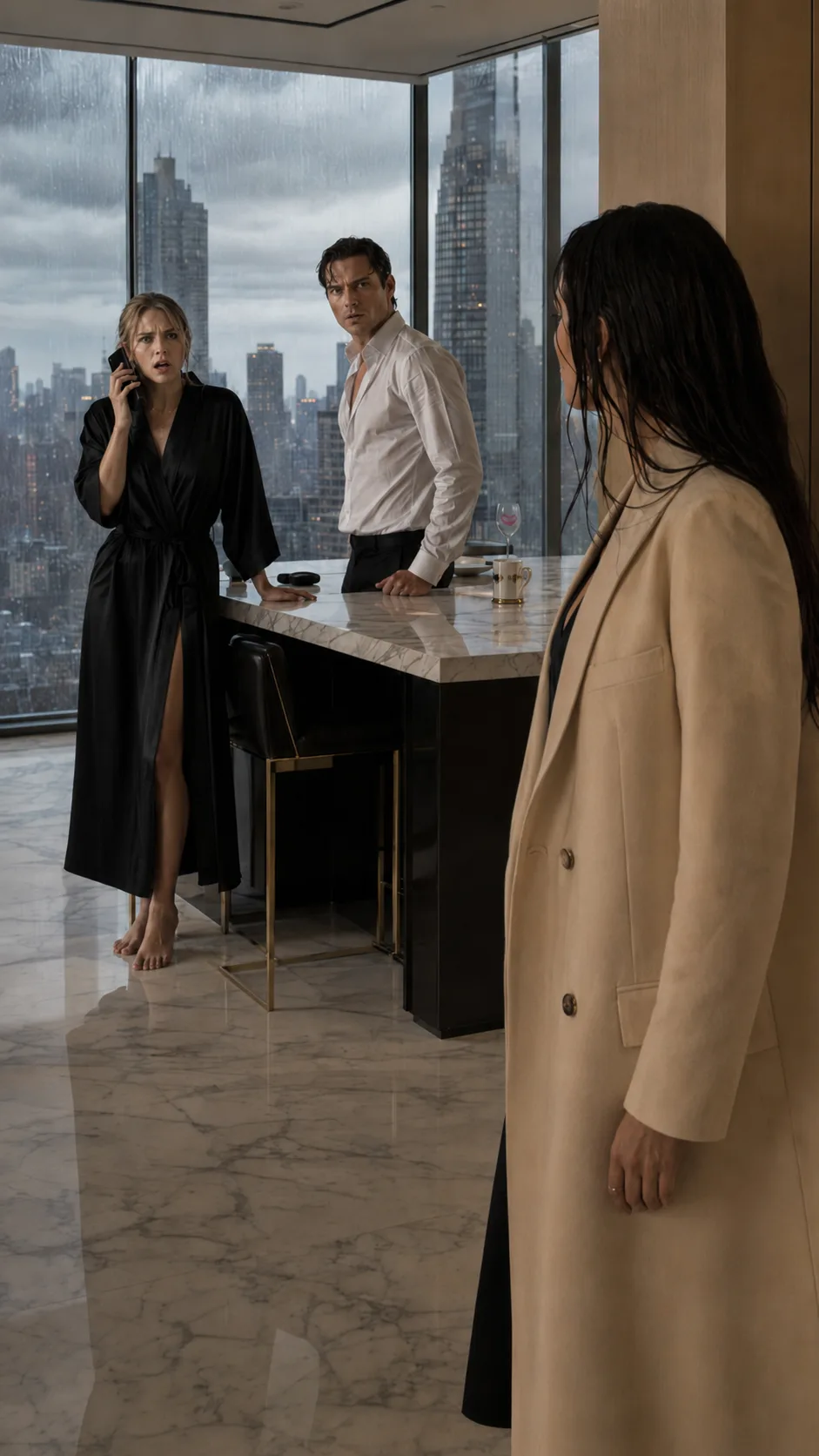
Sloane Avery stood barefoot on my heated marble floor, stirring oat milk into coffee using the porcelain mug my mother had left me before she died, humming softly like she was practicing a role she already believed she had mastered. My black silk robe—custom-embroidered with my initials near the collar—was tied around her body as if it had always been hers, and when she turned slightly to glance at me, there was no embarrassment in her expression, only curiosity, as though I were a guest arriving late to a home she had already settled into.
=
Grayson leaned against the kitchen counter in a crisp white shirt with the top two buttons undone, his wedding ring
missing, his posture relaxed in a way that suggested nothing in this room required his respect anymore.
“You’re home early,” he said, like I had interrupted something insignificant.
Not a betrayal.
Not a replacement.
Just an inconvenience.
I looked at the robe first, then at Sloane, then at the faint stain of lipstick on Grayson’s collar that had not been there that morning when he kissed me goodbye with practiced indifference.
Sloane tilted her head slightly, studying me as if I were a question she was about to answer incorrectly on purpose. “I hope you don’t mind,” she said lightly, lifting the mug as though it belonged to her, “Grayson said everything in the apartment is technically his anyway.”
There are moments in life that do not feel dramatic while they are happening, yet later become the exact point where everything splits into before and after. That sentence was one
of them.
Not because it was cruel.
But because it revealed how completely I had been erased in his version of reality.
I did not raise my voice. I did not throw anything. I did not give them the satisfaction of watching me fracture.
Instead, I looked at Sloane and said quietly, “Take off my robe.”
Grayson let out a small laugh, like I had told a harmless joke.
Sloane smiled wider, unfazed, her fingers tightening around the silk as if she was deciding whether to obey or test how far she could go before I became interesting.
That sound—his laughter—was what hurt most.
Not the affair.
Not the robe.
But the certainty in his voice without him saying a word: that I would do nothing.
For four years, I had allowed Grayson Harlow to believe I was a decorative presence in his life, the quiet wife who arranged philanthropic galas, corrected speeches before he delivered them, and stood beside him for photographs that made him appear more stable than he was. I had let him forget that before I married him, I was not simply “his wife,” but someone whose name once made entire boardrooms go silent.
Then my phone rang.
Not the phone Grayson knew.
Not the one I used for dinners, calendars, and polite conversations.
The other one.
The black one buried in my handbag, hidden under a false lining, the one that never left my possession unless I wanted someone to forget I existed.
Before I could move, Grayson reached into my bag, pulling it out with casual curiosity. “Relax,” he said, turning it in his hand. “It’s probably just another charity request.”
Sloane leaned closer, amused, and in one fluid motion took it from him. “Let me,” she said brightly, swiping the screen before I could stop her. She pressed it against her ear with theatrical confidence.
“Hello,” she said sweetly, “Grayson Harlow’s residence. This is Mrs. Harlow speaking.”
Grayson chuckled again, shaking his head like she was entertaining rather than dangerous.
Then the voice came through.
Calm.
Professional.
Cold in the way only people who control billions of dollars can afford to be.
“Mrs. Whitaker-Harlow,” the voice said, “this is Elias Monroe from Wren Capital. The board packet has been finalized. Do you still want us to proceed with the hostile takeover?”
The kitchen changed temperature.
Sloane’s smile did not disappear immediately; it dissolved slowly, like something melting under pressure it had never been designed to withstand. Her fingers tightened around the phone until her knuckles paled, and for the first time, she looked at Grayson not as a partner in mischief, but as someone who might not survive what she had just heard.
Grayson straightened slightly. “What call is that?”
The voice continued, unaware of the silence it was destroying.
“We are prepared to move on Harlow & Pierce before market open. Shall we execute?”
Sloane’s hand trembled. She lowered the phone, then—without looking at me—placed it into my palm as if it had become dangerous.
Grayson stopped smiling.
For the first time since I walked into the room, he looked uncertain.
Not afraid of me.
Afraid of losing control.
I held the phone gently, watching both of them—Sloane still in my robe, Grayson still standing in my kitchen like a man who had mistaken ownership for permanence—and I understood something with absolute clarity.
They had not just betrayed me.
They had underestimated me.
And worse than that, they had done it comfortably.
I lifted the phone again and spoke into it, my voice steady, almost conversational.
“Yes,” I said. “Start with my husband’s company.”
There was a pause on the line.
Then Elias Monroe replied, “Understood.”
The call ended.
Grayson laughed once, but it was forced now, brittle at the edges. “What was that supposed to be?”
I looked at him carefully, as though seeing him correctly for the first time in years.
“You always thought I was just your wife,” I said softly.
Sloane shifted behind him, suddenly less certain about her position in the room.
Grayson frowned. “You are my wife.”
“No,” I said. “I was your protection.”
The silence that followed was different from earlier.
Earlier it had been arrogance.
Now it was recognition without understanding.
I placed the phone down on the counter.
Then I reached into my handbag again and removed a second device, unlocking it with a code Grayson had never seen me use. On the screen were live financial dashboards, legal filings, and board communications already moving without his knowledge.
He stared at it.
“What is that?”
“My company,” I said.
Sloane let out a small, nervous laugh. “That’s ridiculous. Grayson told me you don’t work anymore.”
I almost smiled at that.
“I don’t need to work,” I replied. “I own the capital that decides who does.”
The realization hit him slowly, like a delayed fall.
Grayson stepped forward. “You’re bluffing.”
I tilted my head slightly. “Call your CFO.”
He did.
I watched him listen.
Watched confusion turn into panic.
Watched him realize the trading halt had already been triggered.
Watched his belief in permanence begin to collapse in real time.
When he finally lowered the phone, his voice had changed. “What did you do?”
“I stopped protecting you,” I said.
Sloane stepped back, suddenly aware that she was no longer part of anything stable. The silk robe no longer looked luxurious on her—it looked borrowed, temporary, exposed.
Grayson’s voice sharpened. “You can’t just destroy my company.”
“I didn’t destroy it,” I replied calmly. “I reclaimed the leverage you forgot was never yours.”
The irony was almost gentle.
For years, he had spoken to me like I was replaceable, as if affection granted ownership, as if proximity equaled power.
He had let another woman wear my robe.
Drink from my mother’s mug.
Answer my private phone.
All because he believed I was too small to matter.
Now he understood the truth.
I had never been small.
Only quiet.
Grayson took a step toward me, desperation cracking through his voice. “We can fix this.”
Sloane looked at him sharply. “Fix what?”
But I was already moving past them, walking toward the floor-to-ceiling windows where Manhattan stretched endlessly beneath the storm.
“I didn’t marry you for protection,” I said without turning back. “You married me because you thought I was safe.”
I looked over my shoulder once.
“And that,” I added quietly, “was your first mistake.”
By sunrise, Harlow & Pierce had entered emergency suspension. Board members were voting without Grayson. Investors were pulling out faster than the company could respond. Legal filings had already begun restructuring ownership rights that he had never fully understood.
Sloane disappeared before noon.
Some people leave when power leaves the room.
Grayson remained longer.
Not because he had hope.
But because he had nowhere else to go.
When I finally saw him again weeks later, it was not in my penthouse or his office, but in a quiet legal conference room where silence no longer meant power, only consequence.
He looked smaller.
Not physically.
But in the way men do when they realize they were never standing on solid ground.
“I didn’t think you would actually do it,” he said.
I studied him for a long moment.
“That was always your problem,” I replied gently. “You never thought I would choose myself.”
The settlement was clean.
Efficient.
Unemotional.
By the time it ended, he had lost control of the company, the reputation he had built on illusion, and the certainty that people would always remain where he placed them.
As for me, I did not celebrate.
I simply returned to work.
Because while he was busy replacing me, I had been building something he never noticed.
And in the end, the difference between us was not love or betrayal.
It was preparation.
Months later, standing in a restored Manhattan apartment that no longer belonged to shared history but to my own decisions, I received a message from my legal team confirming final asset transfer completion.
Grayson’s name no longer held power anywhere that mattered.
Sloane had vanished into anonymity.
And for the first time in years, my phone stayed quiet for reasons that had nothing to do with being ignored.
I set it down, walked to the window, and watched the city move forward without asking permission.
Sometimes people think revenge changes you.
But it doesn’t.
It only reveals who was always in control.
And as the skyline reflected back at me in glass and rain, I finally understood something simple, and long overdue.
I had never been the woman in the background of his story.
I had been the one holding the pen the entire time.
THE END.
Chapter complete
You have reached the end of this chapter.
Continue reading
A few more worlds to get lost in after this chapter.