MY HUSBAND BOOKED OUR HONEYMOON SUITE FOR ANOTHER WOMAN — SO I UPGRADED HIS BETRAYAL INTO HIS ENDING
PART 2 — THE ROOM WHERE FOREVER DIED
CHAPTER 1: The Room Where Forever Died
The confirmation email arrived at 8:17 p.m.
Chapter 3
MY HUSBAND BOOKED OUR HONEYMOON SUITE FOR ANOTHER WOMAN — SO I UPGRADED HIS BETRAYAL INTO HIS ENDING
PART 2 — THE ROOM WHERE FOREVER DIED
CHAPTER 1: The Room Where Forever Died
The confirmation email arrived at 8:17 p.m.
on a Wednesday, while Grant was supposedly in Chicago closing a merger.
He had kissed my forehead that morning in the practiced way men do when they are already somewhere else.
“Don’t wait up, Evie,” he said, adjusting his cufflinks in the hallway mirror. “The board dinner will run late.”
He smelled like cedar, expensive soap, and a lie.
I had been married to Grant for seven years. Long enough to know every version of his voice. There was his public voice, polished and warm as bourbon. His business voice, sharp enough to cut bone. His husband voice, soft and handsome, the voice that once convinced me we were inevitable.
And lately, there was another voice.
A careless voice.
A voice that left the room before his body did.
That morning, I watched him tuck his phone into the inside pocket of his navy Tom Ford suit. I watched the
smile he tried to hide when it buzzed. I watched him leave our penthouse without looking back.
I did not ask questions.
Women like me are trained, by old money and older pain, not to ask questions until we already know the answers.
At 8:17 p.m., the answer came dressed as a reservation.
Dear Mrs. Whitmore,
We are delighted to confirm your upcoming stay in the Vanderbilt Honeymoon Suite at The Marlowe Atlantic…
I blinked once.
Then again.
My name sat at the top, elegant and innocent.
Mrs. Evelyn Whitmore.
But the guest notes below told the truth.
Primary guest: Grant Whitmore.
Additional guest: Savannah Blake.
Arrival: Friday, 5:00 p.m.
Departure: Sunday, 11:00 a.m.
Savannah Blake.
Of course her name was Savannah.
It sounded like something a man in midlife crisis would whisper into hotel sheets. Young, sunlit, soft at the edges. I recognized the name immediately. She was a
lifestyle influencer from Miami with eight hundred thousand followers, a mouth made for champagne flutes, and a talent for making expensive things look accidental.
She had appeared at three of Grant’s company events that year.
Always laughing too close.
Always touching his arm like punctuation.
Always calling me “so elegant” in a tone that meant “so old.”
I was thirty-four.
Savannah was twenty-six and treated youth like a weapon she had invented herself.
I opened the attachment.
The Vanderbilt Honeymoon Suite.
Images filled the screen: ivory walls, antique mirrors, blue velvet chairs, floor-to-ceiling windows facing the Atlantic. A marble fireplace. A freestanding tub beneath a chandelier. A king bed dressed in cream silk.
I knew every inch of that room.
Seven years ago, I had stood on that balcony in a satin robe while rain stitched silver lines across the ocean. Grant had wrapped his arms around me from behind
and said, “When I make it big, I’ll bring you back here every anniversary.”
“You don’t have to make it big,” I’d whispered. “You already have me.”
He had kissed my shoulder and laughed.
At the time, I thought the laugh meant love.
Now I understood it meant ambition.
Grant Whitmore had not married me because he loved me. He married me because I made him look like a man who deserved important rooms.
I forwarded the confirmation to my private attorney, Camille Rosenthal, with no explanation.
She replied in four minutes.
Tell me you did not just discover this from a hotel email.
I typed back:
I did.
Her response came instantly.
Do not confront him.
I wasn’t going to.
Confrontation is for people who still want to be chosen.
I no longer wanted Grant to choose me.
I wanted him to remember me.
I opened the hotel website and called the private concierge line.
“Marlowe Atlantic, this is Oliver speaking. How may I assist you this evening?”
His voice was smooth, trained, discreet. The kind of voice that had delivered diamonds, divorce papers, and disasters without changing pitch.
“This is Evelyn Whitmore,” I said.
A pause.
Not long. Just enough.
“Mrs. Whitmore,” Oliver said, warmer now. “It’s always a pleasure.”
“I received a confirmation for the Vanderbilt Suite.”
“Yes, Mrs. Whitmore. We apologize for the duplicate email. Your name remains attached to the preferred guest profile from your previous stays.”
“How fortunate,” I said.
Another pause.
“Is there something I can assist with?”
“Yes. I’d like to upgrade the reservation.”
“Of course. To which suite?”
“The Astor Penthouse.”
Silence.
The Astor Penthouse occupied the entire top floor of The Marlowe Atlantic. It had a private elevator, a wraparound terrace, a Steinway grand piano, and a dining room that could seat twenty-four beneath a ceiling painted with clouds. Celebrities rented it to hide. Senators rented it to sin. Billionaires rented it because they could.
Oliver cleared his throat softly. “The Astor Penthouse is available, but it is typically reserved—”
“For owners,” I finished.
A longer pause this time.
“Yes, ma’am.”
“Then there shouldn’t be a problem.”
“No, Mrs. Whitmore,” he said quickly. “No problem at all.”
“Good. Keep the Vanderbilt Suite prepared exactly as requested. Orchids. Champagne. Fireplace. Everything.”
“May I ask if you would like the second guest name updated?”
“No,” I said. “Leave everything exactly as my husband requested.”
“Understood.”
“And Oliver?”
“Yes, Mrs. Whitmore?”
“When Mr. Whitmore arrives, I’d like the front desk to hand him an envelope with his room key.”
“Certainly. What should the envelope contain?”
I looked at the confirmation again. Grant’s name. Savannah’s name. Our beginning.
“My ending,” I said.
That night, I slept better than I had in months.
CHAPTER 2: The Woman He Thought I Was
Grant met me when I was twenty-six, at a charity auction in Boston.
He was not rich then.
He was handsome, yes. Clever, absolutely. But not rich. He wore a borrowed tuxedo and the bright, hungry expression of a man studying every chandelier in the room and calculating how to own it one day.
I noticed him because he was the only man there pretending not to stare.
He bid on a painting he could not afford, lost immediately, and laughed as if losing was part of a private joke. Later, I found him on the balcony overlooking the harbor, drinking tap water from a champagne flute.
“You know they have actual champagne inside,” I said.
He turned, and his smile arrived before his shame could.
“I prefer to disappoint people creatively.”
I laughed.
That was the beginning.
Not the honeymoon suite. Not the vows beneath white roses. That balcony in Boston. That ridiculous glass of water. That boyish grin that made me think hunger could be holy if it was honest.
He told me he came from a small town outside Pittsburgh. His father fixed boats. His mother cleaned offices at night. He had put himself through Penn on scholarships, charm, and an unreasonable belief that the world owed him a seat at the table.
I liked that.
I had been raised around men who inherited their chairs and still complained about the upholstery.
Grant wanted everything. But back then, he wanted me too.
Or he wanted what being loved by me could do for him.
It took me years to separate the two.
My full name before marriage was Evelyn Hartwell Vaughn. The Vaughns were an old New England family with newer money than they liked to admit and older secrets than they could afford. My grandfather built luxury hotels. My mother expanded them. I inherited a controlling interest in the Marlowe Collection when she died, though almost no one knew it.
By design.
My mother had taught me that visible wealth attracts performance. Hidden wealth reveals character.
“Never tell a man everything you own,” she once said, fastening pearls around my neck before my first gala. “If he loves you, it won’t matter. If he doesn’t, it will matter too much.”
So when I met Grant, I was simply Evelyn Hart.
Not Vaughn.
Not heiress.
Not majority shareholder of twelve luxury hotels from Newport to Napa.
Just a museum development consultant with a nice apartment, a quiet wardrobe, and a refusal to name-drop.
Grant knew I came from comfort, but not power. He knew I had connections, but not control. He knew my grandmother summered in Maine and that my father collected rare books. He did not know that the hotel where we spent our honeymoon belonged, through a maze of trusts and holding companies, to me.
I almost told him on our first anniversary.
We were living in Tribeca then, in a loft with exposed brick and more dreams than furniture. Grant had just launched Whitmore Capital, and he was working eighteen-hour days trying to convince men twice his age that his instincts were worth their money.
He came home one night exhausted and defeated.
“They don’t see me,” he said, loosening his tie with shaking hands. “They see a kid with a rented office and no pedigree.”
I nearly told him then.
I nearly said, I can open doors for you.
But instead, I crossed the room and held him.
“You’ll build your own pedigree,” I whispered.
And he did.
With my introductions. My dinner parties. My quiet calls. My name placed gently in the right ears without ever appearing in the paperwork.
Grant believed he had climbed alone.
I let him.
That was my first mistake.
By our fifth year of marriage, Whitmore Capital managed billions. Grant wore success beautifully. Too beautifully. His suits improved. His laugh changed. He started saying things like “self-made” in interviews while I sat beside him in cream silk, smiling like a well-trained ghost.
At dinners, he interrupted me.
At galas, he introduced me as “my wife, Evelyn,” as if I had no last name, no work, no bloodline, no mind.
When reporters asked about his rise, he spoke of discipline, risk, and vision.
Never luck.
Never partnership.
Never me.
Still, I stayed.
Not because I was weak.
Because I was loyal to the man I remembered.
Women are often accused of not seeing red flags. The truth is worse. We see them. We fold them carefully and store them beside the wedding album, hoping one day they will look like warnings we survived instead of evidence we ignored.
Then came Savannah.
She arrived at a summer fundraiser in Southampton wearing a silver dress and the confidence of a woman who had never been told no by a mirror.
Grant introduced her as a “brand strategist.”
She introduced herself as “obsessed with authenticity.”
I watched her take selfies beside a silent auction table raising money for pediatric cancer research and understood exactly what kind of authenticity she meant.
Later that night, I saw Grant watch her from across the lawn.
Not glance.
Watch.
There is a difference.
A glance is human.
A watch is a decision.
By winter, his phone faced down at dinner. By spring, he traveled more. By early summer, our bed became a country where we both held passports but neither of us visited.
I did not spy at first.
I waited for dignity to make him honest.
Dignity, I discovered, is terrible at catching liars.
So I began to collect.
Receipts. Calendar gaps. Photographs from events where Savannah appeared in the background wearing earrings I knew Grant had purchased in Paris. A credit card charge at a boutique hotel in Miami during a week he claimed to be in Dallas. A voice memo accidentally synced to our shared home system, his laugh low and intimate as he said, “No, she has no idea.”
She.
Me.
No idea.
I played that sentence once.
Then I poured a glass of Sancerre, opened my laptop, and began preparing for war.
Not the messy kind.
The elegant kind.
The kind with embossed stationery.
CHAPTER 3: Champagne for the Execution
By Friday afternoon, Newport looked like a painting of money.
The sky was pearl gray. The Atlantic rolled dark and restless beyond the cliffs. The Marlowe Atlantic rose above the shoreline like a palace that had learned American manners: white stone, black shutters, brass lanterns, and a driveway curved around a fountain where water spilled from the mouths of marble swans.
I arrived at three o’clock in a black cashmere coat, oversized sunglasses, and no wedding ring.
Oliver met me in the private entrance.
He was younger than I expected, perhaps thirty, with immaculate posture and the pale expression of someone who knew where too many bodies were buried metaphorically, and perhaps one or two literally.
“Mrs. Whitmore,” he said, bowing his head slightly.
“Miss Vaughn,” I corrected.
His eyes flickered.
“Yes, Miss Vaughn.”
It was the first time in seven years I had heard my true name spoken in that hotel.
Something inside me settled.
We took the private elevator to the Astor Penthouse. The doors opened onto a foyer of black marble and gold-veined mirrors. Beyond it, the ocean spread wild and metallic beneath a bruised sky.
On the dining table sat five cream envelopes.
Camille had been efficient.
Envelope one: Petition for divorce.
Envelope two: Evidence of adultery, including hotel records, photographs, messages, and financial receipts.
Envelope three: Notice of forensic audit into Whitmore Capital’s misrepresentation of marital assets.
Envelope four: Resignation request from three board members whose seats Grant had secured through my family’s network.
Envelope five: A handwritten note from me.
I picked up the fifth envelope.
My hands did not shake.
Camille stood by the windows in a burgundy suit, her silver hair pinned into a knot sharp enough to qualify as a weapon. She had represented actresses, heirs, founders, one governor’s wife, and at least two women who smiled on magazine covers while quietly taking half of everything behind closed doors.
“You’re sure you want the public element?” she asked.
“I’m not putting it on the internet,” I said.
“No,” Camille replied. “But Savannah will.”
That was true.
Savannah Blake did not experience anything unless an audience could validate it. Her entire life was a mirror held up to strangers.
“She’ll spin it,” Camille warned. “She’ll make herself the victim.”
“She can try.”
“And Grant?”
I looked toward the hallway mirror. My reflection looked calm, almost soft. Dark hair brushed into a low chignon. Diamond studs. A black silk dress beneath the coat. Red lipstick, but not too red. Mourning, but expensive.
“Grant will do what Grant always does,” I said. “He’ll underestimate the woman in the room.”
At 4:38 p.m., the hotel general manager, Margaret Ellis, arrived.
Margaret had run The Marlowe Atlantic for sixteen years and could silence a ballroom with one eyebrow. She wore navy, pearls, and the serene expression of a woman who had denied late checkouts to billionaires.
“Miss Vaughn,” she said, taking my hands. “Your mother would be proud.”
That nearly broke me.
Not Grant’s betrayal. Not Savannah’s name on the reservation. Not the thought of them in our bed.
My mother.
Because suddenly I was twenty-two again, standing in a hospital room while she told me not to confuse endurance with love.
I swallowed.
“Thank you, Margaret.”
“We have prepared everything exactly as requested. Mr. Whitmore and Ms. Blake are expected at five. The Vanderbilt Suite is ready. The champagne is chilled. The fireplace is lit.”
“And the envelope?”
“At the front desk with his key.”
“Good.”
Margaret hesitated. “There is one more thing.”
I turned.
“Mr. Whitmore requested a photographer.”
Camille’s brows lifted.
“A photographer?” I asked.
“Yes. For what he described as a private engagement-style shoot.”
The room went very quiet.
Camille whispered, “That bastard.”
For the first time all day, anger reached my face.
Engagement-style.
Our beginning.
I saw it instantly: Savannah on the balcony where I had once stood in my honeymoon robe. Grant behind her, hand on her waist. The ocean. The fireplace. The champagne. A caption about choosing happiness. A soft launch of their affair disguised as destiny.
He wasn’t just cheating.
He was replacing the memory.
He was taking the room where he promised me forever and using it to announce another woman.
I walked to the window.
Below, waves shattered white against the rocks.
“Let the photographer come,” I said.
Camille stared at me. “Evelyn.”
“No,” I said. “Let him document everything.”
Margaret’s mouth curved, just slightly.
“Of course.”
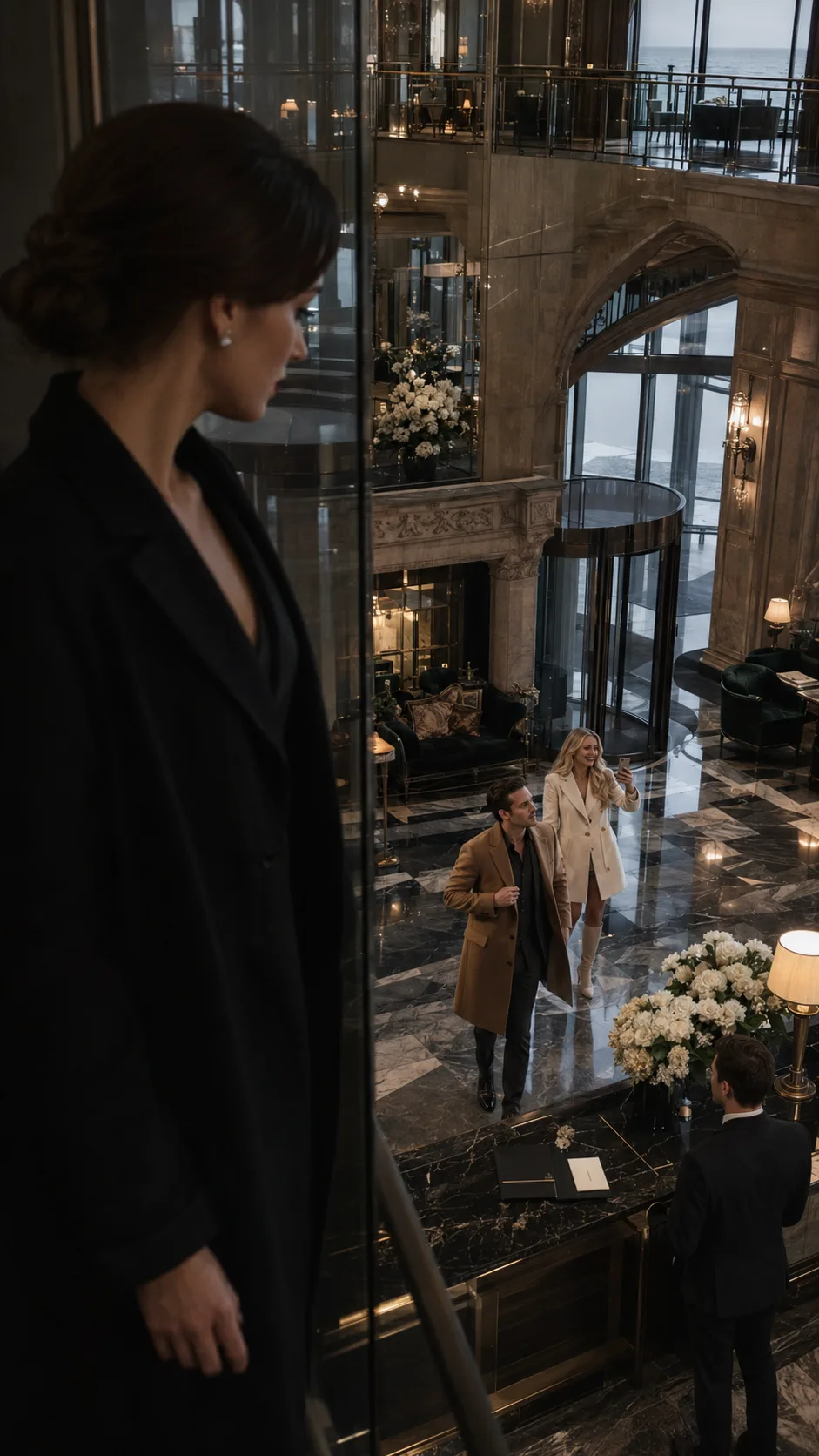
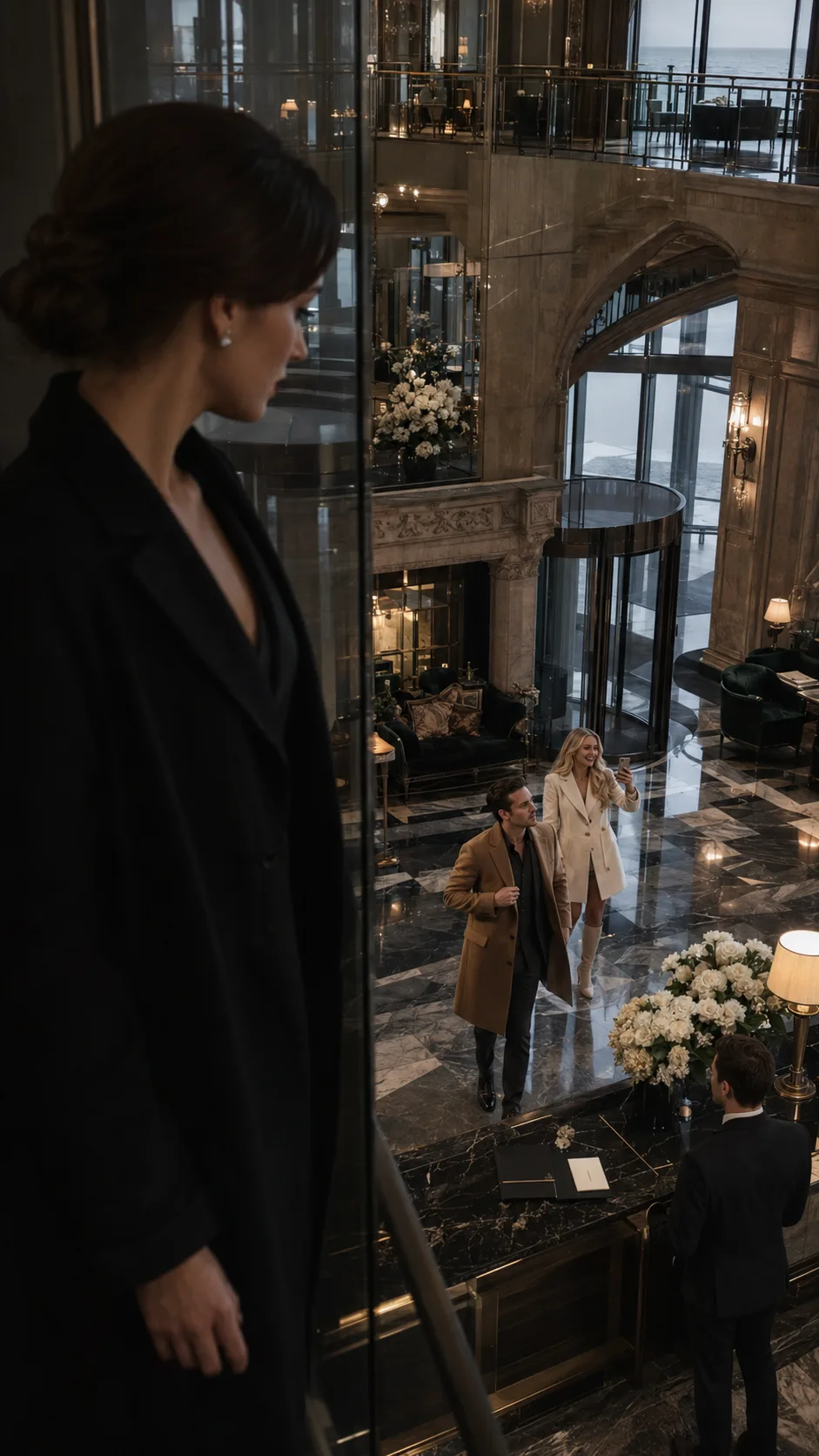
At 4:56 p.m., I stood behind the mirrored glass of the private mezzanine overlooking the lobby.
The Marlowe lobby was a cathedral of wealth. Black-and-white marble floors. A fireplace large enough to roast an ox. Velvet sofas. A grand staircase curling down like a ribbon. Fresh flowers everywhere—white roses, hydrangeas, lilies so fragrant the air itself seemed expensive.
Guests drifted through with leather luggage and quiet voices.
Then Grant walked in.
He wore a camel coat over a charcoal suit, no tie, sunglasses tucked into his breast pocket. Handsome. Confident. Familiar enough to hurt.
Savannah entered beside him in winter white: a fitted coat, bare legs, high boots, glossy hair falling in perfect waves. She held her phone out, filming.
“Okay, you guys,” her voice floated up, bright and breathless. “We just got to the dreamiest hotel in Newport. I can’t say too much yet, but this weekend is going to be very special.”
Grant smiled at her phone.
Not at her.
At the audience.
That was when I stopped grieving him.
The man I loved would have hated being filmed in a lobby. The man below me adjusted his cuff and turned slightly toward the better light.
At the front desk, Oliver greeted him.
“Welcome back to The Marlowe Atlantic, Mr. Whitmore.”
Grant grinned. “Good to be back.”
Savannah leaned into him. “Back?”
He kissed her temple. “I told you. This place is important.”
My stomach tightened.
Oliver placed a black leather key folder on the counter. Beside it, a cream envelope.
Grant glanced at it. “What’s this?”
“A note for you, sir.”
“From?”
Oliver’s face remained perfect.
“Mrs. Whitmore.”
The lobby did not stop.
But Grant did.
Savannah’s phone dipped.
“What?” she said, still smiling, though the smile had gone brittle.
Grant stared at the envelope as if it might explode.
Then he laughed too loudly.
“That’s impossible.”
Oliver said nothing.
Grant picked up the envelope. His thumb broke the seal.
From the mezzanine, I watched his face change.
Confusion first.
Then irritation.
Then color draining so quickly he seemed to age five years in five seconds.
Savannah grabbed his arm. “Grant?”
He didn’t answer.
Papers slid partly from the envelope.
I saw the top line from where I stood.
SUPREME COURT OF THE STATE OF NEW YORK
COUNTY OF NEW YORK
EVELYN HARTWELL VAUGHN WHITMORE, Plaintiff,
against
GRANT ANDREW WHITMORE, Defendant.
Savannah stepped closer. Her phone was still recording.
“Is that… a divorce thing?”
Grant snapped, “Turn that off.”
But Savannah, being Savannah, looked down at the papers.
And then she saw the guest names.
Hers.
His.
Mine.
The lobby began to notice.
Not openly at first. Rich people are trained to observe disaster through peripheral vision. A woman in a sable wrap paused beside the flowers. A man at the concierge desk lowered his newspaper. Two girls near the staircase whispered.
Grant looked up slowly.
His eyes found the mezzanine.
Found me.
For a moment, there we were again. Husband and wife. Bride and groom. Two ghosts staring across the lobby of a hotel that remembered everything.
His mouth formed my name.
I descended the staircase.
Not quickly.
Never quickly.
My heels tapped the marble with the calm rhythm of a verdict.
Savannah stared as I came down. Her eyes moved over my dress, my diamonds, my bare left hand. She recognized me, of course. She had smiled across enough charity tables to know exactly whose marriage she had been stepping through.
“Evelyn,” Grant said when I reached the lobby.
“Grant.”
His voice dropped. “This is not what it looks like.”
I looked at Savannah. Then at the phone in her hand. Then back at him.
“That sentence has carried too many mediocre men through too many hotel lobbies.”
Someone behind us made a small choking sound.
Savannah flushed. “I didn’t know—”
“Yes, you did,” I said gently.
Her mouth closed.
That was the trick. Never yell when the truth can do it for you.
Grant stepped toward me. “Can we talk privately?”
“We had seven years of privacy.”
His jaw tightened. “You’re making a scene.”
“No,” I said. “You booked one.”
The lobby went silent.
Even the fireplace seemed to hush.
Grant’s eyes hardened in the way I knew well. That was his boardroom face. The face he used before destroying someone.
“Evelyn,” he said softly, dangerously, “be careful.”
I smiled.
It was the first real smile I had given him in months.
“Oh, Grant,” I said. “I finally am.”
CHAPTER 4: The Name on the Deed
Camille appeared beside me like a storm in pearls.
Grant noticed her and paled further.
“Camille Rosenthal,” he said.
“Mr. Whitmore,” she replied. “Congratulations on recognizing counsel before making your situation worse.”
Savannah looked between them. “Counsel? What is happening?”
“What’s happening,” Camille said, “is that Mr. Whitmore has been served with divorce proceedings, notice of asset review, and several related legal disclosures.”
Grant’s voice turned cold. “You can’t serve me like this.”
“I can,” Camille said. “We did.”
Savannah took a step back. “Grant, asset review?”
He ignored her.
His eyes stayed on me. “You planned this.”
“I responded to an invitation.”
“You humiliated me in public.”
I leaned in slightly.
“You brought your mistress to our honeymoon suite with a photographer.”
His face twitched.
There it was.
Not shame.
Annoyance at being accurately described.
Savannah’s eyes widened. “Photographer?”
Grant turned on her. “Not now.”
But Savannah was already unraveling. Her brand was soft luxury, clean-girl betrayal, feminine empowerment, morning matcha with ocean views. Being caught as the other woman in a wealthy man’s marriage did not fit the aesthetic.
Her phone began vibrating. She looked down.
The live stream.
She had never turned it off.
Comments were flooding in.
I saw them reflected in her eyes before I saw the screen.
Girl what is happening???
Is he married???
Not the wife serving papers omg
SAVANNAH TURN THE CAMERA BACK
This is insane
The wife is stunning
He looks SICK
Savannah’s thumb shook as she ended the video.
Too late.
The internet is a wolf. Once fed, it hunts.
Grant lowered his voice. “You have no idea what you’re doing.”
“I know exactly what I’m doing.”
“This will hurt you too.”
“No,” I said. “It will reveal me.”
Something in his expression shifted.
For the first time, he seemed uncertain.
I turned to Margaret, who had approached with the poise of a queen attending an execution.
“Margaret,” I said, “would you please join us?”
“Of course, Miss Vaughn.”
Grant blinked.
Miss Vaughn.
He looked from Margaret to me.
“What did she call you?”
I did not answer immediately. I let the silence bloom.
Grant had married Evelyn Hart. He had built his empire beside Evelyn Whitmore. He had dismissed, corrected, patronized, and betrayed the woman he thought he understood.
But he had never truly met Evelyn Hartwell Vaughn.
Margaret faced him. “Miss Vaughn is the majority owner of The Marlowe Collection, including this property.”
Savannah whispered, “What?”
Grant laughed once. “No.”
I looked at him sadly then, because his disbelief was almost touching.
All those years. All those rooms. All those introductions. All those doors opening just when he needed them. And he had never wondered who held the key.
“My mother was Caroline Vaughn,” I said. “My grandfather founded the Marlowe Collection in 1964. I inherited my position before we were married.”
Grant stared at me as if my face had rearranged itself.
“You never told me.”
“No,” I said. “I waited to see whether you would love me without it.”
The words landed harder than any accusation.
For one second, I saw the old Grant. The balcony boy. The man with tap water in a champagne flute. Shocked. Hurt. Maybe even ashamed.
Then ambition rushed back into his eyes.
“So this is about money.”
“No,” I said. “It became about money when you started hiding marital assets, moving consulting fees through shell accounts, and promising Savannah equity in a fund you didn’t fully control.”
Savannah turned sharply. “Grant?”
His neck reddened.
I looked at her. “He told you he was leaving me after the quarter closed, didn’t he? That the divorce was complicated because I was emotional. That the penthouse was his. That the firm was his. That he built everything alone.”
Savannah’s face answered for her.
Poor girl.
Not innocent. But not special either.
Just the newest audience for his favorite speech.
Grant’s voice dropped. “Stop.”
I didn’t.
“He also told you The Marlowe Atlantic had sentimental meaning because he came here when he had nothing and dreamed of more.”
Savannah swallowed.
“He came here on our honeymoon,” I said. “I paid for the suite.”
Grant snapped, “That’s enough.”
“No,” I said. “Enough was when you forgot my birthday but remembered her launch party. Enough was when you let me sit beside you at charity dinners while she texted you from the bathroom. Enough was when you took a vow and treated it like a lease you could break when a newer view became available.”
The lobby remained frozen around us.
A bellman stood with a luggage cart, motionless. A child near the fireplace stared until his mother covered his ears, though I had not raised my voice once.
Grant looked around, aware now of the spectators. His pride flared.
“You think this makes you powerful?” he asked.
“No,” I said. “Power is not needing to ask that question.”
Camille handed him another envelope.
“What is this?” he demanded.
“Notice of an emergency board meeting for Whitmore Capital on Monday morning,” she said. “Several investors have concerns.”
Grant’s face tightened.
I saw the calculation begin.
Investors. Reputation. Control.
His marriage had become secondary in his mind in under fifteen seconds.
That was when I knew I had made the right choice.
“You called my investors?” he asked me.
“No. They called me.”
“Why would they call you?”
I tilted my head. “Because three of your largest original investors were friends of my mother. Two sit on the Marlowe board. One is my godfather. They took your meetings because I asked them to.”
He stared.
I continued, softly. “They stayed because you were talented. They will leave because you became reckless.”
Savannah’s face had gone pale beneath her perfect makeup.
“Grant,” she said, “what equity did you promise me?”
“Savannah,” he warned.
“What equity?”
He did not answer.
That was answer enough.
Her humiliation sharpened into anger. For the first time all evening, I saw the influencer vanish and the woman appear.
“You said you were free,” she whispered.
Grant closed his eyes. “This is not the place.”
“Oh, now you care about the place?” she said.
A murmur moved through the lobby.
Savannah looked at me, and there was something like hatred in her eyes, but also something like fear.
“I’m not the villain here,” she said.
“No,” I replied. “You’re not important enough for that role.”
It was cruel.
It was also true.
Her mouth opened, then closed. She picked up her white designer bag with trembling hands.
Grant reached for her. “Savannah—”
She stepped away.
“Don’t touch me.”
Then she looked at her phone again, at the damage already blooming across her screen, and hurried toward the revolving doors.
Her photographer, who had just arrived with a camera bag slung over one shoulder, stood awkwardly near the entrance.
Savannah pointed at him. “Delete my number.”
She left in a gust of perfume and panic.
Grant watched her go.
I watched him watch her.
That hurt more than I expected.
Not because he loved her. He didn’t. Grant loved reflection. He loved women who made him look victorious.
But still, some foolish part of me had hoped that when stripped of everything, his first instinct might be to reach for me.
It wasn’t.
His first instinct was to measure what he had lost.
He turned back slowly.
His face was no longer handsome. Handsome requires ease. Without it, he was just a man with good bones and nowhere to hide.
“You think you’ve won,” he said.
“No, Grant. I think I’m free.”
He laughed bitterly. “You’ll miss me.”
“I already did,” I said. “For years. While you were standing right in front of me.”
That silenced him.
I took the black leather key folder from the desk and opened it. Inside were two key cards.
The Vanderbilt Honeymoon Suite.
Our old room.
I placed one card on top of the divorce packet and slid it toward him.
“Your room is ready.”
He stared at it.
“You’re serious?”
“The fireplace is lit. The champagne is chilled. The orchids are white.” I paused. “Everything you requested.”
His nostrils flared.
I lowered my voice, not for secrecy, but for mercy.
“Spend the night there, Grant. Sit in that room and remember every promise you made. Then read every page Camille gave you.”
He looked at me with something I had not seen in a long time.
Fear.
Not of losing me.
Of finally seeing me.
THE END.
Chapter complete
You have reached the end of this chapter.
Continue reading
A few more worlds to get lost in after this chapter.




