My Half-Sister Stole My Inheritance and Wore My Ring, But My Fiancé’s Confession Broke Me Worse
I found the first warning in my father’s desk drawer, folded beneath an old restaurant receipt and a silver key I had never seen before.
Chapter 1
I found the first warning in my father’s desk drawer, folded beneath an old restaurant receipt and a silver key I had never seen before.
It was not a letter.
It was not a will.
It was only a small white card with my name written in my father’s handwriting.
Clara — if they rush you, slow down.
That was all.
Five words.
I sat in his study with the drawer still open and the winter light cutting across the polished mahogany like a blade. The house had gone quiet after the funeral. Too quiet. The kind of quiet that did not belong to grief, but to people waiting behind closed doors.
Downstairs, someone laughed.
It was brief. Polite. Almost swallowed at once.
I folded the card and put it into the pocket of my black dress.
My father had been dead for thirteen days.
Everyone in the family had started counting from the funeral. I counted from the hospital corridor, from the moment the machines went flat and my aunt Lydia stepped away from
me before anyone had said the word. She had been standing near the nurses’ station with her phone already in her hand, thumb moving fast, pearls pressed against her throat.
My father’s name was Edmund Vale.
To the newspapers, he had been a self-made industrialist, the founder of Vale Consolidated, the man who bought failing factories and turned them into empires of steel, shipping, logistics, and private equity. To politicians, he had been a donor. To banks, a problem worth flattering. To employees, depending on whom you asked, either a tyrant or the only man who remembered their children’s names.
To me, he had been the man who taught me to read balance sheets with a red pencil and to cook eggs in a cast-iron pan because “money does not make breakfast.”
He kept both lessons with equal seriousness.
After my mother died, he raised me in that house as
if grief were a room we could not leave but could at least keep clean. He never remarried. That was what the society pages liked to say.
It was not entirely true.
There had been a woman before my mother. A mistake, according to my aunt. A scandal, according to old family friends. Her name was Marielle Stone, and she had left my father with a daughter before disappearing into a string of bad marriages and unpaid debts.
That daughter was Celeste.
My half-sister.
She arrived in our lives when I was fourteen and she was thirteen, wearing a white cardigan in July and crying without making a sound. My father took her in. He gave her a bedroom overlooking the rose garden, a tutor, a trust, a name, a seat at the table.
He told me blood was not a contest.
I believed him.
For years, I tried.
I
gave Celeste my scarves when she complained the house felt cold. I took her side when Aunt Lydia called her “the girl from nowhere.” I shared my father’s library with her, even though she used the books as props in photographs. When she turned eighteen, I planned the dinner. When she turned twenty-one, I let her wear my mother’s pearl earrings because she said she wanted to feel like she belonged.
She lost one.
She blamed a waiter.
My father paid for the replacement without looking at the bill.
That was Celeste’s gift.
She could break something and make you apologize for noticing the pieces.
The week before my father died, she came to the hospital carrying lilies in a glass vase too large for the room. The nurses asked her to move them because the pollen bothered one of the patients next door. Celeste smiled, said of course, and left the vase on the windowsill anyway.
My father was awake that afternoon.
Barely.
His fingers were cold when they closed around mine.
“Do not sign quickly,” he said.
I leaned close. “What?”
His eyes moved toward the door.
Celeste stood outside the glass, talking to Adrian.
My fiancé.
Adrian Blackwood looked like the kind of man old families described as safe. Tall, disciplined, educated in all the right schools, dressed as if wrinkles were personal failures. He came from money, but not enough money to intimidate my father. He worked in acquisitions, mostly real estate and private holdings, and he knew how to make a room feel as if it had been waiting for him.
When he proposed, my father did not cheer.
He watched.
That was his way.
Adrian slipped my mother’s emerald ring onto my finger in the garden terrace at dusk. The stone had been in our family for three generations, square-cut, deep green, with tiny diamonds along the sides like frost. My father had placed it in Adrian’s palm that morning.
“This is not decoration,” he had said.
Adrian smiled. “I understand.”
My father looked at me then, not him.
“Do you?”
I had laughed because I thought he was being dramatic.
I was twenty-seven.
I still believed betrayal had to announce itself.
The day after the funeral, Adrian told me I should rest and let the lawyers handle everything.
“You have barely slept,” he said, standing in my bedroom while I searched through a drawer for the ring box. “The will reading is procedural. Bell knows what he’s doing.”
Mr. Bell had been my father’s attorney for twenty-six years. He sent Christmas baskets full of fruit no one ate. He wore bow ties to summer meetings and smelled faintly of tobacco even though he claimed he had quit in 2008.
I found the ring box empty.
My hand paused inside the drawer.
Adrian watched from the doorway.
“What is it?”
“My ring.”
“You took it off before the funeral.”
“I put it here.”
He came toward me, face arranged into concern. “Maybe the housekeeper moved it.”
“The housekeeper never touches this drawer.”
“Clara.”
One word.
Soft. Careful.
Too careful.
I looked at him.
He reached for my wrist, but I stepped back before he touched me.
For a second, his face changed. Not much. Only the corners of his mouth, only the eyes. Something impatient passed behind them and vanished.
Then he sighed.
“You are exhausted.”
I shut the drawer.
Maybe I was.
That was the danger of grief. It made every insult sound like guidance.
The will reading was scheduled for Thursday at four in my father’s study. Not an office. Not Bell’s downtown conference room. The study.
My father had requested it years earlier, apparently. According to Bell, Edmund Vale wanted his affairs settled “inside the house that built them.”
By three-thirty, the mansion had filled with black clothes and low voices.
Aunt Lydia arrived first, perfume sweeping through the foyer before she did. She kissed the air beside my cheek and left a faint powder mark near my ear. Her husband followed with his hands clasped behind his back, already looking around at the paintings.
Cousins came next. Then board members. Then two of my father’s old partners, men who had not visited him in the hospital but cried loudly near the staircase.
The servants moved like shadows.
Silver trays. Coffee cups. Water glasses.
No one touched the pastries.
Celeste arrived at three-fifty.
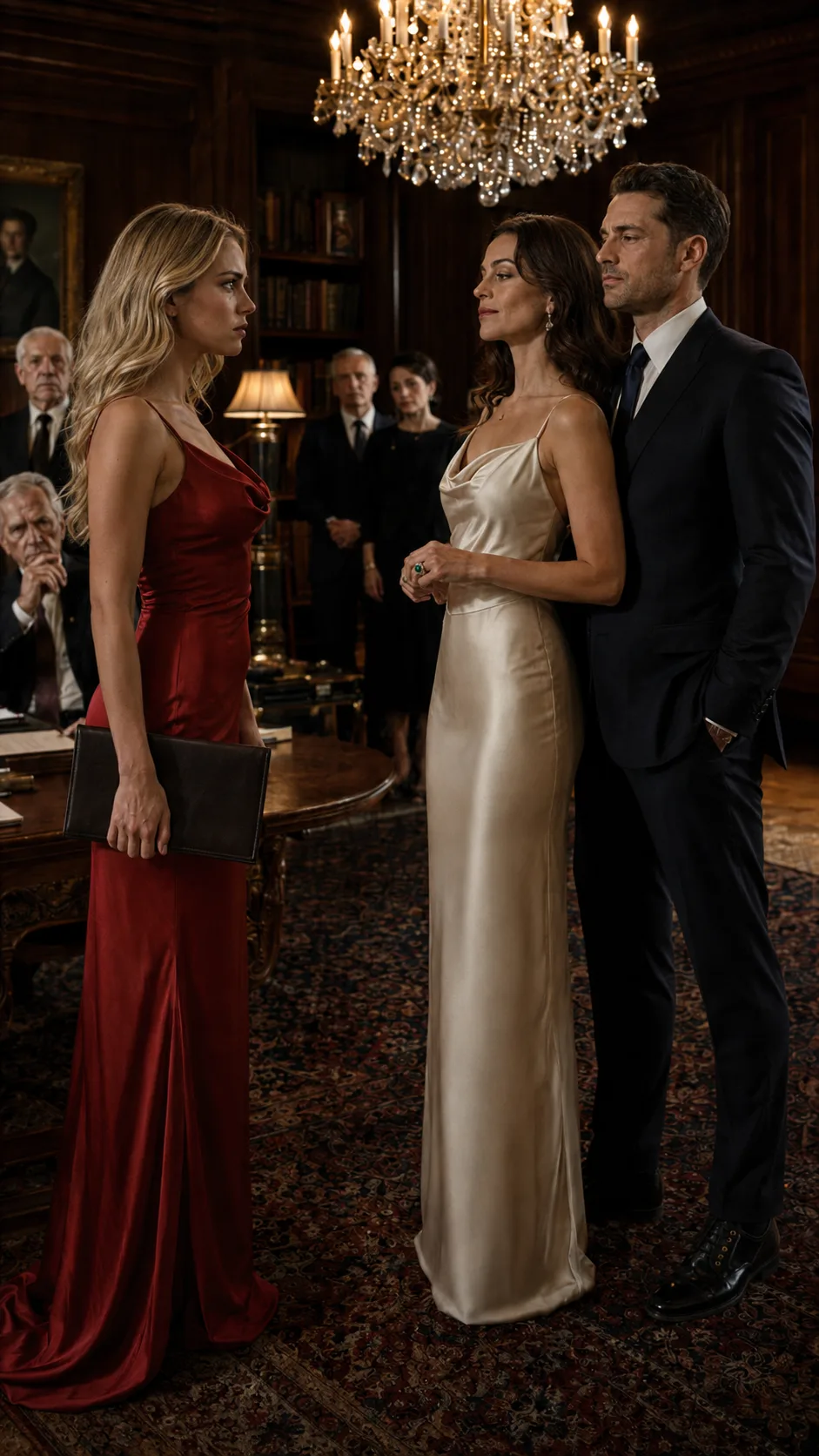
She wore ivory.
Not white, exactly. That would have been too obvious. Ivory satin, cut close to the body, with thin straps and a neckline low enough to be noticed but high enough to be defended.
Her hair was pinned in soft waves. Her mouth was painted the red my father once told her made her look like an actress in a movie where everyone dies at the end.
She kissed Aunt Lydia.
She nodded to the board members.
She did not come to me.
Adrian arrived with her.
That was the first real crack.
He should have arrived with me. He had stayed in the east guest suite for the past week, claiming he wanted to give me space but remain nearby. That morning he had texted that he had calls and would meet me downstairs.
Now he entered through the foyer beside Celeste, one hand near the small of her back, not touching, but too close.
People notice distance in grieving houses.
They pretend not to.
I stood at the foot of the staircase with the card in my pocket and my father’s old watch pressed against my palm. The watch had stopped at 2:17. No one had wound it since he died.
Celeste looked up at me.
She smiled.
Not warmly.
Not cruelly enough for anyone else to accuse her.
Just enough.
Adrian’s eyes found mine and moved away.
My fingers closed around the watch until the ridged crown bit into my skin.
Mr. Bell called everyone into the study at exactly four.
The room had been prepared too beautifully.
That was my second warning.
The curtains were open even though my father hated afternoon glare on his desk. The decanter had been placed on the sideboard, though he never served whiskey before business. His leather chair had been pushed back from the desk and replaced by a row of formal chairs, as if we were attending a performance.
A performance needs an audience.
I took the chair closest to the bookshelves, not my father’s chair. Never his chair.
Adrian should have sat beside me.
He stood near the fireplace instead.
Celeste stood near him.
The legal staff placed folders on the table. Cream paper. Navy seals. Ribbons. Too much ceremony for what should have been a reading.
A clock ticked on the mantel.
One of the servants, Marta, brought in a tray of water glasses. Her hands trembled when she set one in front of me. A drop spilled onto the coaster and spread into the paper ring left by some older drink.
She did not look at me.
“Marta,” I said.
Her eyes lifted for half a second.
Then Bell cleared his throat.
She left.
The door closed.
Mr. Bell began with the usual language.
I heard my father’s full name. His date of birth. His place of residence. The formal declaration that he had been of sound mind. I watched Bell’s mouth move and thought of my father in the hospital, eyes turned toward the door, fingers cold in mine.
Do not sign quickly.
Bell read for twenty-two minutes.
My father’s personal library to the university.
A fund for longtime employees.
Three charitable grants.
A small property in Maine to Aunt Lydia, who blinked as if she had expected an island.
Several investment accounts divided among extended relatives.
Then Bell paused.
He removed a second folder from beneath the first.
A folder I had not seen before.
The room shifted.
Not loudly.
But enough.
My cousin Peter leaned forward. Aunt Lydia’s pearls clicked softly as she swallowed. Celeste did not move at all.
Bell adjusted his glasses.
“An amendment was executed three days prior to Mr. Vale’s passing.”
My breath went shallow.
Three days prior, my father had not known what day it was. Three days prior, he had signed nothing except, perhaps, the air with fingers that no longer obeyed him.
Bell continued.
The amendment transferred the controlling interest of the Vale family holding company, the mansion, several investment vehicles, the Palm Beach property, the Geneva accounts, and all remaining personal shares into a private trust.
Trustee and primary beneficiary: Celeste Marielle Vale.
My aunt made a small sound.
Someone behind me whispered.
A servant outside the door dropped something metal. It clattered once and went still.
I looked at Celeste.
She lowered her eyes, as if overcome.
The act was delicate.
Perfect.
Adrian watched the fire.
Bell kept reading.
He spoke of my father’s desire to “repair old wounds.” He spoke of family unity. He spoke of faith in Celeste’s capacity to carry the Vale legacy forward. He read sentences my father would have torn apart with a red pen.
Legacy.
Unity.
Capacity.
My father hated dead words.
I stood before Bell finished.
Every head turned.
The room did not breathe.
“This is false,” I said.
Bell looked up. “Miss Vale—”
“My father was unconscious.”
“There are medical witnesses.”
“Which ones?”
His hand touched the folder.
Not opened.
Touched.
“Miss Vale, I understand this is painful.”
I laughed once.
It did not sound like me.
Celeste lifted her face then.
The tears were gone.
“Clara,” she said, “don’t embarrass yourself.”
Adrian finally moved.
He stepped toward me, not beside me. Toward me like one approaches a glass too close to the edge of a table.
“Sit down,” he said.
“No.”
His jaw tightened.
Only a little.
“Clara.”
There it was again.
My name, used like a leash.
I looked at him, and the room stretched thin between us.
“Did you know?”
He did not answer quickly enough.
That was an answer.
Celeste gave a soft sigh and stepped away from the fireplace.
Her heels made no sound on the rug.
She crossed the room slowly, drawing every eye with her, letting the study rearrange itself around her body. She did not approach Bell. She did not approach Aunt Lydia.
She came toward me.
And as she moved, the chandelier caught something on her hand.
Green.
Bright.
Familiar.
The room disappeared at the edges.
I looked down at her finger.
My mother’s emerald ring sat there, nestled against Celeste’s skin as if it had chosen her.
The diamonds along the sides flashed under the light.
A small chip near the left prong.
I knew that chip. I had touched it with my thumb the night Adrian proposed. I had asked if it needed repair. My father said no.
“Some marks prove a thing survived,” he told me.
Celeste stopped two steps away.
She raised her hand, just slightly.
Not enough to show the room.
Enough to show me.
I heard my own breath once.
Then nothing.
“Don’t look so surprised,” Celeste said. “Everything you had was never truly yours.”
No one moved.
Not Bell.
Not my aunt.
Not the cousins who had eaten at my father’s table since childhood.
A servant stood near the sideboard with a coffee pot in both hands. The pot tilted a fraction. Coffee touched the silver rim and held there, dark and trembling.
Celeste smiled.
It was beautiful.
That made it worse.
I looked at Adrian.
He had turned from the fireplace. His hands were at his sides. His expression was composed, almost bored, except for one vein moving near his temple.
Say something, I wanted to tell him.
Not because I believed in him.
Because some part of my body had not received the news.
Say anything.
Celeste turned before he could.
She walked back to him, each step slow, the emerald catching and losing light. The hem of her ivory dress brushed the rug. She stopped close enough that her shoulder touched his sleeve.
Adrian did not step away.
That was the third warning.
No.
That was not a warning anymore.
Celeste lifted her ringed hand and placed it against his chest.
The stone rested on the black fabric of his suit.
A signature.
A brand.
She rose slightly onto her toes and kissed his cheek.
In front of me.
In front of my family.
In front of the lawyer who had just handed her my father’s life in a folder.
Adrian let her mouth touch his skin.
His eyes stayed on mine.
The coffee pot made a tiny sound against the tray.
Celeste lowered herself back onto her heels.
“Poor Clara,” she said. “Always Daddy’s favorite. Always so delicate. But delicate things break.”
My fingers opened.
The folder I had been holding slid against my thigh, but I did not drop it. The leather corner pressed into my palm. My father’s stopped watch sat heavy in my other hand.
Aunt Lydia looked at the floor.
Peter stared at the ring.
Bell began gathering papers, too fast, too clumsy.
“Perhaps we should take a brief recess,” he said.
“No,” I said.
My voice came out flat.
Bell stopped.
Celeste tilted her head. “You don’t get to decide how this goes anymore.”
The room waited for me to crack.
I could feel it.
They wanted tears. A scream. A trembling accusation they could call hysteria. They wanted the favorite daughter reduced to something small and wet and easy to escort upstairs.
I looked at Adrian.
Only him.
“You helped her.”
It was not a question.
Adrian inhaled through his nose.
Celeste’s hand remained on his chest. The emerald ring looked darker now, almost black at the center.
For the first time that afternoon, Adrian gave me his full attention.
There was no grief in his face.
No shame.
No apology.
Only impatience sharpened into contempt.
“You wouldn’t have known what to do with that kind of power.”
The words did not echo.
They did not need to.
They landed on the desk. On the bookshelves. On my father’s empty chair. On every photograph in silver frames. On the carpet where my mother used to stand barefoot in the mornings because she hated slippers.
Something shifted behind my ribs.
Not broke.
Shifted.
A place made room for a fact.
Adrian had not been stolen from me.
He had left quietly and waited for me to notice in public.
Celeste’s smile widened by a fraction.
Aunt Lydia whispered, “Adrian.”
He ignored her.
He adjusted his cuff with two fingers, as if the confession had wrinkled him.
“Your father built things you never understood,” he said. “He protected you from the weight of it. We won’t apologize for stepping in.”
“We,” I said.
Celeste’s eyes brightened.
That tiny word pleased her.
We.
The victory was not complete until it had an audience.
“You heard him,” she said. “Even Adrian sees it. You were loved because you were harmless.”
Marta, the servant near the sideboard, set the coffee pot down. Too hard.
Several people turned toward her.
She lowered her eyes again.
I did not.
Harmless.
That was what they had mistaken for restraint.
My father had taught me to listen through insults. Not to forgive them. To collect them. An insult spoken freely tells you what a person thinks the room will allow.
This room had allowed too much.
I took one step toward the table.
Celeste’s smile faltered.
Not fear.
Not yet.
Only surprise that I moved at all.
Bell said, “Miss Vale, I advise—”
“You advise?” I looked at him.
His mouth closed.
I placed the folder on the table. The leather cover made a soft, final sound.
Then I set my father’s stopped watch beside it.
2:17.
The hands had not moved since the hospital.
Adrian glanced at the watch, then away.
Celeste looked bored again. “Is that supposed to mean something?”
“No,” I said. “Not to you.”
I opened the folder.
Inside were the documents I had found that morning after reading my father’s card. Not all of them. Not enough for court, maybe. Enough for a room.
A copy of the hospital visitor log.
A medication chart.
A power of attorney request denied two weeks before his death.
A note from my father’s private nurse, unsigned, but written in the same rounded script as the labels on his medication drawer.
Miss Celeste asked whether a sedated patient could sign if his hand was guided.
I had read that line twelve times.
Each time, the house had become colder.
Bell leaned forward.
His eyes moved across the top page.
His skin changed color.
Adrian saw it.
So did Celeste.
For the first time, her ringed hand slipped off Adrian’s chest.
“What is that?” she said.
I turned the first page.
“Something my father left where you would never look.”
Celeste gave a short laugh. “You’re bluffing.”
“Maybe.”
I turned another page.
Adrian stepped closer. “Clara.”
Not a leash this time.
A warning.
Good.
“Do not,” he said.
I looked up.
“Do not what?”
He glanced at the relatives, at Bell, at the servants, at the people who had become witnesses without choosing it.
His control thinned.
“You are making this uglier than it needs to be.”
Celeste touched his arm. “Let her. She has nothing.”
I closed the folder.
Slowly.
Then I looked at the ring.
My mother’s ring.
On Celeste’s hand.
It should have hurt like a wound.
Instead, it became useful.
I stepped closer to Celeste.
She did not step back. Pride held her in place better than courage ever could.
“You really wanted me to see it,” I said.
Her eyes narrowed.
“You wanted me to lose my voice before Bell finished reading. You wanted me staring at that ring instead of the papers.”
She smiled again, but now it had effort in it.
“And yet here you are,” she said, lifting her hand between us, “still staring.”
I looked at the stone.
Then at Adrian.
“She took it from my room.”
Adrian’s face did not move.
Celeste laughed under her breath. “Don’t be childish. Engagements end. Rings move on.”
“Did ours end?”
Adrian’s mouth tightened.
The room listened.
That was what I needed.
He said nothing.
Celeste answered for him.
“It ended when he understood what you were.”
“And what am I?”
“A daughter raised to inherit without earning it.”
I turned to Adrian. “And you?”
He looked tired again. The mask had returned, but not perfectly.
“You were never prepared,” he said. “Your father knew it. Everyone knew it. You played at charity dinners and employee birthdays while men like him carried the risk.”
“My father let me review the quarterly debt schedules when I was sixteen.”
“You reviewed what he allowed you to see.”
“He had me sit in on union negotiations.”
“As a sentimental gesture.”
“He gave me voting notes.”
“To comfort you.”
I nodded once.
Each answer was a door closing.
Behind me, Aunt Lydia stood. Her chair scraped across the rug.
“Adrian, stop speaking.”
He looked at her.
She sat back down.
That was how power had always worked in that house. People learned quickly which voices ended rooms.
But he had mistaken my silence for absence.
Celeste moved closer to me.
We were near enough now that I could see the powder settling near the corner of her nose, the tiny crease beside her mouth, the pulse moving in her throat.
“You’re done,” she said. “The amendment is signed. The trust is active. The estate is mine. Adrian chose correctly. Your father’s name will survive through someone strong enough to carry it.”
She turned to the room.
A performance again.
“To avoid further unpleasantness, Clara can stay in the guest wing for a week while she arranges new accommodations.”
No one challenged her.
Not one person.
She lifted her ringed hand.
“I’ll even let her keep some of the old dresses. The plain ones suit her.”
The humiliation was meant to sting.
It did.
But pain, if held still long enough, becomes shape.
Mine became a plan.
I picked up my father’s stopped watch and fastened it around my wrist. The strap was too large. The face slid toward the bone.
2:17.
Still.
“I want the amendment read again,” I said.
Bell shook his head. “That is unnecessary.”
“I want it read again.”
Celeste laughed. “You heard it the first time.”
“Yes.”
I looked at Adrian.
“So did everyone else.”
His eyes sharpened.
There.
He understood before she did.
Bell’s fingers tightened on the document.
“Miss Vale, I cannot—”
“You can,” I said. “And you will. Read the section naming Celeste trustee and primary beneficiary.”
Celeste folded her arms. The emerald flashed.
“Let him,” she said. “Maybe repetition helps the delicate.”
Bell looked at Adrian.
Adrian gave the smallest shake of his head.
Too late.
Celeste saw it.
Her smile died for half a second.
“What?” she said.
No one answered her.
I slid the hospital log from my folder and placed it in the center of the desk.
Then the nurse’s note.
Then the denied power request.
Then the photograph I had found tucked into my father’s copy of the old family trust. It was not dramatic. Just a security still from the hospital corridor, grainy and gray, printed on cheap paper.
Celeste outside my father’s room.
Adrian beside her.
Bell entering behind them with a document tube under his arm.
Time stamp: 2:17 a.m.
My father’s watch had stopped at 2:17.
Not because of the hospital machines.
Because he had pulled the crown loose himself, with hands that could barely hold a pen, and left it for me to find.
A marker.
A witness without a mouth.
Aunt Lydia covered hers.
Bell sat down.
Adrian stared at the photograph.
Celeste reached for it.
I moved it back.
“No.”
Her eyes snapped to mine.
For the first time, there was no softness, no polish, no elegant cruelty.
Only the girl who had always believed taking was the same as winning.
“You think a blurry hallway picture changes anything?”
“No.”
I gathered the papers.
“I think it makes people curious.”
Adrian stepped toward me.
“Give me the folder.”
The room changed.
Not loudly.
But bodies reacted before voices did. Peter rose halfway. Marta took one step from the sideboard. Aunt Lydia whispered my name.
I held the folder against my side.
Adrian stopped close enough that I could smell his cologne.
The same cologne from the garden terrace.
The proposal.
The lie.
“Give it to me,” he said.
“No.”
His hand lifted.
Not high.
Not violent enough for anyone to gasp.
But enough.
Celeste saw it and smiled again.
She wanted him to take it.
She wanted me forced.
I let the silence hold.
Then I said, “In front of them?”
His hand froze.
That was the problem with men like Adrian. They loved control, but only when it looked civilized.
He lowered his hand.
I turned away from him before he could decide whether to hate me for it.
Then I faced the room.
“My father told me not to sign quickly,” I said. “I thought he meant after the funeral. I thought he meant grief makes people careless.”
Celeste rolled her eyes. “How poetic.”
I looked at her.
“He meant you.”
The room went still again.
Celeste’s chin lifted. “I am not afraid of you.”
“I know.”
That was true.
She had never been afraid of me.
She had been afraid of being invisible.
There was a difference.
I picked up Bell’s amendment and held it by the corner.
“I am not signing acknowledgment of this reading today.”
Bell swallowed.
“You are not required—”
“No,” I said. “But you wanted me to. There’s a receipt page in the folder. A beneficiary acknowledgment. You placed the pen beside my glass.”
Everyone looked.
There it was.
Black fountain pen.
Gold clip.
Waiting.
Adrian’s eyes closed for half a second.
Celeste turned to Bell.
“You said it was standard.”
Bell’s face had gone slick with sweat.
“It is standard.”
“No,” I said. “It is useful.”
I slid the acknowledgment page out and read the line near the bottom.
By signing below, interested parties affirm they have reviewed and do not contest the amendment presented.
Aunt Lydia stood again.
This time she did not sit.
“You were going to have her waive contest in the room?”
Bell said nothing.
Celeste’s head turned slowly toward Adrian.
“You knew?”
He did not answer.
That was his habit today.
Silence where loyalty should have been.
I placed the acknowledgment on the desk.
“I was supposed to cry,” I said. “Then sign whatever was placed in front of me to make the room stop looking.”
Celeste’s mouth hardened. “You always did enjoy making yourself the victim.”
I smiled.
Not much.
Enough.
“No. Today I am making myself difficult.”
Marta made a sound behind me.
Almost a laugh.
Almost.
Celeste heard it.
Her face sharpened.
“You.” She pointed toward the sideboard. “Leave.”
Marta did not move.
Celeste’s finger trembled.
A servant disobeying her in a room she believed she owned.
Small things split crowns.
I picked up my folder and stepped back from the table.
“The reading is over for me.”
Adrian moved to block the path.
“Clara, think carefully.”
“I did.”
“Then think again.”
I looked at him.
He had been handsome once to me. Not in the way strangers saw him, but in small private ways. The loosened tie after dinner. The half-smile when my father cornered him about supply chains. The hand resting at my back when cameras were present.
Especially when cameras were present.
Now I saw the calculation under the posture.
The hunger dressed as patience.
“You helped her,” I said again.
This time, the room knew it was not accusation.
It was record.
Adrian leaned closer.
His voice lowered, but not enough.
“I tried to help you by keeping you out of something you would destroy.”
I waited.
He made his final mistake because silence made him uncomfortable.
“You were never built for this family’s power. You were raised inside it like a child in a museum. Celeste knows what it costs to want something. You don’t.”
Celeste’s face softened as if he had offered her a crown.
Then Adrian looked at me with the clean certainty of a man who had mistaken cruelty for intelligence.
“You wouldn’t have known what to do with that kind of power.”
There.
Again.
Clearer.
Public.
Unrecoverable.
No one could pretend after that.
The study held the sentence.
My father’s books. My mother’s portrait. The stopped watch on my wrist. The pen waiting on the desk. The ring on Celeste’s hand.
All of it held.
I nodded once.
Then I walked around Adrian.
He did not stop me.
Maybe he thought I was leaving defeated.
Celeste certainly did.
She turned to the room with a little smile, ready to receive their obedience.
I reached the door and paused with my hand on the brass knob.
The metal was cold.
My father hated that knob. He said it shocked him every winter.
I looked back.
Celeste stood beside Adrian, ivory satin glowing under the chandelier, my mother’s emerald burning on her finger.
“Keep the ring,” I said.
Her smile returned fully.
“I intended to.”
“I know.”
I opened the door.
Then I looked at Bell.
“I’ll see you in court.”
His mouth opened.
No words came out.
Adrian’s face changed first.
Then Celeste’s.
Not fear yet.
But the first clean fracture of certainty.
Good.
I stepped into the hallway.
Behind me, voices rose at once.
Celeste snapped my name. Adrian told Bell to fix it. Aunt Lydia demanded to know what had been done. A chair fell. Marta’s tray rattled against glass.
I kept walking.
The foyer seemed longer than it had that morning. Portraits watched from the walls, dead relatives in gilt frames, all of them painted as if they had never lied in their lives.
My shoes struck the marble.
One step.
Then another.
At the base of the staircase, I stopped.
The house was not mine anymore.
Not legally.
Not today.
Maybe not for years.
But every corner of it knew my name.
I went upstairs to my bedroom and locked the door.
My hands shook only after the lock turned.
I set the folder on the bed and stood very still until the shaking moved through me and left. On the dresser, the empty ring box waited with its velvet mouth open.
I picked it up.
There was dust inside the lid.
A tiny line of it where the ring had protected the fabric from time.
I closed the box and put it in my suitcase.
Not because I wanted the ring back.
Because I wanted to remember the shape of what had been taken.
That night, I did not sleep in my father’s house.
I left through the service entrance with one suitcase, the folder, and the stopped watch on my wrist. Marta waited near the laundry hall with my coat.
She said nothing.
She only handed me a paper bag.
Inside were three things: a thermos of coffee, a pair of gloves, and a flash drive wrapped in a napkin.
I looked at her.
She looked down the hallway, then back at me.
“Your father kept copies,” she said.
Then she walked away before I could answer.
Outside, the air cut through the thin fabric of my dress. The driveway lamps burned gold against the gravel. Behind the study windows, shadows moved fast. Celeste’s silhouette crossed once, then Adrian’s.
They were fighting already.
That comforted me more than it should have.
The car was cold. I sat behind the wheel with my suitcase on the passenger seat and the folder on my lap. For a long time, I did not start the engine.
I watched the house.
My father had built it from another family’s ruin. He bought it when I was six, after a shipping deal made him richer than even his enemies expected. My mother hated the size of it. She said no house needed more than one staircase unless the people inside planned to avoid each other.
She was right.
At midnight, my phone began to ring.
Adrian.
I let it ring.
Then a message.
Clara, do not make decisions tonight.
Another.
We can still handle this privately.
Another.
Celeste went too far, but you need to be strategic.
I laughed then.
Not loudly.
Just once.
Strategic.
He still thought the door was open.
He still thought he could walk through it wearing a calm voice and expensive wool.
I turned the phone off.
Then I started the car.
The next six months were not beautiful.
People prefer revenge stories with clean edges. One room. One reveal. One perfect downfall before dinner. They want the villain exposed while the heroine stands untouched in good lighting.
That is not how families rot.
Celeste moved into my father’s bedroom suite within three days. She gave interviews about honoring Edmund Vale’s legacy. She wore ivory to a memorial board luncheon and black to a charity gala, where the emerald ring appeared in every photograph.
Adrian stood beside her at both events.
Never too close.
Close enough.
The press called them united.
Society called it complicated.
My aunt called me twice, then stopped when I sent her a copy of the hospital still. Peter sent one message: I didn’t know.
I believed him.
It did not matter.
Not knowing had been useful to him.
Bell resigned from the firm before my attorney filed the contest. He cited health concerns. The firm issued a statement about transition and continuity. I kept the statement in a folder labeled Cowards.
The flash drive Marta gave me contained more than I expected.
Security clips.
Scanned invoices.
Emails printed to PDF.
A recording from my father’s study three weeks before he died, his voice thin but clear as he told Bell to prepare a protective trust for me, not because he doubted me, but because he doubted everyone around me.
Especially Adrian.
I listened to that recording once.
Only once.
My attorney listened three times.
Then she removed her glasses and said, “We can work with this.”
Her name was Naomi Cross, and she had no patience for drama she could not bill. She kept a ceramic frog on her desk full of paper clips. The frog had a chipped eye and a permanent grin.
“You understand this will take time,” she said.
“I understand.”
“You may lose access to the house during proceedings.”
“I already did.”
“You may lose friends.”
I looked at her.
She nodded. “Right.”
We filed quietly.
That was Naomi’s advice.
“Let them believe you are wounded and underfunded,” she said. “People who think they already won write careless emails.”
She was right.
Celeste wrote many.
To Adrian, mostly.
Some were tender in a way that made me set the pages down and walk around the room before continuing. Not because I wanted him back. Because humiliation has aftershocks. It returns in small administrative formats. Dates. Attachments. Hotel charges. Jewelry insurance forms.
They had begun before my father’s final hospitalization.
Before my engagement party.
Before Adrian proposed with my mother’s ring.
That knowledge did not explode.
It settled.
Like ash.
One email from Celeste to Adrian read: Once she signs the acknowledgment, she has no ground unless she wants to look unstable.
Another: Bell says the nurse is manageable.
Another: Wear the navy suit. She trusts you in navy.
I did not cry over that one.
I put it in the court file.
The first hearing took place in a room with bad lighting and beige walls. Celeste wore gray and no ring. Adrian wore navy.
I almost laughed.
Naomi noticed.
“Don’t,” she said.
I didn’t.
Celeste avoided looking at me until the judge asked whether she understood the allegations.
Then she turned.
For the first time since the will reading, we stood nearly level. No chandelier. No servants. No old family audience trained to obey wealth.
Just a judge, a clerk, two lawyers, a court reporter, and truth with page numbers.
Celeste looked smaller without the house behind her.
Adrian did not.
Men like him bring their own walls.
The proceedings dragged through winter.
My father’s company froze certain internal transfers pending review. The bank requested additional documentation. Bell’s former assistant produced calendar entries he had “forgotten.” Marta gave a deposition in a navy cardigan, hands folded, voice steady.
When Celeste’s attorney tried to imply she had been bribed by me, Marta looked at him and said, “I worked in that house for twenty-two years. Miss Clara never learned how to bribe. Her father taught her to overtip.”
The transcript became my favorite document.
By spring, the amendment was under formal challenge. By summer, Bell was facing investigation for professional misconduct. By autumn, the private trust Celeste thought she controlled had become a locked box no one could touch without court permission.
The house sat empty except for maintenance staff.
Celeste moved to a hotel.
Adrian moved somewhere else.
Not with her.
That part reached me through gossip before documents confirmed it. He had attempted to distance himself, claiming he had acted under incomplete information and emotional influence. Celeste forwarded his texts to her attorney. Her attorney forwarded them by accident during discovery.
Naomi read them and smiled at the frog.
“Romance is alive,” she said.
The ring turned up in a jewelry insurance claim.
Celeste had listed it as a Vale family emerald valued at nearly seven figures.
The appraisal said otherwise.
The stone was real, but the ring had been altered. Reset. Insured under false provenance. The original emerald, according to records my father had kept, had been placed in a vault years earlier after the prong cracked. The ring Adrian gave me had been a replica my father used for the proposal because he wanted the original secured until the wedding.
Only three people knew.
My father.
The jeweler.
And apparently, after my father died, me.
Celeste had stolen the symbol.
Not the thing.
When Naomi told me, I sat very still.
Then I asked, “Where is the original?”
She slid an envelope across the desk.
Inside was a vault receipt in my father’s name and a handwritten note.
For Clara, when she chooses herself.
I folded the note once and put it in my wallet.
The final settlement came almost fourteen months after the will reading.
Not dramatic.
No sirens.
No fainting.
No one dragged Celeste from the room.
The court invalidated the amendment based on incapacity, undue influence, and procedural misconduct. Bell lost his license before the year ended. Adrian was removed from all advisory roles connected to Vale holdings and named in a civil action he settled with money he did not enjoy parting with.
Celeste received what my father had originally intended for her: a separate trust large enough to live on, small enough to punish her pride. It came with oversight. She hated that most.
I did not take everything.
People expected me to.
Naomi expected me to consider it.
Aunt Lydia begged me to.
The board assumed I would step in immediately and prove Adrian wrong by becoming exactly what he accused me of not being.
Instead, I did something my father would have called irritating.
I split the house from the company.
Vale Consolidated went to a professional board with employee representation and strict oversight. The charitable funds were restored. The staff pensions were protected first. My father’s library went to the university as planned.
The mansion, after months of legal dust and supervised inventory, returned to me.
I walked through it alone on a cold afternoon in November.
The study smelled different. Less coffee. More closed air. A cleaning crew had covered the furniture in white sheets. My father’s desk had been polished, but the wood still bore the faint mark where Bell’s amendment folder had sat.
I stood in the doorway for a long time.
Then I crossed the room and opened the curtains.
Light hit the desk.
Dust moved.
On the sideboard, someone had left a silver tray. Not polished. Tarnished along the rim.
I picked it up and saw my reflection bend across the metal.
Older.
Sharper.
Still there.
Marta returned the next week as house manager, not servant. Her first act was to throw away every coffee cup left from the will reading. Her second was to change the locks.
Aunt Lydia visited once.
She stood in the foyer with a casserole she had clearly purchased and transferred into her own dish.
“I should have spoken,” she said.
“Yes.”
She looked at me.
No defense came.
Good.
I took the casserole.
She did not ask to come in.
Celeste sent one letter through her attorney.
Not an apology.
A negotiation.
She wanted some of her clothes from the house. Some photographs. The ivory dress. The ring.
I sent the clothes.
Not the dress.
Not the ring.
The replica stayed in my desk drawer for three days.
Then I took it to the garden terrace where Adrian had proposed and placed it on the stone ledge beside a pot of dead lavender my father had refused to replace because he claimed it was “thinking about recovery.”
I looked at the ring under gray morning light.
It was still beautiful.
That was the ugliest part.
Beautiful things do not become honest because they glitter.
I carried it inside and locked it away with the court documents.
Not as memory.
As evidence.
The original emerald remained in the vault for another month. When I finally retrieved it, the jeweler brought it out in a plain black box. No velvet romance. No music. No kneeling man with a practiced smile.
Just a stone.
Deep green.
Quiet.
Mine, if I wanted it.
I looked at it for a long time.
Then I asked him to remove it from the engagement setting entirely.
“What would you like done with it?” he asked.
“A pendant,” I said.
He nodded.
“No diamonds.”
“No diamonds.”
When I wore it for the first time, I did not go to a gala.
I wore it to breakfast.
In the kitchen.
With Marta arguing with a supplier on speakerphone and the new housekeeper burning toast near the stove. The emerald rested at my throat instead of my hand, no longer waiting for someone to choose me.
The watch on my wrist still said 2:17.
I never repaired it.
Some marks prove a thing survived.
A year and a half after the will reading, I hosted the first dinner in the house.
Not for relatives.
For employees.
Factory supervisors. Drivers. Accountants. The woman who ran the scholarship fund. Marta’s nephew, who had just started in logistics and looked terrified of the silverware.
We used the dining room my mother said was too large for honest meals. I had the servants sit, too. No one knew what to do at first.
Then Marta sat at the head of the table.
That fixed it.
Near the end of the night, I stepped into the study for more wine and found the room quiet, lit by two lamps instead of the chandelier. The desk was clear. The curtains were half-open. The chair behind it remained empty.
I did not sit there.
Not yet.
Maybe never.
My phone buzzed once.
Unknown number.
I knew before opening it.
A photograph loaded slowly.
Celeste.
Some charity luncheon in Monaco or Milan or another city designed to make exile look like leisure. She wore pale blue. No emerald. Her smile looked expensive and tired.
The message below it read: He left me too.
No apology.
No question.
Just a fact placed on my doorstep.
I deleted it.
Then I blocked the number.
In the hallway, laughter rose from the dining room. Real laughter, badly timed and too loud. Someone dropped a fork. Someone else clapped. Marta shouted that if they stained the runner, they were paying for it.
I stood in my father’s study with the wine bottle in my hand and the emerald at my throat.
For the first time, the house did not feel like a witness.
It felt like a room.
I turned off the lamp on my father’s desk and left the chair empty.
Then I went back to dinner. THE END.
Chapter complete
You have reached the end of this chapter.
Continue reading
A few more worlds to get lost in after this chapter.




