The first time I noticed something was wrong, my father dropped a wrench.
Chapter 1
The first time I noticed something was wrong, my father dropped a wrench.
That may not sound like much.
But Robert Hayes had spent most of his life fixing things. Engines. Fences. Broken hinges. Leaky pipes. If something in our town stopped working, there was a good chance my father could repair it before lunch.
So when a simple wrench slipped from his hand and clattered across the concrete floor of his garage, I looked up.
He stood perfectly still.
Not because he couldn't reach it.
Because he didn't move.
For several seconds, he simply stared at the tool lying at his feet.
Then he bent down slowly, picked it up, and pretended nothing had happened.
I should have asked questions.
I didn't.
Like most families, we had become experts at accepting the explanations we were given.
Dad was getting older.
Dad had arthritis.
Dad had earned the right to slow down.
Those excuses sounded reasonable.
So we used them.
The truth was
much harder.
My father had returned from the Gulf War carrying something he never brought into the light.
And somehow the only person who knew was my fifteen-year-old son.
Not me.
Not my sister.
Not my mother before she passed away.
My son.
Ethan.
The secret sat between them for three years before it finally exploded in front of everyone.
And when it did, it changed my understanding of both of them.
It started on a rainy Saturday.
I stopped by Dad's house to drop off groceries.
His truck was in the driveway.
The garage door was open.
Inside, I expected to find him working on another project.
Instead, I found Ethan.
My son sat on an overturned bucket beside the workbench.
Dad sat across from him.
Neither of them noticed me immediately.
They were talking quietly.
Not about sports.
Not about school.
Something else.
Something serious.
Dad's voice was
low.
Ethan listened without interrupting.
The way adults listen when someone is trusting them with something important.
Then Dad noticed me.
The conversation stopped instantly.
Too instantly.
Ethan stood.
Dad smiled.
The moment disappeared.
At least on the surface.
After that day I started seeing things differently.
Ethan visited Grandpa constantly.
Sometimes twice a week.
Sometimes three times.
Sometimes he'd leave immediately after school.
If I asked what they did together, he shrugged.
"Just talked."
About what?
"Stuff."
Normal teenagers weren't known for voluntarily spending hours talking to seventy-two-year-old men.
Yet Ethan kept going back.
Again and again.
There was something there.
Something I couldn't see.
Months passed.
Small clues accumulated.
Dad stopped attending certain events.
He avoided long car rides.
He found reasons not to travel.
At family gatherings he often stood near walls or exits.
Always positioning himself carefully.
Always calculating distances.
I noticed.
Then ignored it.
Because
that's what people do when they love someone.
They protect the version of reality that feels safe.
One winter evening Ethan came home unusually quiet.
He sat at the kitchen table staring at nothing.
I placed dinner in front of him.
He barely touched it.
"You okay?"
"Yeah."
"School?"
"No."
"Friends?"
"No."
I waited.
Finally he spoke.
"Do you think Grandpa lies?"
The question hit me sideways.
"What kind of question is that?"
He looked down.
"Just asking."
My father wasn't a liar.
At least that's what I said.
At least that's what I believed.
Ethan nodded.
But he didn't look convinced.
The next summer brought another strange moment.
Dad collapsed during a community picnic.
Not dramatically.
Not the kind of collapse that sends people running.
His legs simply gave out.
One second he was standing.
The next he was sitting hard on the grass.
Everyone rushed over.
Including me.
Including Ethan.
Dad insisted he was fine.
A muscle cramp.
Nothing more.
But while everyone else listened to him, Ethan looked angry.
Not worried.
Angry.
As if he'd heard this excuse before.
As if he knew it wasn't true.
Later I found him standing beside Grandpa's truck.
"What was that about?"
He kicked at a pebble.
"Nothing."
"Ethan."
His jaw tightened.
"He should tell people."
Then he walked away.
That sentence stayed with me for weeks.
He should tell people.
Tell people what?
The answer didn't come.
Not yet.
It arrived two years later.
By then Dad's limp had become impossible to ignore.
His right leg dragged slightly after long walks.
His balance wasn't as good.
His hands shook occasionally.
Still he refused help.
Refused doctors.
Refused questions.
The family learned not to push.
Then Veterans Day arrived.
The community center in New York hosted an annual recognition ceremony for local veterans.
Dad usually attended.
This year he almost backed out.
Ethan wouldn't let him.
I watched the argument unfold in Dad's driveway.
"You should go."
"No."
"You promised."
Dad stared at him.
Ethan didn't back down.
Finally Dad sighed.
"Fine."
That single word sounded like surrender.
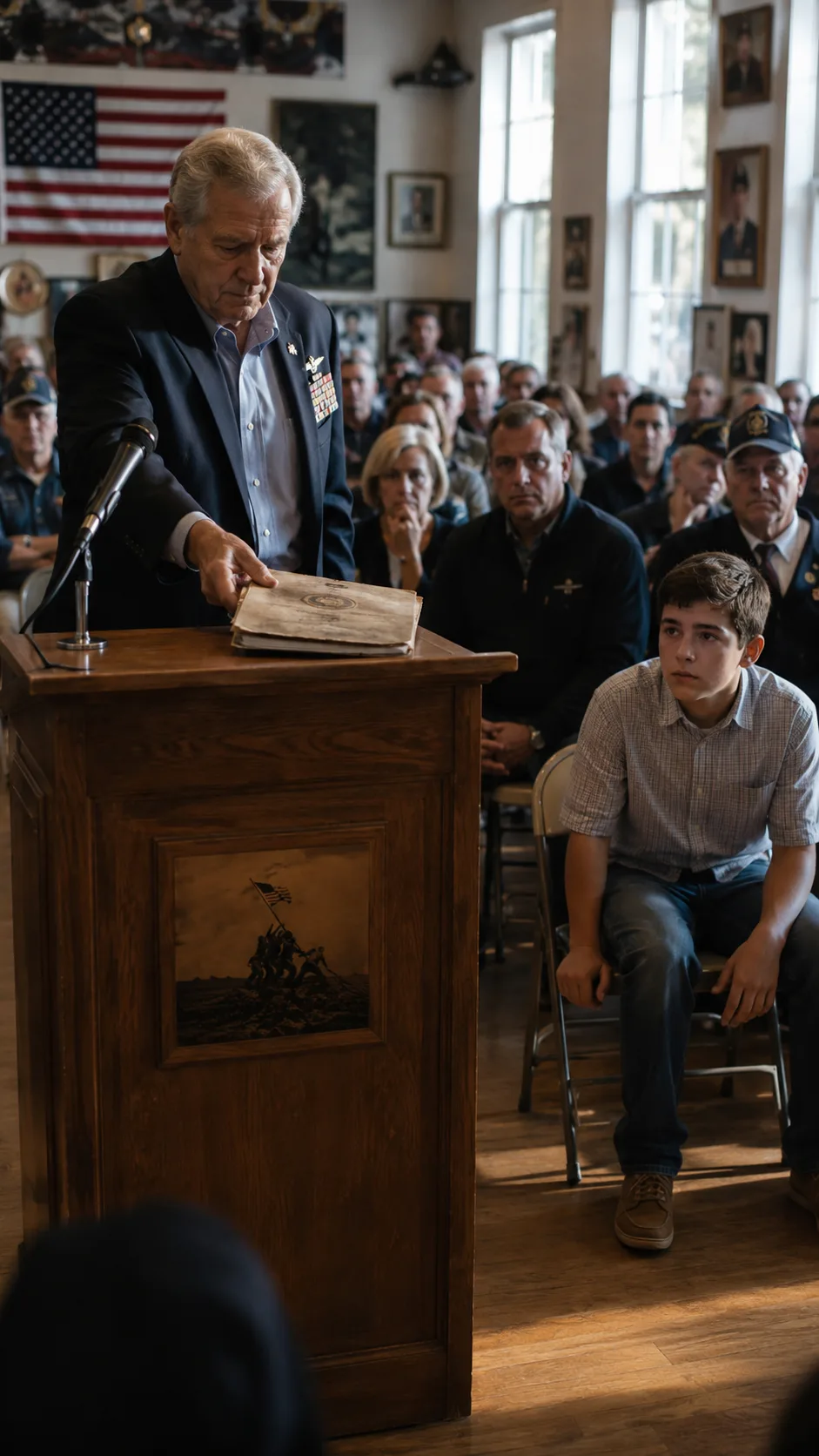
The ceremony took place in a large veterans' hall decorated with military photographs and American flags.
Families filled every row.
Old friends shook hands.
Children ran between chairs.
Coffee brewed in the corner.
The atmosphere felt warm.
Comfortable.
Ordinary.
Dad arrived carrying a worn military folder.
I'd never seen it before.
Not once.
It looked old enough to have survived several decades.
The edges were yellowed.
The corners bent.
The cover softened by time.
He never let it leave his hand.
Not for a second.
Ethan noticed it too.
Or rather, he noticed everyone noticing it.
Because he already knew what was inside.
That much became obvious.
As the ceremony began, veterans were called one by one.
Stories were shared.
Medals displayed.
Achievements celebrated.
When Dad's name was announced, he didn't immediately stand.
Instead he looked toward Ethan.
The two exchanged a glance.
No words.
No gestures.
Yet something passed between them.
Permission.
Maybe courage.
Maybe both.
Dad rose slowly and walked toward the stage.
The folder remained under his arm.
Every step seemed deliberate.
Heavy.
The hall applauded.
People smiled.
Nobody expected what was about to happen.
Dad reached the podium.
The applause faded.
He placed the folder on top.
His hand rested on it.
For a long moment he said nothing.
The silence stretched.
People shifted in their seats.
Someone coughed.
A chair creaked.
Then Dad spoke.
"I wasn't planning to do this."
His voice sounded rough.
Older somehow.
"I spent a long time deciding whether I should."
The room became still.
"I told myself it wasn't important."
He looked down at the folder.
"I told myself nobody needed to know."
A veteran in the front row frowned.
Confusion spread.
Dad opened the folder.
Inside were military records.
Medical reports.
Photographs.
Documents.
Pieces of a story nobody had heard.
Including me.
His hand trembled slightly.
Not from fear.
From effort.
Years of effort.
"I came home from the Gulf War carrying an injury."
The room remained silent.
"I hid it."
People exchanged glances.
My sister leaned forward.
I felt my stomach tighten.
Dad continued.
"For three years after returning home, I couldn't walk properly without pain."
Nobody moved.
"I lost strength in my right leg."
He paused.
"I hid that too."
My chest felt hollow.
The words didn't fit the man I thought I knew.
He looked toward the audience.
Toward family.
Toward friends.
Toward people who had known him for decades.
"I kept hiding it after those three years."
A murmur moved through the room.
Questions forming.
Assumptions breaking.
Then Dad said something I'll never forget.
"I was ashamed."
Not because of weakness.
Not because of pride.
Because he thought he had failed.
He thought soldiers came home whole.
He thought fathers were supposed to be stronger.
So he carried the burden alone.
Year after year.
Decade after decade.
Until carrying it became part of his identity.
Then something happened.
Ethan stood.
His chair scraped loudly against the floor.
Every head turned.
My son walked toward the stage.
Toward his grandfather.
Toward the secret.
I remember feeling confused.
Then worried.
Then suddenly terrified.
Because Ethan looked like someone who had reached the end of a promise.
He climbed the steps beside Dad.
The room watched.
Dad watched.
Ethan stopped beside him.
Neither spoke.
For a second they simply stood there.
Two generations.
One secret.
Then Ethan turned toward the audience.
Toward all of us.
And said the sentence that shattered everything.
"I've known for three years."
The room froze.
Absolute silence.
No coughs.
No whispers.
Nothing.
My sister's mouth opened.
My own heartbeat felt loud.
Ethan swallowed.
Then continued.
"Grandpa told me."
He looked at Dad.
"I promised I wouldn't tell anyone."
A woman in the audience covered her mouth.
A veteran lowered his head.
The entire room struggled to process what it had just heard.
Not because a secret existed.
Because a fifteen-year-old boy had carried it.
Alone.
For three years.
Dad placed a hand on Ethan's shoulder.
The gesture looked small.
It wasn't.
It contained three years of conversations.
Three years of trust.
Three years of shared weight.
Ethan's voice cracked.
"People think he hid it because he didn't care."
He shook his head.
"He hid it because he thought protecting us mattered more."
Nobody interrupted.
Nobody could.
"He didn't want Grandma worried."
"He didn't want Dad worried."
"He didn't want anyone treating him differently."
Ethan looked directly at me.
For the first time all evening.
"He wasn't protecting himself."
The words landed harder than anything before them.
Dad lowered his eyes.
Not hiding.
Remembering.
The room understood something new.
The injury wasn't the secret.
The sacrifice was.
The years of pretending.
The years of smiling through pain.
The years of carrying limitations nobody knew existed.
That was the secret.
And somehow a teenage boy had become its guardian.
The applause didn't start immediately.
Nobody knew if applause was appropriate.
Then one veteran stood.
Just one.
He clapped once.
Then again.
Another joined him.
Then another.
Then another.
Within seconds the entire hall was standing.
Applauding.
Not the injury.
Not the confession.
The honesty.
The courage.
The trust between grandfather and grandson.
Dad looked overwhelmed for the first time in his life.
He wasn't a man who cried easily.
Yet his eyes shone.
Ethan stood beside him.
Straight-backed.
Proud.
Not because the secret was finally public.
Because Grandpa no longer had to carry it alone.
After the ceremony ended, people lined up to speak with Dad.
Veterans shared stories.
Families shared hugs.
Old friends admitted they'd noticed signs but never understood them.
For hours the hall buzzed with conversations.
Different conversations.
More honest ones.
Meanwhile Ethan sat quietly at a folding table drinking a soda.
Like nothing extraordinary had happened.
I sat beside him.
For several minutes neither of us spoke.
Finally I asked the question.
"Why didn't you tell me?"
He stared at the bottle in his hands.
"Because he trusted me."
Simple.
Direct.
True.
I couldn't argue with it.
The secret had never belonged to me.
It belonged to him.
And to Grandpa.
Months later Dad finally agreed to proper treatment.
Not because people pressured him.
Because he no longer needed to hide.
That changed everything.
He accepted help.
Accepted support.
Accepted reality.
The burden became lighter.
Not physically.
Emotionally.
The family changed too.
Questions replaced assumptions.
Conversations replaced silence.
And Ethan?
People looked at him differently after that day.
Not older.
Not wiser.
Just stronger.
Because everyone understood what he'd carried.
Three years.
No recognition.
No reward.
Just a promise.
One afternoon nearly a year later, I found Dad and Ethan sitting together in the garage again.
The same garage.
The same workbench.
The same bucket.
A wrench rested on the table between them.
Dad picked it up.
This time he didn't drop it.
He handed it to Ethan instead.
Neither said much.
They didn't need to.
Some stories end with a revelation.
Ours ended with a handoff.
A burden set down.
A promise fulfilled.
And for the first time in decades, my father stopped carrying it alone.
Chapter complete
You have reached the end of this chapter.
Continue reading
A few more worlds to get lost in after this chapter.




