MY GRANDDAUGHTER WAS ASHAMED THAT I USED TO BE A WAITRESS… BUT AT HER GRADUATION, THE ENTIRE AUDITORIUM STOOD UP FOR ME
PART 1
My name is Rose Bennett, and for forty-one years, I wore a name tag on the left side of my chest.
Chapter 1
My name is Rose Bennett, and for forty-one years, I wore a name tag on the left side of my chest.
It was a small plastic tag, white with red letters.
ROSE.
That was all it said.
Not Mrs. Bennett.
Not Mom.
Not Grandma.
Just Rose.
I wore it at Miller’s Diner, a little roadside restaurant outside Columbus, Ohio, where the coffee was always too strong, the floors always smelled faintly of syrup, and the same old men came in every morning at six-thirty to argue about football, gas prices, and which waitress made the best pie.
For most of my life, people knew me as the woman who refilled their coffee.
The woman who carried three plates on one arm.
The woman who smiled even when customers snapped their fingers instead of saying please.
The woman who came home every night with swollen feet, smelling like bacon grease and black coffee.
And I was never ashamed of that.
Not once.
I had been poor. I had been tired. I had
been overlooked.
But I had never been ashamed of honest work.
My granddaughter Emily did not feel the same way.
Emily Bennett was eighteen, beautiful in the way girls are beautiful when they have never had to wonder whether the electricity bill could wait another week. She had long blonde hair, clear skin, perfect teeth, and a way of walking into a room like she already knew where the best light was.
She was smart, too.
That was what made me proudest.
She had gotten into Westbrook Academy on a partial scholarship when she was fourteen. It was the kind of private school where parents wore tailored coats to parent-teacher conferences and casually mentioned ski trips to Aspen. The students drove nicer cars than any teacher in the parking lot. The girls carried designer bags. The boys wore watches that cost more than my first car.
Emily learned quickly how
to belong there.
She stopped saying “Grandma Rose” when her friends were around.
Then she stopped inviting me to school events.
Then, one afternoon, she corrected me in front of two girls from her class.
I had come to pick her up because her father, my son David, had called and said he was stuck at work.
I waited near the school entrance in my old blue sedan, wearing my cardigan and the comfortable black shoes I used to wear at the diner. When Emily came out with her friends, I stepped out and waved.
“Emily, honey!”
Her face changed so fast it was like watching a curtain fall.
One of the girls looked at me and asked, “Is that your grandma?”
Emily’s smile froze.
“She’s… a family friend,” she said.
A family friend.
I stood there with my hand still raised.
Her friends barely noticed. They were already laughing
about something on their phones.
Emily rushed toward me, opened the passenger door, and hissed under her breath, “Grandma, why did you get out of the car?”
I blinked. “I just wanted to say hello.”
“You can’t just shout across the front steps like that.”
“I didn’t shout.”
“You know what I mean.”
I drove home in silence while she stared out the window.
At a red light, I said softly, “Are you embarrassed by me?”
Emily sighed like I had asked a childish question.
“No. I just don’t want people asking stuff.”
“What stuff?”
She turned to me.
“Like why you dress like that. Or what you did before you retired.”
The light turned green, but my foot didn’t move for half a second.
Behind us, someone honked.
I pressed the gas.
I didn’t say anything else.
That night, David came by my house alone.
My son was forty-five, a financial planner with expensive shoes and a tired face. He had my husband’s brown eyes, but not his softness. David loved me, I knew that. But somewhere between his first promotion and his second mortgage, he had learned to measure people by how polished they looked.
He stood in my kitchen, loosening his tie.
“Mom, Emily’s under a lot of pressure.”
I poured him coffee. “That doesn’t explain why she lied about knowing me.”
He looked down.
“She’s a teenager.”
“She called me a family friend.”
He rubbed his forehead. “I know. That was wrong.”
“Then tell her that.”
“I will.”
But he didn’t sound like he would.
He took the mug from my hand and leaned against the counter.
“You have to understand, Westbrook is different. Those kids are brutal. Their parents are worse. Emily’s trying to make a future for herself.”
I stared at him.
“And I’m part of her past she needs to hide?”
His face tightened.
“That’s not what I said.”
“But it’s what you mean.”
David looked away, and that hurt more than if he had agreed.
A week later, Emily came over for Sunday dinner.
I made pot roast, mashed potatoes, green beans with almonds, and the chocolate cream pie she used to beg for when she was little. She barely ate. She kept checking her phone under the table.
When I asked about graduation, her shoulders stiffened.
“It’s in three weeks,” she said.
“I know. I marked it on the calendar.”
She glanced at David.
David cleared his throat.
My daughter-in-law Melissa smiled too brightly.
“Well, Rose, graduation is going to be very crowded. The school only gave out a limited number of seats for close family.”
I set my fork down.
“I’m close family.”
Melissa’s smile thinned.
“Of course you are. But Emily has her parents, and there’s a senior reception afterward with donors and faculty. It might be a lot for you.”
“A lot for me?”
Emily looked up sharply.
“Grandma, please don’t make this a thing.”
The table went silent.
I turned to her. “Make what a thing?”
She pushed her hair behind her ear.
“I just mean… it’s my graduation. I don’t want drama.”
“Me being there is drama?”
She looked miserable and annoyed at the same time.
“No, but you don’t understand what it’s like there.”
“I understand graduations.”
“No, you don’t understand Westbrook.”
I looked at my son.
David stared at his plate.
Emily took a breath.
“People ask questions. They judge everything. They’ll ask where you went to college, what you did, where you live. And I don’t want to explain that my grandmother was a waitress at some roadside diner.”
The words landed slowly.
Not loudly.
Not dramatically.
Just plainly, like she had been holding them in and finally decided I deserved to hear the truth.
My hands folded in my lap.
Melissa whispered, “Emily…”
But she didn’t correct her.
David closed his eyes.
I looked at my granddaughter, the little girl whose fever I had stayed up all night to break when she was six, the girl whose first bike I bought secondhand and painted pink, the girl who used to fall asleep against my shoulder while I read her Charlotte’s Web.
“You don’t want them to know I was a waitress,” I said.
Emily’s eyes filled, but her voice stayed firm.
“I don’t want them to look at me differently.”
I nodded.
I stood up.
“Then I won’t come.”
Emily looked startled, like she hadn’t expected me to agree.
“Grandma…”
“No. It’s all right.”
I picked up the plates because my hands needed something to do.
“I wouldn’t want to ruin the way people look at you.”
No one spoke.
Not even David.
That night, after they left, I washed the dishes by hand even though I had a dishwasher.
I washed every plate slowly.
Then I dried them.
Then I sat alone at my kitchen table and opened the bottom drawer where I kept things no one asked about anymore.
Inside was my old Miller’s Diner name tag.
ROSE.
Beside it was a folded newspaper clipping from twenty-seven years ago.
LOCAL WAITRESS DONATES ANONYMOUSLY TO STUDENT LUNCH FUND.
I had laughed when they printed that because “anonymous” didn’t mean much in a town where everyone knew everyone’s handwriting.
Under that clipping was another one.
DINER WORKER FUNDS COMMUNITY COLLEGE SCHOLARSHIP IN LATE HUSBAND’S HONOR.
Then another.
BENNETT FAMILY FOUNDATION EXPANDS STUDENT AID PROGRAM.
That one had no photograph. I had insisted on it.
For years, I had kept most of my giving quiet.
Not because I was ashamed.
Because kindness made too much noise when people attached a name to it.
I had started small. Twenty dollars in a lunch account. Fifty dollars for a prom dress. A hundred dollars toward books for a girl whose mother cleaned houses.
Then Henry died.
He had left me more than people realized. Not millions in flashy money, but enough from his life insurance, pension, and a piece of land his father had bought decades earlier. I sold that land to developers when the city expanded.
David thought I lived modestly because I had nothing.
Emily thought I was poor because I did not dress rich.
They were both wrong.
I had money.
I simply knew what money could do when it stopped trying to impress people.
And three years earlier, Westbrook Academy had called me.
Not because of Emily.
Not at first.
They had called because one of their board members knew about the scholarship fund I ran through the community foundation. Westbrook had wealthy students, yes, but it also had a small group of scholarship kids who were drowning in fees, books, trips, laptops, uniforms, and the invisible cost of trying to stand beside privilege without flinching.
I had created the Rose Bennett Future Fund.
At my request, my name had been kept quiet.
Not hidden.
Just quiet.
The school knew.
The students receiving help did not.
Emily did not.
David did not.
And now, sitting in my kitchen with my old name tag in my palm, I wondered whether quiet kindness had protected the wrong people.
The morning of graduation arrived bright and warm.
The kind of Ohio spring morning that made everything look forgiven.
Sunlight came through my bedroom curtains in soft gold stripes. The birds were noisy in the maple tree. My neighbor’s sprinkler clicked rhythmically across the lawn.
I stood in front of my closet for nearly twenty minutes.
There was the navy dress I had bought for Emily’s eighth-grade ceremony. It was old, but clean. The sleeves covered my arms. The fabric had a tiny tear near the hem that I had stitched myself.
Beside it hung a cream cardigan.
I touched the dress, then pulled it out.
On my dresser was a small box wrapped in silver paper and tied with a blue ribbon.
Inside was not jewelry.
Not money.
Not a gift card.
It was my first waitress name tag, the original one from Miller’s Diner. The plastic was yellowed now. The pin was slightly bent. But I had kept it all those years because that little tag had fed my son, paid our mortgage, bought Emily’s winter coats, and eventually helped fund futures for children I would never meet.
I had written a note, too.
Dear Emily,
One day, I hope you understand that dignity is not something people give you. It is something you carry, even when others refuse to see it.
Love,
Grandma Rose
I placed the note under the name tag and closed the box.
Then I sat on the edge of my bed.
I had promised not to go.
But I had also promised Henry, years ago, that no matter how proud or foolish our family became, we would always show up for the people we loved.
So I went.
Westbrook Academy looked like something from a magazine.
Red brick buildings. Tall white columns. Perfect lawns. Banners that said CLASS OF 2026 in navy and gold. Parents walked toward the auditorium carrying bouquets wrapped in expensive paper. Fathers adjusted cufflinks. Mothers took photos under the archway. Students hugged, laughed, shouted each other’s names.
I parked near the back.
For a moment, I stayed in the car.
My hands rested on the steering wheel.
“You came this far,” I whispered to myself.
Then I picked up the gift box and walked inside.
The auditorium was already crowded. Sunlight poured through tall windows on one side, falling across rows of polished wooden seats. The stage was decorated with white flowers and gold ribbons. A podium stood at the center. Behind it, a large projection screen displayed the Westbrook crest.
I saw David and Melissa near the front.
They had saved seats with Melissa’s purse and David’s suit jacket.
There was no empty seat for me.
I shouldn’t have been surprised.
Still, something inside me sank.
I looked toward the stage and saw Emily with the other honor students. She wore her navy gown and cap. Her blonde hair fell in perfect waves over her shoulders. She looked beautiful.
For one second, I forgot everything else.
That was my granddaughter.
My Emily.
Then her eyes found me.
Her smile vanished.
She looked at me, then quickly at her friends, then back at me. Her face tightened with panic.
I gave her a small smile.
She did not smile back.
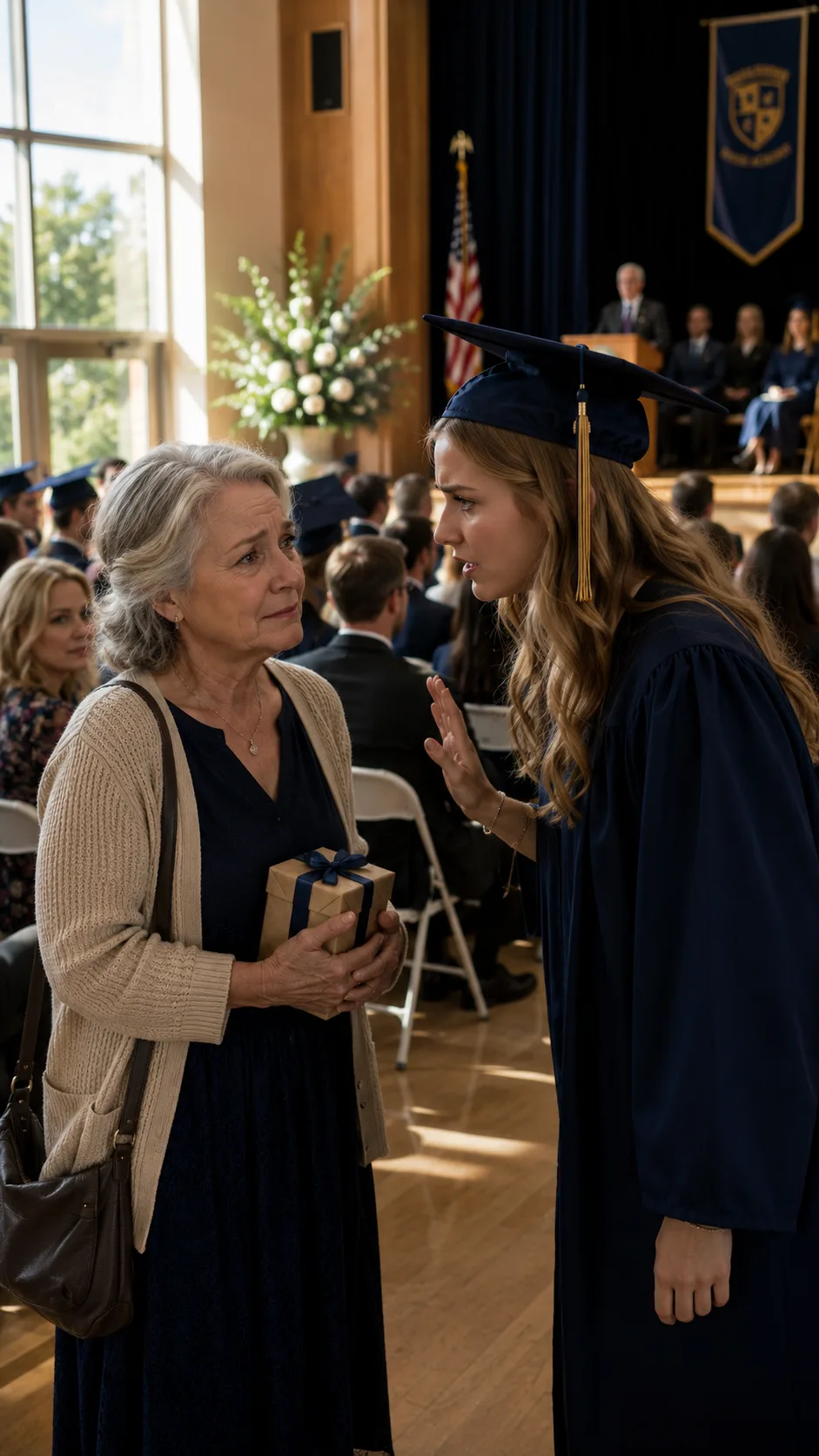
I moved quietly toward the last row and sat near the aisle.
A few minutes later, Emily came down from the side of the stage, walking fast.
“Grandma,” she whispered sharply.
I looked up. “Hi, sweetheart.”
“What are you doing here?”
“I came to see you graduate.”
“I told you not to come.”
Her voice was low, but the words cut.
“I know.”
“Then why would you do this?”
I glanced around. A few students were watching.
“I’ll stay in the back. No one has to know.”
Emily’s jaw tightened.
“That’s not the point.”
“What is the point?”
She leaned closer.
“My friends are right there.”
“Then go back to them.”
Her eyes flicked to the box in my lap.
“What’s that?”
“A gift.”
“Please don’t give it to me here.”
I looked down at the silver paper.
“All right.”
She exhaled, irritated.
“And please don’t tell anyone you used to work at that diner.”
My fingers tightened around the box.
A boy standing behind her heard enough to smirk.
One of Emily’s friends, a girl with glossy brown hair and pearl earrings, walked up.
“Em? Everything okay?”
Emily straightened instantly.
“Yes. Fine.”
The girl looked at me politely.
“Hi.”
I smiled. “Hello.”
Emily’s face flushed.
“She’s just… someone my family knows.”
The girl nodded vaguely and walked away.
Someone my family knows.
Not even family friend this time.
Less than that.
A person near the family.
An old woman holding a gift in the back row.
Emily turned back to me.
“Please don’t make this harder.”
I felt something in me go very quiet.
“I won’t.”
She left.
I watched her walk back toward the stage.
The ceremony began ten minutes later.
The orchestra played. The graduates filed in. Parents stood with phones held high. The principal, Dr. Howard, gave a speech about excellence, service, integrity, and the responsibility of privilege.
I almost laughed at that word.
Privilege.
People talked about privilege like it always arrived wearing diamonds.
Sometimes privilege looked like being able to hide where you came from.
Sometimes it looked like being embarrassed by the hands that helped lift you.
Emily gave the student address.
I had not known she was speaking.
She stood at the podium, calm and bright, and talked about dreams, ambition, and becoming the kind of people who changed the world.
“Westbrook taught us that success is not just about where we begin,” she said, “but where we dare to go.”
The room applauded.
I clapped too.
Even with my heart sore, I clapped.
Because love does not disappear just because it is wounded.
After the diplomas, Dr. Howard returned to the podium.
“Before we conclude,” he said, “we have one final honor to announce.”
The room settled.
“This year, Westbrook Academy is proud to formally name the largest student aid award in our school’s history.”
I sat up slightly.
I knew this part was coming.
The fund had grown. The board had asked months earlier if they could publicly recognize it. I had said no at first.
Then Dr. Howard had asked gently, “Mrs. Bennett, do you know how many students think help comes from nowhere? Sometimes knowing a real person cared enough to sacrifice changes them.”
I had agreed to let the name be used.
But I had asked them not to make a fuss.
No speech.
No spotlight.
Just the name.
Dr. Howard continued, “The Rose Bennett Future Fund will provide full college support for twelve students this year.”
A ripple moved through the auditorium.
Emily’s head snapped toward the podium.
David, near the front, went completely still.
Melissa turned halfway around, searching the room.
Dr. Howard smiled.
“For many years, the donor behind this fund asked to remain private. But today, with her permission, we are honored to recognize a woman whose life reminds us that service is not small. Service is the foundation of every decent community.”
My breath stopped.
That was more than we had discussed.
On the screen behind him, a photograph appeared.
I heard the first gasp before I even turned my head.
It was me.
I was twenty-six in the picture, standing behind the counter at Miller’s Diner, wearing my pink uniform and white apron, holding a coffee pot in one hand. My hair was dark then, pinned up badly because I never had time to fix it. My name tag was bright and clear.
ROSE.
The auditorium became strangely silent.
Dr. Howard’s voice softened.
“Rose Bennett worked more than four decades as a waitress. She raised a son, cared for her late husband, and quietly saved money most people would have spent on comfort. Instead, she used it to build scholarships.”
I stared at the floor.
My face burned.
Not because I was ashamed.
Because hundreds of people were looking at a version of me I had kept private—not hidden, but sacred.
He continued.
“She has paid for lunches, uniforms, textbooks, application fees, and tuition deposits. She has helped students at Westbrook and across this county take steps into futures they thought were closed to them.”
A girl in the second row began crying.
A boy near the aisle covered his mouth.
Dr. Howard turned toward the back of the auditorium.
“Mrs. Rose Bennett, would you please stand?”
For one second, I could not move.
Then a teacher rose to her feet and began clapping.
Another teacher stood.
Then a parent.
Then several students.
The applause spread like rain becoming a storm.
By the time I stood, the entire auditorium was on its feet.
I held the little silver box against my chest.
My knees trembled.
At the front, David had both hands over his mouth.
Melissa’s face was pale.
And Emily…
Emily stood frozen on the stage, her diploma hanging at her side, her eyes wide and wet.
The girl with pearl earrings leaned toward her and whispered something.
Emily did not answer.
Dr. Howard gestured for me to come forward.
I wanted to shake my head.
I wanted to sit down.
I wanted to disappear back into the last row where no one expected anything of me.
But then I saw three students standing near the stage, crying openly.
And I understood.
This was not about me.
It had never been about me.
I walked down the aisle.
People kept clapping.
Some reached out to touch my arm as I passed.
“Thank you,” one mother whispered.
A young man in a graduation gown stepped into the aisle with tears in his eyes.
“My mom said I couldn’t go to college,” he said. “Your fund changed that.”
I swallowed hard.
“I’m proud of you,” I whispered.
When I reached the stage stairs, Emily took one step forward as if she wanted to help me.
Then she stopped, unsure she had the right.
That broke my heart more than anything else.
Dr. Howard handed me the microphone.
I had not prepared a speech.
I looked out at the sea of faces.
Then I looked at Emily.
My granddaughter, who had wanted me hidden.
My granddaughter, who now could not hide from me.
I held the microphone with both hands.
“My name is Rose Bennett,” I said.
My voice shook, but it carried.
“And yes, I was a waitress.”
No one laughed.
No one whispered.
So I kept going.
“I served coffee to people who never looked up from their newspapers. I wiped tables after children spilled syrup. I worked double shifts when my son needed school shoes. I came home with sore feet, aching hands, and sometimes only twelve dollars in tips.”
I paused.
Emily’s face crumpled.
“But I was never ashamed.”
The auditorium went completely still.
“Honest work fed my family. Honest work kept our lights on. Honest work taught me that every person deserves to be seen, whether they are sitting at the table or cleaning it after everyone leaves.”
My eyes found Emily again.
“I don’t believe poverty makes a person small. I believe forgetting kindness does.”
Emily covered her mouth.
A tear ran down her cheek.
I lifted the little gift box.
“I brought this today for my granddaughter. I wasn’t sure I should give it to her. But I think maybe today is the right day.”
I opened the box and took out my old name tag.
A camera from the school livestream zoomed in, and the image appeared on the screen behind me.
ROSE.
Small.
Plastic.
Worn.
The room let out a collective breath.
“This little name tag paid for more dreams than any diamond I ever owned,” I said.
Then I turned fully toward Emily.
“And I hope one day, sweetheart, you’ll understand that the people who serve are not beneath you. Sometimes they’re the reason you’re standing where you are.”
Emily broke.
Not quietly.
Not politely.
She sobbed once, hard, in front of everyone.
Then she ran across the stage.
Emily reached me so fast that her graduation cap slipped sideways.
She stopped a foot away, shaking.
For a second, she looked like she had when she was five and had broken my favorite teacup, terrified that love could be taken away because of one mistake.
“Grandma,” she whispered.
The microphone caught it.
The whole auditorium heard.
“I’m sorry.”
I lowered the microphone.
She looked at the name tag in my hand, then at my face.
“I’m so sorry.”
I wanted to tell her it was all right.
But it was not all right.
Some wounds should not be covered too quickly just because the person who caused them finally starts crying.
So I said the truth.
“You hurt me, Emily.”
Her chin shook.
“I know.”
“You made me feel like my life was something dirty.”
“I know.”
“You looked at the hands that held you as a baby and wished nobody would notice them.”
Her sob caught in her throat.
Behind us, the auditorium remained silent.
No one moved.
No one wanted to breathe too loudly.
Emily wiped her cheeks with both hands.
“I was scared,” she said. “Everyone here acts like where you come from decides what you’re worth. I thought if they knew, they’d think less of me.”
“And did they?”
She looked out at the audience.
Hundreds of people were still standing.
Some crying.
Some holding their hands over their hearts.
The girl with pearl earrings was crying too.
Emily shook her head.
“No.”
I held out the name tag.
“Then maybe today you learned something worth more than a diploma.”
She stared at it.
Then, slowly, she took it with both hands.
The moment she did, applause erupted again.
Not the polite applause from ceremonies.
This was loud.
Messy.
Human.
Emily clutched the name tag to her chest and cried harder.
David walked onto the stage next.
He looked older than he had that morning.
His polished image had cracked, and underneath it was my son—the little boy who used to sit in a diner booth doing homework while I worked closing shifts.
“Mom,” he said.
I turned to him.
His eyes were red.
“I should have stopped this.”
“Yes,” I said.
He flinched.
“I should’ve told her the truth.”
I studied his face.
“What truth, David?”
He looked at Emily, then at the audience.
His voice broke.
“That you didn’t just work to feed me. You gave up college for me.”
Emily turned sharply toward him.
“What?”
David wiped his face.
“My mother had a scholarship,” he said. “Before I was born. She wanted to become a teacher.”
I closed my eyes.
I had not expected him to say that.
The auditorium quieted again.
David continued, voice rough.
“My father got sick when I was little. Medical bills piled up. Mom worked at the diner because it paid cash tips and let her take extra shifts. She never went back to school. She never complained. And when I got older, I acted like the life she gave me was something I had outgrown.”
Melissa was crying now, too.
David turned to me.
“I let my daughter feel ashamed because somewhere along the way, I became ashamed too.”
The honesty of that sentence hit me harder than any apology.
Because I had known.
Of course I had known.
A mother always knows when her child starts editing her out of the picture.
David stepped closer.
“I’m sorry, Mom.”
I looked at the man I had raised.
For years, I had excused his distance. His busyness. His careful invitations that never included me when important people were around. I had told myself he was tired. Pressured. Trying to succeed.
But success had not made him cruel.
Fear had.
Fear of being seen as the son of a waitress.
Fear that everything he built could be questioned if people knew where he started.
I touched his cheek.
“You don’t owe me pride because other people are watching,” I said. “You owed me respect when no one was.”
He nodded, crying openly.
“I know.”
The ceremony ended differently than planned.
There was no smooth closing line. No perfect final song. Students surrounded me afterward in the lobby, one after another, telling me what the fund had done.
A girl named Marisol told me she had been working nights at her aunt’s bakery and thought she would have to turn down her college offer.
A boy named Aaron said the fund paid for his application fees after his father lost his job.
Another girl, Sophie, whispered, “I used to be embarrassed that my mom cleans houses. I’m going home to apologize to her.”
That one nearly undid me.
Emily stood beside me through all of it.
Not in front of me.
Not hiding me.
Beside me.
Every time someone asked, “Are you Mrs. Bennett’s granddaughter?” she answered clearly.
“Yes. She’s my grandmother.”
The first time she said it, her voice shook.
The tenth time, it did not.
Later, in the parking lot, the sunlight had turned softer. Families were taking pictures under trees. Graduates tossed caps. Parents hugged their children.
Emily walked with me to my car.
She still held the name tag.
The silver gift box was empty now.
For a while, neither of us spoke.
Then she said, “Grandma, can I ask you something?”
“Of course.”
“Why didn’t you tell me?”
“About the fund?”
She nodded.
I looked across the parking lot at students laughing in their gowns.
“Because I didn’t want love to become a performance.”
She frowned slightly.
“I don’t understand.”
“If people know you have money, some of them respect the money and mistake it for respecting you. I wanted you to learn to value people without needing a reason that impressed others.”
Emily looked down.
“I failed.”
I touched her arm.
“You made a mistake.”
“A terrible one.”
“Yes.”
She looked up, surprised by my honesty.
I smiled sadly.
“But terrible mistakes can still become turning points if you don’t run from them.”
She turned the name tag over in her fingers.
“I told my friends you were nobody.”
Her voice cracked.
“You are the reason I had birthday cakes when Dad was between jobs. You’re the reason I had books, and piano lessons, and someone cheering at every little school play. And I treated you like you didn’t belong at my graduation.”
Tears filled her eyes again.
“I don’t know how to fix that.”
“You don’t fix it with one apology,” I said. “You fix it with who you become after today.”
She nodded slowly.
Then she surprised me.
She walked away from me.
For one painful second, I thought she was leaving.
Instead, she went straight to her group of friends near the school fountain.
I watched her stand in front of them, still crying, still holding my old name tag.
I could not hear every word, but I saw her lift it.
Then I heard enough.
“This is my grandmother’s,” Emily said. “She was a waitress for forty-one years. And I was horrible to her because I cared more about what you thought than who she is.”
Her friends went silent.
One of the boys looked uncomfortable.
The girl with pearl earrings stepped forward.
“My mom was a cashier,” she said quietly. “Before she married my stepdad.”
Emily stared at her.
The girl shrugged, wiping her eyes.
“I never tell people either.”
Something shifted among them.
Not dramatically.
Not perfectly.
But honestly.
A few minutes later, Emily brought them over.
“Grandma,” she said, “this is Claire, Madison, Jordan, and Lily.”
They all greeted me politely.
Claire, the girl with pearl earrings, looked at me and said, “Mrs. Bennett, I’m sorry if I ever made Emily feel like she had to hide you.”
That was more maturity than most adults manage.
I smiled at her.
“Just don’t hide the people who loved you before you knew how to impress anyone.”
She nodded.
David and Melissa invited me to dinner that night.
For the first time in years, it did not feel like an obligation.
We went to a small family restaurant—not fancy, not expensive, just warm and busy. The waitress who served us was middle-aged, with tired eyes and quick hands. Her name tag said JANET.
Emily noticed before anyone else.
When Janet came to refill our water, Emily looked her in the eye and said, “Thank you.”
Janet smiled, surprised by the sincerity.
“You’re welcome, honey.”
After she left, Emily whispered, “I never paid attention before.”
“I know,” I said.
She looked ashamed.
“Everyone should.”
“Yes,” I said. “They should.”
Three weeks later, Emily posted a photo online.
Not one of the professional graduation portraits Melissa had paid for.
Not the one where Emily stood perfectly under the archway with flowers in her arms.
She posted a photo someone had taken from the side of the stage.
In it, I was holding the microphone with my old name tag in my palm. Emily stood beside me, crying, her cap crooked, her perfect image completely gone.
The caption read:
This is my grandmother, Rose Bennett. She worked as a waitress for forty-one years. I used to be embarrassed by that because I was too shallow to understand what dignity looked like. At my graduation, I learned that her hands built more futures than any title ever could. I am proud to be her granddaughter.
The post spread through the school first.
Then through the town.
Then farther.
Former students began commenting.
Mrs. Bennett helped pay for my nursing books.
Rose bought my lunch for three months and never told anyone.
That fund is why I’m at Ohio State.
My mom cried when she saw this. She worked diners too.
Emily read every comment.
Sometimes she called me crying.
“Grandma, you helped so many people.”
“I helped where I could.”
“No. You changed lives.”
I looked around my little kitchen, at the chipped mug by the sink, the old curtains, the sunlight on the floor.
Maybe I had.
But I had never thought of it that way.
I had simply remembered what it felt like to need help and be too proud to ask.
That summer, Emily came to my house twice a week.
At first, I thought guilt brought her.
Then habit.
Then love.
She helped me repaint the porch railing. She learned to make pie crust. She asked me stories about Miller’s Diner and wrote them down in a notebook.
One afternoon, she found an old photograph of me and Henry outside the diner.
“Grandpa looked so handsome,” she said.
“He knew it too.”
She laughed.
Then she grew quiet.
“Do you regret it?”
“What?”
“Not becoming a teacher.”
I thought about lying.
Then I decided she deserved the truth.
“Sometimes.”
Her face fell.
“But not because of your father,” I said. “Life asks things of us. Some choices are made from love, but love doesn’t mean they cost nothing.”
She wrote that down.
Years later, when Emily graduated from college, she wore my old name tag pinned inside her gown.
No one could see it unless she showed them.
But she knew it was there.
After the ceremony, she took me to a diner.
Not an expensive brunch place.
A real diner.
Vinyl booths. Coffee rings on the counter. Waitresses moving fast. Plates clattering. Someone laughing too loudly near the register.
Emily ordered coffee and pie.
Then she raised her mug.
“To honest work,” she said.
I tapped my mug against hers.
“To honest hearts,” I answered.
She smiled.
By then, the Rose Bennett Future Fund had grown larger than I ever imagined. Emily had helped build its website. David had joined the board—not as the man in charge, but as a son trying to honor what he once failed to protect. Melissa organized student events and, to her credit, never again tried to polish me into something more acceptable.
But the biggest change was quieter.
Emily stopped chasing rooms where she had to shrink her own history to be welcomed.
She became the kind of young woman who introduced me first.
“This is my grandmother Rose,” she would say. “She worked harder than anyone I know.”
And every time, I stood a little taller.
Not because my granddaughter finally gave me permission to be proud.
I had always been proud.
But because she had finally stopped being poor in the one way that mattered.
Poor in gratitude.
Poor in courage.
Poor in understanding.
The day of her Westbrook graduation could have remained the day she broke my heart.
Instead, it became the day she began repairing her own.
And that old name tag?
The one she once would have hidden?
She framed it.
Years later, it hung in the office of the scholarship foundation, beneath a simple brass plaque.
Not a long quote.
Not a fancy title.
Just one sentence.
The woman who served tables taught us how to serve people.
THE END.
Chapter complete
You have reached the end of this chapter.
Continue reading
A few more worlds to get lost in after this chapter.




