Avery Thompson noticed the missing chair before anyone said her name.
Chapter 1
Avery Thompson noticed the missing chair before anyone said her name.
It sat against the dining room wall, half-hidden behind a tall arrangement of dried wheat and orange roses, polished and empty, as if someone had set it aside for a guest who had canceled. The Thanksgiving table stretched beneath the chandelier in a long, glowing line of white china, crystal stems, folded linen napkins, and silverware placed with military precision. Every place setting had a card in her mother’s careful handwriting.
Derek Thompson.
Haley Thompson.
Margaret Thompson.
Charles Thompson.
Avery’s card had been placed near the end, between an old brass candlestick and a serving spoon.
Not beside her mother.
Not beside Derek.
Not anywhere close to her father.
She stood in the doorway with her coat over one arm and looked at the chair against the wall.
One extra chair.
One message.
Her mother appeared from the hallway wearing pearl earrings and a cream silk blouse that had probably
been pressed twice. Margaret Thompson carried a crystal dish of cranberry sauce as if the room might judge her if the sauce trembled.
“Avery,” she said. “You made it.”
“I said I would.”
“Yes, well.” Her mother glanced at Avery’s blazer, her low bun, the black leather bag hanging from one shoulder. “Traffic from the airport can be difficult this time of year.”
Avery smiled with her mouth only. “It was fine.”
Her mother looked past her toward the foyer. “No luggage?”
“At the hotel.”
That got a pause.
A small one.
Avery had once slept in the second bedroom upstairs, the one with pale blue wallpaper and a desk her father said was too cluttered. She had taken apart her first router on that desk. She had built a crude inventory tracker there at sixteen while her family watched football downstairs. She had left for Seattle with two suitcases
and a laptop that overheated if she opened more than six tabs.
Now the room had been turned into a “gift wrapping suite.”
Her mother had sent photos last Christmas.
Avery had not replied.
“You could have stayed here,” Margaret said.
“No,” Avery said. “I couldn’t.”
Her mother’s fingers tightened on the crystal dish.
Avery took it from her before it slipped.
“Where do you want this?”
“Table. Near your father.”
Of course.
The dining room smelled of roasted turkey, butter, rosemary, and furniture polish. Her father believed expensive homes should smell like nothing had ever gone wrong inside them. The walls were lined with framed family photographs: Derek shaking hands with executives, Haley at charity luncheons, her father at award dinners, her mother smiling beside donors.
Avery appeared in three photos.
One from high school graduation.
One from Derek’s wedding.
One from a family Christmas where she stood near
the edge of the frame, half-covered by a poinsettia.
She set the cranberry sauce near her father’s plate and adjusted the spoon so its handle pointed toward him. That small habit came from years of watching her mother do it. Everything in the house leaned toward Charles Thompson, even the silverware.
Derek entered with a glass of wine already in his hand.
“Ave,” he said.
He used the nickname like he had bought it.
“Derek.”
He looked older than she remembered, but not by much. His jaw had softened, his hairline had moved back a careful inch, and his navy sweater looked expensive in a way that wanted credit for being casual. He kissed her cheek and left the smell of wine and cedar cologne in the air.
“Seattle treating you well?”
“Yes.”
“Still consulting?”
There it was.
Not “building.”
Not “running.”
Not “founding.”
Consulting.
Avery reached for a water glass and filled it from the crystal pitcher.
“Still working.”
Derek gave a short laugh.
“That’s the spirit.”
He looked at her bag.
Not curious.
Dismissive.
He had always been good at seeing value only after a man in a suit told him where to look.
Haley came in next, phone in hand, hair glossy, nails pale pink, black dress hugging her like it had been chosen with three mirrors and an audience in mind. She kissed Avery’s cheek without touching her skin.
“You look so serious,” Haley said. “Is that a Seattle thing?”
“It’s a work thing.”
Haley glanced at Derek.
Derek smiled into his wine.
Avery set her glass down.
One ring of condensation appeared on the tablecloth.
Her mother noticed. Her eyes moved to it and back.
Nobody moved the glass.
Charles Thompson entered last.
He did not walk into rooms.
He arrived in them.
Her father wore a dark gray sport coat, no tie, white shirt open at the throat, watch visible at his cuff. At fifty-eight, he still carried himself like every doorway had been built at his request. His hair had gone silver at the temples, which made him look wise to people who mistook volume for authority.
“Avery,” he said.
“Dad.”
He leaned in and kissed the air beside her cheek.
The gesture landed nowhere.
“I’m glad you came,” he said.
Avery looked at him.
“Are you?”
His face did not change.
Then he smiled.
Dinner began exactly the way family meals in that house always did: with everyone performing warmth while measuring rank.
Her father carved the turkey even though the chef had already sliced it. Derek praised the new distribution-center expansion outside Indianapolis, though Avery knew from quarterly filings and two supplier calls that the expansion had overrun its budget by nearly six million. Haley talked about a charity auction where she had secured “excellent visibility” for the Thompson name. Margaret corrected the placement of a butter knife three times.
Avery ate slowly.
She listened.
That had always been her advantage.
When she was a child, adults mistook her silence for shyness. At thirteen, she had sat on the stairs while her father held late meetings in the study, absorbing words like margin, route density, client churn, compliance risk. At sixteen, she understood enough to know Thompson Logistics was surviving on old relationships and manual patches dressed up as proprietary systems.
At twenty-three, she had believed showing them the answer would be enough.
She had spent six weeks building a logistics dashboard that pulled warehouse throughput, driver utilization, route delays, and predictive demand into one clean operating layer. She had not slept the night before the company retreat in Wisconsin. Her presentation had been titled, badly, “Modernizing Operational Intelligence Across the Thompson Network.”
Her father had let her speak for three minutes.
Then he laughed.
Not a shout. Not cruelty with teeth.
A controlled laugh.
It made the room turn from her screen to him.
“People like Avery,” he had said, “sometimes confuse intelligence with leadership.”
Derek had been standing beside him.
Her father had put one hand on Derek’s shoulder.
“The future of this company will stay where it belongs.”
Avery had driven home that night with her laptop still open on the passenger seat, the dashboard glowing blue whenever the road lights passed over it. By morning, she had packed. By the next evening, she was in Seattle with two suitcases, a cracked phone charger, and three hundred eighty dollars she could touch without asking anyone’s permission.
Her family called it a phase.
Seattle called it Tuesday.
Nobody cared that she was a Thompson. Nobody asked whether she had been invited to the right rooms. She rented a studio in Ballard where the radiator hissed like a snake and the kitchen drawer stuck if the weather changed. She took freelance contracts that paid late, fixed code written by men who called themselves visionaries, and built her own tools after midnight with the stubbornness of someone who had already been humiliated and survived it.
She stopped using Avery Thompson in business.
She became Alex Rivera.
The name started as a shield.
Then it became a door.
By twenty-six, she had a lean analytics platform serving small warehouses that could not afford enterprise systems. By twenty-eight, she had clients in four states and a team of nine. By thirty, she had acquired two struggling route-forecasting tools, stripped out their nonsense, and merged them into one predictive operations suite. By thirty-two, investors who had once ignored her were asking for meetings with “Alex.”
She gave them meetings.
She gave them numbers.
She gave them nothing personal.
Avengers Holdings existed on paper first as a parent company for acquisitions. The name had been a joke from one sleepless night with her first engineer, Marcus, who said they were collecting broken systems like misfit heroes.
The joke stayed.
The company grew teeth.
Avery learned patience the hard way. She studied markets, watched legacy operators refuse to modernize, and tracked every mid-sized logistics platform still pretending reputation could outrun automation. Thompson Logistics became one of those names on a board in her office.
Not because it was family.
Because it was vulnerable.
Old contracts. Aging infrastructure. Weak data integration. A leadership team more loyal than skilled. A CEO who believed relationships were a moat even while the river dried around him.
She sent one partnership proposal through intermediaries.
Quiet.
Generous.
A soft door.
Her father rejected it in eleven days.
The email had come through counsel: Thompson Logistics was not interested in speculative technology partnerships with companies lacking “institutional continuity.”
Institutional continuity.
Marcus had laughed for almost a full minute.
Avery had not.
She printed the rejection, folded it once, and placed it inside a black folder she kept in her desk. Not for revenge.
Not exactly.
For memory.
Six months later, Avengers Holdings began exploring acquisition targets in the Midwest.
Three months after that, Thompson Logistics entered conversations through a boutique advisory firm in Chicago.
Two weeks before Thanksgiving, Avery signed the internal approval memo authorizing the final offer.
Fifty-three million.
Her father thought he had found a buyer.
He had found the daughter he once dismissed, wearing a different name and holding cleaner numbers than he had ever demanded from Derek.
Now she sat at his table while Derek explained to Haley that “market consolidation is inevitable” using phrases he had stolen from people who worked harder than he did.
Avery cut into a piece of turkey.
Dry.
She set down her knife.
Her father checked his phone once.
Then again.
Derek noticed on the second glance. His posture shifted, a tiny lift in the shoulders. Haley saw Derek shift and turned her phone screen down. Margaret looked at Charles and pressed her lips together.
Avery saw all of it.
The room had been rehearsed.
That made sense. Charles Thompson did not improvise family wounds. He preferred them polished.
He waited until dessert plates had been placed but before anyone had taken a bite of pumpkin pie. Good timing, Avery thought. The sweetness would sit there untouched after he finished.
Her father stood.
He tapped the side of his glass with a knife.
Crystal rang through the dining room.
Clean.
Controlled.
Every face turned toward him.
“I have something important to share,” Charles said.
Derek set his wine down and folded his hands.
Too ready.
Haley lifted her eyebrows, already performing surprise for later. Margaret lowered her eyes to her napkin.
Avery stayed still.
Her glass sat near her right hand, water beading down its side.
“As many of you know,” Charles said, “the logistics technology market has changed significantly. The past few years have brought increased competition, increased regulatory pressure, and new expectations from clients.”
Derek nodded like he had written the speech.
He had not.
Avery knew the language of the advisory deck. She had approved the acquisition team’s summary herself.
Her father continued.
“After careful consideration, I’ve decided that the best path forward for Thompson Logistics Systems is a sale.”
Haley’s lips parted.
“A sale?”
Margaret touched her napkin to the corner of her mouth though there was nothing there.
Derek stayed silent.
Avery looked at him.
That was enough.
He knew.
Maybe not everything. But enough to feel crowned.
Charles raised one hand.
“This is not a loss. It is a strategic transition. The company will be protected, employees will be retained where appropriate, and the Thompson family will be well positioned.”
Where appropriate.
Avery had once heard him use the same phrase before cutting an entire customer support team.
Haley’s hand moved toward her phone.
“Dad, what does this mean for us?”
“For the family,” he said, “it means stability.”
Derek looked down to hide a smile and failed.
Avery picked up her fork and placed it across the top of her plate.
Her father’s eyes found the movement.
Then he looked at her fully.
Here it comes.
“There are, however, certain matters that should be understood clearly tonight,” Charles said.
Margaret said, “Charles.”
He did not look at her.
“Avery, you left this family’s business years ago. You made it clear you wanted your own path. I respect that.”
No, he did not.
He had never respected a path he had not paved.
“But that choice has consequences. Derek has remained involved. Haley has supported the family’s public commitments. Your mother has been at my side through every stage of this company’s growth.”
He paused.
Derek looked at his plate.
Haley blinked quickly.
Avery’s hand remained beside her glass.
“So there will be no role for you in this transition,” Charles said. “No shares. No advisory position. No claim on the proceeds. I think it’s better to state that plainly now rather than invite confusion later.”
The room made tiny sounds.
A candle hissed.
A fork touched porcelain.
Haley whispered, “Dad, maybe not at dinner.”
Derek said nothing.
That was worse.
Margaret’s face had gone smooth, the way porcelain goes smooth right before it cracks.
“Charles, we discussed wording.”
“I’m being honest,” he said.
Avery looked at the centerpiece. Tiny white pumpkins nestled between dried wheat and eucalyptus leaves. One pumpkin had a faint brown bruise on its side, turned away from the room.
She almost smiled at that.
Almost.
Her father’s eyes stayed on her, waiting.
He wanted tears.
Or protest.
Or the familiar heat of a daughter forced back into the role assigned to her: too much, too sharp, too difficult, too late.
Avery reached for her water.
One sip.
Ice touched her teeth.
She set the glass down in the same damp circle on the linen.
“No response?” Charles asked.
“Not to that.”
Derek’s head lifted.
Haley stared at her.
Charles let out a quiet laugh. The same type. Smaller now, but cut from the same cloth as the laugh in Wisconsin.
“Avery, this is exactly what I mean. You’ve always had intelligence, but you never understood family order.”
Avery folded her napkin once.
“Family order.”
“Yes,” he said. “Structure. Continuity. Trust.”
Derek had the nerve to nod.
Avery looked at her brother.
“How long have you known?”
He shifted.
“Known what?”
“About the sale.”
Derek glanced at their father before answering. A child’s move.
Still.
“A few weeks.”
Haley sat back.
“A few weeks?”
“It wasn’t final,” Derek said.
“Final enough for you to look like that,” Avery said.
His face tightened.
Charles placed both hands on the table.
“This is not an interrogation.”
“No,” Avery said. “It’s dinner.”
Margaret said her name under her breath.
Avery did not look away from Derek.
Derek picked up his wine and drank too much in one swallow.
“Don’t make this ugly.”
Avery looked around the table.
The chandelier light softened every hard surface. The house had always been good at that. Gold over bruises. Crystal over rot.
“I’m not making anything,” she said.
Her father’s smile returned, thinner now.
“Good. Then we can toast.”
He lifted his glass.
Derek followed immediately.
Haley hesitated, then lifted hers.
Margaret raised hers halfway.
Avery’s glass remained on the table.
Charles noticed.
Everyone did.
“Avery,” he said.
There was warning in it.
Avery glanced at the wine in his hand, then at the dessert no one had touched. Pumpkin pie. Whipped cream. A silver serving knife angled toward her father like a small blade.
She asked one quiet question.
“Dad, who’s the buyer?”
For a second, Charles looked almost amused.
That helped him make the mistake properly.
“Avengers Holdings,” he said. “They’re paying fifty-three million.”
The name entered the room and sat down before anyone knew what it meant.
Haley frowned.
“Avengers?”
Derek said, “Big group. West Coast, I think.”
Avery kept her eyes on her father.
Charles looked pleased with Derek’s answer.
“They’ve been acquiring operational software firms and logistics platforms. Strong capitalization. Aggressive growth plan. Good fit.”
Avery nodded once.
“Good fit,” she repeated.
“Yes.”
“And they passed diligence?”
Charles’s mouth tightened.
“Of course they passed diligence.”
“Employee retention?”
“Under negotiation.”
“Data migration risk?”
Derek cut in.
“Avery, come on.”
She did not look at him.
“Client contract assignment?”
Her father’s fingers tightened around the stem of his glass.
“I don’t need to explain the terms to you.”
“No,” Avery said. “You don’t.”
The room changed by one degree.
Not visibly.
Not enough for anyone to name.
But Margaret’s hand moved away from her napkin. Haley stopped touching her phone. Derek’s eyes narrowed with the delayed suspicion of a man hearing a language he should have studied.
Charles set down his wine glass.
“What are you implying?”
Avery rested both hands in her lap.
“I’m asking about the buyer.”
“I told you the buyer.”
“Yes.”
She reached down to her bag.
Derek leaned forward.
“What are you doing?”
Avery unzipped the bag.
The sound was soft, almost swallowed by the dining room. Leather moved against leather. Metal teeth parted. Her hand found the card case immediately because she had placed it in the inner pocket before leaving the hotel.
Black.
Matte.
Heavy.
She took out one card.
Not a folder.
Not a contract.
Not proof thick enough to impress people who had ignored proof all their lives.
One card was cleaner.
Her father watched her hand with irritation first.
Then confusion.
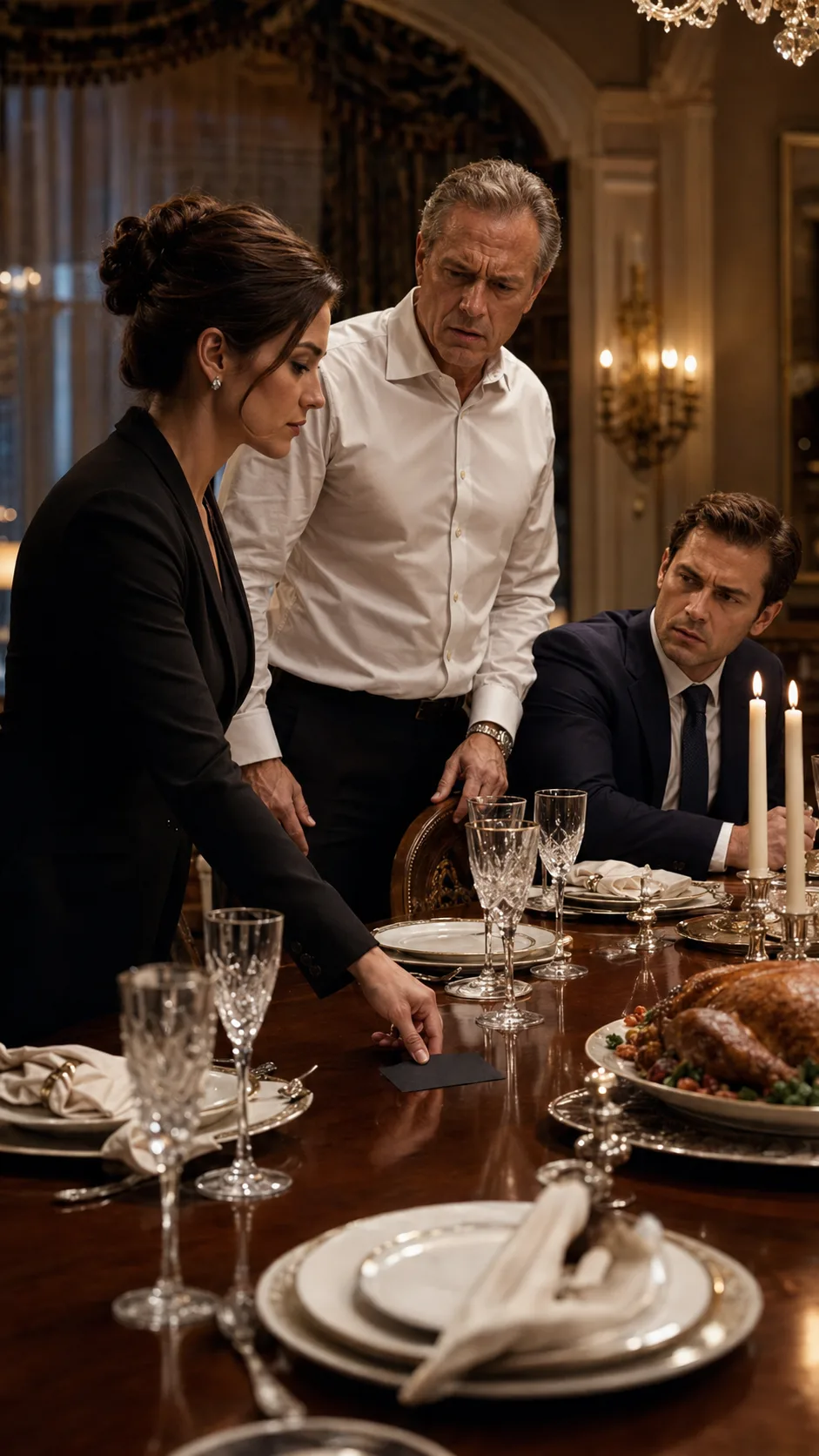
Avery placed the card on the table between the crystal glasses and the cranberry sauce.
The sound was nearly nothing.
Still, the whole room heard it.
The black card lay against the white linen like a door cut into the table.
Charles looked down.
Derek leaned toward it.
Haley whispered, “What is that?”
Avery did not answer.
Her father read the top line.
AVENGERS HOLDINGS.
His face held for one second.
Then his eyes moved lower.
Chief Executive Officer.
Alex Rivera.
A smaller line beneath it carried her legal name for regulatory purposes and board documentation.
Avery Thompson.
Charles did not move.
Not his hands.
Not his mouth.
Only his eyes, once, back to the top of the card.
Derek reached for it.
Avery’s fingers landed on the edge before he touched it.
“No.”
Derek froze.
One word had stopped him.
That was new.
Haley stood halfway, then sat again. Her chair legs scraped the rug. Margaret pressed one hand against the table, but not to stand.
To stay upright.
Charles looked at Avery.
For the first time that night, he did not look like a father. He looked like a CEO staring at a number that made no sense until it ruined him.
“You?” he said.
Avery took her hand off the card.
“Yes.”
His mouth opened.
Closed.
Derek grabbed his phone.
“This is some kind of joke.”
“Search it,” Avery said.
He did.
The room waited.
His thumb moved too fast. His face changed too slowly.
Haley leaned over his shoulder.
Derek stopped scrolling.
No one spoke for a long time.
Outside, somewhere beyond the tall windows, a car passed along the road, tires whispering over cold pavement.
Charles finally picked up the card.
He held it by the corner like it might stain him.
“You used a false name.”
“A professional name.”
“You hid behind intermediaries.”
“You rejected the direct proposal.”
His eyes snapped up.
Avery nodded toward the card.
“Eleven days. That was all it took you to dismiss it.”
Margaret looked at Charles.
“What proposal?”
Avery did not answer for him.
Charles put the card back on the table, but his fingers did not release it right away. He was still trying to claim contact with the thing that had exposed him.
“You manipulated this transaction,” he said.
“No. I built a company that could afford it.”
Derek stood.
“You targeted us.”
Avery looked at him then.
Really looked.
At the brother who had accepted every open door and called it merit. At the man who had nodded while their father erased her. At the heir who had never once asked whether he was inheriting a crown or a crumbling roof.
“I evaluated an asset,” she said.
His jaw worked.
No words came out.
Haley sat down fully. Her phone lay dark beside her plate.
Margaret’s voice was thin.
“Avery, why didn’t you tell us?”
Avery looked at her mother.
That question deserved a room of its own.
She could have said because every idea I brought home was treated like noise.
She could have said because you watched him laugh.
She could have said because none of you asked who I became after I left.
Instead, she picked up her water glass and took one sip.
“You didn’t ask.”
Margaret lowered her eyes.
Charles pushed back from the table. His chair struck the rug with a heavy muffled sound.
“This deal is not closed.”
“No,” Avery said. “But your board approved exclusivity. Your advisors have my team’s revisions. Your debt covenants don’t leave you much room after the Indianapolis overrun.”
Derek’s head turned sharply toward Charles.
Haley said, “What overrun?”
Charles ignored her.
“You had no right to access internal financials.”
“They were provided in diligence.”
“Through counsel.”
“Yes.”
“With my authorization.”
“Yes.”
The word landed quietly.
That made it worse.
Avery stood.
Not fast.
Her chair slid back neatly.
The room looked different from standing height. The centerpiece looked smaller. Her father looked older. Derek looked like a man trying to find a door in a wall he had never noticed before.
Avery picked up the card and slid it back into the case.
Charles’s eyes followed it.
“You think this makes you powerful?” he asked.
Avery put the case into her bag.
“No.”
She looked at the table, at the untouched pie, at the extra chair still resting against the wall.
“It makes me the buyer.”
Derek laughed once, harsh and wrong.
“You can’t run Thompson Logistics.”
“I don’t plan to run it the way you did.”
“I didn’t run it.”
“I know.”
That shut him up.
Haley put both hands flat on the table.
“So what happens to us?”
There it was.
Not the employees.
Not the clients.
Us.
Avery looked at her younger sister. Haley’s face had lost its polish around the edges. She looked twenty years younger for half a second, like the girl who used to stand in Avery’s doorway asking for help with math homework and then forget to say thank you.
“The company continues,” Avery said. “The people who do real work will have a chance to keep doing it.”
Derek’s face reddened.
“And me?”
Avery looked at him.
No one else moved.
“You’ll be interviewed.”
He blinked.
“Interviewed?”
“For a position you’re qualified to hold.”
His hand curled around the back of his chair.
Charles stepped forward.
“You will not humiliate your brother.”
Avery turned to him.
“You did that. You just made him believe a company was an inheritance instead of a responsibility.”
Charles’s face went flat.
That had found bone.
Margaret stood at last.
“Enough.”
The word had no power left in it.
Avery looked toward the window. In the dark glass, the chandelier reflected above all of them like a gold cage. She could see herself there too, a dark figure at the end of a table where she had once tried so hard to be chosen.
She had expected triumph to feel louder.
It did not.
It felt like setting down a weight and hearing how hard it hit.
Charles lowered his voice.
“What do you want?”
Avery looked back.
That was the question he should have asked when she was sixteen and building dashboards no one requested. When she was twenty-three and standing in front of his executives with six weeks of work in her hands. When she was twenty-eight and sending money to payroll before paying herself because the company might not survive the month.
Now it arrived dressed as negotiation.
“I want the signed employee retention schedule by Monday,” she said. “I want the Indianapolis liabilities disclosed without creative language. I want Derek removed from all transition communications unless my team requests him. I want Haley’s consulting agreement terminated before closing.”
Haley’s mouth fell open.
“My what?”
Avery looked at her.
“The one paying you twelve thousand a month for brand visibility.”
Derek stared at Haley.
Margaret closed her eyes.
Charles said nothing.
Avery picked up her coat from the back of her chair.
“And I want Granddad’s original ledger from the study.”
Her father’s face shifted.
Small.
Sharp.
That one mattered.
“The ledger has nothing to do with the sale,” he said.
“No,” Avery said. “It has to do with me.”
Her grandfather had kept the first five years of Thompson Logistics in a green cloth ledger with frayed corners. Fuel receipts. Driver names. Handwritten client notes. The first profit entry circled twice in blue ink. When Avery was ten, he had let her hold it at the kitchen table and told her companies were just promises written carefully enough that people could stand on them.
After he died, Charles locked it in the study cabinet.
Avery had asked for it once.
Her father had said, “That belongs with the company.”
Now she owned the next answer.
Charles looked at her for a long time.
Then he reached into his pocket, took out a key ring, and removed one small brass key. He placed it on the table.
Not near her.
Near the centerpiece.
Avery walked around the table and picked it up.
The key was warm from his hand.
No one stopped her.
She left the dining room without saying goodbye.
The hallway outside was quieter than she remembered. Family photos lined the wall, all in silver frames. She passed Derek at fourteen holding a tennis trophy, Haley at sixteen in a white dress, her parents at some gala where her father held a plaque and her mother held his arm.
There was one photo of Avery in a blue graduation gown.
She paused before it.
Her smile in the picture looked careful, like she had already learned not to take up too much space.
She kept walking.
The study smelled of leather, dust, and old paper. Charles had not changed it much. Same walnut desk. Same green banker’s lamp. Same locked glass cabinet beside the bookcase.
The brass key turned with a small click.
Inside, the ledger sat on the second shelf.
Green cloth.
Frayed corners.
Smaller than she remembered.
Avery took it down with both hands.
A receipt slipped from the back pages and fluttered onto the rug. She bent to pick it up. It was for fuel, dated thirty-eight years earlier, stamped with a gas station name that no longer existed.
On the bottom, in her grandfather’s handwriting, were four words.
Paid late. Keep promise.
Avery read them twice.
Then she placed the receipt back where it belonged.
When she returned to the foyer, Margaret stood near the staircase.
Alone.
Her mother had wrapped both arms around herself, though the house was warm.
“Avery,” she said.
Avery stopped.
Margaret looked at the ledger in her hands.
“He would have wanted you to have that.”
Avery waited.
Her mother swallowed.
“Your grandfather.”
The chandelier above the foyer hummed faintly. Somewhere behind them, a door closed too hard. Derek, probably. Or Charles. It no longer mattered which.
Avery said, “You could have said that sooner.”
Margaret’s mouth moved.
No answer came.
Avery nodded once, not cruelly, not kindly.
Then she opened the front door.
Cold air entered the house.
The kind that does not ask permission.
Outside, the driveway lights glowed along the stone path. Her rental car waited beneath a maple tree stripped nearly bare for winter. One brown leaf clung to a branch above the windshield.
Avery placed the ledger on the passenger seat beside her bag.
For a few seconds, she stood with one hand on the car door and looked back at the house.
From the street, it still looked warm.
Gold windows.
Brick walls.
A family home.
Avery got into the car and started the engine. The dashboard lit softly. Her phone buzzed once with a message from Marcus.
How bad?
She looked at the house one more time.
Then she typed back.
Clean.
She put the phone face down, shifted into reverse, and backed out of the driveway.
No one came after her.
That was fine.
Some doors are better closed from the outside.
Chapter complete
You have reached the end of this chapter.
Continue reading
A few more worlds to get lost in after this chapter.




