My mother’s text arrived while I was standing in the detergent aisle at Target, holding two bottles of the same brand and trying to decide whether spring rain or lavender sounded less fake.
Chapter 1
My mother’s text arrived while I was standing in the detergent aisle at Target, holding two bottles of the same brand and trying to decide whether spring rain or lavender sounded less fake.
Thanksgiving. Everyone will be here. It’s time to come home and stop being dramatic.
No hello. No how are you. No mention of the six months of silence she had enforced with the same precision she used on table settings and charity seating charts.
Just a command.
I stared at the message until the bottles blurred into purple and blue plastic. A woman beside me reached for stain remover and gave me the careful look strangers give when they can tell you are standing still for the wrong reason.
I put both bottles back.
Not today.
In my family, silence had always been treated like a virtue, but only when it belonged to me. My father, Richard Devereux, called it maturity when I swallowed an insult. My mother, Evelyn, called it respect when I let her rewrite something she had said. My older brother, Logan, called it “not being so
sensitive” when he laughed at the parts of me he had helped break. Madison, my younger sister, usually looked down at her phone until it was over.
That was how we stayed elegant.
The Devereux family did not fight in public. We smiled. We donated. We served on boards. We dressed in muted colors and never raised our voices where anyone useful could hear. My father owned Devereux Development Group, a real estate company with municipal contracts, private investors, and a reputation built on handshakes at golf clubs. My mother chaired fundraising committees. Logan worked at the company under the title of Vice President of Strategic Growth, which was a beautiful name for spending other people’s money and arriving late to meetings.
For years, I had handled the parts nobody wanted photographed.
Invoices. Donor records. Vendor contracts. Insurance letters. Old emails that should have been deleted. I had started in
the company after college because my father said family built together. By twenty-six, I knew more about his business than half the men who called him brilliant over bourbon.
Then I found the first forged signature.
It was mine.
Not exactly mine. A practiced imitation. Good enough to pass through a bank employee who had never met me, bad enough to make my fingers go cold when I saw it attached to a loan guarantee I had never signed.
I confronted my father privately because I was still naïve enough to think privacy would make him decent.
He leaned back in his office chair and said, “Do you understand how many people depend on this company?”
I said, “You used my name.”
He looked at me over his reading glasses. “Your name exists because of this family.”
That was the first crack.
There were others. A shell vendor connected to
Logan. A charitable foundation my mother used like a private purse. A property transfer involving my grandmother’s trust. Missing invoices. Inflated renovation bids. A city inspector’s email sent from the wrong account at 2:13 a.m.
I copied everything.
Not because I planned revenge. Not at first. I copied it because every person who had ever told the truth in my family had eventually been told they remembered it wrong.
Six months before Thanksgiving, I left.
I resigned from the company by email, moved into a small apartment above a bakery in New Haven, and stopped answering family calls after my mother left a voicemail saying I was punishing them for loving me too much. My father sent one message through his assistant asking for the company laptop. Logan texted a laughing emoji and said I had never had the stomach for real business.
Then came the lawyer.
Her name was Maren Bell, and she had silver hair, narrow glasses, and the kind of office where even the plants looked like they had signed NDAs. I went to her with one folder and left three hours later with instructions, dates, and the first clear sentence anyone had given me in months.
“Do not warn them again,” she said.
So I didn’t.
When my mother’s Thanksgiving text arrived, I had already signed statements, uploaded records, and given Maren permission to file if my father tried to drag me back into anything with my name on it. There were three calls in my phone marked only by initials: M.B., H.C., and D.R. Lawyer. Bank investigator. State contractor compliance officer.
I did not want to use them.
I wanted one dinner where my family proved they could sit across from me without needing someone to bleed.
That was stupid.
But I went anyway.
The Devereux house sat at the top of a private road in Greenwich, all glass, stone, and old money trying very hard to look older. Warm light spilled from every window when I pulled into the driveway. Luxury cars lined the curve: Mercedes, Range Rovers, two black town cars, Madison’s fiancé’s silver Porsche parked badly near the fountain.
The backup folder was in the glove compartment.
I looked at it once before I got out.
The bakery downstairs from my apartment had sent me with a paper box of cranberry-orange rolls because I had not known how to show up empty-handed to a house that had emptied me. The box left a crescent of butter on the passenger seat.
A tiny, ridiculous stain.
I carried it to the door.
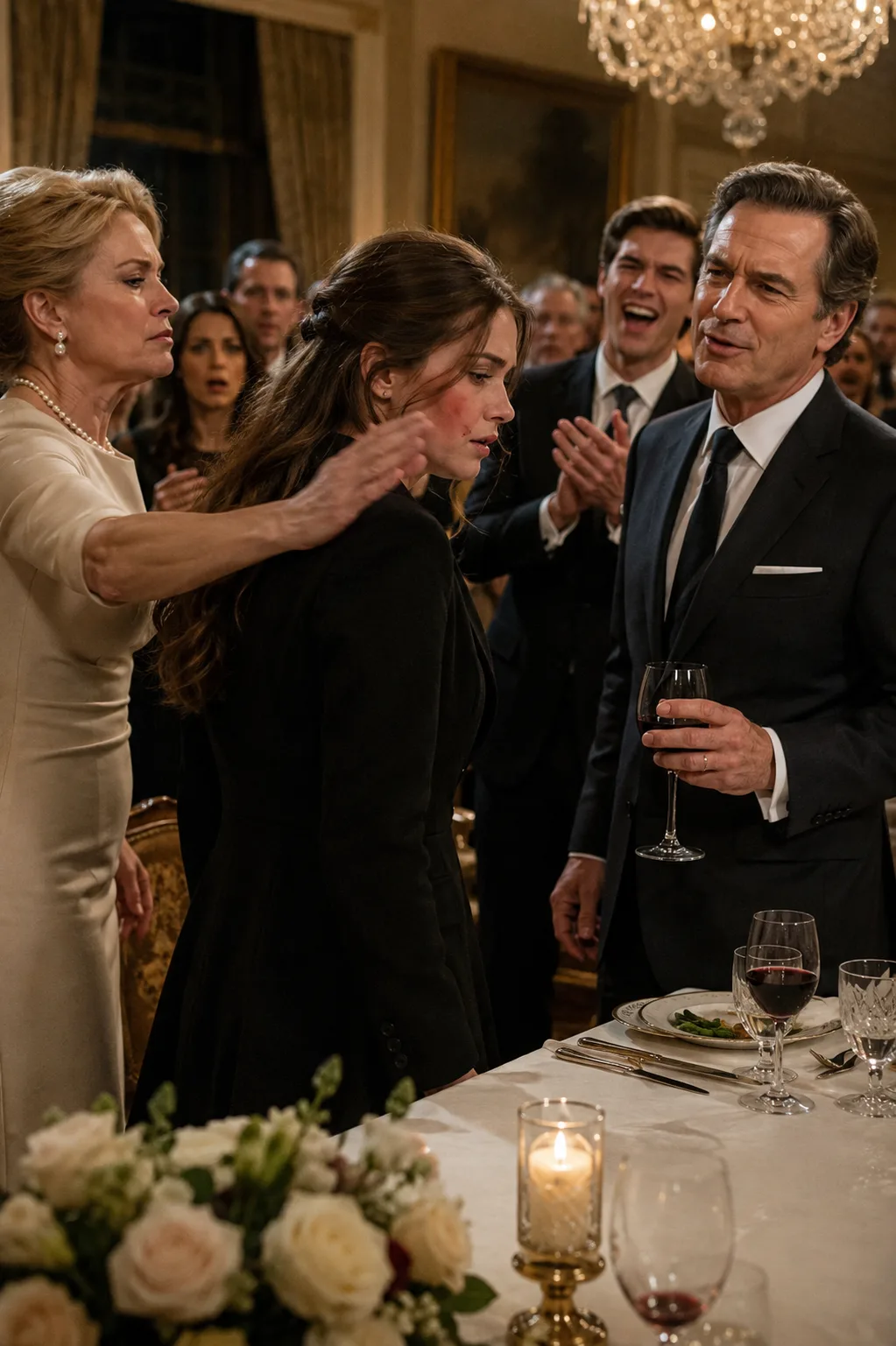
My mother opened before I rang. She wore a cream dress, pearls at her throat, and the expression she used when photographers asked for one more picture.
“Claire.”
“Mom.”
Her eyes moved over my coat, my hair, the bakery box.
“You brought something.”
“It’s from a local place.”
“How rustic.”
She took the box like it might leak poverty onto her floor. Then she leaned in and gave me a hug that touched shoulders and nothing else.
“Try not to embarrass us tonight,” she said against my ear.
I looked past her into the foyer. A caterer carried a tray of champagne flutes. A cousin I barely knew laughed near the staircase. Madison stood by the fireplace, showing her ring to two women from my mother’s committee.
“Good to see you too,” I said.
My mother’s mouth tightened for half a second.
Then she smiled for someone behind me.
The house smelled like roasted herbs, expensive candles, and chilled wine. Every surface had been polished. The dining room was set for more than fifty people, though not all would sit at once. My mother liked Thanksgiving to unfold in layers: cocktails in the library, dinner in the formal dining room, dessert in the sunroom, digestifs near the fire for anyone my father still needed to impress.
I saw him near the bar.
Richard Devereux had always understood posture. He stood with one hand in his pocket and one wrapped around a glass, silver hair perfectly combed, navy suit tailored to make him look less like a contractor’s son and more like a man whose ancestors had owned ships. Men leaned toward him when he spoke. Women laughed a beat too warmly. He was telling a story with just enough humility to make himself seem generous.
Then he saw me.
The story did not stop. His eyes paused on me, moved to my empty hands, then returned to the circle around him.
Dismissal could be quiet.
Logan was louder.
“Well, look who found the road home.”
He appeared beside me with a drink already half gone, wearing a dark suit, no tie, and the smug restlessness of a man who believed charm was a legal defense. He kissed the air beside my cheek.
“You still doing the whole self-made exile thing?”
“I live twenty-eight minutes away.”
“Tragic. We should start a fund.”
A man behind him laughed.
I set my coat over my arm. “Happy Thanksgiving, Logan.”
He leaned closer. His cologne was too sharp.
“Dad says you’re still holding company files. That’s not cute, Claire.”
I looked at his glass. “You should eat something.”
His smile thinned.
Across the room, Madison caught my eye, lifted two fingers in a small wave, then glanced at our mother and lowered her hand. She was twenty-four and newly engaged to a man named Preston Hale, whose family had money that behaved like a weather system. Madison had spent the last month turning her engagement into a public merger. Her dress was ivory, almost bridal, and her diamond was large enough to make every gesture look choreographed.
She came over when Logan left.
“You came,” she said.
“You sound surprised.”
“I wasn’t sure.”
“Neither was I.”
Her eyes moved to my cheek, though nothing had happened yet. She did that often, looked for injuries before they arrived.
“Mom’s been weird all week,” she said.
“That narrows it down.”
“No, I mean... more than usual.”
A waiter passed with stuffed mushrooms. Madison took one, didn’t eat it.
“She had Dad’s assistant bring boxes from the office yesterday. Old records, I think. Logan was in the study with them for hours.”
The room sharpened around me.
“What kind of records?”
“I don’t know. I heard your name once.”
“From who?”
She looked toward the bar. “Logan.”
The stuffed mushroom sat untouched in her palm.
I almost asked more, but Preston appeared and wrapped an arm around her waist. He had perfect teeth and the relaxed confidence of someone raised by people who had never been told no by a receptionist.
“Claire,” he said. “Heard so much.”
“Congratulations.”
“Thanks. Big year for the family.”
Madison’s smile flickered.
I thought of the folder in my glove compartment.
Not yet.
Dinner began at seven.
My mother had placed me near the middle of the table, not close enough to appear honored, not far enough to look like punishment. Richard sat at the head. Evelyn moved between guests like a conductor. Logan sat two seats from our father, laughing with a bank executive whose name appeared in one of Maren’s files. Madison and Preston sat near the opposite end, wrapped in congratulations.
The cranberry rolls never made it to the table.
Fine.
Wine was poured. Plates arrived. Candles flickered against crystal. People talked about property taxes, ski houses, Madison’s wedding venue, a charity auction my mother was chairing in February. Every few minutes, I caught Logan looking at me with the bright-eyed pleasure of someone waiting for a trap to spring.
The first one came with the soup.
“So, Claire,” said Aunt Helena, my father’s sister, who wore emerald earrings and collected grudges like porcelain. “Are you working now?”
A spoon paused halfway to my mouth.
“I consult.”
“How flexible.”
Logan smiled into his glass.
My father did not look at me.
I said, “It pays my bills.”
My mother, from three chairs away, set down her fork.
“That was never the issue.”
A few conversations softened.
There it was.
I took a sip of water.
My mother smiled at the guests nearest us. “Claire has always had a dramatic sense of independence.”
“Independence is usually good,” said a woman beside her, unsure.
“Of course,” my mother said. “When it’s earned.”
My fork rested against the plate. A tiny smear of squash soup marked the rim.
Not important.
I looked at the smear until I could breathe evenly.
Logan leaned back. “Careful. She’ll accuse the soup of oppression.”
Two people laughed because they thought they were supposed to.
Madison stared at her plate.
My father finally spoke.
“Enough.”
For one foolish second, I thought he meant enough at my expense.
He didn’t.
He looked at me. “Your mother worked very hard on tonight.”
I nodded once.
That satisfied him.
The second trap came after the main course, when Richard stood for his toast. He tapped his knife gently against his glass. The room quieted at once. My father loved that part, the instant obedience. He waited an extra breath before speaking.
“Family,” he began, “is not just blood. It is loyalty. It is sacrifice. It is the willingness to put something larger than yourself first.”
Guests smiled. Someone murmured, “Hear, hear.”
I watched his hand. His wedding band flashed in the chandelier light.
“This year has tested us,” he continued. “Our family has faced misunderstanding. Hurt. Even betrayal.”
My mother lowered her eyes in a performance of pain.
Logan looked directly at me.
My pulse moved into my throat. I reached under the table and touched the clasp of my handbag. Empty. I had left the backup folder in the car because some part of me had wanted to arrive without weapons.
Stupid.
Richard kept speaking.
“But Thanksgiving reminds us that grace is possible. Even for those who lose their way.”
A few guests turned their heads, not fully, just enough.
He lifted his glass toward Madison and Preston. “And we are blessed to celebrate a daughter who understands family, duty, and legacy.”
Madison’s face drained.
Preston kissed her temple.
Applause filled the room.
I clapped twice. Quietly. For Madison, not for him.
My mother stood after him.
That was not planned. I knew because Richard’s hand paused before he sat.
Evelyn lifted her glass. Her pearls rested perfectly against her collarbone. She smiled with damp eyes and a steady voice.
“I wasn’t going to say anything.”
That meant she had rehearsed.
“But as a mother, sometimes silence becomes impossible.”
My chair seemed too small. The room, too bright.
She turned slightly, not enough to point.
“There is a kind of child who mistakes arrogance for independence. A child who forgets who paid her bills, who opened every door, who tolerated every difficult mood and every selfish decision.”
A fork clicked against a plate. Someone coughed once.
I looked at Madison. Her lips parted.
My mother continued.
“And still, we leave a place at the table. Because that is what family does. We forgive people who do not yet understand what they owe.”
I stood.
No speech. No defense. Just my napkin folded once and set beside my plate.
My mother’s eyes snapped to me.
“Sit down, Claire.”
“I’m leaving.”
The words landed softly. Too softly.
Logan laughed. “Classic.”
My father’s face hardened. “Do not make a scene.”
I reached for my coat on the back of the chair.
The chair leg scraped the floor.
That sound did it.
My mother crossed the room faster than I thought she could move in heels. The guests saw her coming. Nobody stopped her. Not Richard. Not Logan. Not the bank executive. Not Aunt Helena with her emerald earrings and moral superiority.
Her hand rose.
The slap cracked across my face.
My head turned with it. My hair fell forward. The right side of my cheek burned hot and immediate. The sound seemed to hang above the table, bright and ugly, before sinking into the white cloth and crystal.
No one moved.
A candle flickered near my plate.
Then Logan clapped.
One loud clap.
Then another.
He stood halfway from his chair, grinning like a boy at a game.
“Well,” he said. “Finally.”
A laugh burst from someone and died quickly.
My mother’s hand remained in the air for a second, fingers slightly curled, as if she had surprised herself with the force. Then she lowered it with care.
Richard did not rise.
He sat at the head of the table, wineglass in hand, looking at the red heat blooming on my cheek. He smiled. Not broadly. Just enough for me to see he approved.
“You deserved that,” he said.
The room waited.
That was the strange thing about public cruelty. People always waited for the victim to make them feel better about witnessing it. Cry, and they could pity you. Shout, and they could blame you. Leave, and they could say you were unstable.
I did none of those things.
I turned my face back toward my father.
Slowly.
His smile stayed in place for two seconds too long.
My handbag sat on the chair beside me. I picked it up and placed it on the table. The black leather looked harsh against the white cloth. My mother’s eyes dropped to it.
“Claire,” she said.
Not a warning.
A plea she hoped nobody else could hear.
The clasp clicked open.
Logan’s clapping stopped.
I reached inside and touched only lipstick, keys, a folded receipt from a parking garage, and my phone.
No folder.
Of course.
It was in the car.
For half a second, the room tilted.
Then my fingers found the envelope Maren had insisted I carry separately. Smaller than the main file. Thinner. Enough.
I pulled it out.
Plain white. No label. Sealed.
My father’s gaze moved from my hand to my face.
“What is that?”
His voice still had command in it, but the bottom had shifted.
I set the envelope on the table.
“Sit down,” my mother said.
I looked at her hand, the same one that had struck me. A faint mark of my makeup dusted two fingers.
Tiny. Almost pink.
I placed my phone beside the envelope, face-down.
Richard’s eyes narrowed.
Logan straightened. “Don’t start this nonsense here.”
I looked at him then.
His mouth closed.
A chair shifted near the far end of the table. Madison was standing, one hand on the back of her seat.
My father put his wineglass down.
Finally.
“Claire,” he said, “you are embarrassing yourself.”
I slid the envelope two inches toward the center of the table.
“No,” I said. “I’m done doing that for you.”
The bank executive beside Logan leaned forward before he could stop himself. Aunt Helena pressed her napkin to her mouth. Preston’s arm fell away from Madison’s waist.
My father reached for the envelope.
I placed two fingers on it.
“Don’t.”
One word.
He looked at my fingers as if they belonged to someone else.
My phone buzzed once against the table.
Then again.
The sound was small, but it moved through the room like a dropped match.
Richard’s face changed.
Not much. A tightening near the jaw. A slight shift of his eyes. But I had spent my life studying the weather of his moods, and I knew what fear looked like when it wore a good suit.
“You need to leave,” he said.
“I was leaving.”
“You need to leave now.”
My mother reached for my wrist.
I moved just enough that her fingers closed on air.
The room saw.
That mattered.
I picked up the phone and turned it over. The screen lit under my thumb, but I kept it angled down, unreadable to the guests. Maren Bell’s initials sat at the top of the call list. Under hers, two others.
My father knew them.
He should not have.
His wineglass was still too close to the edge of the table. I noticed that and almost laughed, not because anything was funny, but because the man who controlled zoning boards and contractors and politicians had placed a glass badly when my phone rang.
“You’ve made calls?” he asked.
I did not answer.
Logan stepped around his chair. “Give me the phone.”
Madison said, “Logan, stop.”
Everyone heard her.
He froze, more offended by her voice than by mine.
I looked at my sister. She was pale, but she did not sit back down.
My father pushed his chair away from the table. The legs dragged against the floor with a low scrape.
“Whatever you think you have,” he said, “you do not understand it.”
That sentence had raised me.
I lifted the envelope.
My mother’s face went blank.
“No,” she said.
That was the word that turned the room.
Not my envelope. Not my phone. Her no.
Because it was not confused. It was not offended. It was recognition.
I broke the seal.
Aunt Helena stood halfway, then sat back down.
Inside was a single copy, folded once. Maren had told me to carry the page that could not be explained away at a dinner table: the emergency injunction draft, the forged guaranty notice, and the transfer summary tied to my grandmother’s trust. Too much for a full story, enough for a headline. Names. Dates. Signatures.
Mine.
Not mine.
I unfolded it and placed it flat on the white tablecloth.
Richard looked down.
The bank executive looked too.
His face lost color first.
“What is that?” Logan demanded.
I kept my eyes on my father. “Read the signature.”
Nobody breathed right.
Richard did not touch the page.
“Claire,” my mother said, “please.”
Please.
That word had never belonged to me before.
The phone buzzed again. Maren, probably. Or the bank. Or the compliance office acknowledging the scheduled filing window. It did not matter. The room had already shifted. The people who had watched my mother slap me now watched my father avoid a piece of paper.
I slid it toward him.
“Read it.”
His hand rose, stopped, then lowered to the back of his chair.
Logan reached for the paper.
The bank executive said, “Don’t.”
One clean word.
Logan turned on him. “Excuse me?”
The man did not look at Logan. He looked at my father. “Richard. Is that attached to the Stonebridge financing?”
There it was.
A specific name.
The kind of name that makes wealthy people stop pretending they do not understand.
Two guests near the door exchanged a glance. Someone set down a wineglass. Madison’s fiancé stepped back from the table, small but visible. My mother’s fingers found her pearls.
My father looked at me, and for the first time in my life, he did not look like my father.
He looked like a man calculating distance to an exit.
“You stole confidential documents,” he said.
I nodded once. “That’s your defense?”
His mouth opened.
Nothing came out.
Logan grabbed the back of his chair. “She’s lying.”
I turned the page slightly, enough for him to see the signature line.
His name appeared three rows below mine.
Not a forged version. His real one.
His grip slipped.
The guests saw that too.
I tapped my phone once and accepted the incoming call.
Maren’s voice came through the speaker, calm enough to cut glass.
“Claire, are you safe?”
My mother closed her eyes.
The room heard.
“I’m at my parents’ house,” I said.
“Has anyone attempted to take the documents?”
Richard’s hand dropped from the chair.
Logan stepped back.
“No,” I said. “Not anymore.”
Maren paused.
“Good. The filings went through at 7:42. Do not surrender your phone or the packet. State compliance has acknowledged receipt. The bank’s fraud unit has opened the file.”
The words did not sound dramatic. That was what made them worse. They sounded procedural. Already moving. Already outside my father’s control.
My father whispered my name.
I almost did not recognize it without ownership attached.
The dining room had changed shape. Same chandelier. Same flowers. Same plates of cooling food and cranberry sauce untouched in porcelain bowls. But the center of the room had moved. It was no longer at the head of the table where my father stood.
It was under my two fingers, on a folded page with a false signature.
Maren spoke again.
“Claire?”
“I’m here.”
“Walk out when you can.”
I looked at my mother.
Her hand was at her side now. The hand that had slapped me. Small. Bare. Human in a way she would hate.
“I can,” I said.
I ended the call.
No one stopped me when I picked up the page. No one stopped me when I put my phone back into my handbag. No one stopped me when I took my coat from the chair and laid it over my arm.
Logan’s face twisted. “You think this makes you powerful?”
I looked at him for a moment.
Then I looked at the table, at the soup smear still dried near my plate, at the candle that had burned low and bent toward the centerpiece.
“No,” I said. “It makes me finished.”
I walked toward the foyer.
Behind me, voices started at once.
“Richard, what is going on?”
“Is this true?”
“Should I call—”
“Don’t call anyone.”
“Madison, get your coat.”
That last one was Preston. Madison did not move for him. When I reached the doorway, I heard her chair slide back.
“Claire.”
I turned.
She stood beside the table, one hand at her throat, the engagement ring catching the chandelier light like a warning flare.
“Did they use my name too?”
My mother made a sound. Not a word.
My father said, “Madison, sit down.”
Madison did not sit.
I looked at her ring, then at her face.
“I don’t know,” I said. “But you should ask someone who isn’t him.”
The room went silent again, but not for me this time.
For her.
I left before they could make me responsible for that too.
The air outside was cold enough to sting my cheek. I walked down the front steps with my coat still over my arm because putting it on required more coordination than I had. The driveway lights shone over polished cars and wet stone. Somewhere behind the house, a generator hummed. The party noise had changed; it now came through the walls in broken bursts, sharp and uneven.
My car unlocked with a small beep.
Inside, the main folder waited in the glove compartment.
I took it out and set it on the passenger seat beside the butter stain from the bakery box. My hands shook only after the door was closed.
I sat there for a while.
Not crying.
Just sitting.
My phone buzzed with messages.
Madison: What do I do?
Maren: Drive directly home. Call me from the road.
Unknown number: This is Hannah Cole from First Atlantic Bank. Please confirm you are safe.
Then, finally, my father.
Answer your phone.
I watched the screen go dark.
The house behind me glowed like it had before, warm and perfect from a distance. People driving past would see beauty. They would see money. They would see the Devereux home lit for Thanksgiving, and they would never know that inside, men in suits were lowering their voices over cold turkey and a forged signature.
I started the car.
By midnight, Maren had filed the emergency petition tied to the forged guaranty. By 1:30 a.m., the bank froze two related accounts pending review. By morning, Devereux Development Group’s Stonebridge financing had been suspended. The compliance officer called at 8:12 and asked if I would provide a recorded statement.
I said yes.
The worst secret came out three days later.
Not mine.
Madison’s.
Her name had been used on a preliminary trust consent tied to a property transfer that would have helped cover one of Logan’s failed side deals. She had signed nothing. She had known nothing. Her wedding, her ring, her perfect merger into the Hale family, all of it had been arranged while our parents quietly turned her into collateral.
She called me from her car outside Preston’s apartment.
“He said his parents need time,” she said.
I could hear traffic behind her. Rain, maybe. Or tires on wet pavement.
“Where are you going?”
“I don’t know.”
“Come here.”
There was a pause.
“You mean it?”
I looked around my small apartment. One couch. Two mugs in the sink. A bakery bag on the counter. No guest room. No polished silver. No chandelier.
“Yes.”
She arrived with one suitcase, no ring, and mascara wiped hard from under both eyes. I made coffee too late in the day and put one of the cranberry-orange rolls from the bakery into the oven because I had bought more after Thanksgiving. She sat at my tiny kitchen table and stared at the steam from her mug.
“Mom said you destroyed the family.”
I set a plate in front of her.
“Did you believe her?”
Madison touched the edge of the roll. “Not this time.”
That was enough.
The investigations took months. My father resigned from two boards before anyone could remove him. Devereux Development Group lost Stonebridge, then two municipal contracts, then its clean reputation. Logan tried to blame an accounting consultant who produced emails faster than Logan could hire a crisis manager. My mother stopped chairing the February gala due to “family health concerns,” though I saw photos of her shopping in Westport the same week.
They did not go to prison. People like my father often landed on softer ground than they deserved. But the company shrank. The calls stopped coming. The men at the golf club found new tables. The bank executive who had seen the paper at Thanksgiving gave a statement that made Maren smile for the first time in my presence.
Madison stayed with me for nine weeks.
She cried in the shower because she thought I couldn’t hear. She sold the ring through a broker and used part of the money for her own lawyer. She learned to make coffee badly. She burned toast twice. She laughed once at a movie neither of us was watching, then covered her mouth like she had done something wrong.
I told her, “You’re allowed.”
She did not ask allowed what.
Good.
One afternoon in early March, a package arrived at my apartment without a return address. Inside was the bakery box I had brought to Thanksgiving, flattened, stained, and empty. My mother had written a note on her cream stationery.
You have made your point.
No apology. No signature.
I held the note over the trash can for a long time.
Madison watched from the couch.
“What are you going to do?”
I dropped it in.
The box too.
Outside, the bakery downstairs had its door propped open even though the air was still cold. Someone had burned cinnamon. A delivery truck blocked half the street. Normal things. Ordinary things. The kind of things my family had taught me to ignore because they could not be used to impress anyone.
My phone buzzed.
Maren again.
Final settlement documents. Another signature needed. Mine this time.
I walked to my desk, picked up a pen, and signed my own name slowly, every letter belonging to me.
No one corrected it.
No one owned it.
I kept the pen.
Chapter complete
You have reached the end of this chapter.
Continue reading
A few more worlds to get lost in after this chapter.