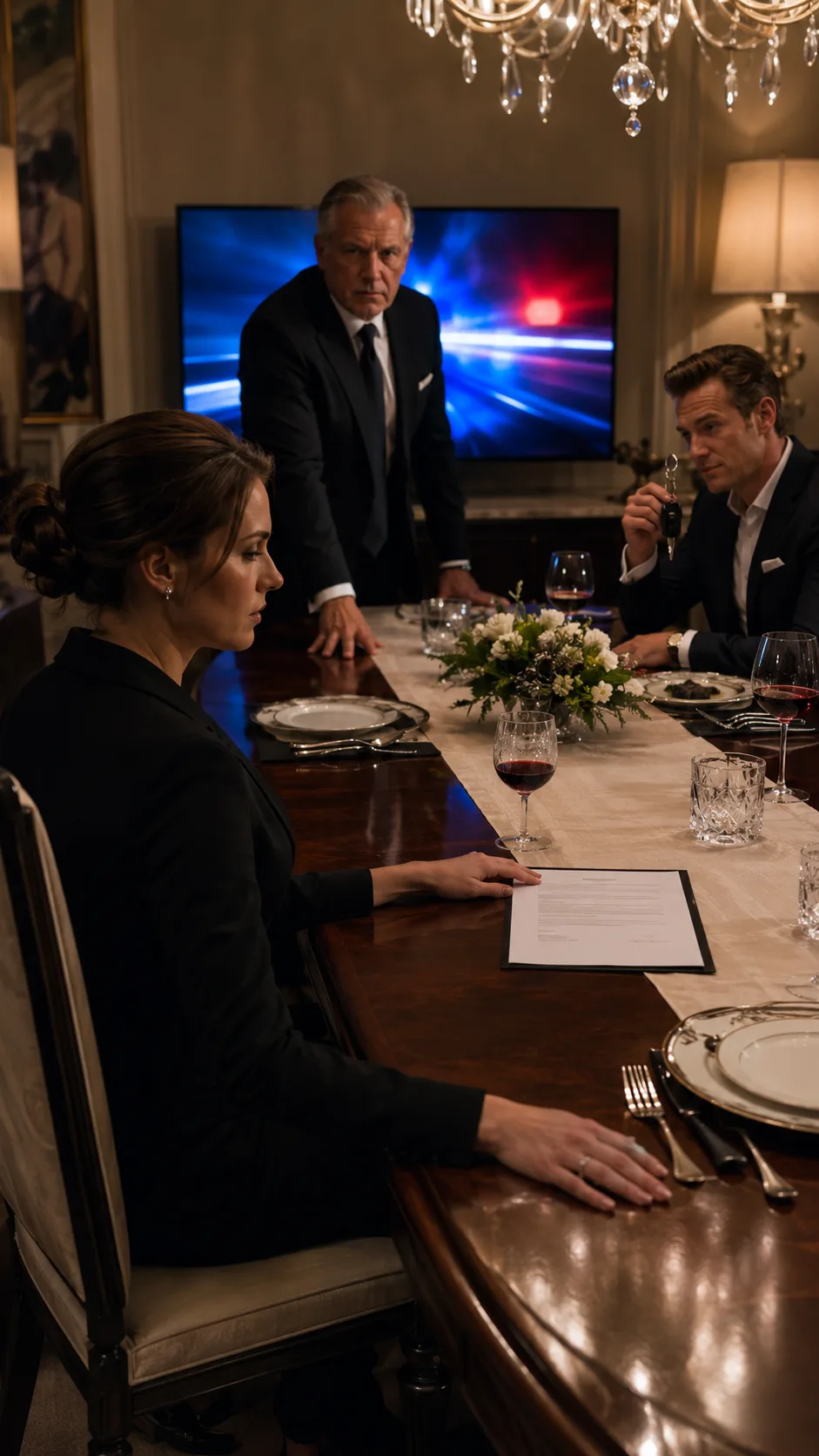
My father slid the employment contract across the dining table before the soup had gone cold.
Chapter 1
My father slid the employment contract across the dining table before the soup had gone cold.
The folder was navy blue, heavy, and expensive, the kind his company used for clients who needed to feel important before being robbed with polite language. My name had been typed on the first page in bold letters.
Jamie Madeline Vance.
Below it sat a title so small I almost smiled.
Junior Financial Strategy Associate.
Probationary.
My mother did not look at the folder. She lifted her wine glass with two fingers and watched the red surface tremble under the chandelier light. Marcus watched me instead. He had been waiting for this part all night.
“Go on,” he said. “Open it.”
I did.
The paper smelled faintly of ink and leather. Someone had placed a yellow signing tab beside the final page. Someone had underlined the salary. Someone had written my start date in blue pen, as if the decision had already been made and all that remained was my
signature.
Monday.
I had arrived at my parents’ house twenty-eight minutes earlier in an old black suit, with my hair pinned back and my Honda keys in my coat pocket. The valet had stared at the car for a second too long before taking the keys. He knew me. He had parked cars for my family since I was sixteen. Back then, he used to call me Miss Jamie and tell me when my father came home in a bad mood.
Tonight he had only said, “Dinner is already seated.”
Already seated.
That was how my family did punishment. They did not shout first. They arranged a room, picked a chair, placed witnesses where they wanted them, and let you walk into the shape they had prepared.
The dining room looked exactly as it had when I was a child. Mahogany table polished until the chandelier reflected in it. White
linen runner. Crystal glasses. Silver forks lined in rows nobody actually needed. My mother’s favorite cream roses sat in the center, cut short and packed tight in a low glass bowl.
One chair was slightly crooked.
Mine.
Marcus sat across from me in a charcoal suit that cost more than my first apartment’s rent. He had arrived late on purpose, making sure we all heard the engine of his Mercedes on the circular driveway. His watch flashed every time he lifted his fork. His wedding ring flashed too, though his wife was not there.
Dad sat at the head of the table. He had barely greeted me.
Mom kissed the air beside my cheek and said, “You look tired.”
Not hello.
Not good to see you.
Just tired.
The first twenty minutes had been Marcus’s theater. He talked about permits, towers, investors, cement delays, golf with a senator, dinner with
a lender, a six-figure bonus he pretended not to care about. He said “my new development” six times and “our family legacy” four. Dad listened like a king hearing reports from a favorite general. Mom kept nodding, pressing her napkin to the corners of her mouth.
I ate the soup.
It was too salty.
That helped.
“You’re quiet tonight,” Marcus said.
“I’m eating.”
“You always do that.” He smiled at Dad. “Hide in simple sentences.”
Dad cut into his steak without looking up. “Your brother asked you a question.”
“No,” I said. “He made an observation.”
Marcus leaned back. “Same attitude. Seven years on Wall Street and you still talk like someone pretending to belong there.”
I put my spoon down.
The housekeeper, Elena, stepped in to refill water. Her hand paused near my glass. She did not look at me. She did not need to. She had seen enough dinners in that room to know when someone was being placed on the cutting board.
Marcus lifted his Mercedes key fob from beside his plate and let it dangle from one finger. “Still driving that Honda?”
“It starts.”
“That’s not an answer.”
“It is for a car.”
Mom made a small sound into her glass.
Dad set down his knife. “Do not be cute.”
I looked at him then. He had aged in places money could not soften. Around the mouth. Around the eyes. But the old command was still there. He expected silence from a room when he wanted it. He expected obedience to look natural.
Marcus tapped the key fob against the table once.
Click.
“Jamie,” Mom said, “your father and I have been discussing your situation.”
“My situation.”
“Yes.” She folded her hands. “You are thirty.”
“I know.”
“You rent.”
“Yes.”
“You have no equity, no property, no family of your own, and no position anyone outside your little finance circle would understand.”
My water glass left a ring on the table.
Marcus smiled. “She manages portfolios, Mother. Important portfolios. Rich men’s leftovers.”
The word landed softly.
Leftovers.
Dad did not correct him. Mom did not either. The chandelier hummed faintly above us. Somewhere in the wall, the heating system clicked and went quiet.
I picked up my water and drank.
Marcus hated that most.
“You don’t even deny it anymore,” he said.
“There’s nothing to deny.”
He leaned forward. “Then explain what you actually do.”
“No.”
Dad’s hand came down on the table.
The glasses jumped.
Red wine spilled from my mother’s glass and ran across the white linen runner in a widening stain. Elena appeared at the doorway and froze. Dad did not look at her.
“Answer your brother,” he said.
Marcus sat back, pleased.
I wiped one drop of wine from the edge of my plate with my thumb.
Dad pushed the folder toward me.
“Sign it tonight,” he said. “You start Monday.”
There it was.
Clean.
Prepared.
The folder stopped inches from my hand. I saw the title again. Junior Financial Strategy Associate. Probationary. Reporting to Marcus Vance.
Not my father.
Marcus.
I turned the page.
The salary had been circled.
It was less than my assistant’s bonus.
“You prepared this before asking me,” I said.
Mom lowered her glass. “We prepared it because someone had to.”
Marcus laughed through his nose. “Don’t act insulted. This is a rescue.”
“A rescue.”
“Yes.” He spread his hands slightly, as if presenting mercy. “You can stop pretending. Come home. Learn the business. Do something real.”
I looked at the yellow signing tab.
Dad watched me watch it.
“You have spent years gambling with numbers,” he said. “Your brother builds things. Buildings. Hotels. Towers. Real assets.”
“Debt is also real.”
Marcus scoffed. “Please don’t start.”
Dad pointed at the contract. “This family has covered for your embarrassment long enough.”
Elena took one step backward in the doorway.
Mom saw her and said, “That will be all.”
The housekeeper vanished.
I wanted to tell her to stay. Not for help. Not because I needed a witness. Just because the room became uglier when only family remained.
Marcus reached for his wine. “You know what people ask me?”
“No.”
“They ask why my sister still lives like a broke analyst after seven years in finance. They ask why she comes to charity events in the same black suit. They ask why she never brings anyone, never buys anything, never invests in the family company.”
“Maybe you should stop answering.”
He set the glass down harder than necessary. “I’m tired of defending you.”
“You never have.”
His smile thinned.
Mom shifted in her chair. “Jamie, don’t be difficult tonight.”
“I haven’t been.”
“You have been distant for years.”
“That was cheaper than being close.”
Dad’s jaw moved once.
There were rules in that room. Marcus could humiliate me. Mom could pity me. Dad could command me. But I was not allowed to say anything plain enough to disturb the furniture.
Marcus picked up the contract, flipped to the final page, and slid it closer to me. “You know what your problem is? You think silence makes you powerful.”
I looked at his hand.
He had manicured nails. Smooth knuckles. No scars. My grandfather used to say a man who bragged about building things should have at least one scar not caused by a ski weekend.
Marcus tapped the signature line.
“Sign.”
I did not move.
Dad stood.
His chair scraped the hardwood with a long, ugly sound. Mom’s fingers tightened around her napkin. Marcus watched me with the kind of smile men wear when they believe a room belongs to them.
“You will sign,” Dad said. “You will start Monday. You will stop making this family explain you.”
I folded the contract closed.
Marcus leaned in.
His voice dropped, but not enough to hide from Mom.
“If you refuse, don’t expect this family to keep covering for your embarrassment.”
My hand stopped on the folder.
There are sentences that do not cut when they are spoken. They enter clean. They wait. Later, they open.
I looked at my brother.
He still thought this was about dinner.
Behind my father, the television mounted above the sideboard flashed red.
BREAKING NEWS.
The CNBC anchor’s voice filled the room before Dad could reach for the remote.
“After years of secrecy, the identity of the investor known only as J.M. has been revealed in an emergency SEC filing tonight.”
Dad turned halfway toward the screen, irritated. “Not now.”
Marcus’s smile stayed in place for one second.
Then it didn’t.
The anchor continued. “The thirty-year-old woman behind one of the most aggressive private investment strategies on the East Coast is now confirmed as Jamie Madeline Vance.”
Nobody moved.
Not my father.
Not my mother.
Not Marcus.
The television painted the polished table in cold blue and red light. The wine stain on the runner looked almost black now. My name hung in the dining room like smoke.
Mom turned to me first.
Her lips parted. Nothing came out.
Marcus stared at the screen as if a word could be unread if he hated it hard enough.
Dad’s hand tightened around the remote.
The anchor’s voice sharpened. “The SEC filing confirms that Ms. Vance is the sole owner of Vance Alpha, the firm currently holding controlling positions in several major development entities, including debt exposure tied to Vance & Sons Construction.”
Marcus pushed his chair back.
Just an inch.
The sound was small.
Good.
He looked at me then. Not with mockery. Not with pity. Not even with anger yet.
With math.
His eyes moved the way men’s eyes move when numbers rearrange behind them and every answer is worse than the one before.
“That’s impossible,” he said.
Dad lifted the remote toward the TV, but his thumb did not press the button.
The anchor went on. “A secondary filing indicates Vance Alpha has acquired a majority position in the outstanding private debt associated with Vance & Sons Construction, including obligations previously concealed through offshore structures.”
Mom’s napkin slid from her lap to the floor.
Marcus stood so quickly his wine glass tilted. Red wine spilled beside his plate.
“No,” he said. “No, no. That debt was private.”
I opened the folder again and looked at the signature tab.
Dad turned toward me slowly.
“What did you do?”
I smoothed the edge of the contract with one finger.
Marcus’s face had gone gray under the warm light. “Our debt was held through Veritas Holdings.”
“Yes,” I said.
He stopped breathing through his mouth.
I looked up. “Veritas Holdings was purchased four months ago.”
Dad’s eyes narrowed.
Mom pressed one hand to her necklace.
Marcus swallowed. “By who?”
I pushed the contract away from me.
“By me.”
The room did not explode.
It contracted.
The chandelier crystals stopped trembling. The heating clicked again inside the wall. Somewhere far down the hall, a door closed. None of us looked.
Marcus grabbed the back of his chair.
“You bought Veritas.”
“Yes.”
“You bought our paper.”
“Yes.”
Dad’s voice came low. “You used family information.”
“No.” I stood. “I used public filings, lender chatter, weak covenants, delayed permits, overvalued collateral, and Marcus’s habit of bragging after three glasses of Barolo.”
Marcus’s hand tightened on the chair.
Dad stepped away from the head of the table. “You planned this.”
I looked at him.
Seven years ago, I had sat in this same room with a binder on my knees. I had been twenty-three, wearing a navy dress I bought on sale and shoes that pinched the skin off both heels. Inside the binder were projections for my first fund. Small, careful, ugly with work. I had asked for a loan against the inheritance my grandfather left me.
Dad had laughed first.
Marcus had laughed louder.
Mom had said, “Sweetheart, women are better with households than portfolios. Don’t embarrass yourself.”
Two weeks later, Marcus received my inheritance as “seed capital” for his first hotel deal.
That hotel still had moisture problems on the sixth floor.
“I remembered,” I said.
Mom stood too. “Jamie, whatever this is, you need to stop it before it damages the family.”
“The family.”
“Yes.” She reached for me across the table, but her fingers stopped before touching the wine stain. “You don’t want this public.”
“It’s already public.”
“The reporters will twist it.”
“They’re reading filings.”
Dad’s face hardened. “You think you can walk into my company and take what I built?”
“No.”
Marcus exhaled too fast.
I turned to my father fully.
“I don’t think I can walk into it,” I said. “I already did.”
The TV changed to a split screen. A financial analyst appeared beside the anchor, gesturing at a chart no one in the room could read from that distance. He said my name again. Then Vance Alpha. Then hostile leverage event. Then board control.
Marcus looked at the screen like it had struck him.
Dad said, “Turn it off.”
No one did.
His hand still held the remote.
He could have pressed the button. He did not.
That was the first honest thing he did all night.
Marcus rounded the table toward me. He stopped three feet away. Close enough for threat. Not close enough for courage.
“You don’t understand what you’ve done,” he said. “Those towers are weeks from closing permanent financing.”
“I know.”
“The bridge loan matures next Friday.”
“I know.”
“We have extensions.”
“No, you don’t.”
His face changed again.
There it was.
The second calculation.
I picked up my water glass and took a sip. It had gone warm. A small piece of ice knocked against my tooth.
Dad pointed at me with the remote. “You will restructure this quietly.”
“No.”
“You will not humiliate your brother.”
“He did that himself.”
Mom said my name. Once. Like she had found a version of me she did not recognize in her own house.
I looked at her.
“You watched him do it.”
Her mouth tightened. “We were trying to help you.”
“No. You were trying to place me.”
Marcus laughed once. It came out wrong. “Place you? You came in here in that tired suit with a Honda key and let everyone believe—”
“I let you talk.”
His eyes flicked to my jacket.
I touched the sleeve.
The suit looked plain because it was supposed to. Black wool. No visible label. Hand-finished seams. A London tailor who did not advertise.
Marcus saw the fit then.
Finally.
His jaw shifted.
Dad’s phone began vibrating on the table.
Then Marcus’s.
Then Mom’s.
A chain of buzzing, tapping, glowing screens.
Nobody picked up.
The house phone rang in the hall. Once. Twice. Elena did not answer it.
The television anchor continued. “Sources close to the matter suggest emergency board action has already begun.”
Marcus grabbed his phone.
His thumb moved over the screen.
He read.
The color left the rest of his face.
I set my glass down.
“Check your email,” I said.
He looked at me.
“No.”
“Check it.”
Dad snatched his own phone up.
Mom held hers like it might burn her.
Marcus opened the email first. His eyes moved left to right. Then back. Then down. His mouth opened slightly.
Dad’s phone hit the table.
“What is this?” he said.
I picked up the contract again.
“The board met at five.”
Marcus shook his head. “The board can’t meet without me.”
“They can when the controlling creditor requests emergency review under default risk protocols.”
“You’re not the controlling creditor.”
“I am.”
Dad took one step closer. “Jamie.”
It was not command this time.
It was warning.
Too late.
I looked down at the contract they had prepared for me. My probationary title. My start date. My reporting structure. My salary circled like bait for a desperate woman.
Then I tore it in half.
The sound was louder than I expected.
Paper gives up with a particular kind of honesty.
I tore it again.
The yellow signing tab stuck briefly to my thumb before falling onto the wine-stained runner.
Mom flinched.
Marcus looked at the pieces as if each one had been cut from his skin.
I let them fall across the table.
“You offered me probation,” I said. “I’m offering you consequence.”
Dad’s eyes stayed on the torn paper.
I turned to Marcus.
“The board voted to terminate you for gross financial negligence, failure to disclose leverage exposure, misrepresentation of project liquidity, and unauthorized debt concealment.”
His mouth worked once.
No words.
“You have until Monday to clear your office.”
Mom grabbed the edge of the table. “You cannot fire your brother.”
“I didn’t.”
I picked up my Honda keys from beside my plate.
“The board did.”
Dad moved around the table, not fast, not slow. Controlled. Always controlled. He stopped at the corner near me.
“You want revenge,” he said.
I looked at the wine stain spreading toward the torn contract.
“No.”
“Then what do you want?”
I thought of that night seven years earlier. My binder. My shoes. My mother’s little smile. Marcus flipping through my projections as if he were grading a child’s drawing. My father saying, “You’re not built for this kind of pressure.”
I thought of every investor who called me “sweetheart” before asking me to rescue his balance sheet. Every dinner where men explained debt to me while drowning in it. Every time I kept my name off a filing because silence bought room to move.
I looked back at my father.
“Control.”
The room had no answer for that.
Marcus sat down heavily. The chair legs scraped again, shorter this time. His phone slipped from his hand onto his plate. The screen faced up. I could see the subject line from where I stood.
Termination Notice.
Mom bent to pick up her fallen napkin. Her hand shook once before she hid it under the table.
Dad did not sit.
He looked older now. Not broken. Not yet. But the shape of him had changed. Men like my father did not lose power all at once. First they lost the room. Then they lost the voice. Then they had to decide what to do with their hands.
His still held the remote.
I walked toward the door.
No one stopped me.
Elena stood in the hall with the house phone silent in her hand. She stepped aside, but her eyes moved to the dining room behind me. She had heard enough.
“Good night, Elena,” I said.
She nodded once. “Good night, Miss Jamie.”
The old name.
It followed me through the foyer.
The house had always been too large after dinner. Marble floors. Tall mirrors. A staircase wide enough for entrances. On the console table near the front door sat a silver bowl full of keys, invitations, and things my mother did not want to see twice.
My Honda keys felt warm in my palm.
The valet hurried when he saw me.
Behind me, my father’s voice rose from the dining room. Not words. Just volume. Marcus answered. Mom said something sharp. A glass broke.
The valet pretended not to hear.
He brought the car to the front steps.
My Honda waited beneath the portico, black paint reflecting the porch lights. It was not old, not exactly. The exterior was ordinary because I liked ordinary things that worked. Under the hood, it carried a prototype hybrid system from a company I funded before anyone with a louder name understood why battery efficiency would matter in commercial fleets.
Marcus had mocked the car for three years.
That was useful too.
I got in.
My phone lit up before I started the engine.
Thirty-six missed calls.
Eleven from Marcus.
Four from Dad.
Two from Mom.
The rest came from reporters, attorneys, board members, and people who had called me “difficult” in rooms where they needed my money but not my face.
I ignored them all.
Then one message arrived from an unknown number.
Ms. Vance, CNBC wants a live comment.
I put the phone facedown on the passenger seat.
The gates opened.
As I drove away, the house shrank in the rearview mirror. The dining room windows glowed gold. Three shadows moved behind the glass. One stood. One paced. One sat.
For years, I had imagined leaving that house with a speech behind me. A final sentence sharp enough to make them understand. A clean exit. A door closed with perfect timing.
Instead, I drove with one hand on the wheel and the other resting on the console beside a cold cup of gas station coffee I had forgotten to throw away.
The cup rattled when the road dipped.
I laughed once.
Not loud.
Not long.
Just enough.
Monday came with rain.
Not dramatic rain. Not movie rain. Thin, gray rain that made the windows of Vance & Sons Construction look dirty by eight in the morning.
I arrived at 7:42.
The security guard at the lobby desk stood when he saw my name on the visitor log. Then he looked at the second line. Chairwoman. Then he stood straighter.
“Ms. Vance,” he said.
“Morning.”
The elevator smelled like metal and wet wool. On the twenty-sixth floor, the receptionist stared at me with the careful expression people use when gossip has arrived before the person. Behind her, employees moved slower than normal. Coffee cups hovered. Conversations stopped in pieces.
Marcus’s office door was open.
He was inside.
A cardboard box sat on his desk.
He had not filled it.
He stood by the windows, still wearing a suit, still trying to look like the building belonged to him. His tie was loose. His hair was combed, but not well. There were no keys in his hand this time.
“You came early,” he said.
“Yes.”
He nodded toward the hallway. “Did you enjoy it?”
I stepped into the office.
His shelves were full of awards. Developer of the Year. Urban Vision Leadership. Legacy Builder. Most of them had been purchased through sponsorship tables, charity dinners, and rooms where Dad introduced him before anyone could ask hard questions.
A framed photo sat on his desk.
Marcus and Dad at the groundbreaking of his first hotel.
The one built with my money.
“No,” I said.
He looked at me then.
For once, he did not know what to do with the answer.
“You could have warned me.”
“You could have read your loan documents.”
His mouth tightened. “You sound like him.”
“No.”
I picked up the framed photo from his desk and set it inside the empty cardboard box.
“I listened to him long enough to know what not to become.”
His eyes dropped to the photo.
“You’re really going to take the company.”
“I already have.”
“And Dad?”
“He’ll keep the founder title through transition. No operational authority.”
Marcus laughed without humor. “That will kill him.”
“No. It will annoy him.”
The corner of his mouth twitched. Almost a smile. Almost a wound.
He turned back to the window.
“What happens to me?”
“You leave quietly. You cooperate with the audit. You don’t speak to the press. You don’t call lenders. You don’t touch project files.”
“And if I don’t?”
I looked at the awards again.
“Then I stop being generous.”
He did not answer.
Outside, construction cranes moved through the rain beyond the glass, slow and pale against the city. For the first time, I looked at them and did not feel outside the family business.
Concrete. Land. Debt. Risk.
Things people could touch.
Things people could lose.
I turned to leave.
“Jamie,” Marcus said.
I stopped at the door.
He picked up the Mercedes key fob from his desk. He held it for a second, then dropped it into the cardboard box.
It made a dull sound against the frame.
I left him there.
By noon, the boardroom was full.
By three, the audit team had access to every concealed obligation Marcus thought he had buried.
By six, my father’s portrait had been removed from the executive conference room and moved to the lobby wall, where founders belonged after they stopped making decisions.
Mom called at 8:17 that night.
I let it ring.
Then I answered.
For three seconds, neither of us spoke.
“I saw you on the news,” she said.
“I didn’t go on.”
“They showed photographs.”
“There were filings.”
A pause.
Then, “You looked thin.”
I almost smiled.
Almost.
“Good night, Mom.”
“Jamie.”
I waited.
She breathed through the phone once. Twice.
“We should have listened.”
The sentence came late. Thin. Poorly built. But it came.
I looked at the city outside my office window. My reflection stood over the skyline in a black suit that still looked plain to anyone who did not know how to measure seams.
“Yes,” I said.
Then I ended the call.
On Friday, I drove past my parents’ house without stopping.
The gates were closed. No valet waited. No Mercedes sat in the drive. Through the trees, I could see the dining room windows, dark in the afternoon light.
A week earlier, my chair had been crooked at that table.
A folder had waited beside my plate.
A family had mistaken silence for failure.
I kept driving.
At the next red light, my phone buzzed with another news alert. This one had my name in it too. Vance Alpha Completes Control Transfer. Jamie Vance Named Executive Chair.
The light turned green.
I placed the phone facedown and put both hands on the wheel.
No one had to explain me anymore. THE END.
Chapter complete
You have reached the end of this chapter.
Continue reading
A few more worlds to get lost in after this chapter.




