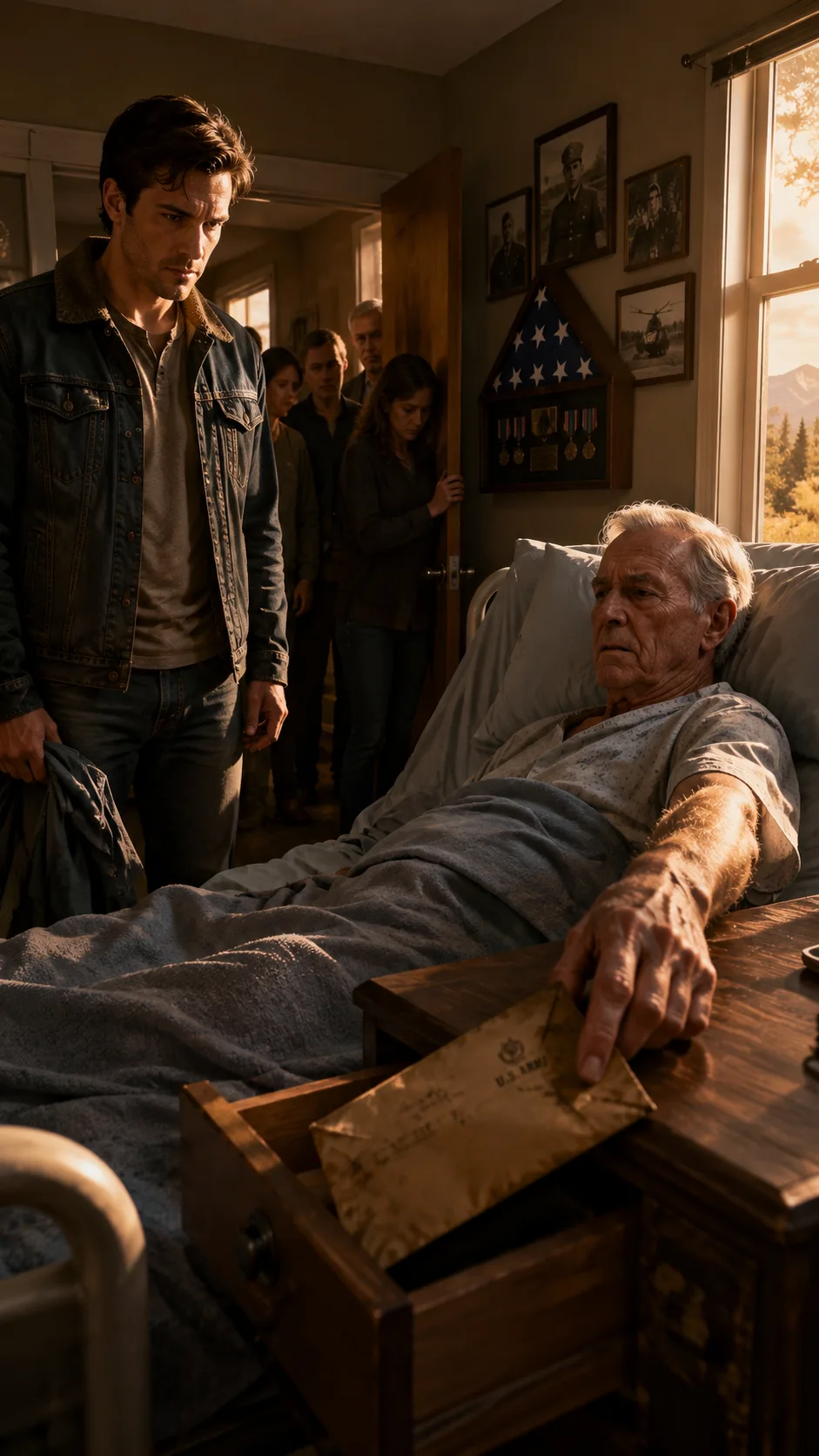
The first thing I noticed was that my father’s boots were still by the door.
Chapter 1
The first thing I noticed was that my father’s boots were still by the door.
Not hospital slippers. Not soft shoes. His old brown leather boots, polished even after years of use, placed side by side beneath the coat rack like he might stand up any minute, pull them on, and walk out of that hospice room under his own power.
He had always kept them that way.
Straight.
Silent.
Ready.
The nurse who led me down the hall did not say much. She kept both hands folded around a clipboard and walked like someone trying not to disturb a house where people were already mourning. The hospice center sat outside Helena, Montana, where the mountains looked close enough to touch through the windows. Pine trees pressed against the glass. A vending machine hummed somewhere behind us.
I had not seen Colonel James Carter in twelve years.
Not since the afternoon he threw me out.
I was fifteen then. Skinny, angry, too proud to cry
in front of him. He had stood on the porch of our house with his arms crossed, his jaw locked, the Montana wind pulling at the sleeves of his old field jacket.
“You don’t belong here anymore,” he said.
That was all.
No explanation.
No warning.
I waited halfway down the gravel drive for him to call me back. I remember the weight of my duffel bag cutting into my shoulder and the smell of wet dirt after a spring rain. I remember turning once.
He was still on the porch.
He did not move.
So I kept walking.
For twelve years, I built a life out of whatever pieces I could carry. I worked ranch fences outside Billings, cleaned motel rooms in Missoula, loaded lumber in Idaho, fixed engines badly until I learned to fix them well. I slept in rooms with thin walls and bought my coats from
thrift stores.
Every Christmas, I told myself I did not care.
Every Father’s Day, I worked double shifts.
People asked about my family less and less as I got older. Maybe they heard something in my voice that told them not to ask again.
Then my phone rang on a Tuesday morning while I was changing the oil on a logging truck in Spokane.
The woman on the other end said her name was Marlene. I remembered her only after she mentioned the church potlucks. She used to bring potato salad in a blue glass bowl and stand beside my father like she was allowed to be near him but never close.
“Ethan,” she said. “Your father is asking for you.”
I wiped my hand on a rag.
There was grease under every fingernail.
“He has family there,” I said.
“You’re family.”
I almost laughed.
The sound did not come
out.
She told me he was dying. She told me the doctors did not think he had much time. She told me he had refused morphine twice because he wanted his head clear.
That sounded like him.
Then she said, “He keeps saying your name.”
I looked at the truck hood propped above me. A slow drip of oil fell into the pan.
One drop.
Then another.
“I’ll think about it,” I said.
I hung up before she could answer.
For the rest of the day, I kept seeing him on that porch.
I saw the way his hand had gripped the railing. I saw the flat look in his eyes. I saw the duffel bag at my feet because he had not even let me pack properly.
That night, I drove home and sat in my truck outside my apartment until the streetlights came on.
I did not go inside.
At 9:17 p.m., I started the engine again.
Fourteen hours later, I crossed into Montana.
The hospice room was crowded when I arrived. Too crowded. Cousins I had not seen since childhood stood near the walls with paper coffee cups in their hands. My father’s younger brother, Ray, sat in the corner wearing a bolo tie and a black suit jacket that looked too tight at the shoulders. Ray had aged into a softer version of himself, but his smile was the same.
Small.
Careful.
He stood when he saw me.
“Well,” he said. “Look who finally came home.”
Nobody corrected him.
Marlene stood by the window. She looked older, smaller, but her eyes followed me with something like warning. She gave the slightest shake of her head.
Not now.
My father lay in the bed beneath a gray blanket. His skin had gone thin over the bones of his face. His hair, once dark and cut short enough to satisfy any commanding officer, was white and flattened against the pillow.
But his eyes were open.
Sharp.
He looked at me.
The room seemed to shrink.
For a second I was fifteen again, standing in mud with nowhere to go.
Ray cleared his throat.
“He’s been stubborn all morning,” he said. “Wouldn’t eat. Wouldn’t rest. Kept insisting we wait for you.”
My father’s eyes flicked toward Ray.
Just once.
Ray stopped talking.
That was the first crack.
My father lifted one hand from the blanket. The movement cost him. His fingers shook, but he pointed toward the door.
“Out,” he said.
One word.
Nobody moved.
Ray gave a little chuckle, the kind men use when they want to make disobedience look friendly.
“Jim, we’re all here for you.”
My father’s hand stayed raised.
“Out.”
The nurse stepped forward. Marlene put down her coffee cup. One cousin looked at another. Chairs scraped. Someone whispered something about giving us privacy.
Ray did not move at first.
He looked at me, then at my father.
“You sure that’s wise?” he said.
My father turned his head on the pillow. Slowly. His mouth pulled tight at one corner.
Ray stood.
His chair bumped the wall behind him.
“Fine,” he said.
He passed me on the way out. His shoulder brushed mine though there was plenty of space.
The door closed.
Not all the way.
It stayed open an inch.
My father noticed.
So did I.
He stared at the gap until I crossed the room and pushed the door shut with two fingers. The latch clicked.
Only then did he lower his hand.
I stood at the foot of his bed.
The old folded flag in its triangular case sat on the dresser beside three medals and a photograph of him in uniform. I remembered that photograph from our living room. He had never let me touch it as a kid.
“Don’t stand there like a stranger,” he said.
His voice was weaker, but the command was still there.
I took one step closer.
“That’s what I am.”
His eyes closed for half a second.
When they opened, he looked at the bedside table.
“Drawer.”
I did not move.
He turned his hand palm down and tapped twice on the sheet.
The sound was barely there.
Still an order.
I pulled open the drawer.
Inside were tissues, a small comb, a cracked leather wallet, and a yellowed military envelope tied with string. My name was written across the front in black ink.
Ethan Carter.
Not typed.
Written by hand.
My father’s hand.
I stared at it.
“When did you write this?” I said.
He swallowed. The tendons in his neck rose.
“Years ago.”
I lifted the envelope from the drawer. The paper felt soft at the edges, handled too many times and opened too often.
“Why is my name on it?”
“Sit.”
I almost told him no.
Instead, I pulled the chair closer. One leg caught on the floor and made a hard scraping sound that filled the room.
My father winced.
Good, I thought.
Then hated myself for thinking it.
I sat.
He looked at the envelope in my hands.
“Open it.”
The string had been tied in a neat military knot. I fumbled with it. My fingers were too large, too clumsy. I finally slipped the loop free and opened the flap.
A photograph slid out first.
It landed face down on my knee.
Behind it was a folded letter, brittle at the crease, and two photocopied pages with black marker redactions across several lines.
I picked up the photograph.
Three men stood beside an Army truck in a place I did not recognize. My father was younger, leaner, wearing fatigues and holding his helmet under one arm. Beside him stood Ray.
My uncle Ray.
Younger by decades, but unmistakable.
The third man had dark hair and a narrow face. His hand rested on Ray’s shoulder. Something about him made my stomach tighten.
“Who is he?” I asked.
My father’s gaze moved to the photograph.
“Calvin Mercer.”
The name meant nothing.
Then it did.
Mercer Supply.
I remembered the old sign on the highway outside town. I remembered men coming to our house when I was little. Men with polished boots and quiet voices. My father always sent me to my room when they arrived.
“Why do I know that name?”
My father’s fingers curled on the blanket.
“Because his sons came looking for you.”
The room seemed to tilt a fraction.
I looked at the door.
Then back at him.
“What?”
His breathing roughened. He lifted one finger toward the letter.
“Read.”
I unfolded it carefully.
The first line stopped me.
Colonel Carter,
If you care about the boy, remove him from your house before my family decides the debt should pass to him.
My thumb pressed into the paper hard enough to bend it.
I read the line again.
Then again.
The words did not change.
“What debt?”
My father shut his eyes.
On the other side of the door, a floorboard creaked.
I looked over.
A shadow moved under the gap.
Someone was standing outside.
My father opened his eyes.
“Ray,” he said.
Not a question.
I stood so fast the chair tipped backward and hit the wall.
I crossed the room and pulled the door open.
Ray stood three feet away with one hand raised like he had been about to knock.
Behind him, two cousins looked at the floor.
“Well,” Ray said. “We were worried.”
I held the envelope at my side.
His eyes dropped to it.
Only for a second.
But I saw it.
His mouth changed.
Not much.
Enough.
My father’s voice came from behind me.
“Let him in.”
I turned.
He was struggling to sit higher against the pillows. His face had gone gray around the mouth.
“Dad—”
“Let him in.”
The word Dad came out before I could stop it.
Ray heard it.
His eyes flicked to mine.
I stepped aside.
Ray entered slowly, smoothing the front of his jacket. The cousins stayed in the doorway until my father pointed again.
“Close it.”
This time Ray closed the door himself.
The room held the three of us.
My father in the bed.
Ray near the door.
Me between them with the envelope in my hand.
Ray smiled at my father.
“Jim, this isn’t good for you.”
My father looked at him for a long moment.
“You always said that before you lied.”
Ray’s smile thinned.
I looked down at the letter again. My hands had started to shake.
“What is this?” I said.
Ray stepped toward me.
“Old nonsense. Your father has been confused for weeks.”
My father gave a dry sound from the bed.
Not quite a laugh.
Ray kept his eyes on me.
“Ethan, you’ve been gone a long time. You don’t know what went on here. Your father had enemies. He had regrets. He collected papers and stories and turned them into ghosts.”
I looked at the photograph.
“You’re in this.”
Ray glanced at it.
“Vietnam was a long time ago.”
“Who was Calvin Mercer?”
Ray’s jaw tightened.
My father answered.
“A man I should’ve reported sooner.”
Ray turned toward him.
“Jim.”
My father did not look away.
“A man your uncle chose over his own blood.”
There it was.
Something in the room shifted, but not all at once. It happened in small ways. Ray’s hand stopped moving across his jacket. The hall outside grew quiet. My grip tightened on the photograph.
I looked from one brother to the other.
“What did he do?”
My father breathed in through his nose. It rattled.
“We were in-country together near the end of my second tour. Mercer ran supplies through channels that didn’t exist on paper. Fuel. medicine. radios. Things men needed. Things men died without.”
Ray took another step forward.
“That’s enough.”
I turned toward him.
He stopped.
My father kept going.
“I found out. I was going to report it. Mercer found out first.”
Ray’s face had lost color now.
The room smelled faintly of antiseptic and old coffee. The cup Marlene had left on the windowsill had gone cold, a pale ring forming at the rim.
My father lifted his hand toward the pages.
“Second sheet.”
I unfolded the photocopied page.
Most of it was blacked out. Names. Dates. Locations.
But one paragraph remained clear.
Subject Carter has refused negotiation. Pressure may be applied through family channels after discharge. Younger male dependent remains viable leverage if necessary.
Younger male dependent.
Me.
I read it once.
Then I read it again because my mind refused to hold it.
Ray reached for the paper.
I pulled it back.
“No.”
His hand hung in the air.
For the first time in my life, I saw my uncle without his smile.
My father’s voice dropped.
“When you were fifteen, Mercer’s eldest son came to the house.”
My mouth went dry.
“I don’t remember that.”
“You were at school.”
Ray said, “Jim, stop.”
My father turned his head.
“You had twelve years to tell him.”
Ray’s nostrils flared.
My father looked back at me.
“He stood in my kitchen. Same place you used to do homework. He put your school picture on the table and asked if I still thought old debts stayed buried.”
My fingers folded around the paper.
I could see the kitchen. The yellow counter. The chipped mug by the sink. My backpack by the chair.
My school picture.
On the table.
“And you sent me away.”
My father’s eyes did not soften.
He had never been good at that.
“I made you hate me.”
The words came flat.
Like a report.
Like a fact.
The space behind my ribs tightened.
Ray shook his head.
“He sent you away because he couldn’t handle raising you. Don’t let him dress it up now.”
My father’s eyes cut to him.
Ray stepped closer to the bed.
“You were cruel, Jim. Everyone knows that. You drank. You shouted. You treated the boy like a recruit instead of a son. Now you want to turn that into some noble sacrifice because you’re scared of dying?”
The sentence landed hard.
Because pieces of it were true.
My father had been cruel sometimes. He did shout. He did drink after nightmares and sit in the dark with the television on mute. He did make home feel like barracks on bad days.
Truth can wear a lie’s coat.
That is what made Ray dangerous.
I looked at my father.
He did not defend himself.
He reached under the blanket with shaking fingers and pulled at something around his neck. A chain appeared first. Then a small brass key.
He held it out.
His arm trembled.
I took it before it fell.
Ray’s body went still.
My father said, “Bus station locker. Helena. Number seventeen.”
Ray moved.
Fast.
He crossed the room toward me, one hand out.
“Give me that.”
I stepped back.
My hip hit the chair.
The key cut into my palm.
Ray’s face opened into something ugly.
“You don’t know what you’re holding.”
My father pushed himself higher against the pillow. The monitor beside the bed ticked faster.
“He knows enough.”
Ray pointed at him.
“You old bastard.”
My father did not blink.
“Say it louder. Let them hear you.”
Ray looked at the door.
So did I.
Shadows moved again beyond the frosted glass panel. People were listening. Marlene. Cousins. Maybe the nurse.
Ray lowered his hand.
Too late.
The room did not belong to him anymore.
I could feel it.
So could he.
I lifted the photograph between us.
“Did you know?”
Ray’s eyes came back to mine.
He said nothing.
“Did you know they threatened me?”
His mouth tightened.
“I knew your father made enemies.”
“That’s not what I asked.”
Ray looked at the key in my fist.
His voice dropped.
“You were a kid. You were never supposed to be part of it.”
My father exhaled through his teeth.
There.
There it was.
Not a full confession.
Enough.
I heard someone outside the door gasp.
Ray heard it too. His head snapped toward the sound.
My father’s hand settled back onto the blanket.
He looked smaller now. Drained. But his eyes stayed on me.
“I gave Ray the first file,” he said. “Told him to take it to the investigator in Bozeman if anything happened to me.”
Ray’s face hardened.
My father’s mouth pulled down at one corner.
“He took it to Mercer instead.”
Ray said, “You don’t know that.”
My father looked at the bedside drawer.
“Top compartment. Wallet.”
I opened the drawer again.
The cracked leather wallet lay where I had first seen it. I picked it up.
“Inside.”
I opened it.
Behind his VA card, folded so tightly the edges had gone soft, was a receipt. Faded ink. A date from twelve years ago.
Mercer Supply Office.
Cash received.
Raymond Carter.
My uncle’s name.
Ray closed his eyes.
Just once.
The room went very quiet.
Even the monitor seemed too loud.
I held up the receipt.
The paper shook in my hand, but my voice did not.
“You sold the file.”
Ray’s eyes opened.
He looked past me to my father.
“You should’ve burned it.”
My father stared back.
“I copied it.”
Ray’s shoulders dropped half an inch.
That was the moment.
Not when I read the letter. Not when I saw my name. Not when the key cut into my palm.
It was Ray’s shoulders.
The loss of height.
The first visible surrender.
My father had been dying in that bed, too weak to stand, barely strong enough to breathe. But Ray was the one who had stepped backward.
The door opened behind us.
Marlene stood there with one hand over her mouth. The nurse was beside her. Two cousins hovered in the hall, pale and silent.
Ray turned.
“Get out,” he said.
Nobody moved.
My father looked toward Marlene.
“She stays.”
Ray laughed once, sharp and empty.
“Of course she does.”
Marlene stepped into the room.
Her eyes were on the receipt.
Then on me.
“I tried to tell your mother,” she said.
My whole body went cold.
“My mother died when I was six.”
Marlene nodded once.
“She knew enough to be afraid before that.”
I looked at my father.
His jaw worked. No sound came.
Marlene’s voice stayed steady, but her fingers gripped the back of the chair so tightly the knuckles shone white.
“Your mother found one of the letters before she got sick. She begged James to leave Montana. He wouldn’t. He thought he could control it. Then after she passed, he started keeping copies of everything.”
Ray said, “Marlene.”
She did not look at him.
“You came to my house,” she said. “The night Ethan was sent away. You told me if I helped James contact him, Mercer’s people would know where the boy had gone.”
Ray’s face changed again.
Smaller.
Meaner.
“You always did enjoy pretending you mattered.”
Marlene flinched.
My father’s hand struck the bed rail.
Not hard.
But enough.
The metal gave a thin ring.
Ray stopped talking.
I moved before I thought. I stepped between Ray and Marlene, the envelope pressed against my chest.
Ray looked at me as if seeing me for the first time.
Not a kid.
Not an absence.
A man.
“You think this makes him a hero?” he said. “He threw you out. He let you spend twelve years believing you were unwanted.”
The word hung there.
Unwanted.
My father’s eyes closed.
For the first time since I entered that room, I saw something break across his face.
Not loudly.
His mouth moved once. His chin pulled tight. His hand searched the blanket for the bed rail and missed.
I looked at him.
All those years I had imagined apologies. I had imagined shouting. I had imagined him admitting he was wrong and begging forgiveness like people do in movies.
He did not beg.
He could barely breathe.
He looked at me and said, “I knew you’d survive hating me.”
His throat worked.
“I didn’t know if you’d survive them.”
The words struck harder because they were not polished.
They were ugly.
Practical.
Exactly him.
Ray reached for the doorknob.
The nurse stepped in front of him.
Not blocking him. Just standing there.
Ray looked at her uniform, then at her face.
She said nothing.
Marlene picked up her phone.
Ray saw it.
“Who are you calling?”
She looked at my father.
“The sheriff.”
Ray’s laugh came out wrong.
“For what? Old paper? War stories? A dying man’s fantasy?”
I held up the receipt.
Then the letter.
Then the key.
Ray’s eyes moved to each item.
The cousins in the hall did too.
No one spoke for him.
My father turned his head toward me.
“Locker first,” he said.
His voice was almost gone now.
“Before he reaches it.”
Ray took one step toward the bed.
I stepped with him.
Not fast.
Not dramatic.
Just enough that he had to stop.
He looked down at the envelope in my hand.
Then at me.
“You don’t know what’s in that locker.”
“No,” I said.
The word came easy.
“But you do.”
His eyes hardened.
For one second, I saw the man behind all the soft smiles and family handshakes. I saw the calculation. The fear. The old loyalty to someone who had bought him cheap and kept collecting.
Then he looked past me at his brother.
“You should’ve stayed quiet, Jim.”
My father’s mouth curved faintly.
Not a smile.
Something worse.
“I did.”
The room held its breath.
He looked at me.
“Twelve years too long.”
Ray turned and shoved the door open.
The cousins stepped back.
Nobody followed him.
We heard his shoes down the hall, then the exit door, then nothing but the monitor beside the bed and my father’s uneven breathing.
Marlene lowered her phone from her ear.
“She’s sending someone,” she said.
My father nodded once.
The movement barely counted.
The nurse checked his pulse. Her face gave nothing away, but her hands moved gently. She adjusted the blanket. She lifted the bed rail. She asked if he wanted water.
He shook his head.
Everyone else drifted out without being told. Marlene stayed by the window. I stayed in the chair.
The envelope lay across my knees.
The photograph faced upward now. My father, Ray, and Calvin Mercer beside an Army truck under a hard white sky.
Three young men.
Two secrets.
One bill that had come due late.
My father looked toward the boots by the door.
I followed his gaze.
“They brought them from the house,” Marlene said. “He asked.”
Of course he had.
I leaned forward.
“Why didn’t you tell me after? Once I was gone?”
He stared at the ceiling.
“For the first year, I watched from a distance.”
My hands tightened around the envelope.
“What?”
“Marlene’s cousin in Idaho knew where you were. You worked at that feed store. Then you moved. Then again.”
I remembered the feed store. The owner had paid me cash and let me sleep in the storage room when I had nowhere else.
My father continued.
“I sent money through people. Not enough. Never enough.”
I looked at Marlene.
She nodded.
“Sometimes it came as grocery cards,” she said. “Sometimes rent paid ahead.”
My mouth opened.
I thought of the winter I found my motel bill paid after I had been sure I would be sleeping in my truck. The manager said an old mistake had been corrected. I had believed him because I needed to.
My father’s eyes stayed on the ceiling.
“After that, Ray started asking questions. I stopped risking it.”
I sat back.
A laugh almost came out.
It died in my throat.
“You let me think I was alone.”
His eyes closed.
“Yes.”
There was no excuse attached.
No defense.
Just the word.
I wanted to hate him again. It would have been easier. Cleaner. Hate had kept me warm for years. Hate gave shape to hunger and cold rooms and birthdays spent at work.
But now it had nowhere simple to stand.
The nurse left us for a moment.
Marlene stepped into the hall.
The room became small again.
Just us.
My father’s hand moved on the blanket. I knew what he wanted before he asked.
I placed the envelope in his hand.
He did not take it.
He pushed it back toward me.
“Yours.”
I swallowed.
“What’s in the locker?”
“Copies. Names. Mercer’s sons. Ray’s payments. Enough.”
“For what?”
His eyes opened.
“For you to decide.”
That was the first thing he had ever handed me without telling me what to do with it.
The monitor ticked.
Outside the window, the last light moved off the mountains. The room turned blue at the edges.
My father’s breathing changed after that. Longer gaps. Smaller returns.
I stood and adjusted the blanket near his shoulder because I did not know what else to do.
His hand caught my sleeve.
Not hard.
Just enough.
I looked down.
He was staring at the denim jacket I wore. Old, faded, torn near the cuff.
“Had one like that,” he said.
“I know.”
It had been his.
I had taken it the day he sent me away. I told myself it was theft. Maybe it was. Maybe a boy leaving home with half a duffel bag takes what proves he existed there.
His fingers brushed the cuff.
“Kept you warm?”
“Sometimes.”
His hand fell back.
The nurse returned. Marlene stood in the doorway, eyes red but dry. She did not come in.
My father’s gaze found mine one last time.
“I was wrong in the way I did it.”
That sentence cost him more than the others. I could see it. Each word had to climb out.
I leaned closer.
He said, “But not in sending you away.”
I nodded once.
Not forgiveness.
Not yet.
Something else.
A door not fully closed.
His eyes moved to the envelope.
“Go.”
I did not.
His fingers tightened weakly.
“Ethan.”
The way he said my name stopped me.
Not soldier.
Not boy.
Not son as a command.
Just Ethan.
I picked up the envelope, the key, the receipt, the photograph. I put them inside my jacket.
At the door, I looked back.
My father’s boots waited beneath the coat rack.
Straight.
Silent.
Ready.
I drove to the Helena bus station with Marlene in the passenger seat and a sheriff’s deputy following two cars behind us. Ray’s truck was not in the parking lot when we arrived, but the locker area smelled of metal, dust, and old cigarette smoke.
Locker seventeen sat near the end of the row.
The brass key fit.
Inside was a small black case wrapped in a towel. No drama. No glowing revelation. Just a case, heavy for its size, with a broken zipper and my father’s blocky handwriting on a tag.
E.C. only.
The deputy opened it on a bench.
There were copies of letters. Payment records. Photographs. Names. Dates. A cassette tape in a cracked plastic box. A small notebook full of my father’s handwriting.
And beneath all of it, a birthday card.
Unsent.
For my sixteenth birthday.
Then seventeenth.
Then eighteenth.
More cards, rubber-banded together, one for every year I had been gone.
I did not open them there.
Marlene sat beside me on the bench and looked straight ahead while the deputy photographed the contents.
Ray was picked up two days later outside Great Falls. The Mercer sons had already scattered by then, but paper moves differently than people. It waits. It survives drawers, lockers, and men who think time will soften ink.
My father passed before sunrise the morning after I opened locker seventeen.
Marlene called me from the hospice.
I was sitting in my truck outside a diner with the birthday cards on the seat beside me. I had opened only one.
The sixteenth.
The message inside was short.
Keep moving. Stay alive. Hate me if you have to.
There was no signature.
He had not needed one.
The funeral was held on a cold Saturday with wind moving hard across the cemetery. Fewer people came than I expected. More than I wanted. Ray was not there. His absence stood beside the grave like a second marker.
The folded flag was handed to me.
For a second, I almost refused it.
Then I took it.
The man presenting it did not know what it weighed.
Afterward, I drove out to the old house. It looked smaller than it had in my memory. The porch railing had been replaced. The gravel drive was still uneven. Grass had grown through the cracks near the steps.
I stood where I had stood at fifteen.
No duffel bag this time.
No rain.
No voice behind me telling me to leave.
Inside, the kitchen still had the yellow counter. Someone had left a chipped mug near the sink. I touched it with two fingers and then left it exactly where it was.
I did not move back to Montana.
Not permanently.
There are some places you can forgive without living inside them again.
But I stayed long enough to give statements. Long enough to turn over the case. Long enough to read every birthday card in order, sitting at the same kitchen table where my school picture had once been used as a threat.
Some cards had only one sentence.
Some had none, just dates.
The last one, written the year before he died, said:
I hope your hands are steady. Mine are not.
I kept that one in my wallet.
Months later, when the first charges were filed against men with the Mercer name, reporters called my father a whistleblower. A patriot. A complicated hero.
People like clean words.
I knew better.
He was a hard man who made a brutal choice. He saved me in a way that broke me. He loved me with the only tools he trusted: distance, silence, preparation, proof.
That does not make it simple.
It only makes it true.
On the first Christmas after his death, I drove through Montana again. I stopped at the cemetery before sunset. Snow lay thin over the grass. Someone had left a small flag by his stone.
I brushed the snow from his name.
Colonel James Carter.
Father.
Vietnam Veteran.
I stood there until my fingers went numb.
Then I took off my denim jacket and folded it over my arm. The old tear near the cuff had finally split wide enough to show the lining.
In my truck, on the passenger seat, sat his boots.
Polished.
Straight.
Ready.
I drove west before dark.
Chapter complete
You have reached the end of this chapter.
Continue reading
A few more worlds to get lost in after this chapter.




